

OBLIQUE Bookcase: A 45-Degree Zigzag Shelf That Works From Both Sides of the Room
Darshana Chawan's flat-pack shelving system angles its shelves at 45 degrees, turning a bookcase into a double-sided divider for compact interiors.


Most bookcases have a back. They stand against a wall, face one direction and ask the room to arrange itself around them. OBLIQUE removes that back. By folding its shelves into a zigzag set at 45 degrees, the unit becomes reachable from either side, and a piece of furniture that usually hugs the perimeter can move into the middle of a room and work there as a partition, a display and a storage system at once.
Designed by Darshana Chawan and published as a project on uni.xyz, OBLIQUE is a 2-in-1 modular shelving system meant for retail, commercial and residential interiors where floor area is scarce and layouts change often. The proposal is modest in scale but clear in its argument: in compact urban spaces, shelving should behave like a small piece of architecture, organising circulation and sightlines as well as holding objects.
A Zigzag Rack That Pulls Shoppers Around It

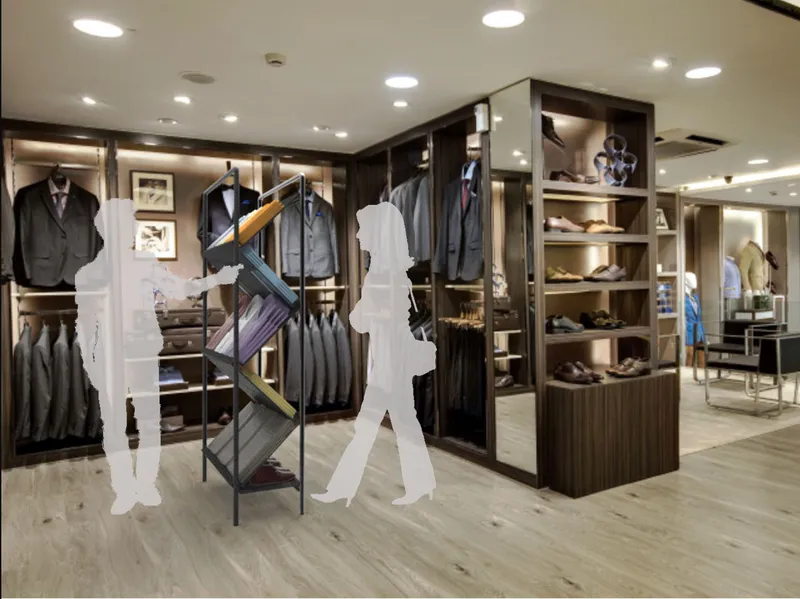
The retail renders show the strongest case for the geometry. Inside a timber-slatted shop opening, folded shirts and shoes sit on the angled shelves, each item turned partly toward the passing shopper instead of lined up flat against a wall. In the menswear interior, the rack stands free beside dark timber shelving and hanging suits. Its two faces mean that a customer on either side of the aisle sees the same stock, and the unit sets up a loop of movement around itself rather than a dead end.
This is where the 45-degree angle earns its place. A conventional double-sided gondola needs two full shelf depths placed back to back. The oblique fold lets each shelf serve both directions within one slender profile, so the rack takes up little floor area while showing more of its contents. For small shops, where every metre of circulation counts, that trade is significant.
Dividing a Lobby Without Closing It Off
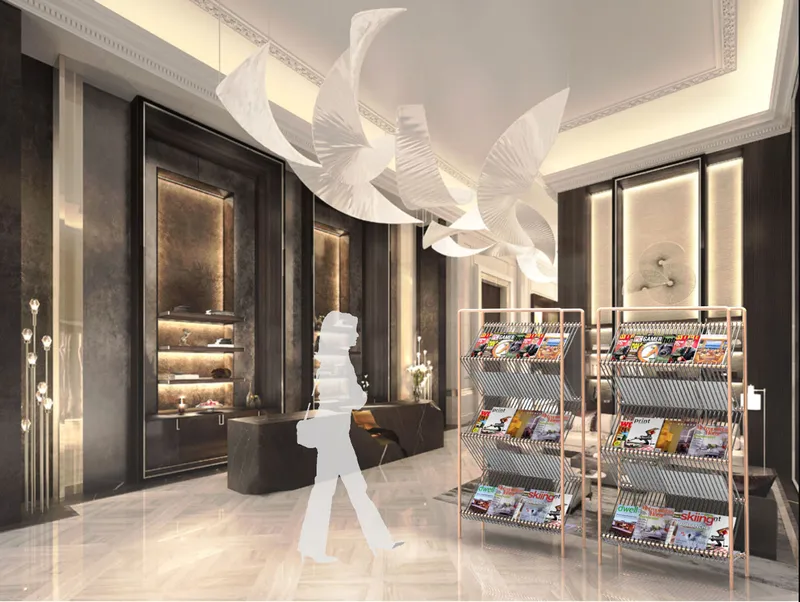
The hotel lobby render moves the system into a hospitality setting: two copper-framed racks hold magazines beneath sculptural white ceiling forms while a figure crosses the herringbone marble floor. Here OBLIQUE acts less as storage and more as a spatial marker. Because the frame is made of thin pipes and open shelves, the racks define zones in the lobby without blocking light or views across it, which is exactly the role Chawan describes for commercial interiors.
The shift in finish also matters. The same framework that reads as playful in the retail scenes reads as restrained once the colour changes, which suggests the design's identity rests on its line work and rhythm more than on any single material treatment. That adaptability is a large part of why one system can credibly span a menswear shop and a hotel lobby.
Stoppers, Rubber Shoes and a Yellow Steel Spine
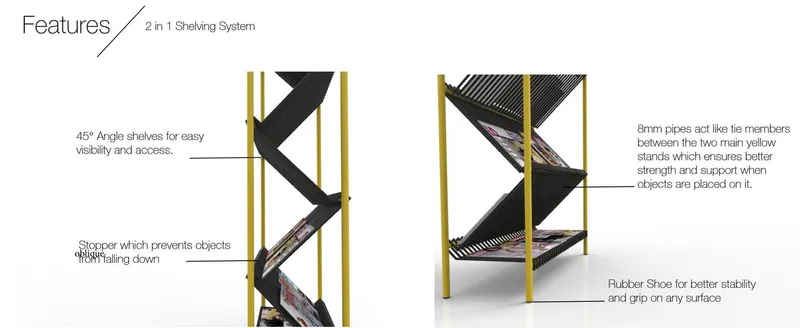
The feature diagram explains the system in three parts. Yellow powder-coated steel pipes form the vertical structural frames and carry the load. Black zigzag shelving modules sit between them at 45 degrees, fitted with integrated stoppers so objects do not slide off the angled surfaces. Rubber shoes at the base give the unit grip and stability on different floor finishes, an important detail for a piece meant to stand freely in busy spaces.
The stopper is the small detail that makes the concept practical. Tilting a shelf improves visibility, but it also invites things to slip. Solving that problem inside the shelf profile, instead of adding brackets or lips afterward, keeps the visual language clean: vertical yellow lines, diagonal black planes, and nothing extra. The contrast between the two colours makes the structural logic readable at a glance.
Three Steps From Flat Pack to Freestanding Frame

The exploded axonometric lays out assembly as a sequence. First, horizontal tie members, 8 mm pipes, fit into the vertical pipes through integrated inserts. Next, the shelf pipes slide into precision cut-outs that hold them in alignment and stop them from shifting. Finally, the remaining vertical members are secured to close the structure. The tie members do more than connect parts; they lock the frame together and spread loads across it.
This flat-pack logic is where OBLIQUE moves from object to system. Shipping as a bundle of pipes and shelf components cuts transport volume and storage space, and a three-step assembly reduces installation effort on site. Chawan links this to reduced material waste and logistical impact, and the argument holds: a shelf that can be taken apart and rebuilt is also a shelf that can follow a shop through several refits.
Why This Project Matters
OBLIQUE is a reminder that furniture design can test architectural ideas at a scale where they can actually be built and checked. Its central move, a 45-degree fold that gives a single-depth shelf two working faces, addresses a real constraint in compact interiors: storage usually consumes walls and floor space, and partitions usually block light. Here one element handles both jobs without either cost.
What makes the project convincing is that the detailing supports the concept. The stoppers, rubber shoes, 8 mm tie members and slot-fit shelves all serve the idea instead of decorating it. For a young designer, that alignment between gesture and joint is the right priority, and it gives OBLIQUE a credible path from render to retail floor.
View the Full Project
About the Designers
Designer: Darshana Chawan
Enter a Design Competition on uni.xyz
uni.xyz runs architecture and design competitions year-round that reward proposals with spatial conviction and real site intelligence.
Project credits: OBLIQUE Bookcase by Darshana Chawan.


Popular Articles
Popular articles from the community


GROUP A Strips a 1969 Rotterdam Harbor Headquarters to Its Frame and Wraps It in Timber Louvers
In Rotterdam's M4H harbor district, Ferro Offices reuses a 1969 frame, adds one timber storey and reaches BREEAM-NL Outstanding.

Cube Design Draws an Ecological Corridor Between Two Shenzhen Hills with the Nankai Building
Beside Shenzhen's container docks, the Nankai Building pairs stacked balconies with a climbing green screen to connect two hillsides across its height.

LT2A and OPEN Architectes Thread a Brick and Glass High School Through a Wooded Belgian Campus
In Braine-l'Alleud, a 3,000 m² wing for Collège Cardinal Mercier pairs pale brick with a glazed colonnade, deferring to a small chapel and a dense wood.

Juan García Correa, John González and Claudia Rueda Sink a Circular Amphitheater into a Manizales Engineering Building
On the La Nubia campus in Manizales, Colombia, the S1 Building folds labs and offices into a hillside of ramped lawns that double as a campus route.

Similar Reads
You might also enjoy these articles
Healing Façade: A Modular Chapel System That Restores Ethiopia's Sacred Forests
Winner of the Eco-Chapel competition, this circular timber façade collects water from air to rebuild soil and reforest degraded Ethiopian landscapes.
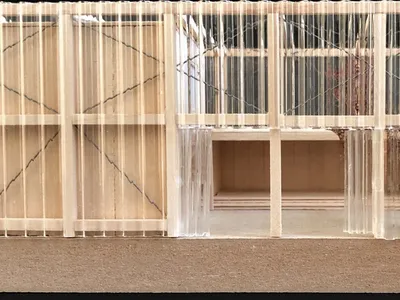
Kaffeebühnen: Where Coffee Shop Architecture Becomes a Civic Stage in Vienna
A linear sequence of timber boxes, transparent shells, and open yards turns the Viennese café tradition into a public performance space.

Eco Chapel: A Modular Forest Pavilion That Grows Like the Landscape It Protects
Hexagonal timber modules weave through existing trees, turning a chapel into a living system for prayer, education, and reforestation.


Urban Forest: A Vertical Ecosystem for 5,000 Workers in Singapore's Changi Business Park
Radially stacked pods and layered green decks turn a 7-acre plot into 47 acres of ecological workspace projected for 2040.

Explore Modular Furniture Competitions
Discover active competitions in this discipline

Design challenge to equip cities with modern furniture

Competition to design a workstation for architects
Comments (0)
Please login or sign up to add comments
No comments yet. Be the first to comment!