
Obra Arquitetos Carves a Lush Internal Void into a Monolithic Brick House in Jundiaí
Casa TG uses a central planted courtyard and concrete pergola to organize domestic life on a corner lot in a Brazilian gated community.


In the gated communities that ring Brazilian cities like Jundiaí, houses tend to bloat to fill their lots. Setbacks shrink, gardens become decorative afterthoughts, and the relationship between interior life and the landscape collapses into a token strip of lawn. Casa TG, designed by Obra Arquitetos under lead architect João Paulo Daolio, starts from a different premise: carve the garden into the center of the house itself and let everything else organize around that void.
The result is a 623 m² residence on a 1,233 m² corner lot that reads from the street as a closed, almost fortified brick volume but opens internally into a double-height planted courtyard flooded with daylight. A reinforced concrete pergola, glazed overhead, spans the void and distributes filtered light across split levels that step down the site's natural slope. It is a house built around air, soil, and the decision that green space should not be relegated to whatever land is left over.
The Brick Envelope and the Corner Condition
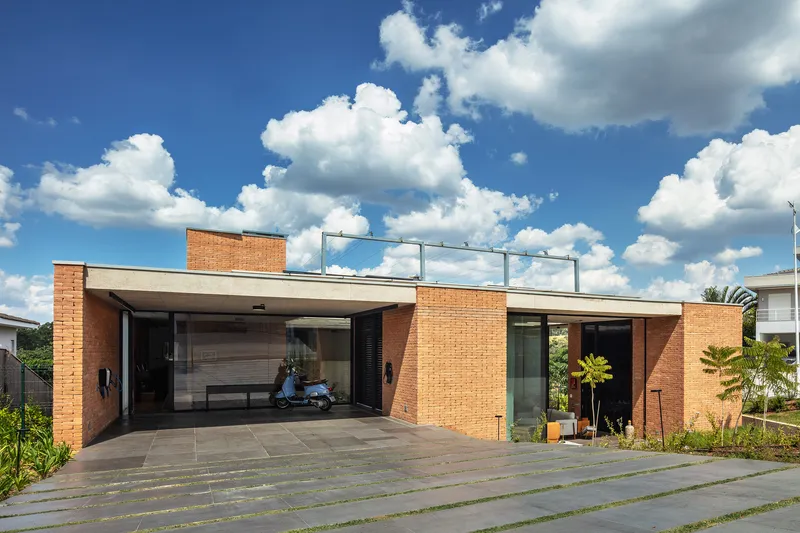
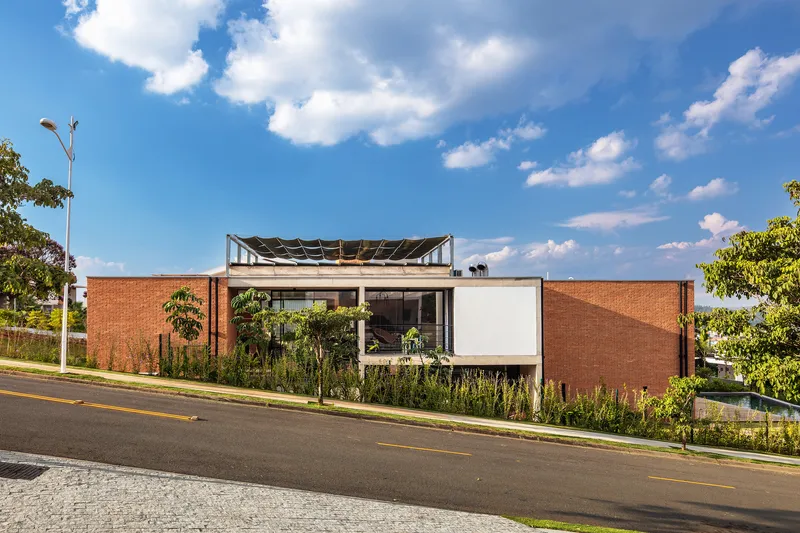
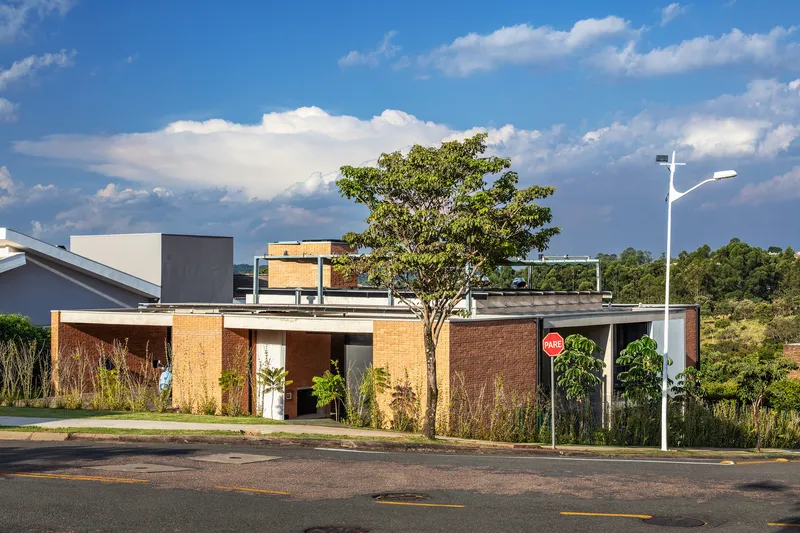
From the street, Casa TG presents a composition of warm orange brick volumes, punched sparingly with recessed glazing. The corner lot demanded two legible facades, and Obra Arquitetos treated both as part of one continuous monolithic gesture. Brick walls rise to different heights, creating a stepping roofline that hints at the split levels inside without telegraphing the plan. There is no front and back in the conventional sense; the house wraps the corner with equal conviction on both sides.
A planted verge softens the boundary between the residence and the community's streets. Young palms and low garden beds push greenery outward, an act of generosity in a neighborhood where most lots present blank perimeter walls. The white panel and exposed roof structures visible in the upper registers break the brick mass just enough to signal that something more permeable is happening within.
Arrival and Threshold
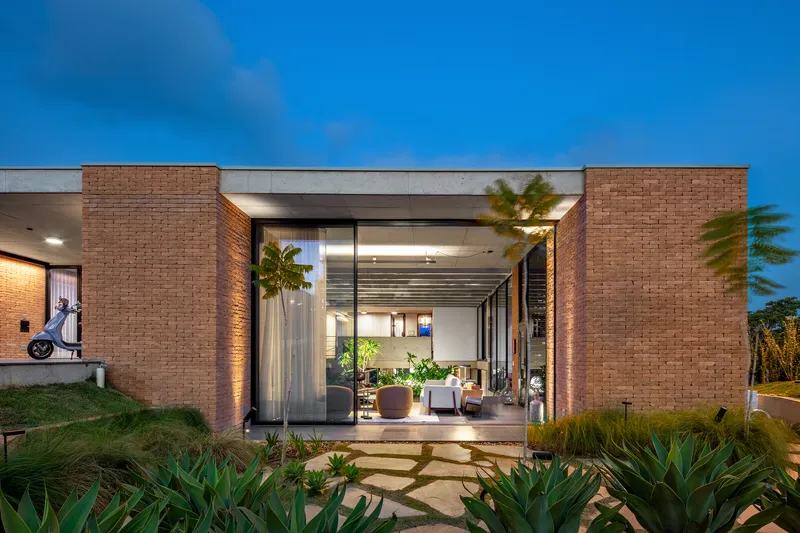
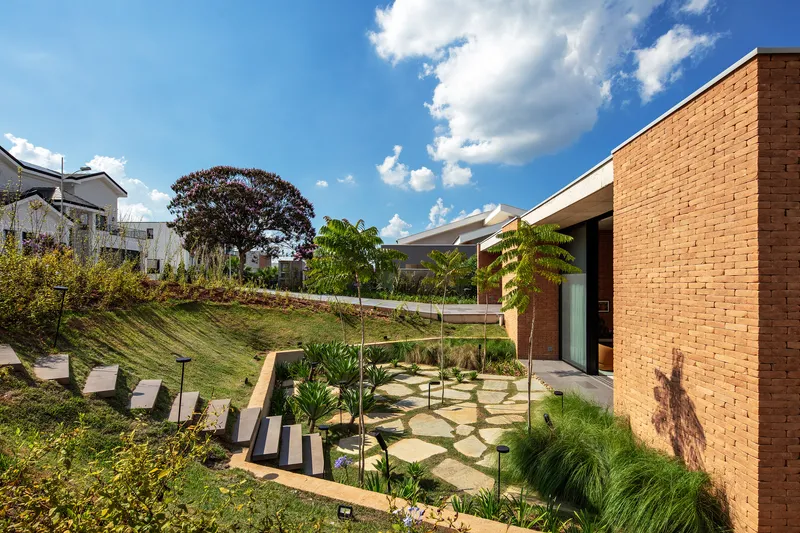
The entry portal, framed by brick walls and illuminated from within at dusk, compresses the visitor before releasing them into the central void. Planted stepping stones and exposed ceiling joists establish the material language immediately: concrete structure, brick enclosure, vegetation everywhere. It is a threshold that manages the transition from the sealed exterior to the lush interior without resorting to a grand foyer or any ceremonial waste of space.
The sloping garden along one side of the house, paved in stone with young palms catching afternoon light, reinforces the idea that landscape is not a luxury layered on at the end but a spatial tool deployed from the first sketch. Ground levels shift here, preparing the eye and the body for the split-level organization inside.
The Central Courtyard as Organizing Principle
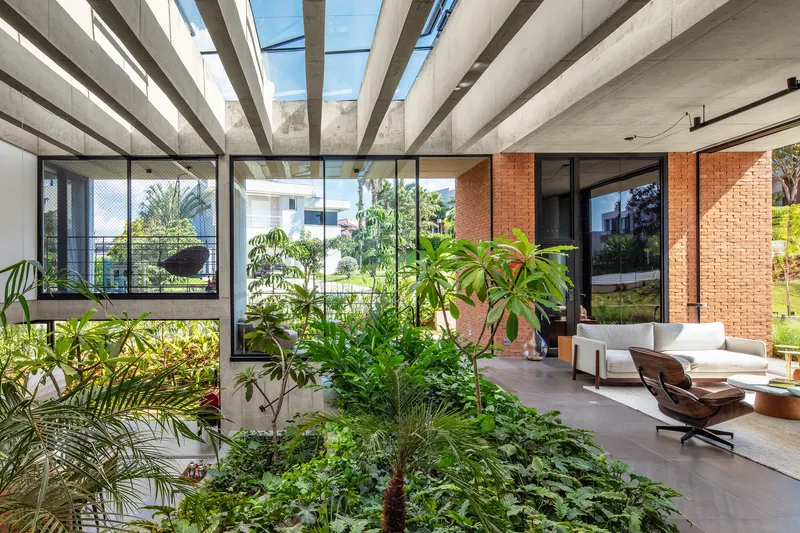
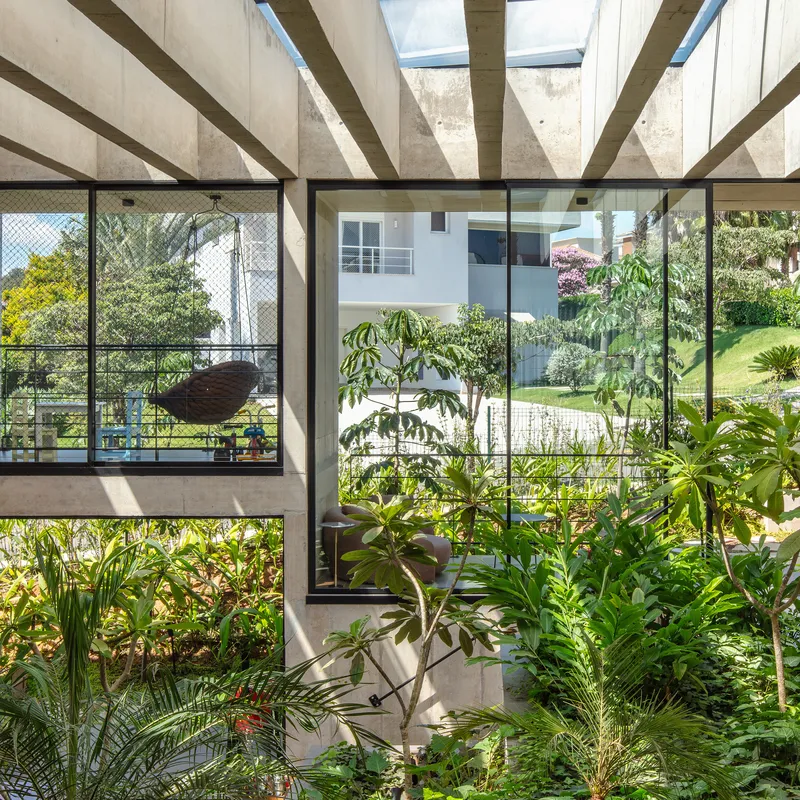
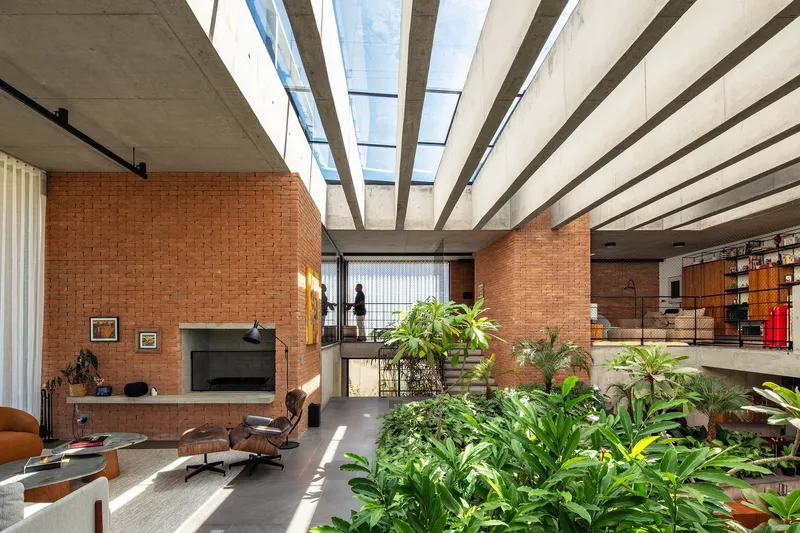
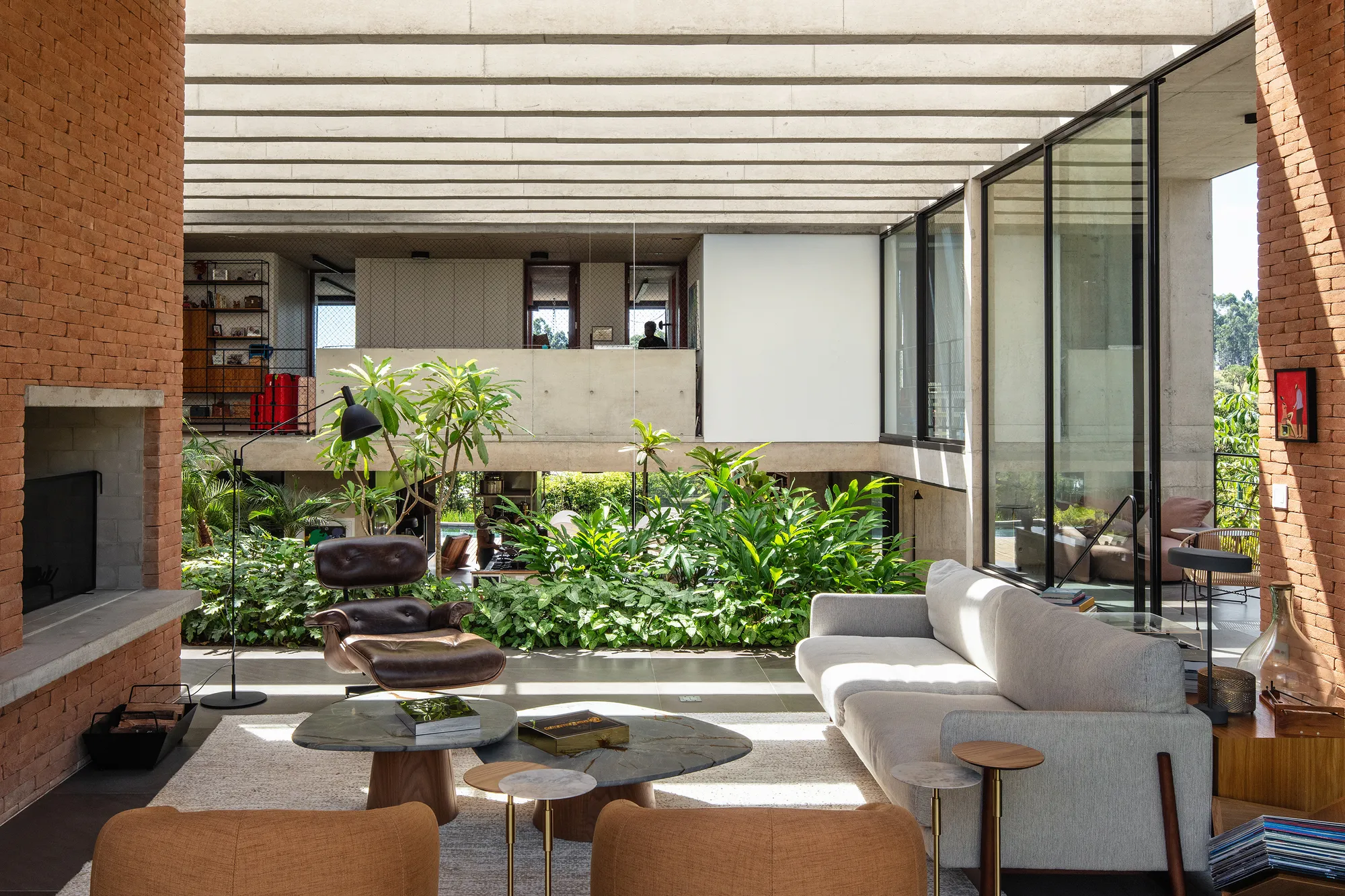
The heart of Casa TG is its internal planted courtyard: a double-height void spanned by heavy concrete beams and capped with a glass roof. Daylight pours through the pergola structure, casting rhythmic shadow bands across the foliage and the polished concrete floors below. Floor-to-ceiling glazing lines the courtyard's perimeter, making it visible from nearly every room in the house. The effect is less patio, more vertical garden room, a living core that the rest of the program wraps around.
What makes this courtyard work is scale. The beams are substantial, almost brutal in their proportions, yet the glass between them keeps the space from feeling oppressive. Plants climb the tiered concrete beds and soften every hard edge. The courtyard is not a light well grudgingly cut into the plan; it is the plan. Circulation, sightlines, and ventilation all derive from its presence.
Split Levels and the Terraced Interior
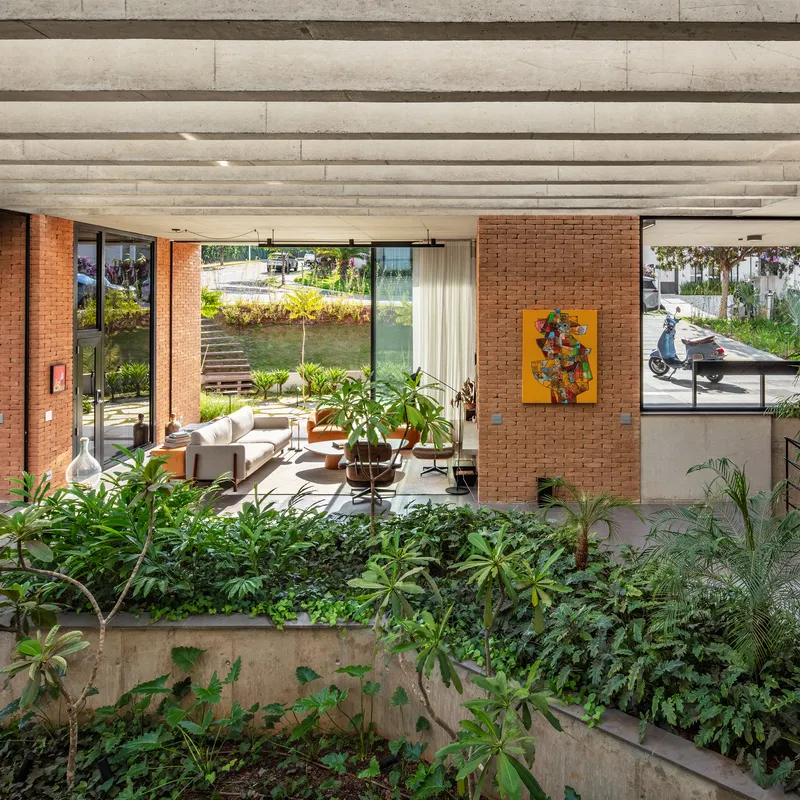
The house descends the site's natural slope in a series of half-levels connected by timber stairs. An intermediate level holds a wine cellar and living room that open onto both the internal courtyard and external gardens. Above, four bedrooms and a common living area occupy the upper level, where balconies take advantage of the elevated position for views out over the community. The sectional play is not arbitrary; each shift in floor level corresponds to a shift in program and privacy.
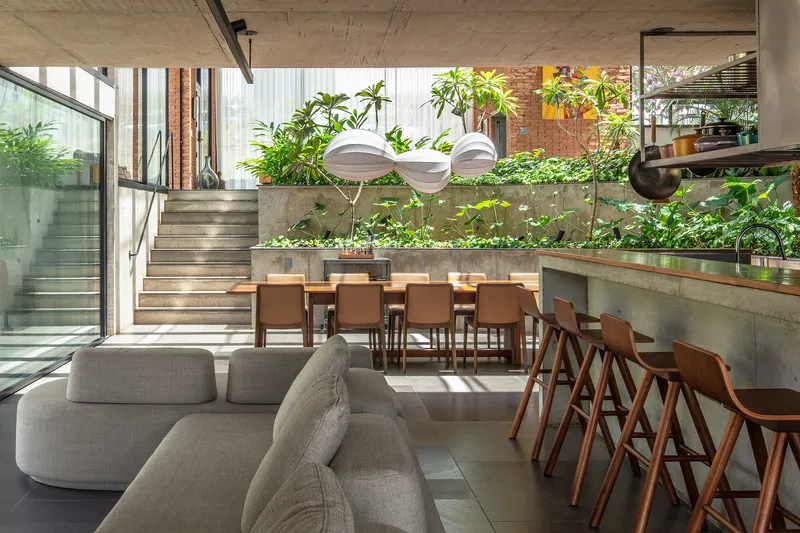
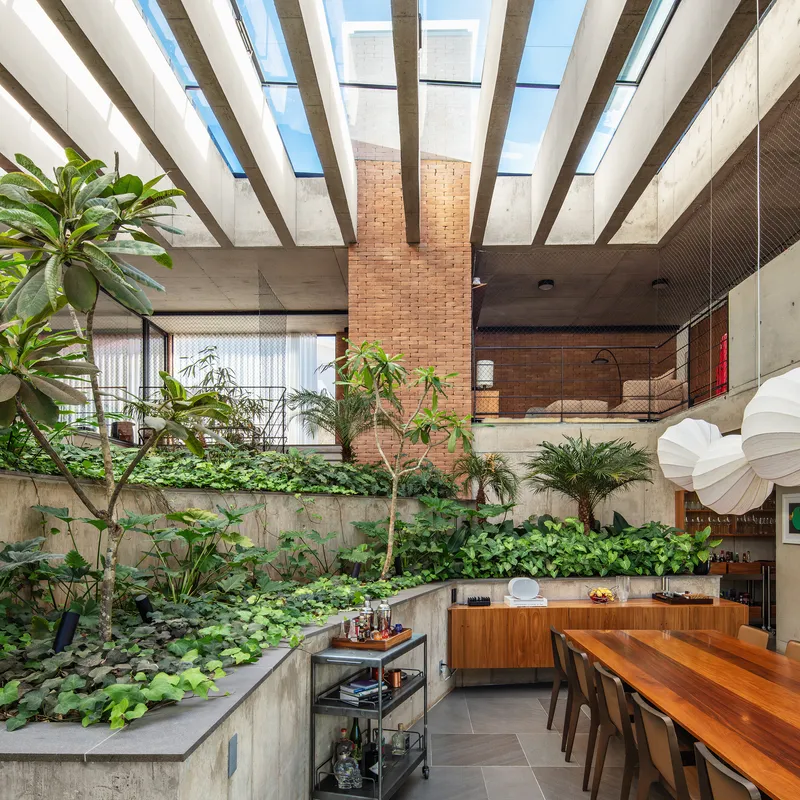
Tiered concrete planters filled with foliage appear at every level change, blurring the line between structure and landscape. From the dining area, you look across ascending beds of greenery toward the mezzanine with its timber cabinetry and pendant lamp. The interior feels simultaneously compact and expansive, compressed in plan but stretched vertically through the courtyard void.
Material Honesty in the Living Spaces
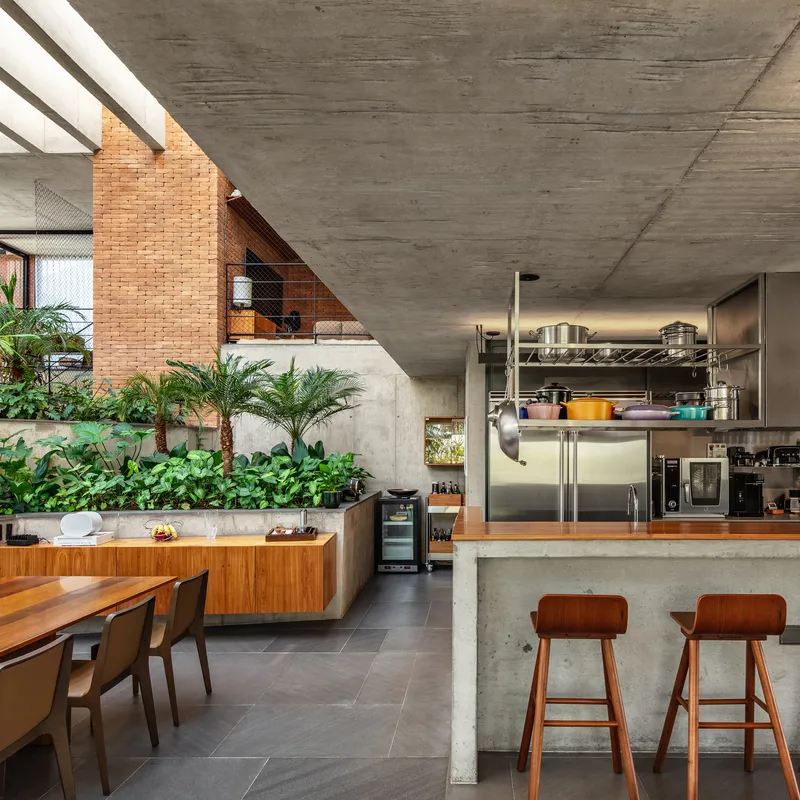
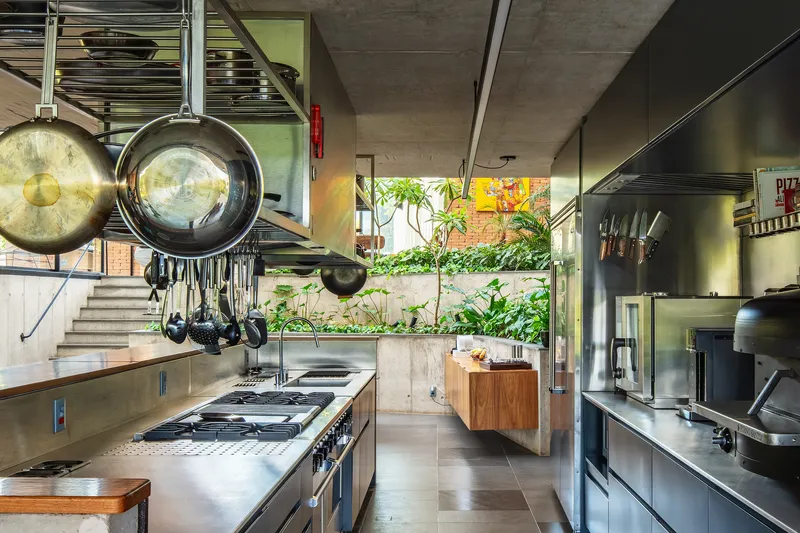
Obra Arquitetos kept the palette tight: exposed concrete for ceilings and structural elements, brick for walls, timber for built-in furniture and stair treads, and stainless steel for the kitchen fittings. The galley kitchen, with its stainless steel appliances, hanging cookware, and concrete island, has a functional intensity that avoids the domestic showroom aesthetic plaguing many houses at this scale. It overlooks a planted terrace, grounding kitchen work in a view of living things.
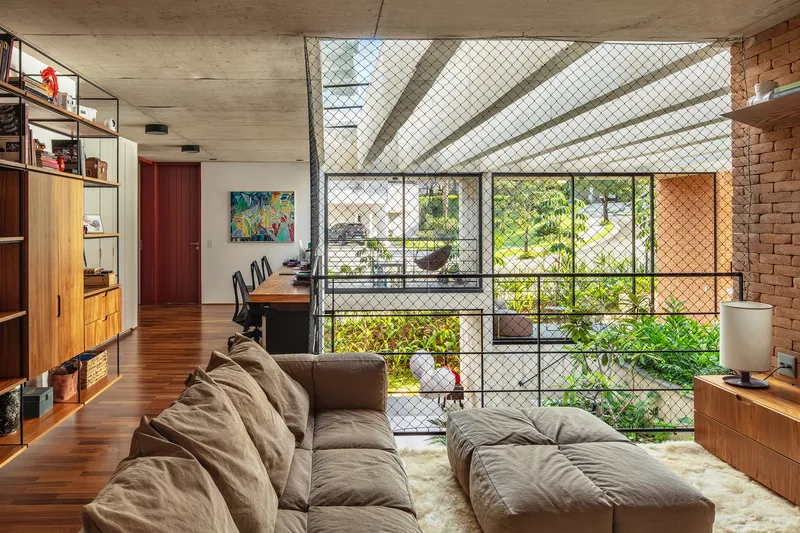
In the living room, exposed brick walls meet timber shelving and a chain-link safety screen at the mezzanine opening. That screen is a telling detail: instead of a glass balustrade or a solid parapet, the architects chose an industrial mesh that allows air and sound to travel freely between levels. The house breathes through its connections, favoring porosity over polish.
The Rear Facade and the Pool Deck
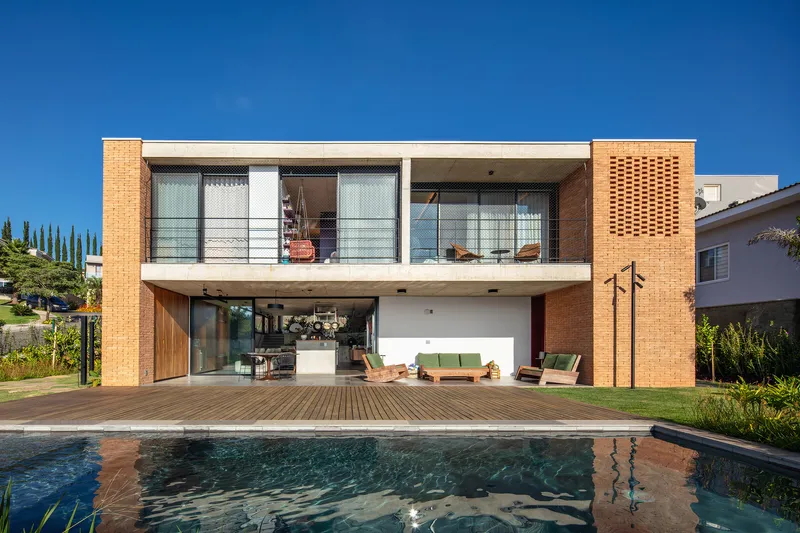
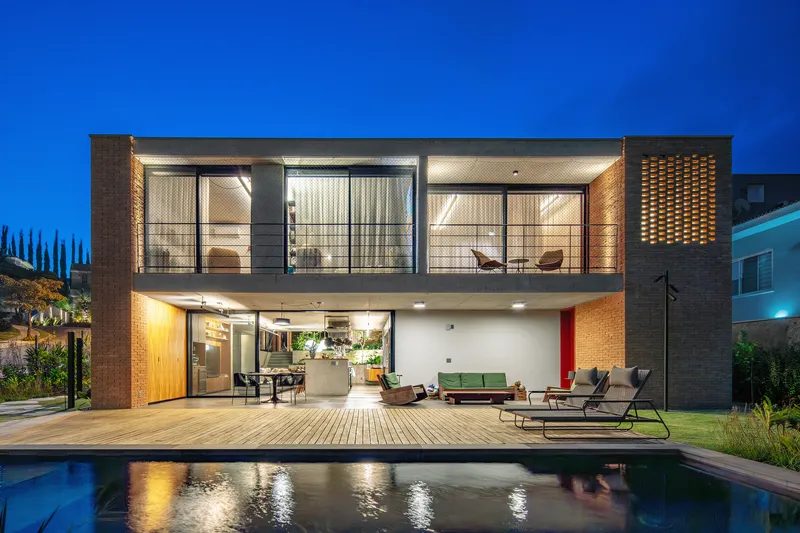
Where the street facades are opaque and protective, the rear elevation dissolves into two stories of glass overlooking a timber deck and swimming pool. At dusk, the house glows from within, the concrete beams and planted beds visible like a cross-section model brought to life. The reflecting pool at ground level on the garden side mirrors the brick volumes above, doubling the perceived depth of the facade.
The contrast between front and back is deliberate and legible. Obra Arquitetos understood that a house on a corner lot in a gated community must negotiate two audiences: the community outside and the family within. The brick shell handles the first; the glass rear wall serves the second, opening domestic life toward the garden, the pool, and the sky.
The Dining Core and Interior Landscape
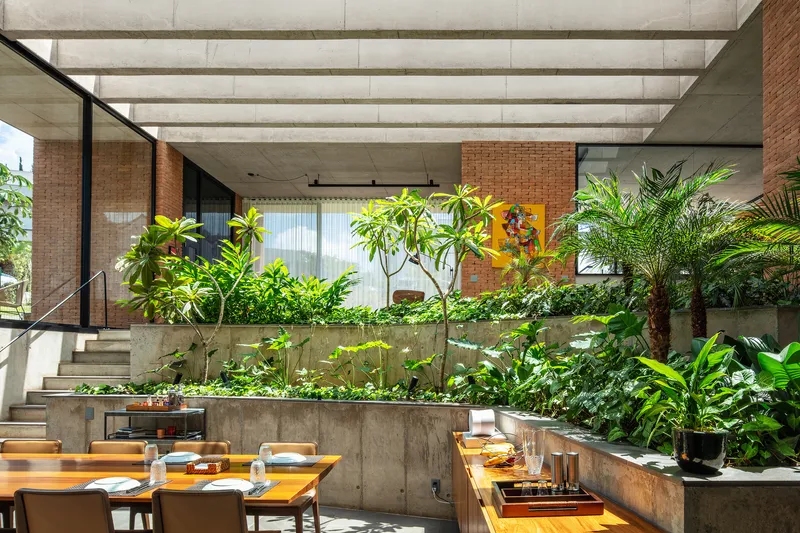
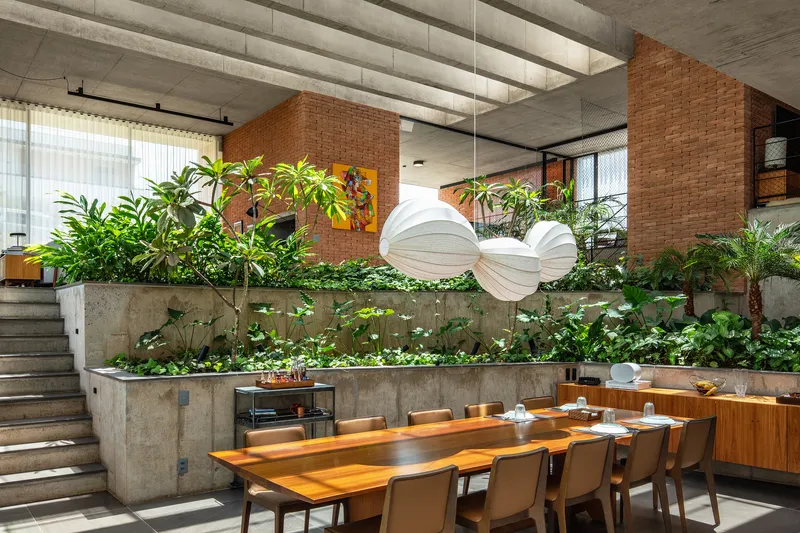
The dining area sits at the intersection of the courtyard and the split-level stairs, making it the social hinge of the house. A long timber table faces the tiered concrete planters, which rise in three steps and overflow with ferns and broad-leafed tropical plants. Overhead, the exposed concrete ceiling beams run uninterrupted, tying the dining zone to the courtyard beyond. Eating here means eating in a garden, which is precisely the point.
Plans and Drawings
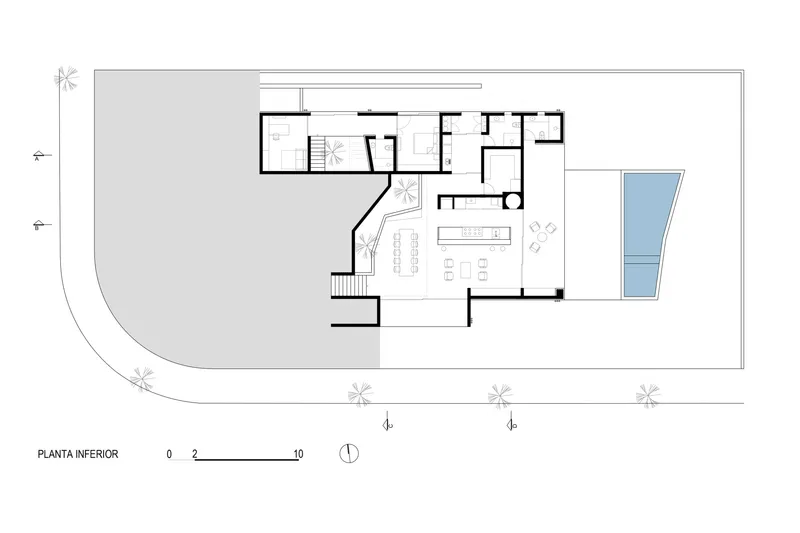
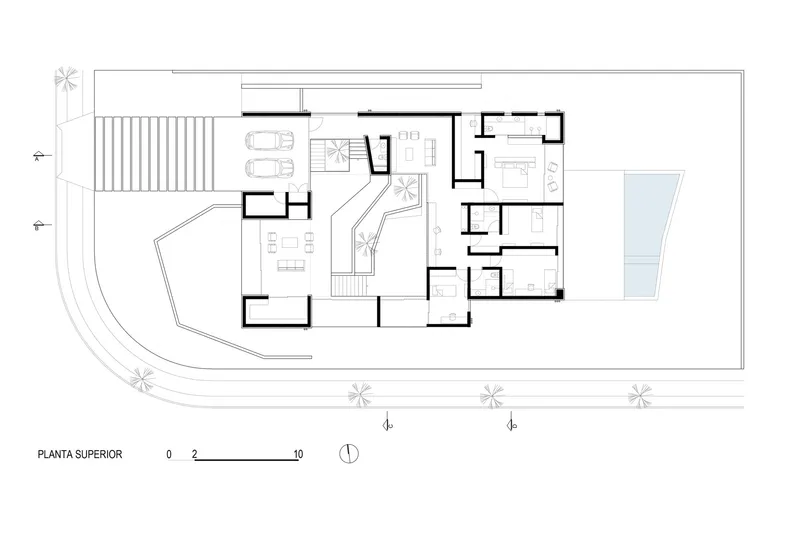
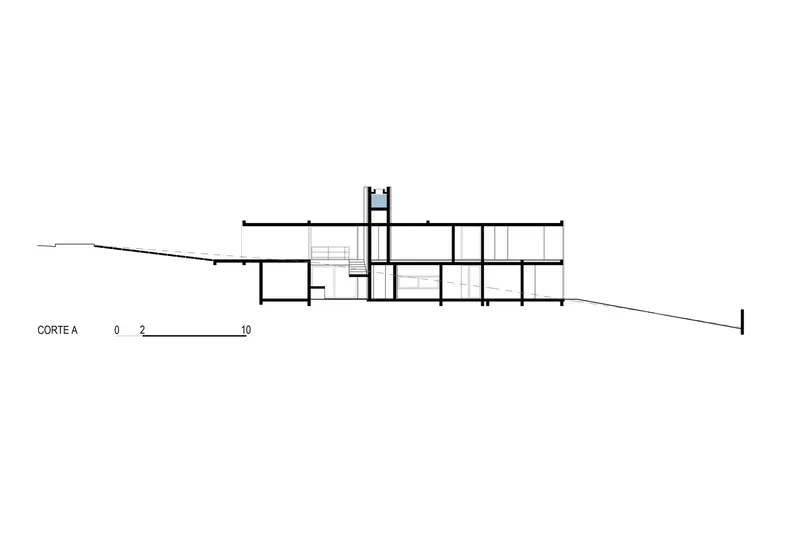
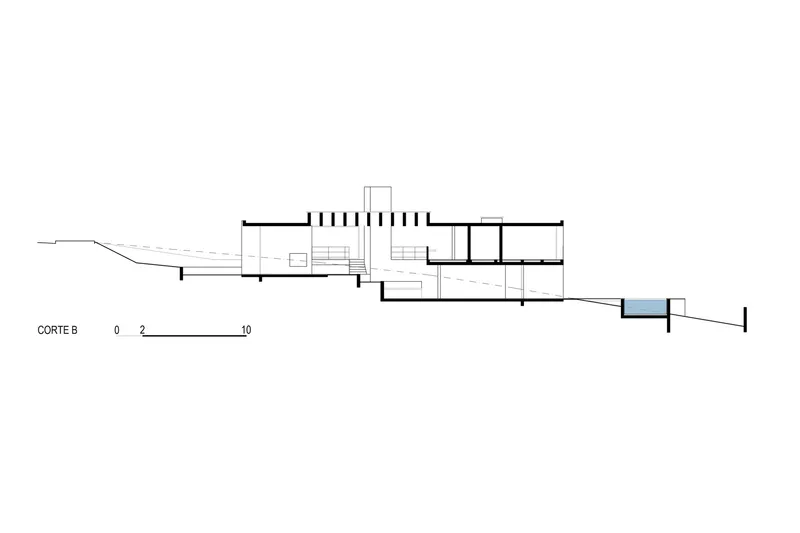
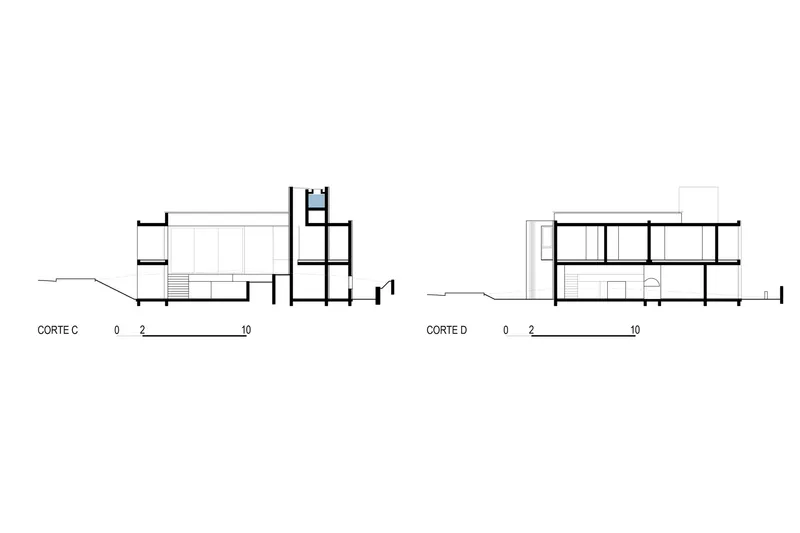
The ground floor plan reveals the angled circulation path that connects the entry to the pool at the rear, threading between the central courtyard and the service zones. The upper floor plan shows how the four bedrooms are organized around a cantilevered deck overlooking the back garden. In section, the relationship between the site's slope and the house's split levels becomes fully legible: the building does not sit on the terrain so much as it steps through it, using every grade change as an opportunity to create a distinct spatial condition.
The transverse sections are especially instructive. They show the concrete pergola rising through the full height of the house, the glass roof above, and the planted beds descending in tiers toward the lower levels. Structure and landscape are genuinely fused here; the beams that hold the house up are the same beams that frame the garden within it.
Why This Project Matters
Casa TG is a corrective to the land-hungry suburban house that treats its plot as a commodity to be maximized. On a 1,233 m² lot where neighbors build to the edges, Obra Arquitetos deliberately held back, folding the garden into the building's core rather than leaving it as leftover space around the perimeter. The result is a house that feels larger than its footprint because every room participates in the courtyard's volume. It is an argument, made in concrete and brick and soil, that density and generosity are not opposites.
The project also demonstrates how a limited material palette, deployed with structural clarity, can do more than any number of finishes. Concrete beams, brick walls, timber floors, glass, and plants: that is nearly the entire list. Yet the sectional complexity, the split levels stepping down the slope, and the central void animated by shifting light ensure that no two spaces in the house feel the same. In a context where residential architecture often defaults to spectacle or efficiency, Casa TG insists on something rarer: spatial intelligence in the service of daily life.
Casa TG by Obra Arquitetos, lead architect João Paulo Daolio. Located in Jundiaí, Brazil. 623 m². Completed 2026. Photography by Nelson Kon.
About the Studio
Share Your Own Work on uni.xyz
If projects like this are the kind of work you want to make, uni.xyz is a place to publish your own, find collaborators, and enter design competitions.




Popular Articles
Popular articles from the community


The Musturak Paradise: Senior Living Architecture for a Connected Future in Temara, Morocco
The Musturak Paradise reimagines senior living architecture in Temara via private homes, social spaces, culture, community, and shared care.

Conexión: Biophilic Design Reimagines High-Rise Living in Hong Kong
Conexión reimagines high-rise living in Hong Kong through biophilic design, green facades, shared spaces, daylight, water and nature within.

Co-Life: Senior Housing Design That Reconnects Older Adults With the City
Co-Life reimagines senior housing design through healing gardens, shared streets, workshops, and a sustainable community across generations.

Hill & Cross Opera: Sculptural Opera House Architecture Shaped by Tallinn’s Landscape and Identity
Hill & Cross Opera reimagines opera house architecture in Tallinn through its sculptural hill, civic plaza, glass wave and a luminous cross.


Similar Reads
You might also enjoy these articles

Bao Huynh Watercolor Atelier: A Serene Art Retreat in Hội An
Bao Huynh Watercolor Atelier in Hội An blends multifunctional art spaces, sustainable design, local materials, and family-friendly living in a serene environment.

Atelier Macri Concept Store Interior Design by CASE-REAL
Atelier Macri store features a "ko" counter, walnut wood details, cork displays, blending retail, gallery, and seamless customer experiences.

Manuel Vargas Izquierdo Stadium and High-Performance Sports Center: Architectural Excellence in Jalpa de Méndez
The Manuel Vargas Izquierdo Stadium blends sustainable design, inclusive sports facilities, and cultural-inspired architecture, revitalizing Jalpa de Méndez’s public spaces.

KAKR Buluh Awar Hall: Revitalizing Community and Ecology Through Bamboo Architecture
Community built bamboo hall revitalizes Buluh Awar village, empowering youth, restoring ecology, celebrating vernacular craftsmanship through sustainable architecture and culture.
Explore Architecture Competitions
Discover active competitions in this discipline



Challenge to reimagine the Iron Throne


Photograph architecture without architects


Illustrate the lost glory of Angkor Wat - Render Challenge


Design challenge to reuse E-waste
Comments (0)
Please login or sign up to add comments
No comments yet. Be the first to comment!