
OODA Buries a Concrete House into a Portuguese Hillside to Save Its Century-Old Pines
A 350-square-metre residence in Oeiras digs into sloping terrain, wrapping a U-shaped plan around a courtyard pool framed by ancient trees.


Privacy is easy to achieve with walls. The harder problem is achieving it without sacrificing openness, light, or the landscape you came for. In Oeiras, a coastal town west of Lisbon, OODA solved that problem by going underground, or rather, halfway underground. Their 350-square-metre house for a client with a public profile and a need for discretion is semi-buried into a rocky, westward-sloping site, its accessible roof nearly continuous with the terrain above. From the street level, the house barely registers. From inside, it is all sky, water, and centuries-old pine trees.
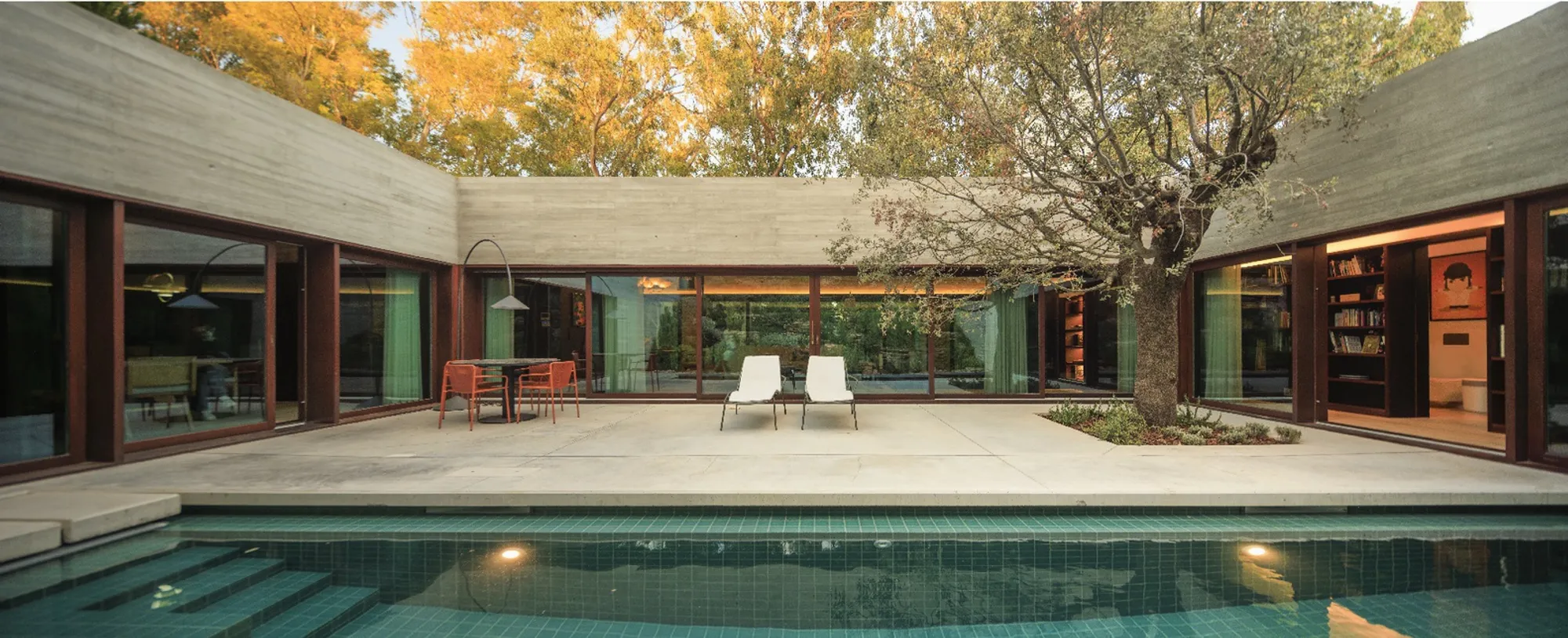
The strategy is deceptively simple: a U-shaped plan wraps three volumes around a central courtyard, with one wing holding bedrooms to the north, another containing the kitchen to the south, and a connecting social zone between them. A scenic pool occupies the courtyard floor, compensating for the semi-buried condition by bouncing light deep into the interior. Soil and vegetation flow between the exterior hillside and the courtyard itself, dissolving the line between built and natural ground. It is an earthen-house concept that owes something to the mid-century thinking of Frank Lloyd Wright and Walter Gropius, but executed in a distinctly Portuguese register of board-marked concrete, dark timber, and stone.
Digging In: Topography as Architecture


The site's irregular slope is not just accepted here; it is the generating force. OODA dug the two wings slightly into the hillside so the roof plane aligns with the upper grade, turning the entire top of the house into a walkable landscape. What would have been a retaining wall problem became a habitable section: the house steps down with the terrain, its cantilevered concrete roof floating over the courtyard like a tray balanced on the hill's edge. Existing trees, particularly the pines that give the site its character, were conserved rather than cleared. The half-buried solution wraps around their root zones, letting their canopies shade the roof and filter the light that reaches the patio below.
From the elevated vantage at dusk, you can read the full strategy: terraced planting cascades down toward the pool, the concrete slab hovers above fully glazed walls, and the landscape appears uninterrupted. The house does not compete with its terrain. It occupies a seam within it.
The Courtyard Pool as Light Engine
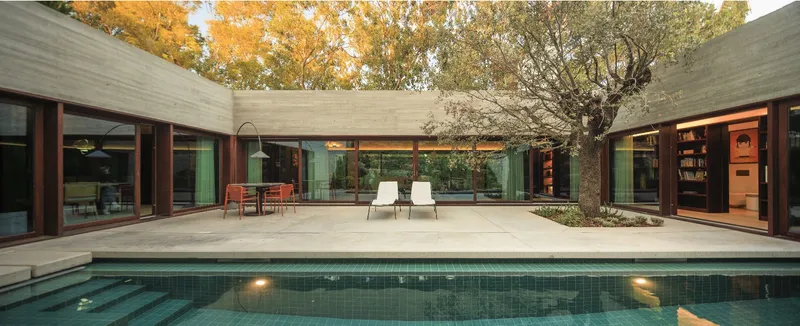

In a semi-buried house, light is currency, and the courtyard pool is the mechanism OODA uses to spend it generously. The water surface acts as a reflector, bouncing daylight upward onto the board-marked concrete soffits and into the glazed volumes that surround it. At dusk, the effect inverts: interior illumination spills out across the water, and the courtyard becomes a lantern sunken into the hillside. An olive tree stands in the paved court, its trunk a vertical counterpoint to all those horizontal planes.
Standing beneath the poolside overhang and looking outward, you get a framed view of the terraced landscape and scattered pines. The overhang creates deep shade that makes the bright garden beyond almost cinematic. It is a threshold space, neither fully inside nor fully outside, that captures the essence of OODA's approach: architecture as a series of calibrated frames for the landscape.
Concrete Above, Timber Within
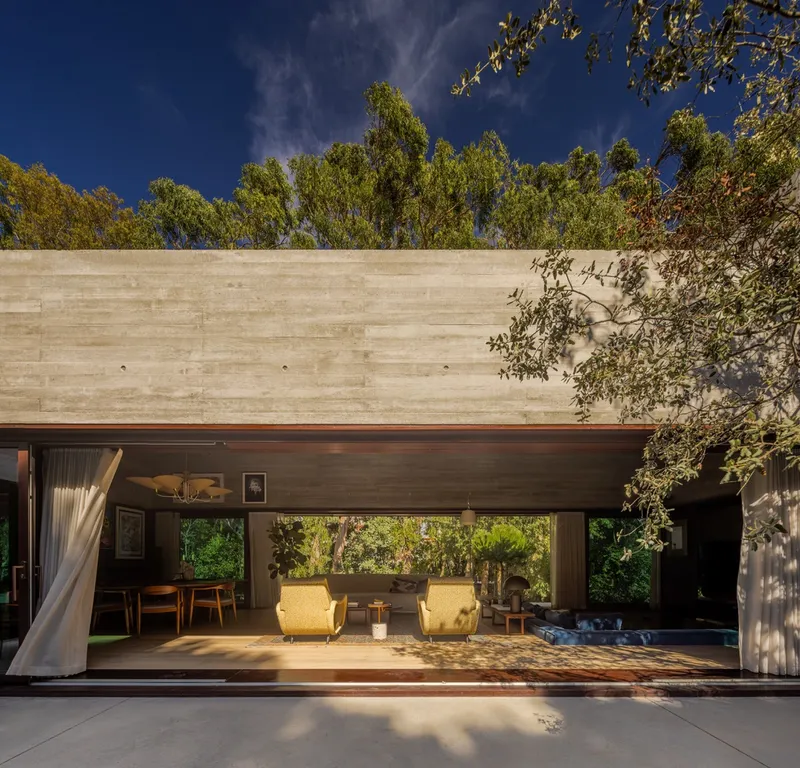
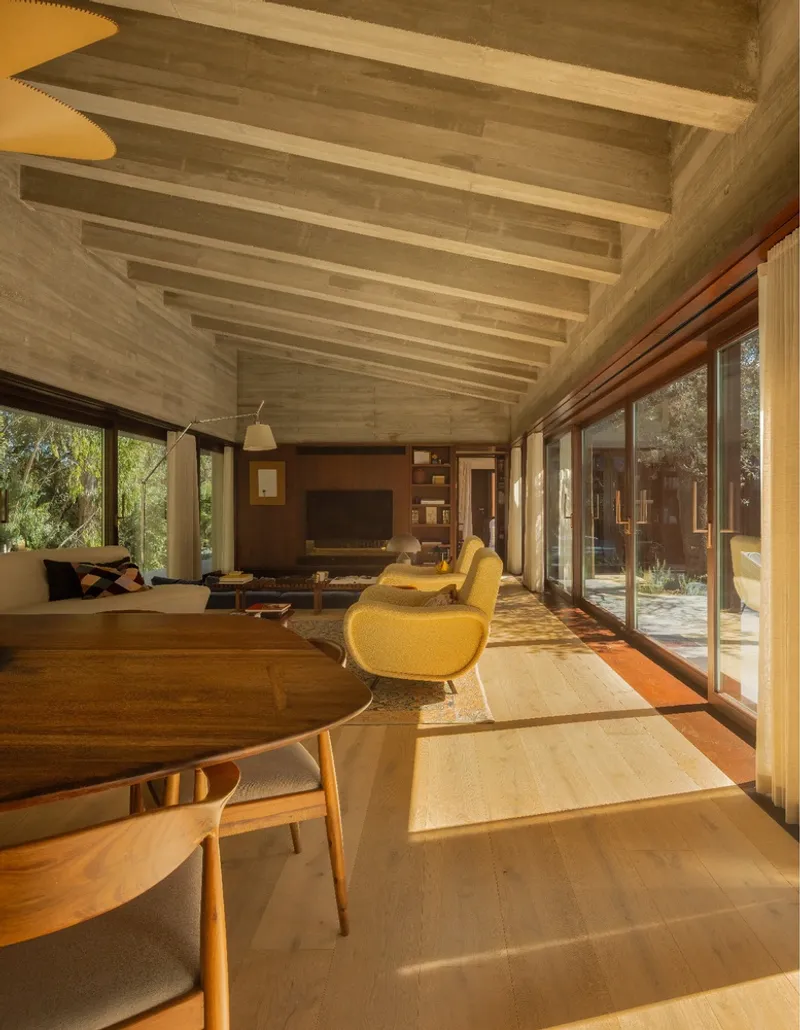

The material hierarchy is legible from the outside. The upper level reads as exposed board-marked concrete: heavy, geological, continuous with the rocky site. Light grey block cladding distinguishes the orthogonal volumes and rooftop elements. Below, where the house opens onto the courtyard, dark wood panelling and floor-to-ceiling glazing soften the interior. The contrast is deliberate. Concrete anchors the house to the earth; timber warms the spaces you actually inhabit.
Inside the main living pavilion, thick concrete beams span column-free across the width of the space, eliminating internal pillars and allowing the glazed walls to slide fully open. The result is a room that can become a covered terrace in seconds. Exposed timber ceiling joists in the adjacent living room carry a different mood: lower, warmer, more domestic. OODA shifts between these two structural registers as you move through the house, using the material change to signal transitions from public to private, from expansive to intimate.
Kitchen and Interior Craft
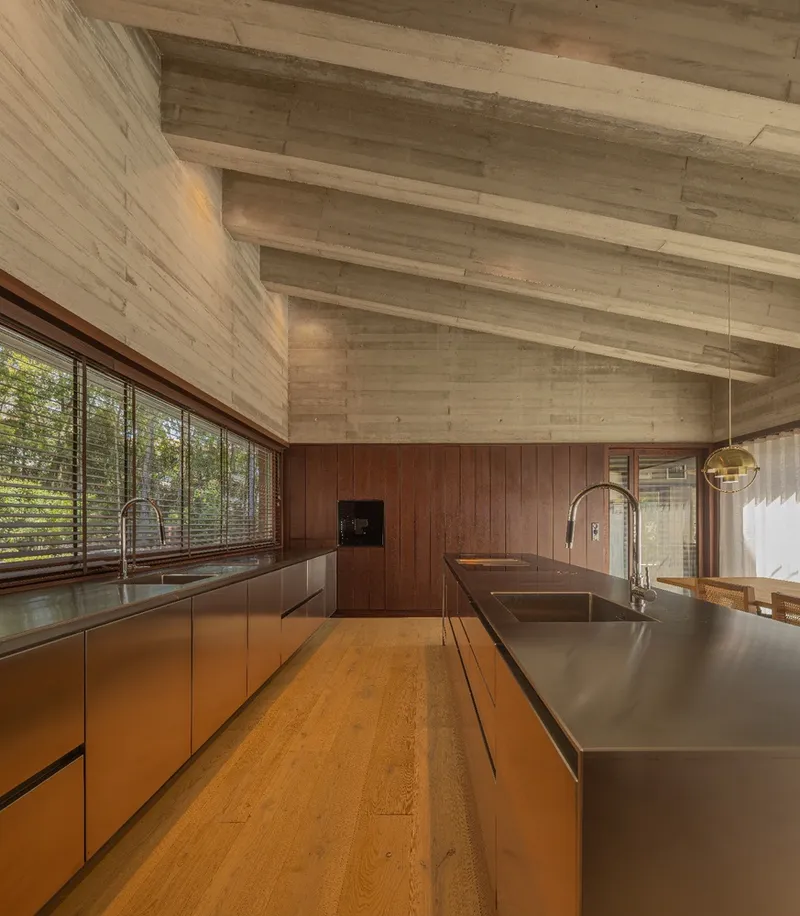

The south wing's kitchen occupies its own tonal world. Exposed timber ceiling beams run above a stainless steel island, and wood-framed windows open directly into the forest. It is a working room designed to feel like a cabin, with the structural honesty of the concrete zones replaced by something softer and more tactile. The timber plank ceiling has a visible grain and rhythm that gives the space a handmade quality, even though the detailing is precise.
Backlit sheer curtains filter the western light into a warm glow, a move that echoes through the rest of the interiors. OODA clearly thought about light not just in terms of openings and orientations but as a material to be shaped: reflected off water, filtered through linen, bounced off stainless steel. The custom furniture and concealed storage keep surfaces clean, letting the play of light and material do the expressive work.
Corridors, Bathrooms, and the Details That Hold

The north wing's bedroom corridor reveals how carefully OODA detailed the private zones. Built-in timber shelving runs the length of one wall, turning a circulation space into a library. On the opposite side, textured linen curtains hang floor to ceiling, concealing storage or secondary openings while adding acoustic warmth. The proportions are narrow enough to feel protected without becoming claustrophobic.
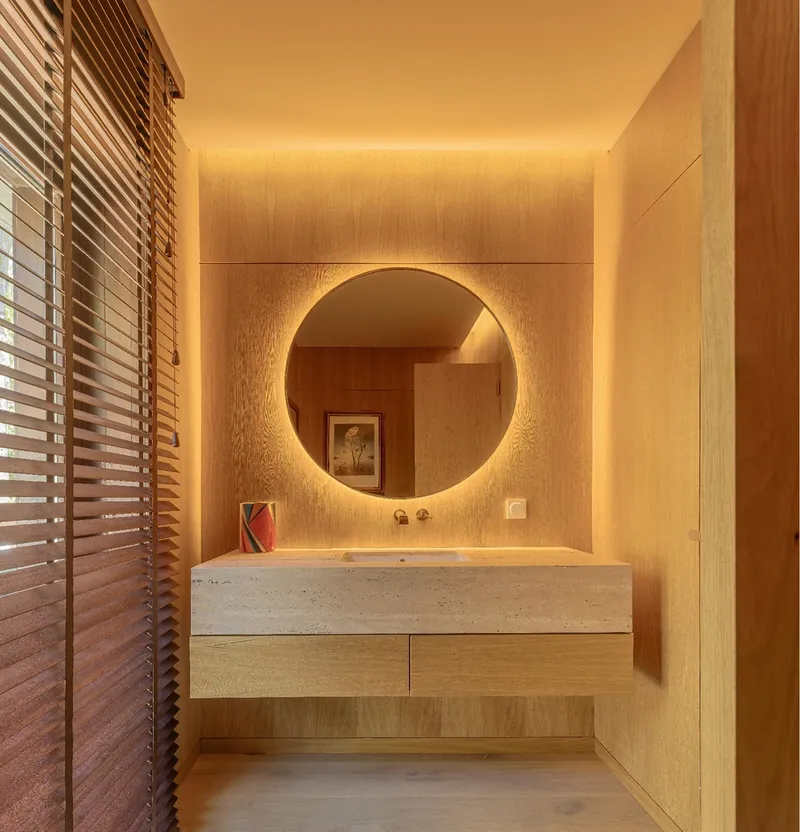
The bathroom takes a different approach to enclosure. A terrazzo vanity sits beneath a circular backlit mirror, and wood louver shutters filter the evening light into horizontal bands. The skylit condition OODA designed for the bathroom and entrance area means these rooms never depend on electric light during the day. It is a small move with large consequences for the feeling of living in a semi-buried house: even the most enclosed rooms connect to the sky.
Why This Project Matters
Oeiras House is a useful corrective to the idea that privacy requires introversion. OODA achieved near-total seclusion from the street while creating a house that is radically open to its own landscape. The U-shaped plan, the semi-buried section, the reflective pool, and the conserved trees all work together as a single system. None of these moves is novel on its own, but their orchestration on this particular slope, for this particular client, produces something genuinely site-specific rather than merely site-adjacent.
The project also demonstrates that mid-century earth-sheltered ideas still have room to evolve. By pairing that tradition with contemporary craft, column-free concrete spans, and a thoughtful material palette of board-marked concrete and dark timber, OODA has produced a house that feels rooted without feeling retro. In a coastal market where villas tend to sit on top of their sites and announce themselves, this one disappears into the hillside and is better for it.
Oeiras House by OODA. Located in Oeiras, Portugal. 350 m². Completed 2024. Engineering by TEKK and A3R Lda. Landscape by P4.
About the Studio
Share Your Own Work on uni.xyz
If projects like this are the kind of work you want to make, uni.xyz is a place to publish your own, find collaborators, and enter design competitions.




Popular Articles
Popular articles from the community


Conexión: Biophilic Design Reimagines High-Rise Living in Hong Kong
Conexión reimagines high-rise living in Hong Kong through biophilic design, green facades, shared spaces, daylight, water and nature within.

Co-Life: Senior Housing Design That Reconnects Older Adults With the City
Co-Life reimagines senior housing design through healing gardens, shared streets, workshops, and a sustainable community across generations.
EW PARK: Sustainable Architecture Reimagines the Future of Urban Parking
EW PARK reimagines city parking as a modular wooden tower combining automation, solar energy, electric mobility, and adaptable urban design.

The Musturak Paradise: Senior Living Architecture for a Connected Future in Temara, Morocco
The Musturak Paradise reimagines senior living architecture in Temara via private homes, social spaces, culture, community, and shared care.


Similar Reads
You might also enjoy these articles


Hodi-Mandai Geram
Project Function: Preservation and revitalization of the Intangible heritage and socio-spatial identity of the Hodi by Housing, Cultural Memory Center, Sacred Grove, landscape, local tourism economy


Olio Towers: A Mid-Rise for Performers That Fuses Housing, Rehearsal, and Stage
Located blocks from Houston's Theater District, this modular tower stacks living units around a central performance atrium.

Oasis: Modular Green Housing Carved into Dhaka's Urban Fabric
A shortlisted Plugin Housing entry reclaims unauthorized settlements in Dhaka with stepped concrete volumes, green roofs, and ventilation-driven design.

Black Hole: A Floating Megastructure for the Post-Physical Era
Emiliano Mazzarotto envisions a spherical, self-scaling arena where e-sports, digital hotels, and holographic stadiums replace traditional public space.

Explore Aotu Architecture Office Competitions
Discover active competitions in this discipline



Challenge to reimagine the Iron Throne


Photograph architecture without architects


Illustrate the lost glory of Angkor Wat - Render Challenge


Design challenge to reuse E-waste
Comments (0)
Please login or sign up to add comments
No comments yet. Be the first to comment!