
OHLAB Threads Fifteen Homes Through a Medieval Palma Palazzo Without Erasing Its Layers
Can Santacilia recovers centuries of architectural history in Palma de Mallorca's old town, turning two adjoining stone buildings into layered dwellings.


Most heritage conversions pick a moment in time and restore everything to that single frame. OHLAB refused that approach with Can Santacilia, a pair of adjoining buildings in the heart of Palma de Mallorca's old town that trace their origins to the 12th or 13th century and were first registered in city archives in 1576. The 3,300 m² complex had already passed through a major 18th-century reform and a series of 20th-century subdivisions before the firm arrived. Rather than stripping everything back to some idealized medieval or baroque state, OHLAB chose to treat each era's contributions as legitimate architectural evidence, keeping layers visible and letting them coexist with overtly contemporary insertions.
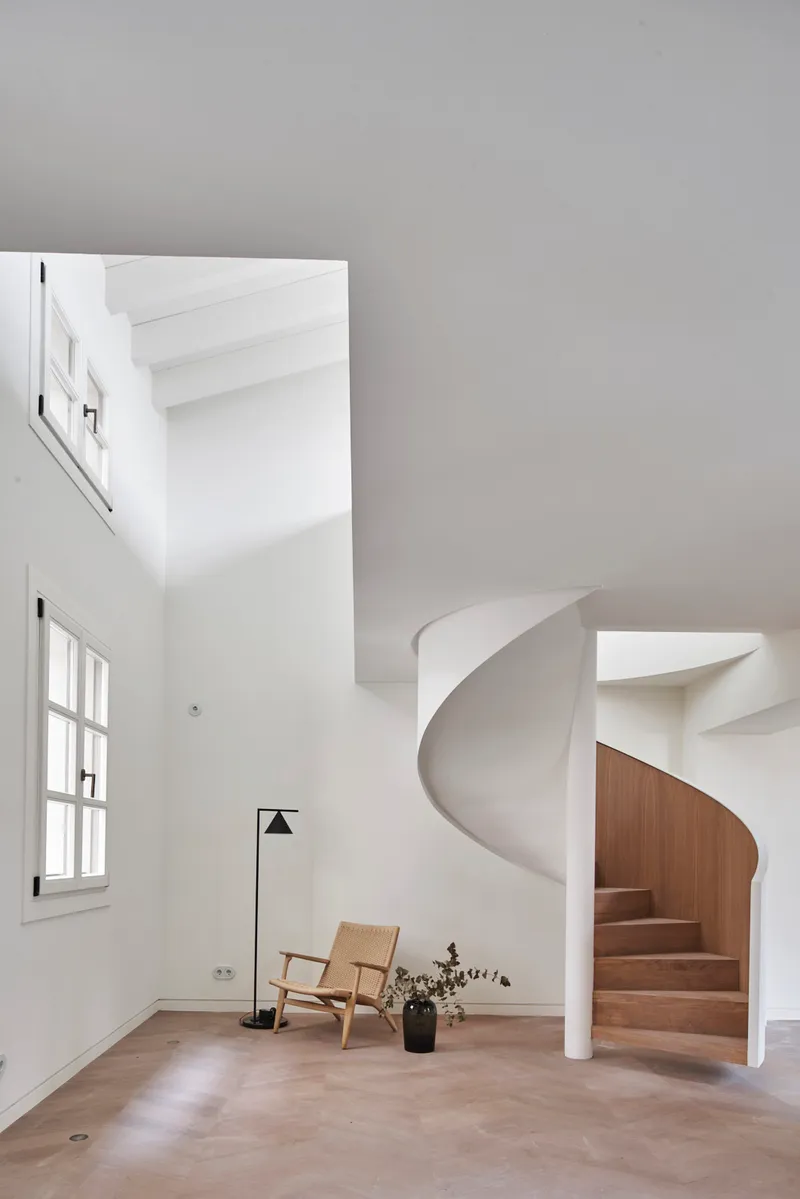
The result is 15 dwellings and a suite of communal amenities organized around two inner courtyards, one of which follows the classic entrance courtyard typology deeply rooted in Palma's noble houses. What makes the project genuinely compelling is not the restoration work alone but the deliberate tension between old and new. Mirrored partition volumes that stop short of the ceiling, a sculptural white spiral staircase, and a subterranean lap pool sit alongside painted medieval coffered ceilings, wrought iron balconies, and stone arches. The discovery of an ornate medieval ceiling mid-construction prompted the redesign of roughly 40 percent of the total project, including six apartments, a commitment that says everything about OHLAB's priorities.
Street and Courtyard: Reading the Building from the Outside In
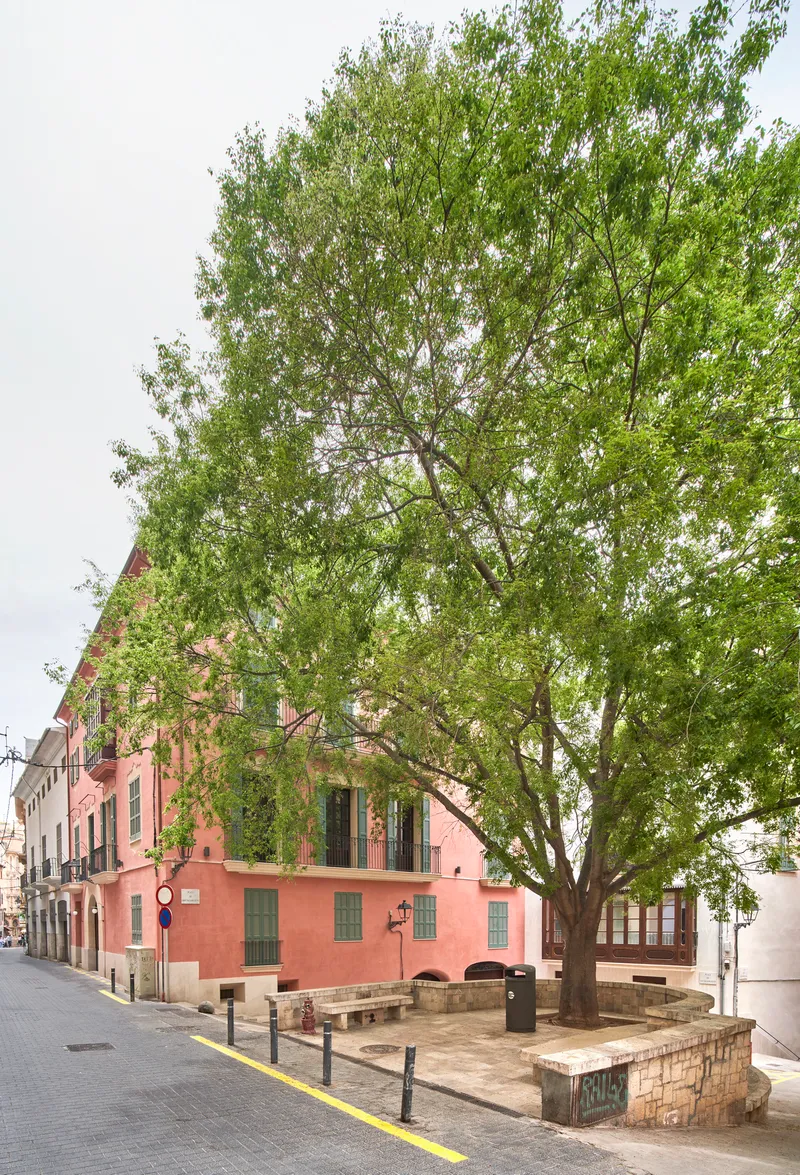
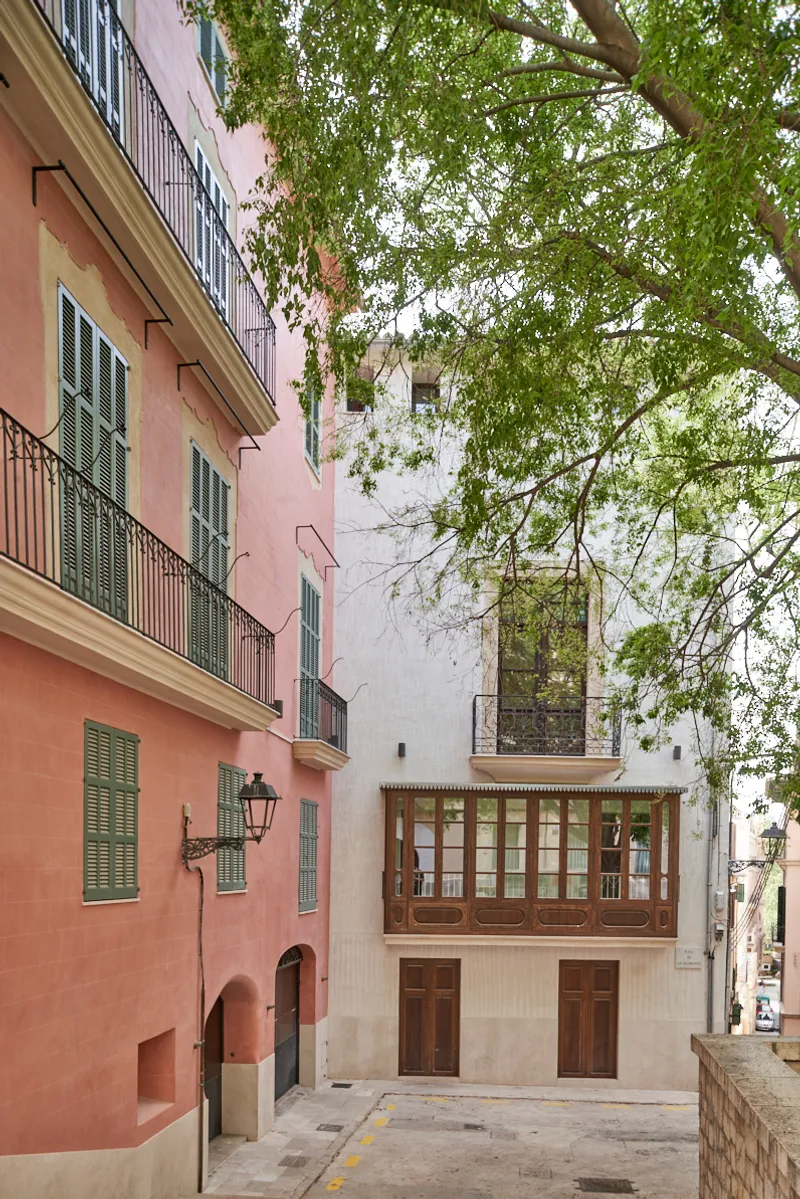
Can Santacilia presents itself modestly to the street. The coral-painted facade on Tagamanent Square preserves part of its 18th-century decor, while the narrower elevation down the lane reveals a timber bay window between plastered walls. Neither frontage announces the scale of what sits behind. That restraint is characteristic of Palma's patrician houses, which reserve their architectural generosity for the interior.
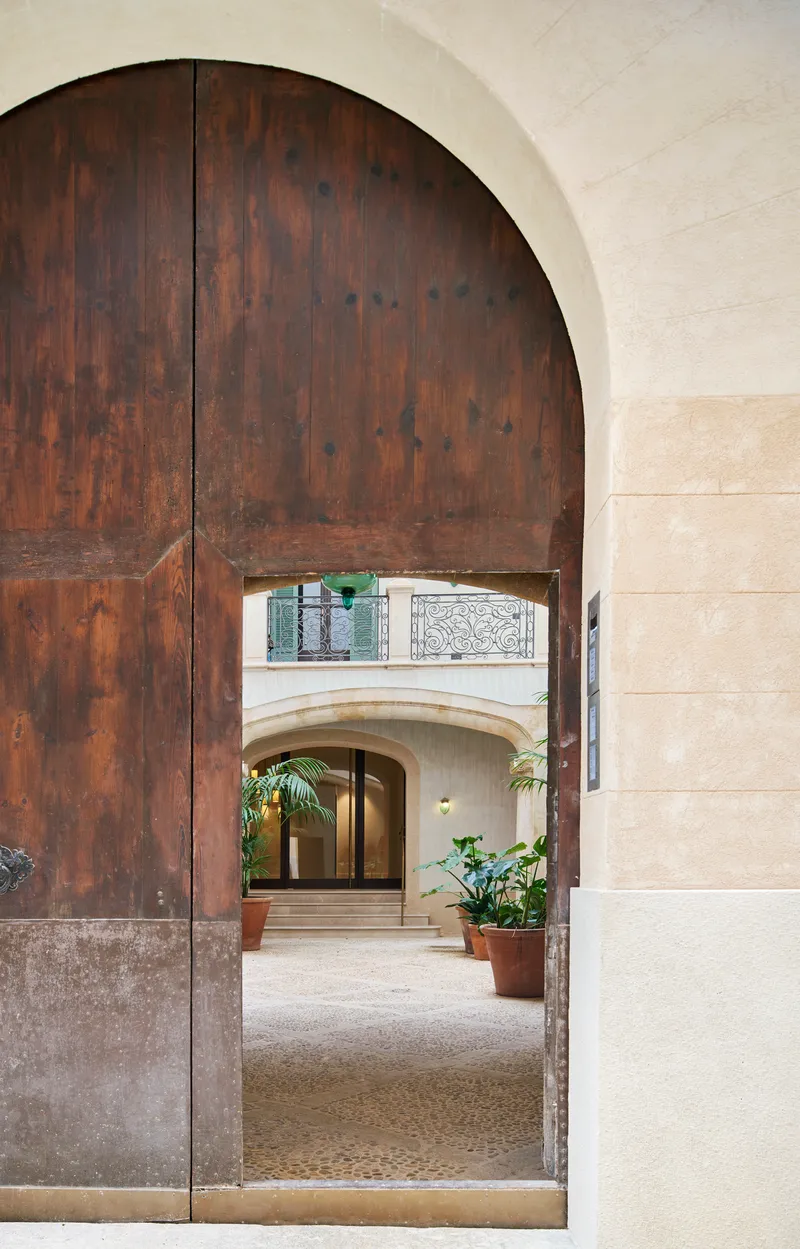
The arched timber entrance door opens directly into a stone courtyard with potted plants, a wrought iron balcony overhead, and a pebble mosaic floor underfoot. It is the threshold between the city and the private world of the building, a spatial device that OHLAB restored rather than reinvented. The courtyard functions as the address for all 15 homes, the communal pool, the gym, and the landscaped terraces above.
Inner Courtyards and Communal Life
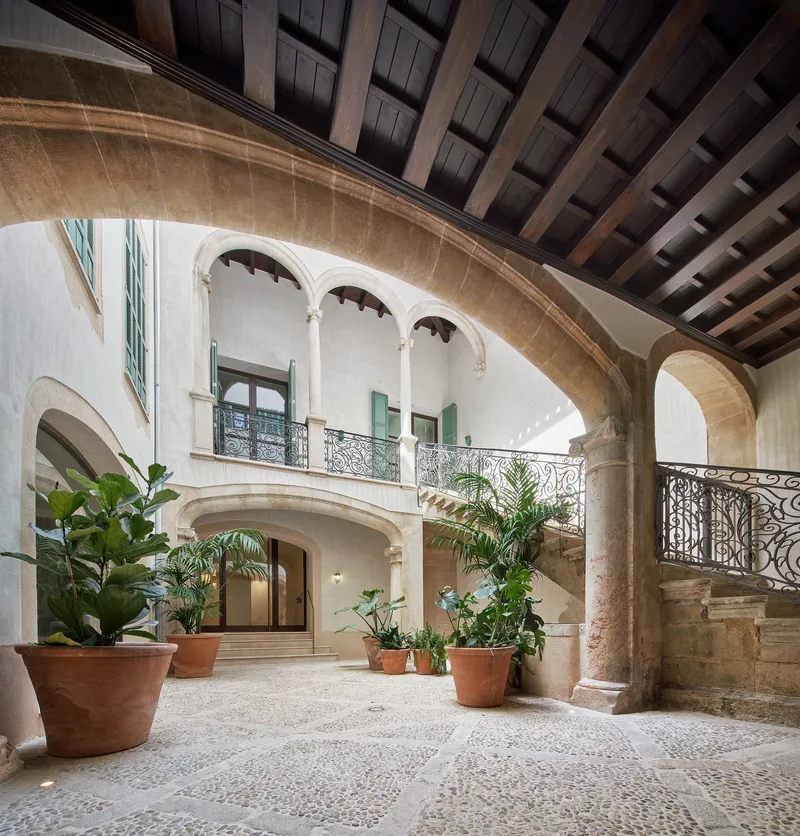
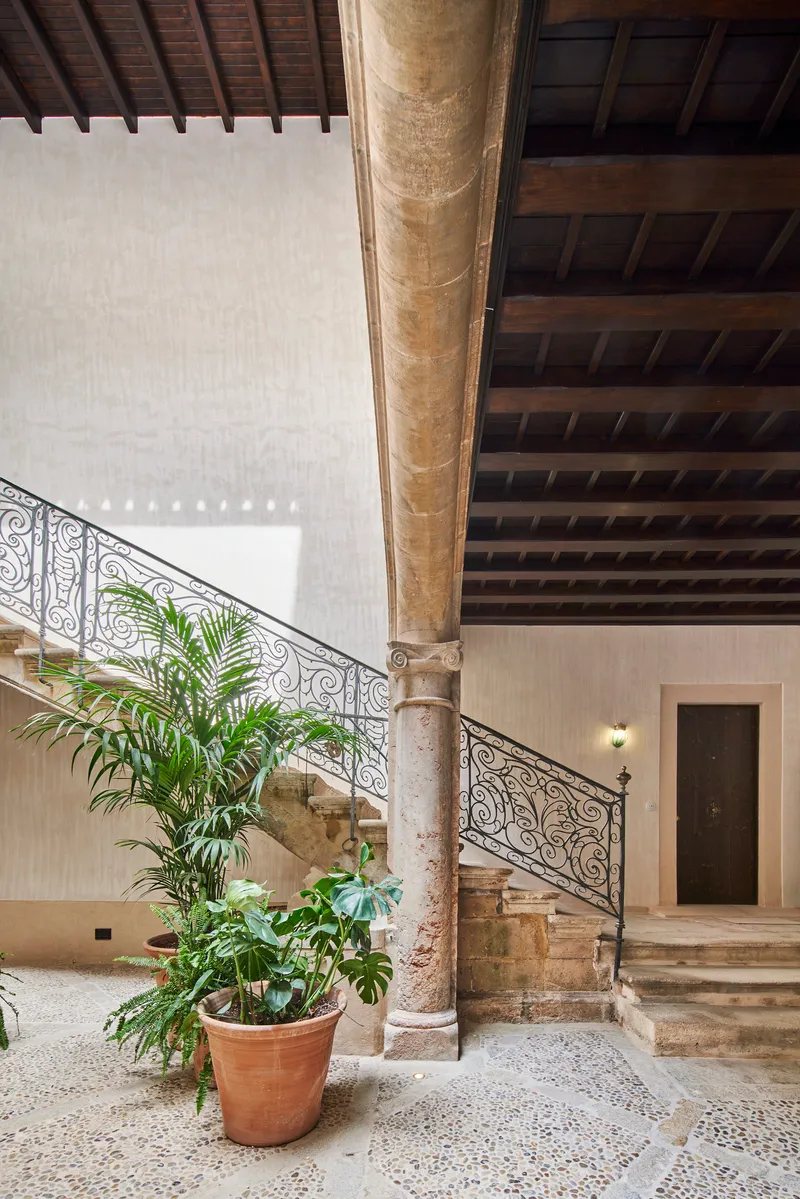
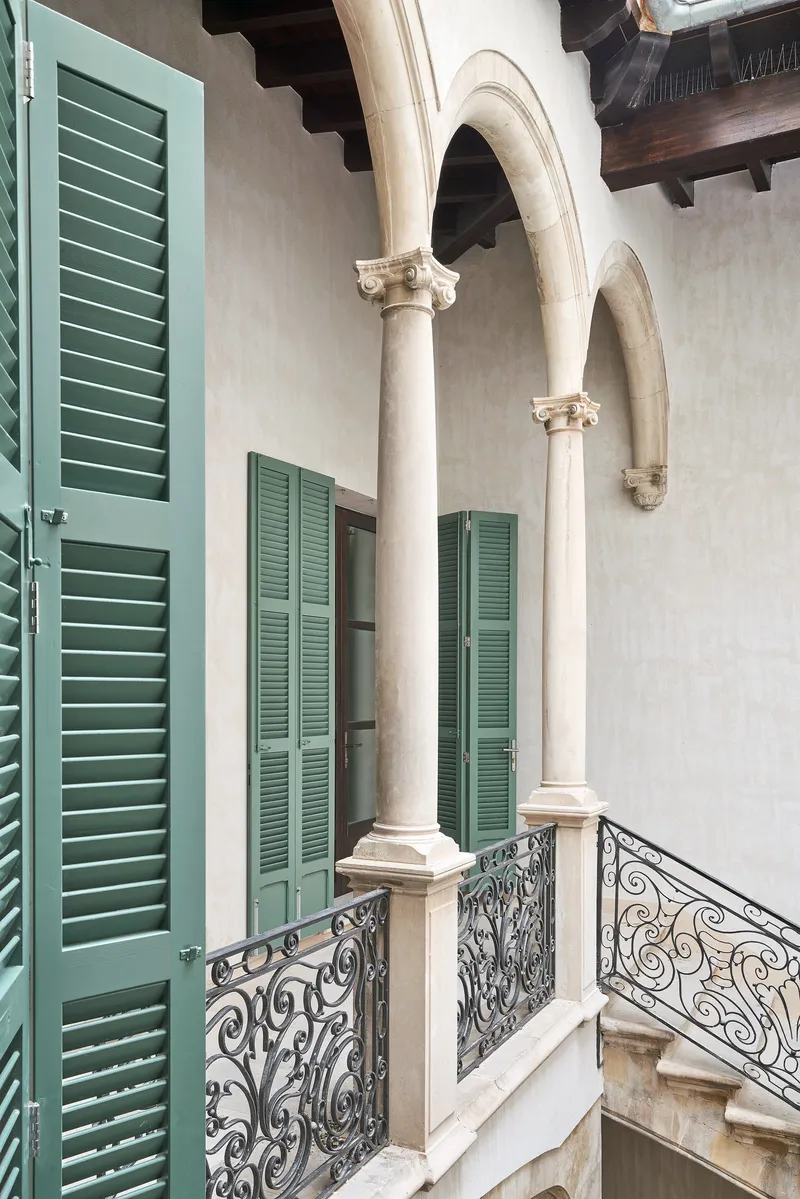
The main courtyard is anchored by a curved stone archway and a coffered timber ceiling that makes the transitional space feel more like a room than a corridor. Pebble mosaic flooring, potted palms, and filtered daylight give the ground level a quality that hovers between public and domestic. On the upper levels, green louvered shutters, white stucco walls, and ornamental iron railings frame a second courtyard that functions as a private garden for several of the apartments.
These courtyards are not decorative leftover space. They are the organizing principle of the entire plan, distributing light, air, and access through a deep urban block where conventional windows would not reach. OHLAB understood that preserving the courtyard typology was not a heritage obligation but a spatial necessity.
Medieval Ceilings and the Decision to Redesign
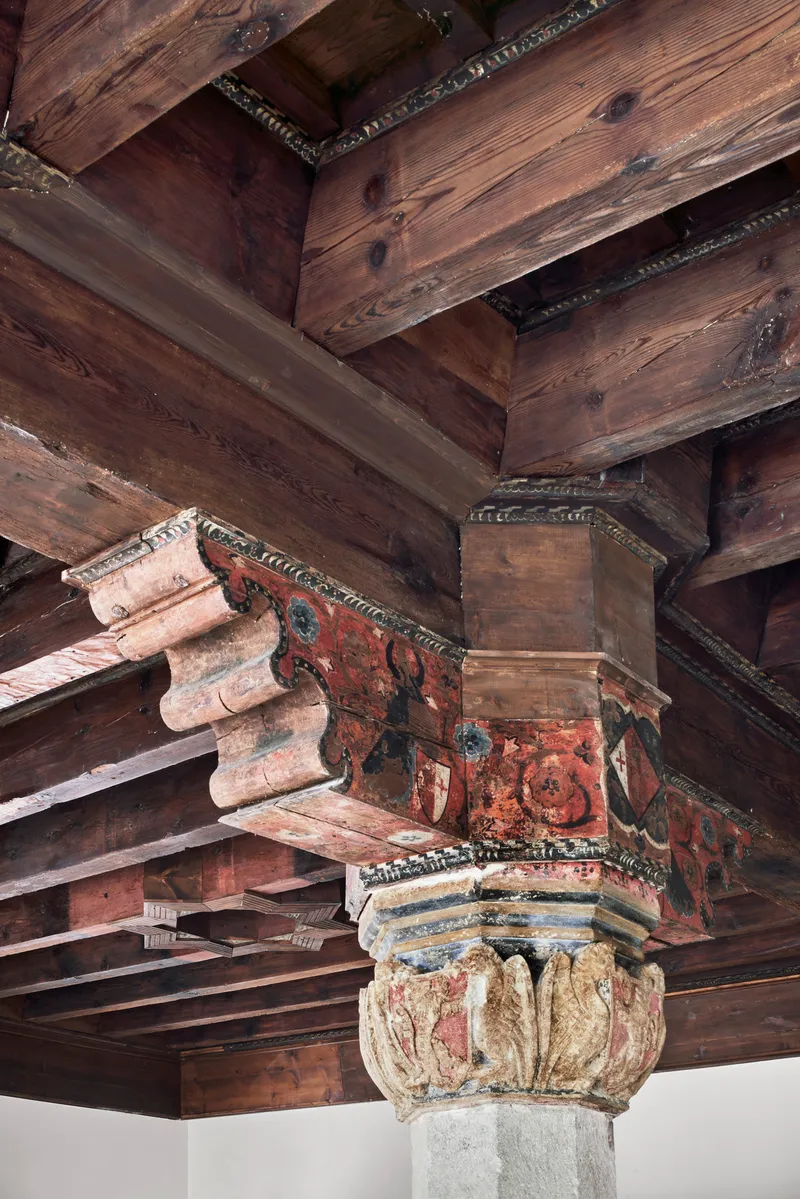
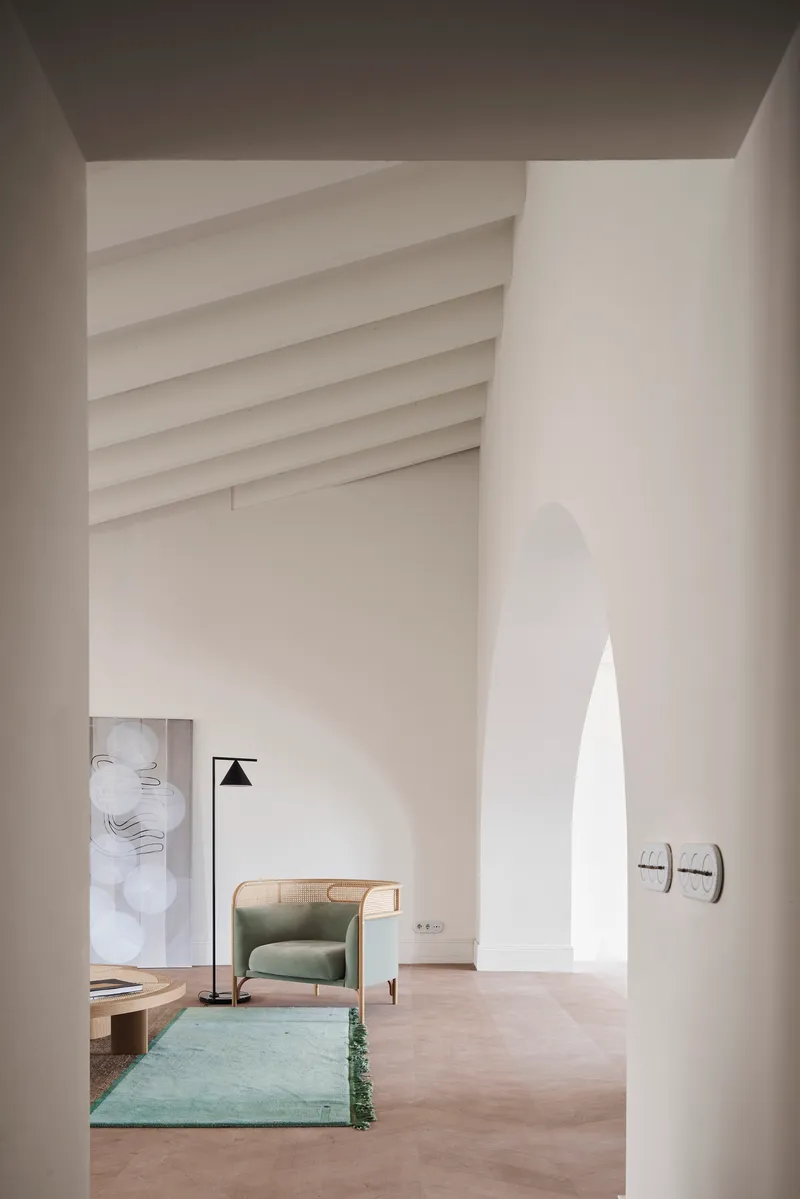
The discovery of a painted medieval coffered ceiling, with red and blue motifs on timber capitals supporting dark wooden beams, changed the trajectory of the project. OHLAB redesigned six apartments and roughly 40 percent of the total area to accommodate these ceilings properly, ensuring they would be visible from the dwellings rather than buried inside partition walls or above false ceilings. That is an expensive and disruptive decision, and it reveals a practice willing to let the building dictate the plan rather than the other way around.
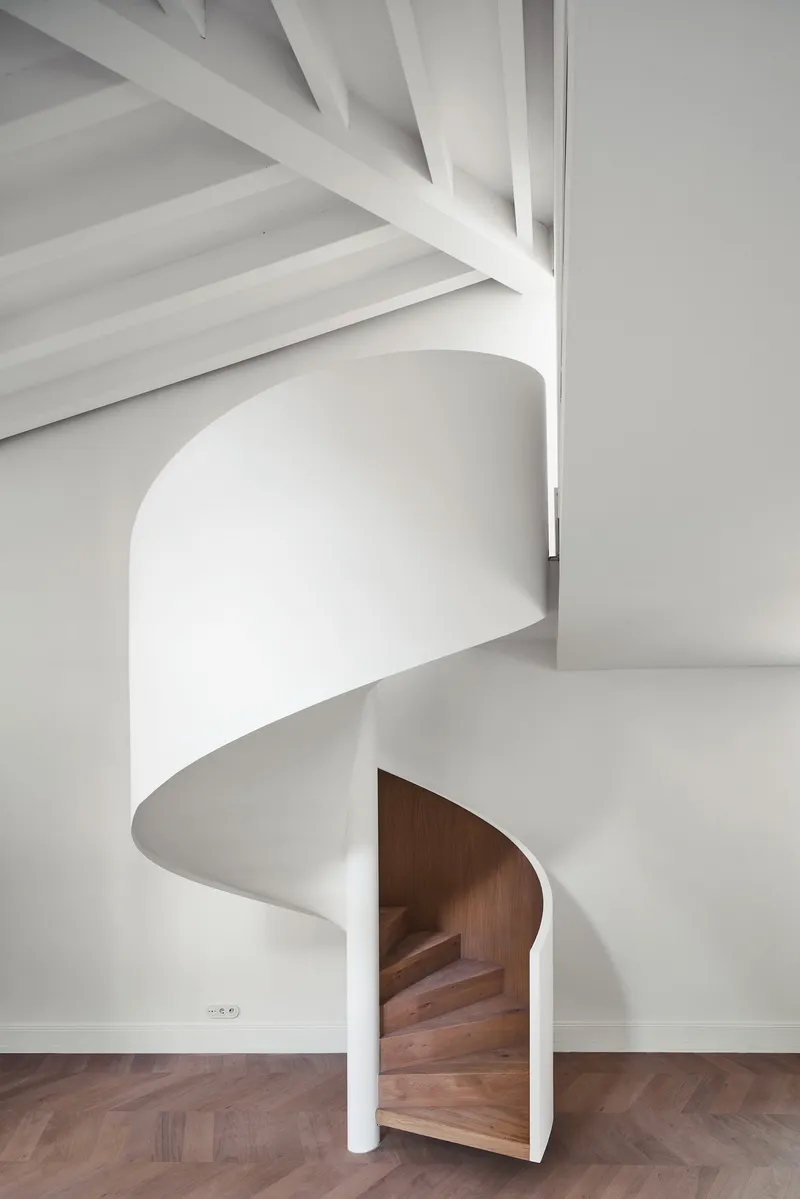
The white spiral staircase, with its clean plaster volume and timber treads, punches through one of these ceiling planes in a way that is deliberately jarring. It reads as a contemporary insertion, not a restoration. Jewish inscriptions found in the old structure add yet another historical layer, reinforcing the argument that the building carries meaning from multiple eras and none should be silenced.
Contemporary Insertions: Mirrors, Volumes, and Contrast
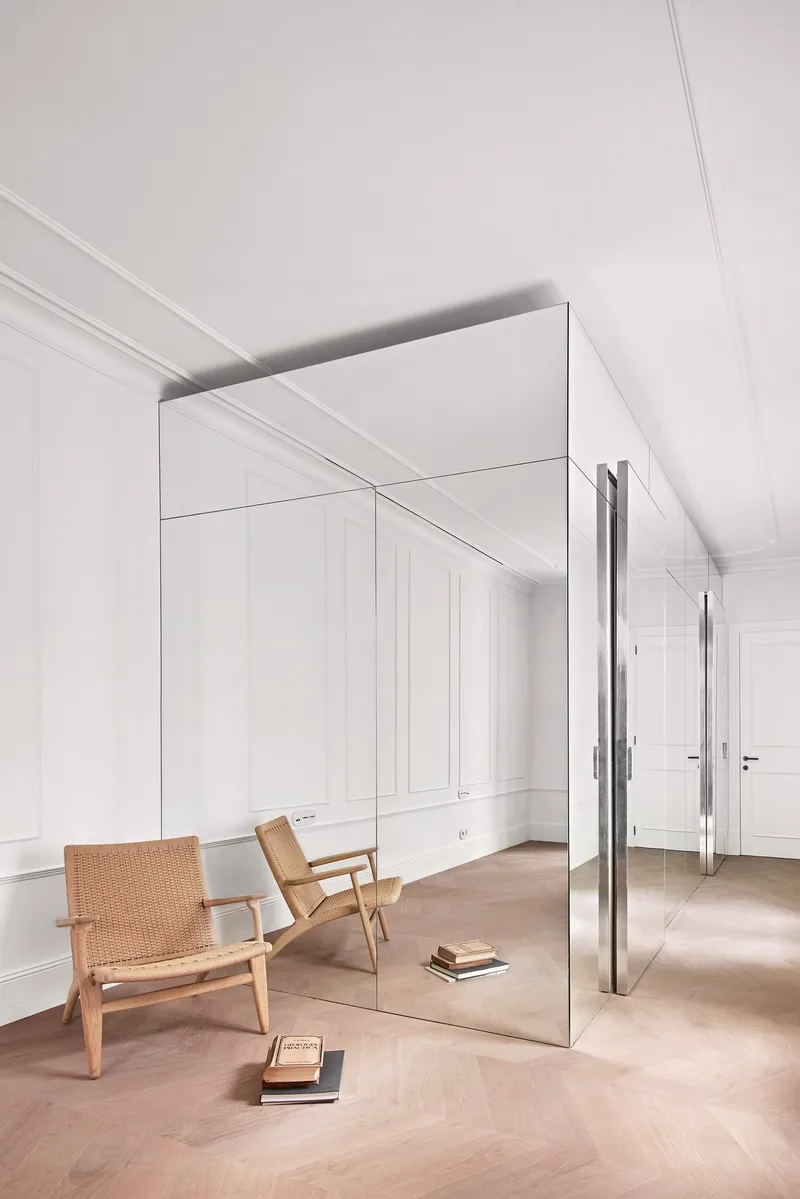
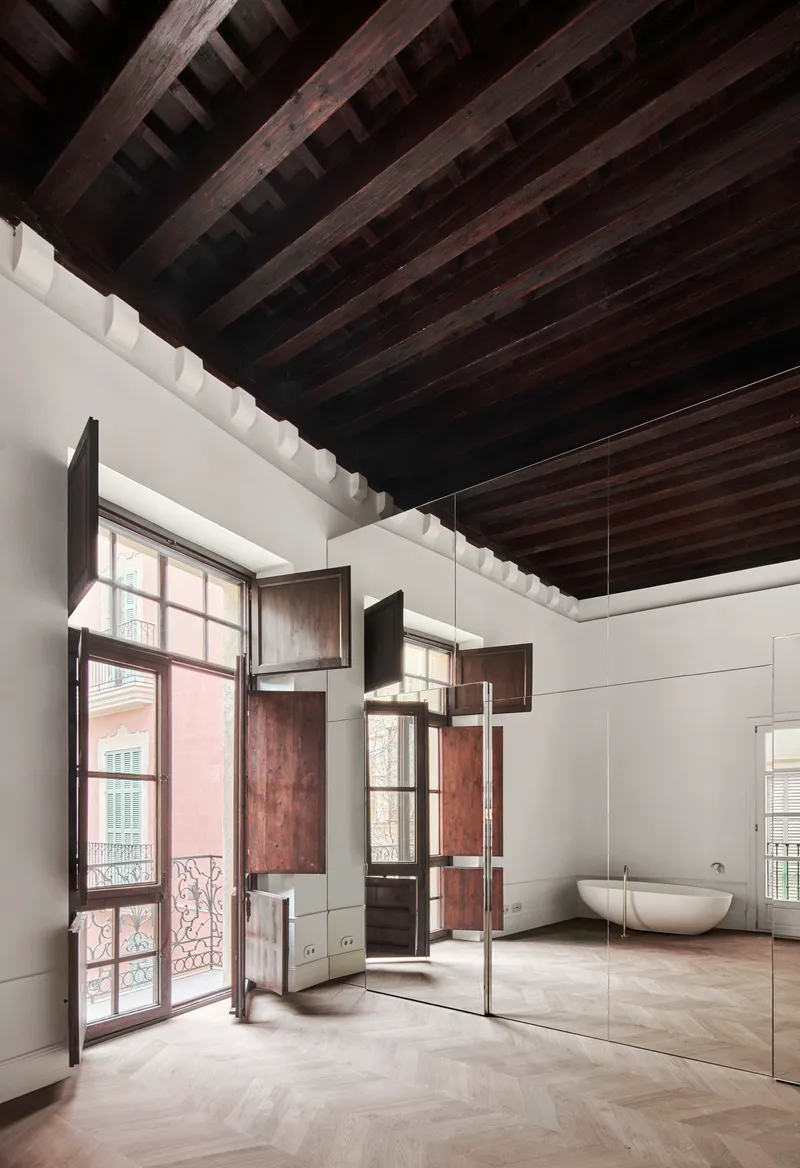
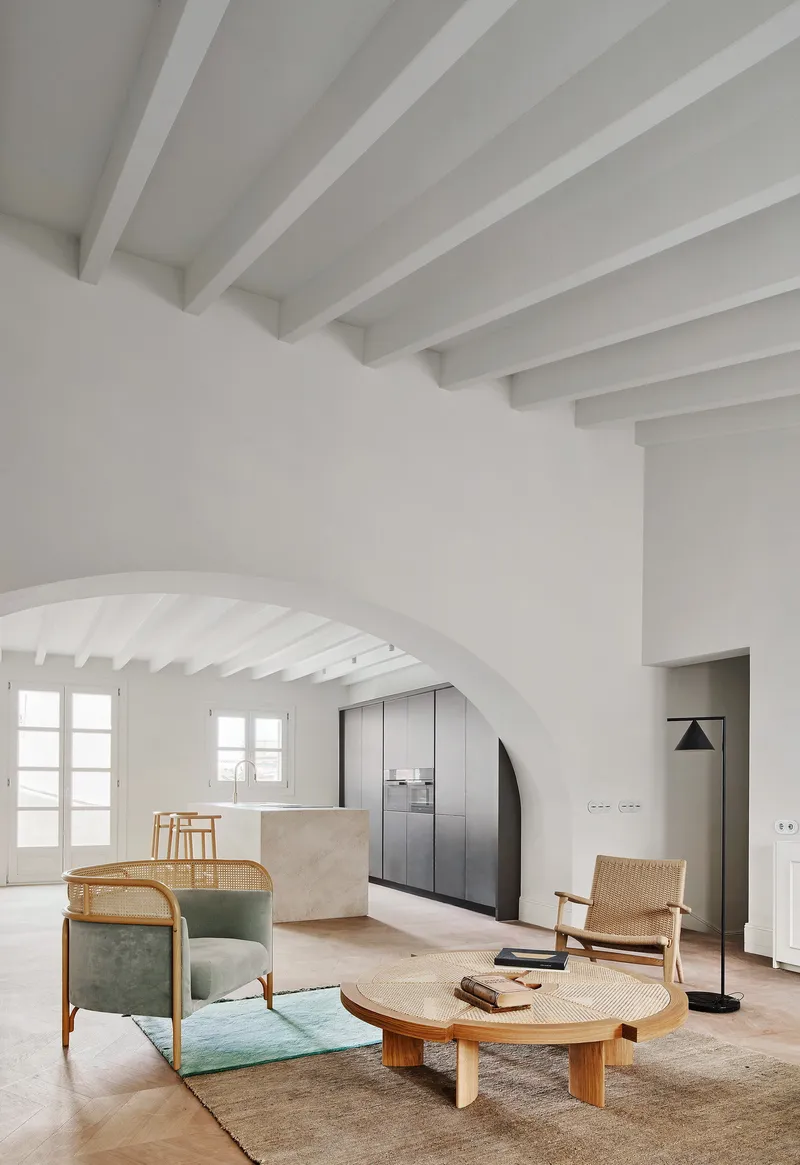
OHLAB's most distinctive move is the use of freestanding mirrored partition boxes inside the apartments. These volumes do not reach the ceiling, preserving the continuity of historic beams and coffered planes above while subdividing the open-plan rooms below. The mirrors amplify the spatial depth of already generous rooms, and their reflective surfaces pick up the texture of herringbone oak flooring, woven chairs, and stone walls without competing with them.
The firm describes these elements as "artistic foreign entities" designed to amplify the characteristics of the traditional architecture rather than mimic them. It is a scenographic strategy, and it works because the mirrored volumes are so plainly modern that there is no confusion about what is old and what is new. That legibility is the project's ethical core: every intervention is honest about its date.
Kitchens, Baths, and Material Restraint
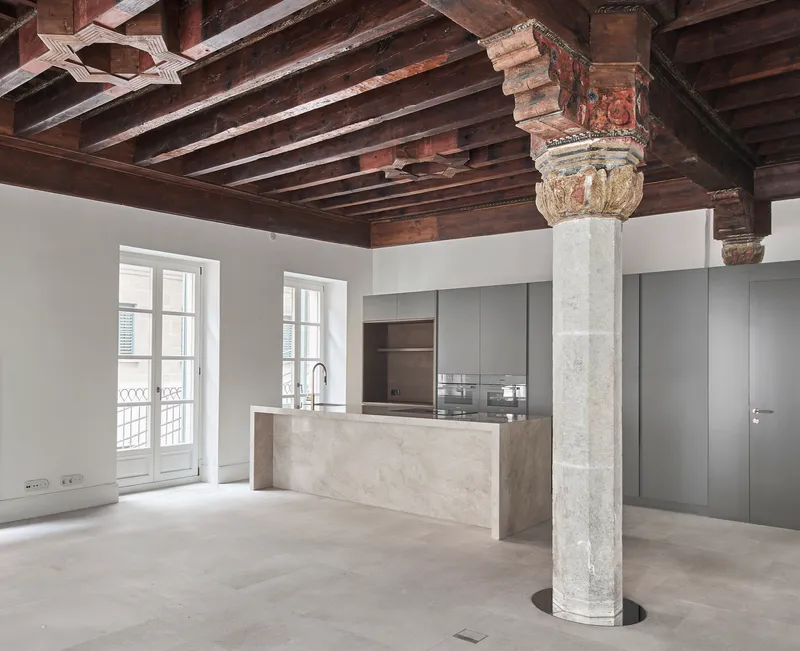
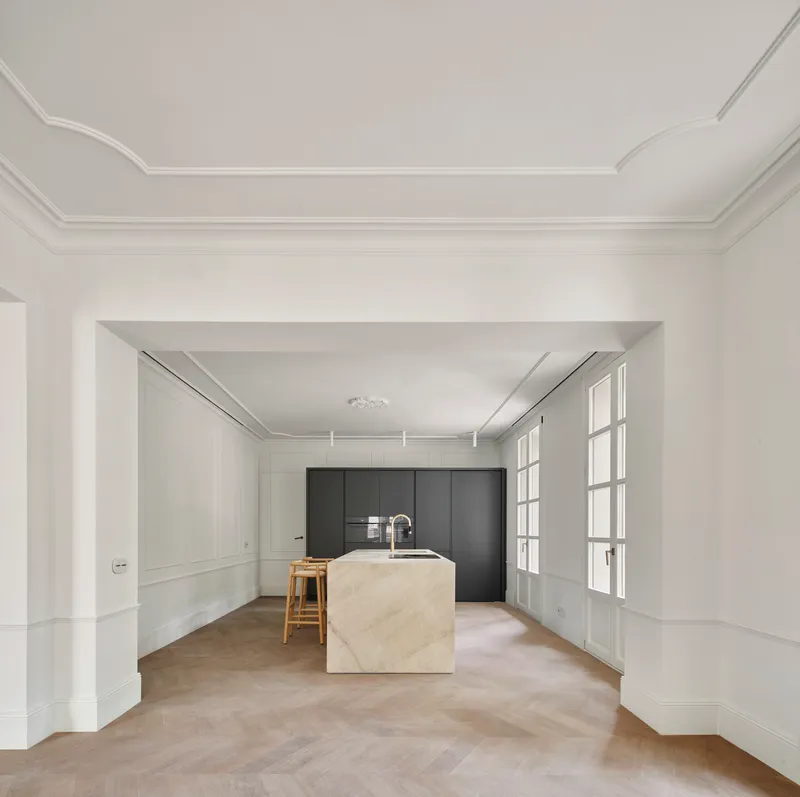
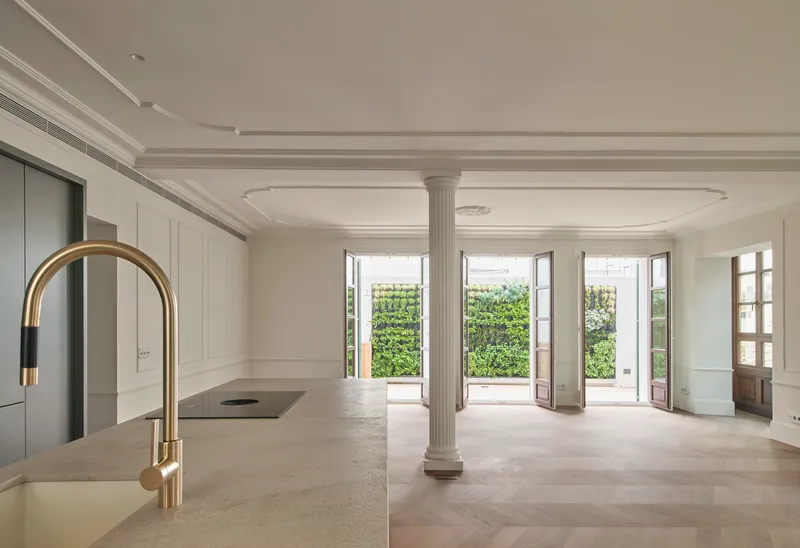
The kitchens demonstrate the palette at its most disciplined. Marble and stone islands, dark or grey cabinetry, and brass fittings sit beneath exposed timber beams and carved stone columns. The material vocabulary, local stone, porcelain, ceramic, and timber, is deliberately Mediterranean without drifting into pastiche. Natural light enters through tall windows and glazed doors, some opening directly onto greenery.
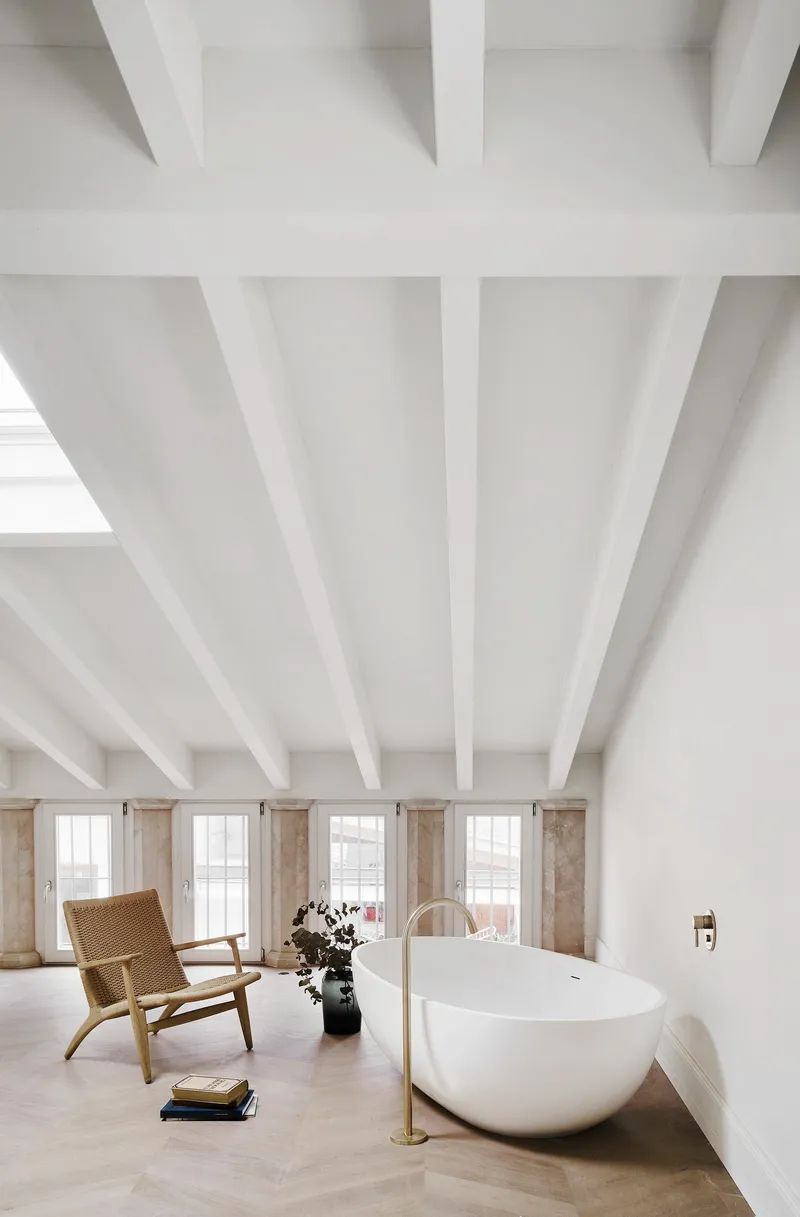
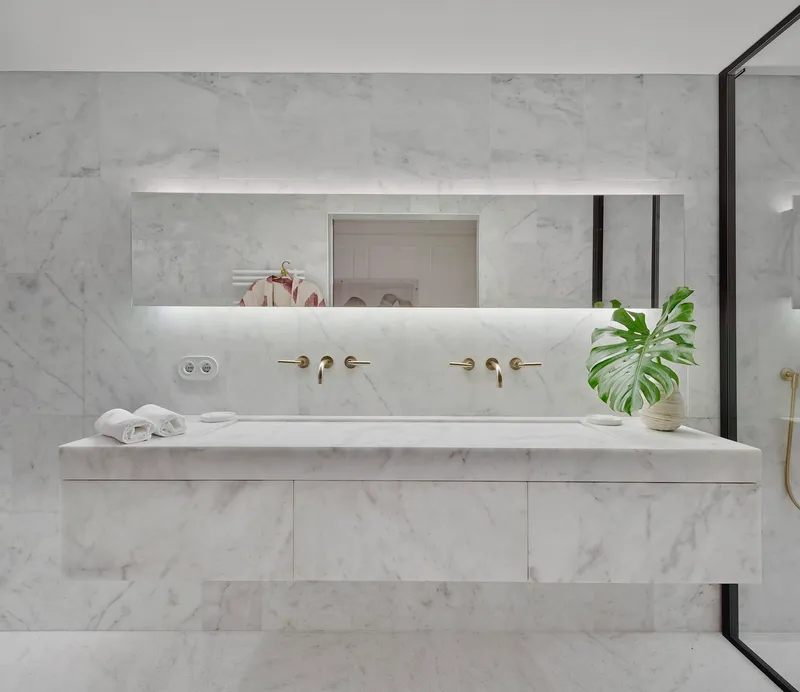
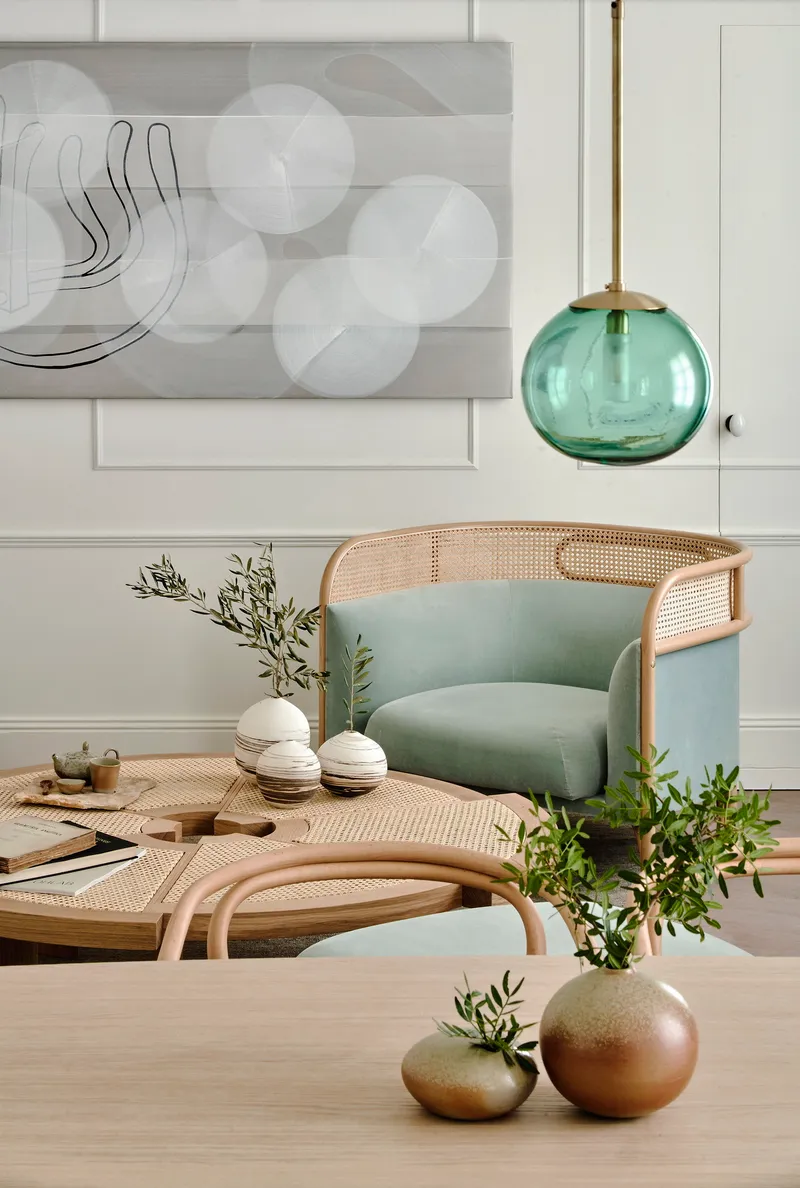
The bathrooms follow the same logic. A freestanding oval tub under white painted beams, a white marble vanity with brass wall-mounted faucets beneath a backlit mirror: these are clean, contemporary fixtures placed inside clearly historic envelopes. Herringbone floors and open timber shutters keep the material continuity with the rest of the dwelling. Local linen and cotton textiles, along with caned furniture, sustain a tactile warmth that prevents the apartments from feeling like museum galleries.
The Pool, the Benches, and Shared Amenities
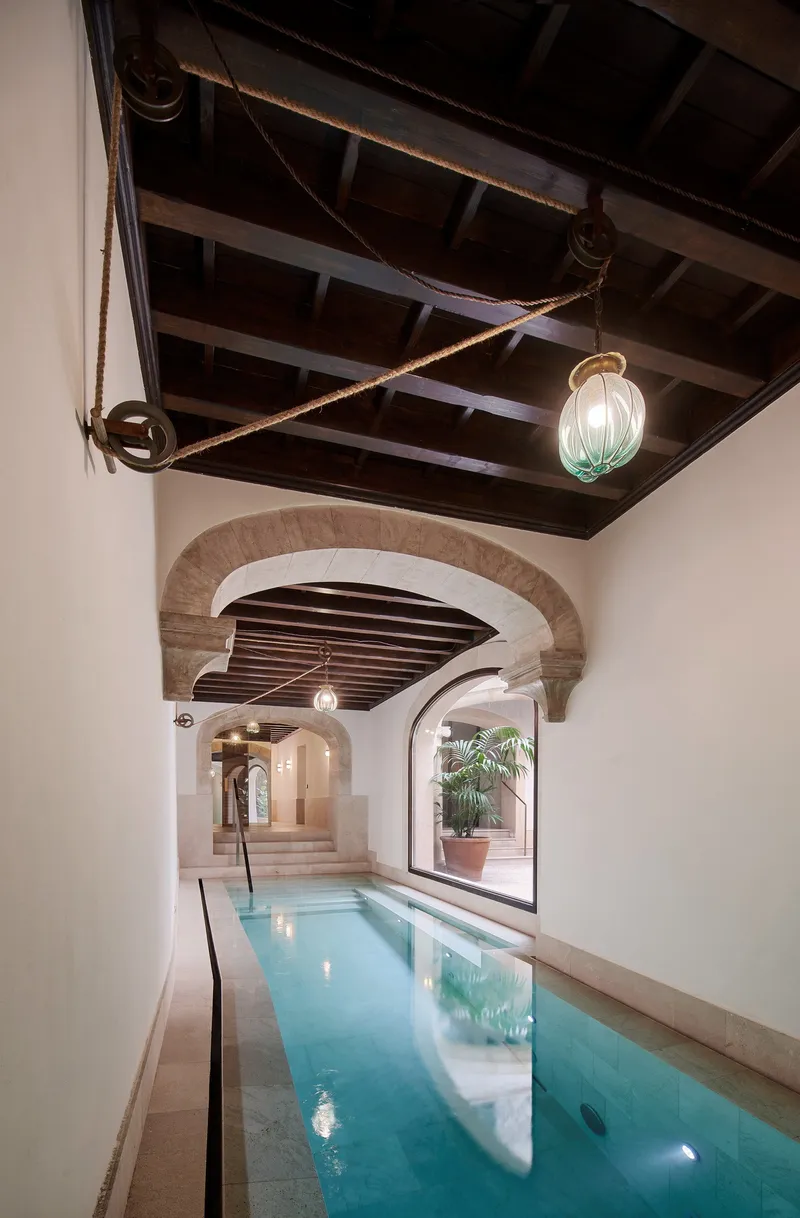
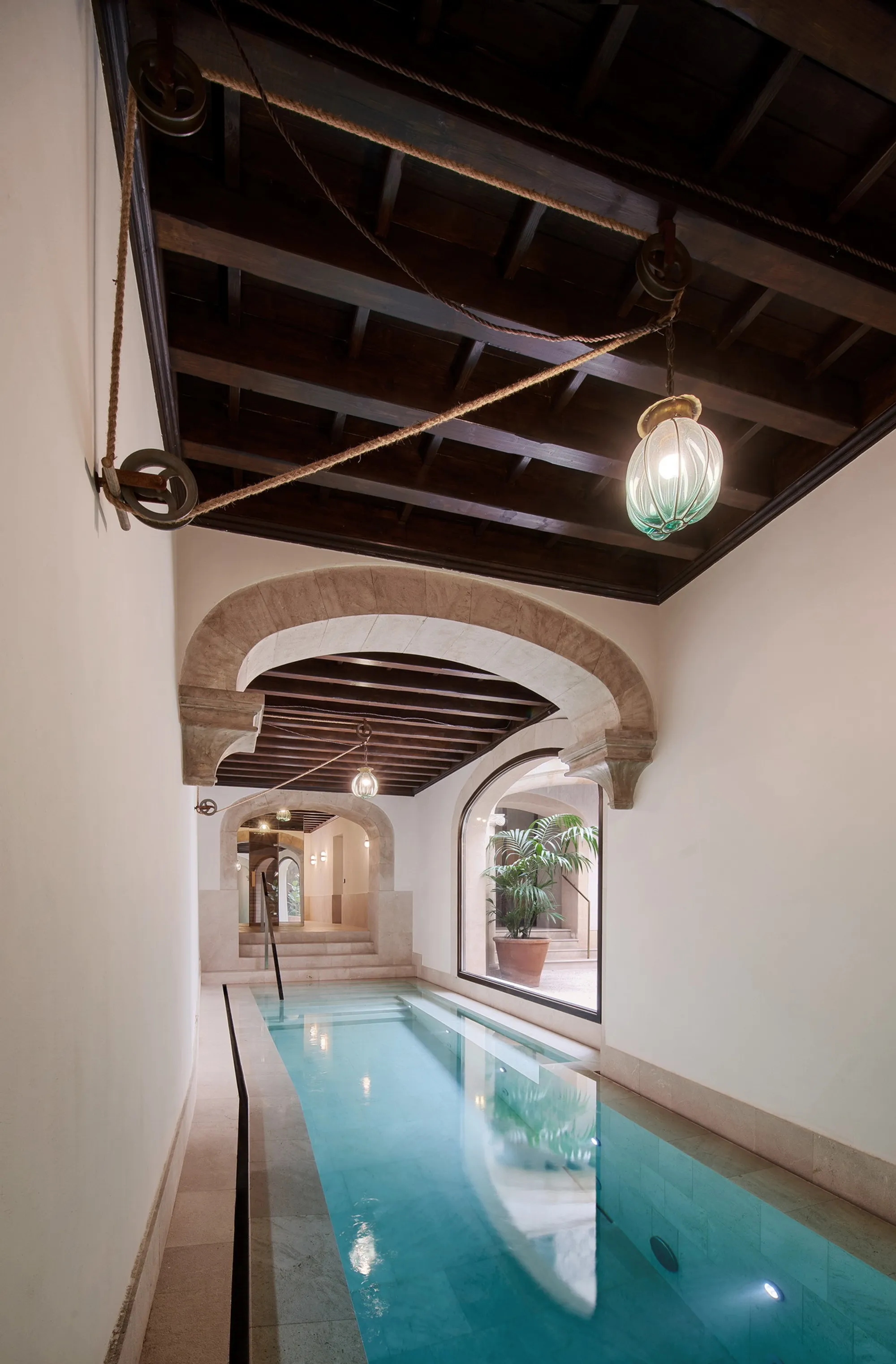
Tucking an indoor lap pool into a vaulted stone corridor is a bold programmatic choice. The pool at Can Santacilia runs beneath stone arches and a dark timber ceiling, with hanging glass pendants casting warm light onto the water's surface. It opens directly onto the main courtyard, connecting the spa to the building's social center in a way that feels like an extension of the ground-floor rooms rather than an afterthought bolted on.
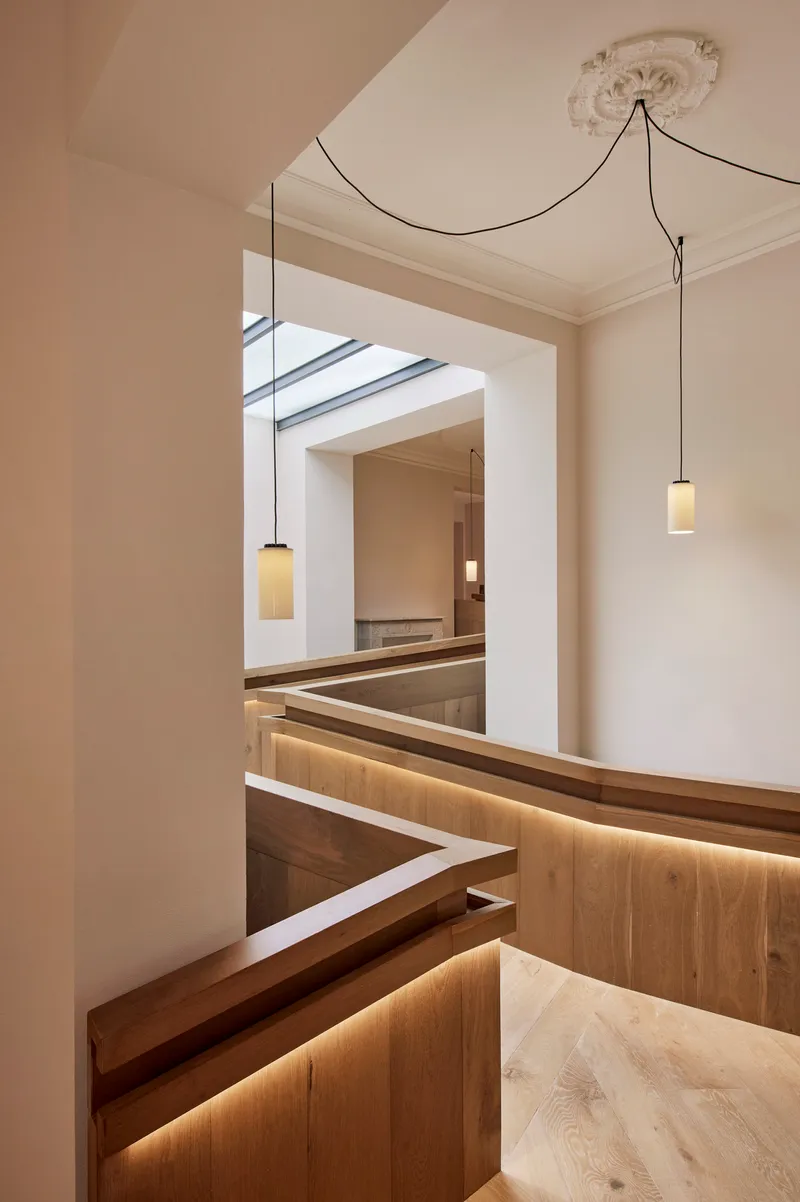
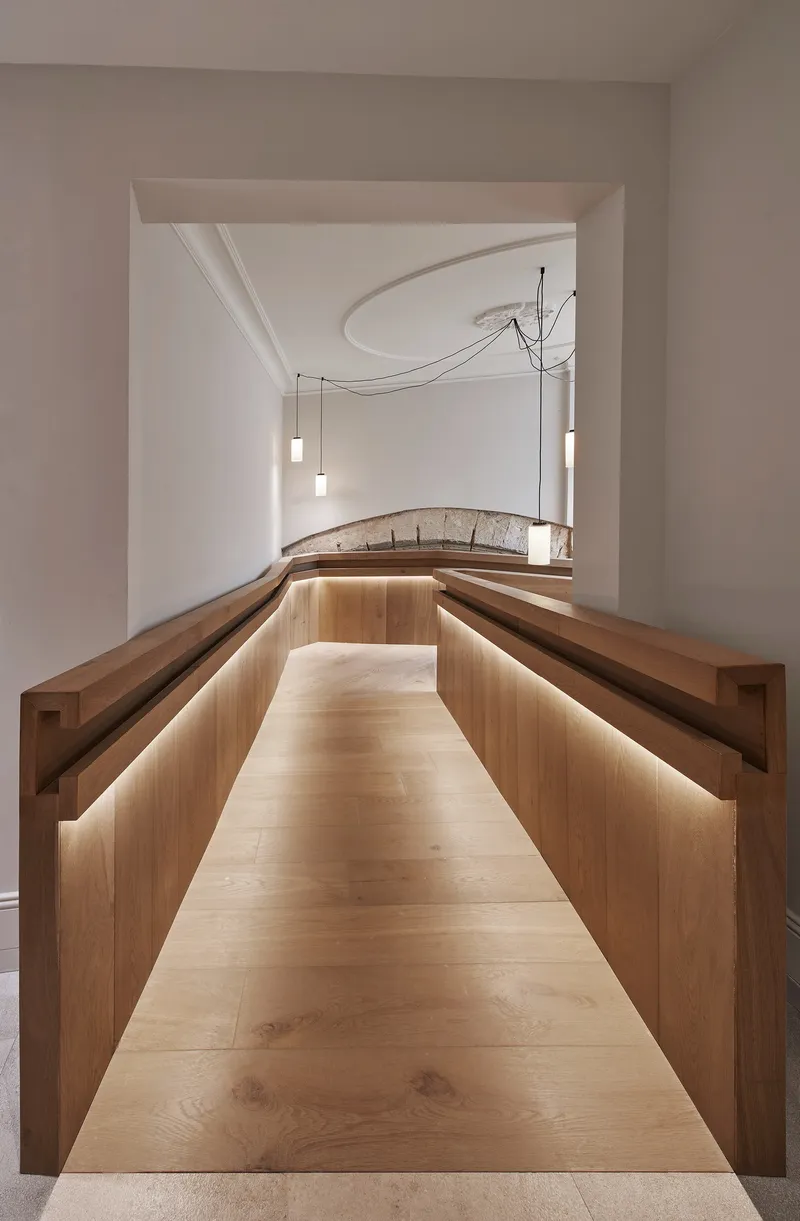
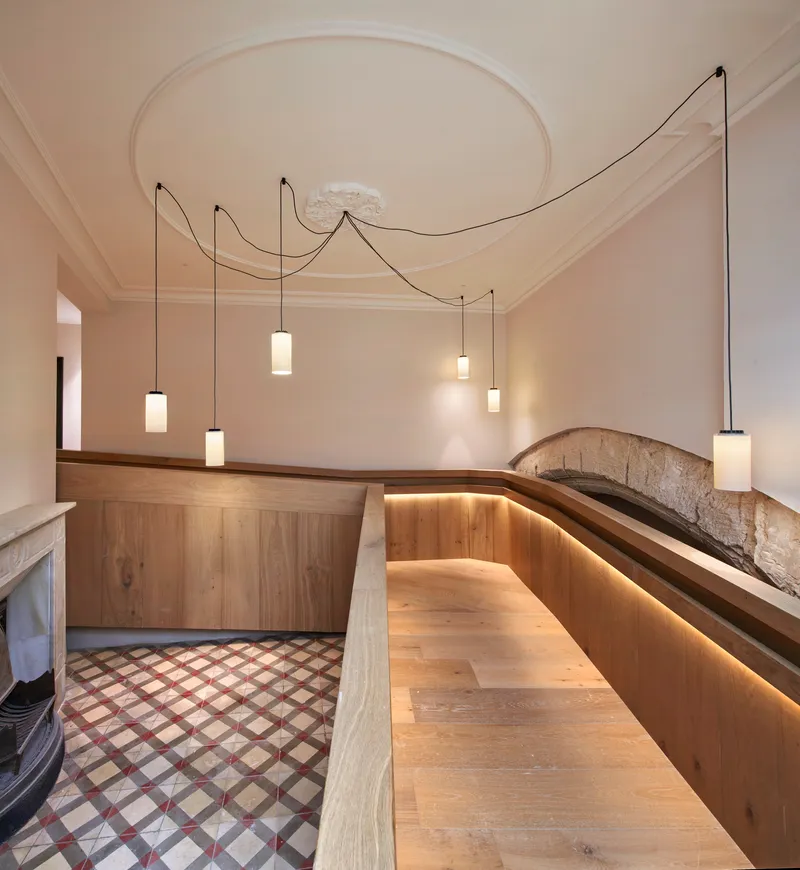
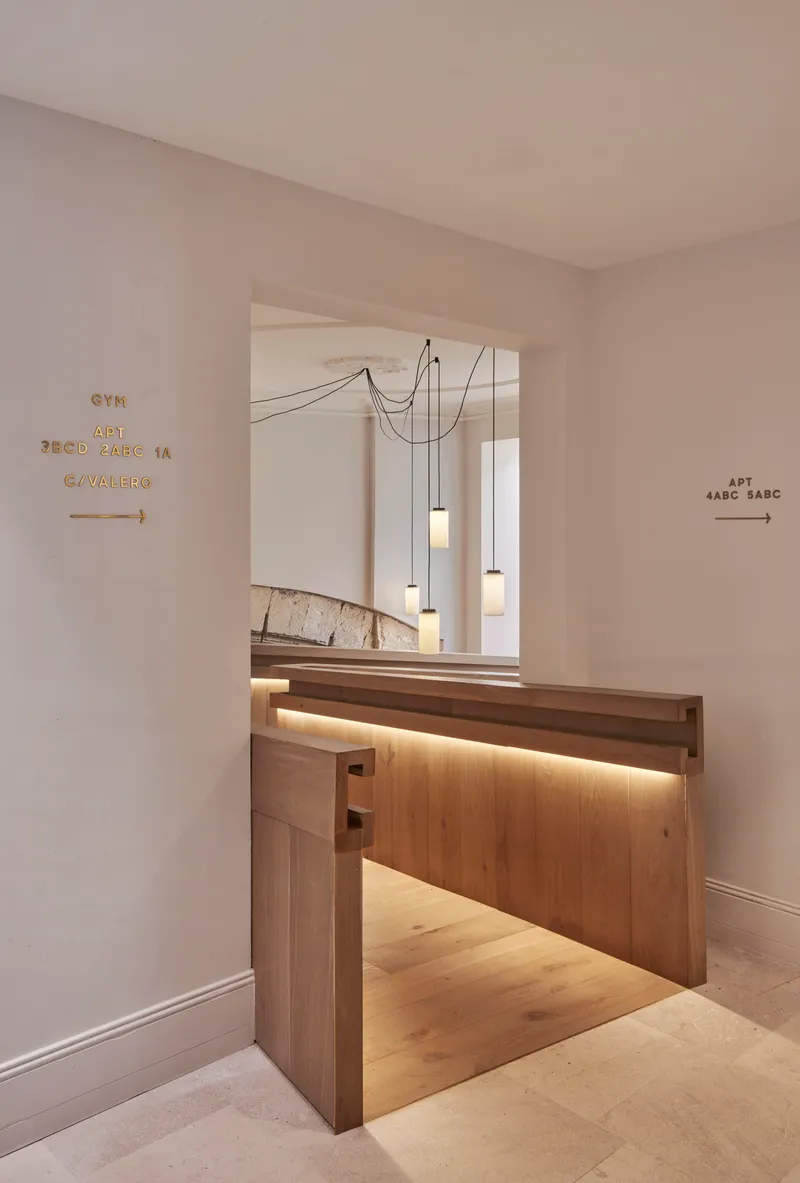
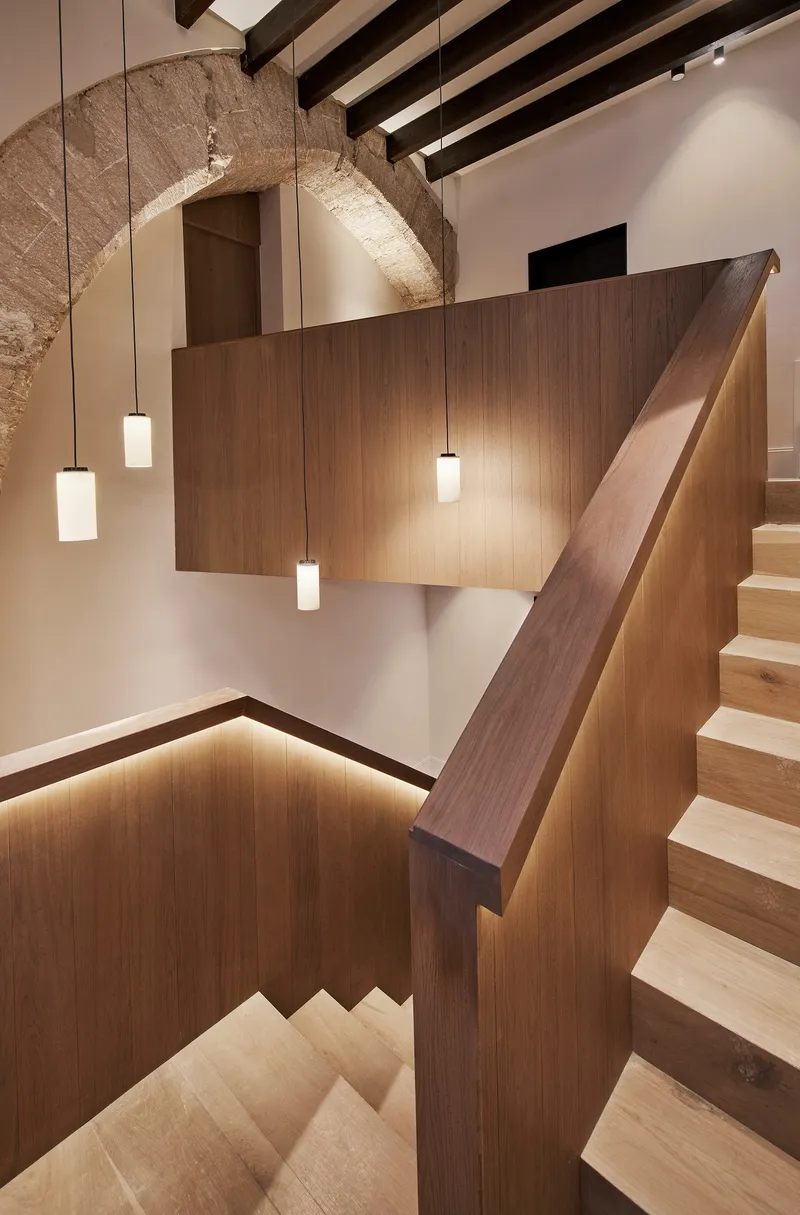
Elsewhere, communal gathering spaces feature timber benches with integrated strip lighting and suspended pendant lamps under curved plaster ceilings. The detailing here, from the reception desk with its directional signage to the curved timber bench below a circular ceiling medallion, suggests that OHLAB treated shared amenities with the same material seriousness as the private dwellings. That consistency is rare in multi-unit residential work.
Rooftop and Terraces
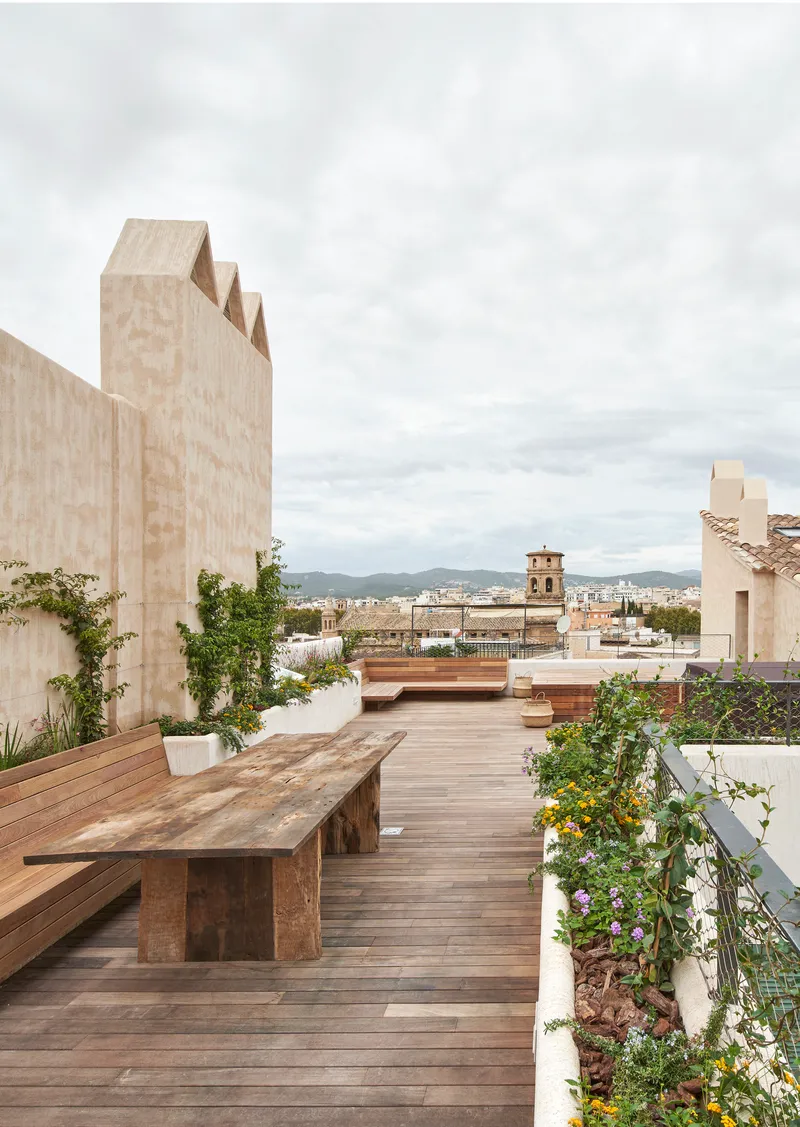
Five terraces serve different homes across the complex, and the rooftop level, with timber decking and planted beds overlooking a bell tower, provides a communal outdoor room that the dense old-town fabric otherwise denies. It is a pragmatic addition, giving residents direct sky access above the tightly packed block, and its planted perimeter softens the transition between the historic roofscape and the new intervention.
Plans and Drawings
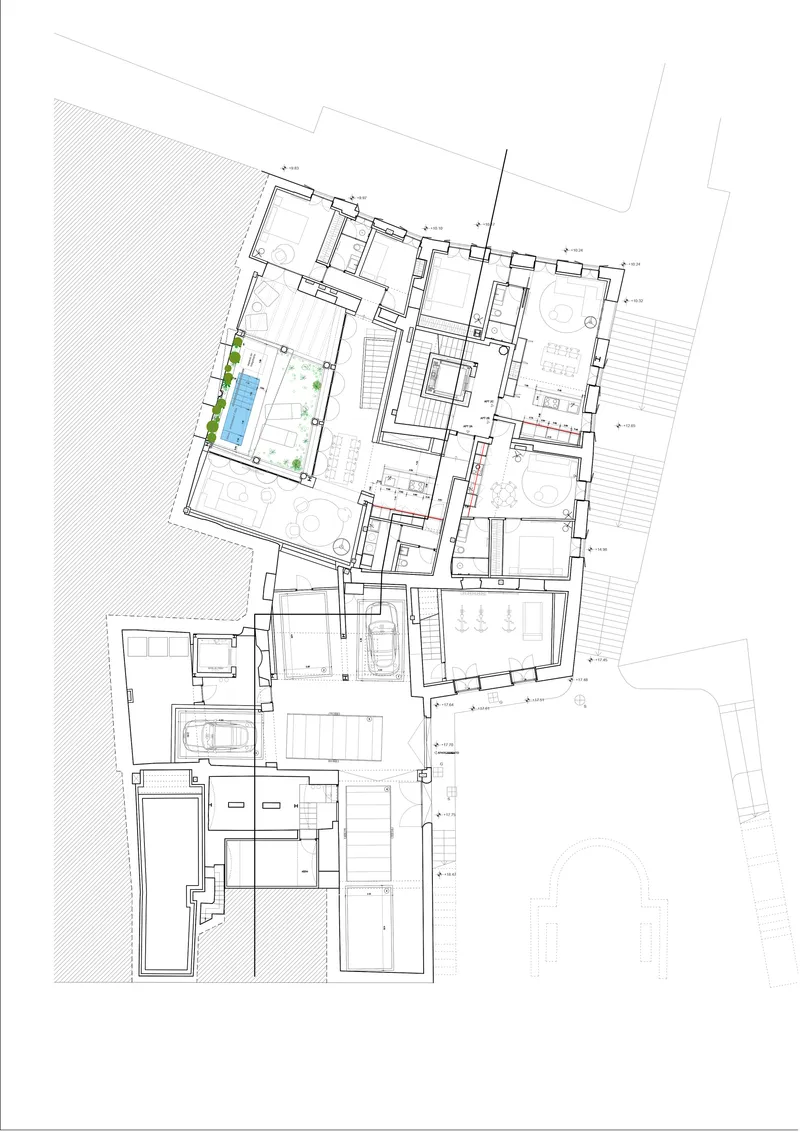
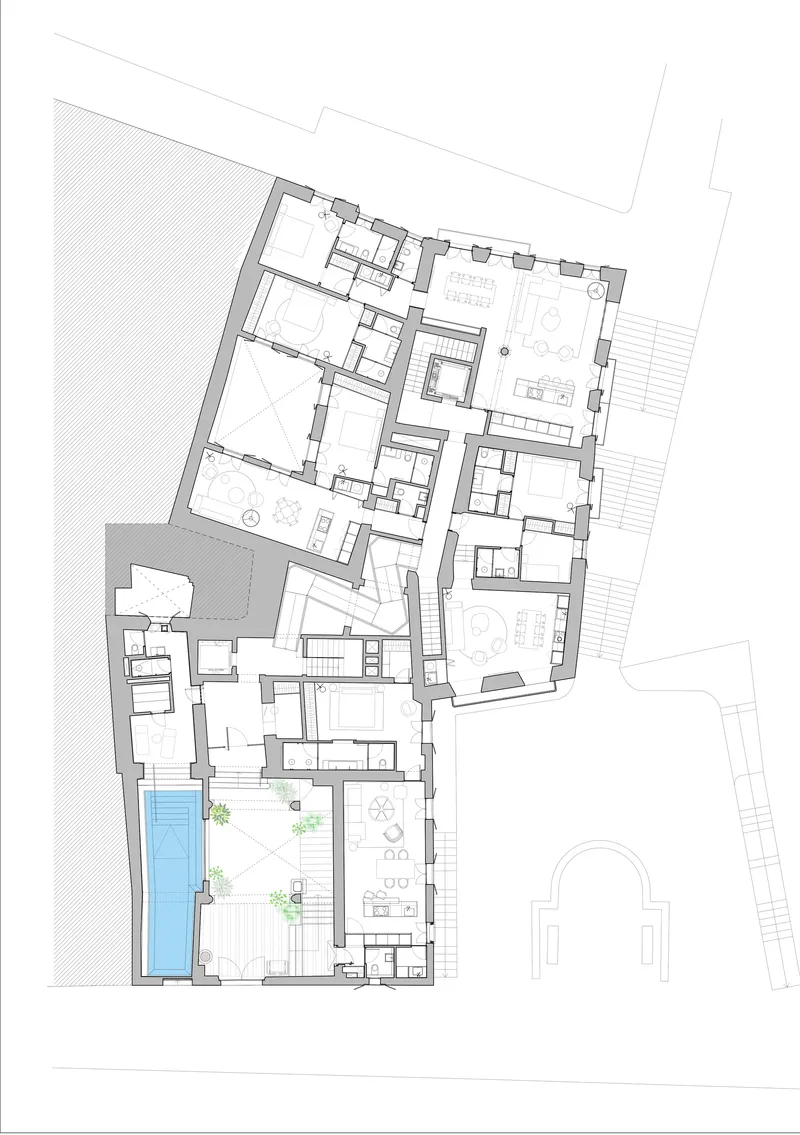
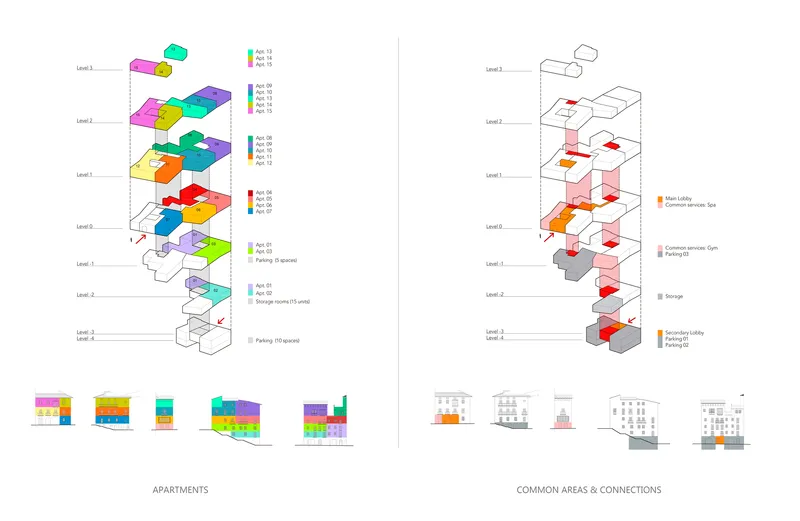
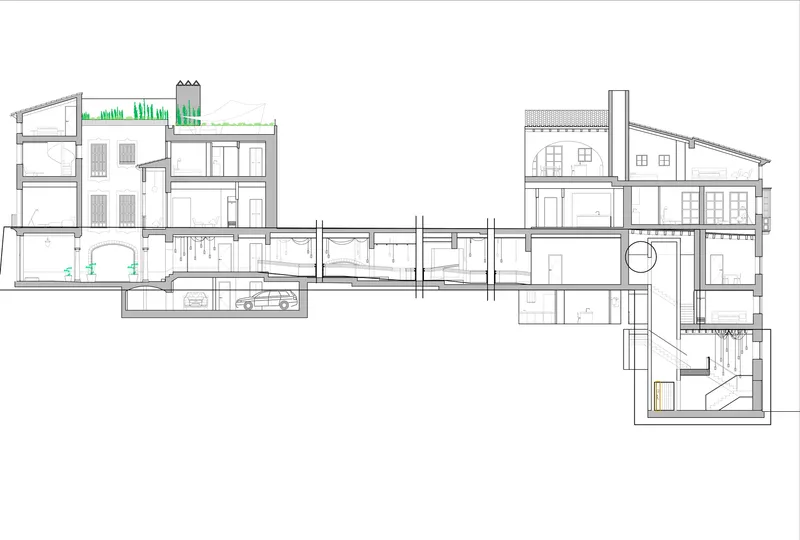
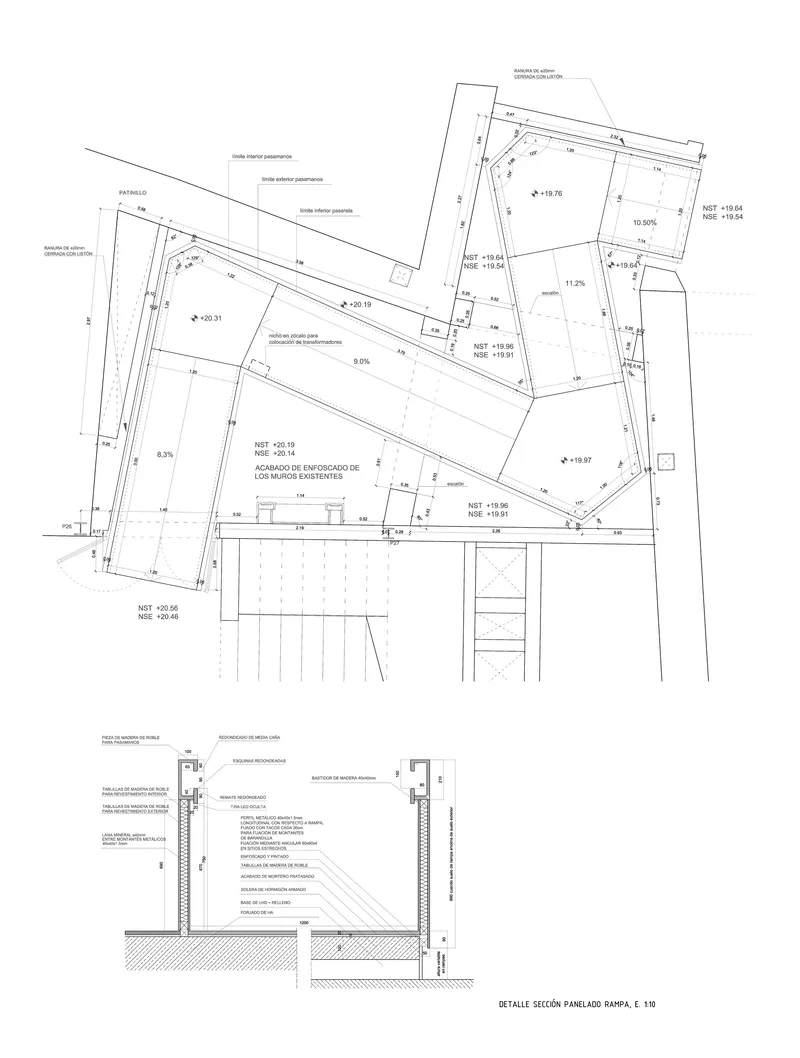
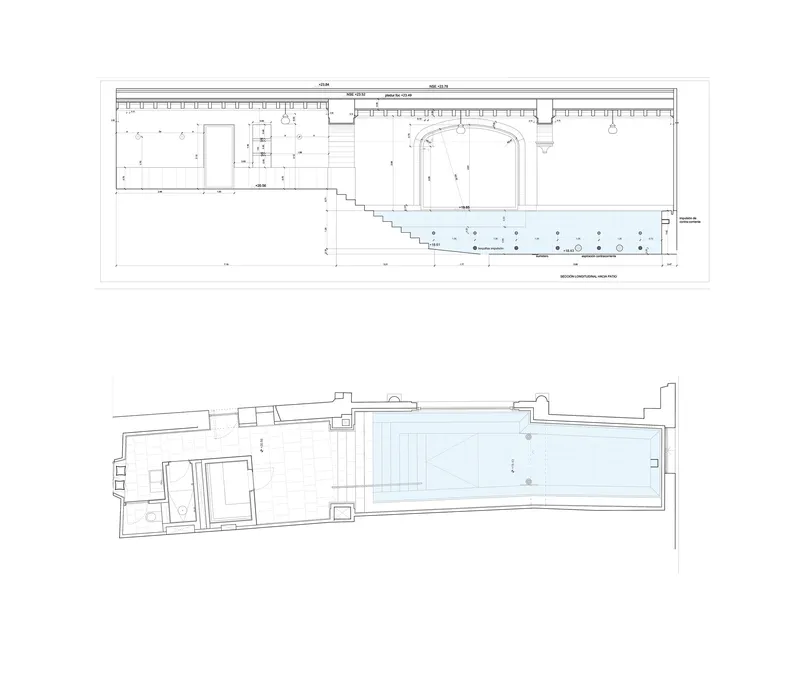
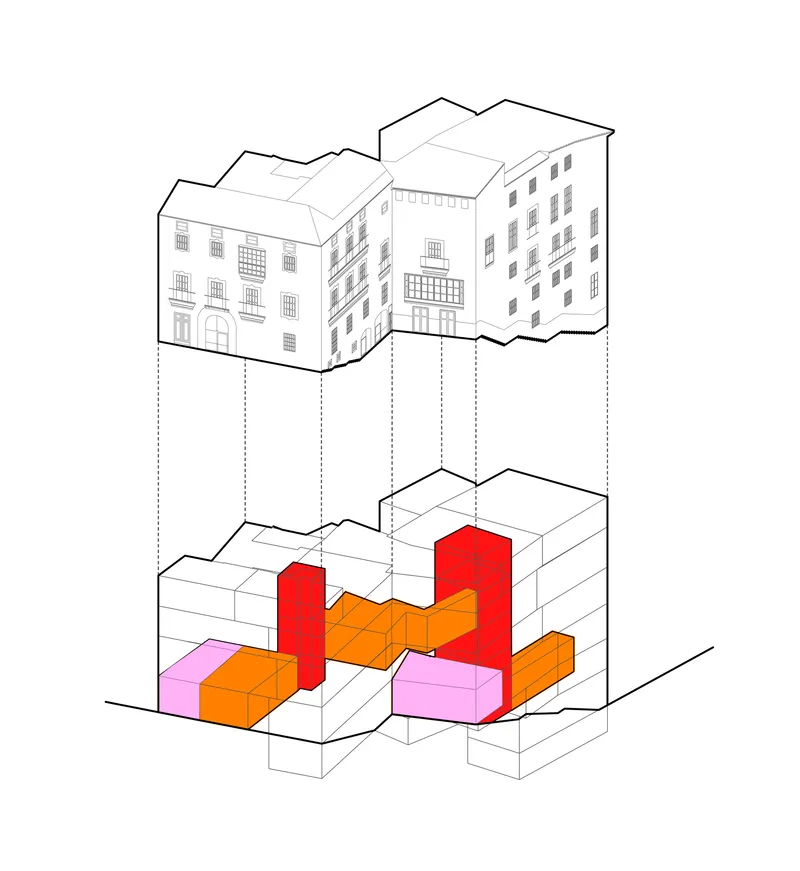
The floor plans reveal the complexity of fitting 15 distinct apartments around two courtyards within an irregular medieval footprint. The exploded axonometric diagrams are particularly useful: color-coded volumes show how apartments stack and interlock across seven levels, with the pool and planted terraces occupying the lower and upper edges of the section respectively. A sunken car park sits beneath the courtyard, solving the parking problem without consuming ground-floor area. The wall section details, annotated in Spanish, show the thermal insulation and bridge treatments that bring the envelope up to contemporary performance standards without altering its external appearance.
Why This Project Matters
Can Santacilia matters because it refuses the two most common approaches to heritage housing: the museum conversion that embalms the past, and the developer renovation that guts everything behind a preserved facade. OHLAB found a third way, one that keeps every century's contributions legible while inserting contemporary elements that are honest about their origin. The mirrored volumes, the white spiral staircase, and the subterranean pool are not compromises. They are arguments for a richer, more layered idea of what a historic building can become.
The willingness to redesign 40 percent of the project in response to a discovered ceiling is the strongest signal. It demonstrates that the practice values the building's testimony over its own design intentions. In a market where Palma's old town is under intense real estate pressure, Can Santacilia shows that density, comfort, and heritage can coexist without any one of them being sacrificed for the other two. That is a lesson worth studying far beyond Mallorca.
Can Santacilia by OHLAB. Located in Palma, Spain. 3,300 m². Completed in 2022. Photography by José Hevia.
About the Studio
Share Your Own Work on uni.xyz
If projects like this are the kind of work you want to make, uni.xyz is a place to publish your own, find collaborators, and enter design competitions.




Popular Articles
Popular articles from the community


Riyadh For All: Intergenerational Urban Design for Active Aging in Rabat
Riyadh For All reimagines urban design in Rabat with intergenerational co-living, adaptive courtyards, and Moroccan cultural exchange today.

Co-Life: Senior Housing Design That Reconnects Older Adults With the City
Co-Life reimagines senior housing design through healing gardens, shared streets, workshops, and a sustainable community across generations.

Conexión: Biophilic Design Reimagines High-Rise Living in Hong Kong
Conexión reimagines high-rise living in Hong Kong through biophilic design, green facades, shared spaces, daylight, water and nature within.

Hill & Cross Opera: Sculptural Opera House Architecture Shaped by Tallinn’s Landscape and Identity
Hill & Cross Opera reimagines opera house architecture in Tallinn through its sculptural hill, civic plaza, glass wave and a luminous cross.


Similar Reads
You might also enjoy these articles

Bao Huynh Watercolor Atelier: A Serene Art Retreat in Hội An
Bao Huynh Watercolor Atelier in Hội An blends multifunctional art spaces, sustainable design, local materials, and family-friendly living in a serene environment.

Atelier Macri Concept Store Interior Design by CASE-REAL
Atelier Macri store features a "ko" counter, walnut wood details, cork displays, blending retail, gallery, and seamless customer experiences.

Manuel Vargas Izquierdo Stadium and High-Performance Sports Center: Architectural Excellence in Jalpa de Méndez
The Manuel Vargas Izquierdo Stadium blends sustainable design, inclusive sports facilities, and cultural-inspired architecture, revitalizing Jalpa de Méndez’s public spaces.

KAKR Buluh Awar Hall: Revitalizing Community and Ecology Through Bamboo Architecture
Community built bamboo hall revitalizes Buluh Awar village, empowering youth, restoring ecology, celebrating vernacular craftsmanship through sustainable architecture and culture.


Explore Architecture Competitions
Discover active competitions in this discipline



Challenge to reimagine the Iron Throne


Photograph architecture without architects


Illustrate the lost glory of Angkor Wat - Render Challenge


Design challenge to reuse E-waste
Comments (0)
Please login or sign up to add comments
No comments yet. Be the first to comment!