

One-Stop Crisis Centre: Trauma-Informed Architecture That Turns Space into an Agent of Healing
A rehabilitation centre in Pune's Yerwada uses a privacy gradient, circular courtyards and counselling pods to restore survivors' sense of control.


Most institutions that receive survivors of sexual violence are built around paperwork: corridors, waiting benches, fluorescent intake rooms. They process people. The One-Stop Crisis Centre starts from the opposite premise, that the building a survivor walks into is part of the treatment, and that a wall, a threshold or a shaded bench can either deepen fear or begin to dissolve it. The project treats trauma-informed architecture as a working method rather than a slogan, translating anxiety, loss of control and social withdrawal into concrete spatial decisions about enclosure, light and choice.
Developed by Mehzabeen Sayyed, the proposal responds to a crisis the designer frames bluntly: in India, crimes against women are reported every few minutes, and support rarely extends beyond immediate medical or legal intervention. Sayyed sites the centre in Pune's Yerwada precinct, a location chosen through data-driven mapping of reported cases and proximity to hospitals, police stations and public infrastructure. The ambition reaches past a single building. The centre is pitched as a prototype, replicable across urban and rural India, and organised around four pillars: prevention, advocacy, rehabilitation and reintegration.
Curves That Enclose Without Confining
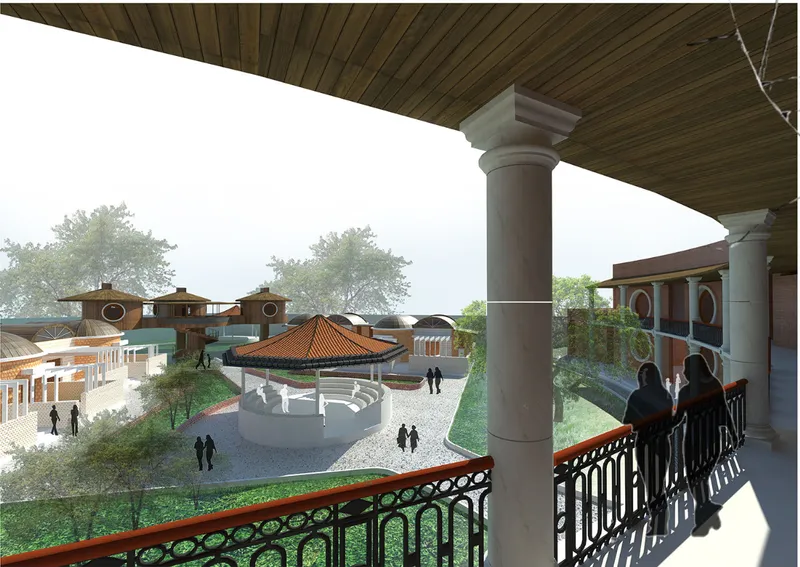

The first impression is one of softness. From a curved upper balcony, stone columns and an iron railing frame a gravel courtyard, a gazebo and a small amphitheatre where people move freely below. At ground level, a curved colonnade of stone columns runs along a brick wall punctured by round windows, edged by a planted water bed and a strip of pebbles catching the sun. Nothing here reads as a clinic or a police annexe, and that is the point: the design deliberately dissolves the boundaries of formal institutions into an informal, human-scaled setting.
The geometry carries real weight. Sayyed describes the psychological rehabilitation block as a calm, circular composition that emphasises continuity and enclosure without confinement. A curve has no dead ends and no hard corners to back into; it holds a courtyard the way cupped hands hold water. The balcony view also matters for a less obvious reason. Being able to observe a space before entering it gives a survivor time to decide, and the upper gallery offers exactly that vantage.
Counselling Pods as Non-Clinical Rooms

The presentation board is where the project's thinking becomes most legible. Elevations and sections sit alongside plans and an axonometric of the individual counselling pods, with construction details for a PET bottle wall, above a rendering of small domed pods with people walking between them. Scale is the key move. Rather than placing therapy in a row of identical offices off a corridor, Sayyed gives each session its own intimate, freestanding volume, closer to a hut in a garden than a consulting room.
Around the pods, semi-shaded transitional areas, pergolas and green buffers slow the movement between inside and outside, so no one is pushed abruptly from open sky into a closed room. Natural light, cross-ventilation and visual links to landscape help regulate sensory input. The designer's phrase for this is architecture as a silent therapist: supportive, non-intrusive and reassuring. It is a fitting description of buildings that do their work by withholding pressure rather than asserting presence.
A Privacy Gradient That Lets Survivors Choose

A two-storey brick arcade with white columns and circular windows curves around a lawn courtyard, facing a tiled-roof pavilion under open sky. This image captures the master plan's organising logic: a clear hierarchy of public, semi-public and private zones. Advocacy offices, workshops and community interfaces form the public edge; counselling, medical aid and rehabilitation facilities occupy the semi-public middle; shelter homes and personal healing spaces sit in the most protected layer.
The value of this gradient is autonomy. Sexual violence strips away control, and a building that forces everyone through the same sequence repeats that loss in miniature. Here, a survivor can engage with a workshop, retreat to a pod or withdraw to private quarters, choosing the level of exposure that feels bearable on a given day. The arcade itself performs this role at small scale, a covered edge where one can be near the courtyard without standing in it. At the neighbourhood level, the same restraint keeps the complex from signalling its purpose to passers-by, avoiding visual stigmatisation while staying approachable.
Shelter Clusters Built Around Shared Ground

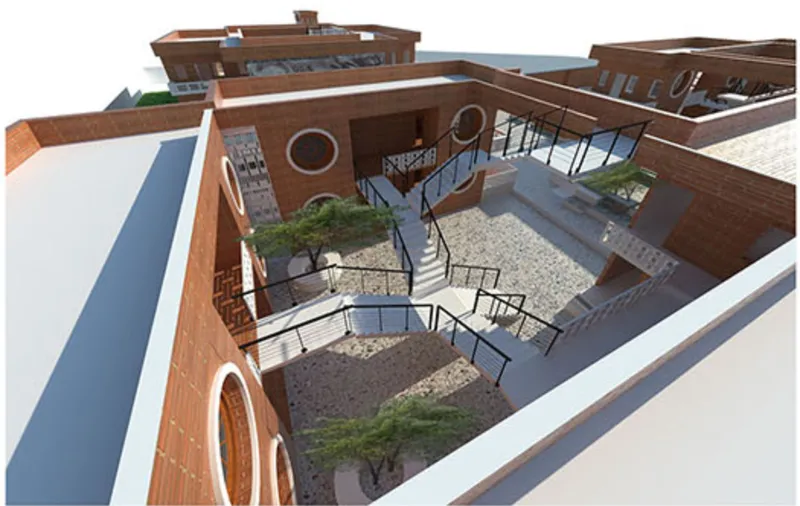
The residential blocks shift the register from treatment to daily life. Brick housing with white balconies rises above a stepped lawn courtyard planted with young trees and threaded by a gravel path, while a stone wall covered in graffiti adds a note of expression and occupation that sterile institutions rarely allow. From above, another courtyard reveals zigzag steel-railed stairs, a gravel floor, potted trees and round windows repeating the motif seen throughout the scheme.
Sayyed organises the shelter housing into modular clusters for distinct user groups: single women, women with children and minor survivors. Each module pairs a private living unit with shared community space, recognising that recovery needs both a door that locks and a common room where trust can be rebuilt slowly. The courtyards make that pairing spatial. Balconies and stairs look onto shared ground, so company is always visible and available, but never compulsory.
Why This Project Matters
Trauma-informed design is often discussed in policy documents and rarely drawn with this much specificity. Sayyed's contribution is to show what the principles look like as plans, sections and courtyards: a circular block that holds without trapping, pods scaled for one conversation, a zoning hierarchy that hands control back to the user. The project argues convincingly that dignity is not a finish applied to a functional building but a property of how rooms are sequenced and how thresholds are crossed.
Its framing as a prototype is equally significant. By grounding the Yerwada site in mapped case data and access to hospitals and police, and by structuring the programme from prevention through reintegration, the proposal sketches a model that could travel to other Indian cities and towns. For a young designer, choosing a subject this difficult and answering it with restraint rather than spectacle is a mark of maturity. The building does not ask survivors to admire it; it asks only that they feel safe enough to stay.
View the Full Project
About the Designers
Designer: Mehzabeen Sayyed
Enter a Design Competition on uni.xyz
uni.xyz runs architecture and design competitions year-round that reward proposals with spatial conviction and real site intelligence.
Project credits: One-Stop Crisis Centre: A Rehabilitation for Rape and Sexual Violence Survivors by Mehzabeen Sayyed.


Popular Articles
Popular articles from the community


Architekt Andreas Gruber Scatters 23 Dark Timber Chalets Across a South Tyrolean Forest Edge
In Molini di Tures, Amonti Chalets breaks a resort into a hamlet of gabled timber houses, with parking, storage and services pushed into the slope.

GROUP A Strips a 1969 Rotterdam Harbor Headquarters to Its Frame and Wraps It in Timber Louvers
In Rotterdam's M4H harbor district, Ferro Offices reuses a 1969 frame, adds one timber storey and reaches BREEAM-NL Outstanding.

David Macias Steps a Doorless Stone and Plaster House Down a Tropical Colombian Hillside
In the humid hills of Colombia, Threshold House replaces the front door with an open void and terraces its 850 m² down the slope instead of fighting it.

Jaramillo Van Sluys Arquitectura and Urbanismo Turn a Demolished Registry Lot in Quito into an Orchard Plaza
In Quito's Centro Histórico, a 2,800 m² plaza exposes the San Agustín convent wall and redraws its lost Augustinian orchard in volcanic stone.

Similar Reads
You might also enjoy these articles
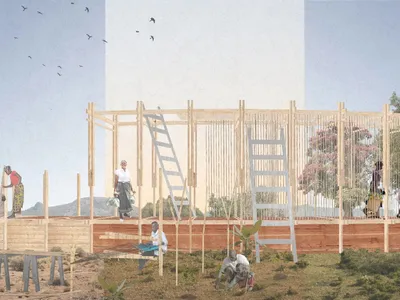
Healing Façade: A Modular Chapel System That Restores Ethiopia's Sacred Forests
Winner of the Eco-Chapel competition, this circular timber façade collects water from air to rebuild soil and reforest degraded Ethiopian landscapes.
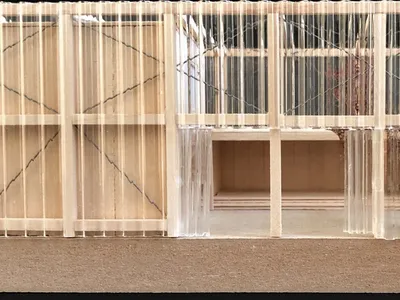
Kaffeebühnen: Where Coffee Shop Architecture Becomes a Civic Stage in Vienna
A linear sequence of timber boxes, transparent shells, and open yards turns the Viennese café tradition into a public performance space.
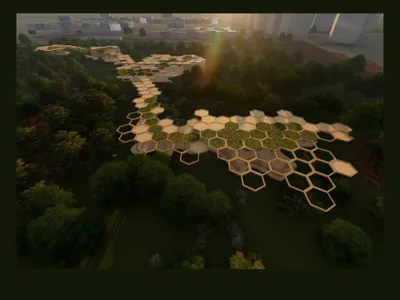
Eco Chapel: A Modular Forest Pavilion That Grows Like the Landscape It Protects
Hexagonal timber modules weave through existing trees, turning a chapel into a living system for prayer, education, and reforestation.


Urban Forest: A Vertical Ecosystem for 5,000 Workers in Singapore's Changi Business Park
Radially stacked pods and layered green decks turn a 7-acre plot into 47 acres of ecological workspace projected for 2040.

Explore Sustainable Design Competitions
Discover active competitions in this discipline

Challenge to design public laboratory

Design challenge to reuse E-waste
Comments (0)
Please login or sign up to add comments
No comments yet. Be the first to comment!