
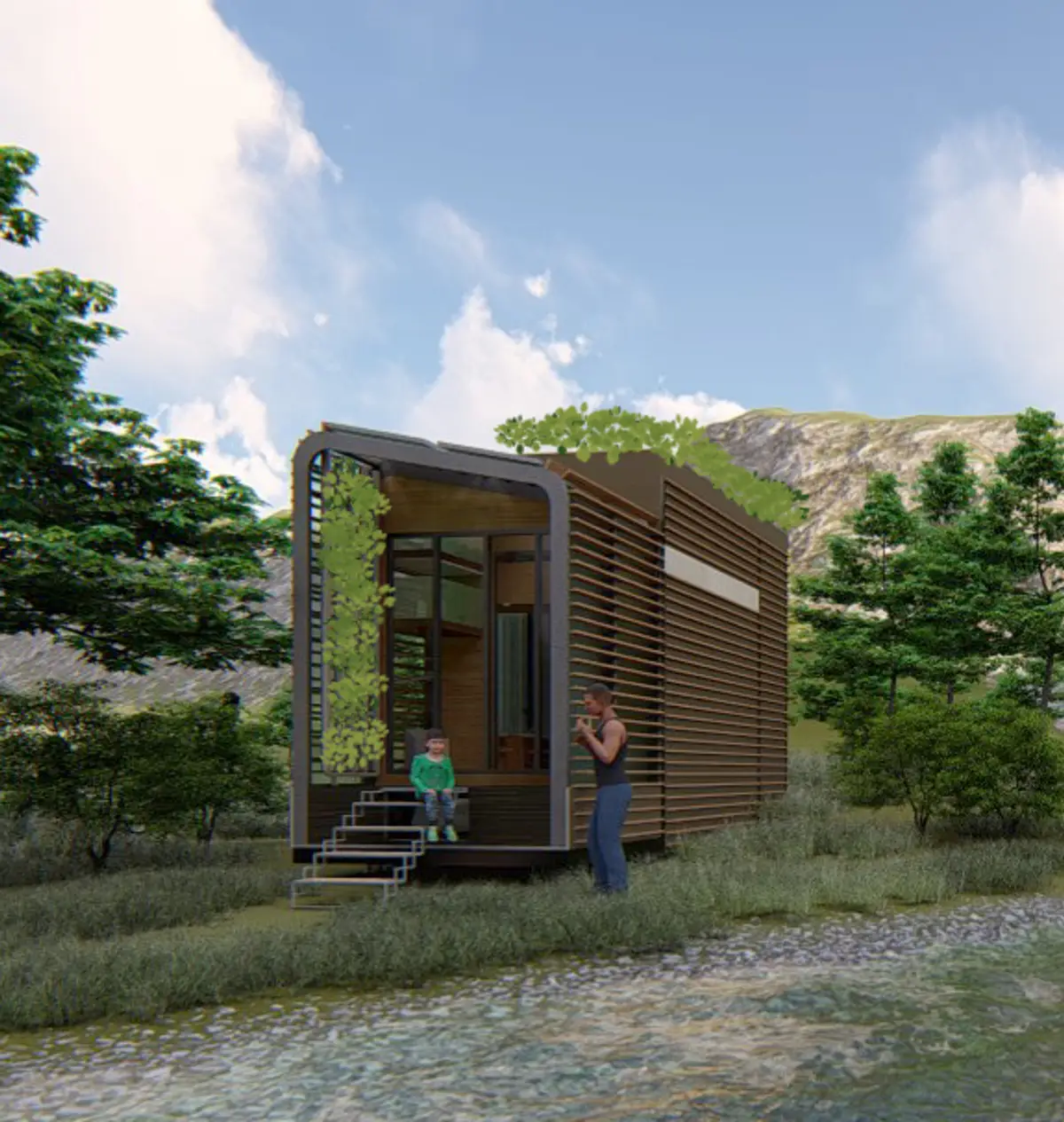
O.N.I.S.-M. The movable habitat
Off-the-grid. Nurturing. Inhabitant. Structure.- Mobile.

In architecture, a field closely related to occupying spaces with strong and mostly permanent constructions, wheels may at first seem to be somewhat out of place. However, due to the increasing population, small scale houses, which concentrate the many functions of a residence in minimal spaces are emerging as a new solution. Our attempt is to provide a movable structure that also incorporates the good living standards making the house self sufficient that has minimum contact with the outside elements which may possess a potential threat of dangerous contaminants.
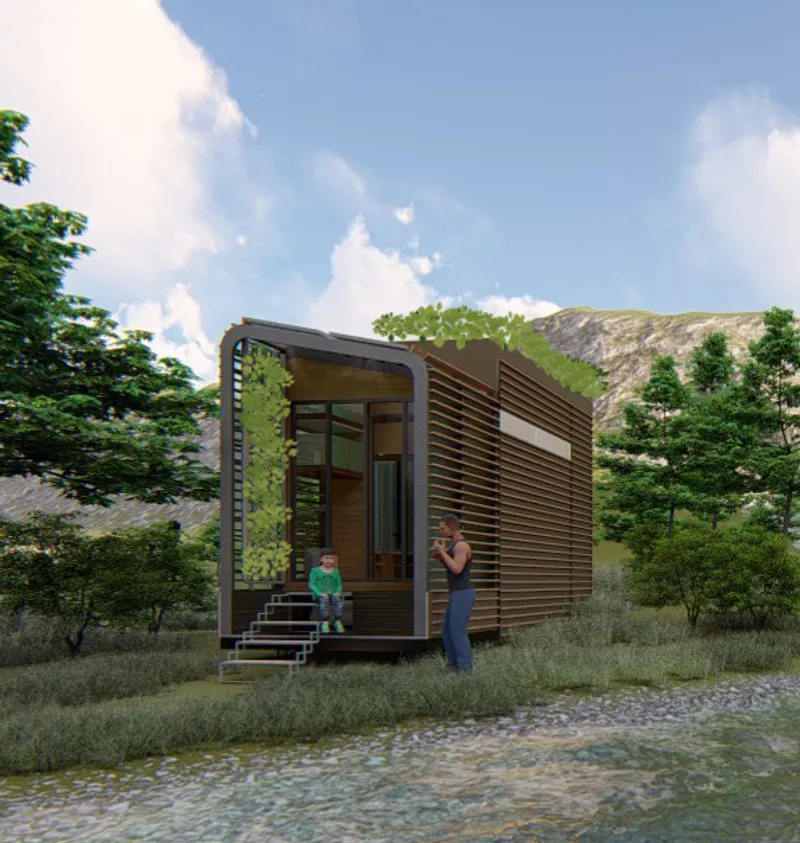
O.N.I.S.-M. Is designed to incorporate technological advancements in a habitable environment creating a structure housing flexible and transforming spaces that moulds the functions according to different needs of the user resulting into a highly functional habitat that promotes off-the-grid living. O.N.I.S. -M which stands for Off-the Grid. Nurturing. Inhabitant. Structure. - Mobile, is derived from word Onism which means awareness of how little of the world we are going to see. This helps is creating a mobile structure that can transport itself to different landscapes creating a habitat on the move that can cater to various needs like, immigration, leisure travel or finding economic stability by cutting living costs and rents using off-the-grid living.
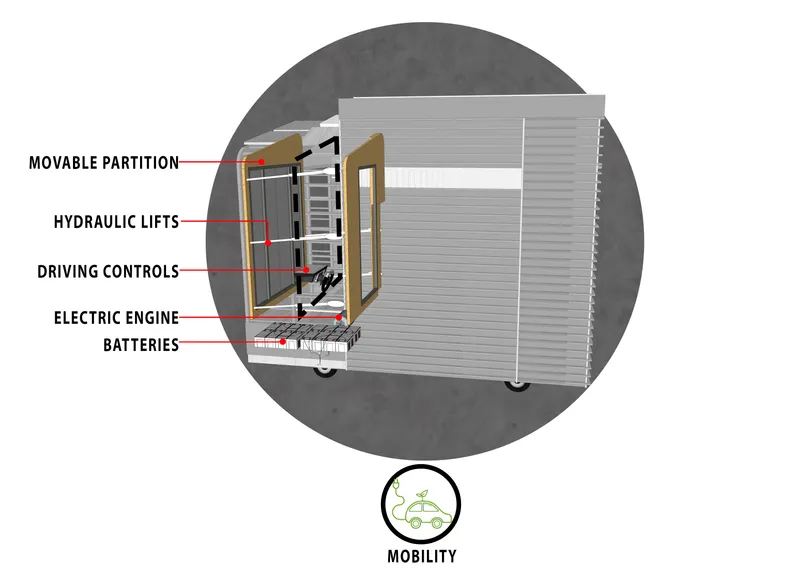
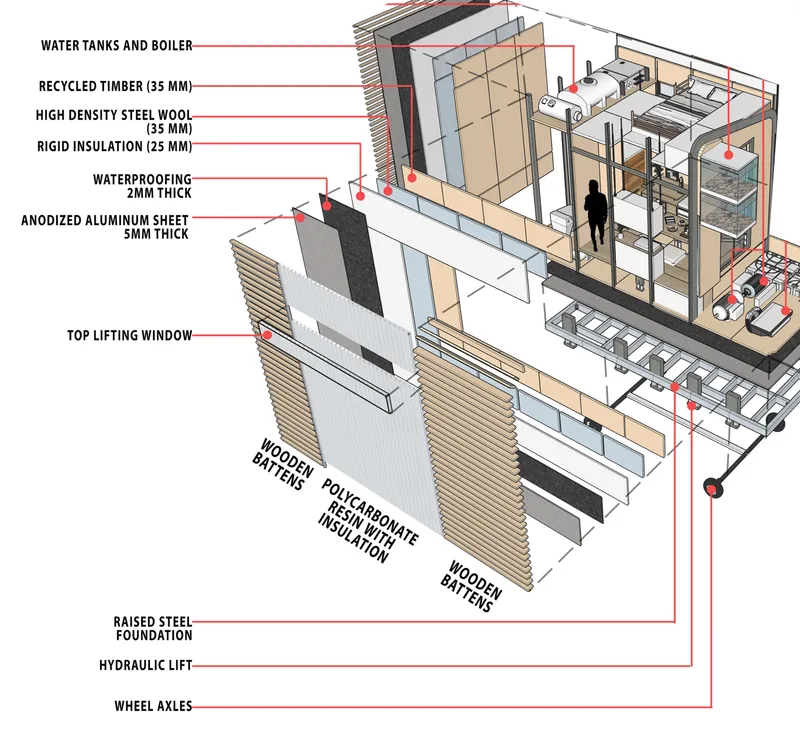
The residence which can accommodate a family of 4. The structure rests on a wheel axle supporting the lightweight steel structure housing hydraulic system which can be activated to provide plinth and lift the structure up to a height where wheels loses contact with the ground, providing a stable foundation for the structure. The highly functional residence is divided into two parts- a 10 sq. m. Residence unit and a 5 sq. m. Convertible driving unit. The driving unit is convertible with the help of a shifting partition that can shift with the help of electric hydraulic lifts. When in static mode the partition divides the unit into two zones - an isolation zone housing fumigation system for disinfecting the user from foreign contamination before entering the house, and a entrance zone which has a detachable vertical plantations of air purifying plants supported by aquaponic system and retractable steps at the floor. When in mobile mode, the partition shift to the edge of the driving unit transforming the divided space into a one driving unit housing driving controls batteries engine and generator which drives the whole structure.
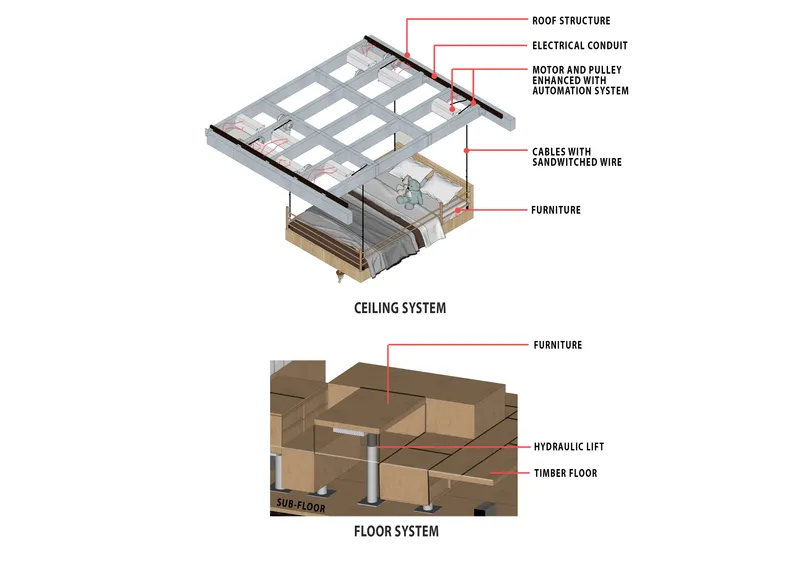
The Residence unit is a good example of utilising minimal spaces by condensing the furniture and functions in the ceiling and flooring which can be pulled or pushed out according to the user needs. The floor has a subfloor housing furniture like storage, bathtub, study tables, consoles that can be pushed up from the flooring conjunction of multiple furniture layouts using hydraulic lifts enhanced with home automation technology. The sub-ceiling part housing overhead cabinets and storage with a sufficient sized bed that can be pulled down with a collaborative system of motors, pulleys and wire sandwiched cables attached to furniture taking advantage of automation system. The combined floor- ceiling technology system can be used to form multiple possible layouts catering to requirements of a user within a single space laying out a good example of efficiency planning of a small space with constraints. Apart from four modes ( Living / Dining mode, Work mode, Sleep mode and Drive mode) the system can be used to explore multiple possibilities of space layout and functioning.
Apart from compulsory requirements of a house, an additional aspect of self sufficiency and off- the- grid living is incorporated in design to provide a living standard close to nature and reducing the contact with outdoor elements to a minimum to rule out the potential contact of dangerous and contagious particles. The top of the residence unit is equipped with a rain water collection tank that helps rain water collection and is piped to a rain water tank at the subfloor area. The tank also holds a farming system supported by aquaponics that can grow profitable plants like( tomato. Cauliflower, etc.) for self consumption or sale within the space constraints. The front entrance area also houses plantation in vertical system which grows air-purifying plants and shrubs for keeping the environment of the O.N.I.S.-M. Low on air- pollution.
The plantation system is also supported with Aquaponics which is a food production system that couples aquaculture (raising aquatic animals such as fish, crayfish, snails or prawns in tanks) with hydroponics (cultivating plants in water) whereby the nutrient rich aquaculture water is fed to hydroponic grown plant, involving nitrifying bacteria for converting ammonia into nitrates, which gets absorbed by the plants making the water free of contaminations and fit enough to be pumped back to the aquaculture tanks, thus, creating a self supporting cycle where plants help aquaculture and vice versa.
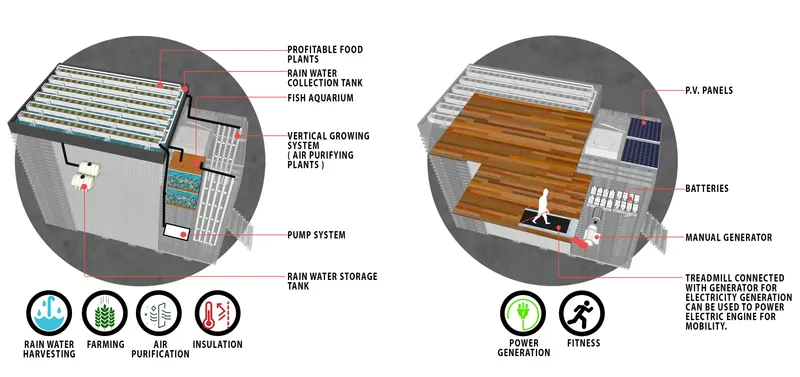
The PV panels at the roof of driving unit powers batteries in the sub floor the batteries and engine can be powered by a dedicated treadmill connected to a manual generator cultivating the energy to power the electric engine for mobility and catering the electrical needs of the house.
The materials of the structure were chosen with local availability and recyclability in mind. The wall panels ceiling and roof are made up of 35 mm thick recycled timber board that is packed with batt and rigid insulation and water proofing from the outside. The outside of the structure is fitted with anodised aluminium sheets. Additionally one side of the structure is fitted with polycarbonate resin with insulation that brings in diffused light and provides a sense of lightness visually. The super structure of the house is made out of recycled metal sections. The outer envelop is fitted with wooden louvers for improved aesthetics. The combination of materials are kept earthly and eco-friendly.
The future evolution of the O.N.I.S.- M can be visualised as a solution to a shifting community and can help immigration and support the individual socially and economically. Moreover, government can provide these shelters on subsidy basis that boosts self employment and farming and trade between government and individual on shelter lease basis.

Popular Articles
Popular articles from the community


Hill & Cross Opera: Sculptural Opera House Architecture Shaped by Tallinn’s Landscape and Identity
Hill & Cross Opera reimagines opera house architecture in Tallinn through its sculptural hill, civic plaza, glass wave and a luminous cross.
ALGAL REALM: A Bio-Integrated Lunar Habitat Design for Life Beyond Earth
ALGAL REALM reimagines lunar habitat design with algae-powered life support, 3D-printed regolith, and vertical living for a lunar future.

Co-Life: Senior Housing Design That Reconnects Older Adults With the City
Co-Life reimagines senior housing design through healing gardens, shared streets, workshops, and a sustainable community across generations.

Play: Fragments of Their World
Familiar architecture becomes modular playground design, creating safe spaces where displaced children can learn, connect, imagine and play.

Similar Reads
You might also enjoy these articles

Day and Night Park: A Time-Based Urban Newsstand in Beijing
A temporary urban newsstand in Beijing blending travel, light, and reading through poetic colors, compact form, and community-focused design.

Modernist Patio Renovation in El Masnou, Barcelona by Oliver Segura Arquitectura + Cebrià Arquitectura
Modernist patio renovation blending tradition and innovation with a movable pool, leveled floors, and Catalan materials in El Masnou.

Alto Residencial Coop: Cooperative Housing Development in Santiago de Compostela by Carbajo Barrios Arquitectos
A linear cooperative housing complex blending white volumes and perforated metal façades, enhancing community living, natural light, privacy, and urban integration.
Vil Genis School by BPA ARCHITECTURE – Massy, France
Vil Genis School in Massy, France, features sustainable design, south-facing classrooms, community integration, accessible spaces, and modern educational architecture.

Comments (0)
Please login or sign up to add comments
No comments yet. Be the first to comment!