

OPEN Unveils Stunning Design for Suzhou's Shanfeng Academy Building
The innovative architecture blends tradition and modernity to create a unique learning environment


Beijing-based architectural practice, OPEN Architecture, has recently unveiled the design for the Shanfeng Academy project, located in a new district of Suzhou city. The building is set to be the campus centre for a new K-12 international school and also serves as a cultural hub for the local community. Suzhou is a city that has a deep cultural heritage, known for its poetic gardens and harmony, which the architects have attempted to preserve while creating a major new urban project.
Li Hu and Huang Wenjing, founders of OPEN, believe that finding radical strategies to address the practical challenges of the project, while creating architecture of poetic spirit deeply connected to the local cultural tradition, is at the heart of this project.
As the campus centre serving nearly 2000 students, Shanfeng Academy will provide essential and shared facilities of the school. The building will include a library, an art centre, a gymnasium, a swimming pool, a grand theatre of 1000 seats, a black box theatre, and a forum.
Given the intensity of the functional programmes and the high concentration of users, the architects decided to divide one massive building into five individual buildings interconnected by covered walkways. The architects aimed to create voids in the form of four gardens and semi-outdoor spaces by breaking down the mass and pulling them apart. The well-connected walkways easily accommodate a large number of students moving between different activities even during rainy days, which are abundant in Suzhou.
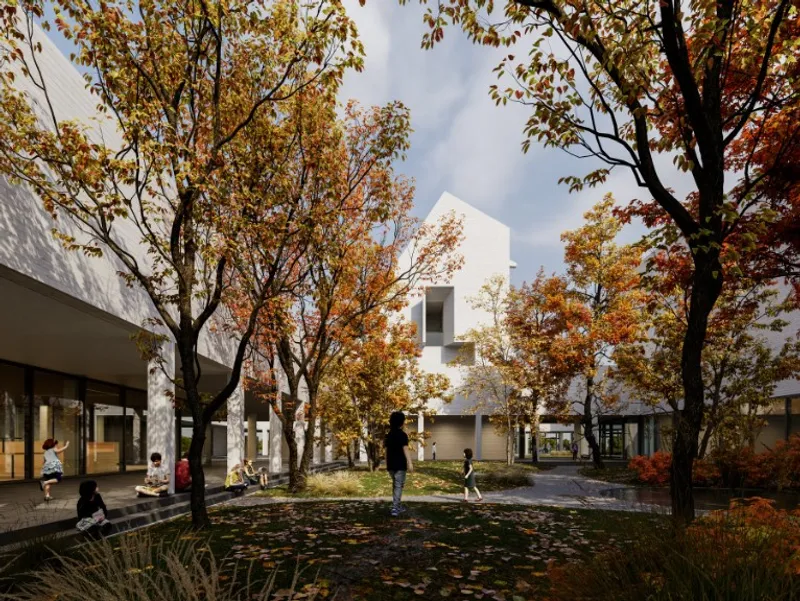 A render of Autumn Garden and the Forum. ©OPEN
The gardens are designed around the four seasons, and plants are selected accordingly to accentuate the traces of time. Elements of classical Suzhou gardens, such as scholar rocks, traditional pavement patterns, and the use of water, are carefully integrated into the gardens. There is also an unnamed fifth garden on the rooftop of the walkways planted with tall grasses and herbs—a pleasant retreat and social gathering place for students and teachers, it is linked to the main classroom building through a short bridge.
The campus centre replaces a large portion of the fence that encloses the school campus for student safety. While acting as the interface between the school and the city, the campus centre is also able to share its many facilities with the local community when the school is not in session, creating a close bond between the two. A café and a courtyard on the ground floor facing the street offer a pleasant place for parents waiting to pick up their children.
 An exterior view. ©OPEN
All spaces have natural lighting and natural ventilation to enhance indoor comfort while reducing energy consumption. Board-formed white concrete is adopted for the building envelope, both to pay tribute to the white-wall-grey-roof traditional architecture of the Suzhou area, and to resolve the problem of the traditional white plaster needing constant maintenance to prevent mildew formation and cracking.
OPEN hopes that the campus centre can become a new type of cultural hub combining the city’s rich cultural heritage with the contemporary dimension of this newly urbanized neighbourhood. The building’s sympathetic design, based on Suzhou’s rich cultural history and values, is expected to be an important landmark for the city in the years to come.
 The construction site. ©OPEN
Press Release. Courtesy of OPEN

Popular Articles
Popular articles from the community


David Ortega Stacks a Two-Story Mexico City Penthouse Around a Steel Stair and a Pergola-Shaded Roof Terrace
In Colonia Roma, a 300 m² penthouse uses oak joinery, a planted steel stair and a slatted roof pergola to make a new-build apartment feel like a house.

Jaramillo Van Sluys Arquitectura and Urbanismo Turn a Demolished Registry Lot in Quito into an Orchard Plaza
In Quito's Centro Histórico, a 2,800 m² plaza exposes the San Agustín convent wall and redraws its lost Augustinian orchard in volcanic stone.

longwave studio Reorganizes a 112 m² Tainan Apartment Around the Daily Routines of a Family and Two Cats
In Tainan, Taiwan, birch plywood, rust-red furniture and a freestanding plaster wall link arrival, storage, work and family life in one apartment.

LT2A and OPEN Architectes Thread a Brick and Glass High School Through a Wooded Belgian Campus
In Braine-l'Alleud, a 3,000 m² wing for Collège Cardinal Mercier pairs pale brick with a glazed colonnade, deferring to a small chapel and a dense wood.

Similar Reads
You might also enjoy these articles


Rede Arquitetos Turns Circulation into Civic Space at the Educar II SESC School in Fortaleza
In Fortaleza, Brazil, Educar II SESC-CE trades a signature form for mesh screens, yellow thresholds and courtyard walkways built for equatorial heat.
116 Rokeby Building, Collingwood
Sustainable Collingwood office building featuring double-skin façade, natural ventilation, rooftop amenities, and carbon-neutral design focused on wellbeing and longevity.
Contemporary Apartment Renovation in Spain: RV House by BIAN Opens Up to the Sea
A minimalist 1930s apartment in Santander is transformed into a flexible, sea-facing home through contemporary Spanish renovation.
3 Marías House: A Contemporary Mediterranean Courtyard Retreat by Bajet Giramé + Burckhardt
Mediterranean courtyard home blending traditional architecture with modern design, terracotta flooring, flexible interiors, sustainable climate strategies, and garden integration.

Explore Educational Building Competitions
Discover active competitions in this discipline


Challenge to design public laboratory

Challenge to reimagine the Iron Throne

Photograph architecture without architects

Illustrate the lost glory of Angkor Wat - Render Challenge
Comments (0)
Please login or sign up to add comments
No comments yet. Be the first to comment!