

A 16 m² Canopy Rewrites the Edge of a Xiamen Village
TAG's Orange Fence is a temporary tensile canopy that turns a narrow street in Gaoqi Village into a threshold between fishing heritage and urban flux.


Gaoqi Village sits at the northernmost tip of Xiamen Island, a place where low-rise stone and brick houses crowd beneath the flight path of aircraft descending into the city's airport. For decades this fishing settlement has been slowly absorbed by urban growth, its narrow alleys and courtyard walls pressed up against traffic, scooters, and vegetable markets. TAG's intervention, titled Orange Fence, occupies just 16 square meters at a street corner, yet it does something that far larger projects rarely manage: it redefines the boundary condition of a village without erasing it.
What makes the project genuinely interesting is the refusal to be either building or sign. The translucent orange canopy reads simultaneously as infrastructure, as shelter, and as a piece of street theater. It glows at dusk. It lets rain through its tensile panels just enough to remind you it's temporary. And it creates a social threshold, a place where neighbors idle on scooters and children drift past, that didn't exist before. In a context where urban villages are routinely demolished or gentrified, a project this small and this deliberate carries an outsized argument about what preservation could look like.
Street Presence and Public Life

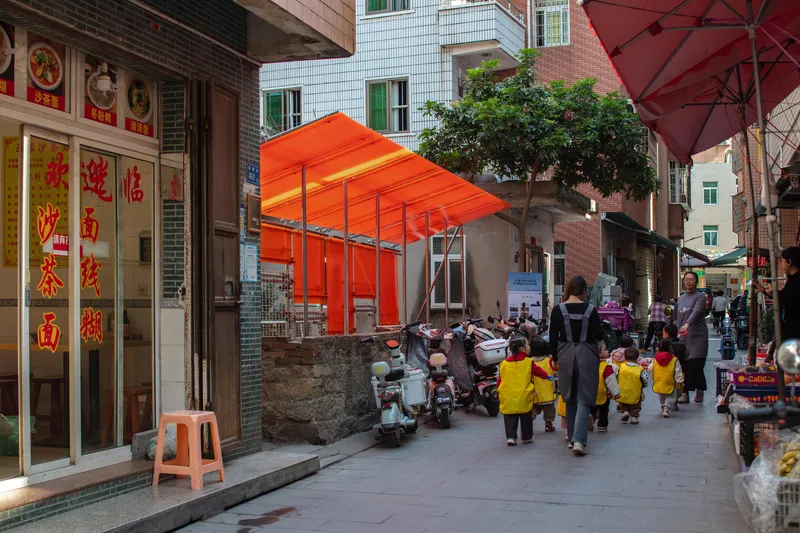

From the street, the canopy is unapologetically visible. Its orange translucent panels catch light in a way that concrete and brick cannot, pulling the eye from a distance without competing with the dense residential fabric behind it. Pedestrians, motorbikes, and children flow beneath it with the casualness that only comes when a structure feels like it belongs to the street rather than to an institution.
TAG calibrated the height and span so that the canopy hovers just above head level, low enough to feel sheltering but open enough at its edges to avoid creating a dead end. The result is closer to a covered sidewalk than a pavilion, and that distinction matters. Pavilions attract visitors; covered sidewalks attract use. The scooters parked casually beneath the frame, the vegetable baskets nearby, all suggest the latter has won out.
Material Honesty at a Tiny Scale
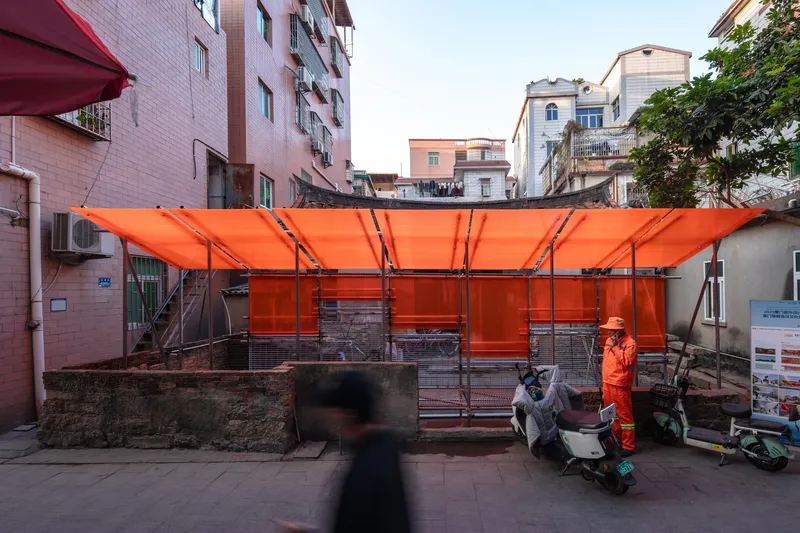
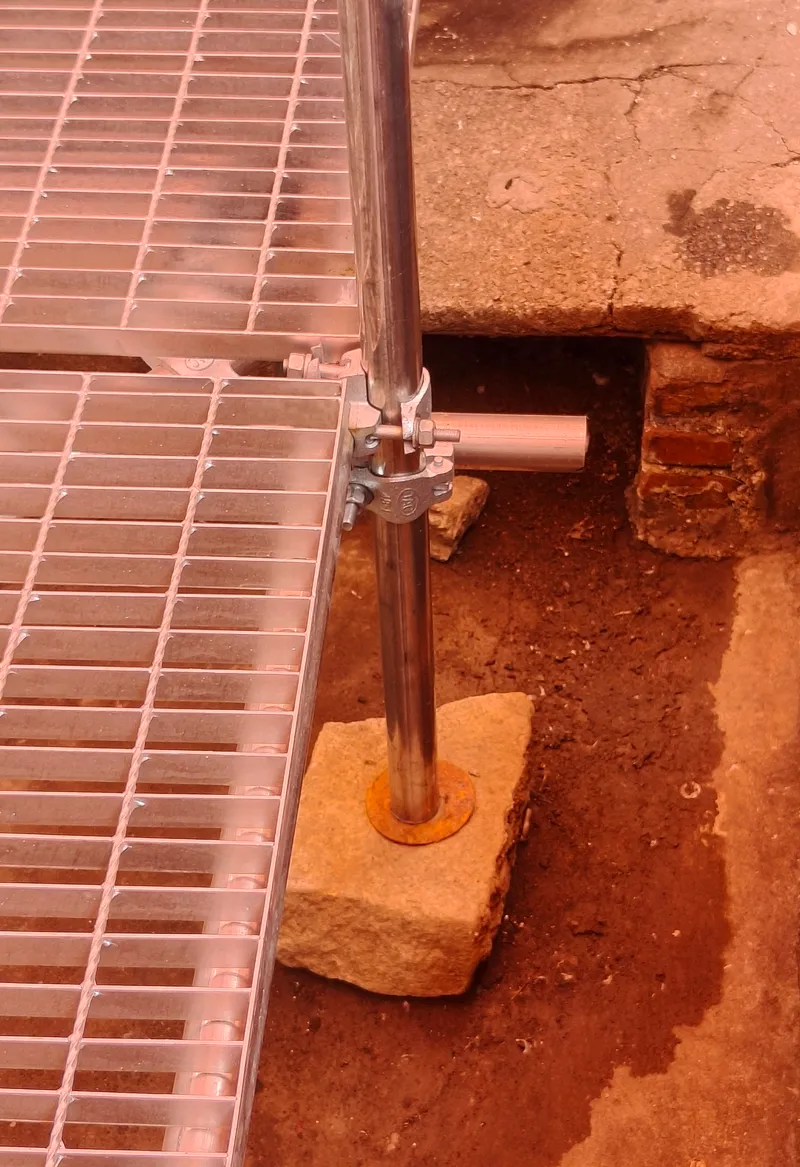
Sixteen square meters does not leave room for ambiguity. Every connection is exposed: the steel column bases anchor directly into compacted earth, the wire mesh flooring reveals the ground beneath, and the tensile orange panels are fastened to a slender frame with no pretense of permanence. There is no cladding, no hidden gutter, no secondary finish. The structure is its own ornament.
The base detail is particularly telling. Rather than pouring a concrete pad or drilling into stone, the columns sit on plates pressed into the existing ground surface. It's a deliberate choice that signals temporariness and reversibility, two words that rarely appear in Chinese urban redevelopment. If the village changes, the canopy can leave without a scar.
Light, Color, and the Threshold Moment
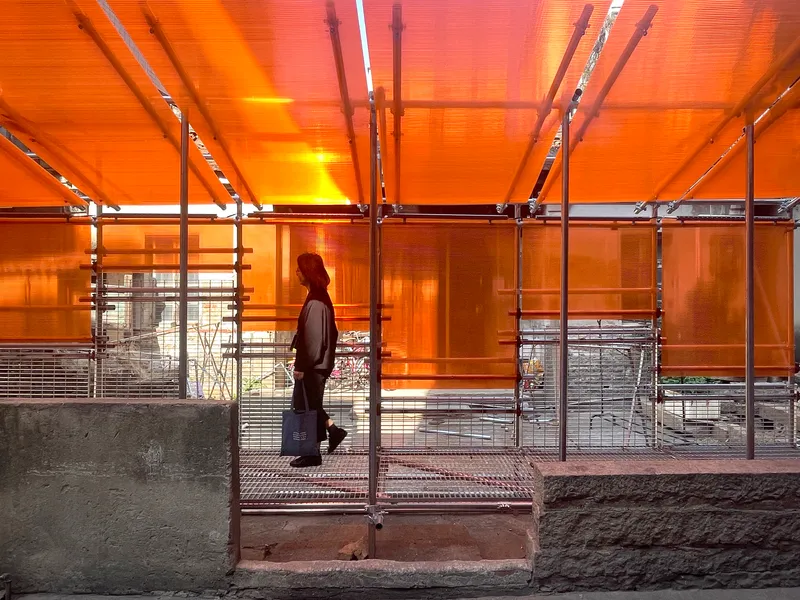
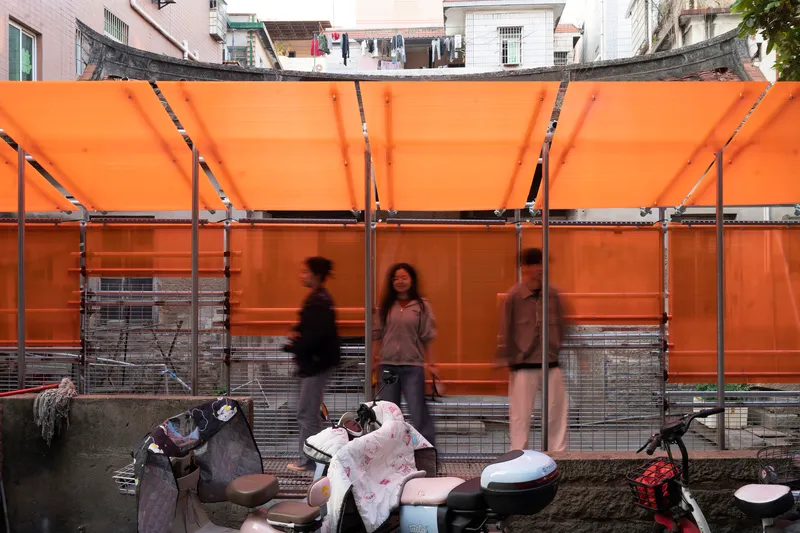
The most compelling image of the project is the view from beneath the canopy at dusk, where a silhouetted figure stands at the threshold between the illuminated orange ceiling and the dark alley beyond. The color is doing real spatial work here: it warms the underside of the roof, saturates the ground plane with a faint amber wash, and separates the covered zone from the cooler tones of the surrounding village. Color becomes atmosphere without becoming spectacle.
TAG chose translucent rather than opaque panels, which means the canopy changes character across the day. Under midday sun it reads as a flat orange plane; at dusk, with ambient light escaping through its edges, it becomes a lantern. The steel frame remains legible at all hours, its diagonal bracing casting sharp shadows that shift the canopy's perceived geometry depending on where you stand.
Context and Contrast


The comparison diagram supplied by TAG is unusually honest. It places the traditional red brick facade of the village alongside the orange canopy installation, making no claim that the two are equivalent. Instead, the drawing suggests a conversation: the brick wall is solid, opaque, and permanent; the canopy is open, translucent, and provisional. Both define edges. Both create shelter. But they operate in fundamentally different registers of time and material.
Seen beside vegetable baskets and beneath a mature street tree, the canopy finds its footing. It is not foreign to this context. Its proportions echo the low eaves and narrow spans of the village houses, and its color, while saturated, is not out of place in a landscape of red brick, terracotta tile, and sun-bleached laundry. What could easily have been a jarring insertion becomes, instead, a warm amplification of what was already there.
Plans and Drawings


The site plan reveals the intervention's strategic placement at the edge of a dense urban block, occupying a transitional gap between the village interior and the street. Seven bays of diagonal bracing run the length of the structure, each topped by a rectangular orange panel, a repetitive rhythm that gives the tiny project a surprising sense of order. The floor plan highlights a single retained timber beam, suggesting that TAG worked around an existing structural fragment rather than clearing the site entirely.
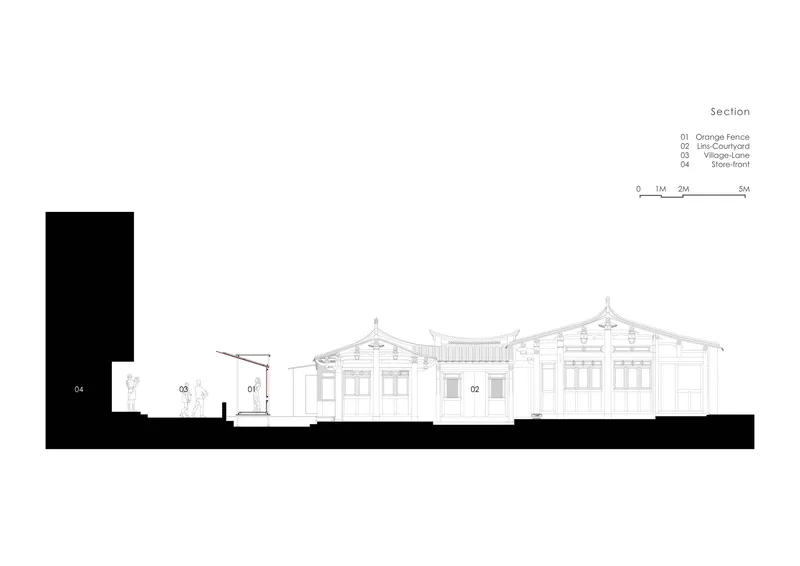
The elevation drawing is the most instructive. Its modular alternation of orange and white panels reads like a graphic pattern, but it also reveals the logic of the facade: solid where privacy is needed, translucent where light and visual connection are desired. The section drawing confirms the canopy's relationship to its neighbors, a low-rise form tucked against a larger dark mass, its pitched profile deferring to the existing roofline.
Why This Project Matters
Architecture's most difficult act is restraint in contexts that demand attention. Gaoqi Village is the kind of site that invites grand gestures: a historic fishing settlement under threat, a dramatic airport flight path overhead, a city expanding on all sides. TAG responded with 16 square meters of steel and translucent orange fabric. The discipline of that choice, the decision to intervene at the scale of a doorway rather than a block, is what elevates Orange Fence from installation to argument.
The argument is this: temporary architecture in urban villages should not aspire to permanence or to spectacle. It should aspire to use. The scooters gathered beneath the canopy, the children running past, the warm glow at dusk, these are not designed moments but emergent ones, made possible because the structure is cheap, light, reversible, and exactly the right size. In a discipline obsessed with scale, Orange Fence is a reminder that the smallest projects can carry the sharpest ideas.
Orange Fence by TAG (lead architects Yanze Wang and Guanzhong Wu), completed 2025 in Xiamen, China. 16 m². Photography by Wenhao Yang, Xiaojia Xiong, and Jia Wei.
About the Studio
Share Your Own Work on uni.xyz
If projects like this are the kind of work you want to make, uni.xyz is a place to publish your own, find collaborators, and enter design competitions.


Popular Articles
Popular articles from the community


graciastudio Turns a Viewless Tijuana Lot Inward Around a Courtyard of Concrete, Timber and Trees
In Tijuana, Jorge Gracia's GA2 House stacks a timber-clad private floor over exposed concrete and replaces a missing view with a planted interior patio.

David Ortega Stacks a Two-Story Mexico City Penthouse Around a Steel Stair and a Pergola-Shaded Roof Terrace
In Colonia Roma, a 300 m² penthouse uses oak joinery, a planted steel stair and a slatted roof pergola to make a new-build apartment feel like a house.

FCC Arquitectura Expands a Portuguese Granite House with a Board-Marked Concrete Wing
In Portugal, JV House pairs a cleaned-up whitewashed and granite dwelling with a timber-shuttered concrete extension, courtyards and a garden pool.


The Amber Palace Opera: A Geological Fiction Surfaces on Tallinn's Baltic Waterfront
Pierre Brillard reimagines a Baltic legend as a public landscape, opera house, and waterfront promenade rooted in Tallinn's coastal identity.

Similar Reads
You might also enjoy these articles

LAVA Architecten Gives Vocational Education a Sawtooth-Roofed Face on a Mechelen School Campus
In Mechelen, Belgium, a 2,053 m² STEM school on a 6×6 m grid turns workshops and classrooms into rooms that can be rearranged as teaching changes.

KEMA Studio Turns a Derelict Marvila Attic into a 60 m² Lighthouse Apartment Above Lisbon
In Lisbon's Marvila district, a rebuilt roof, four skylights and two plywood volumes turn an unlivable attic into a bright home facing the Tagus.

Pixel Gardens: One Repeated Module Stacked Into a Terraced Social Housing Tower for Famagusta
Salem Bader's shortlisted housing tower builds a vertical neighbourhood from one repeated module, offsetting units to carve terraces, light and air.

Bao Huynh Watercolor Atelier: A Serene Art Retreat in Hội An
Bao Huynh Watercolor Atelier in Hội An blends multifunctional art spaces, sustainable design, local materials, and family-friendly living in a serene environment.

Explore Canopy Competitions
Discover active competitions in this discipline

Challenge to design a portable theatre

Challenge to design a portable music platform

Challenge to design an open learning module for the elderly

Bring back Drive In's
Comments (0)
Please login or sign up to add comments
No comments yet. Be the first to comment!