

Orionis Planetarium and Observatory by Snøhetta: A Celestial Landmark in Douai, France
Orionis Planetarium by Snøhetta blends elliptical architecture, sustainable design, and immersive astronomy experiences in a biodiverse, landscaped setting.


A Sculptural Dialogue Between Earth and Sky
Located in Douai, northern France, the Orionis Planetarium and Observatory, designed by renowned Norwegian firm Snøhetta, is a bold architectural statement that connects astronomy, landscape, and urban culture. Nestled between the Scarpe River, the Arkéos archaeological museum, and a residential zone, the 2,000-square-meter facility redefines the region’s relationship with the cosmos, science, and design.


Architecture Inspired by Elliptical Orbits
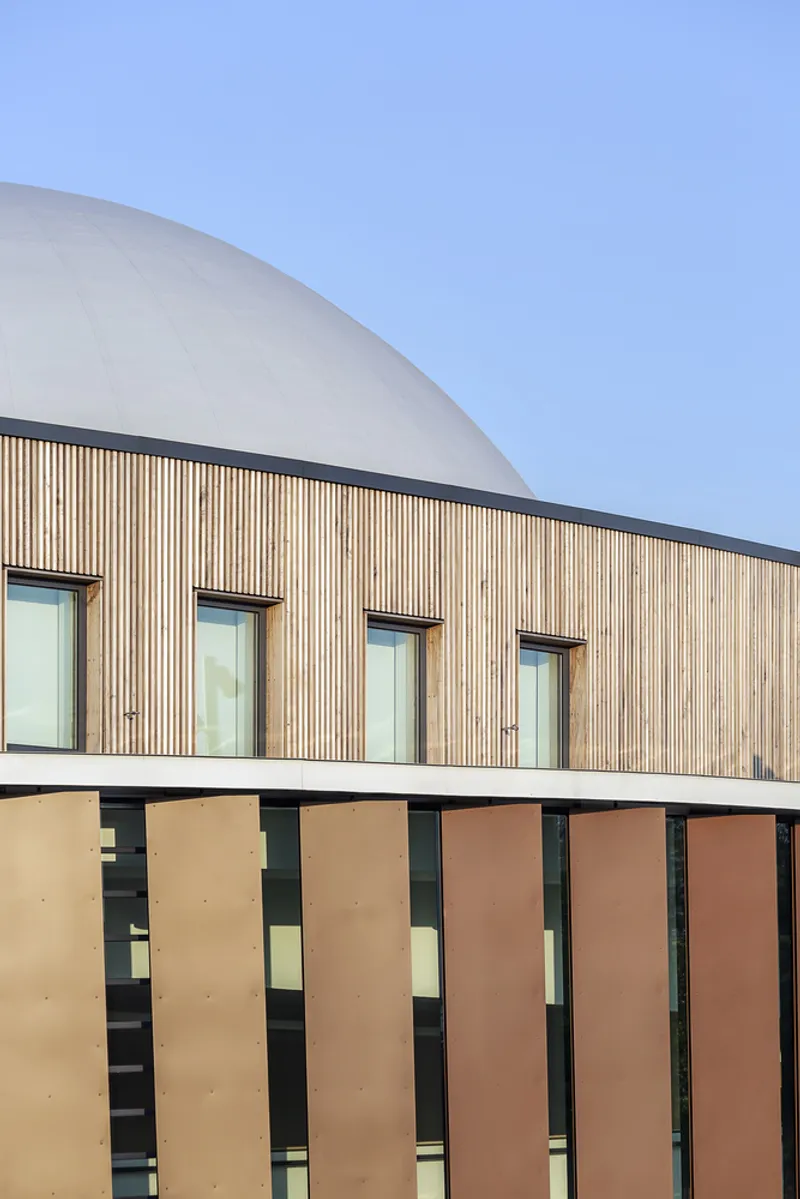
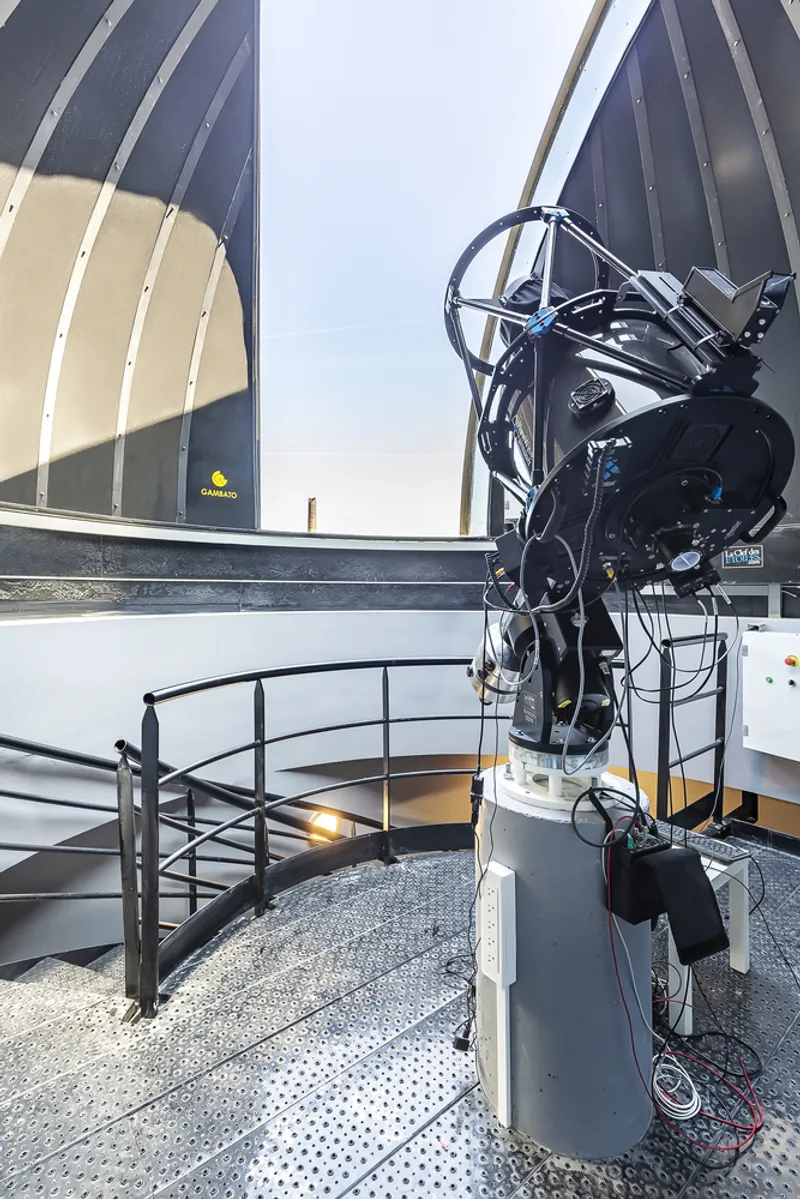
Taking its conceptual cue from the elliptical motion of celestial bodies, the building's architecture celebrates fluidity, continuity, and time. Its sculptural form wraps around two distinct domes — the projection planetarium and the astronomical observatory — forming a sinuous structure reminiscent of orbital paths. The dynamic curves are not merely visual metaphors but spatial experiences guiding visitors through a carefully choreographed journey.
“We envisioned an extraordinary meeting place shaped by the continuous, fluid, and perpetual qualities of the universe,” notes Snøhetta co-founder Kjetil Trædal Thorsen.

Seamless Integration With Site and Landscape
Designed to harmonize with its environment, Orionis links the natural flow of the Scarpe River and the historical language of the Arkéos Museum. Collaborating with Atelier Silva Landscaping, Snøhetta crafted two main landscape components: an elliptical interior courtyard and a biodiversity-focused external garden. A winding bluestone-paved pathway, wild grass roofs, and native planting weave the building into its context, fostering both ecological richness and visual cohesion.

Fluid Visitor Experience and Spatial Programming
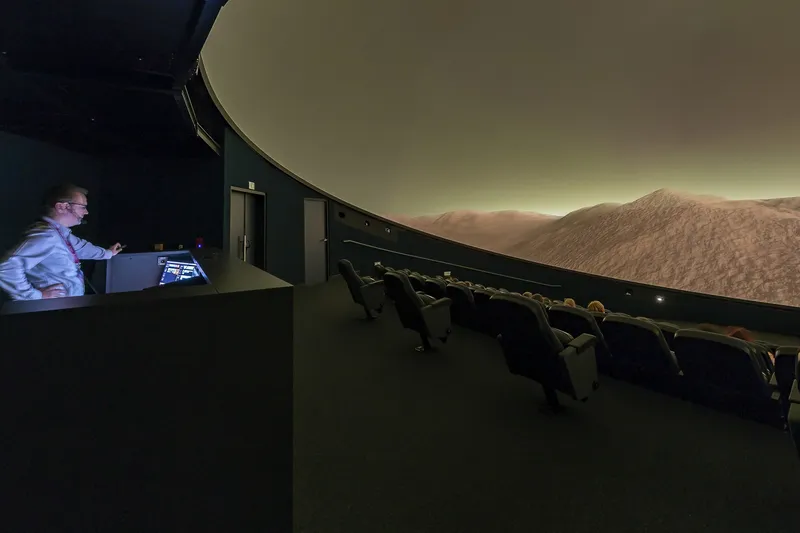
Inside, the building is guided by a user-first design philosophy. Visitors enter through an open reception area, flowing past the gift shop and exhibition spaces, eventually arriving at the immersive dome. A gentle, inclined ramp returns them to the exit — a looped, intuitive path that mimics the cosmic motion inspiring the design.
Dedicated areas like the observatory and administrative offices are positioned to ensure uninterrupted circulation, optimizing access while maintaining privacy for researchers and staff.
Regional Materiality and Environmental Responsibility
Material selection reflects the vernacular architecture of northern France. The project incorporates:
- Locally sourced poplar wood cladding that matures over time
- Rust-toned steel brise-soleils reminiscent of industrial heritage
- Light grey PVC dome cladding that minimizes visual intrusion
Snøhetta’s attention to environmental performance is evident in multiple design strategies:
- Geothermal energy for heating and cooling
- Natural ventilation supported by automated sensors
- Sunshades and green roofs for passive thermal control
- Use of local materials to reduce carbon footprint and support regional economies

A New Cultural Destination for Science and Architecture
Orionis opened to the public on May 13, 2023, becoming an anchor point for educational tourism, scientific outreach, and cultural engagement in the region. Beyond being a functional observatory, it is a public space of wonder — one that invites people of all ages to look up, learn, and explore the universe.

All Photographs are works of Jad Sylla




Popular Articles
Popular articles from the community


The Musturak Paradise: Senior Living Architecture for a Connected Future in Temara, Morocco
The Musturak Paradise reimagines senior living architecture in Temara via private homes, social spaces, culture, community, and shared care.

Conexión: Biophilic Design Reimagines High-Rise Living in Hong Kong
Conexión reimagines high-rise living in Hong Kong through biophilic design, green facades, shared spaces, daylight, water and nature within.

Co-Life: Senior Housing Design That Reconnects Older Adults With the City
Co-Life reimagines senior housing design through healing gardens, shared streets, workshops, and a sustainable community across generations.

Hill & Cross Opera: Sculptural Opera House Architecture Shaped by Tallinn’s Landscape and Identity
Hill & Cross Opera reimagines opera house architecture in Tallinn through its sculptural hill, civic plaza, glass wave and a luminous cross.


Similar Reads
You might also enjoy these articles


Hodi-Mandai Geram
Project Function: Preservation and revitalization of the Intangible heritage and socio-spatial identity of the Hodi by Housing, Cultural Memory Center, Sacred Grove, landscape, local tourism economy


Olio Towers: A Mid-Rise for Performers That Fuses Housing, Rehearsal, and Stage
Located blocks from Houston's Theater District, this modular tower stacks living units around a central performance atrium.

Oasis: Modular Green Housing Carved into Dhaka's Urban Fabric
A shortlisted Plugin Housing entry reclaims unauthorized settlements in Dhaka with stepped concrete volumes, green roofs, and ventilation-driven design.

Black Hole: A Floating Megastructure for the Post-Physical Era
Emiliano Mazzarotto envisions a spherical, self-scaling arena where e-sports, digital hotels, and holographic stadiums replace traditional public space.


Explore Orbital Architecture Competitions
Discover active competitions in this discipline



Challenge to reimagine the Iron Throne


Photograph architecture without architects


Illustrate the lost glory of Angkor Wat - Render Challenge


Design challenge to reuse E-waste
Comments (0)
Please login or sign up to add comments
No comments yet. Be the first to comment!