
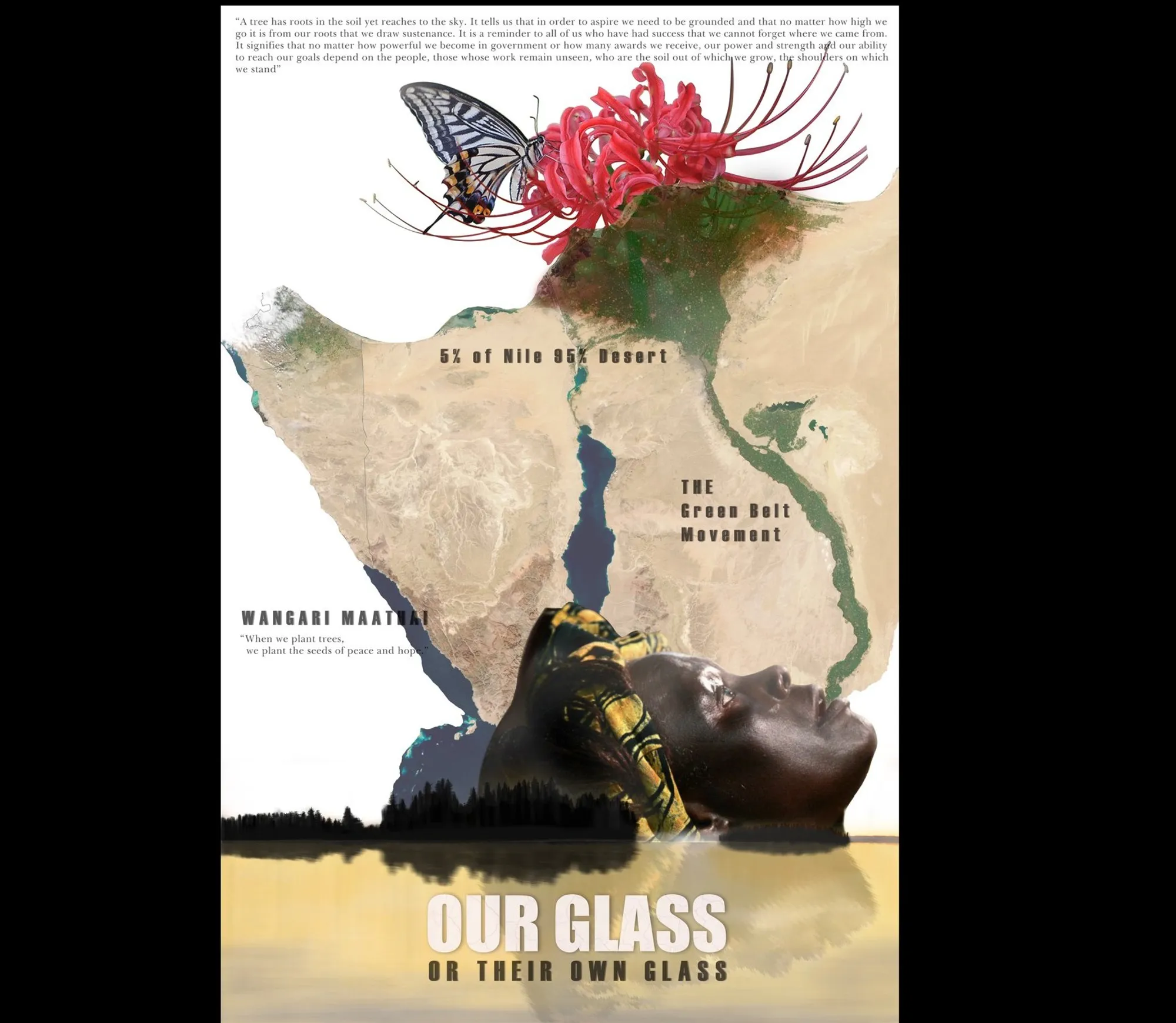
OURGLASS: A Sustainable Architecture Approach to Climate-Responsive Memorial Design
A climate-responsive architectural memorial in Egypt that transforms desert extremes into water, awareness, and spatial experience.


In the evolving discourse of sustainable architecture, projects that operate at the intersection of environmental systems, spatial experience, and cultural narrative are gaining critical relevance. OURGLASS, a shortlisted entry in the Hourglass competition by 태주 전 and 문 이, positions itself as a climate-responsive architectural intervention that addresses global warming through experiential design rather than symbolic monumentality.
Set within the harsh environmental gradient of Egypt, where over 90% of land is desert and life concentrates along the Nile, the project leverages extreme climatic conditions as both a challenge and a design generator. Instead of resisting the desert, the proposal reframes it as an active environmental system.
Concept: Architecture as Environmental Mediator
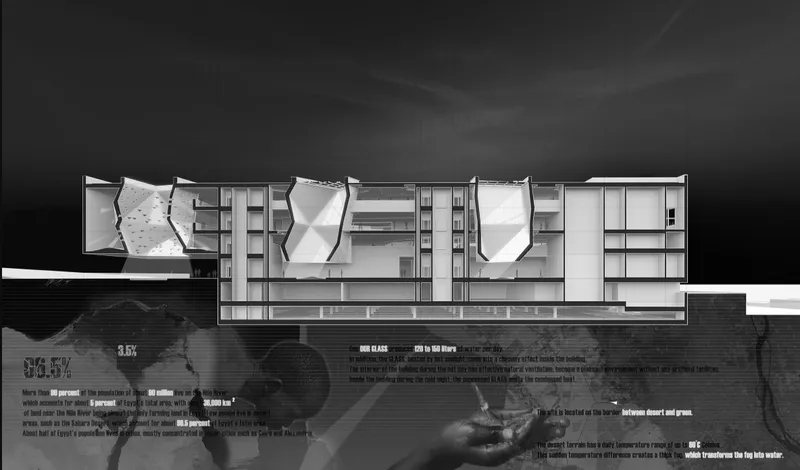
OURGLASS operates as a hybrid between a memorial and an environmental museum. The core concept is structured around vertical tubes that act as both spatial organizers and climatic devices. These elements penetrate the building mass and orchestrate light, airflow, and condensation processes.
The project challenges conventional memorial architecture by shifting from static remembrance to active engagement. Visitors are not passive observers but participants in a system that demonstrates environmental processes in real time.
Three primary conceptual layers define the project:
- Environmental awareness through immersive spatial sequences
- Climatic transformation using passive systems
- Behavioral impact through experiential learning
This positions the project within a broader framework of sustainable architecture that prioritizes performance over symbolism.
Site Strategy: Between Desert and Fertility
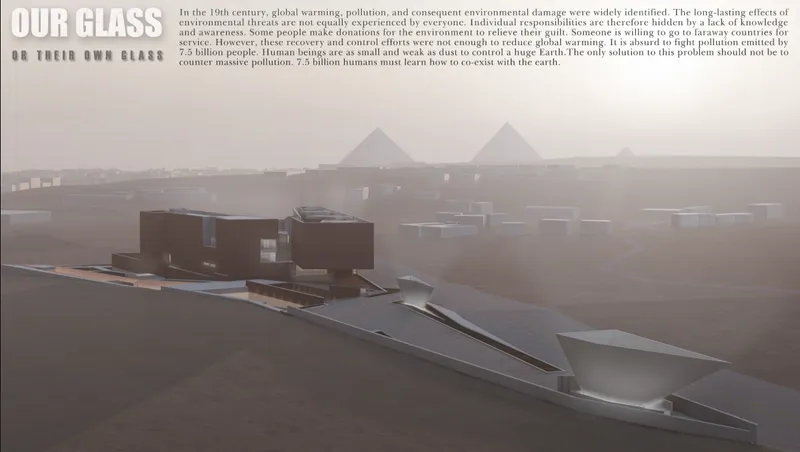
The project is strategically located at the boundary between Egypt’s desert and fertile regions near the Nile. This duality becomes a critical driver of the architectural narrative.
Climatic data indicates extreme diurnal temperature variation, often exceeding 60 degrees Celsius. The design leverages this thermal difference to generate condensation, effectively producing over 120 liters of water per day. This water is not only symbolic but functional, contributing to resource awareness and environmental education.
The site plan responds to its triangular geometry by organizing circulation and program along directional axes, creating a sequence of compression and release that guides the visitor journey.
Spatial Organization: Program as Experience
The building is structured as a multi-level exhibition system where each floor introduces a different environmental condition and narrative layer.
- Entrance: A controlled threshold that introduces the desert context
- Lobby: A transitional space with filtered light and orientation
- Exhibition Spaces: Organized around vertical tubes and environmental simulations
- Auditorium: A space for collective learning and discourse
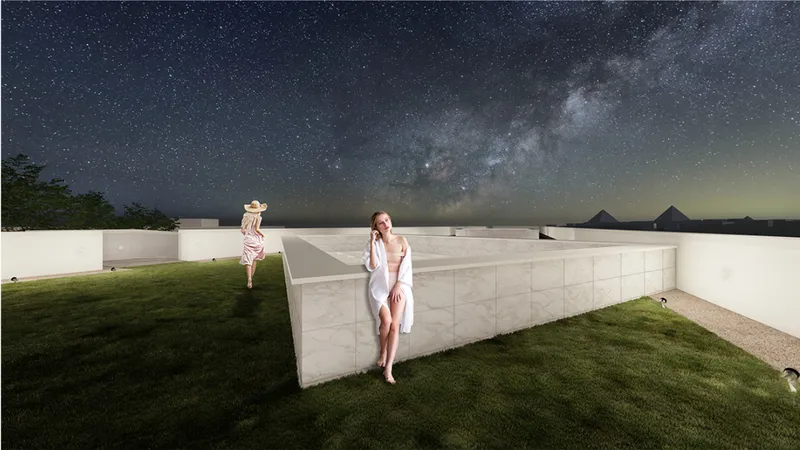
- Corridors and Terraces: Transitional zones that frame exterior and interior relationships
The progression through the building is carefully choreographed. Visitors move from enclosed, controlled environments to open terraces, experiencing shifts in temperature, light, and materiality.
Parametric Design and Computational Workflow
A key aspect of the project lies in its computational design methodology. The geometry of the vertical tubes is not arbitrary but derived through parametric processes.
Using tools such as Grasshopper, Ladybug, and Galapagos, the design team optimized the form based on solar exposure, environmental performance, and spatial efficiency. Parameters such as rotation, scale, height, and point control were iteratively adjusted to achieve optimal results.
Multiple geometric bases including triangle, rectangle, pentagon, and ellipse were explored to test spatial and environmental performance. The final configuration represents a synthesis of these iterations, balancing formal clarity with environmental responsiveness.
This approach aligns strongly with contemporary sustainable architecture practices where data-driven design informs both form and function.
Environmental Systems: Water, Light, and Air
The vertical tubes serve as the backbone of the environmental strategy. Their performance can be understood across three primary systems:
1. Water Generation
Condensation occurs due to temperature differences between day and night. Moisture in the air is captured and converted into water, making the building an active environmental generator.
2. Daylighting
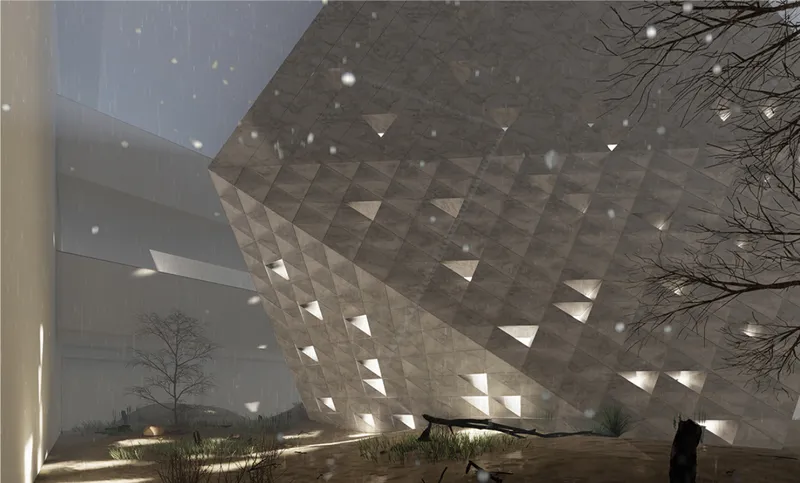
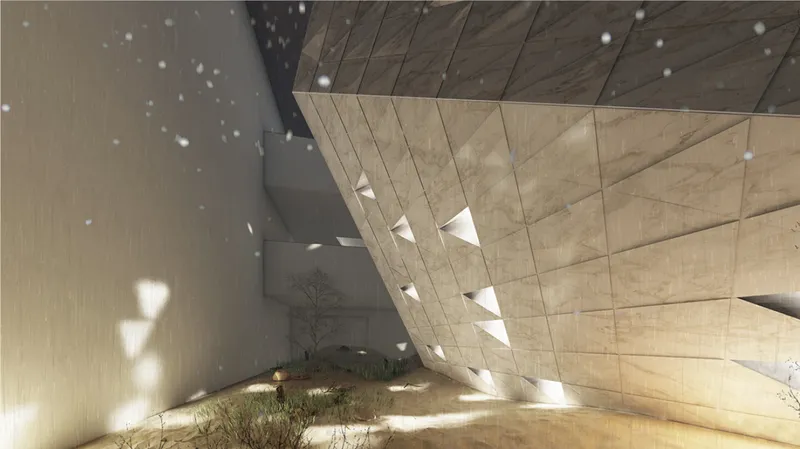
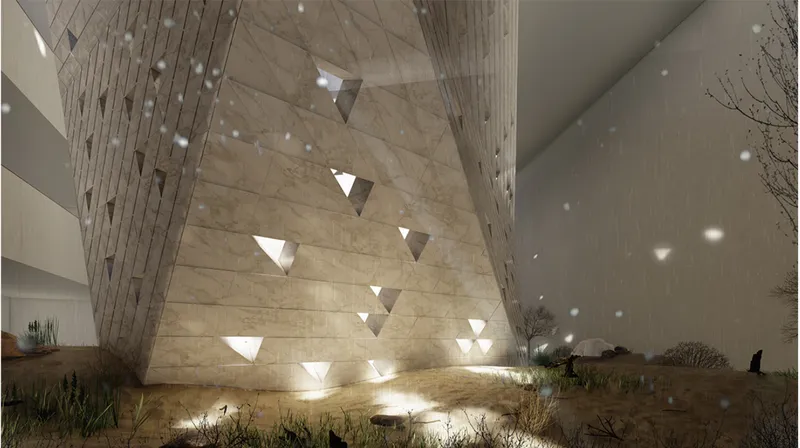
The tubes channel natural light deep into the building, reducing reliance on artificial lighting. Openings and perforations create dynamic light patterns that enhance spatial experience.
3. Ventilation
Stack effect and controlled openings facilitate natural airflow, improving thermal comfort without mechanical systems.
These systems collectively position the project as a model for passive design strategies in arid climates.
Material Strategy and Longevity
The use of brick as the primary exterior material reflects both contextual sensitivity and long-term durability. Brick ages over time, embedding the building within its landscape while maintaining structural integrity.
The material palette is intentionally restrained, allowing environmental effects such as light, shadow, and weathering to define the architectural expression.
Experience and Narrative: From Awareness to Action
OURGLASS is fundamentally an experiential project. The architecture communicates environmental urgency through direct engagement rather than abstract representation.
Visitors encounter contrasting conditions:
- Desert dryness versus interior humidity
- Harsh sunlight versus filtered illumination
- Isolation versus collective gathering
This contrast reinforces the environmental narrative and encourages reflection on human impact and responsibility.
Global Relevance and Architectural Implications
The project addresses a global audience by situating itself within a major tourism corridor near the pyramids. This strategic positioning amplifies its reach and impact.
Beyond its immediate context, OURGLASS proposes a replicable framework for sustainable architecture in extreme climates. It demonstrates how environmental challenges can be transformed into design opportunities through computational tools and passive systems.
Juror Perspective
Juan Pablo Aschner noted that the proposal is complete and well-developed, though it leans more toward a museum than a traditional memorial. This observation highlights a critical tension within the project.
Rather than a limitation, this shift can be interpreted as a redefinition of memorial architecture. By prioritizing spatial resolution and environmental performance, the project expands the typology into a more functional and educational domain.
OURGLASS represents a significant step toward integrating sustainable architecture with experiential design and environmental systems. It moves beyond symbolic gestures and proposes a working model that produces resources, educates users, and responds to climate conditions.
In doing so, it challenges architects to rethink the role of buildings in addressing global issues. Instead of static monuments, future architecture may increasingly operate as active systems that engage, inform, and sustain.
This project stands as a compelling example of how architecture can evolve from form-making to system-thinking, where design is not only seen but experienced and lived.


Popular Articles
Popular articles from the community


Conexión: Biophilic Design Reimagines High-Rise Living in Hong Kong
Conexión reimagines high-rise living in Hong Kong through biophilic design, green facades, shared spaces, daylight, water and nature within.

The Musturak Paradise: Senior Living Architecture for a Connected Future in Temara, Morocco
The Musturak Paradise reimagines senior living architecture in Temara via private homes, social spaces, culture, community, and shared care.

The Earth Pod: 3D Printed Homes for Resilient Refugee Communities
The Earth Pod reimagines refugee housing through 3D printed homes made from clay, combining resilience, self-sufficiency, and rapid shelter.

Co-Life: Senior Housing Design That Reconnects Older Adults With the City
Co-Life reimagines senior housing design through healing gardens, shared streets, workshops, and a sustainable community across generations.

Similar Reads
You might also enjoy these articles

Eco Chapel: A Green Architecture Pavilion Designed in Symbiosis with the Forest
Eco Chapel uses green architecture to weave prayer, learning and reuse into a forest pavilion shaped by modular hexagonal canopies for life.
Kaffeebühnen: Coffee Shop Architecture Designed as a Civic Stage Between Vienna’s City and Park
Kaffeebühnen turns coffee shop architecture into a civic stage, linking Vienna’s park edge, urban life, warm timber yards, and coffee craft.
Healing Façade: Sustainable Architecture for Reforestation, Community, and Sacred Ecology in Ethiopia
Healing Façade reimagines sustainable architecture as a living wall that restores soil, catches water and renews Ethiopia's forest churches.


Urban Forest: A Vertical Ecosystem for 5,000 Workers in Singapore's Changi Business Park
Radially stacked pods and layered green decks turn a 7-acre plot into 47 acres of ecological workspace projected for 2040.

Explore Architecture Competitions
Discover active competitions in this discipline



Challenge to reimagine the Iron Throne


Photograph architecture without architects


Illustrate the lost glory of Angkor Wat - Render Challenge


Design challenge to reuse E-waste
Comments (0)
Please login or sign up to add comments
No comments yet. Be the first to comment!