

Pandora: A Fractured Ground Plane That Turns Rising Seas into a Monument in El Giza
Concrete planes lifted from a flooded void turn glacial melt into a descent visitors walk, a monument to impermanence on Giza's monumental ground.


Most climate memorials ask you to look at something. Pandora asks you to stand on ground that has already given way. The project imagines the earth fracturing under the pressure of rising water, with long concrete planes forced upward like slabs of a submerged surface and then frozen mid-rupture. Its argument is simple: once glaciers melt, the consequences cannot be put back in the box, so the architecture shows the moment the lid comes off.
Designed by Михаил Степучев and recognised as an Editor's Choice entry in the Hourglass competition, Pandora sits in an open urban field in El Giza, Egypt. The choice of site is deliberate. Giza is a landscape defined by monuments built to outlast everything; Pandora takes that tradition and turns it toward vulnerability, using the vocabulary of permanence to describe a world that is coming apart.
Concrete Blades Fanned Around a Sunken Void

From above, the composition reads as a burst. Elongated concrete planes fan outward from a central void, casting long shadows across a paved plaza that is crowded with small figures. The geometry is directional rather than static: each plane points back toward the centre, so the shadows, the paving and the movement of people all converge on the opening where the ground has failed.
This is the project's most effective move. A rupture is normally chaotic, but here it becomes a wayfinding system. The plaza stays open enough for large gatherings, while the blades quietly organise the crowd, pulling attention and footsteps toward the void that holds the project's meaning.
A Section Drawn Around Water That Has Not Arrived Yet

The longitudinal section is where Pandora shows it is more than a sculptural gesture. It sets ground level, water levels and structural elements in one continuous relationship, and it anticipates fluctuating water marks rather than a single fixed condition. Water is not kept out; it is written into the drawing as a participant whose height the building expects to change.
The rendering below the section confirms the reading at eye level: tall blades rise out of a sunken plaza under a hazy sky, their bases sitting in the zone the water claims. The structure looks pushed up from below, and that is the point. The hydraulic pressure the designer describes stays invisible, but you can see what it has done.
Descending Steps That Measure the Flood

The experiential core of the project is the descent. Wide concrete steps lead down to a still pool, and the lower levels gradually submerge as water rises. A visitor moving down the stairs is walking the rising sea level backwards, from the open plaza into an enclosed, more introspective space where the water sits close to the body.
The crowds on the stairs matter here. Against the scale of the concrete planes, people look small, yet the steps are generous enough to sit, pause and gather. Pandora works at two scales at once: a monument that dominates the field and a stepped room for reflection. Visitors take part in the narrative rather than watching it from a distance, and that is what gives the project its educational weight.
A Landmark Beside the Highway

Seen from the road, the blades sweep upward beside multiple lanes of passing traffic under a flat grey sky. The surrounding infrastructure frames the monument without competing with it; the road becomes a viewing corridor, and drivers get the fractured skyline in a single glance before they reach the plaza.
Placing the work in an open urban field rather than an isolated desert setting makes it both landmark and civic space. Reinforced concrete gives the planes the durability expected of a Giza monument, but here that durability holds a moment of collapse in place, so the material keeps the warning standing.
Why This Project Matters
Climate-responsive architecture is usually discussed in terms of performance: shading, cooling, flood resistance. Pandora makes a different case, that architecture can also make environmental data felt. By turning rising sea levels into a sequence of steps, a sectional logic of water marks and a field of displaced slabs, the project gives an abstract crisis a physical form people can walk down into.
Its siting sharpens the message. In a place famous for structures meant to last forever, Степучев builds a monument about things that cannot be undone. The tension between permanent concrete and impermanent ground is what earns the project its Editor's Choice recognition, and it shows how competition work can push the idea of a monument toward warning rather than celebration.
View the Full Project
About the Designers
Designer: Михаил Степучев
Enter a Design Competition on uni.xyz
uni.xyz runs architecture and design competitions year-round that reward proposals with spatial conviction and real site intelligence.
Project credits: Pandora by Михаил Степучев Hourglass (uni.xyz).


Popular Articles
Popular articles from the community


FCC Arquitectura Expands a Portuguese Granite House with a Board-Marked Concrete Wing
In Portugal, JV House pairs a cleaned-up whitewashed and granite dwelling with a timber-shuttered concrete extension, courtyards and a garden pool.


Singing Woman: An Opera House That Performs Before the Curtain Rises
Ovidiu Cristian Pavel's conceptual opera house translates Estonia's choral identity into a sculpted waterfront landmark facing the Baltic Sea.

ETEH Reworks the Shared Spaces of São Domingos School in Brazil Around Timber, Color and Hanging Plants
At São Domingos School in Brazil, 436 m² of hall, refectory and library are recast with timber joinery, a yellow and blue code and trailing greenery.

The Amber Palace Opera: A Geological Fiction Surfaces on Tallinn's Baltic Waterfront
Pierre Brillard reimagines a Baltic legend as a public landscape, opera house, and waterfront promenade rooted in Tallinn's coastal identity.

Similar Reads
You might also enjoy these articles
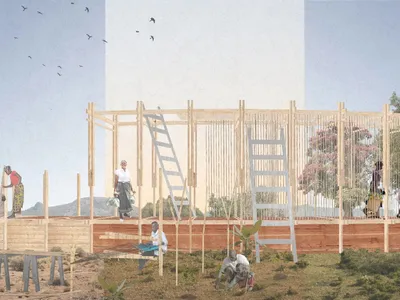
Healing Façade: A Modular Chapel System That Restores Ethiopia's Sacred Forests
Winner of the Eco-Chapel competition, this circular timber façade collects water from air to rebuild soil and reforest degraded Ethiopian landscapes.
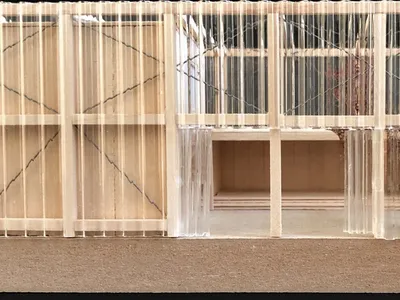
Kaffeebühnen: Where Coffee Shop Architecture Becomes a Civic Stage in Vienna
A linear sequence of timber boxes, transparent shells, and open yards turns the Viennese café tradition into a public performance space.
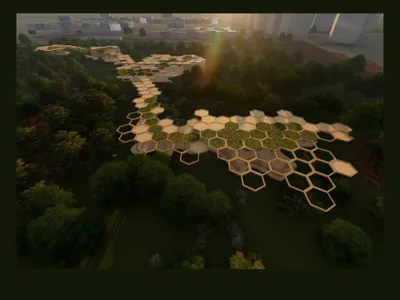
Eco Chapel: A Modular Forest Pavilion That Grows Like the Landscape It Protects
Hexagonal timber modules weave through existing trees, turning a chapel into a living system for prayer, education, and reforestation.


Urban Forest: A Vertical Ecosystem for 5,000 Workers in Singapore's Changi Business Park
Radially stacked pods and layered green decks turn a 7-acre plot into 47 acres of ecological workspace projected for 2040.

Explore Conceptual Architecture Competitions
Discover active competitions in this discipline

Challenge to design a portable theatre

Challenge to design a portable music platform

Challenge to design an open learning module for the elderly
Comments (0)
Please login or sign up to add comments
No comments yet. Be the first to comment!