
Parallel and Staggered: Rebuilding Aleppo Through Spatial Choreographies of Grief and Hope
A post-conflict memorial landscape in Aleppo guides visitors through five emotional atmospheres, from underground grief corridors to sunlit public plazas.


What does it mean to rebuild a city that has lost not just its buildings but its collective sense of self? In Aleppo, where entire neighborhoods were reduced to rubble and centuries of cultural layering were shattered in a few brutal years, the question of reconstruction is inseparable from the question of psychological recovery. Parallel and Staggered refuses the binary of memorial versus functional architecture. Instead, it proposes a continuous spatial sequence that moves visitors through five emotional atmospheres: historical grief, reflection, uncertainty, coexistence, and regeneration. The underground corridors carry the weight of memory; the ground-level plazas invite the city back to life.
Designed by Lyu Liqi and published on uni.xyz, the project treats Aleppo's war-torn terrain as both wound and canvas. A rigorous site analysis maps zones of destruction, areas of dense historical significance, disrupted movement flows, and points of emotional resonance for collective memory. From this forensic reading of trauma, the design constructs a framework where architecture responds not only to functional needs but to the psychological dimensions of a recovering society. The result is part memorial landscape, part civic infrastructure, and entirely a ritual journey rather than a static monument.
Five Atmospheres Below Ground
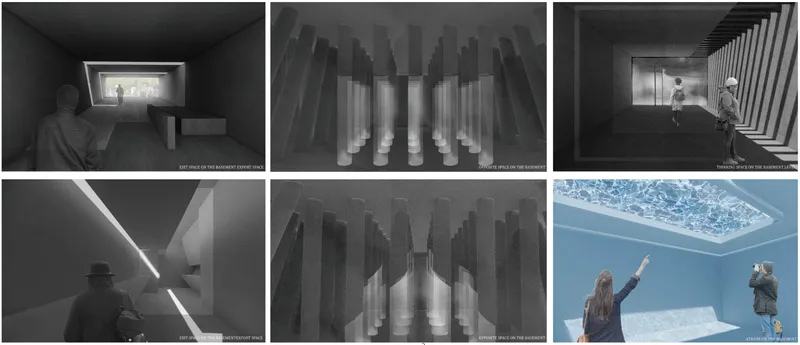
The underground level is the emotional core of the project. Light, shadow, compression, and materiality create rhythms that correspond to distinct stages of the Syrian conflict's psychological aftermath. The sequence begins with the Market of Prosperity, a reinterpretation of Syrian bazaar culture where exchange symbolizes continuity and survival, encouraging dialogue and the slow reconstruction of community ties. It moves through the Ceremonial Space, where vertical light wells and reflective surfaces merge personal memory with collective memory, and then into the Space of Perception, a room where controlled lighting and material transitions strip the world down, enabling visitors to encounter emotion as phenomenon rather than narrative.
The fourth atmosphere, the Opposite Space, physically embodies duality: parallel paths diverge and reconnect, symbolizing different perspectives of the same history. Conflict and coexistence are not argued here but spatially experienced. Finally, the First Park transitions visitors from darkness to nature, signifying healing. The composite view above reveals the range of these interiors: skylit chambers with suspended fabric baffles, gallery spaces scaled to the individual body, and moments of collective gathering. Memory in this project is not observed from a distance. It is felt.
Stone Arches and Dappled Light as Thresholds

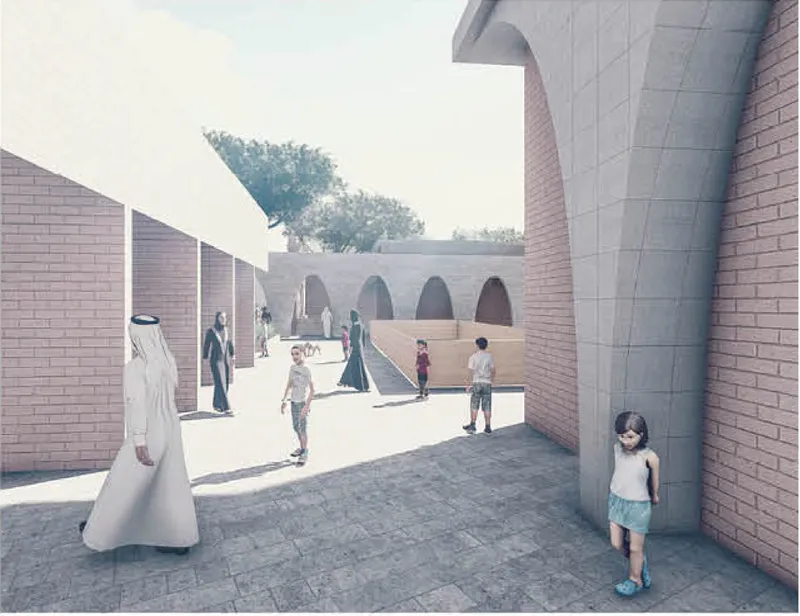
The transition from underground memorial to public ground level is handled with deliberate care. Arched openings in light stone walls recall the vernacular language of Aleppo's historic architecture, yet their proportions and spacing are tuned to the project's own rhythm. Dappled tree shadows fall across the stone, softening what could otherwise read as monumental. Visitors pass through these thresholds casually, as they would move through a souk or a neighborhood passage, and that ordinariness is precisely the point. The architecture does not announce the emotional shift; it lets the body register it.
The courtyard beyond these arches reinforces the strategy. Brick walls flank a generous paved plaza open to the sky, where people gather in clusters. The scale is communal without being institutional. This is the Entrance Plaza described in the program, a space that functions as a threshold between the city's daily rhythms and the deeper memorial journey below. It is public space designed to be claimed by its users rather than curated by its architects.
Barrel Vaults and the Weight of Passage
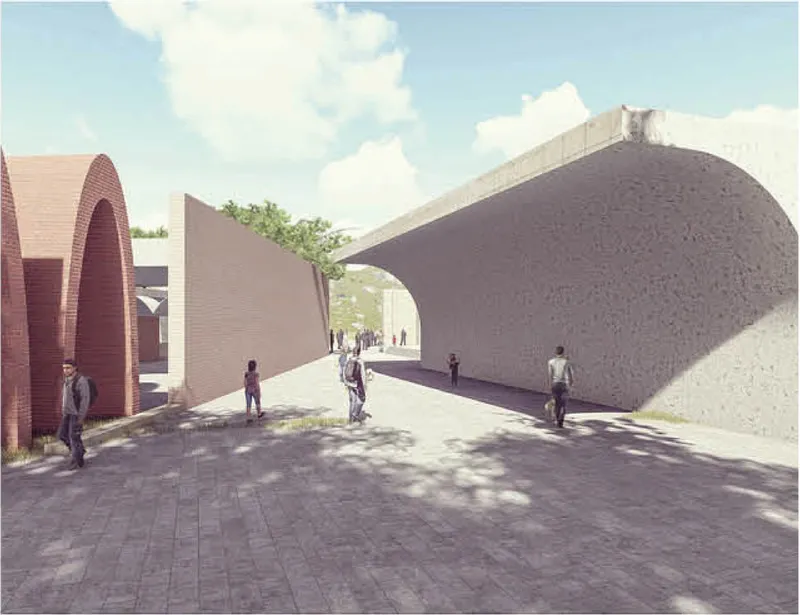
A barrel-vaulted passage with rough concrete walls connects two courtyards, and the material choice here is significant. The concrete is unfinished, bearing the texture of its formwork, a deliberate echo of construction-as-process in a city where so much remains half-built or half-destroyed. People walk through dappled sunlight that filters from above, and the compression of the vault forces a slower pace. The passage is not merely circulation; it is a moment of controlled introspection between two public spaces. The parallel and staggered logic of the project manifests here at an intimate scale: two directions of movement, two experiences of the same corridor, overlapping but never identical.
Columns, Cubes, and the Ground-Level Shift to Public Life
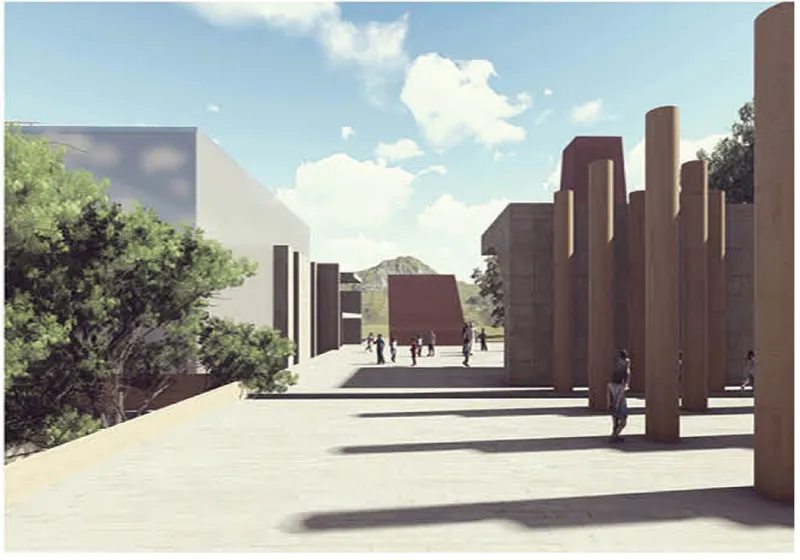
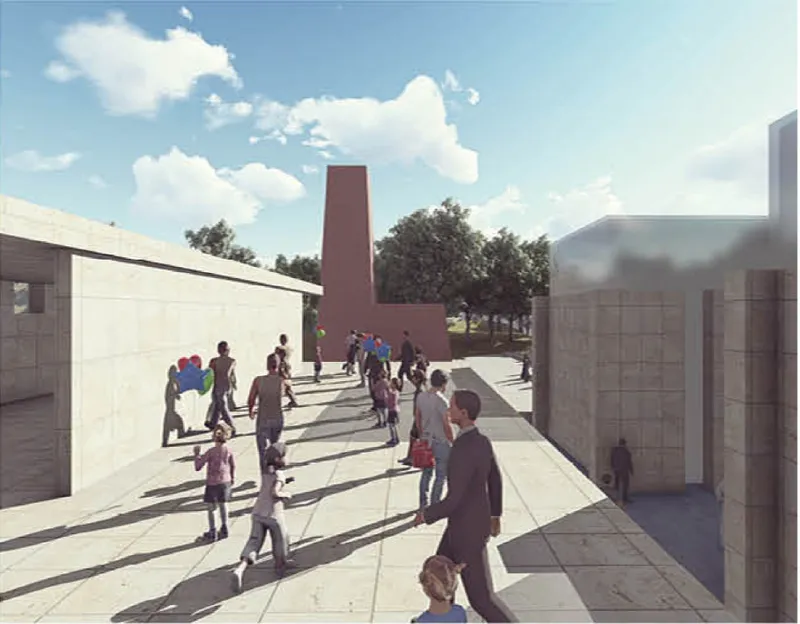
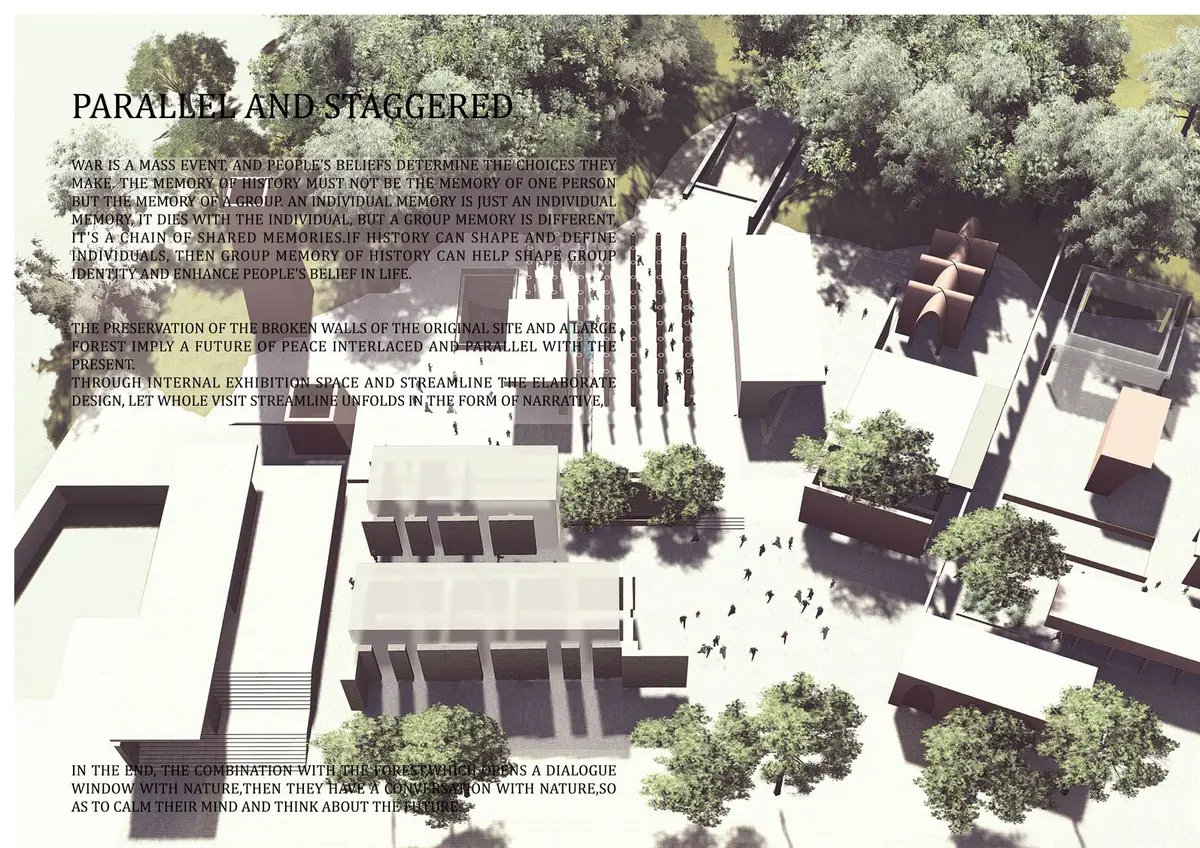
At ground level, the project's narrative pivots from introspection to interaction. A plaza organized around tall cylindrical columns and low cubic volumes creates a landscape of varied scale, where individuals can find both exposure and shelter. The columns establish a loose colonnade that structures movement without dictating it, while the cubic volumes house supporting functions woven discretely into the circulation. Under a partly cloudy sky, scattered visitors occupy the space with the unhurried quality of everyday urban life, which is exactly the condition the design seeks to restore.
A second courtyard view shows crowds crossing sunlit pavement between low pavilions and a tall red masonry tower. The tower is a vertical anchor in an otherwise horizontal composition, and its red masonry distinguishes it materially from the stone and concrete palette of the memorial spaces. This is the Prosperity Space, designed as a social environment celebrating community. The ground floor program includes an Exhibition Hall for narratives of resilience and cultural heritage, a Sensing Entrance that introduces the emotional journey through subtle material cues, and service spaces threaded through the plan. Together, these elements make the ground level a place where daily life and collective memory coexist without hierarchy.
Reading the Whole from Above
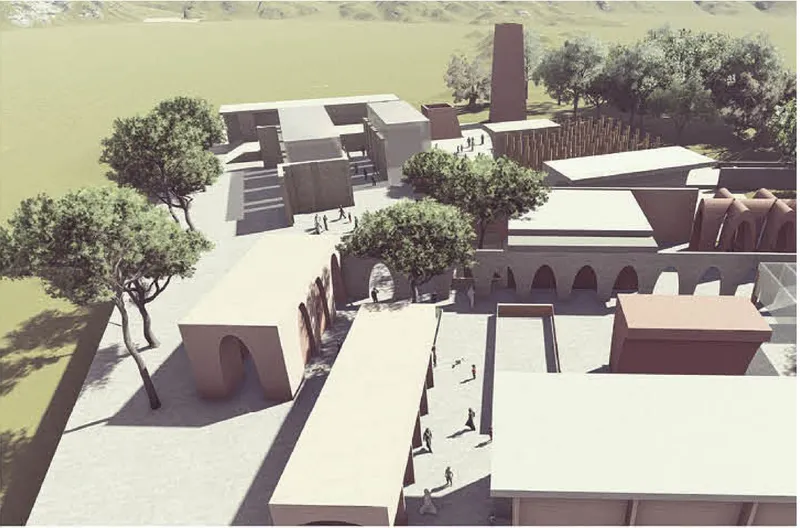

The site model reveals the full logic of the scheme. Angular building volumes are set among dense tree clusters and organized around a central colonnade, and the plan's geometry becomes legible: parallel alignments create order, while staggered offsets between buildings generate the pockets of intimacy, surprise, and variation that make the sequence work. The landscape is not decorative. Dense planting reclaims terrain that was once defined by destruction, and the trees provide the shade, sound, and seasonal change that no amount of concrete can replicate. The architecture and landscape operate as co-authors of the experience.
Why This Project Matters
Post-conflict architecture risks two common failures: sentimentalizing trauma into frozen monuments or ignoring it entirely in the rush to normalize. Lyu Liqi's design avoids both by treating memory and daily life as spatially continuous rather than opposed. The underground corridors are not a museum you visit once; they are woven into the movement patterns of a functioning public landscape. The ground-level plazas are not amnesiac; they carry forward the material and spatial language of the memorial below. The project demonstrates that healing is not a destination but a sequence, one that architecture can choreograph without controlling.
For Aleppo, a city whose identity was forged over millennia and nearly erased in a decade, the proposition is radical in its gentleness. The five emotional atmospheres do not prescribe how visitors should feel. They provide the spatial conditions for feeling to occur. In an era when memorial design often defaults to spectacle, Parallel and Staggered insists on something quieter and more durable: architecture as a framework for collective processing, where grief and hope occupy the same ground, parallel and staggered, never quite resolving but always moving forward.
View the Full Project
About the Designers
Designer: LYU LIQI
Enter a Design Competition on uni.xyz
uni.xyz runs architecture and design competitions year-round that reward proposals with spatial conviction and real site intelligence.
Project credits: PARALLEL AND STAGGERED by LYU LIQI.


Popular Articles
Popular articles from the community


GROUP A Strips a 1969 Rotterdam Harbor Headquarters to Its Frame and Wraps It in Timber Louvers
In Rotterdam's M4H harbor district, Ferro Offices reuses a 1969 frame, adds one timber storey and reaches BREEAM-NL Outstanding.

longwave studio Reorganizes a 112 m² Tainan Apartment Around the Daily Routines of a Family and Two Cats
In Tainan, Taiwan, birch plywood, rust-red furniture and a freestanding plaster wall link arrival, storage, work and family life in one apartment.

Cube Design Draws an Ecological Corridor Between Two Shenzhen Hills with the Nankai Building
Beside Shenzhen's container docks, the Nankai Building pairs stacked balconies with a climbing green screen to connect two hillsides across its height.

LT2A and OPEN Architectes Thread a Brick and Glass High School Through a Wooded Belgian Campus
In Braine-l'Alleud, a 3,000 m² wing for Collège Cardinal Mercier pairs pale brick with a glazed colonnade, deferring to a small chapel and a dense wood.

Similar Reads
You might also enjoy these articles


Aquadapt: An Underwater Habitat That Rewrites Its Rooms by the Hour
Curved modules ring the seabed while one shell shifts from breakfast room to cinema, farm and football pitch as residents' needs change.

Play: Fragments of Their World: Remembered Architecture Rebuilt as a Modular Playground for Refugee Camps
Tom Gardner abstracts domes, arches and towers from the homelands of displaced families into a kit of child-scaled play parts for camp settlements.
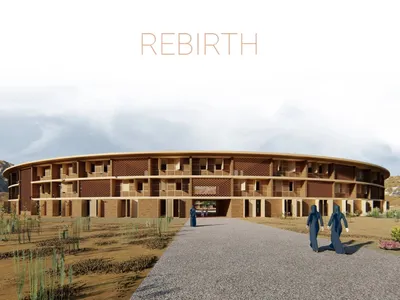
REBIRTH: A Circular Settlement Where Afghan Widows and Their Children Rebuild Life Together
A shortlisted Resile entry turns the circle into a protective ring of timber and brick, gathering homes, classrooms and gardens around a shared landscape.
The Main Dream: A Recycled Plastic Kit That Lets Refugee Children Build Their Own Playground
Thirty-centimetre interlocking cubes that connect on three axes turn play into construction, letting children author the spaces they occupy.

Comments (0)
Please login or sign up to add comments
No comments yet. Be the first to comment!