
Pardo Converts a Portuguese Quinta Outbuilding into a Stone and Timber Family Home
In rural Viana do Castelo, a former school, winery, and storage barn becomes a 360 m² house rooted in its own landscape.


Before it became a house, the building at the western edge of this family quinta in Viana do Castelo served as a school, a winery, and an agricultural store. That layered history is exactly the kind of thing renovation projects tend to erase, smoothing over the scars of previous lives with clean plaster and new windows. Pardo's QBN House does something more careful. The 360 m² rehabilitation keeps the schist masonry volume that faces the lane, extends pre-existing walls vertically using stone quarried from the property itself, and introduces a wood structure that reads as continuous with the roof rather than imposed upon it.
What makes the project worth studying is its refusal to choose between preservation and comfort. The architects maintained every existing opening and added new ones calibrated to the tree canopy outside, so that interior rooms are framed not by views of a generic garden but by specific colors of foliage shifting through the seasons. The result is a house that feels grown from its site rather than placed upon it, where construction materials, spatial sequence, and landscape merge into a single argument.
Two Volumes, One Lane
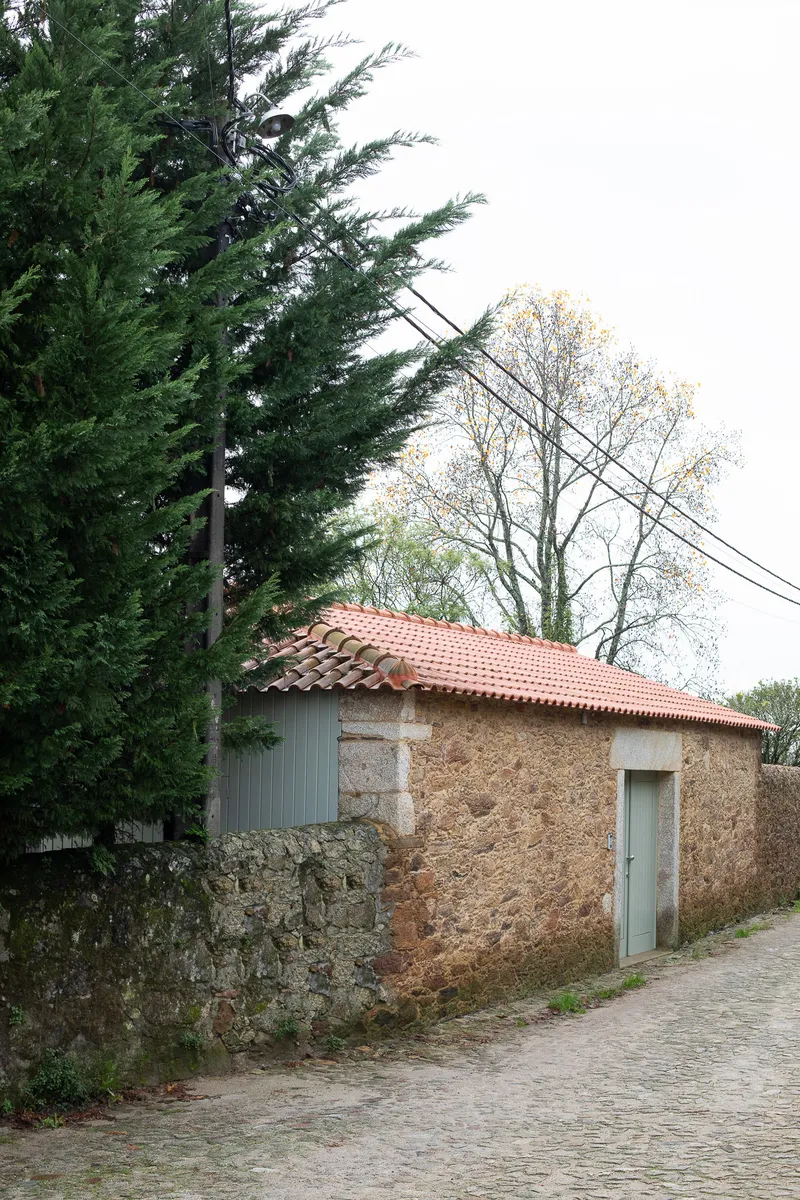


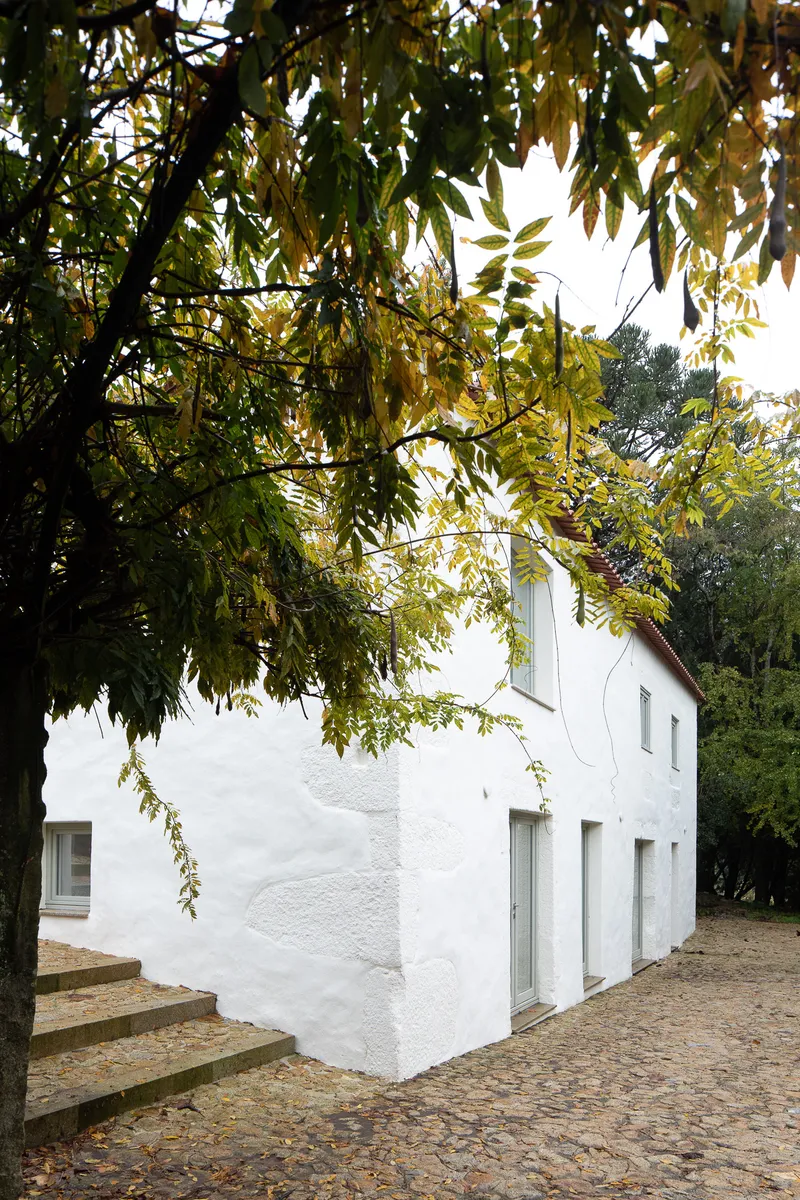
The project reads from the cobblestone lane as two juxtaposed stone masonry volumes: a covered but not fully enclosed structure adjacent to the street, and a two-story building attached behind it. The first volume, with its schist walls and red clay tile roof, is deliberately left legible as an agricultural building. A sage green corrugated metal addition inserted between the whitewashed wall and the stone structure signals that something new has arrived without shouting about it.
This quiet hierarchy matters. In low-density rural Portugal, where quintas are composed of multiple buildings at varying elevations connected by stone walls and paths, the identity of each volume contributes to the legibility of the whole. Pardo understands this, keeping the house subordinate to the landscape ensemble rather than treating the site as a backdrop.
Entering Through Stone

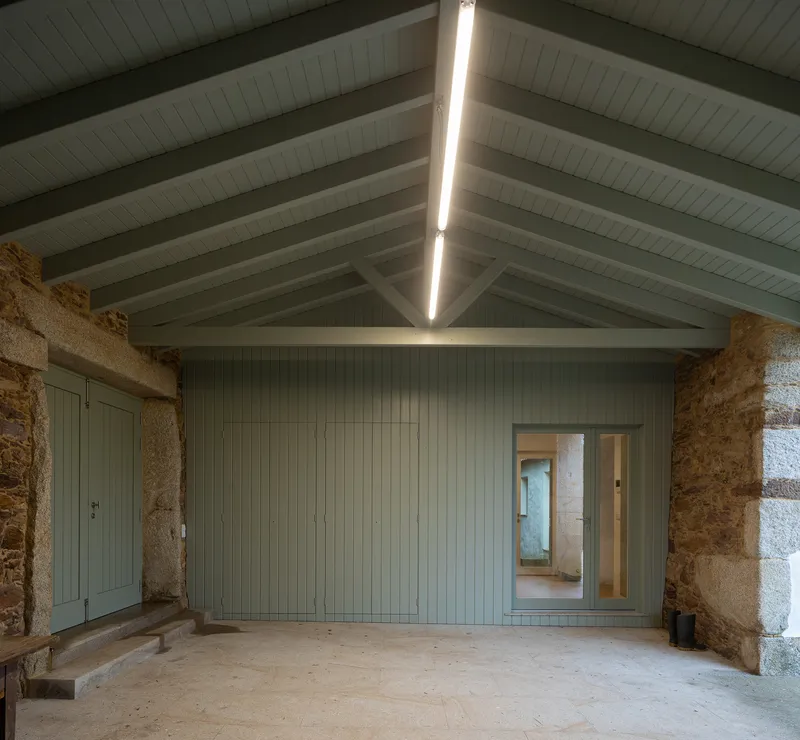

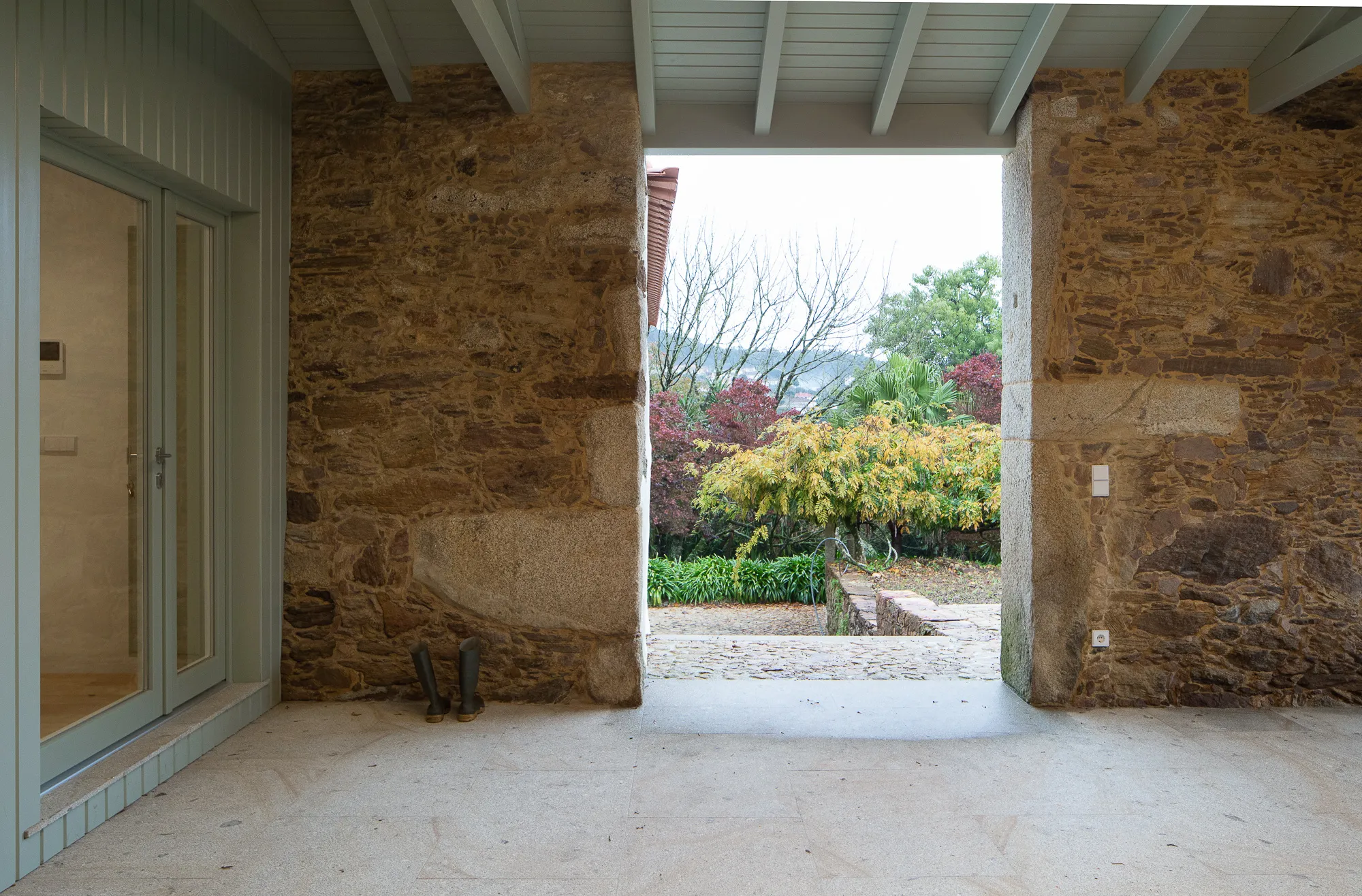
Access occurs at the upper floor level through the covered zone, a passage defined by exposed stone walls and painted timber ceiling beams that frame a garden view at its far end. It is a threshold that works cinematically: you move from the compressed, mineral space of rough granite into daylight and vegetation, and only then arrive at the office and the connection to the main volume. The sequence slows you down, which is the point.
Granite door frames, painted timber double doors, and the raw corners of stone visible at every junction between old and new keep the material history tangible. The architects did not conceal the joints; they celebrated them. A vertical paneled wall meeting a granite corner reads like a deliberate conversation between centuries of construction practice.
Living Under the Vaulted Ceiling

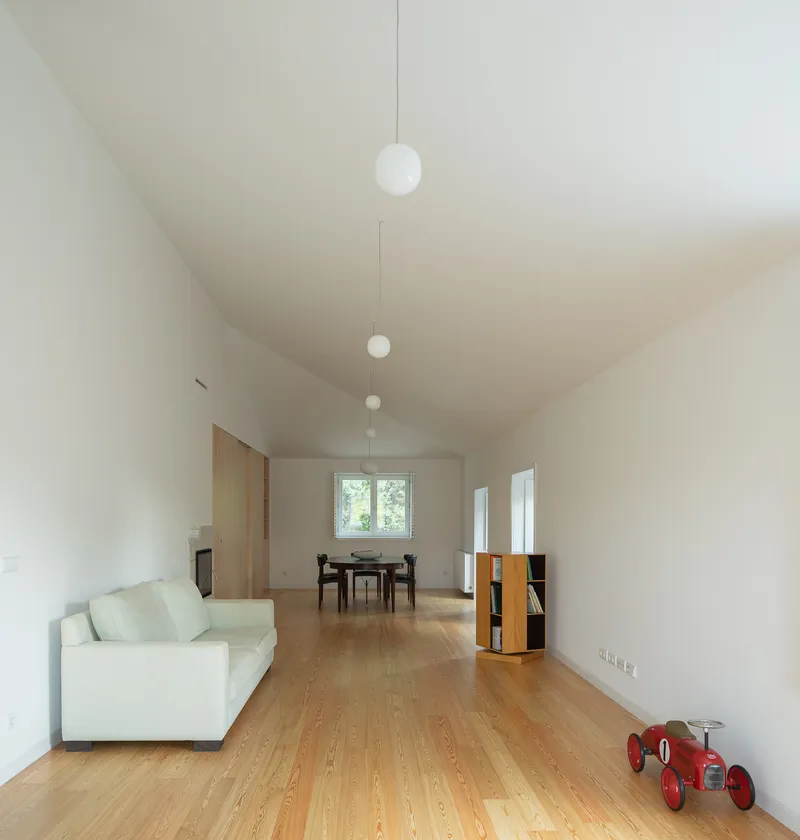

The main volume houses the common areas of the house under a wood-structured roof that spans the full width. Oak flooring runs continuously through the open living and dining spaces, while the vaulted ceiling lifts the proportions of what could have been a low, oppressive barn interior into something generous. Pendant lights suspended in a row establish rhythm without competing with the structure above.
A marble-clad fireplace anchors one end, its surround deliberately monolithic against the warmth of the wood. A sliding timber panel beside it reveals the kitchen beyond, a move that lets the fireplace wall act as both hearth and threshold. The intermediate floor slab, composed of OSB and tricapa over laminated wood beams, keeps the palette consistent: everything structural is legible, and everything legible is warm.
Windows Calibrated to Canopy


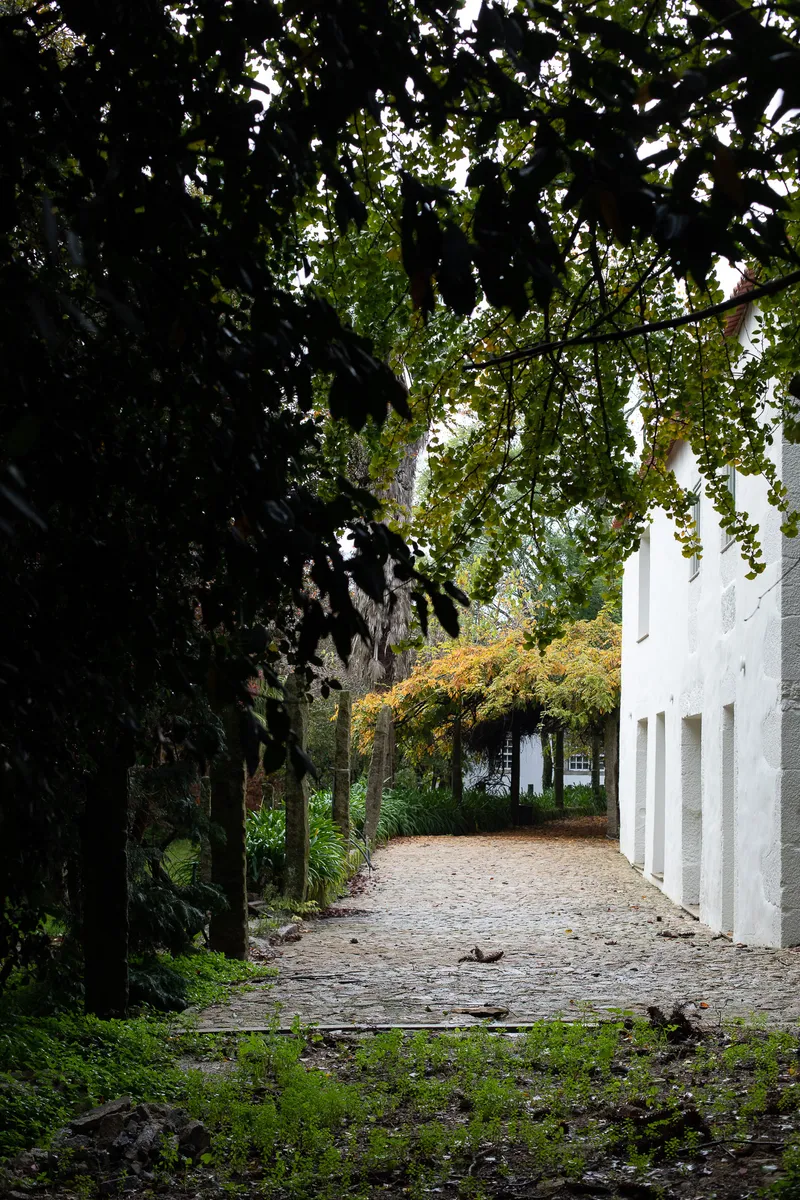
The most distinctive decision in the project is how new openings relate to the landscape. Existing windows were preserved, but the additions are placed specifically at tree canopy level: ribbon windows that frame autumn foliage, terrazzo-lined window seat alcoves that turn a casement into a place to sit, and framed views that treat the garden as a painting that changes with the seasons. Looking down the timber staircase, the eye lands not on ground but on golden leaves.
This is landscape strategy executed through fenestration. The varied trees, flowers, shrubs, level changes, schist paths, granite water tanks, and orchards that characterize the quinta are not just outside the house. They are inside it, pulled in through apertures that the architects clearly positioned one by one. It is painstaking work that reads as effortless.
Circulation as Spatial Event
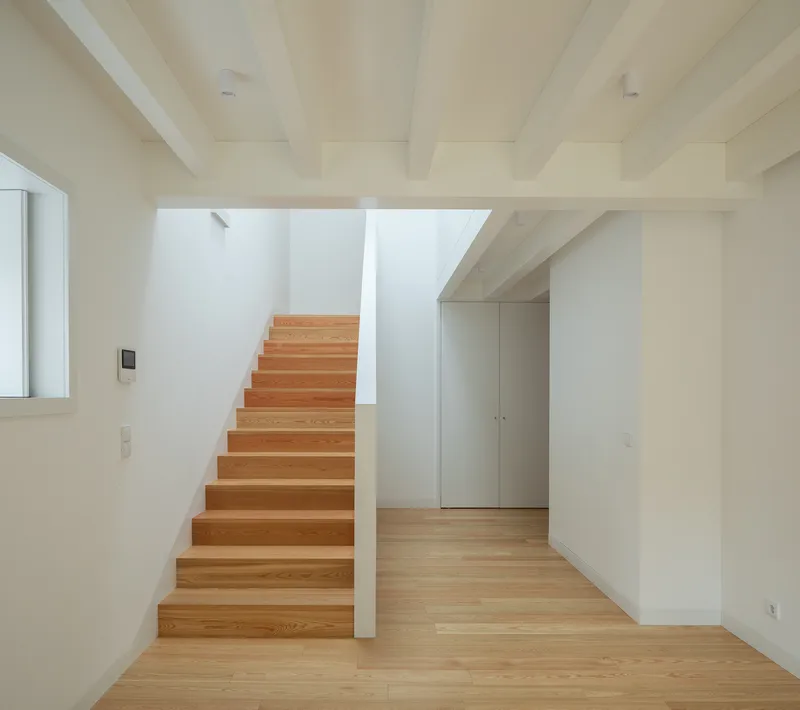

The timber staircase rises through a double-height volume, its exposed ceiling beams working in tandem with the wood flooring to create a vertical core that connects the domestic levels. But circulation here is not merely functional. Hallways feature angled ceiling planes that compress and release as you move through them, and tall vertical windows cast shafts of light that change position throughout the day.
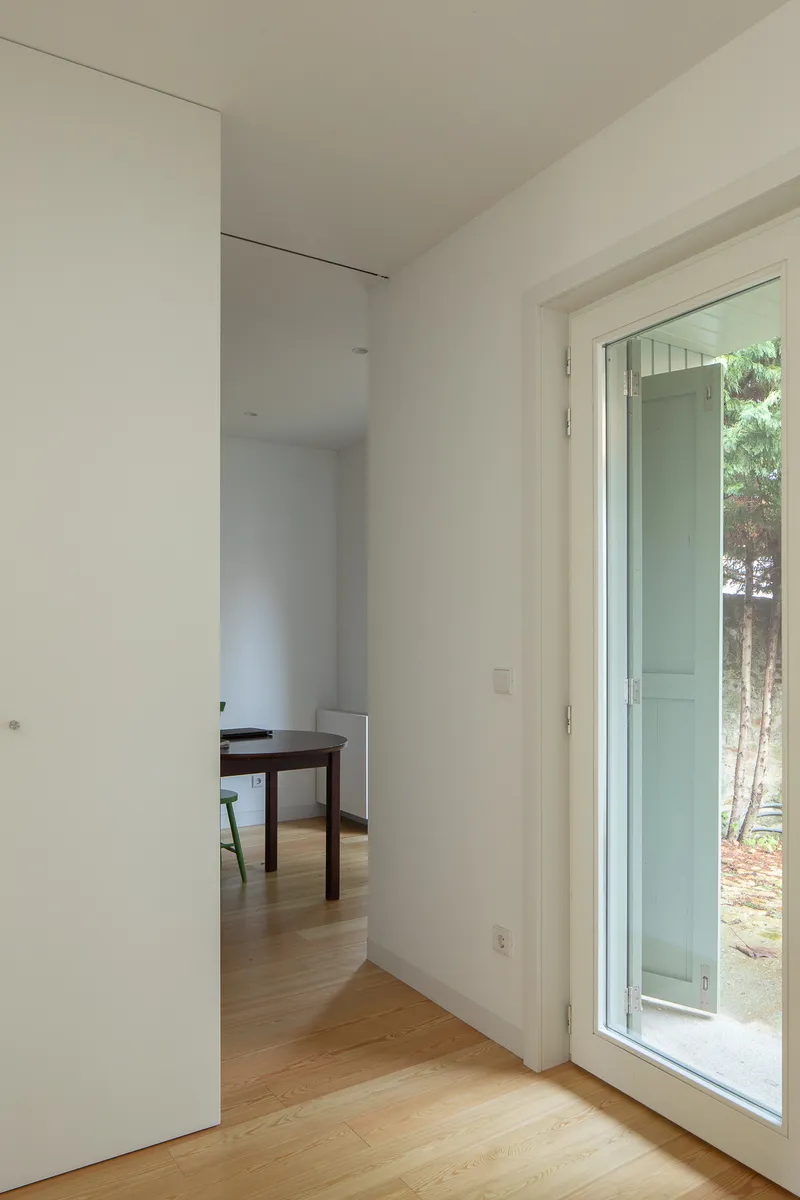
A full-height glazed door opens directly from the circulation space to the garden, with pine needles underfoot on the other side. The boundary between indoors and outdoors is permeable at nearly every turn, reinforcing the sense that the house is not a sealed object but a series of rooms loosely held within the quinta's broader territory.
Bedrooms Open to the Garden

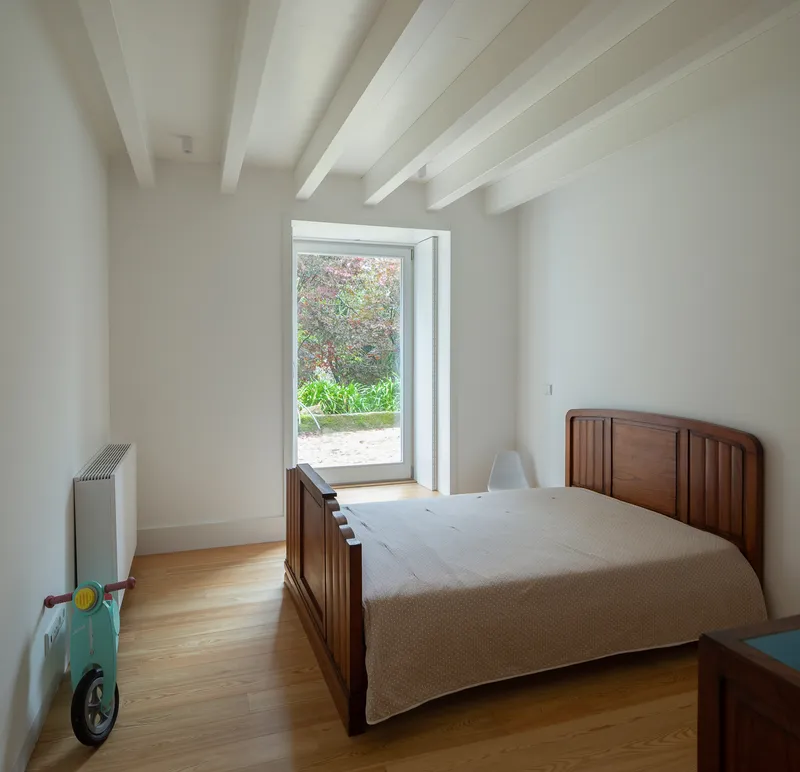
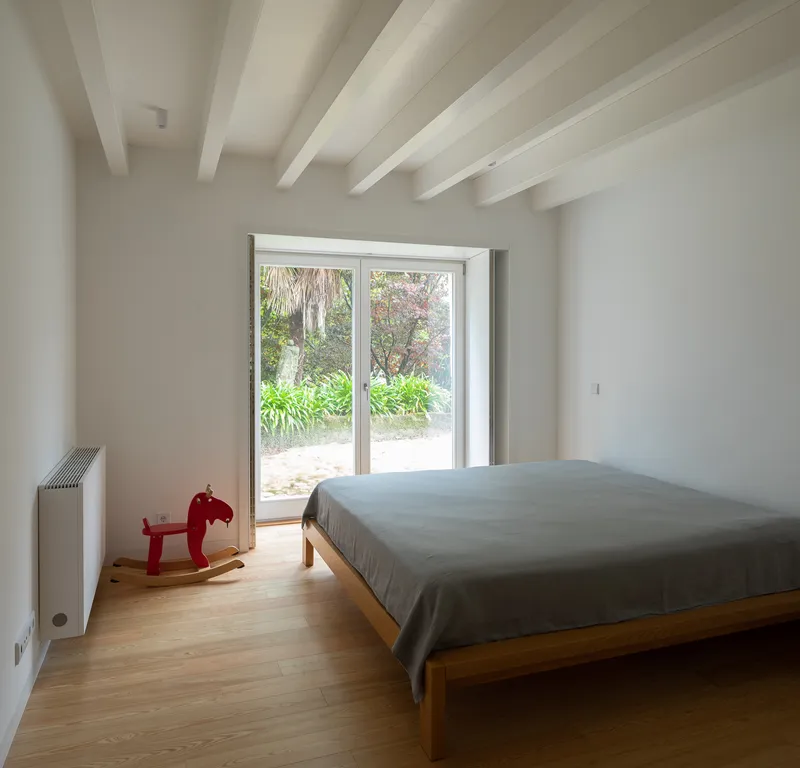
Each bedroom opens through glass doors to a planted courtyard or garden view. Exposed white beams overhead, timber bed frames, and restrained material choices keep these rooms from competing with the landscape they face. One room looks out to a palm tree; another to dense vegetation that filters light into soft green. The architects let the garden do the decorating.
The consistency is notable. Cork aggregate insulation, thermally treated pine cladding, and wood window frames, shutters, doors, and furniture all come from the same material family. Nothing synthetic intrudes. The bedrooms feel insulated from the world not by technology but by layers of stone, wood, and foliage that have been working together on this site for a long time.
After Dark on the Quinta


At dusk, the stone staircase ascending through dense foliage toward an illuminated doorway reveals the project's deepest ambition: to make arrival feel like discovery. The white rendered facades glow softly between evergreen trees, and the horizontal slot windows that looked restrained in daylight become lanterns. The house does not perform for the landscape; it participates in it, modulating its presence with the falling light.
Plans and Drawings


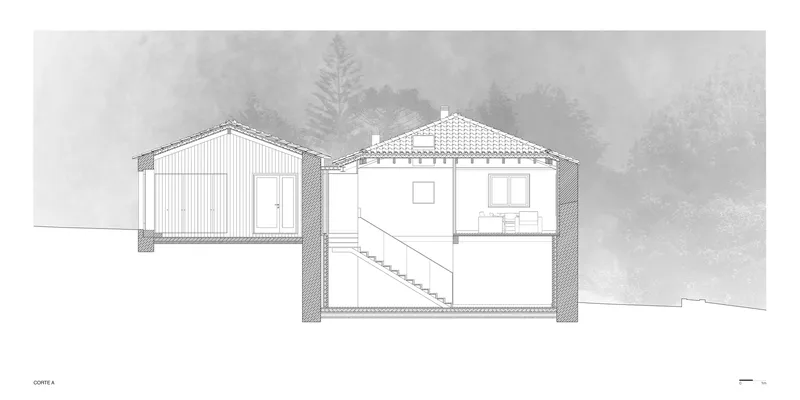
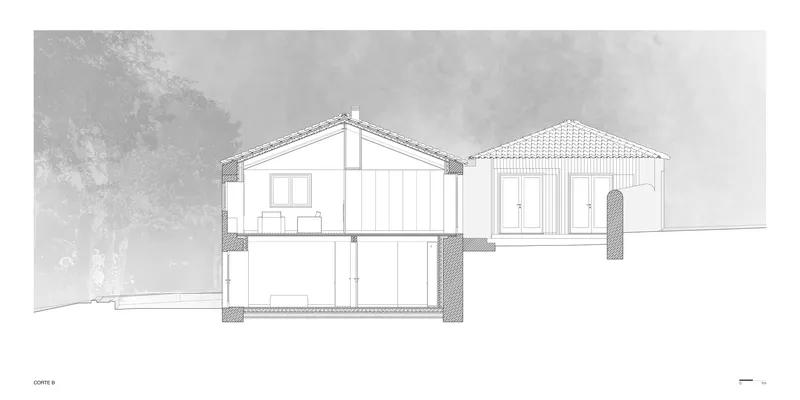


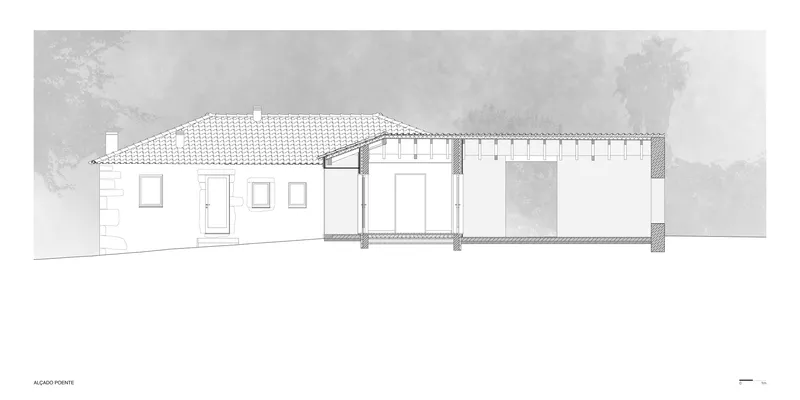
The floor plans confirm the split-level logic: upper level access leads through the covered entrance zone to an office, then into the main volume where living, dining, and kitchen spaces flow around the central staircase. The lower level accommodates three bedrooms and two bathrooms, each opening to the garden. The section drawings are the most revealing documents here, showing how the two gabled roof profiles step down the slope and how the staircase stitches the volumes together across the grade change.
The elevations illustrate the restraint of the exterior treatment. White render, terracotta tile, and stone are the only materials visible. A covered porch connecting the two wings reads in elevation as a deliberate pause, a void between solids that the landscape colonizes. The drawings also reveal just how much of the original masonry structure was retained: the new roof sits atop walls that have been standing, in various configurations, for generations.
Why This Project Matters
Rural rehabilitation in Portugal too often falls into one of two traps: nostalgic pastiche that freezes a building in an imagined past, or aggressive modernization that treats the existing structure as a shell to be gutted. QBN House avoids both by treating the pre-existing building as a collaborator rather than a constraint. Stone from the property extends the walls. Openings are tuned to specific trees. The wood structure reads as a continuation of the roof rather than an insertion. Every decision reinforces the idea that the house belongs here, not just physically but culturally.
The project also offers a quiet lesson in material economy. Cork insulation, locally sourced stone, OSB and laminated wood floor structures: none of these are exotic, and none of them are cheap tricks. They are sensible choices made by architects who understand that in a landscape this rich, the building's job is to be specific, grounded, and self-effacing. Pardo has delivered a house that will likely outlast its current owners precisely because it was never designed to impress. It was designed to belong.
QBN House by Pardo. Viana do Castelo, Portugal. 360 m². Completed 2022. Photography by José Campos.
About the Studio
Share Your Own Work on uni.xyz
If projects like this are the kind of work you want to make, uni.xyz is a place to publish your own, find collaborators, and enter design competitions.



Popular Articles
Popular articles from the community


Hill & Cross Opera: Sculptural Opera House Architecture Shaped by Tallinn’s Landscape and Identity
Hill & Cross Opera reimagines opera house architecture in Tallinn through its sculptural hill, civic plaza, glass wave and a luminous cross.

Co-life: Sustainable Architecture for Age-Friendly Community Living
Co-life reimagines sustainable architecture for seniors through courtyards, rammed earth, shared gardens, and spaces designed for belonging.

AL-JANNAH: Sustainable Architecture and Permaculture for Afghan Widows
AL-JANNAH uses sustainable architecture and permaculture to create resilient oasis of housing, learning, work and renewal for Afghan widows.

The Ocean Hive: Sustainable Architecture for a Self-Sufficient Civilization at Sea
The Ocean Hive imagines sustainable architecture at sea, where modular habitats, algae, wave power and ocean waste sustain a growing colony.

Similar Reads
You might also enjoy these articles

Bao Huynh Watercolor Atelier: A Serene Art Retreat in Hội An
Bao Huynh Watercolor Atelier in Hội An blends multifunctional art spaces, sustainable design, local materials, and family-friendly living in a serene environment.

Atelier Macri Concept Store Interior Design by CASE-REAL
Atelier Macri store features a "ko" counter, walnut wood details, cork displays, blending retail, gallery, and seamless customer experiences.

Manuel Vargas Izquierdo Stadium and High-Performance Sports Center: Architectural Excellence in Jalpa de Méndez
The Manuel Vargas Izquierdo Stadium blends sustainable design, inclusive sports facilities, and cultural-inspired architecture, revitalizing Jalpa de Méndez’s public spaces.

KAKR Buluh Awar Hall: Revitalizing Community and Ecology Through Bamboo Architecture
Community built bamboo hall revitalizes Buluh Awar village, empowering youth, restoring ecology, celebrating vernacular craftsmanship through sustainable architecture and culture.

Explore Residential Building Competitions
Discover active competitions in this discipline



Challenge to design a portable theatre


Challenge to design a portable music platform

Challenge to design an open learning module for the elderly


Challenge to design mud housing for contemporary communities
Comments (0)
Please login or sign up to add comments
No comments yet. Be the first to comment!