
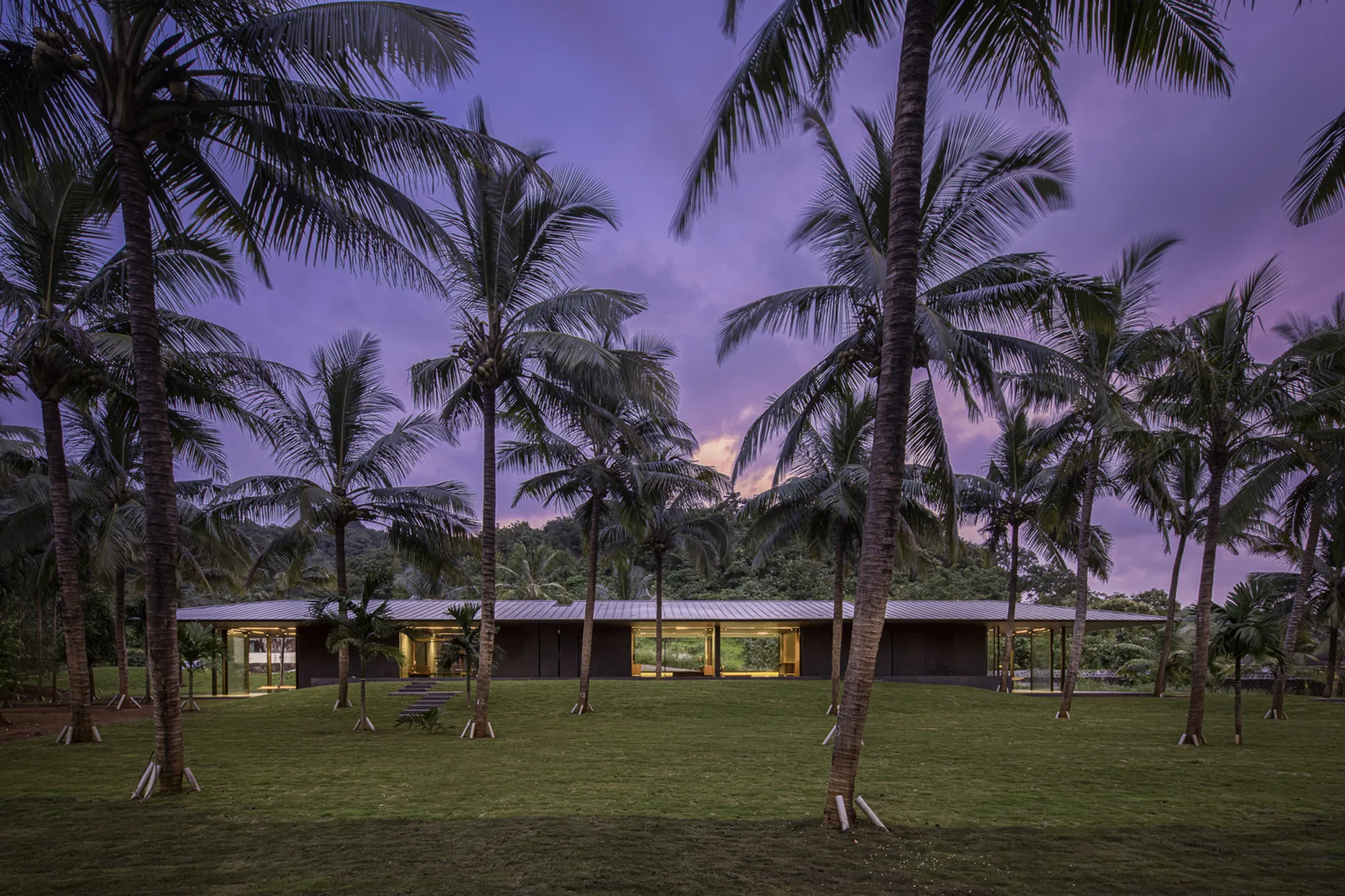
SPASM Design Architects Wrap a Pavilion House Around a Reflecting Pool in Coastal India
Parikrama House pairs raw concrete and brass craft with open-air circulation paths set among coconut palms on India's western coast.


There is a particular kind of house that refuses to announce itself from the road. Parikrama House by SPASM Design Architects is one of those: a low, single-story pavilion that dissolves into a grove of coconut palms and earns its presence through material conviction rather than scale. Set along India's western coast, the project takes its name from the Sanskrit word for circumambulation, a concept that becomes literal in the way the plan routes daily life around a central reflecting pool.
What makes the house worth studying is not its restraint per se, but how precisely that restraint is calibrated. Every surface carries a specific intention: board-formed concrete for thermal mass and shadow play, brass fixtures for warmth against grey walls, timber for tactile intimacy where the body meets the architecture. The result is a home that reads as both ancient and resolutely contemporary, where craft is structural logic rather than ornament.
A Pavilion That Belongs to the Landscape
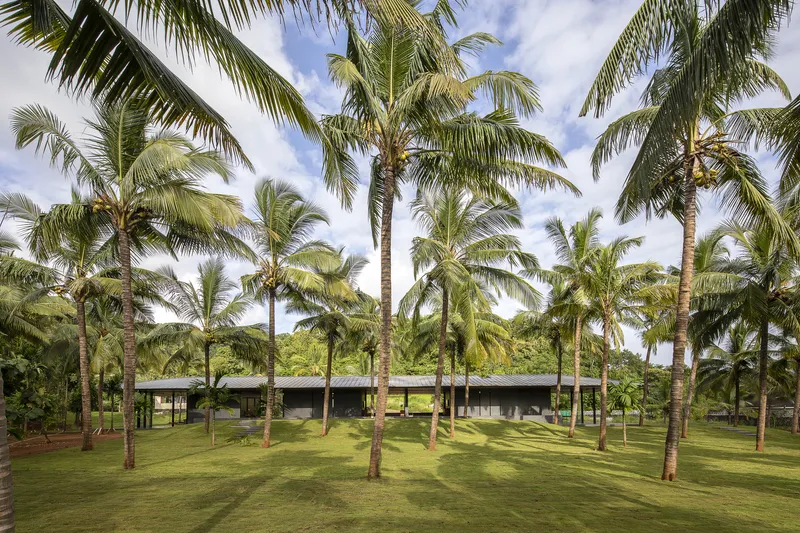

Approached from the lawn, Parikrama House barely rises above the coconut canopy. The overhanging roof plane floats on slender supports, its horizontality reinforcing the flatness of the coastal terrain. At twilight the pavilion becomes a lantern, its full-height glass walls turning translucent and revealing the interior as a warm, inhabited volume. The deliberate choice to stay single-story means the house never competes with the palms; instead it occupies the same stratum, sharing their shade and scale.
The mowed lawn is not manicured for show. It acts as a buffer zone that lets the architecture breathe, keeping mechanical cooling loads low by allowing cross-ventilation from every direction. That simplicity of siting, a rectangle among trees, is deceptively hard to pull off without looking like a resort lobby. SPASM avoid that trap by keeping the plan tight and the material palette grounded.
Circulation as Ritual
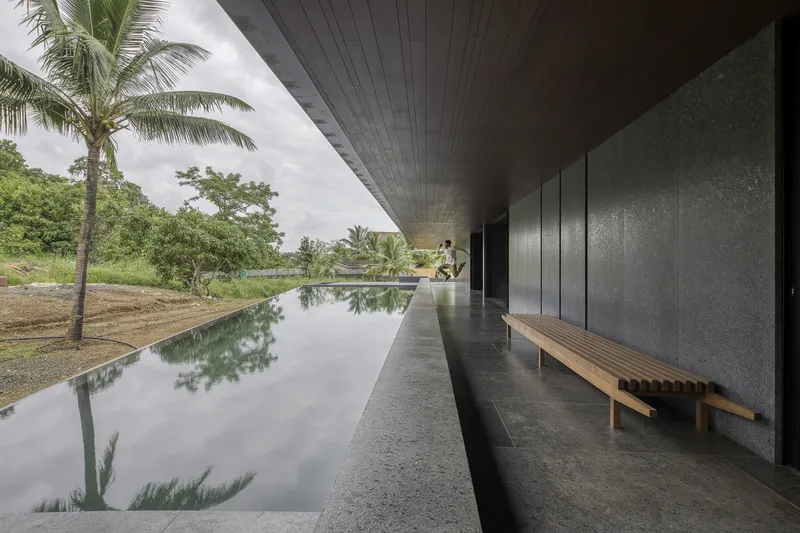

The covered walkway that runs alongside the reflecting pool is the house's spine. A timber bench set against a textured concrete wall turns this passage into a place of pause rather than mere transit. Light skims across the water and bounces onto the rough surface, producing a constantly shifting pattern that makes the corridor feel alive. It is a deliberate borrowing from temple architecture, where the act of walking around a sacred center is itself the experience.
Elsewhere, a cantilevered concrete staircase rises along a similar textured wall, dappled by sunlight filtering through palms. The stair has no visible stringer; each tread projects from the wall as though carved from a single monolith. Together these circulation elements establish a rhythm of compression and release, shadow and light, that sustains attention as you move through the house.
Brass, Concrete, and Timber in Dialogue

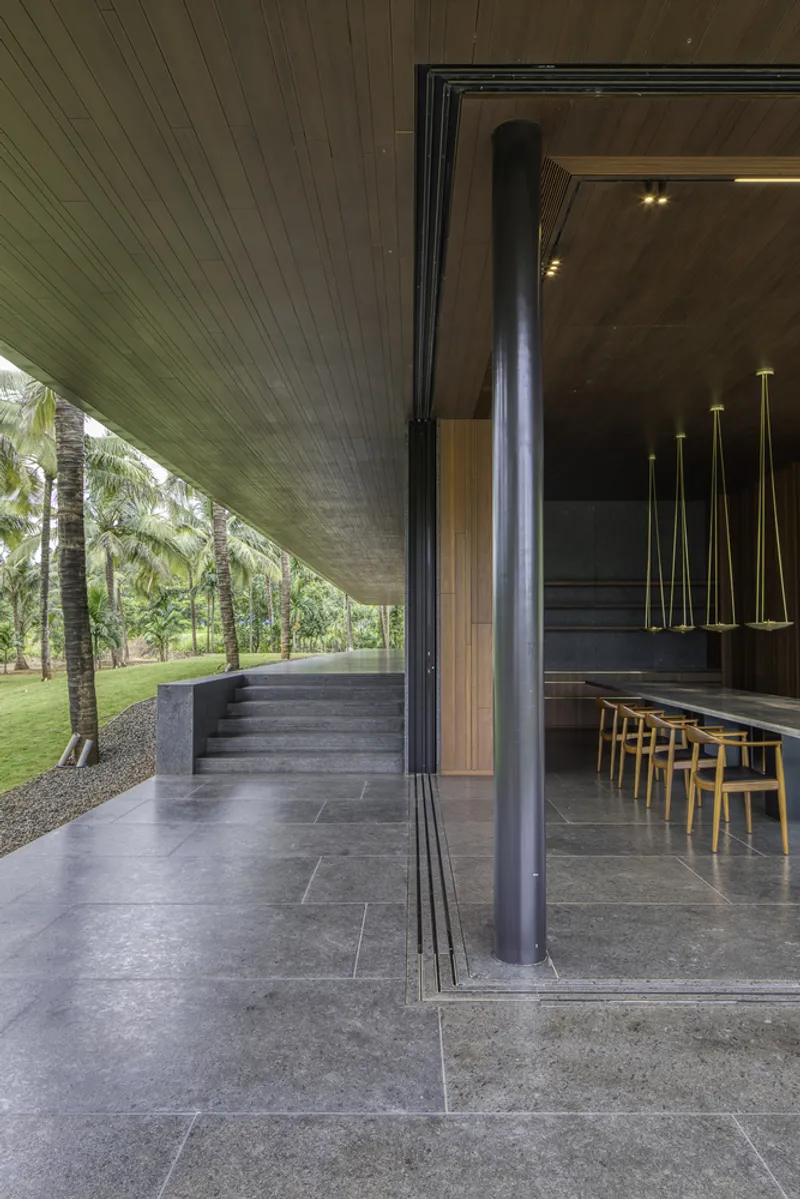
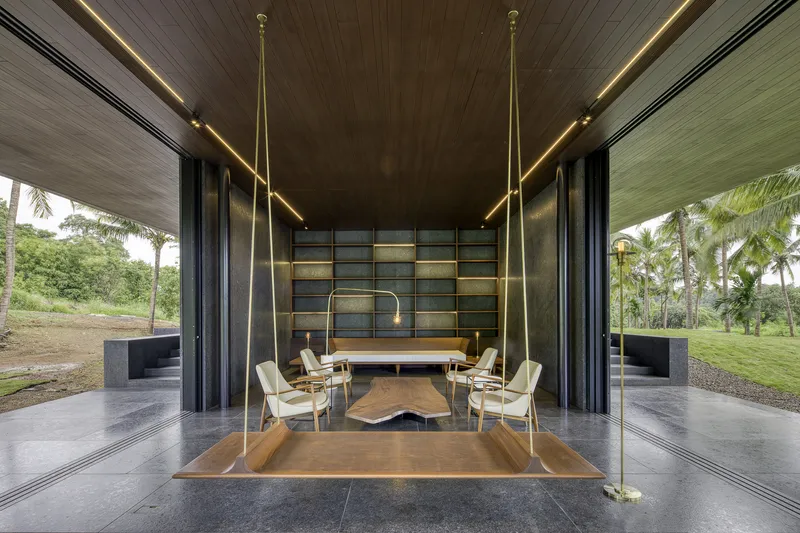
The dining area captures the material thesis in a single frame. A solid timber table sits beneath a row of brass pendant lights, framed by full-height glazing that opens onto the palms. The covered terrace beyond shares the same timber slat ceiling, extending the interior atmosphere outward and collapsing the boundary between inside and out. Steel columns do the structural work honestly, standing free of any cladding.
A suspended timber platform elsewhere in the house introduces a more intimate register. Built-in seating floats between brass rods and linear ceiling lights, creating a room within a room that feels almost like a piece of furniture scaled up to architecture. The brass will patinate over time, drifting toward the dark tones of the concrete, and the timber will silver. SPASM are clearly designing for that future state, not just for the day the photographer arrives.
Details That Earn Their Keep
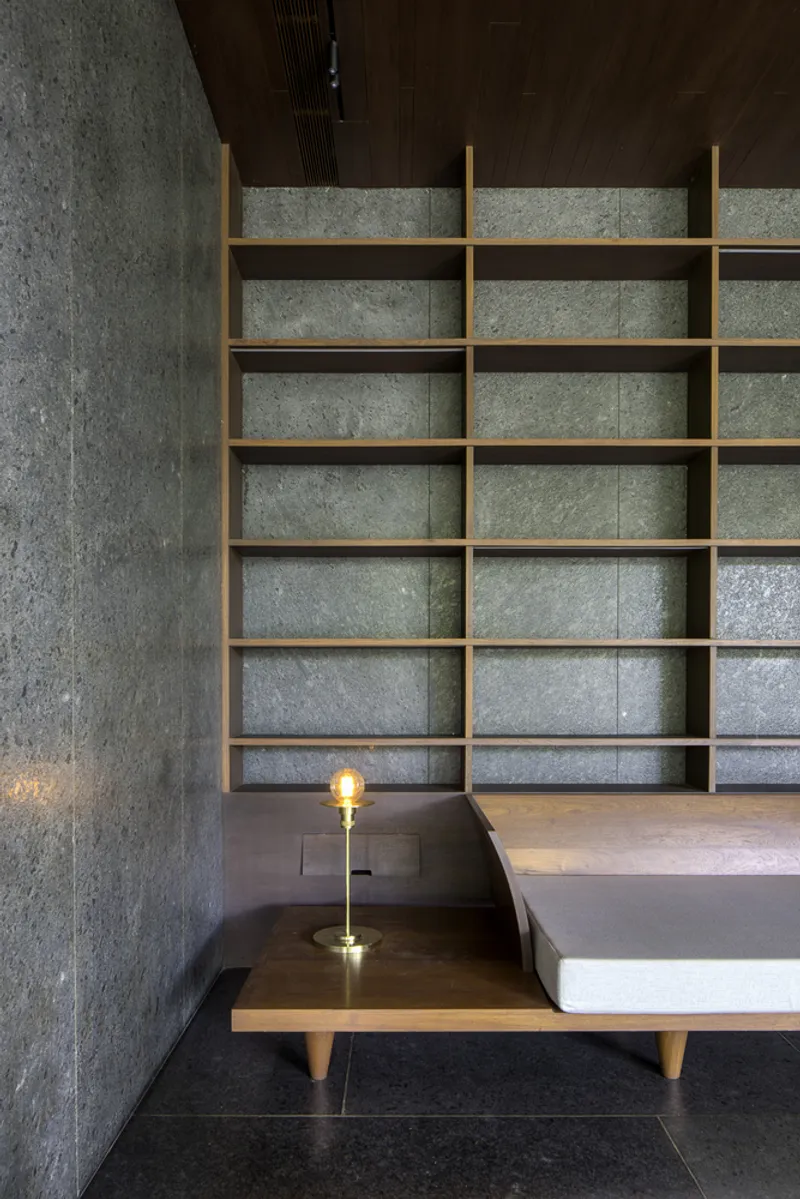

At the scale of a shelf or a vanity, the same discipline holds. A built-in timber shelving unit meets a textured concrete wall with no filler, no trim, just two materials that acknowledge each other's edge. A low platform seat with a single table lamp turns storage into a reading nook. In the bathroom, dark stone wraps an integrated basin with a precision that suggests it was cut from one block, while timber slats below prevent the space from feeling cold.
These details matter because they prove the project's ambition is consistent, not just confined to the big moves. When the joinery matches the structural language, you know the architects were present through construction, not just through concept design.
Plans and Drawings

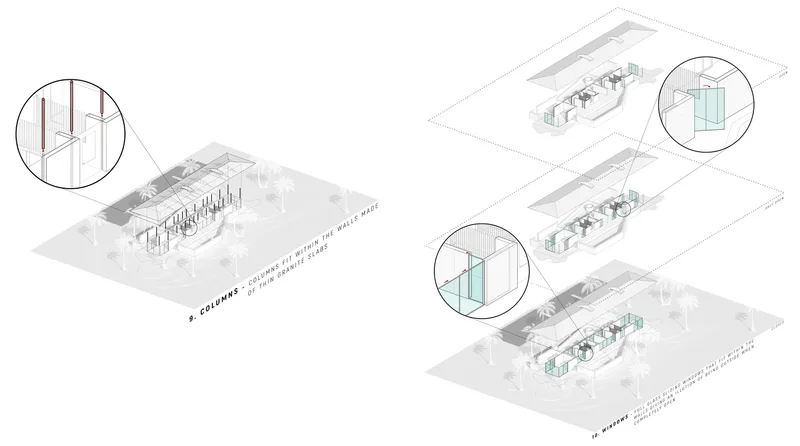
The floor plan reveals the organizing idea at a glance: linear volumes arranged around a central pool, with coconut palms integrated into the plan as architectural elements rather than afterthoughts. The pool is not decorative; it is the axis around which every room orients. An axonometric drawing explodes the building into three layers, showing how structural columns, glazing assemblies, and roof planes work together as an interlocking kit of parts. The clarity of the drawing matches the clarity of the architecture, each system legible and distinct.
Why This Project Matters
Parikrama House is a case study in how regional knowledge and modern minimalism can coexist without either one becoming a costume. The circumambulatory plan is rooted in South Asian spatial tradition, but it is executed with the exposed concrete and glass vocabulary of international modernism. Neither register dominates; they negotiate. That negotiation produces spaces that feel genuinely specific to their place and climate, not transplantable to any other site.
For architects working in tropical contexts, the project also offers practical lessons. Keeping the building low, wrapping it in deep overhangs, and centering life around water are not new strategies, but they are executed here with unusual rigor. SPASM Design Architects demonstrate that when craft is aligned with environmental logic, the resulting architecture does not need to shout. It simply lasts.
Parikrama House by SPASM Design Architects, India. Photography by Umang Shah.
About the Studio
Share Your Own Work on uni.xyz
If projects like this are the kind of work you want to make, uni.xyz is a place to publish your own, find collaborators, and enter design competitions.




Popular Articles
Popular articles from the community


EW PARK: Sustainable Architecture Reimagines the Future of Urban Parking
EW PARK reimagines city parking as a modular wooden tower combining automation, solar energy, electric mobility, and adaptable urban design.

Co-Life: Senior Housing Design That Reconnects Older Adults With the City
Co-Life reimagines senior housing design through healing gardens, shared streets, workshops, and a sustainable community across generations.

The Ocean Hive: Sustainable Architecture for a Self-Sufficient Civilization at Sea
The Ocean Hive imagines sustainable architecture at sea, where modular habitats, algae, wave power and ocean waste sustain a growing colony.

Co-life: Sustainable Architecture for Age-Friendly Community Living
Co-life reimagines sustainable architecture for seniors through courtyards, rammed earth, shared gardens, and spaces designed for belonging.


Similar Reads
You might also enjoy these articles


Hodi-Mandai Geram
Project Function: Preservation and revitalization of the Intangible heritage and socio-spatial identity of the Hodi by Housing, Cultural Memory Center, Sacred Grove, landscape, local tourism economy


Olio Towers: A Mid-Rise for Performers That Fuses Housing, Rehearsal, and Stage
Located blocks from Houston's Theater District, this modular tower stacks living units around a central performance atrium.

Oasis: Modular Green Housing Carved into Dhaka's Urban Fabric
A shortlisted Plugin Housing entry reclaims unauthorized settlements in Dhaka with stepped concrete volumes, green roofs, and ventilation-driven design.

Black Hole: A Floating Megastructure for the Post-Physical Era
Emiliano Mazzarotto envisions a spherical, self-scaling arena where e-sports, digital hotels, and holographic stadiums replace traditional public space.


Explore Uttarakhand Architecture Competitions
Discover active competitions in this discipline



Challenge to reimagine the Iron Throne


Photograph architecture without architects


Illustrate the lost glory of Angkor Wat - Render Challenge


Design challenge to reuse E-waste
Comments (0)
Please login or sign up to add comments
No comments yet. Be the first to comment!