
Z.O.P. Builds a Circular Earth Colonnade in a Slovenian Forest, One Workshop at a Time
The Park of Oracles in rural Slovenia proves that rammed earth, community labor, and iterative experimentation can produce real architecture.


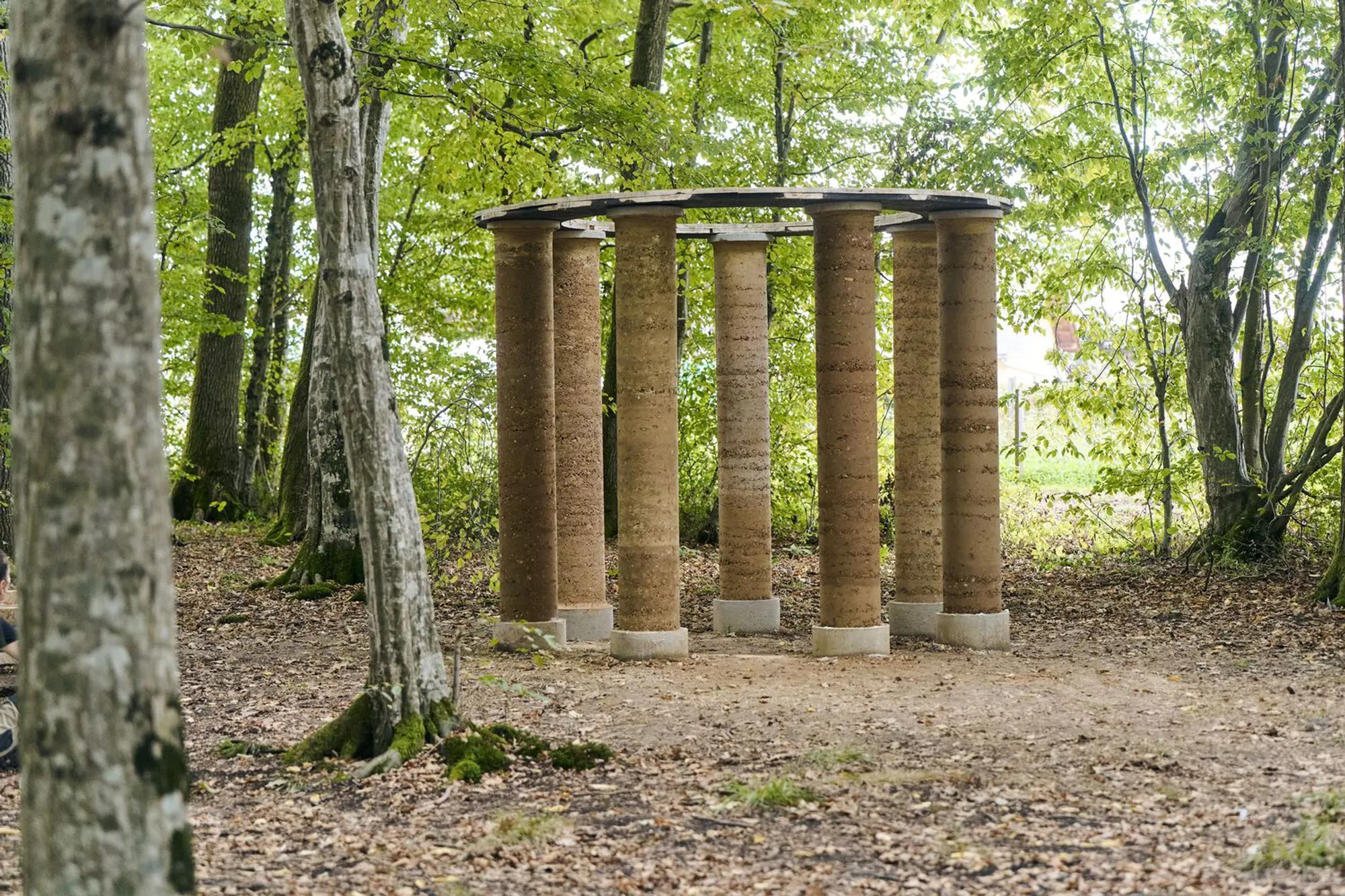
Most manifestos about earth construction stay on paper. Z.O.P. – Institute for Spatial Design, the Slovenian collective behind the architectural magazine Outsider, decided to put theirs directly into the ground. Since 2021, a forest clearing in rural Slovenia has served as their open-air laboratory for rammed earth building, and the Park of Oracles Earth Pavilions are its most compelling output: a sequence of structures that have grown more refined with each summer, culminating in a circular colonnade of hand-compacted earth columns supporting a thin steel roof under a leafy canopy.
What makes the project genuinely interesting is not the material itself, which has been discussed to exhaustion in sustainable design circles, but the method. Z.O.P. assembled architects, sociologists, landscape architects, students, and local residents from across Europe and even Brazil, then handed them formwork, wheelbarrows, and pneumatic ramming tools. Over dozens of workshops from 2022 to 2024, participants collectively learned how to mix, compact, and cure earth through trial and error. The pavilions are records of that collective learning process: each wall, each column, each failure, and each breakthrough is legible in the layered strata of the finished surfaces.
A Forest Clearing as Testing Ground
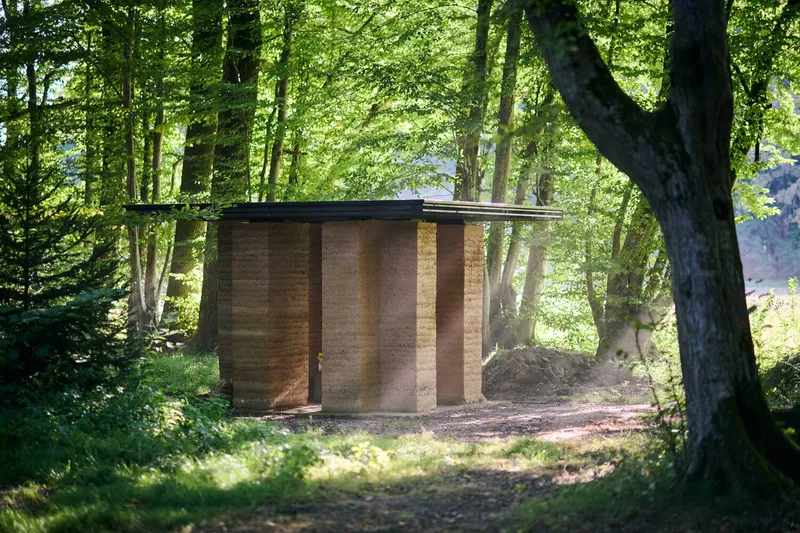
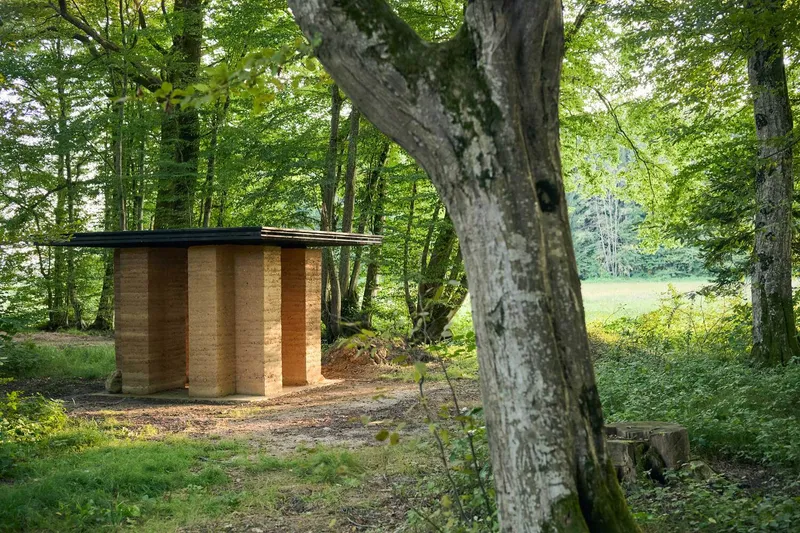
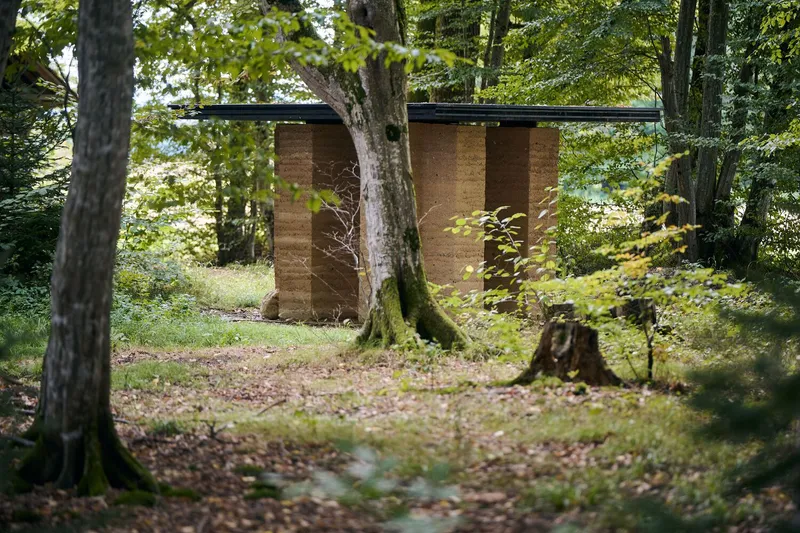
The site operates as something between a construction yard and a public park. The first pavilion, a compact rammed earth volume with a flat roof, sits modestly among the trees like a garden folly that happens to be load-bearing. Its position at the edge of a clearing gives it the quiet presence of something that has always been there, which is, of course, the point: earth is the ground you walk on, rearranged vertically.
Subsequent structures pushed outward into the forest, each one testing a different formal and structural proposition. The campus layout, with pavilions scattered among trees, avoids the monolithic and instead reads as a collection of prototypes at different stages of maturity. It is honest about the fact that this is ongoing work.
The Column as Unit of Learning
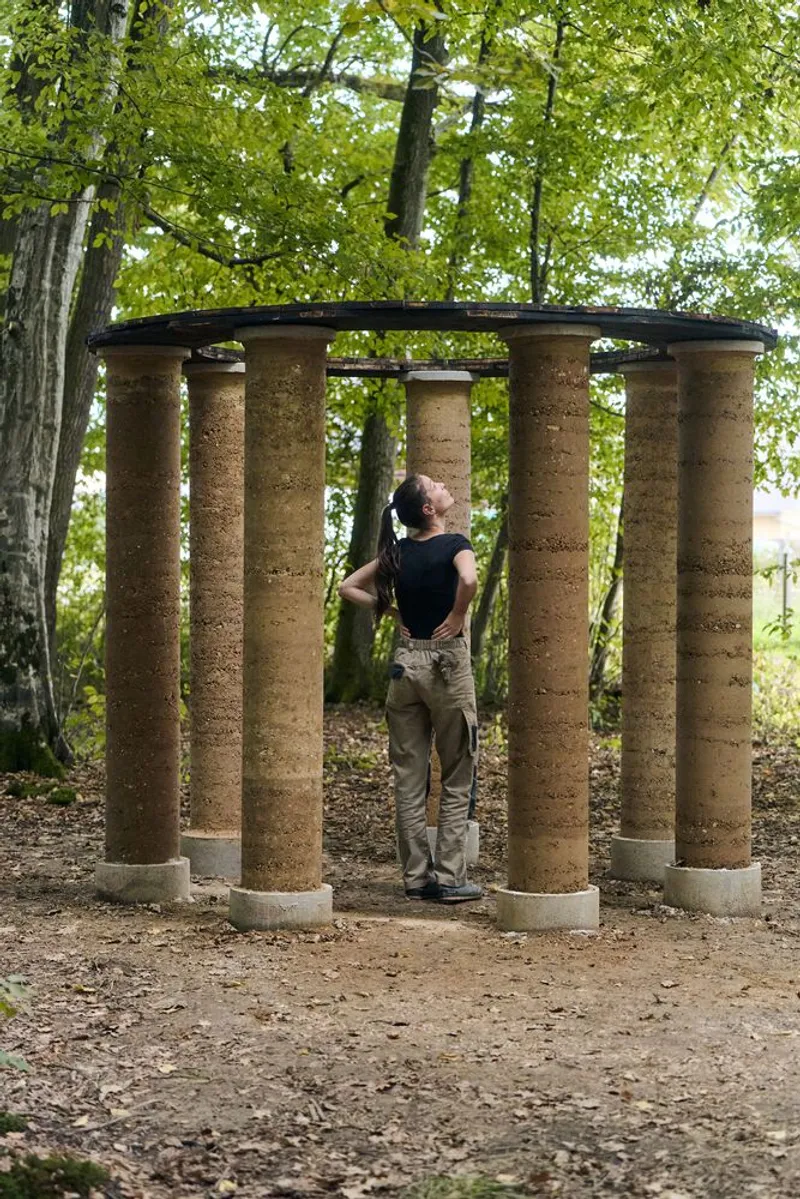
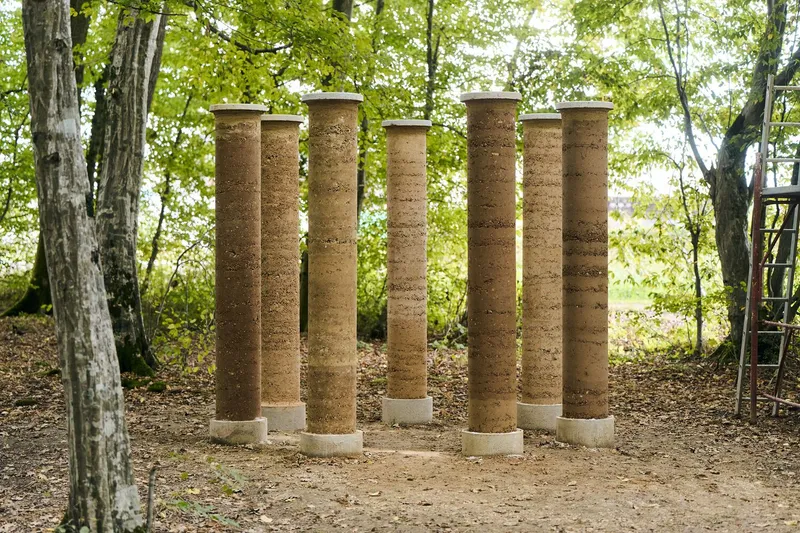
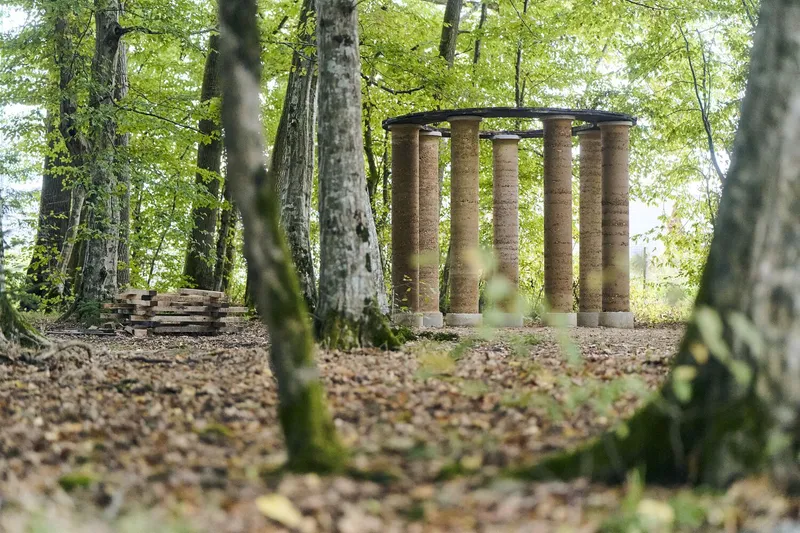
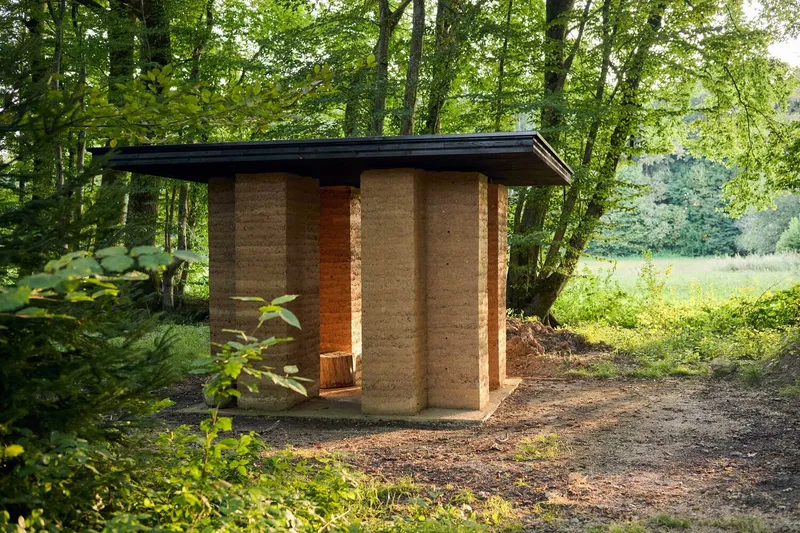
The most visually striking pavilion arranges six cylindrical rammed earth columns in a circle, supporting a flat roof on concrete footings. It looks, from certain angles, like a miniature temple. But it functions as a structural thesis: that slender earth columns, reinforced with rebar and coconut fibers, can carry real loads and support architectural ambitions beyond thick walls and low openings.
The circular plan is not arbitrary. It distributes loads evenly, allows the roof to be a simple ring, and creates a pavilion that can be occupied from all sides. Standing inside, you look through the columns toward the forest, and the visual rhythm of earth cylinders against tree trunks is striking. The material conversation between the two is immediate and unselfconscious.
Surfaces That Tell Stories

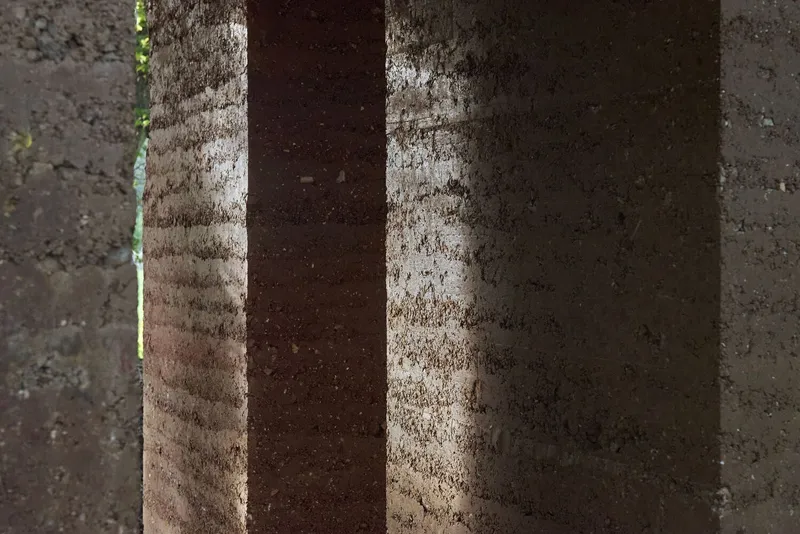

Zoom in and the columns reveal their biography. Each horizontal stratum marks a separate compaction cycle: a day's work, a change in earth mix, a shift in moisture content. The exposed aggregate and the subtle color variations are not cosmetic choices. They are the direct result of process. Where some columns show clean, uniform layers, others bear the scars of early experiments when the team was still calibrating its mixtures.
Weathering is treated as a feature, not a defect. Moss accumulates at the column bases, and rain slowly softens exposed edges. Z.O.P. embraces this entropy as part of earth construction's contract with time. The material will erode, and it can be repaired or returned to the soil. That lifecycle honesty separates this work from the polished renderings that typically accompany sustainability narratives.
Walls, Light, and Canopy
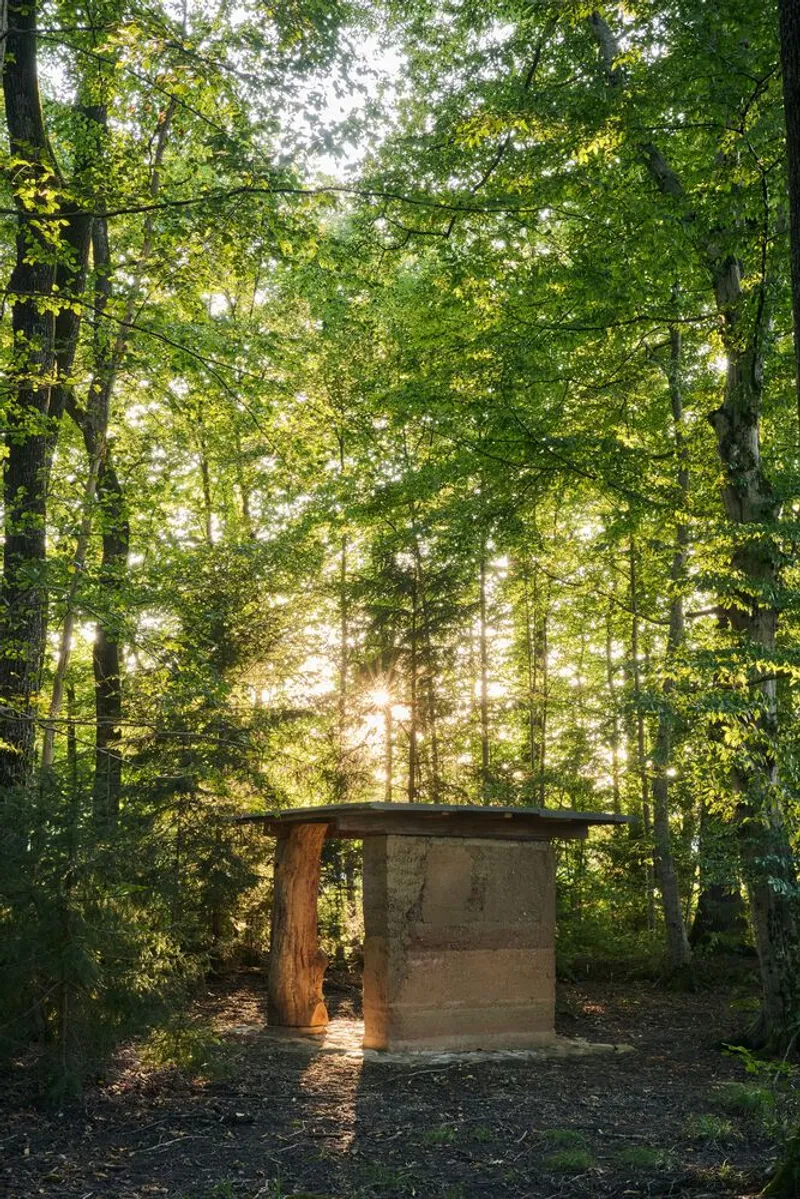
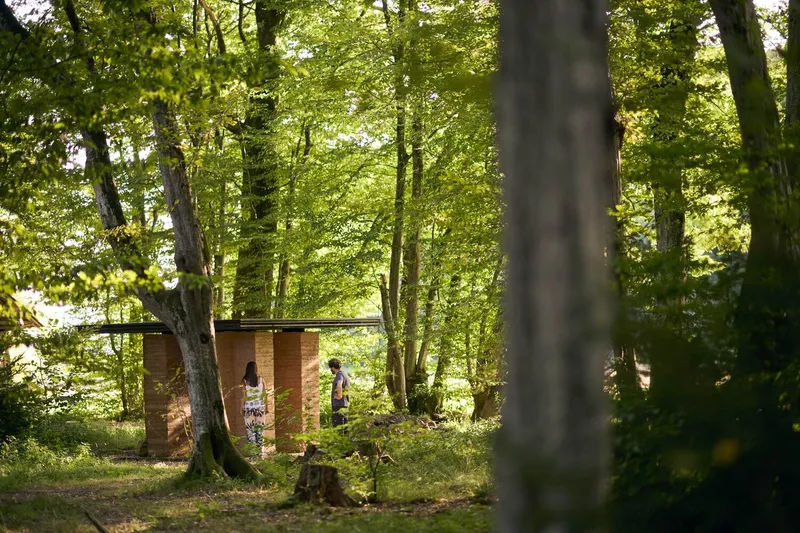
The earlier pavilions rely on planar rammed earth walls rather than columns, and they interact with the forest canopy in a different register. Backlit by golden hour sun, the layered wall sections glow with the warm tones of local soil. The overhanging roofs create sheltered thresholds where the dense materiality of earth meets the filtered light of the canopy.
These wall pavilions demonstrate the thermal qualities that advocates always cite but rarely show: earth's capacity for heat accumulation, moisture regulation, and even the binding of harmful substances. In a forest setting, where the air is already clean and the shade already cool, these benefits might seem redundant. But as prototypes for housing and public infrastructure, the pavilions prove the principle with full-scale evidence.
Construction as Community Practice
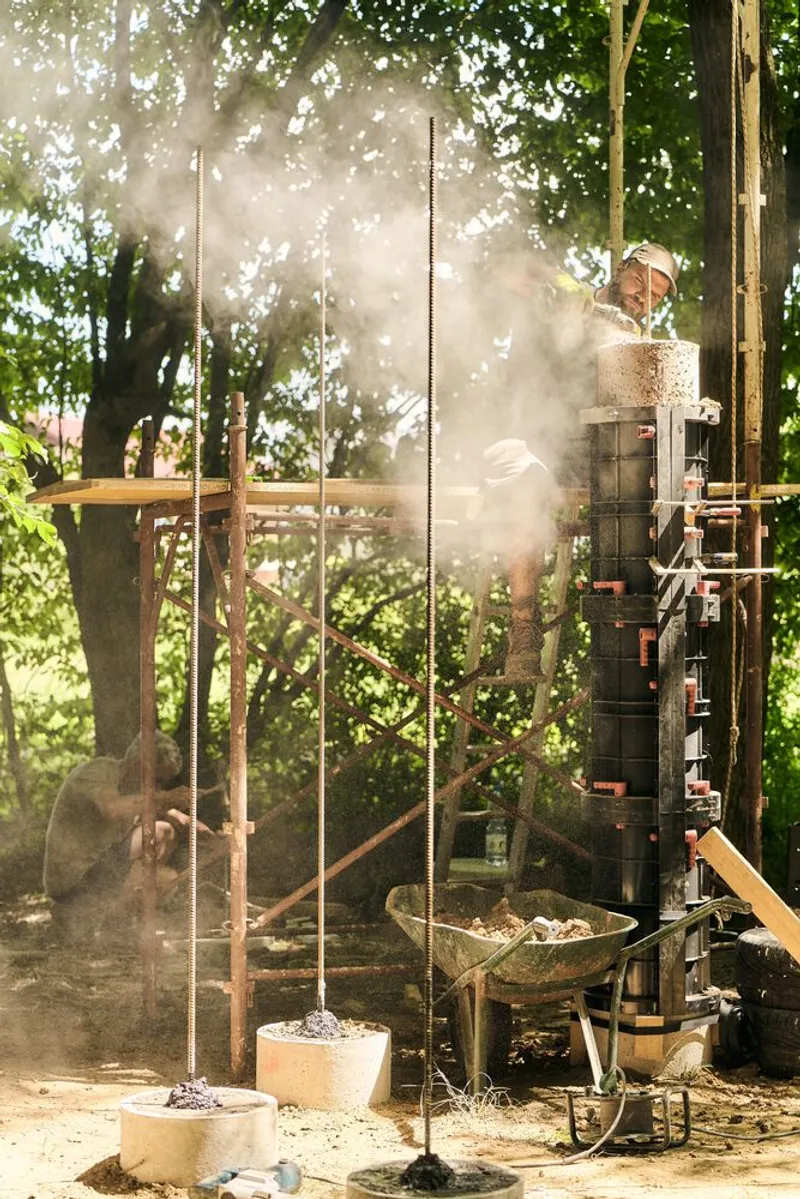
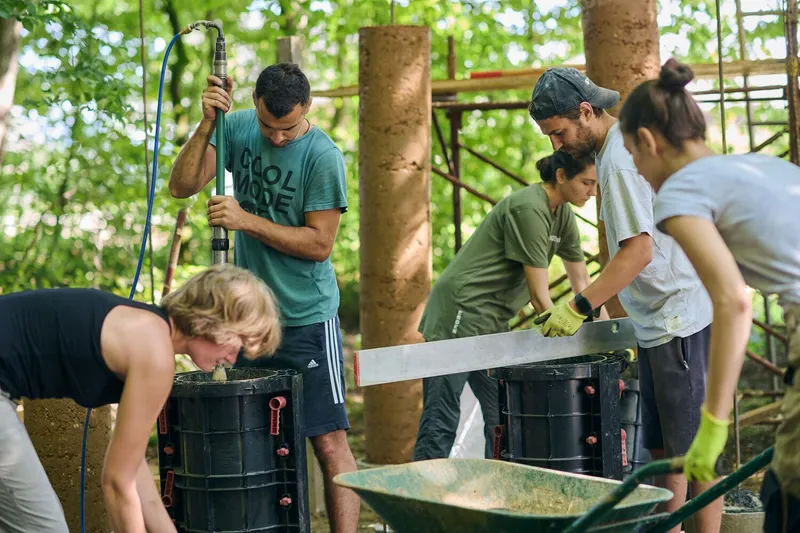
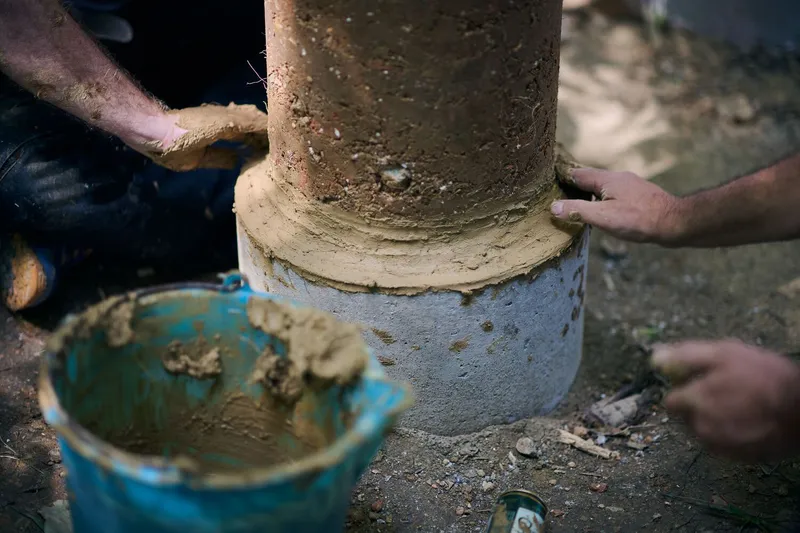
The construction photographs are as important as the finished architecture. Workers compact earth inside vertical formwork, dust rising in the morning light. Others mix material in wheelbarrows and hand-apply plaster to column bases. There is nothing romantic about this labor; it is physical, repetitive, and slow. But the workshops, five in 2022, eleven in 2023, six in 2024, have built a distributed expertise that now spans borders.
Z.O.P. draws explicitly on Johan Huizinga's Homo Ludens and its argument that play is foundational to culture. The workshops encourage participants to rediscover basic architectural forms, walls, columns, supports, through intuitive experimentation. It sounds vague until you see the results: real buildings, standing in a real forest, built by people who arrived knowing nothing about rammed earth.
Assembly and Finishing
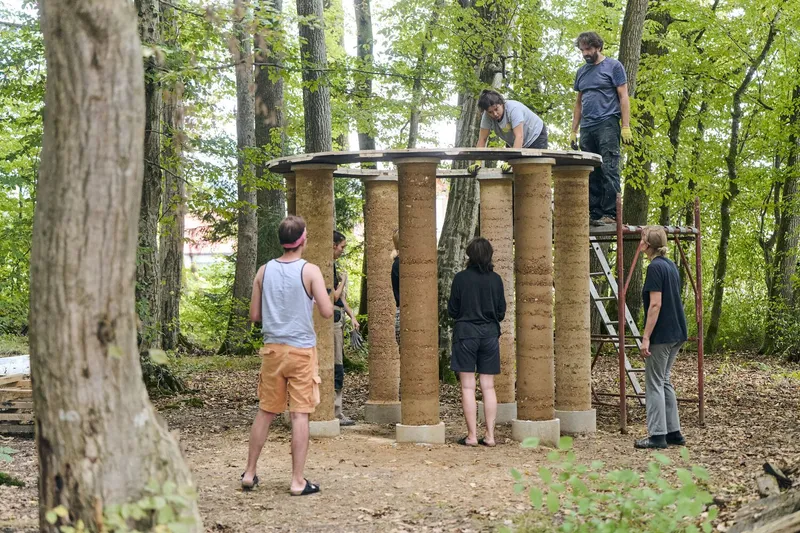
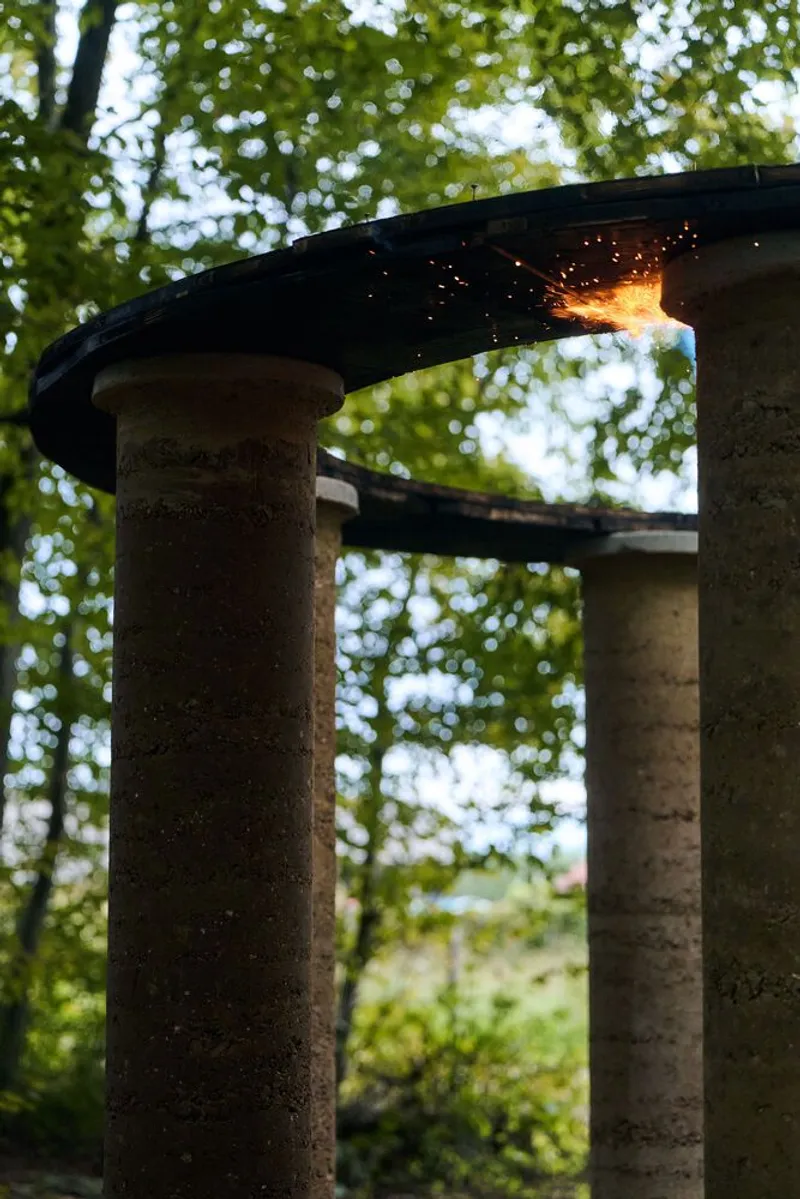
Roof assembly reveals the hybrid nature of the construction. A thin steel ring and timber structure cap the earthen columns, handled by a small team with basic equipment. The moment of contact between industrial steel and hand-compacted earth is resolved simply: a flat capital on each column receives the ring without fuss.
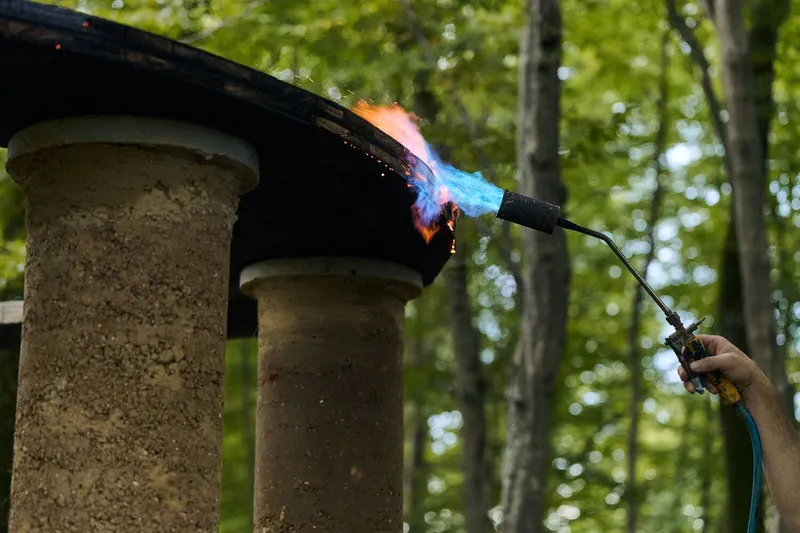
The use of a gas torch to treat the steel edges of the roof is a jarring visual, sparks flying against the quiet forest backdrop. It is a useful reminder that even the most committed earth construction projects depend on complementary materials and techniques. Z.O.P. does not pretend otherwise, and that pragmatism is part of the project's credibility.
The View Between Columns
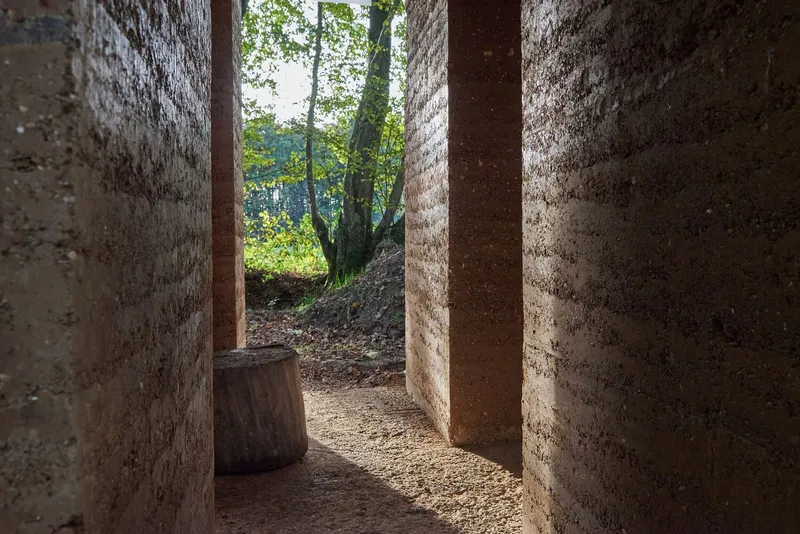


Experienced from within, the circular colonnade frames the surrounding forest in a series of vertical slices. The interplay between the brown, striated columns and the green, irregular tree trunks creates a spatial dialogue that is hard to achieve with more conventional materials. Looking up, the flat capitals and the canopy above flatten into a single overhead plane, collapsing the distinction between built and natural shelter.
The worm's-eye perspective, looking straight up through the columns toward the sky, confirms the structural clarity of the design. Six columns, one ring, one roof. The simplicity is the product of iteration, not the starting point. It took Z.O.P. four refinements of their corner formwork system and years of workshops to arrive at this economy of means.
Workshop Infrastructure
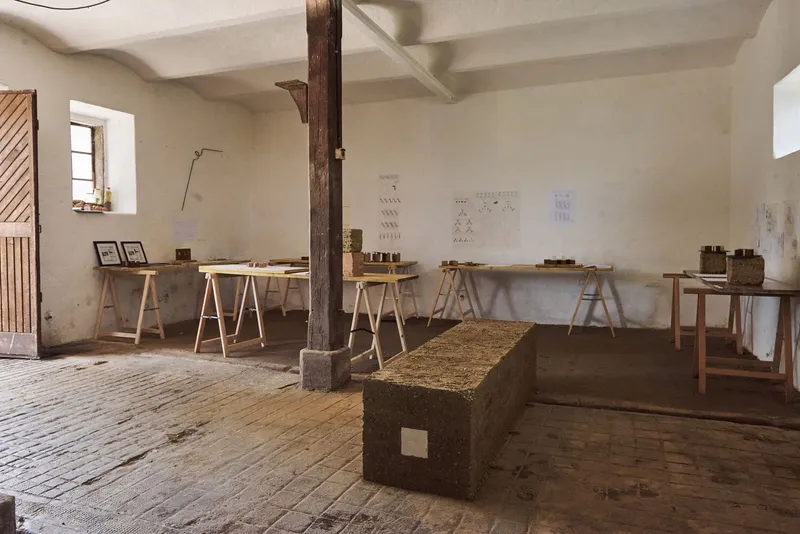
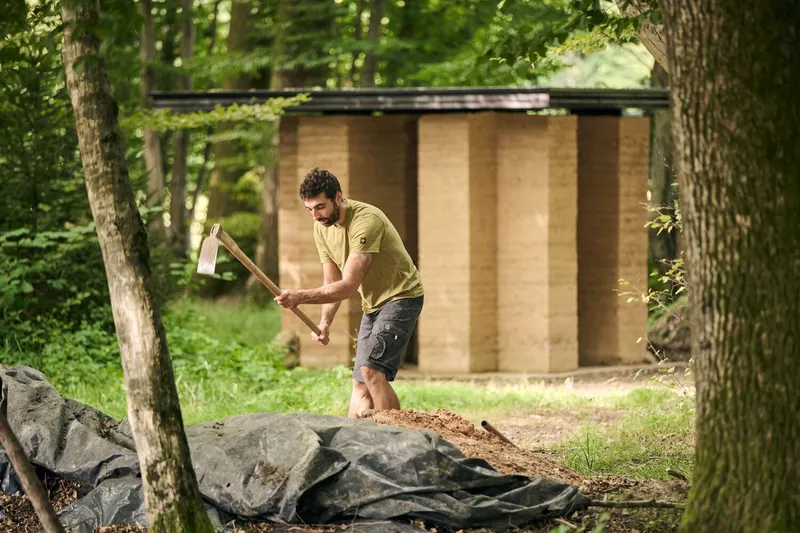
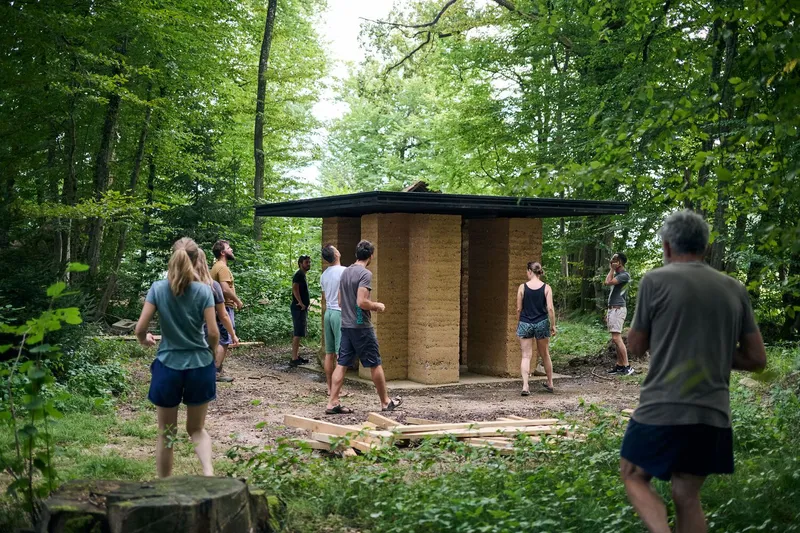
The supporting infrastructure, timber-framed workshop spaces, sawhorse tables, material samples, plywood tool sheds, has the provisional quality of a working site rather than a finished campus. Compressed earth blocks sit on display like geological samples. Visitors wander through during summer sessions, blurring the boundary between audience and participant.
This informality is deliberate. The Center for Earth Building, established in 2021, is not a museum of rammed earth. It is a living production facility where the next pavilion is always under development. A new structure is planned for 2025, continuing the cycle of experimentation that gives the park its momentum.
Plans and Drawings
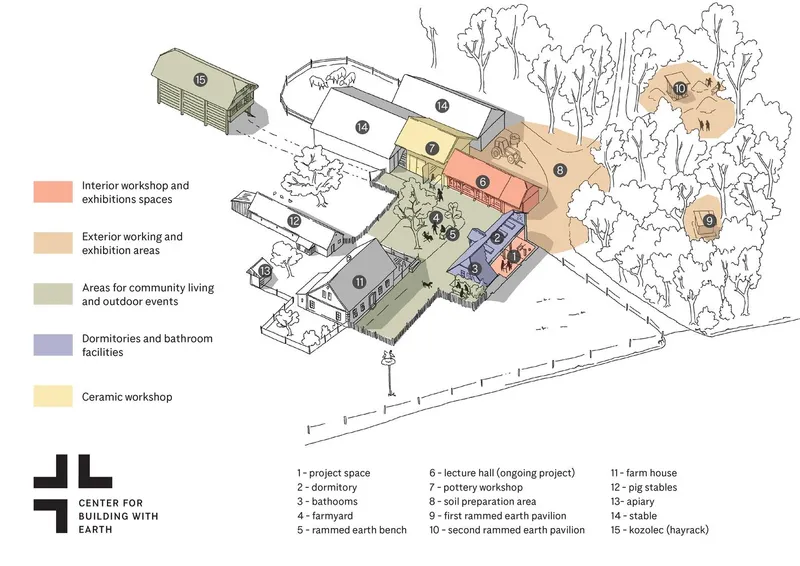
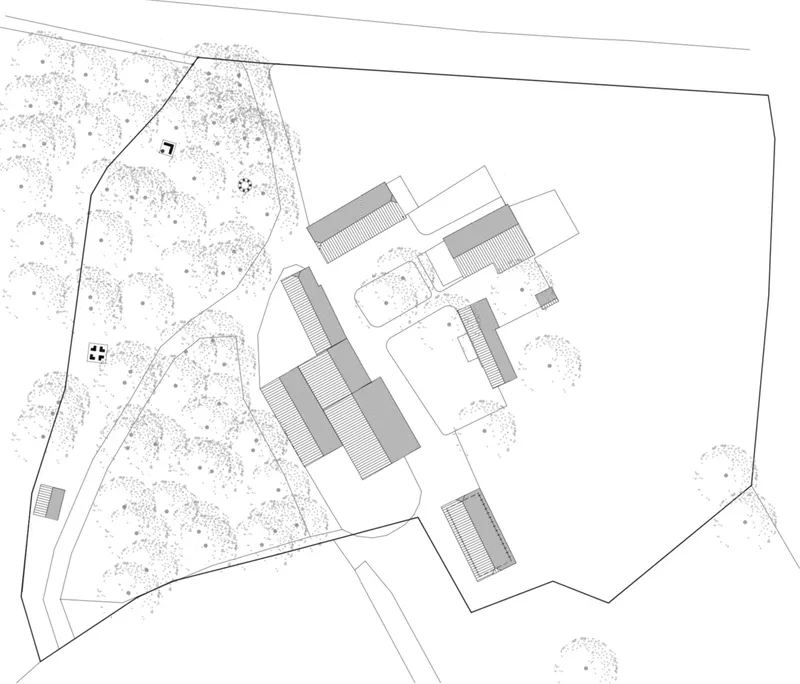
The axonometric drawing maps the campus as a constellation of color-coded program zones scattered among existing trees. It reveals a logic that is less visible at ground level: the pavilions are positioned to create routes and clearings, encouraging movement through the site rather than arrival at a single destination.
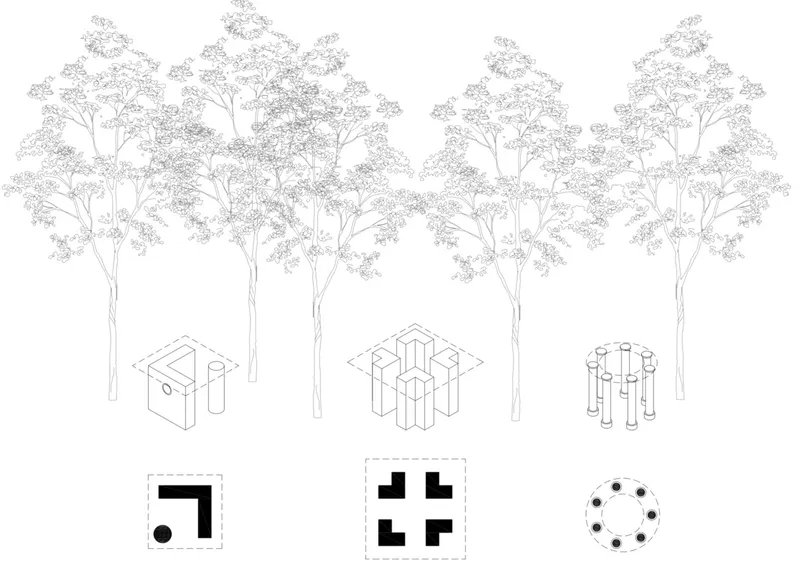
The site plan and the structural evolution diagram are particularly telling. The latter shows three configurations progressing from corner posts to the circular column arrangement, documenting the formal logic that drove the project's development. It is rare for a practice to publish its evolutionary path so clearly. Z.O.P. treats the sequence of failures and refinements not as backstory but as the project's primary content.
Why This Project Matters
The Park of Oracles is not the first rammed earth project, and it will not be the last. What sets it apart is its insistence on process over product. By running workshops year after year, Z.O.P. has created something more valuable than a single pavilion: a distributed community of people who have physically handled the material, made mistakes with it, and learned its properties through their hands. That knowledge is harder to lose than a building.
At a moment when sustainable architecture often means adding photovoltaic panels to business-as-usual construction, this project returns to a genuinely low-carbon material and asks how to make it buildable, teachable, and scalable. The modular formwork system, the iterative workshop model, and the willingness to document failure are all transferable. If earth construction is going to move beyond demonstration projects and into mainstream building practice, it will need exactly this kind of sustained, unglamorous, hands-on work.
Park of Oracles Earth Pavilions by Z.O.P. – Institute for Spatial Design. Located in rural Slovenia. Completed 2023. Photography by Jana Jocif.
About the Studio
Share Your Own Work on uni.xyz
If projects like this are the kind of work you want to make, uni.xyz is a place to publish your own, find collaborators, and enter design competitions.



Popular Articles
Popular articles from the community


Co-life: Sustainable Architecture for Age-Friendly Community Living
Co-life reimagines sustainable architecture for seniors through courtyards, rammed earth, shared gardens, and spaces designed for belonging.
AL-JANNAH: Sustainable Architecture and Permaculture for Afghan Widows
AL-JANNAH uses sustainable architecture and permaculture to create resilient oasis of housing, learning, work and renewal for Afghan widows.

Riyadh For All: Intergenerational Urban Design for Active Aging in Rabat
Riyadh For All reimagines urban design in Rabat with intergenerational co-living, adaptive courtyards, and Moroccan cultural exchange today.

Co-Life: Senior Housing Design That Reconnects Older Adults With the City
Co-Life reimagines senior housing design through healing gardens, shared streets, workshops, and a sustainable community across generations.

Similar Reads
You might also enjoy these articles


Hodi-Mandai Geram
Project Function: Preservation and revitalization of the Intangible heritage and socio-spatial identity of the Hodi by Housing, Cultural Memory Center, Sacred Grove, landscape, local tourism economy


Olio Towers: A Mid-Rise for Performers That Fuses Housing, Rehearsal, and Stage
Located blocks from Houston's Theater District, this modular tower stacks living units around a central performance atrium.

Oasis: Modular Green Housing Carved into Dhaka's Urban Fabric
A shortlisted Plugin Housing entry reclaims unauthorized settlements in Dhaka with stepped concrete volumes, green roofs, and ventilation-driven design.

Black Hole: A Floating Megastructure for the Post-Physical Era
Emiliano Mazzarotto envisions a spherical, self-scaling arena where e-sports, digital hotels, and holographic stadiums replace traditional public space.


Explore Earth Architecture Competitions
Discover active competitions in this discipline



Challenge to reimagine the Iron Throne


Photograph architecture without architects


Illustrate the lost glory of Angkor Wat - Render Challenge


Design challenge to reuse E-waste
Comments (0)
Please login or sign up to add comments
No comments yet. Be the first to comment!