

Dishna Thilanka Architects Builds a Metal Sculptor's Pavilion That Breathes Through the Trees
A passive-cooled art studio and residence on Sri Lanka's urban fringe preserves every mature tree on site while framing sculpture in light.


At the edge of Maharagama, where Colombo's suburban sprawl starts to thin into something greener, Dishna Thilanka Architects has threaded a two-storey glass and concrete pavilion through an existing canopy of mature trees. The Path Art Studio and Personalized Residence, completed in 2024 in Boralesgamuwa, Sri Lanka, is a combined home and workspace for a metal sculptor. It sits on a compact 3,149-square-foot site within a larger 42-perch plot, and the design's central premise is that the unbuilt space matters as much as the built form. Every significant tree was kept. The building bends around them.
What makes the project genuinely instructive, rather than merely pleasant, is the way it refuses to separate its sustainability agenda from its artistic one. The passive-cooling strategy, the solar orientation, the cross-ventilation openings: these are not add-ons to the architecture. They are the architecture. Light, shadow, and airflow do double duty, conditioning the interior while composing the experience of moving through it. For a sculptor who works in metal, the play of natural illumination across raw concrete and stone surfaces is not decoration. It is the daily context for making work.
A Glass Pavilion Under the Canopy


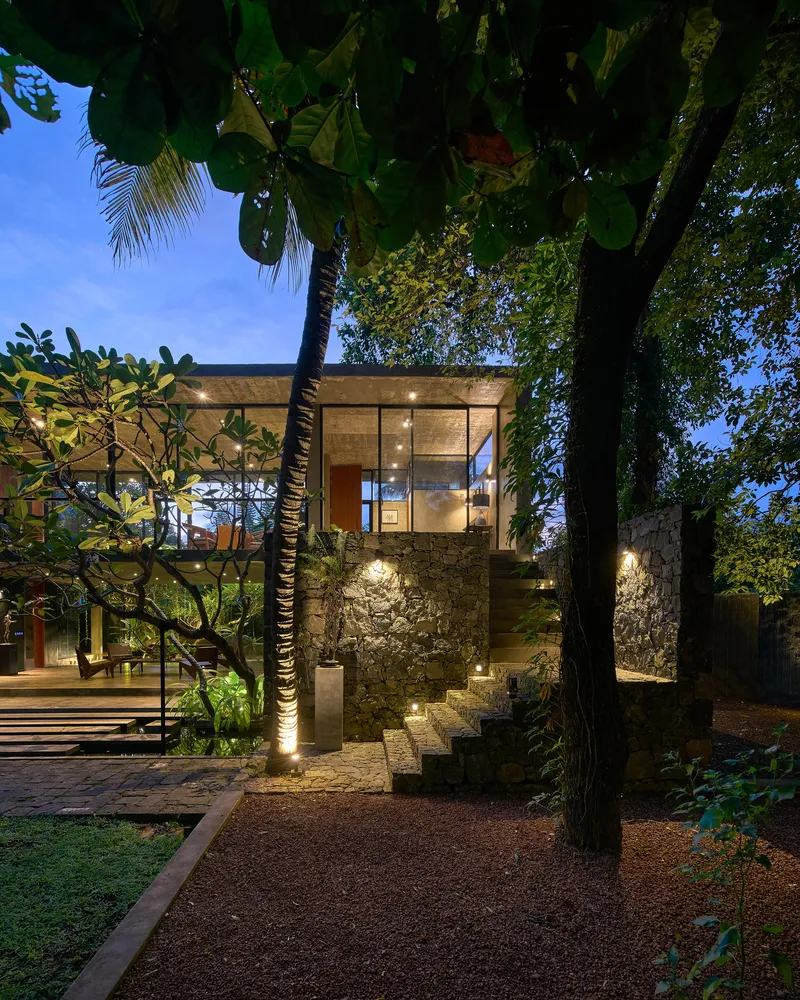
From the planted courtyard, the building reads as a series of horizontal concrete planes suspended above full-height glazing. At dusk, the effect is theatrical: the glass volume glows against a stone base while palm trees and tropical foliage press close on all sides. The pavilion-style layout, defined by intersecting linear planes and cubes, keeps the building slim enough to avoid overwhelming its site. There is no monumental front elevation. Instead, the house presents different faces depending on where you stand among the trees.
The stone base, clad in granite and anchored by gabion walls, ties the structure visually to the ground. Above it, the concrete slab roof projects outward in deep overhangs that shade the glass walls below. This layering, heavy below, transparent in the middle, heavy again at the roof, gives the building a sense of compression and release that a simpler box would lack.
Concrete, Stone, and the Sculptor's Material World
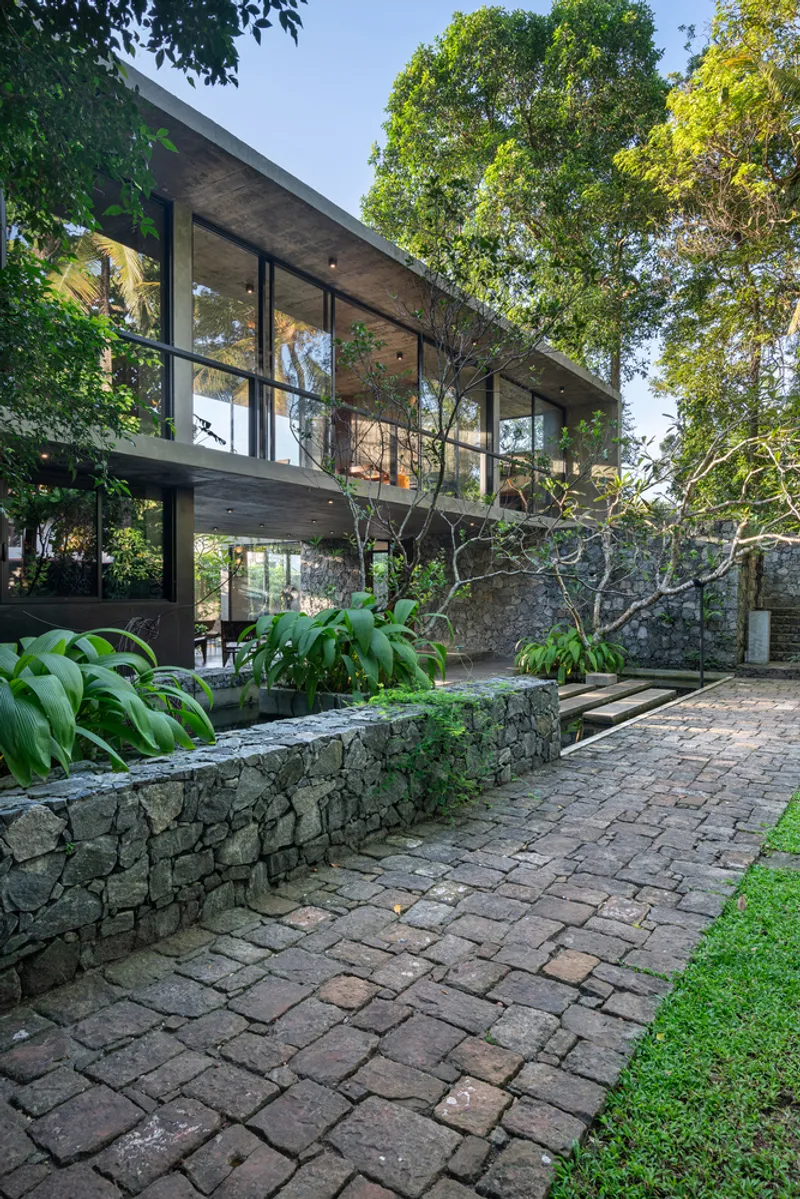
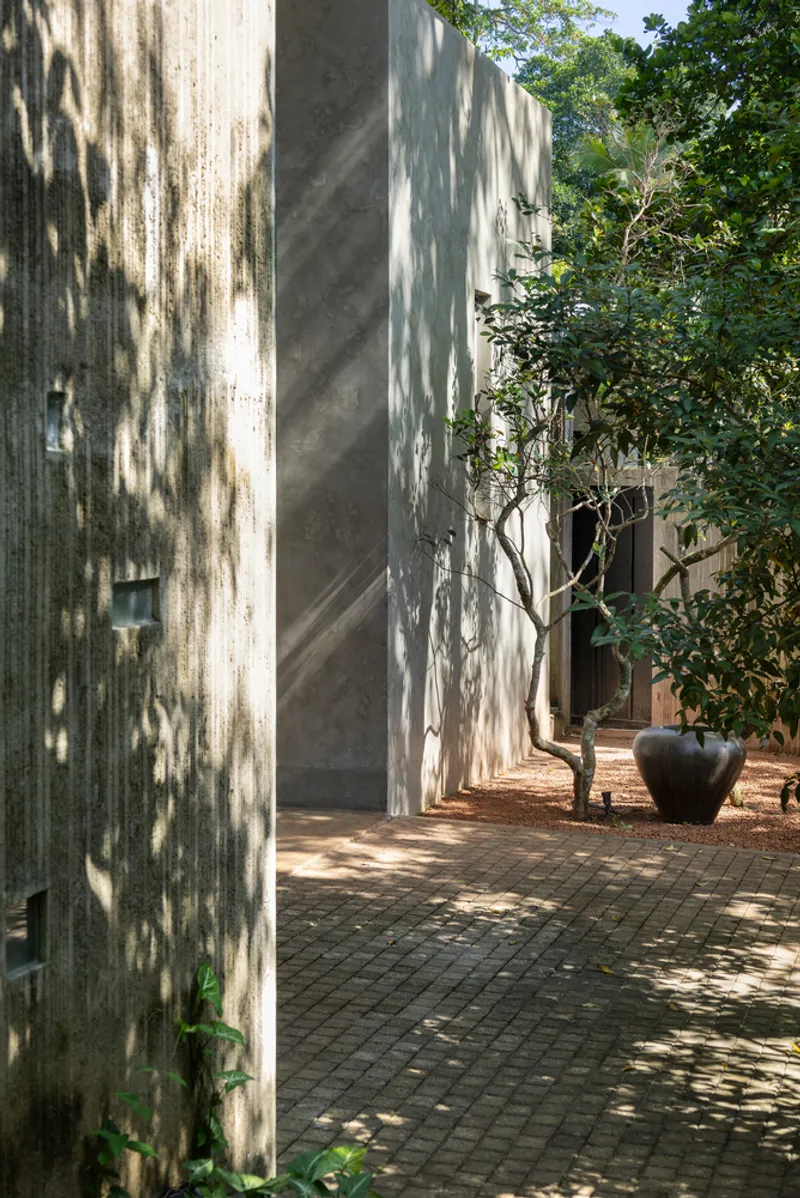
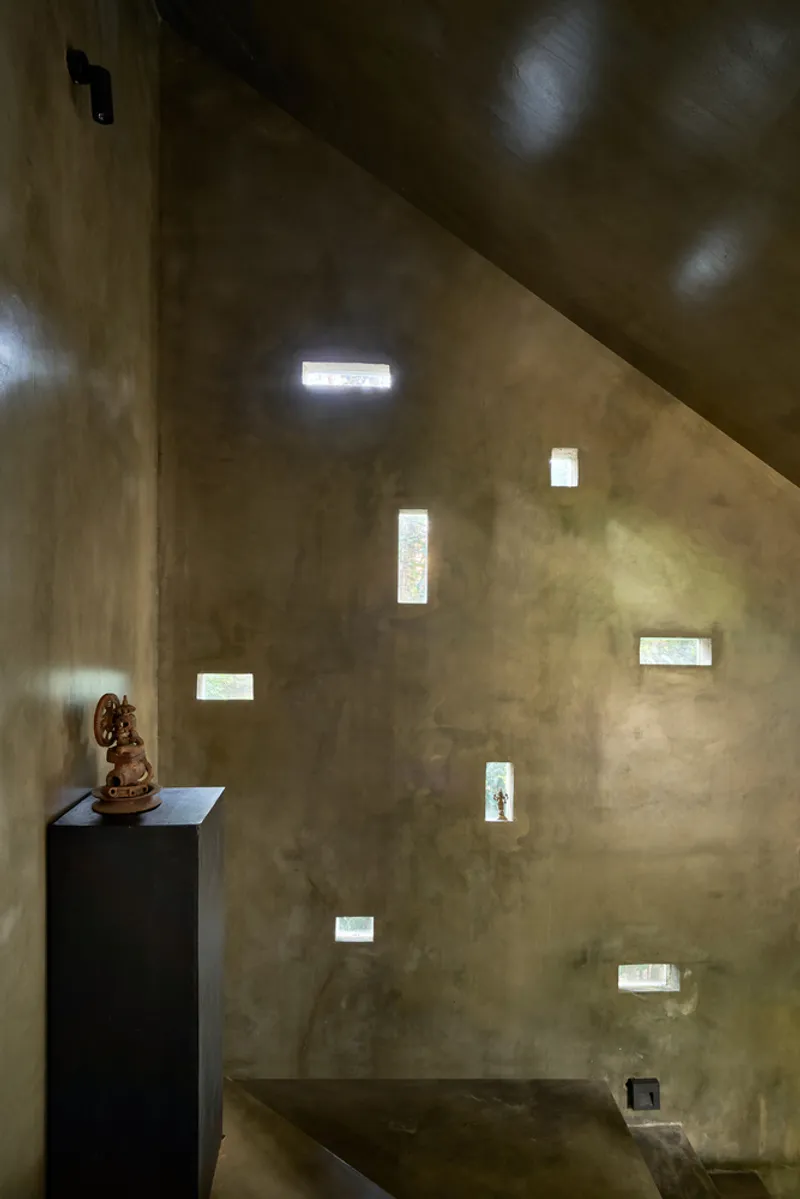
The material palette, granite, textured cement, natural wood, and metal, was chosen to echo the sculptor's own working vocabulary. Board-formed concrete ceilings carry the grain of their formwork, weathered exterior walls collect tree shadows like a slow exposure photograph, and scattered rectangular apertures punch through interior walls to frame individual sculptures on pedestals. The architecture becomes a gallery without ever declaring itself one.
Gabion walls filled with stone serve a structural and spatial role, defining planted beds and terraces while providing thermal mass that stabilizes indoor temperatures. The earthy roughness of these surfaces grounds the project. Nothing here is polished to a corporate sheen. The building wears its construction honestly, and that honesty aligns it with the sculptor's own practice of shaping raw metal into expressive form.
The Courtyard Pool as Climate Device and Refuge


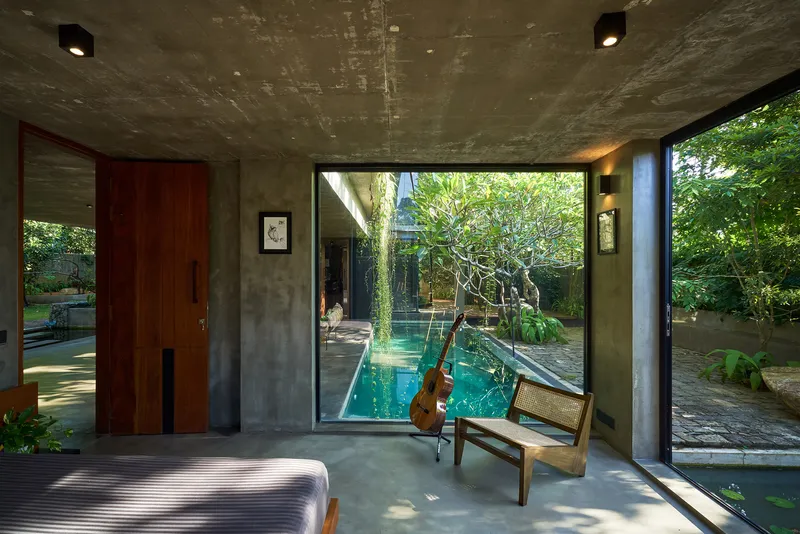
A reflecting pool sits at the heart of the plan, bordered by plaster walls, stone cladding, and cascading greenery. It is beautiful to look at, but it also works. Water features in this climate function as evaporative cooling surfaces, lowering ambient air temperature as breezes move across the pool and into adjacent rooms. The bedroom opens directly onto this courtyard through floor-to-ceiling glazing, so the cooling effect is immediate and tangible.
Hanging vines and a mature vine-covered tree complete the microclimate loop. The planting filters sunlight into dappled patterns that shift across the pool throughout the day. For a house that relies on passive strategies rather than mechanical systems, this kind of layered environmental performance, combining water, vegetation, shading, and cross-ventilation, is essential. Each element supports the others.
Living Spaces Open on All Sides

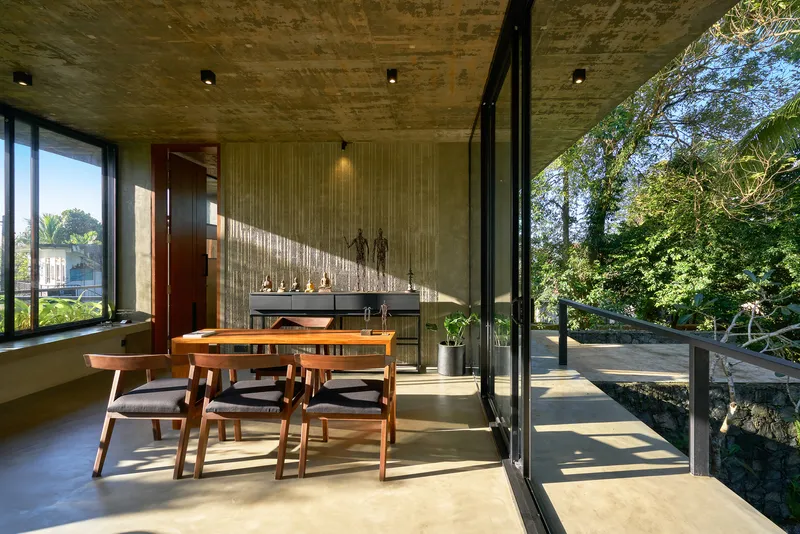

The living room is glazed on both sides, framing views of surrounding foliage in warm afternoon light. It functions less as a sealed room than as a covered terrace with glass walls. The dining area, set beneath an exposed concrete ceiling, opens directly onto a terrace overlooking the dense tree canopy. Wooden lounge chairs under a board-formed concrete overhang extend the living space outward, blurring the line between inside and outside in a way that feels earned by the climate rather than imposed as a stylistic gesture.
The open layout dissolves conventional room boundaries. You move from studio to living area to garden without encountering a corridor or a closed door. For an artist, this continuity matters: the work is never compartmentalized away from daily life. A sculpture in progress can be glimpsed from the kitchen. The garden is visible from the bed.
The Gallery Floor and Studio Spaces

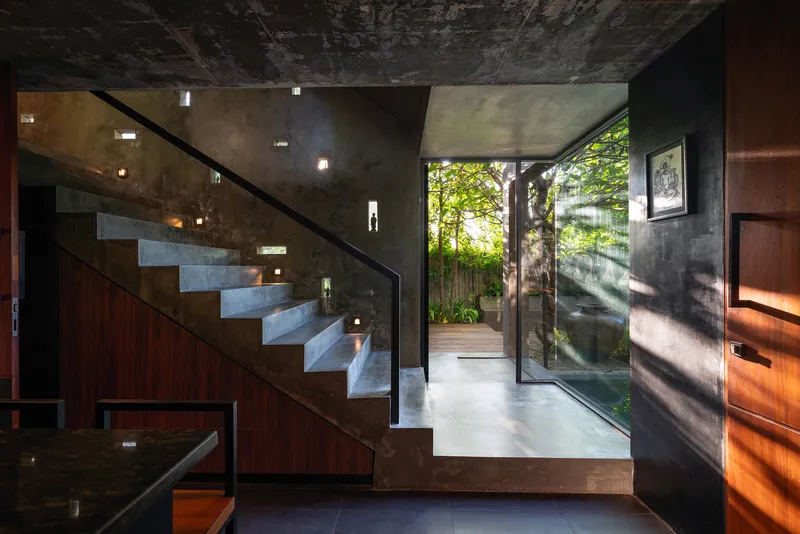
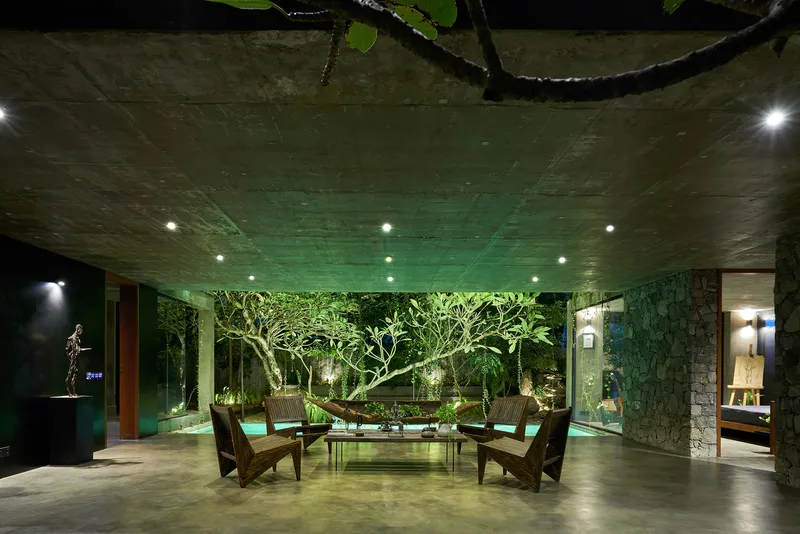
The open-air gallery space on the ground floor features a board-formed concrete ceiling and polished concrete floor, providing a neutral backdrop for displaying metal sculptures. The space reads as industrial enough to accommodate heavy work yet refined enough to host visitors. A concrete staircase with a steel railing rises past a glazed corridor, connecting the gallery level to the private rooms above. The transition from public to private is handled through changes in elevation and transparency rather than walls.
At night, the covered terrace transforms. Uplighting on trees turns the foliage into a theatrical backdrop, and the board-formed concrete ceiling catches warm light from below. The project demonstrates that modest materials, concrete, steel, stone, can produce spaces of genuine atmosphere when deployed with precision and lit with care.
Private Rooms Framed by Landscape


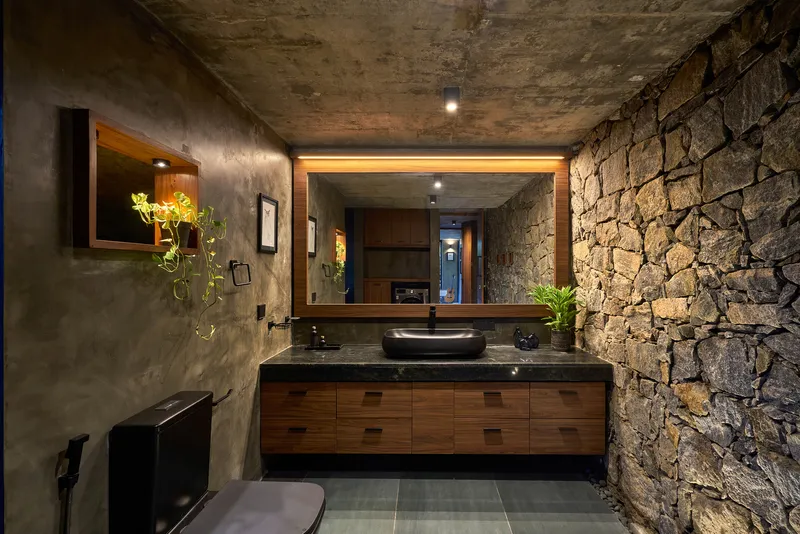
The bedrooms are intimate but never claustrophobic. One features concrete walls and a platform bed flanked by glazed walls facing the courtyard pool. Another employs an exposed concrete barrel vault ceiling, a structural move that adds spatial drama to a compact room while directing the eye outward through floor-to-ceiling glazing onto the outdoor terrace. Even the bathroom, with its timber cabinetry, black basin, and rustic stone accent wall, maintains the project's commitment to natural materials and careful detailing.
Concealed service areas keep the aesthetic minimal. Plumbing, electrical runs, and storage are tucked away so that surfaces remain clean. In a house where shadow and texture do so much work, clutter would be the enemy. The restraint is deliberate and consistent across every room.
Plans and Drawings

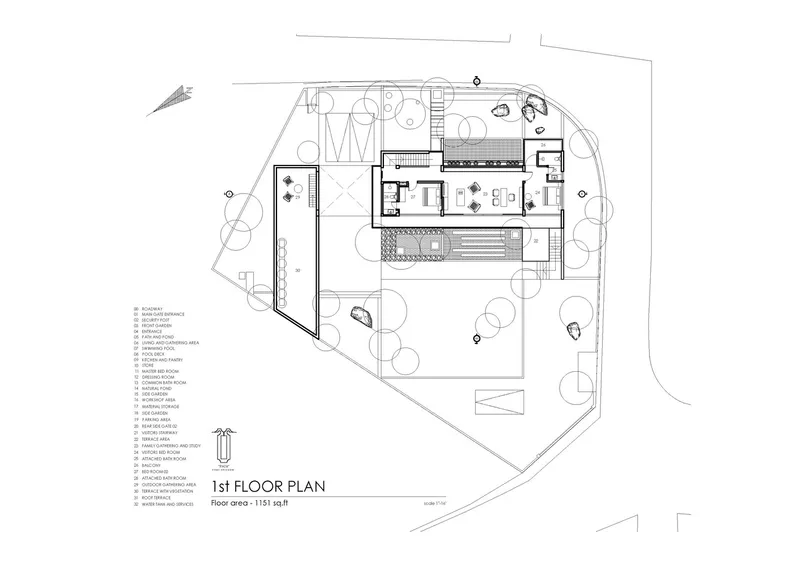
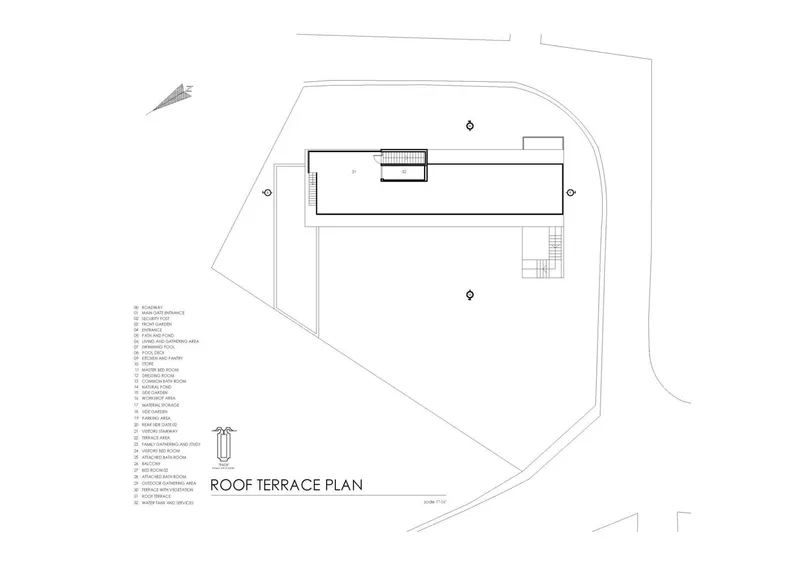
The ground floor plan reveals an irregular pentagonal plot with existing trees marked and preserved. The building wraps around these green anchors, creating pockets of courtyard space on multiple sides. The first floor plan shows the bedroom wing and an open terrace cantilevering over the landscape below. A roof terrace plan indicates the linear pavilion volume and stair access, with the flat roof designed to accommodate future solar panels.
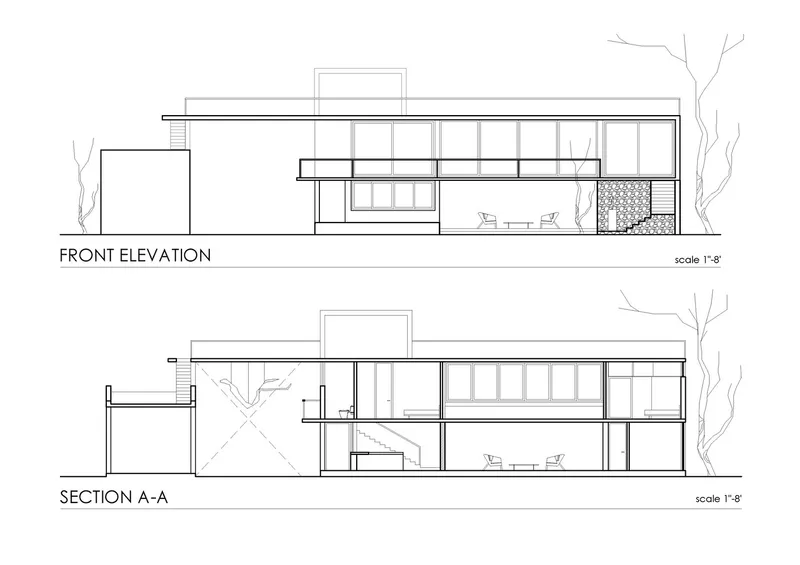
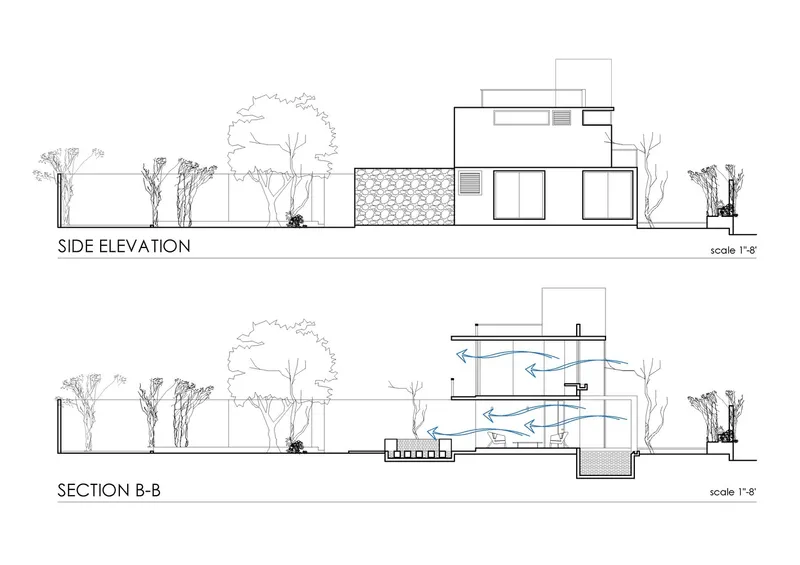
The front elevation and section drawings confirm the two-storey volume's proportions: a relatively low building that defers to its trees rather than competing with them. Side elevations include ventilation diagrams illustrating the natural airflow strategy. Cool air enters through low openings, rises through the double-height spaces, and exits at the roof level. The drawings make explicit what the photographs only imply: that every opening was placed to facilitate air movement as much as to frame a view.
Why This Project Matters
The Path Art Studio and Personalized Residence is a small project, three rooms on a modest site, but it operates with the clarity and conviction of work at a much larger scale. Its passive cooling strategy is not a checklist of green features bolted onto a conventional plan. Solar orientation, fenestration, water features, and tree preservation are woven into the architecture so tightly that removing any one of them would compromise both the building's performance and its spatial quality. That integration is rare.
For architects working in tropical climates where rapid urbanization is erasing tree cover and driving temperatures upward, the project offers a concrete model. You can build on a tight urban-fringe site without clearing the canopy. You can create a genuinely comfortable interior without mechanical cooling. And you can design a home for an artist that does not merely house their work but actively participates in shaping it, through light, through material, through the simple act of keeping the windows open.
Path Art Studio and Personalized Residence by Dishna Thilanka Architects, Boralesgamuwa, Sri Lanka. 3,149 sq.ft. Completed 2024. Photography by Ganidu Balasuriya.
About the Studio
Share Your Own Work on uni.xyz
If projects like this are the kind of work you want to make, uni.xyz is a place to publish your own, find collaborators, and enter design competitions.


Popular Articles
Popular articles from the community


Temporary Home for Dogs: A Reversed Zoo Rethinks Animal Shelter Architecture
In Bucharest, a sinuous corridor and freed landscape flip the logic of containment, designing a shelter that works to make itself unnecessary.
Cloaked Colonization: A Mobile Underwater Habitat That Moves Like a Fish
Micah Abaya's shortlisted EHC Pacific entry reimagines ocean settlement as a dispersed network of self-sustaining architectural organisms.

Opera on the Sea: Driftwood Logic Shapes a Timber Opera House on Estonia's Coast
Trevor Orgill's opera house translates the entangled drift of floating timber into a civic building where wood, water, and music converge.

The Amber Palace Opera: A Geological Fiction Surfaces on Tallinn's Baltic Waterfront
Pierre Brillard reimagines a Baltic legend as a public landscape, opera house, and waterfront promenade rooted in Tallinn's coastal identity.

Similar Reads
You might also enjoy these articles


Hodi-Mandai Geram
Project Function: Preservation and revitalization of the Intangible heritage and socio-spatial identity of the Hodi by Housing, Cultural Memory Center, Sacred Grove, landscape, local tourism economy


Olio Towers: A Mid-Rise for Performers That Fuses Housing, Rehearsal, and Stage
Located blocks from Houston's Theater District, this modular tower stacks living units around a central performance atrium.

Oasis: Modular Green Housing Carved into Dhaka's Urban Fabric
A shortlisted Plugin Housing entry reclaims unauthorized settlements in Dhaka with stepped concrete volumes, green roofs, and ventilation-driven design.

Black Hole: A Floating Megastructure for the Post-Physical Era
Emiliano Mazzarotto envisions a spherical, self-scaling arena where e-sports, digital hotels, and holographic stadiums replace traditional public space.

Explore Environmental art Competitions
Discover active competitions in this discipline

Challenge to reimagine the Iron Throne

Photograph architecture without architects

Illustrate the lost glory of Angkor Wat - Render Challenge

Design challenge to reuse E-waste
Comments (0)
Please login or sign up to add comments
No comments yet. Be the first to comment!