

Pavilion in the Oaks by Mork-Ulnes Architects: A Floating Sanctuary Among the Trees
Elevated cedar pavilion in Monte Sereno blending wellness and social space, immersed among oak trees with diffused natural light and openness.


Set amid the tranquil hills of Monte Sereno, California, the Pavilion in the Oaks by Mork-Ulnes Architects is a masterclass in restraint and grace—a light-borne, adaptable space designed for wellness, reflection, and connection. Completed in 2025, this 60-square-meter pavilion floats delicately among redwoods and oak trees, harmonizing with its natural surrounding rather than asserting dominance over it.

Designed as an extension to an existing multigenerational residence, the structure serves dual purposes: a private retreat for yoga and meditation and a gathering space for family and socialevents. It offers a contemporary architectural response to two human needs—solitude andsociability—bridged seamlessly through design.
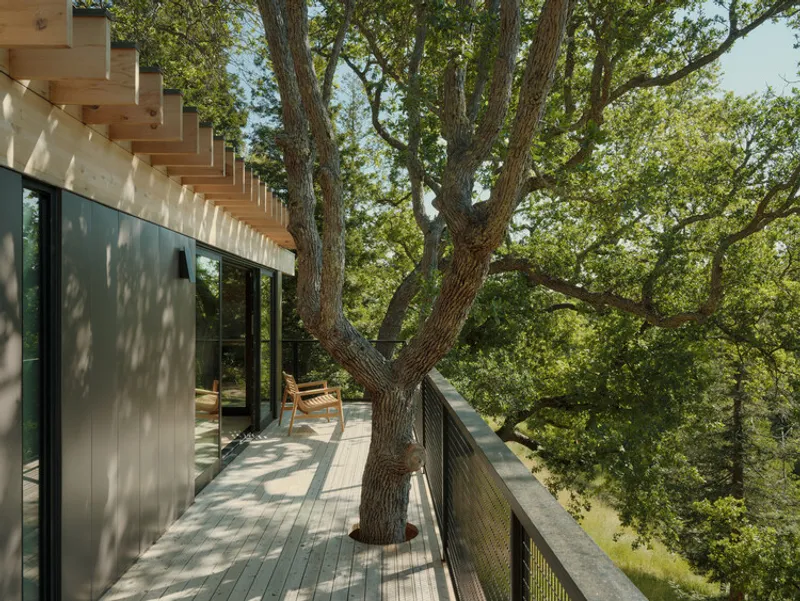
Concept: Lightness, Balance, and Renewal
When the clients approached Mork-Ulnes Architects, their vision was simple yet profound: tocreate a refuge dedicated to physical and mental well-being, while preserving the existing trees and enhancing the overall site. Rather than constructing a conventional annex, the architectsimagined the pavilion as a dialogue with the landscape, floating lightly above the ground in deference to the topography.

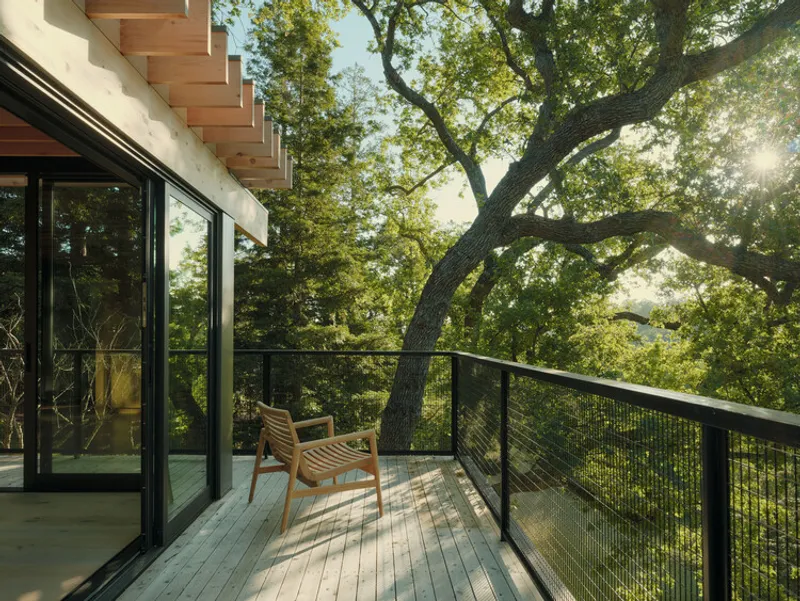
Positioned across a steep slope, the pavilion maintains just enough distance from the main 1970s stucco home to create an intimate courtyard, forming a three-sided spatial composition thatencourages outdoor gatherings and summer events. From this central void, nature is never background—it is participant, teacher, and presence.
Structure: Elevated Connection
The structure is suspended on slender steel supports, raising it to align with the walk-outbasement level of the main house. This elevation minimizes site disturbance and permits air,water, and wildlife to move freely beneath, emphasizing a philosophy of “light toucharchitecture.”

A timber bridge connects the pavilion to the residence, serving as a transitional threshold—anarchitectural pause between domesticity and retreat. This compressed zone, narrow yet luminous, reinforces the meditative experience of crossing into a new mental and sensory state.
Several mature oak and redwood trees pierce through the deck, defining spaces as naturally as walls would. This respectful coexistence of architecture and vegetation reinforces the project’s ecological intent and poetic simplicity.

Spatial Organization: Flexibility and Flow
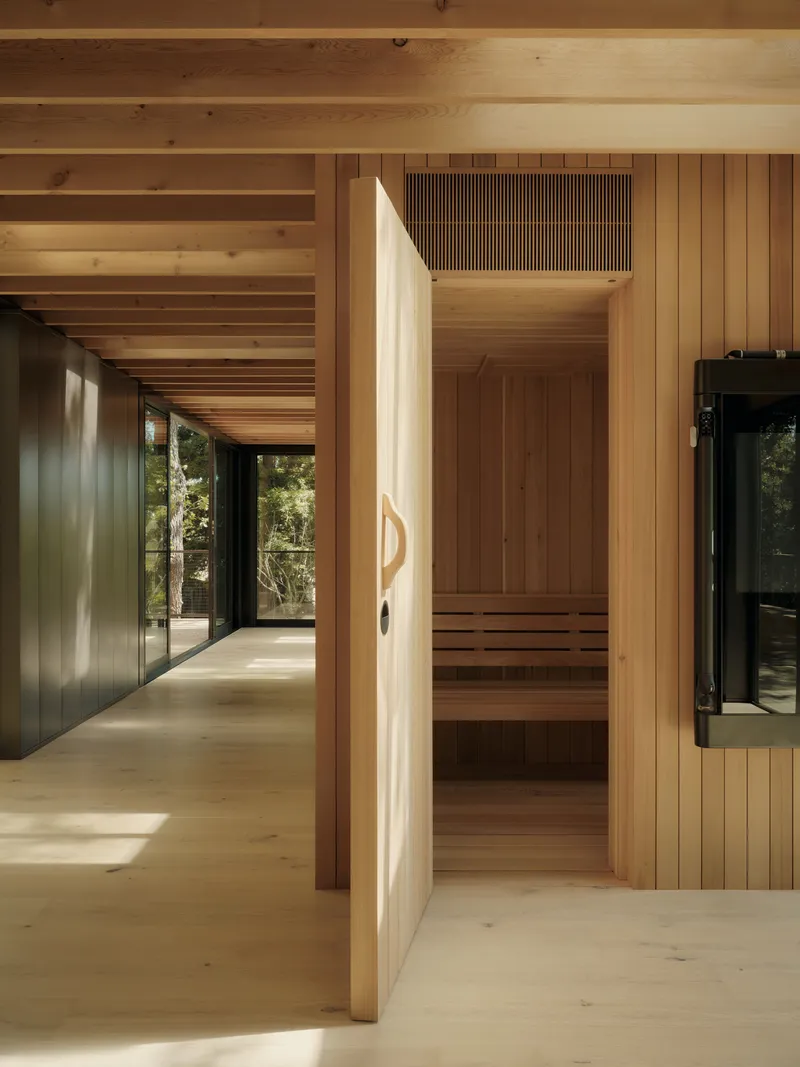
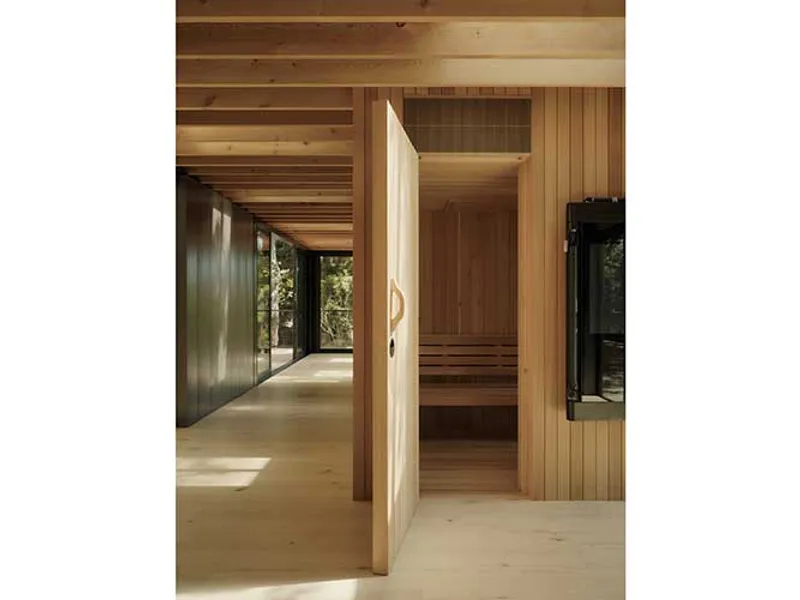
Internally, the pavilion’s modest program includes a flexible yoga and gathering space, a fitness and sauna area, and a compact bathroom. These spaces are centered around a cedar-clad core,with sliding glass doors on all sides that dissolve boundaries between interior and exterior.
The layout is designed to morph easily—morning meditation can flow into family dining, whileafternoon sunlight can animate social gatherings. The pavilion’s transparency ensures continuousvisual connection to the surrounding canopy, allowing its users to feel suspended among leaves, branches, and filtered light.
Material and Light: Nature as Medium
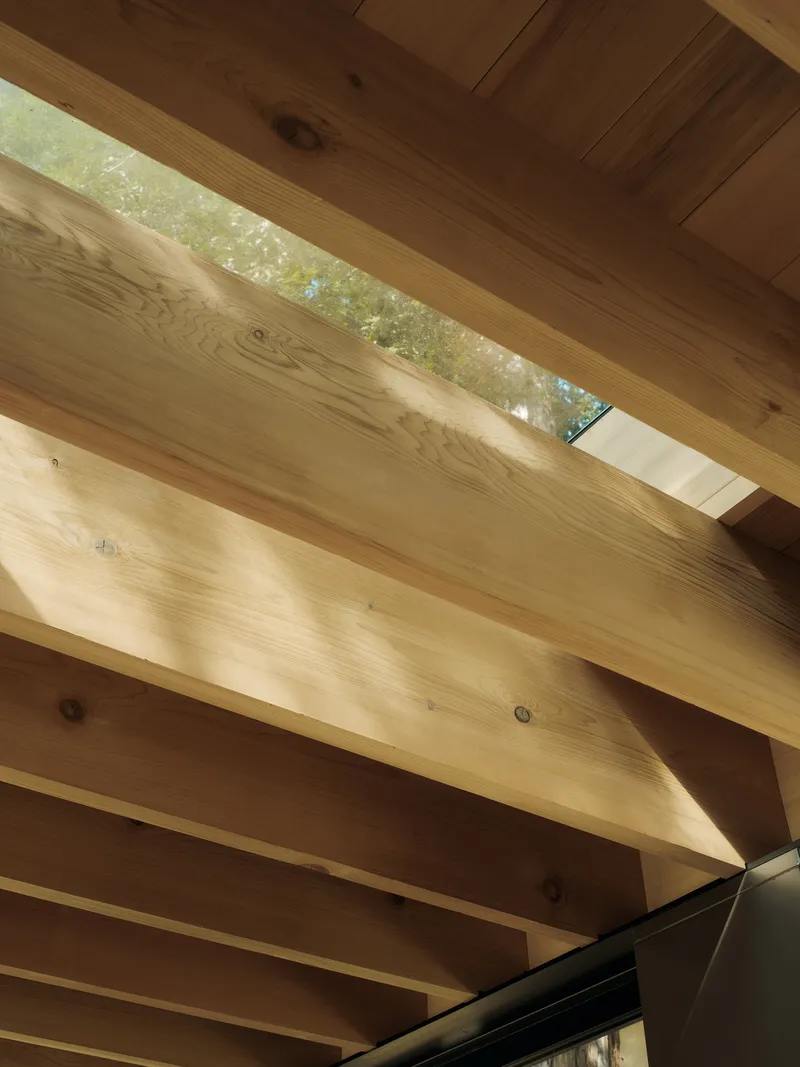
The material palette draws directly from the forest: warm cedar, transparent glass, and dark steelaccents. The exposed roof framing, crafted in cedar, carries a series of nine discrete skylightsthat distribute dappled light across the interior.

This filtered daylight reproduces the experience of sitting beneath the oaks—the architectureitself becoming a mediator between the human body and the forest’s rhythms. As sunlight shifts over the day, so too does the pavilion’s atmosphere: luminous and serene in the morning, thengolden and contemplative by evening.
Externally, the cedar surfaces will weather over time, deepening in tone and blending further intothe wooded landscape. Even in aging, the building honors the living cycles around it.
Sustainability: Built with Sensitivity
From engineering to environmental performance, the project demonstrates meticulous attentionto sustainability.
- Minimal land disturbance: Steel piers replace heavy foundations, protecting root systems.
- Passive daylighting: Skylights and operable glass provide ample light and ventilation withoutmechanical reliance.
- Energy-efficient systems: Consultation with Monterey Energy Group ensured the use of efficient heating and insulation solutions for year-round comfort.
- Longevity through simplicity: Durable timber construction guarantees low maintenance andgraceful aging.

The project partners—including Daedalus Engineering, Romig Engineers, and Lea & Braze Engineering—collaborated closely to marry structural lightness with environmental stewardship.
Living with the Landscape
The Pavilion in the Oaks is more than an architectural addition—it is a philosophical gesture,redefining what it means to inhabit a site. Instead of imposing order, the pavilion accepts the forest’s existing conditions as guiding forces.
Here, architecture exists in quiet reciprocity with its context: suspended among trunks, it captures the sound of leaves and the play of afternoon breeze. Each element—bridge, deck, skylight—serves to frame not a view, but an awareness of presence.
For Mork-Ulnes Architects, whose body of work frequently explores material honesty and environmental restraint, this project encapsulates the firm’s ethos: “In balance with landscape, the building becomes part of the life that surrounds it.”
All the Photographs are works of Joe Fletcher Photography



Popular Articles
Popular articles from the community


Co-Life: Senior Housing Design That Reconnects Older Adults With the City
Co-Life reimagines senior housing design through healing gardens, shared streets, workshops, and a sustainable community across generations.

The Earth Pod: 3D Printed Homes for Resilient Refugee Communities
The Earth Pod reimagines refugee housing through 3D printed homes made from clay, combining resilience, self-sufficiency, and rapid shelter.
AL-JANNAH: Sustainable Architecture and Permaculture for Afghan Widows
AL-JANNAH uses sustainable architecture and permaculture to create resilient oasis of housing, learning, work and renewal for Afghan widows.

The Musturak Paradise: Senior Living Architecture for a Connected Future in Temara, Morocco
The Musturak Paradise reimagines senior living architecture in Temara via private homes, social spaces, culture, community, and shared care.

Similar Reads
You might also enjoy these articles


Hodi-Mandai Geram
Project Function: Preservation and revitalization of the Intangible heritage and socio-spatial identity of the Hodi by Housing, Cultural Memory Center, Sacred Grove, landscape, local tourism economy


Olio Towers: A Mid-Rise for Performers That Fuses Housing, Rehearsal, and Stage
Located blocks from Houston's Theater District, this modular tower stacks living units around a central performance atrium.

Oasis: Modular Green Housing Carved into Dhaka's Urban Fabric
A shortlisted Plugin Housing entry reclaims unauthorized settlements in Dhaka with stepped concrete volumes, green roofs, and ventilation-driven design.

Black Hole: A Floating Megastructure for the Post-Physical Era
Emiliano Mazzarotto envisions a spherical, self-scaling arena where e-sports, digital hotels, and holographic stadiums replace traditional public space.


Explore Pavilion Competitions
Discover active competitions in this discipline



Challenge to reimagine the Iron Throne


Photograph architecture without architects


Illustrate the lost glory of Angkor Wat - Render Challenge


Design challenge to reuse E-waste
Comments (0)
Please login or sign up to add comments
No comments yet. Be the first to comment!