

Payette's ECoRE Building Anchors Penn State's New Engineering Precinct with a 280,000 SF Research Hub
A faceted campus building in State College, Pennsylvania uses a central atrium and vertical fin facade to stitch research and teaching together.


Penn State's College of Engineering has needed a flagship for years, something that could consolidate scattered research groups, attract graduate talent, and signal ambition to anyone driving down Atherton Street. The Engineering Collaborative Research and Education Building, designed by Payette and completed in 2024, is that signal: a 280,000 square foot complex that folds laboratories, teaching spaces, and collaborative lounges into a single address at the heart of a new engineering precinct in State College, Pennsylvania.
What makes ECoRE worth studying is not its size but its organizational gambit. Rather than stacking programs into a conventional slab, Payette broke the mass into angled wings arranged around a central courtyard and threaded them with a multi-story atrium that acts as the building's social and circulatory spine. The result is a plan that reads clearly from the inside, encourages collisions between disciplines, and gives every corridor a sightline to something happening on another floor.
A Facade That Works the Street
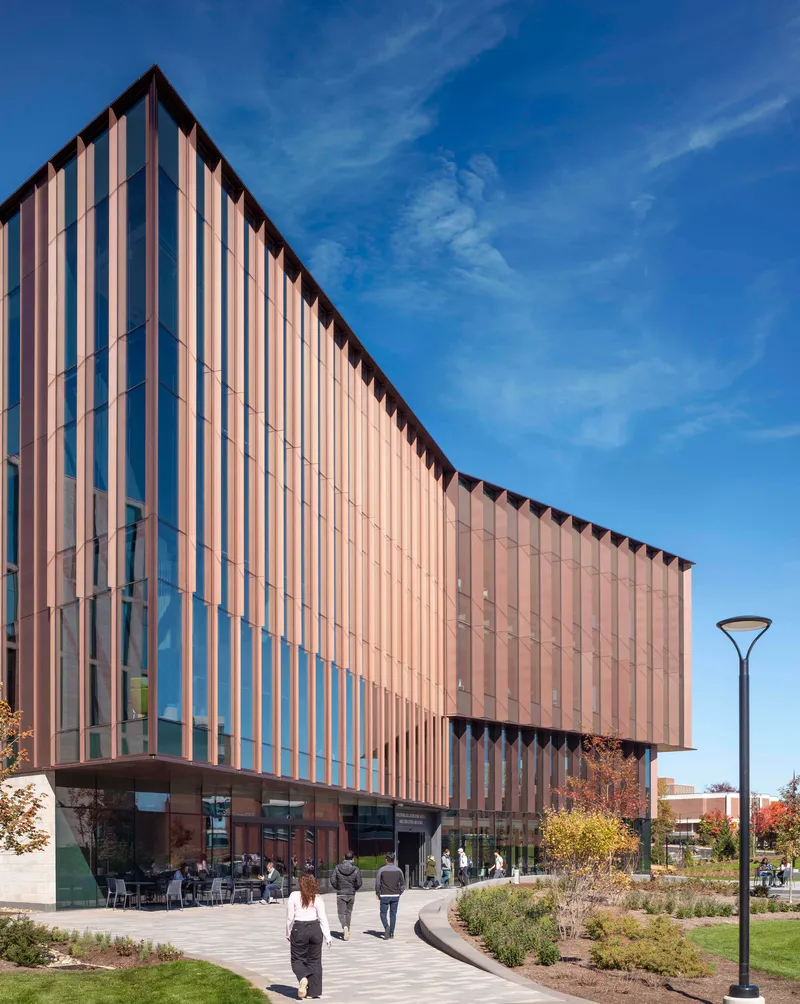
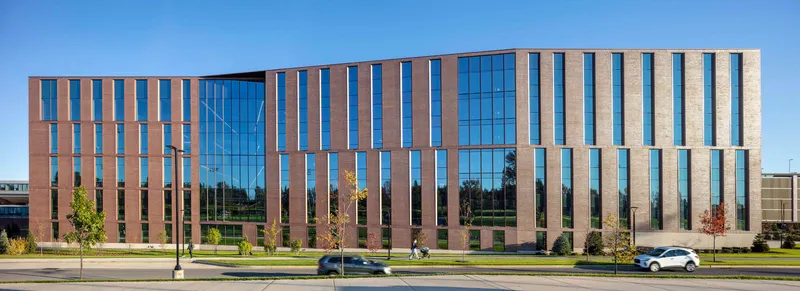
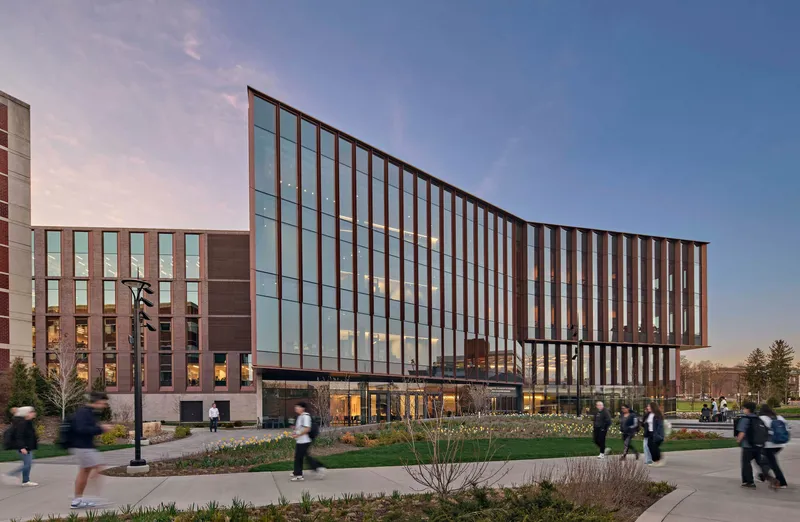
ECoRE's exterior is defined by a rhythmic curtain of vertical metal fins that wrap each volume in a consistent language while allowing variation in depth and spacing. The fins do real work: they manage solar gain on south and west exposures, reduce glare in labs, and give the facade a shimmering, directional quality that shifts as you walk past. Up close, the building is not monolithic. Striped bands of brick and glass break the mass into readable segments, and the ground level opens generously toward the campus plaza.
At dusk the strategy pays off differently. The fins recede and the fully glazed bays behind them light up, turning the building into a lantern that broadcasts activity to the surrounding precinct. It is a straightforward move, but Payette executes it with discipline: no gratuitous cantilevers, no sculptural flourishes, just a well-tuned envelope doing its job.
The Atrium as Social Infrastructure
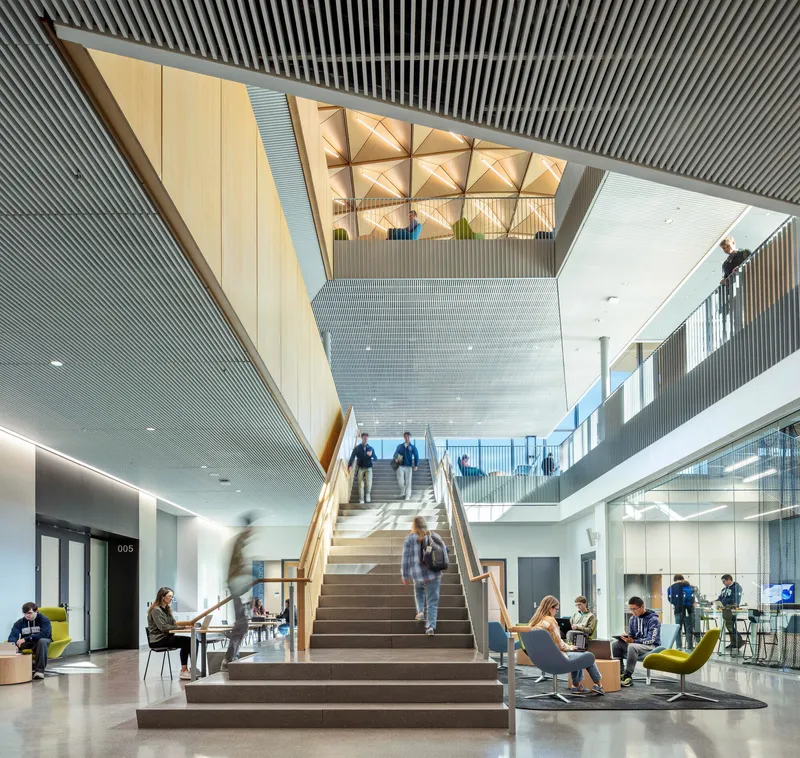
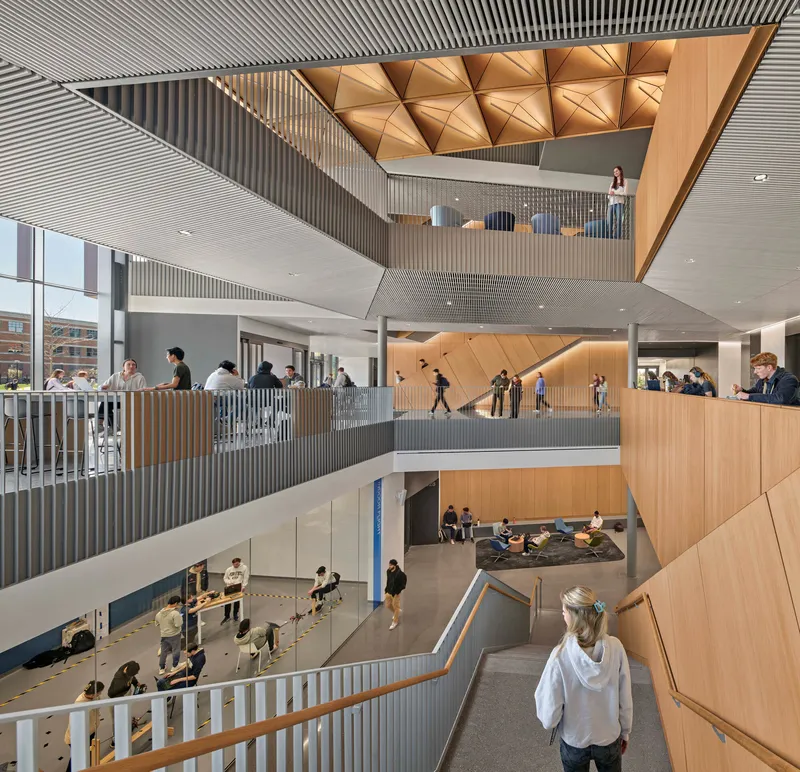
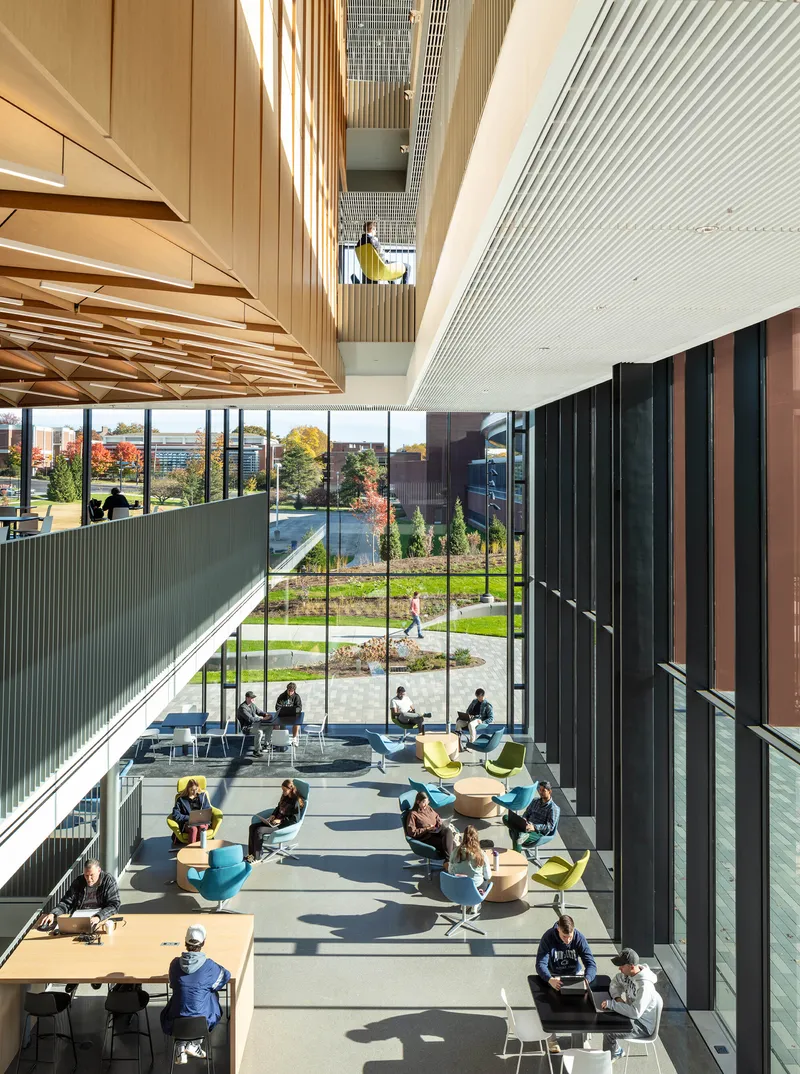
The central atrium is the building's strongest room. A wide staircase rises through multiple levels beneath a triangulated wood ceiling that gives the space acoustic warmth and geometric identity without relying on expensive custom fabrication. Interconnected walkways cross the void at each floor, creating layered views that make the population of the building visible to itself. You can stand on any level and see students working, walking, or just hanging around on three other floors.
Payette lined the atrium's edges with lounge zones, casual seating clusters, and floor-to-ceiling glazing that pulls daylight deep into the plan. The colorful furniture is a minor note, but the spatial generosity is not. These are genuinely large interstitial zones, not leftover corridors dressed up with a bench. For a research building, where chance encounters between disciplines can seed new collaborations, this kind of shared space is not a luxury. It is program.
Vertical Circulation as Spectacle
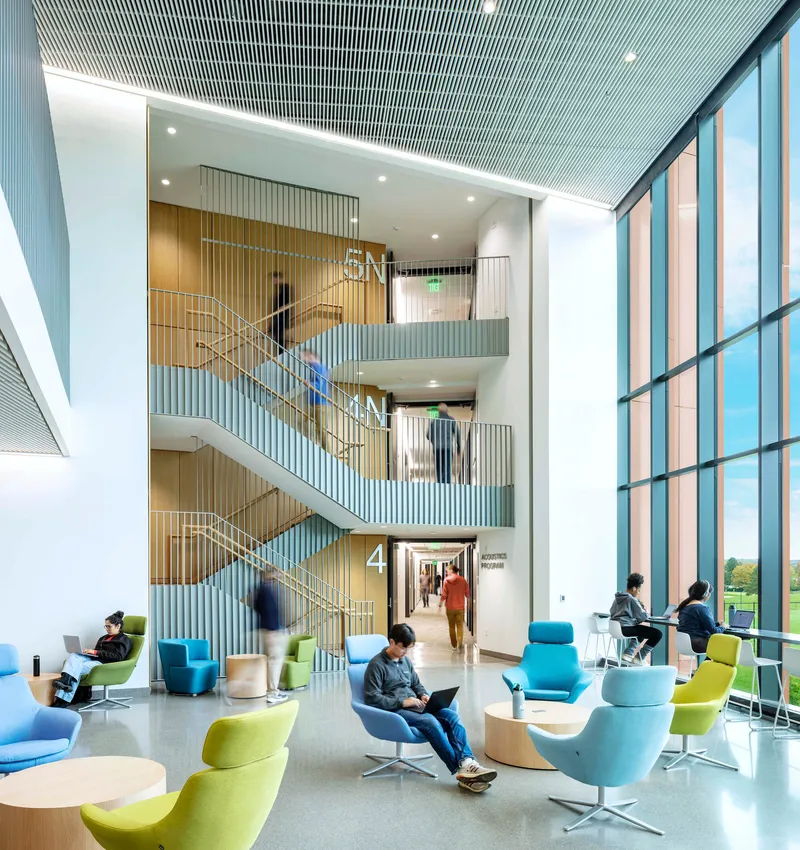
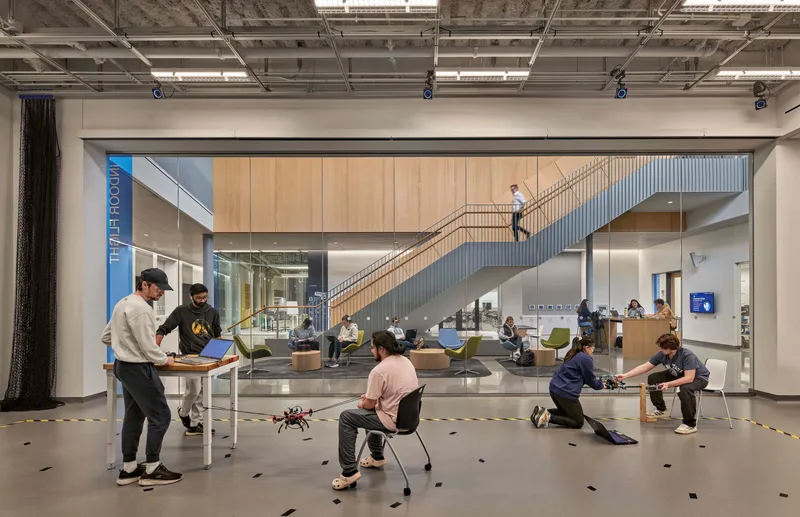
A four-story stairwell wrapped in vertical wood slats and tall glazing panels doubles as an informal gathering space, with students perched on seating ledges at its base. The slatted walls filter light and sound, creating an environment that feels calm despite its scale. It is a deliberate inversion of the typical engineering building stairwell, which tends to be a fireproof afterthought.
Elsewhere, a glass wall opens onto a double-height volume where students test drones mid-flight, visible to passersby in the atrium. These moments of transparency are not accidental. Payette has made research legible, turning the building's circulation into a continuous gallery of what happens inside.
Where the Work Happens
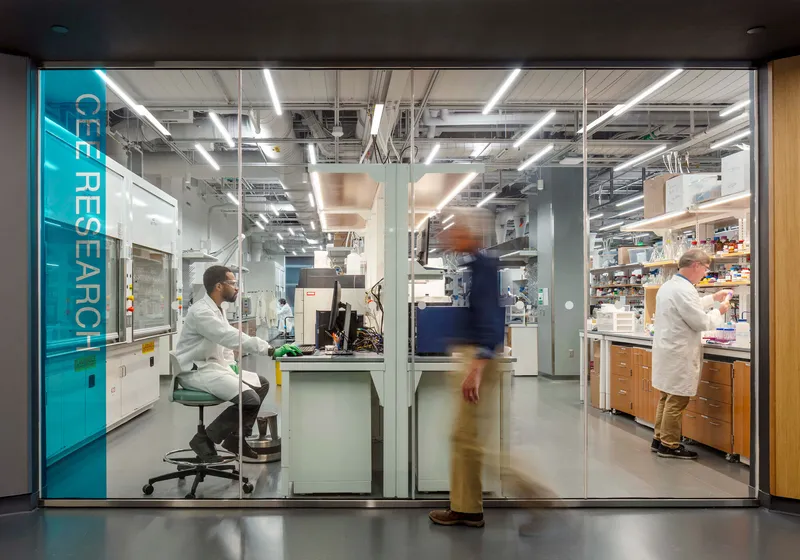
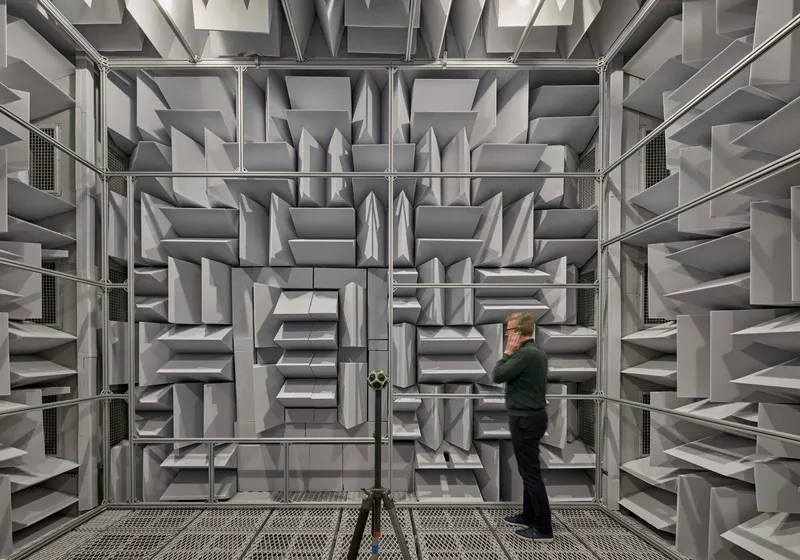
The labs themselves are handled with pragmatic clarity. Glass-walled research spaces with exposed ceilings and flexible bench layouts sit alongside highly specialized environments like an anechoic chamber lined with pyramidal foam baffles. The range is significant: ECoRE serves mechanical, electrical, acoustical, and aerospace engineering programs, each with distinct spatial and environmental requirements.
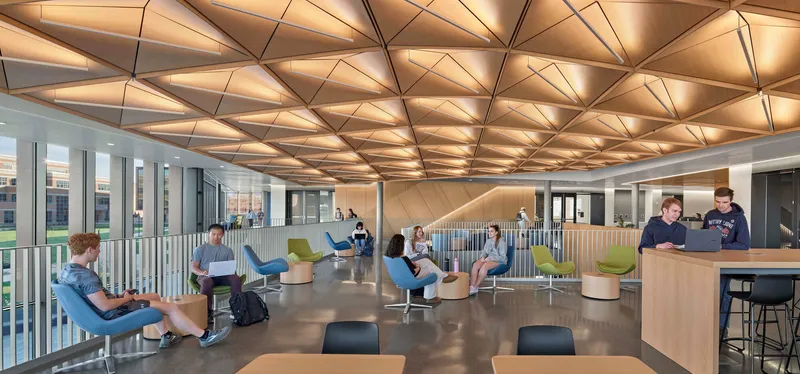
Above and between these technical spaces, upper-level lounges with faceted acoustic wood ceilings provide decompression zones. The ceiling panels here echo the triangulated geometry of the atrium but at a tighter scale, creating pockets of visual and acoustic intimacy within a building that otherwise favors openness. The balance between focused research environments and generous social space is what keeps a building like this from feeling like a warehouse.
Campus Grounds and the Courtyard Strategy
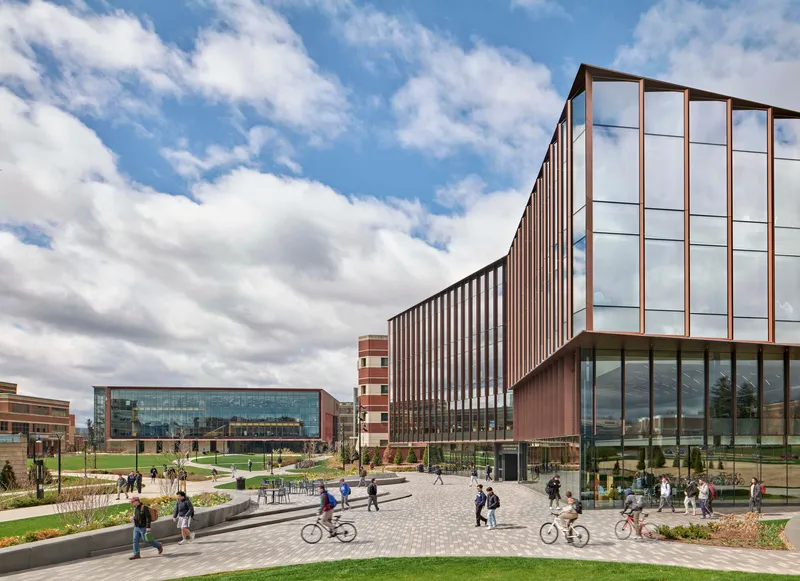
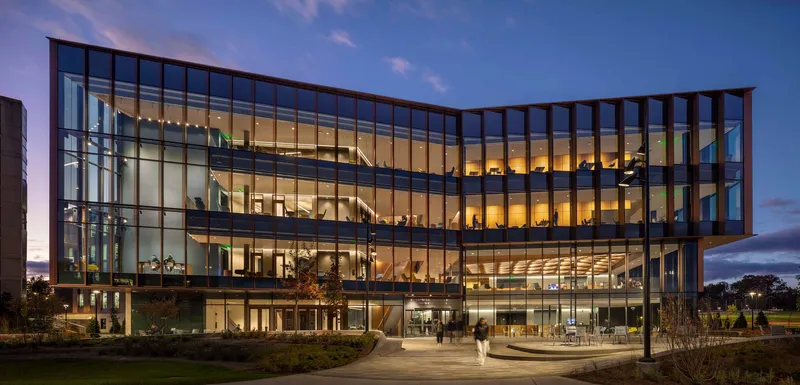
At ground level, ECoRE extends its presence through a landscaped plaza of paved walkways and planted beds that connect the building to the broader campus grid. The angled wings create a sheltered courtyard that acts as an outdoor room, visible from the atrium and accessible from multiple entries. At night, the illuminated interior floors turn the courtyard into a framed stage, reinforcing the building's ambition to be a visible center of activity rather than a closed box.
Plans and Drawings
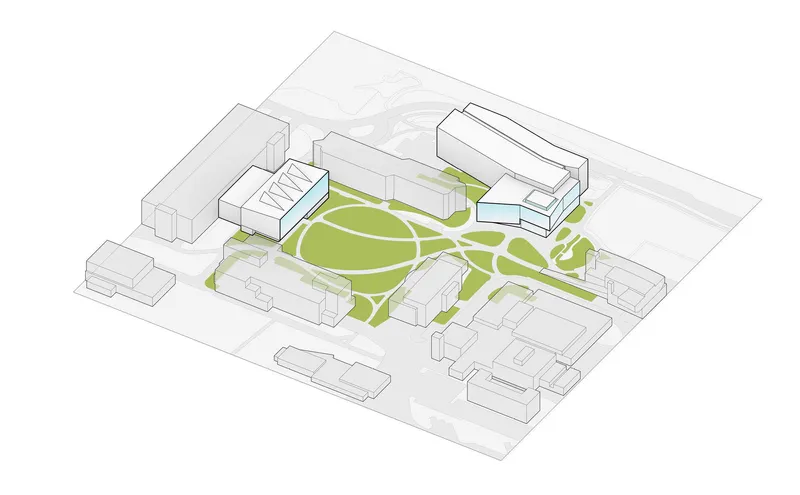
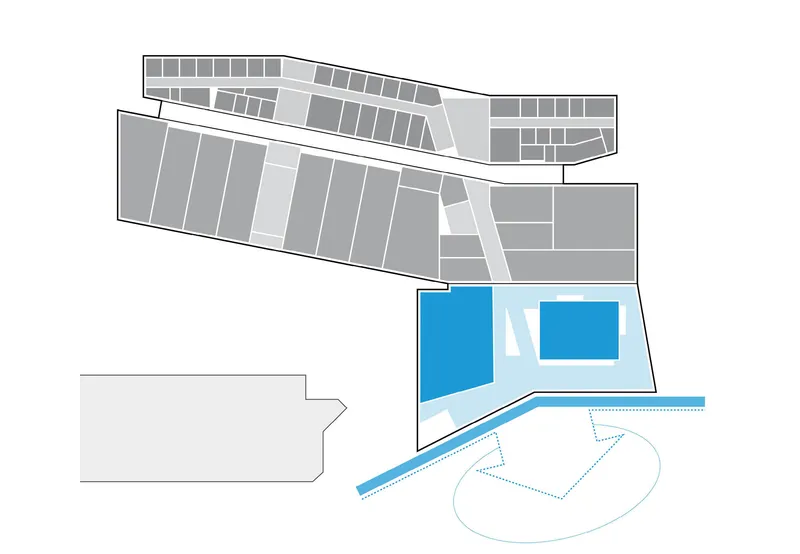
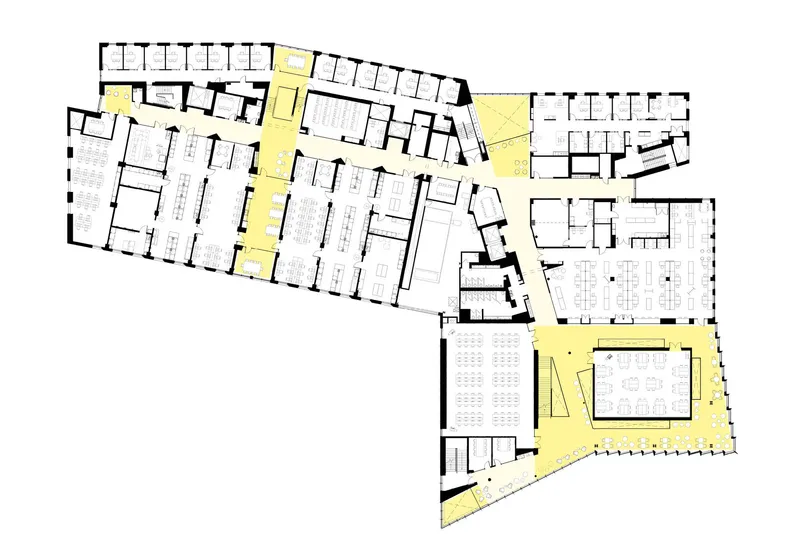
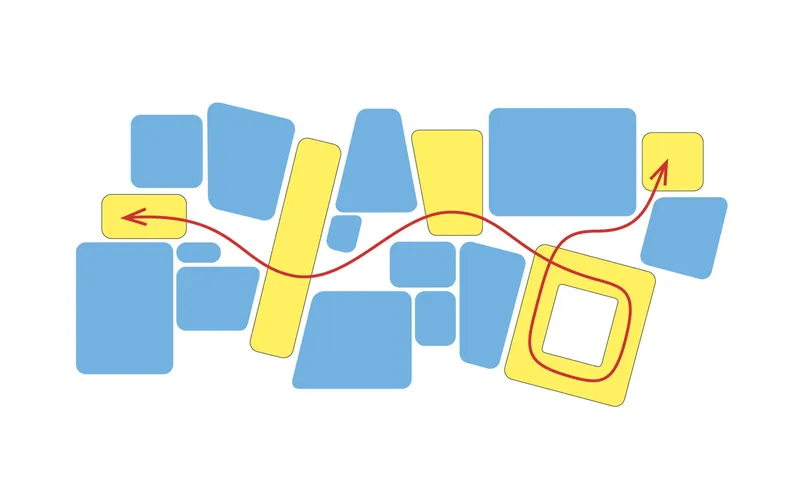
The axonometric drawing confirms the courtyard-centric strategy: building volumes pinwheel around a central green space, with neighboring structures forming the edges of a loose quadrangle. The site plan shows the ground floor's relationship to a landscaped oval, while the floor plan reveals the angled wings and their corridor logic. Circulation diagrams map the paths that connect blue and yellow programmatic zones, making explicit the building's commitment to cross-pollination between disciplines.
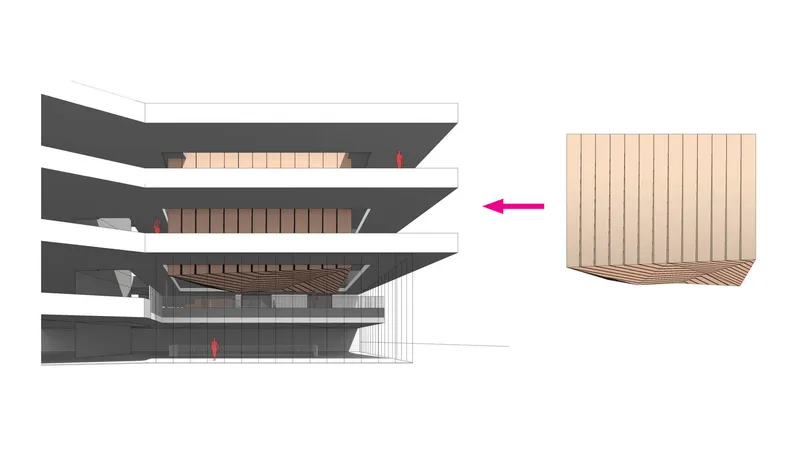
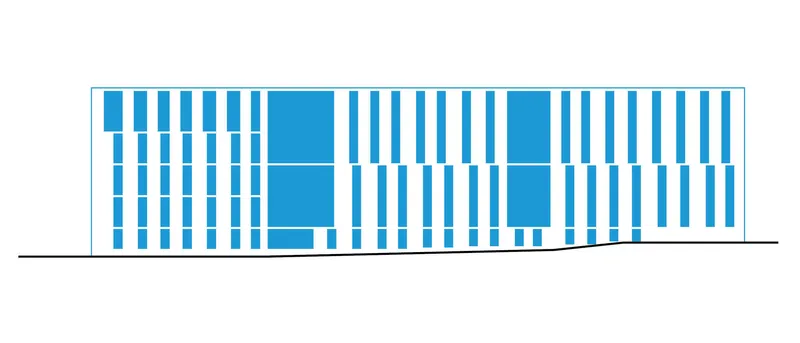
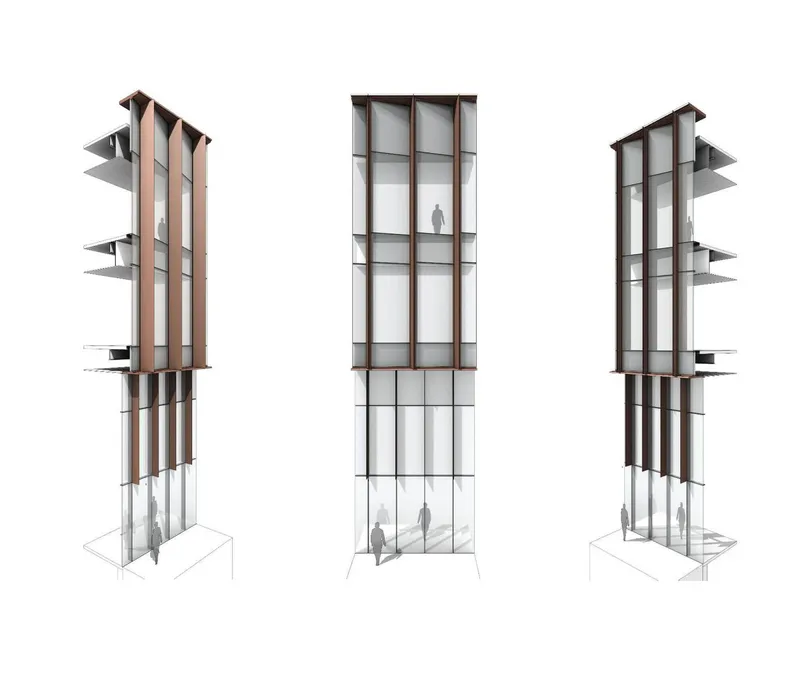
The section drawing reveals stacked floor plates of varying height, accommodating tall lab volumes alongside standard office levels, with a detail callout for the timber ceiling module that gives the atrium its distinctive character. The elevation drawing documents the vertical louver rhythm and its interplay with larger glazed panels. Together, these drawings show a building that was planned with precision and not simply shaped for effect.
Why This Project Matters
University engineering buildings are frequently compromised by competing demands: research wants sealed, controlled environments; teaching wants flexibility; administrators want a building that photographs well for fundraising materials. ECoRE resolves these tensions not through formal gymnastics but through organizational intelligence. The atrium-and-wing plan gives every program its own territory while ensuring no one is more than a staircase away from the communal spine. The facade is dignified without being precious. The labs are real labs, not showpieces.
Payette has built a building that takes its role as precinct anchor seriously. It establishes a scale, a material language, and a public face that future neighbors can respond to without being overshadowed. For Penn State's engineering ambitions, ECoRE is less a monument than a working engine, and that distinction is exactly right.
Engineering Collaborative Research and Education Building (ECoRE) at Penn State University, designed by Payette. State College, Pennsylvania, United States. 280,000 SF. Completed 2024. Photography by Robert Benson Photography and Warren Jagger.
About the Studio
Share Your Own Work on uni.xyz
If projects like this are the kind of work you want to make, uni.xyz is a place to publish your own, find collaborators, and enter design competitions.


Popular Articles
Popular articles from the community

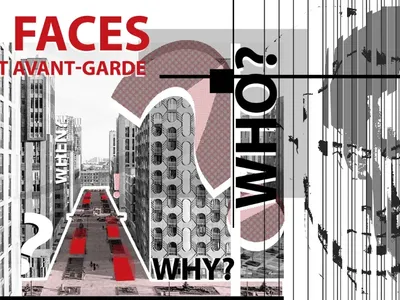
Faces of the Soviet Avant-Garde: Turning Moscow's Street Names into an Open-Air Museum
A network of sculptural installations across a Moscow residential district transforms forgotten architect names into spatial encounters with cultural memor

Opera on the Sea: Driftwood Logic Shapes a Timber Opera House on Estonia's Coast
Trevor Orgill's opera house translates the entangled drift of floating timber into a civic building where wood, water, and music converge.

Manzana Morphosis: Stretching Barcelona's Grid into a Living Landscape for 2050
A radical reworking of the Eixample manzana turns density into a tool for generous public space, vertical ecology, and environmental performance.

Singing Woman: An Opera House That Performs Before the Curtain Rises
Ovidiu Cristian Pavel's conceptual opera house translates Estonia's choral identity into a sculpted waterfront landmark facing the Baltic Sea.

Similar Reads
You might also enjoy these articles

Pixel Gardens: One Repeated Module Stacked Into a Terraced Social Housing Tower for Famagusta
Salem Bader's shortlisted housing tower builds a vertical neighbourhood from one repeated module, offsetting units to carve terraces, light and air.

Bao Huynh Watercolor Atelier: A Serene Art Retreat in Hội An
Bao Huynh Watercolor Atelier in Hội An blends multifunctional art spaces, sustainable design, local materials, and family-friendly living in a serene environment.

Atelier Macri Concept Store Interior Design by CASE-REAL
Atelier Macri store features a "ko" counter, walnut wood details, cork displays, blending retail, gallery, and seamless customer experiences.

Manuel Vargas Izquierdo Stadium and High-Performance Sports Center: Architectural Excellence in Jalpa de Méndez
The Manuel Vargas Izquierdo Stadium blends sustainable design, inclusive sports facilities, and cultural-inspired architecture, revitalizing Jalpa de Méndez’s public spaces.


Comments (0)
Please login or sign up to add comments
No comments yet. Be the first to comment!