

Pedro Moncayo Torres Revives the Primitive Hut on an Ecuadorian Farm for Under $100K
A 175-square-meter stone and timber refuge in Tarqui, Ecuador, channels vernacular building traditions to dissolve into its misty pastoral landscape.


There is a particular kind of ambition in building something that looks as though it has always been there. El Refugio House, designed by Pedro Moncayo Torres arquitectura with lead architects Pedro Moncayo Torres and Tatiana Pérez, sits on a farm in the southern countryside of Cuenca, Ecuador, where a second-order road climbs through endemic forest and rolling pasture. The brief was modest: a weekend retreat for a small family, delivered on a budget between $50,000 and $100,000. The answer is a 175-square-meter composition of local stone, artisanal brick, timber, reed cane, and clay tile that reads less as a house imposed on the land and more as a geological formation slowly colonized by domestic life.
What makes the project worth studying is not its restraint alone but the clarity of its conceptual framework. Moncayo Torres describes the scheme as a return to the primitive hut, the anthropological figure in which fire is the center of social life. That idea is not deployed as metaphor. It structures the plan: two rectangular volumes, one social and one private, are separated by a third zone containing the kitchen and barbecue, which is literally the hearth around which the household gathers. The chimney anchors the section. Everything else radiates outward toward the fog.
Two Volumes and a Hearth Between Them
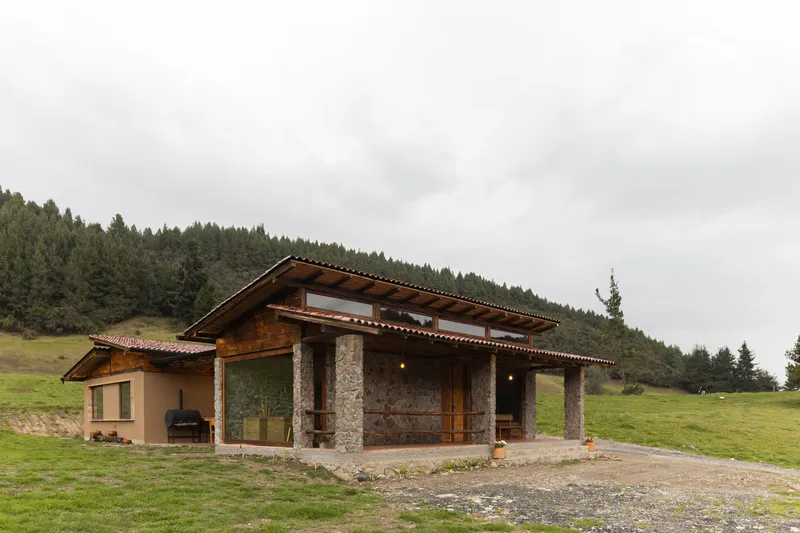
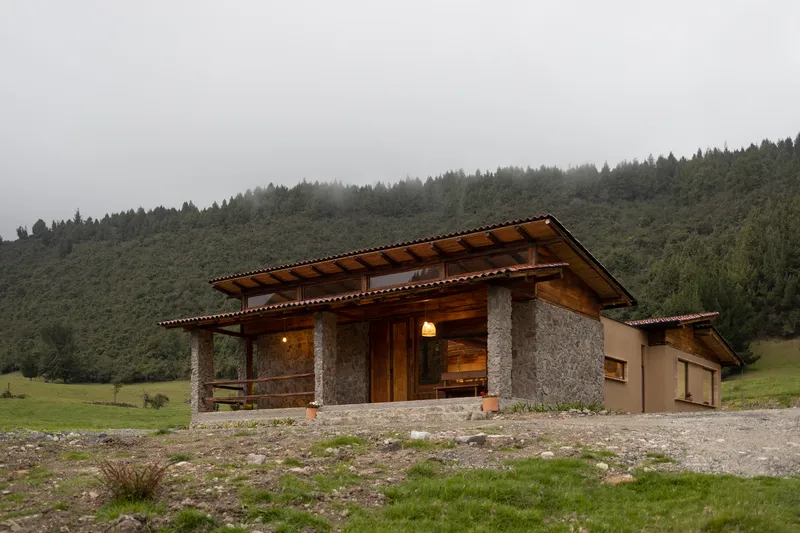

From the exterior, El Refugio presents itself as two low-slung gabled volumes connected beneath generous timber eaves. The front block houses the social areas, the porch, the dining space, and the living room. The rear block tucks bedrooms and bathrooms into a more private zone. Between them, the kitchen and barbecue zone acts as the connective tissue, open to both volumes and to the sky. The organizational logic is legible at a glance: the plan is tripartite, and the hearth is the hinge.
The massing keeps everything single-story and horizontal, which matters on a site where forested hillsides and rolling meadows establish the visual rhythm. Nothing breaks the treeline. The heavy clay-tile roofs reinforce the gravity of the composition, pressing the house into its gravel platform and making it feel anchored rather than perched.
Stone Walls That Work for a Living
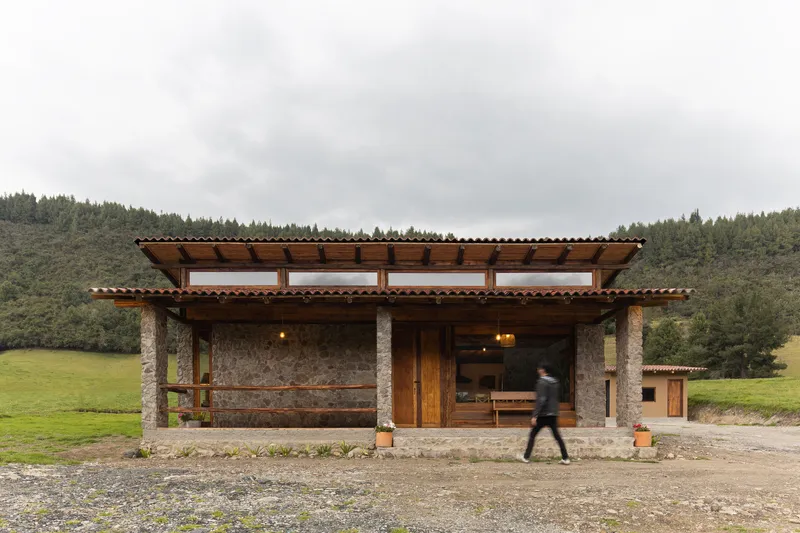
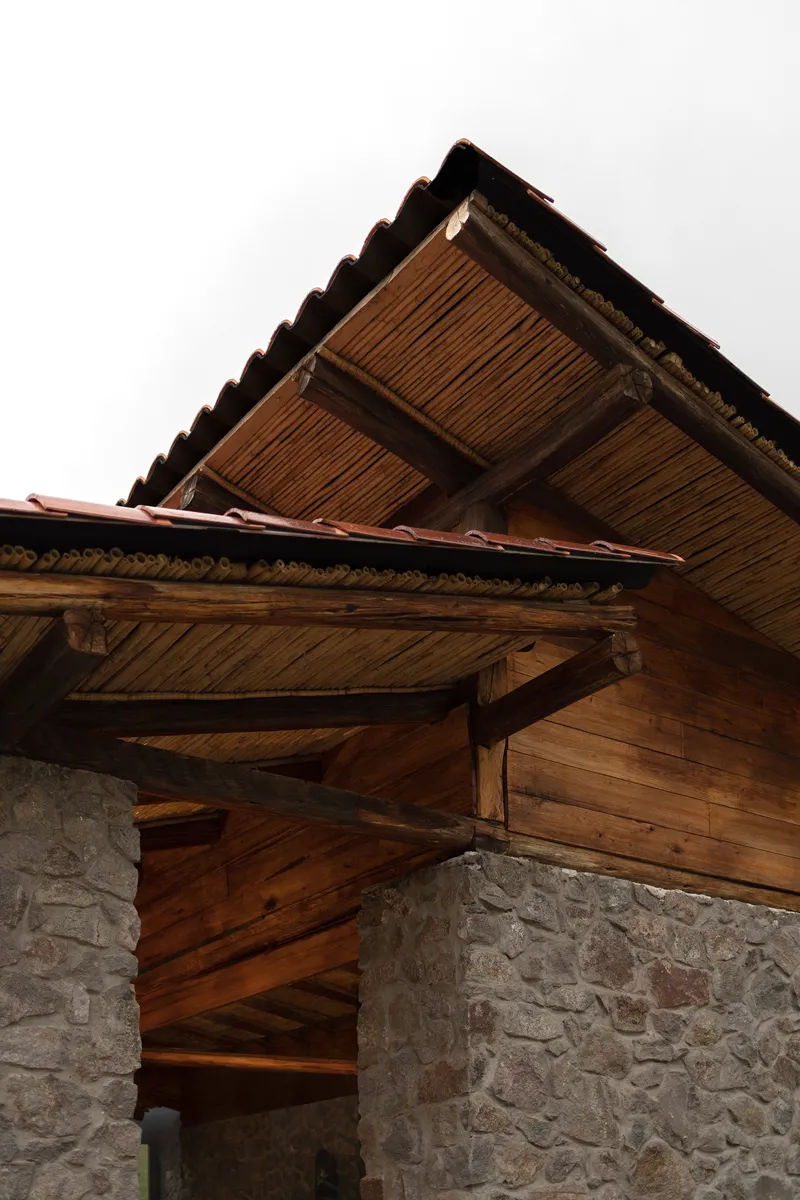

The fieldstone walls are not a cladding decision. They are the structural system: load-bearing masonry drawn directly from local vernacular construction traditions. Stone provides mass, and mass provides thermal stability in a zone where fog, rain, and cool highland air demand insulation without mechanical systems. The walls absorb heat during the day and release it slowly through the evening, a passive strategy as old as architecture itself.
Detailing is honest. Stone columns rise to meet timber beams without ornamental mediation, and where clerestory windows puncture the masonry, they do so as simple rectangular openings. The effect is neither rustic nor precious. It is simply direct, which on this budget is the most intelligent posture available.
The Porch as Threshold

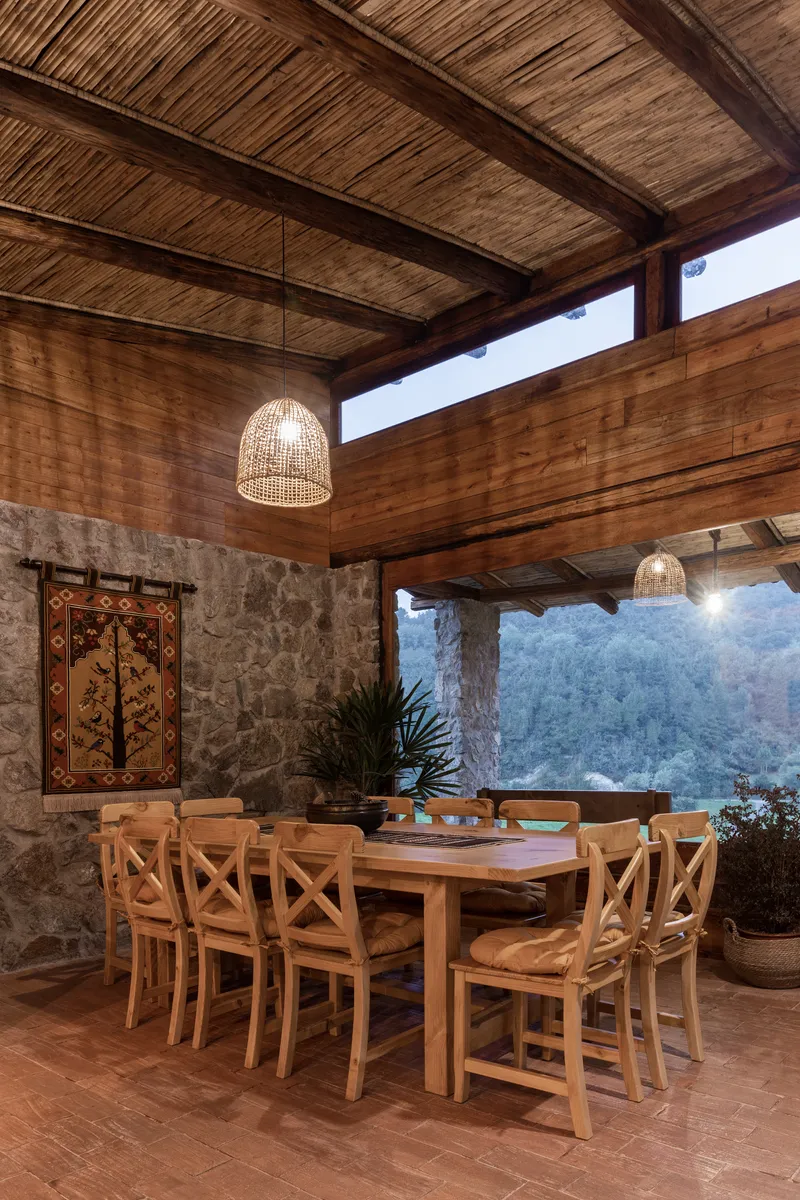
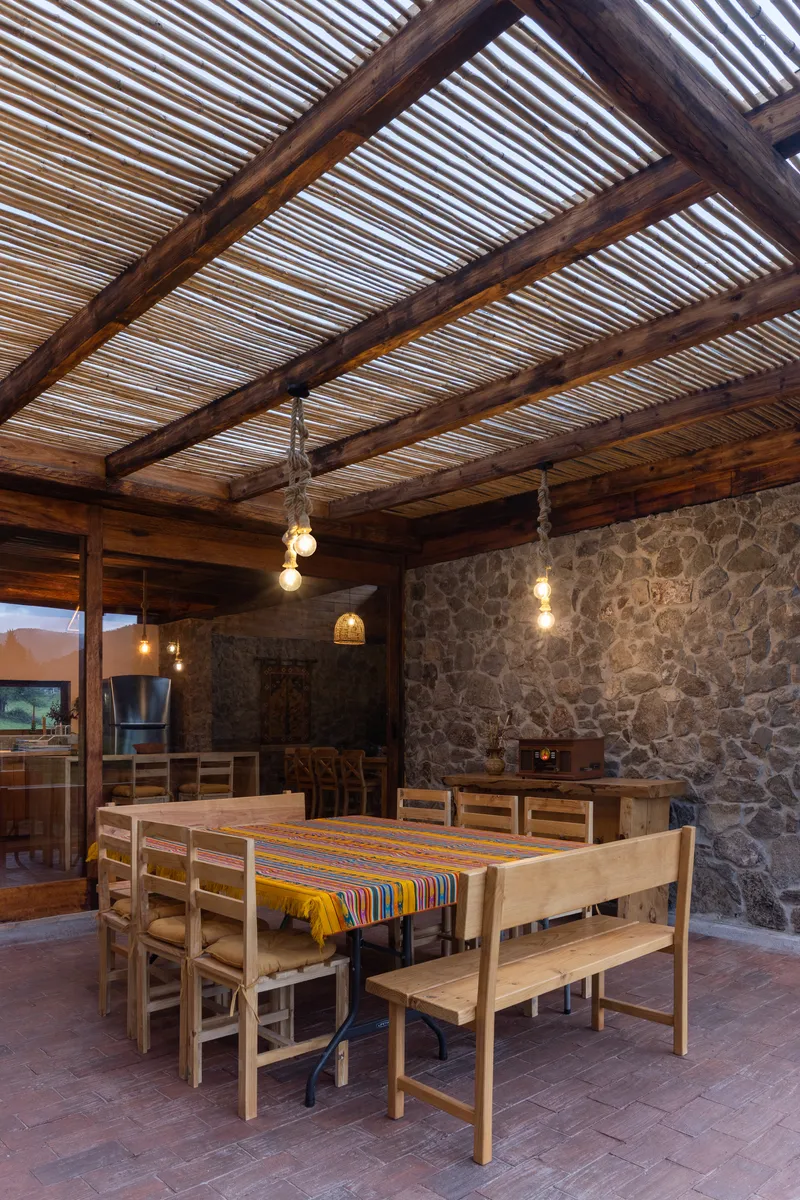
The covered porch is the single most important spatial move in the project. It serves as the transition element between the endemic landscape and the domestic interior, a zone that belongs fully to neither. Deep overhangs shelter this space from rain while keeping it open to the view. Pendant lamps hang from exposed timber beams, signaling habitation without enclosure.
At dusk, the porch becomes the center of gravity. The dining table sits here, framed by stone column wings on either side and the woven pendant fixtures above, looking out across misty pasture toward the treeline. It is the most generous room in the house, and it has no walls. The primitive hut concept becomes tangible in this moment: gather around the table, gather around the fire, and let the weather do what it will beyond the roof edge.
Reed Cane, Timber, and the Ceiling as Surface
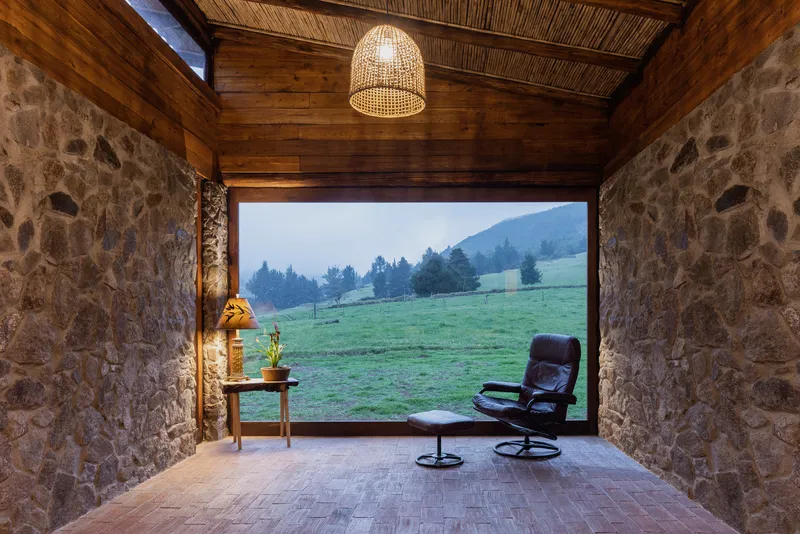

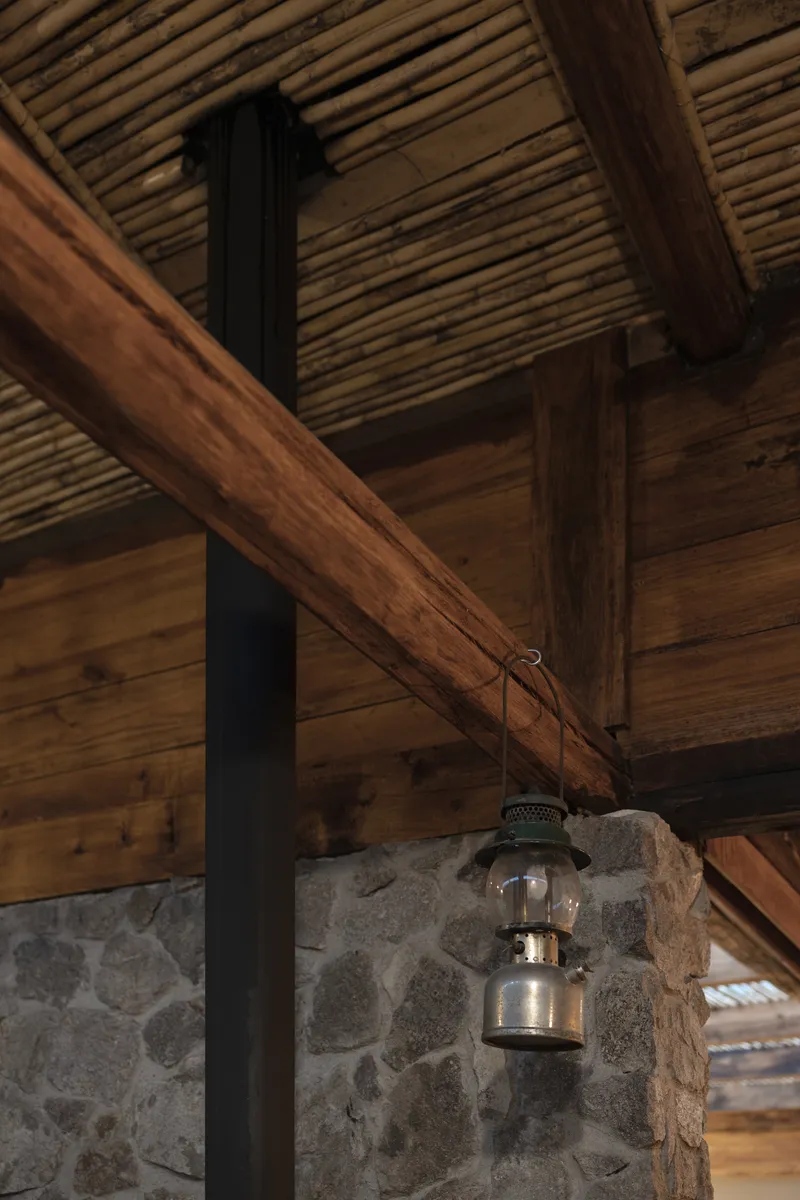
The roof structure is where the project's material palette achieves its finest resolution. Timber rafters support a woven reed cane ceiling that filters light and introduces a warm, striated texture overhead. The cane is not decorative fill; it is part of the roof assembly, working in concert with the clay tiles above to create an insulating air gap and a finished interior surface in a single gesture.
Inside the main volume, fieldstone walls meet the reed ceiling to produce interiors that feel both cave-like and airy. A large opening in the social block frames misty green pasture with the inevitability of a landscape painting, except that the frame is structural stone, and the painting changes with every shift of highland weather. The kitchen pairs a timber island with the same stone-and-beam language, and artisanal brick floors underfoot complete the material cycle. Everything was sourced locally, and everything is legible.
Interior Partitions and Borrowed Light


Where the front volume is open and extroverted, the rear block is quieter. Timber-framed glass partitions divide bedrooms from circulation without severing visual continuity. A person standing near the dining space is visible through the partition, maintaining the social connection that the plan's tripartite logic encourages. Light borrowed from the central glazed link between the two roof volumes filters deep into the plan, ensuring that even the most private rooms participate in the landscape.
The rear elevation reveals the two volumes as distinct but linked entities: stucco and glass walls face the rolling meadows and forest, a lighter touch than the stone front facade. This duality, heavy toward the road and open toward the pasture, gives the house a directionality that reinforces the experience of arrival and retreat.
Plans and Drawings


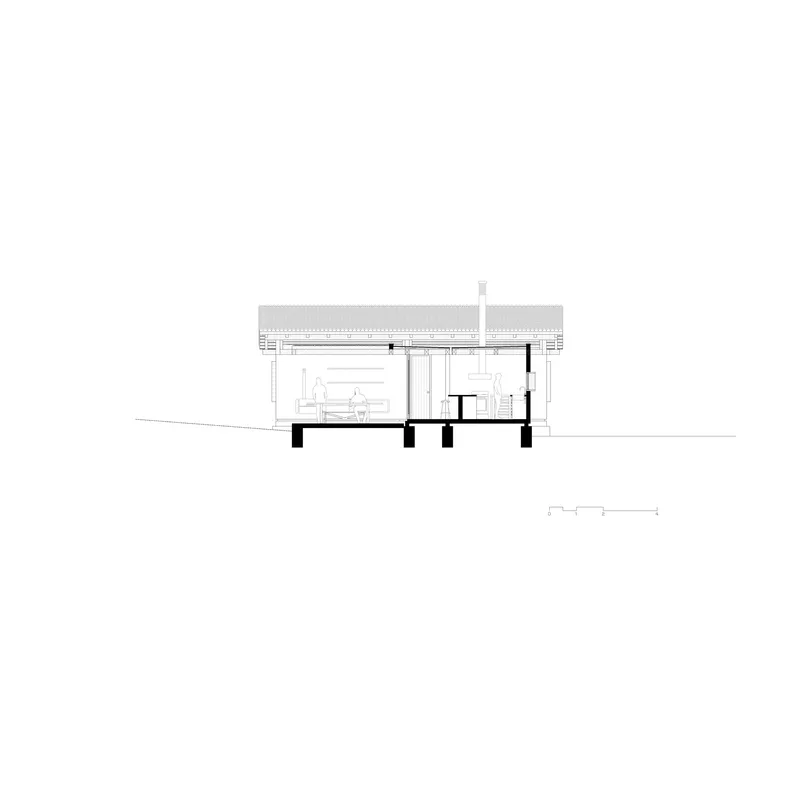

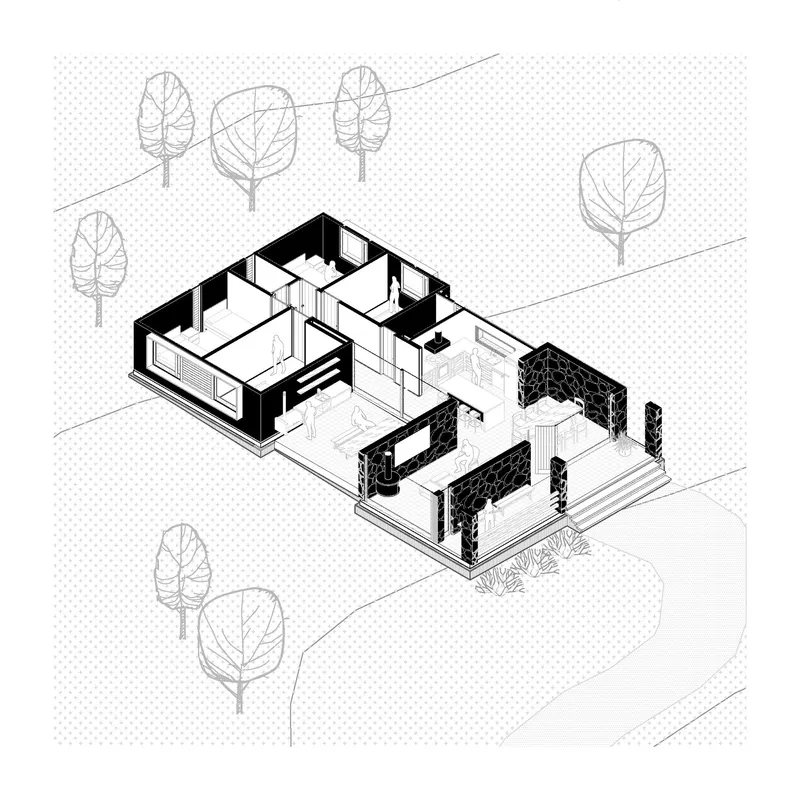


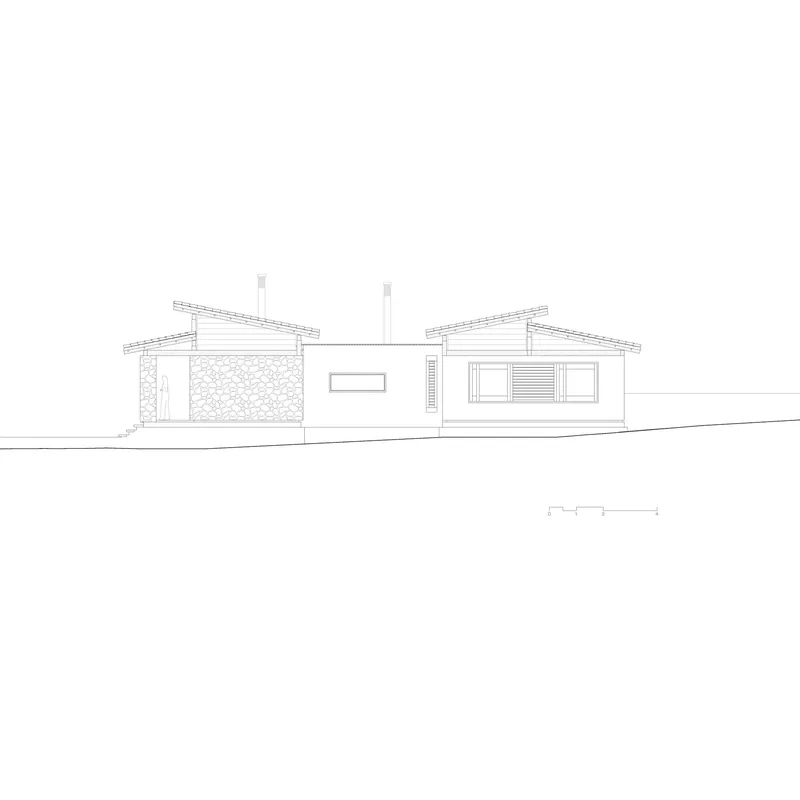


The floor plan confirms the tripartite organization: three bedrooms and bathrooms cluster in the rear volume, while the social block opens generously to the porch. The roof plan reveals the central glazed link between the two rectangular volumes, a seam of light that separates the pitched forms just enough to register as distinct objects. Sections show the sloped roofs resting on elevated floor platforms, with the chimney element rising through the center of the composition as the vertical anchor of the entire scheme.
The isometric drawings are particularly revealing. They show how the two volumes sit within a clearing of stylized trees, and the cutaway version exposes the courtyard-like kitchen zone wedged between the two wings. Elevations demonstrate the horizontal proportions and the disciplined fenestration: stone cladding dominates the entry facade, while ribbon windows and glazed openings punctuate the longer elevations. The drawings collectively reinforce a project whose clarity of intent survives every angle of scrutiny.
Why This Project Matters
El Refugio belongs to a lineage of houses that treat constraint as a design driver rather than a limitation. A budget under $100,000 for 175 square meters in rural Ecuador demands decisions that are simultaneously structural, thermal, and aesthetic. Local stone walls do all three jobs. Reed cane ceilings do all three jobs. The primitive hut is not a nostalgic conceit here; it is a construction methodology that produces architecture capable of lasting in its climate and its culture without mechanical systems or imported materials.
More importantly, the project demonstrates that vernacular intelligence is not opposed to spatial ambition. The porch, the glazed link, the tripartite plan organized around a central hearth: these are sophisticated architectural moves executed with materials that a local builder already knows how to work. Pedro Moncayo Torres and Tatiana Pérez have produced a house that does not challenge its landscape but earns its place within it, and that is a harder thing to achieve than any number of parametric gymnastics.
El Refugio House by Pedro Moncayo Torres arquitectura, lead architects Pedro Moncayo Torres and Tatiana Pérez. Located in Tarqui, Ecuador. 175 m². Completed in 2022. Photography by Nicolás Provoste C.
About the Studio
Share Your Own Work on uni.xyz
If projects like this are the kind of work you want to make, uni.xyz is a place to publish your own, find collaborators, and enter design competitions.


Popular Articles
Popular articles from the community


FCC Arquitectura Expands a Portuguese Granite House with a Board-Marked Concrete Wing
In Portugal, JV House pairs a cleaned-up whitewashed and granite dwelling with a timber-shuttered concrete extension, courtyards and a garden pool.


Aquadapt: An Underwater Habitat That Rewrites Its Rooms by the Hour
Curved modules ring the seabed while one shell shifts from breakfast room to cinema, farm and football pitch as residents' needs change.

Opera on the Sea: Driftwood Logic Shapes a Timber Opera House on Estonia's Coast
Trevor Orgill's opera house translates the entangled drift of floating timber into a civic building where wood, water, and music converge.

The Amber Palace Opera: A Geological Fiction Surfaces on Tallinn's Baltic Waterfront
Pierre Brillard reimagines a Baltic legend as a public landscape, opera house, and waterfront promenade rooted in Tallinn's coastal identity.

Similar Reads
You might also enjoy these articles

LAVA Architecten Gives Vocational Education a Sawtooth-Roofed Face on a Mechelen School Campus
In Mechelen, Belgium, a 2,053 m² STEM school on a 6×6 m grid turns workshops and classrooms into rooms that can be rearranged as teaching changes.

KEMA Studio Turns a Derelict Marvila Attic into a 60 m² Lighthouse Apartment Above Lisbon
In Lisbon's Marvila district, a rebuilt roof, four skylights and two plywood volumes turn an unlivable attic into a bright home facing the Tagus.

Pixel Gardens: One Repeated Module Stacked Into a Terraced Social Housing Tower for Famagusta
Salem Bader's shortlisted housing tower builds a vertical neighbourhood from one repeated module, offsetting units to carve terraces, light and air.

Bao Huynh Watercolor Atelier: A Serene Art Retreat in Hội An
Bao Huynh Watercolor Atelier in Hội An blends multifunctional art spaces, sustainable design, local materials, and family-friendly living in a serene environment.

Explore Refuge Competitions
Discover active competitions in this discipline

Challenge to design a portable theatre

Challenge to design a portable music platform

Challenge to design an open learning module for the elderly

Challenge to design mud housing for contemporary communities
Comments (0)
Please login or sign up to add comments
No comments yet. Be the first to comment!