
&Pierre Replaces a Family Cottage with a Year-Round Shoreline Home on Georgian Bay
A 350-square-meter residence in cedar, limestone, and white oak anchors a multigenerational family to Ontario's rocky coast.


The cottages of Georgian Bay carry a specific weight. They are inherited, patched, loved past their structural limits, and eventually mourned. When a family finally decides to replace one, the new building has to earn its place not just on the shoreline but in a lineage of summers. &Pierre, working with architects Don Schmitt and Gio Tassone, designed this 350-square-meter house to do exactly that: absorb the emotional mandate of the original cottage while reframing it as a permanent, year-round residence built around aging in place.
What makes the project worth studying is how it manages scale along the waterfront. Rather than one monolithic volume, the house breaks into interlocking gabled forms clad in cedar shingle, grounded by heavy rammed earth and stone walls. The effect is closer to a small compound than a single house, and that fragmentation keeps the building from overwhelming the rocky shore. Inside, white oak, locally quarried limestone, and plaster maintain a quiet material continuity that lets the landscape remain the dominant presence in every room.
A Compound, Not a House
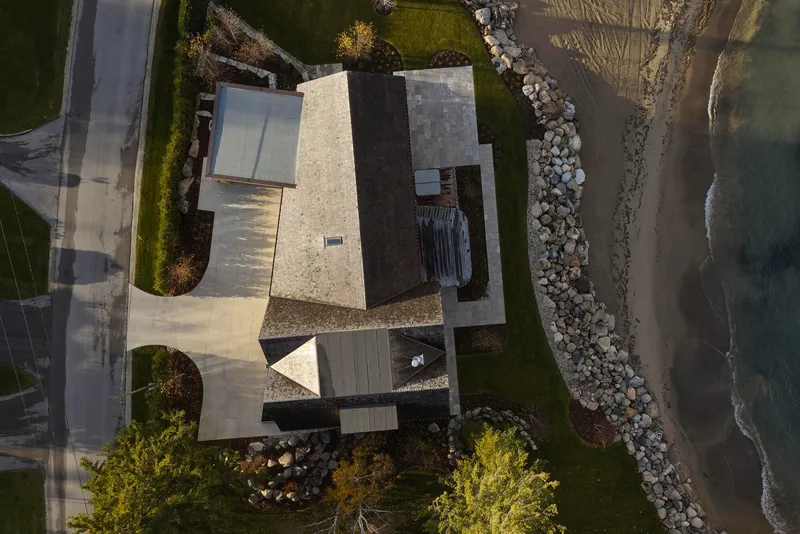
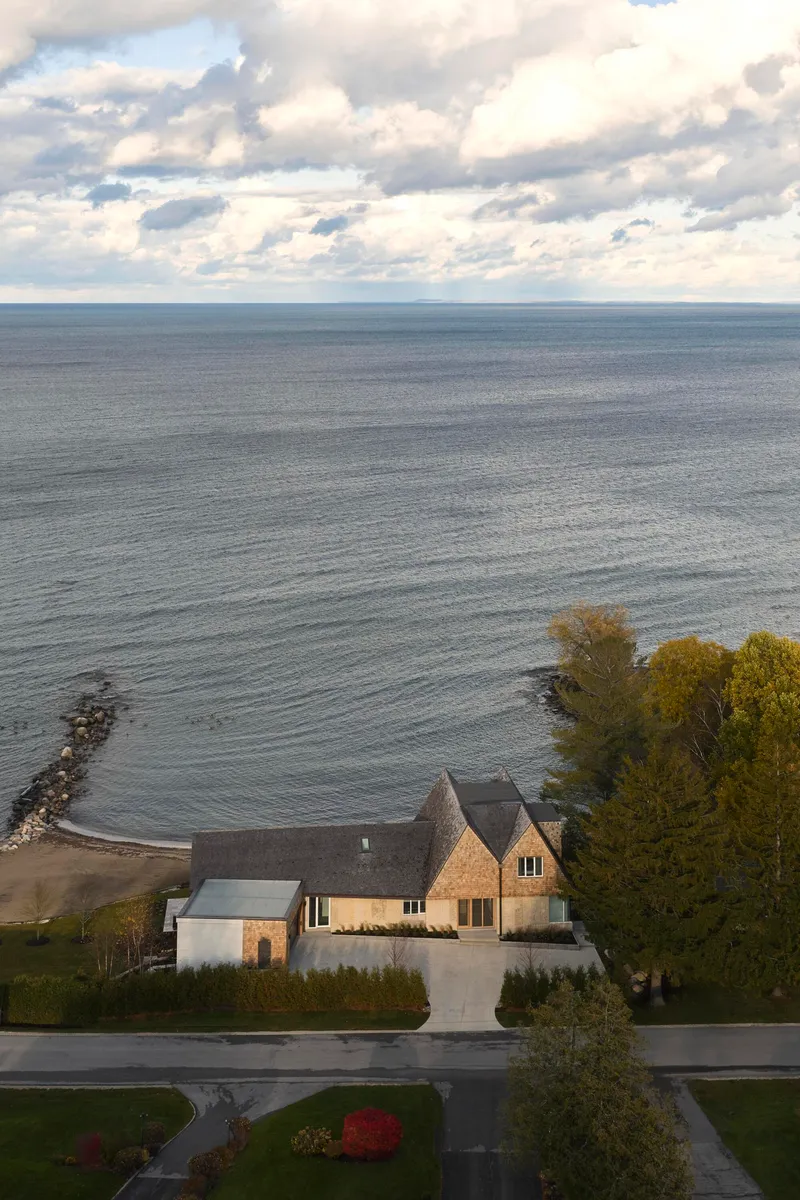
From above, the strategy is legible. Several gabled volumes slot together at slight angles, creating pockets of courtyard and planted beds between them. The approach borrows from the informal accretion of traditional cottage sites, where a boathouse here and a sleeping cabin there accumulate over decades. &Pierre achieves this character in a single build by rotating and staggering the roof forms so that the house reads as a cluster from the street and from the water.
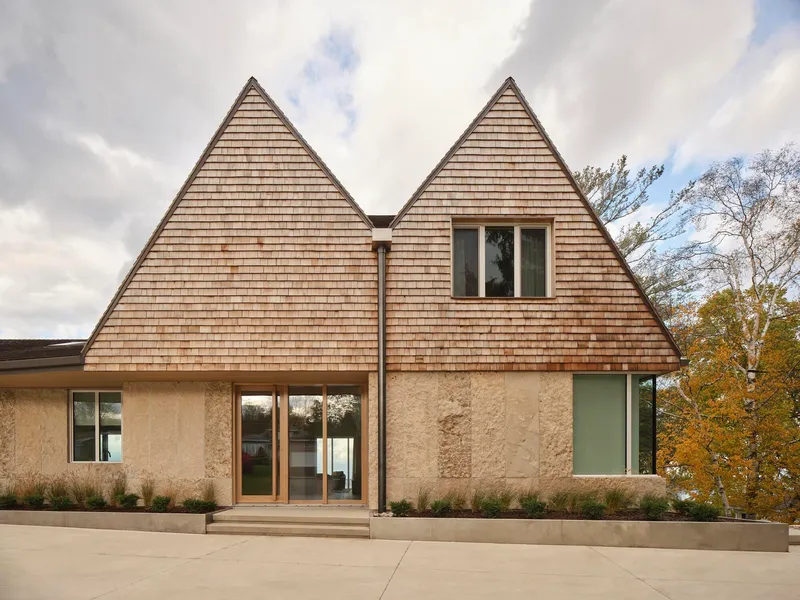
The entrance facade pairs twin gable roofs above textured rammed earth walls and a low concrete terrace. It is confident without being showy, signaling domestic scale rather than institutional ambition. Cedar shingles on the roofs will silver over time, closing the gap between the architecture and the grey-toned rock of the shoreline.
Material Weight at the Base
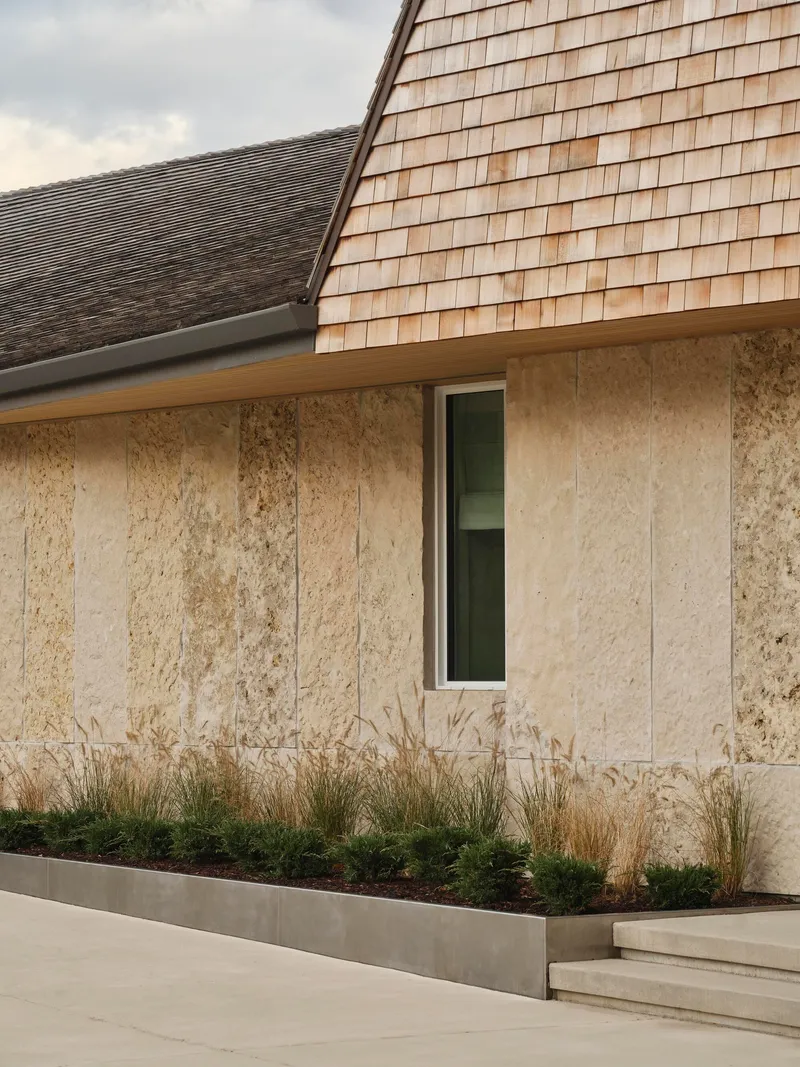
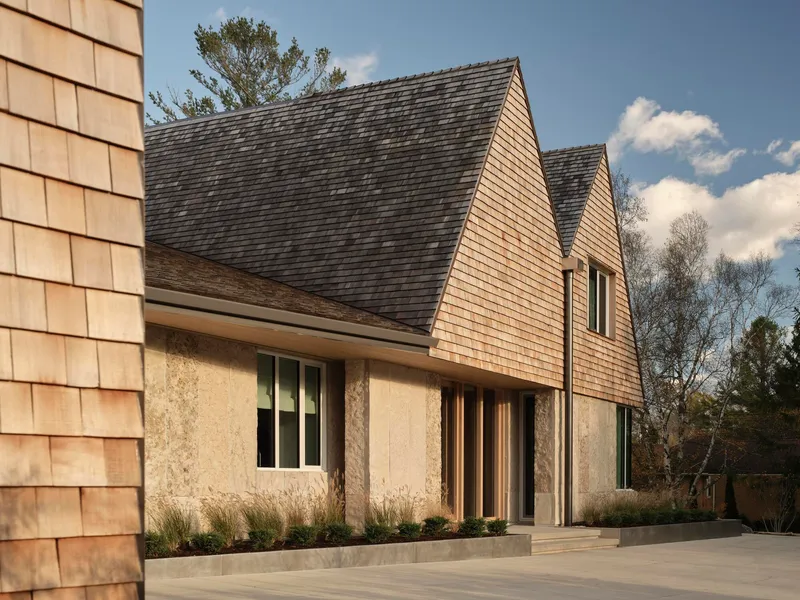
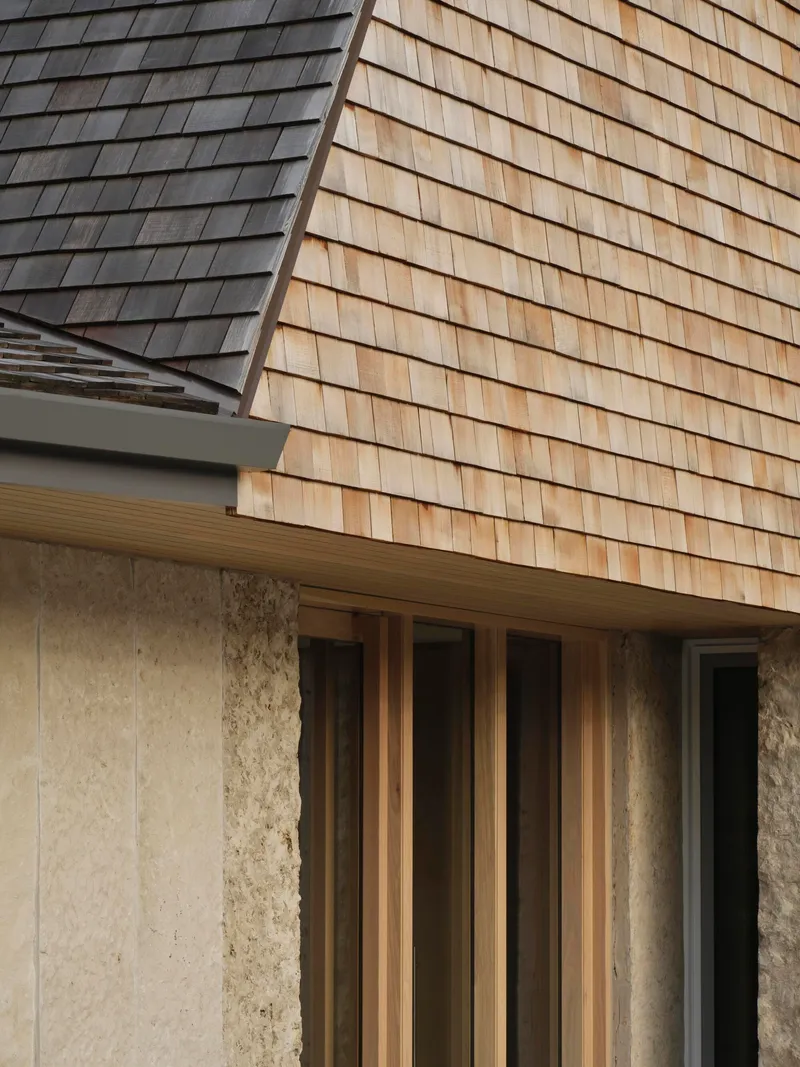
The most convincing detail in the exterior is the transition from ground to roof. Stone and rammed earth form a heavy plinth that anchors each volume to the site, and the cedar shingle roofs sit lightly on top. The proportions recall barns and boathouses more than suburban homes. Up close, the joint where wood shingles meet the stone base reveals careful craft: the materials do not fight each other, and the timber-framed windows cut cleanly through the masonry without fussy trim.
Limestone sourced from nearby quarries gives the walls a geological specificity that poured concrete could never achieve. Dried grasses planted against the facades reinforce the palette of sand, water, and stone that &Pierre names as the project's inspiration. These are not decorative touches; they set up a continuity between the house and the exposed rock of the Georgian Bay coast that begins at the foundation and runs all the way inside.
Vaulted Rooms Facing the Water
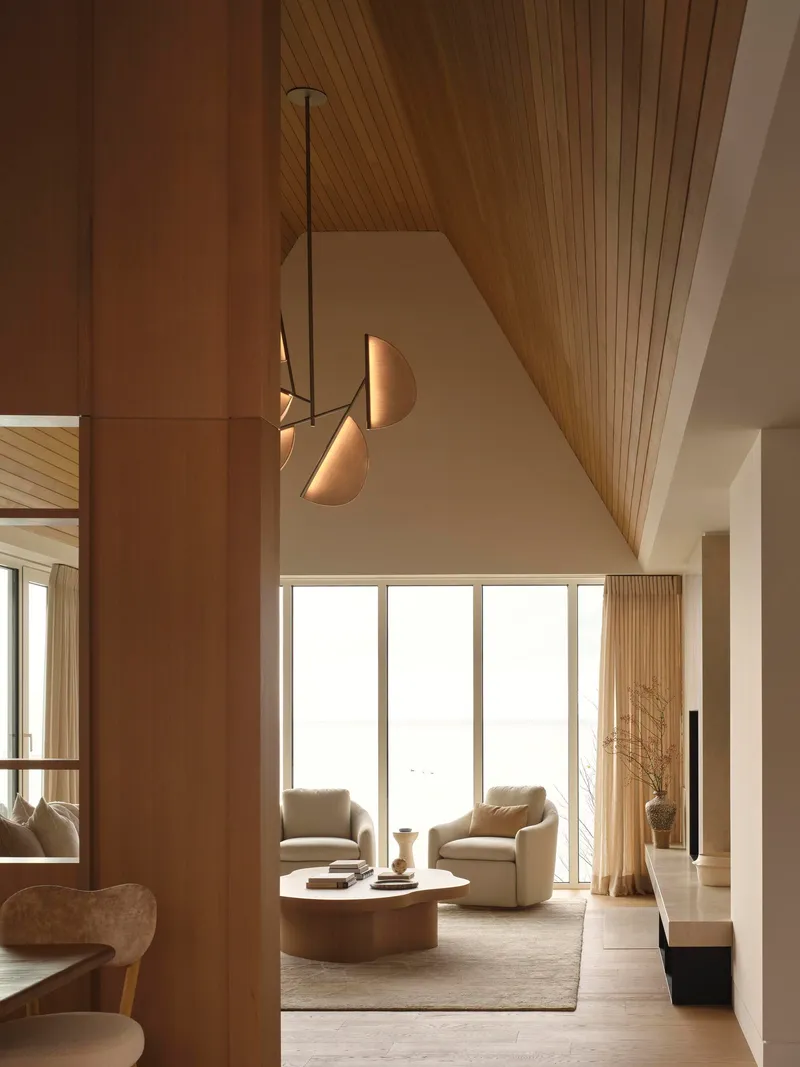
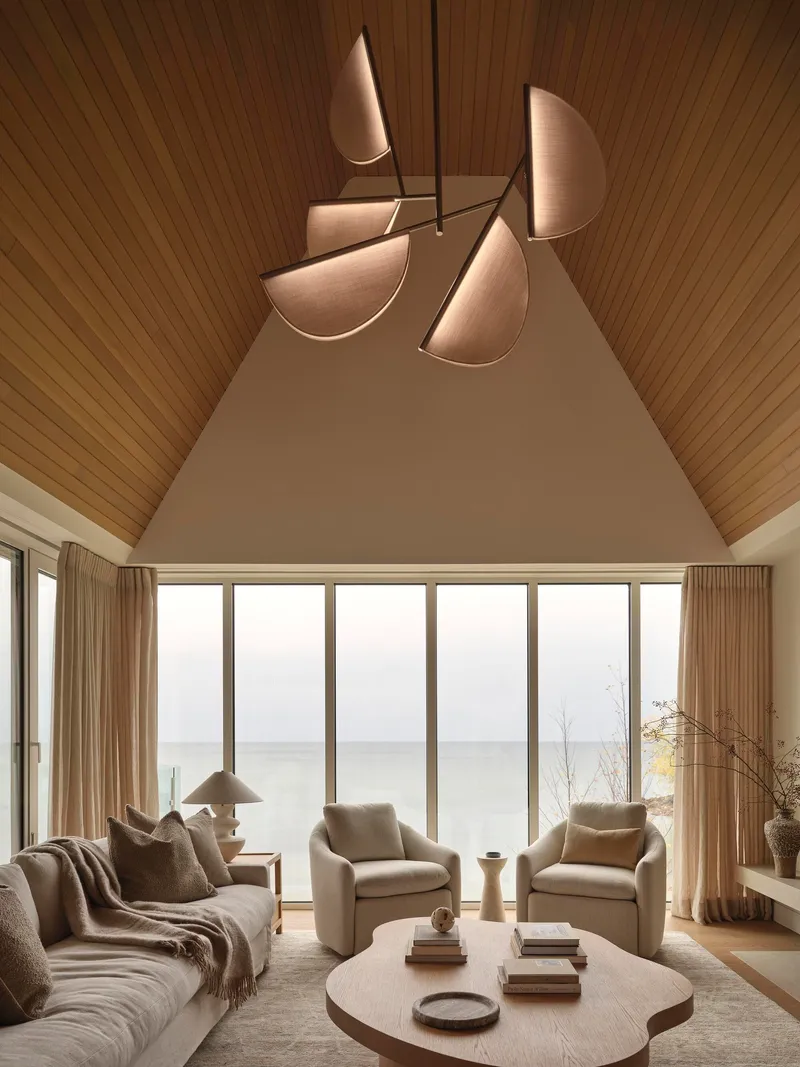
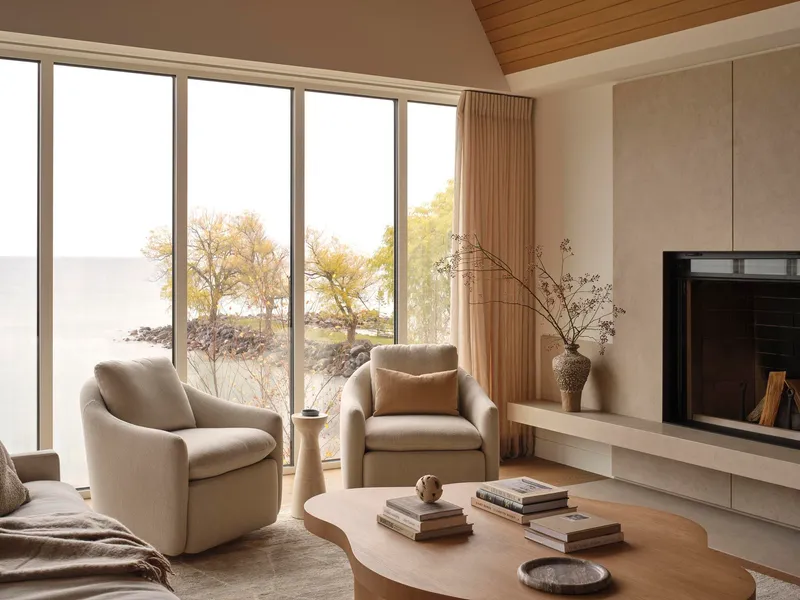
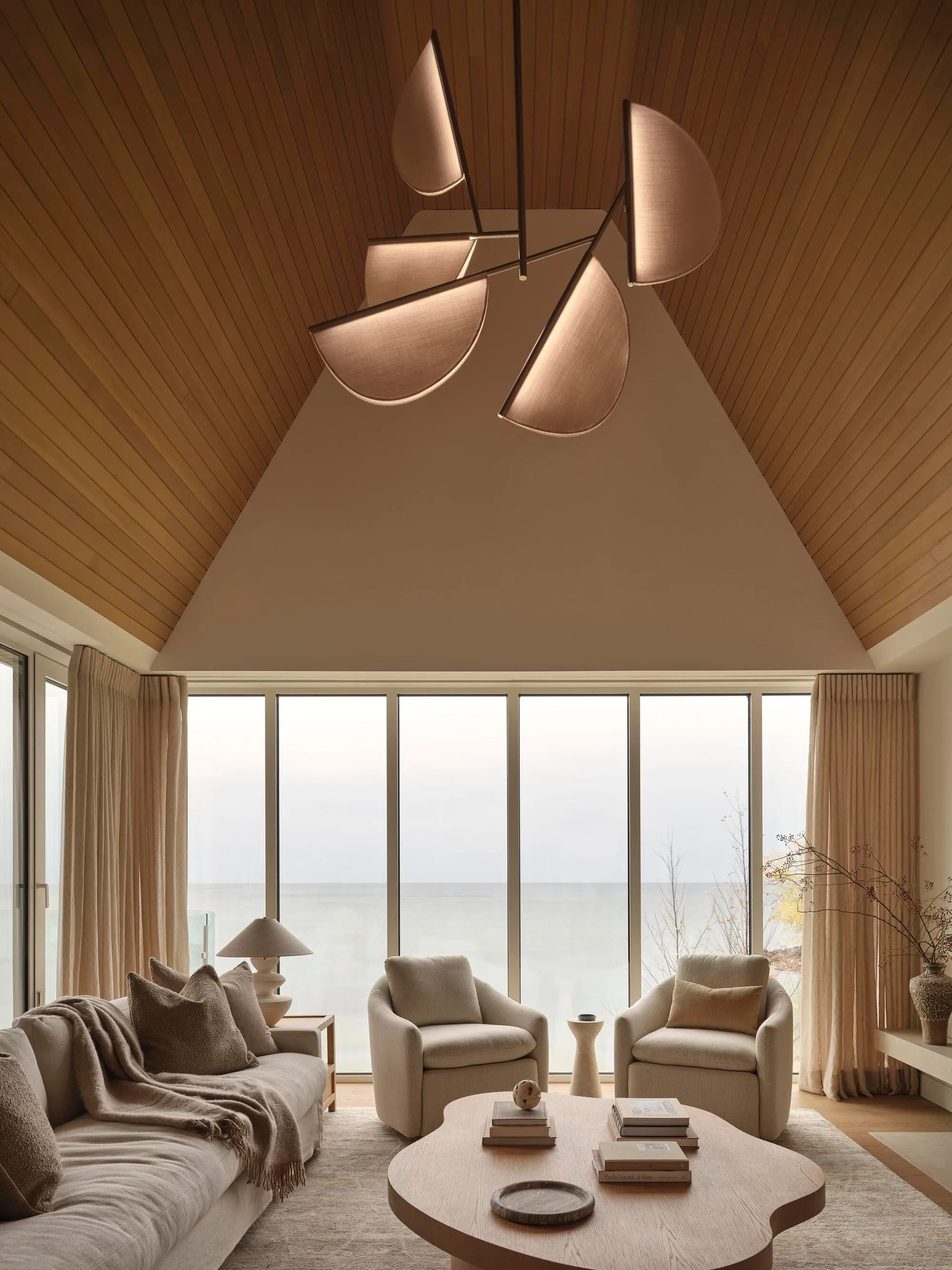
The living spaces occupy the volumes closest to the shoreline and benefit from the full height of the gable roofs. Vaulted timber ceilings lift overhead while floor-to-ceiling glazing opens the rooms to the bay. The result is a clear hierarchy: the roof compresses at the edges and expands at the center, pulling your eye outward and upward simultaneously. Pendant lighting hangs from the ridge, scaling the volume down to something intimate at night without subdividing it.
A fireplace hearth near the water-facing windows provides a counterpoint to the transparency. The stone surround and low seating create a focal point that works against the pull of the view, giving the room an interior center of gravity. In a house this open to its landscape, that inward anchor is essential. Without it, the room would feel like a viewing platform rather than a place to sit.
Kitchen and Dining Under the Skylight
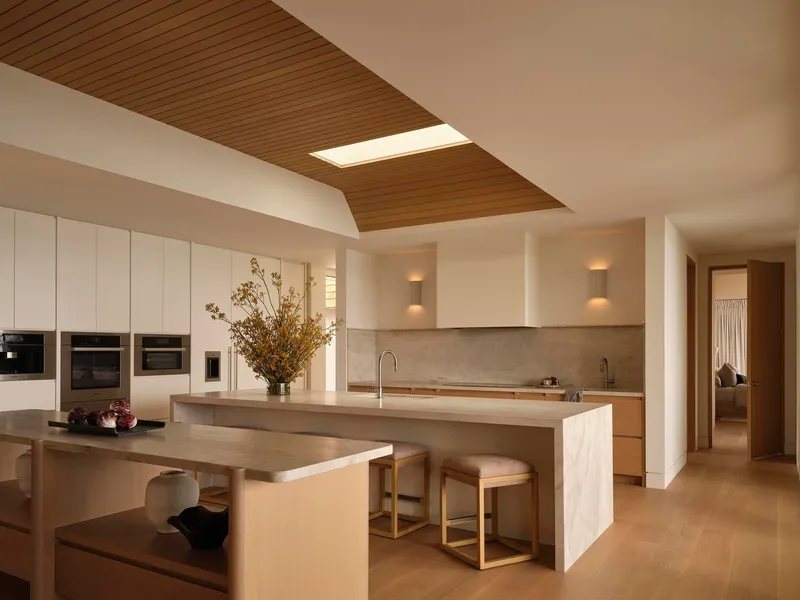
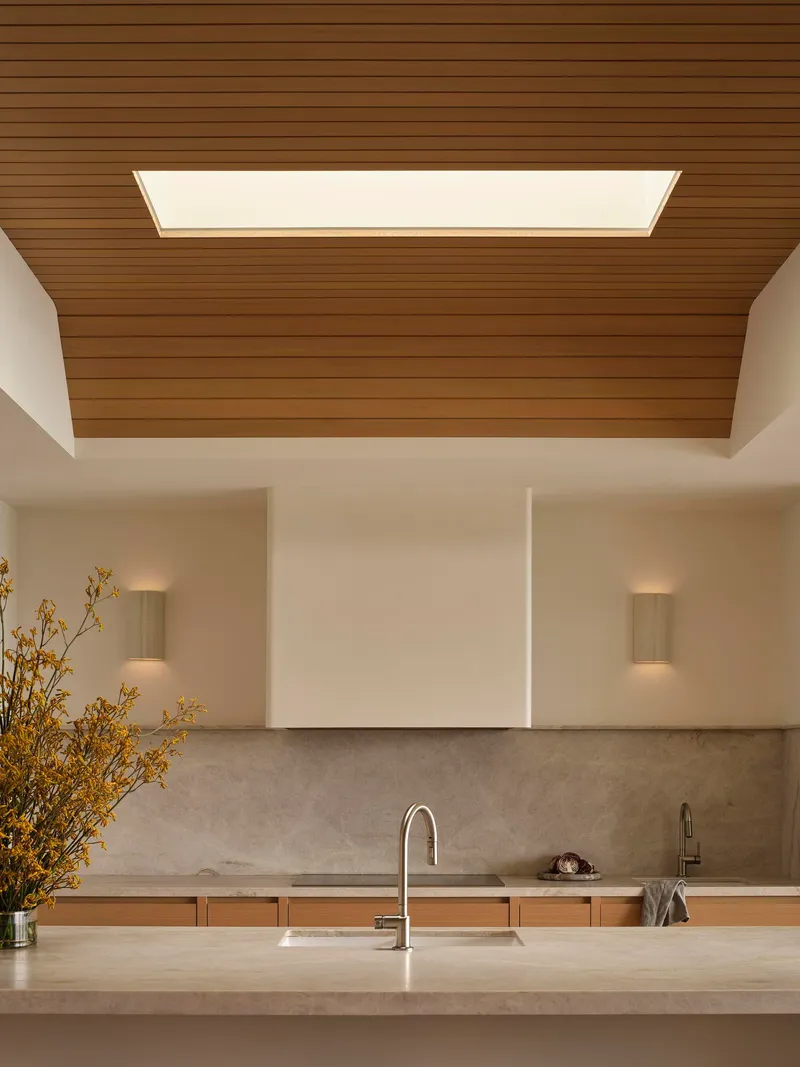
The kitchen occupies its own zone under a timber ceiling panel split by a generous skylight. Light enters from directly above the island, supplementing the horizontal light from the windows and eliminating the dark center that plagues deep floor plans. The stone countertop on the island ties back to the limestone exterior, and the custom millwork by Riverside Custom Cabinetry integrates storage so cleanly that the kitchen reads as furniture rather than a fitted appliance wall.
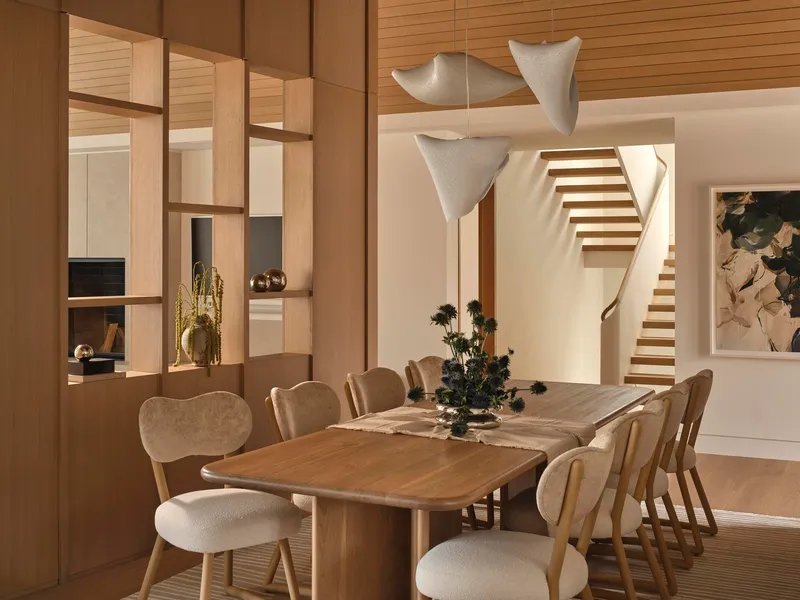
The dining area sits at the junction between volumes, marked by an open shelving partition that filters rather than blocks sightlines. A timber staircase is visible in the background, connecting the three levels of the house. Evening light pours through at a low angle, catching the warm tones of the oak and giving the space a quality that overhead lighting alone could never produce.
Circulation as Atmosphere
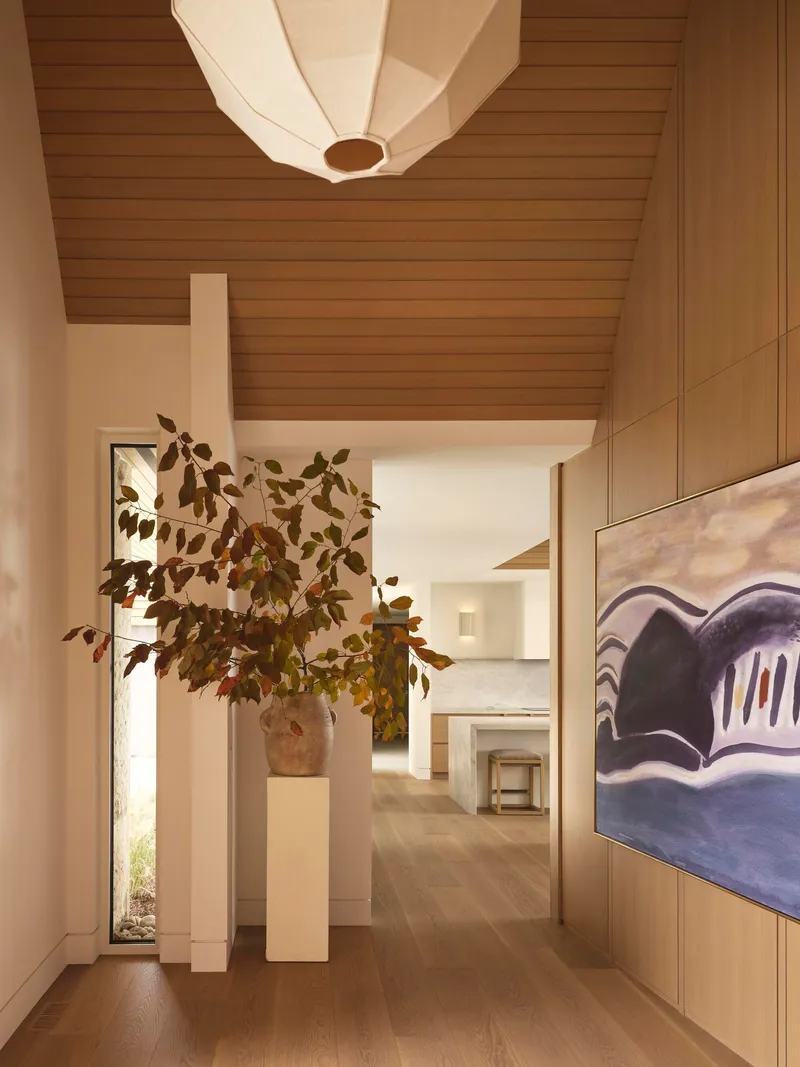
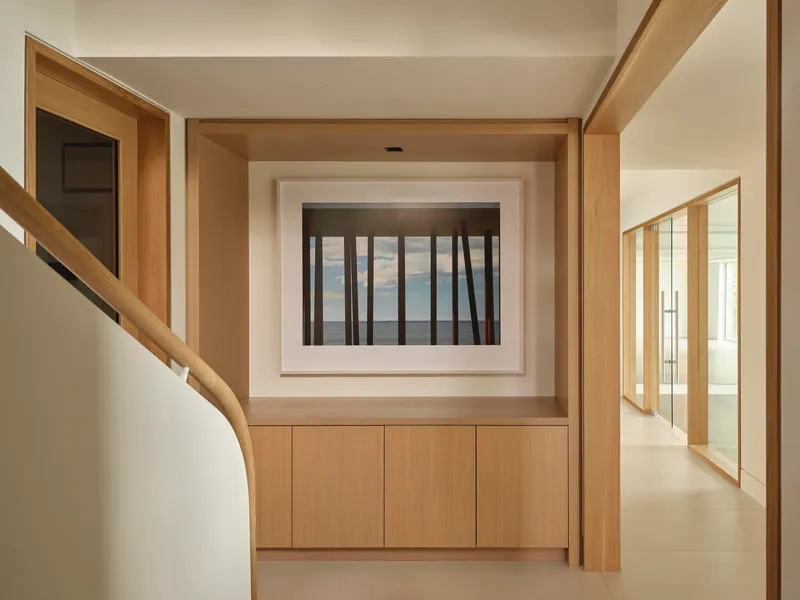
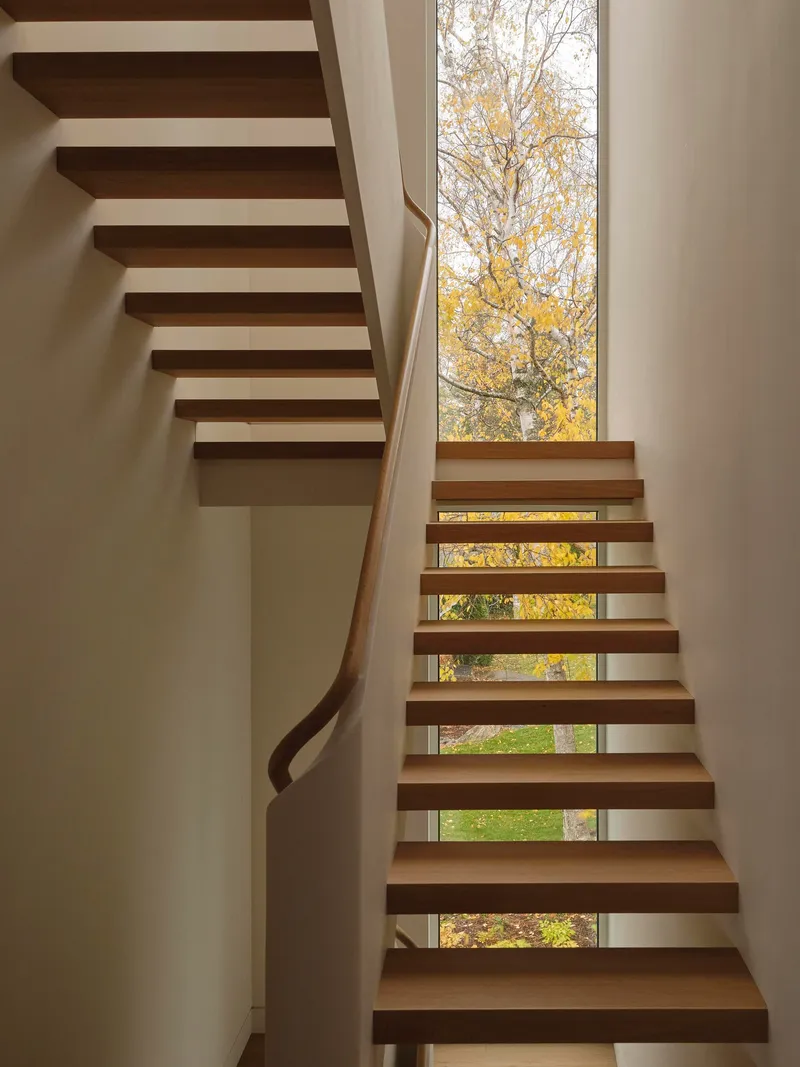
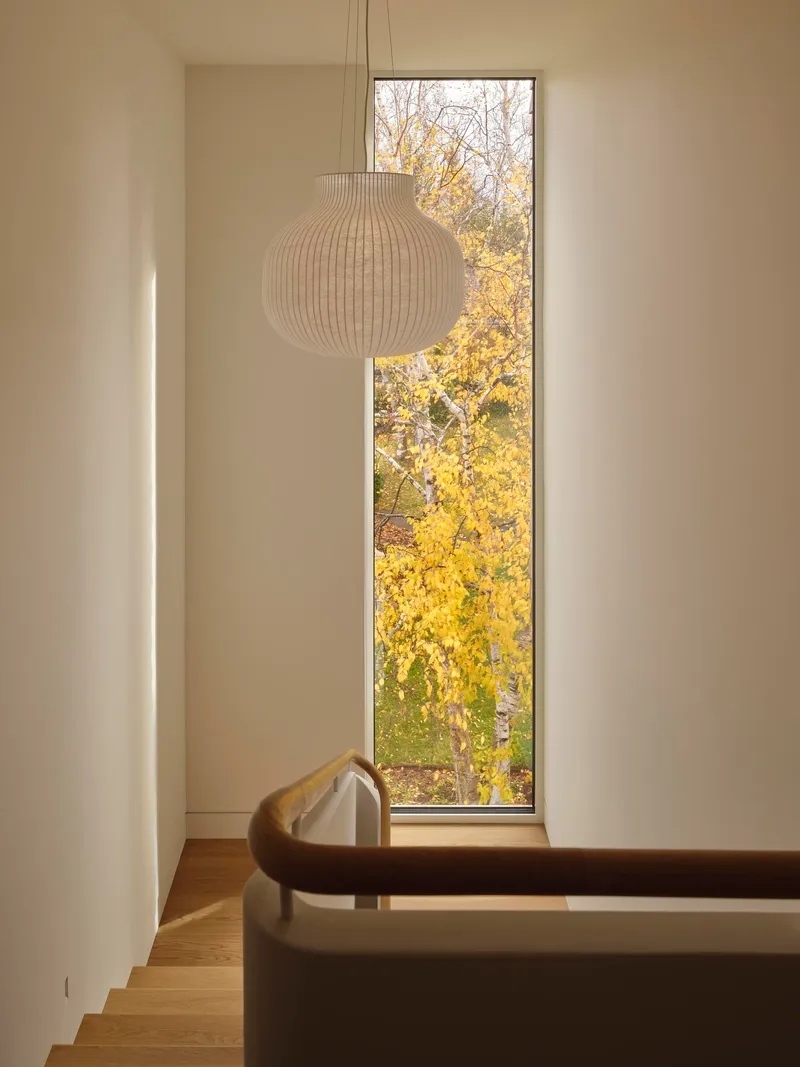
The corridors and stairs are not leftover space. A hallway lined in horizontal wood boards and lit by a sculptural pendant becomes an event in itself. The open-riser timber staircase threads upward between horizontal window slots that frame autumn foliage in tight compositions. The curved stair at the entry hall, visible through built-in cabinets, gives the house a softness that counters the sharp geometry of the gable roofs.
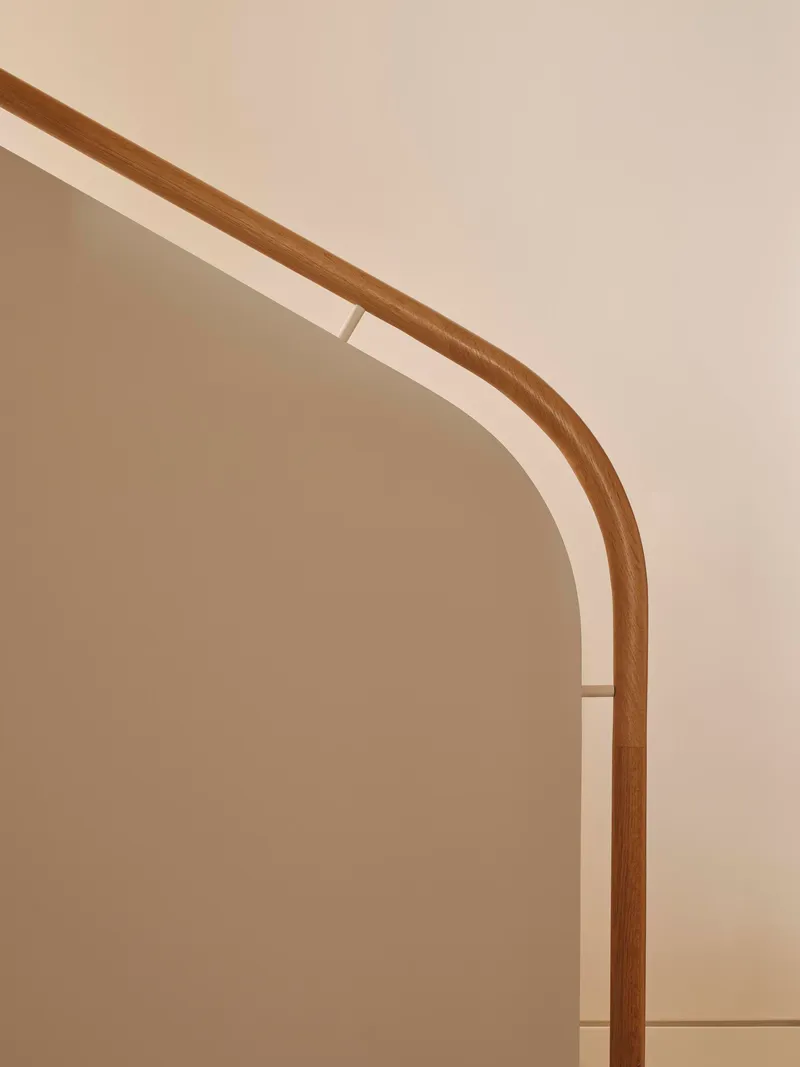
A close-up of the handrail curving along a plastered archway edge reveals the care taken with transitions. The rounding of the timber, the smoothness of the plaster, the absence of hard corners: all of this supports the aging-in-place brief without announcing it. Accessibility here is a spatial quality, not a retrofit. The intuitive circulation that &Pierre describes is genuinely felt in the way rooms connect without thresholds or abrupt level changes.
Private Rooms at the Edges
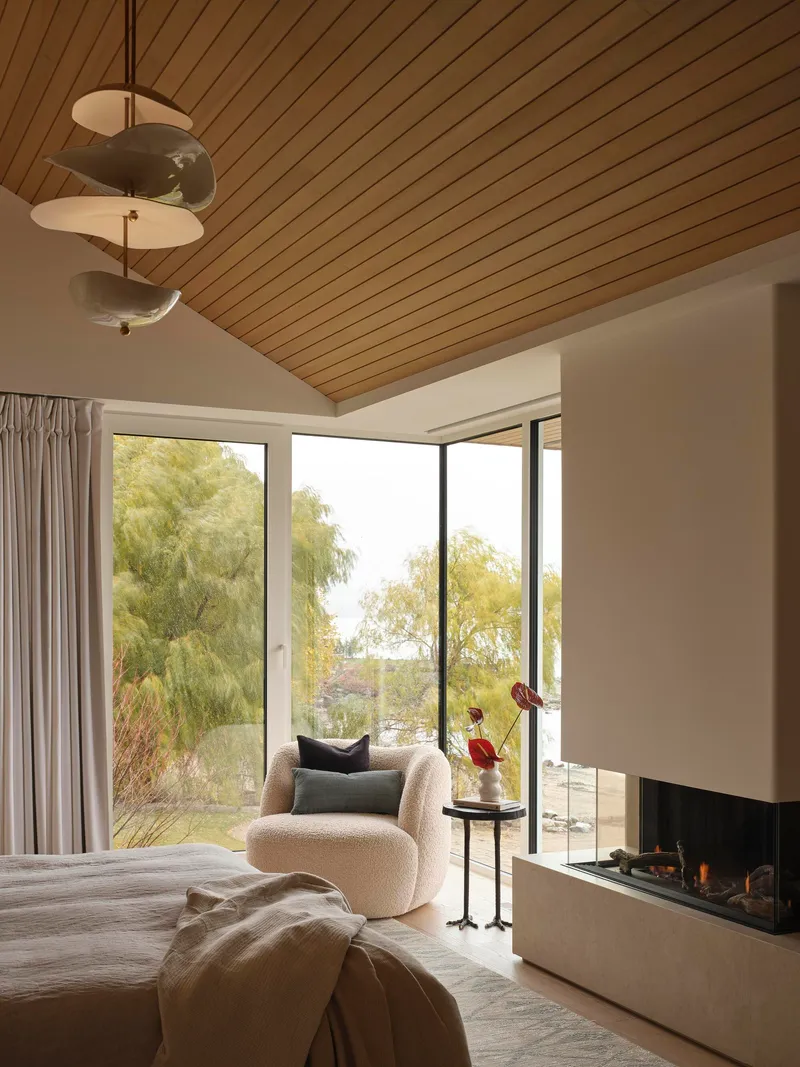
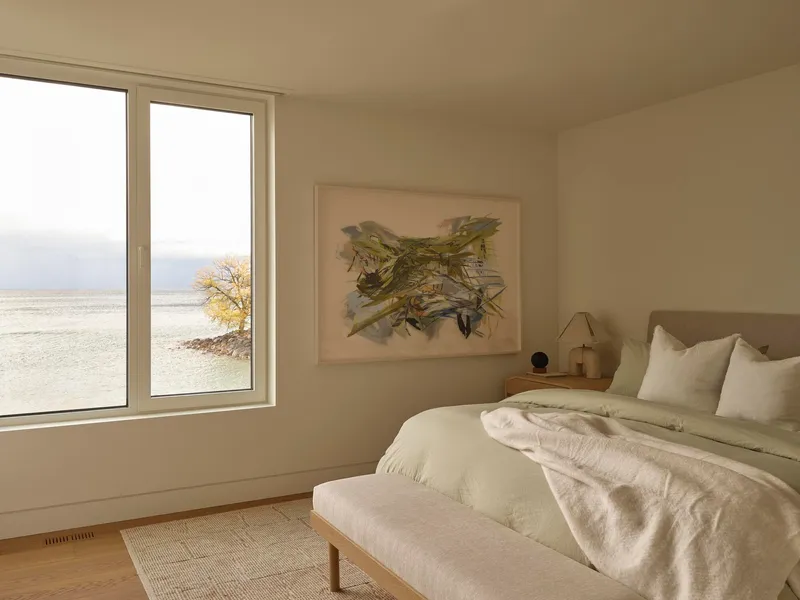
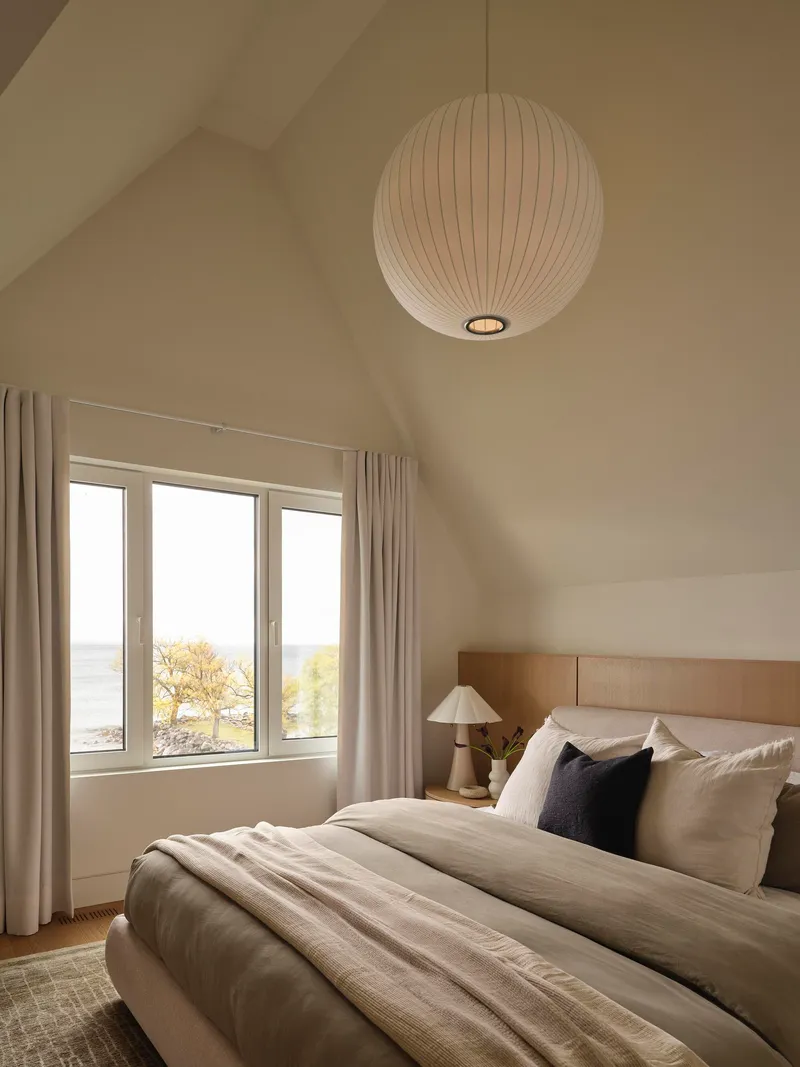
The bedrooms occupy the quieter ends of the plan, where the gable roofs taper and the glazing becomes selective. Each room has a distinct relationship to the landscape: one frames a lone tree against a distant waterline, another opens onto garden foliage through corner glazing, and a third looks out from a vaulted ceiling over the bay. The variety matters. In a house meant for a multigenerational family, each bedroom needs to feel like its own place rather than a repetition.
Timber slat ceilings and spherical pendant lights give the rooms a warmth that the public spaces, with their higher volumes and harder stone, do not pursue. The fireplace in the primary bedroom is a generous gesture, turning what could be a simple sleeping chamber into a room worth spending a winter afternoon in.
Bathrooms as Material Studies
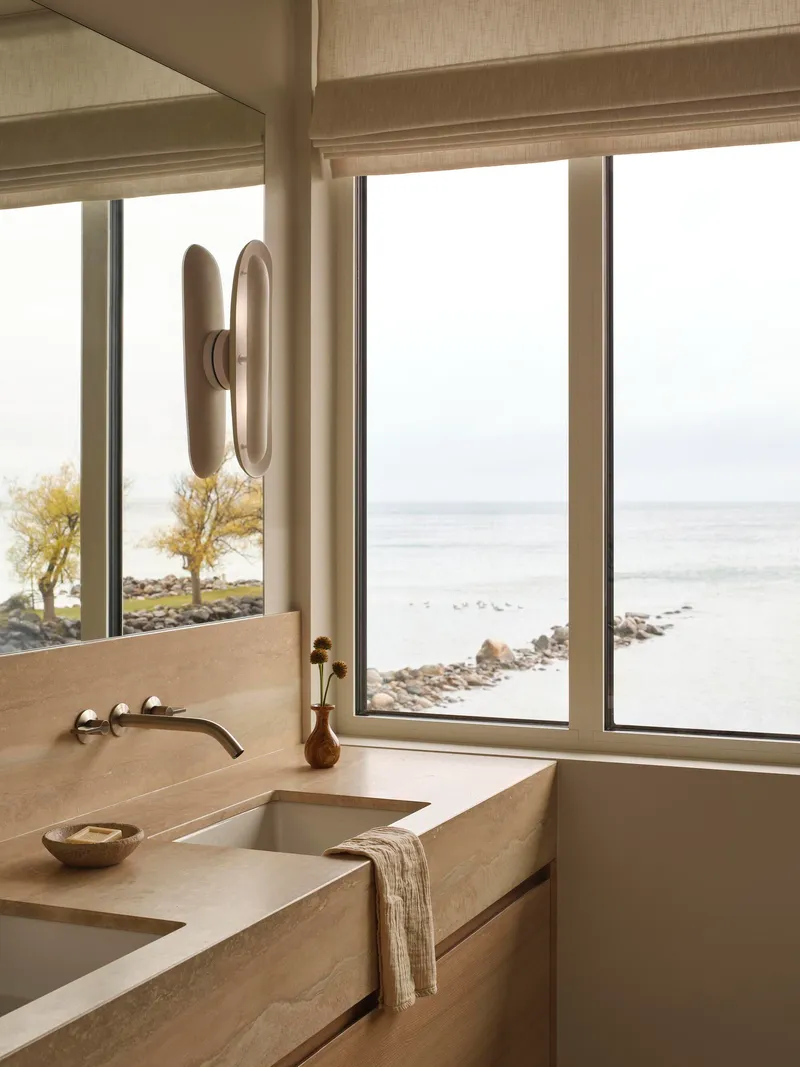
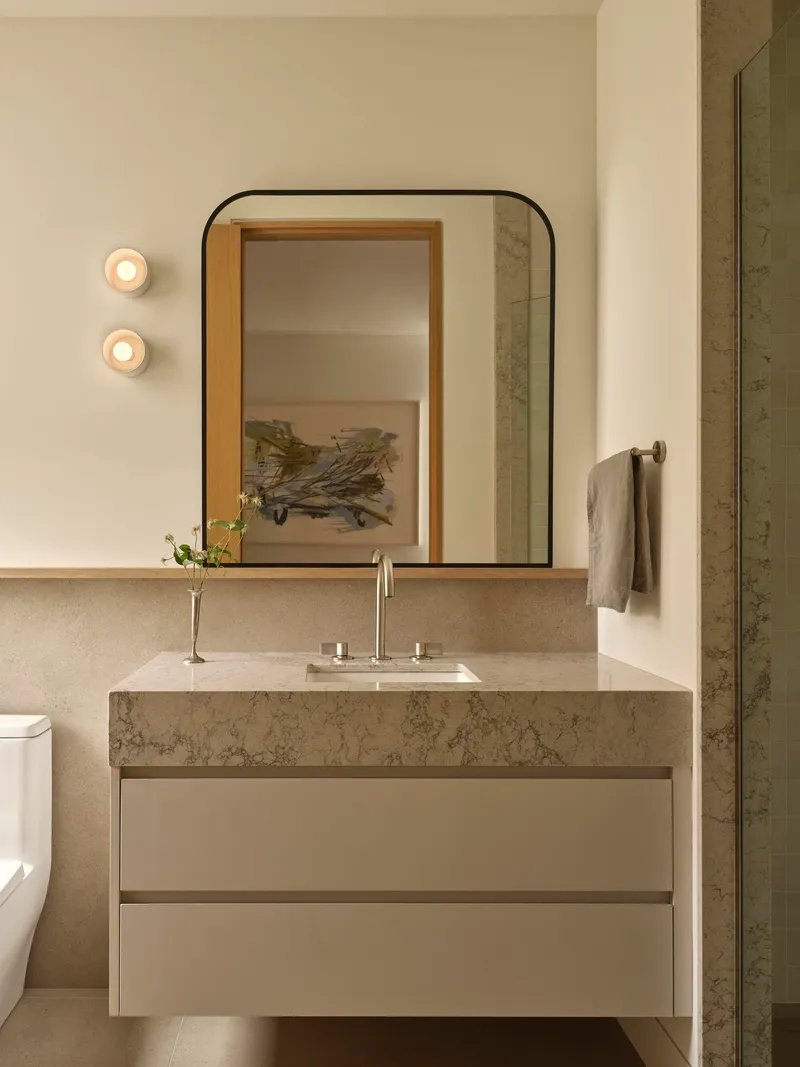
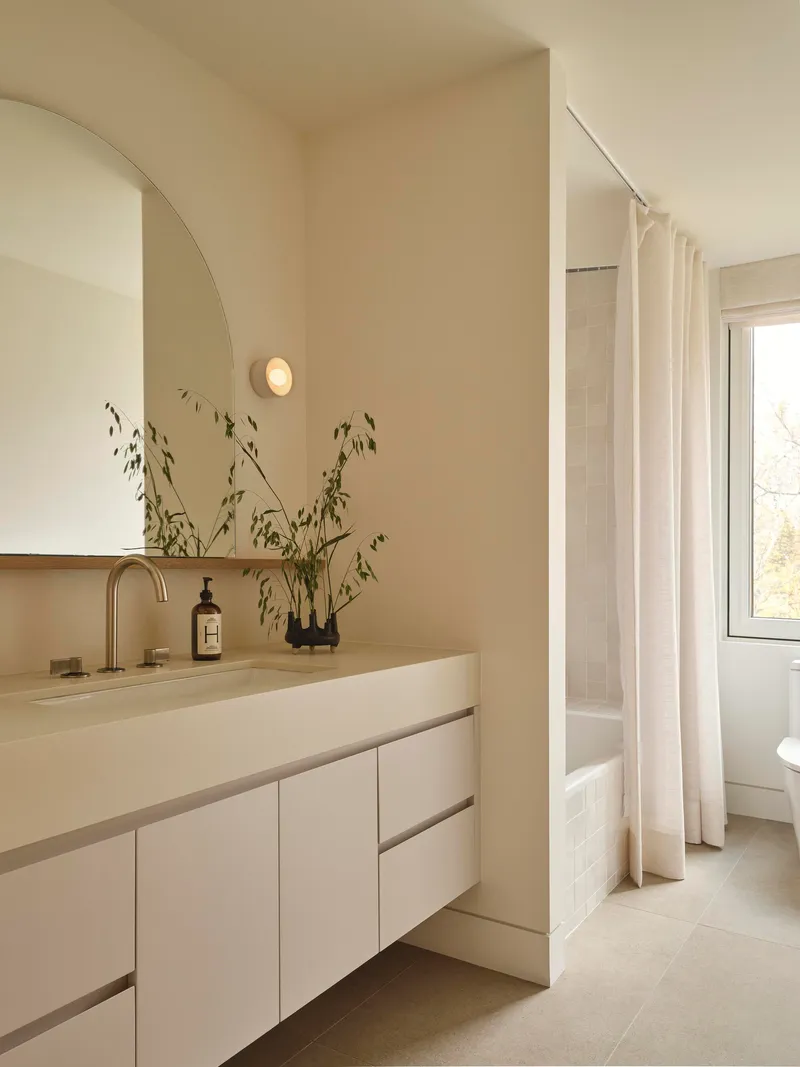
The bathrooms deserve individual attention because they distill the material strategy of the entire house into compact rooms. Pale stone vanities with wall-mounted faucets sit beneath windows that face the waterfront. Custom lighting by Sara Woodby Hand and Concord Lighting provides warm, circular sconces that soften the stone surfaces. Arched mirrors and rounded-corner mirrors introduce curves that echo the stair handrails elsewhere in the house.
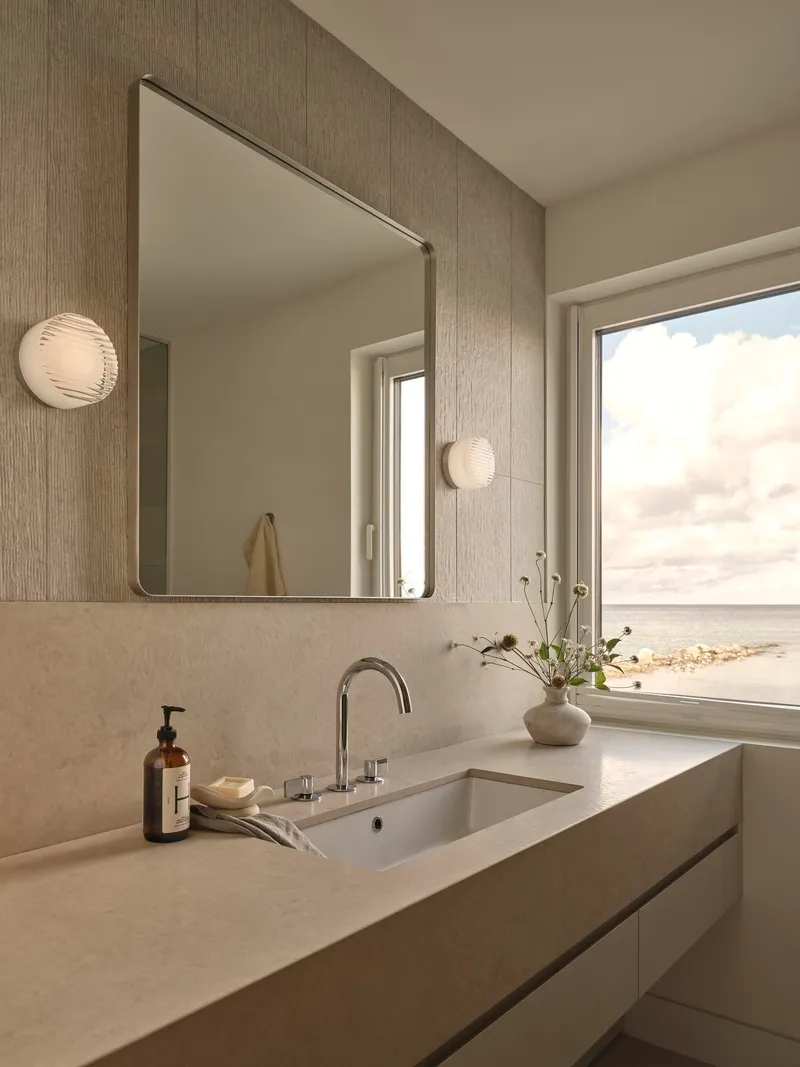
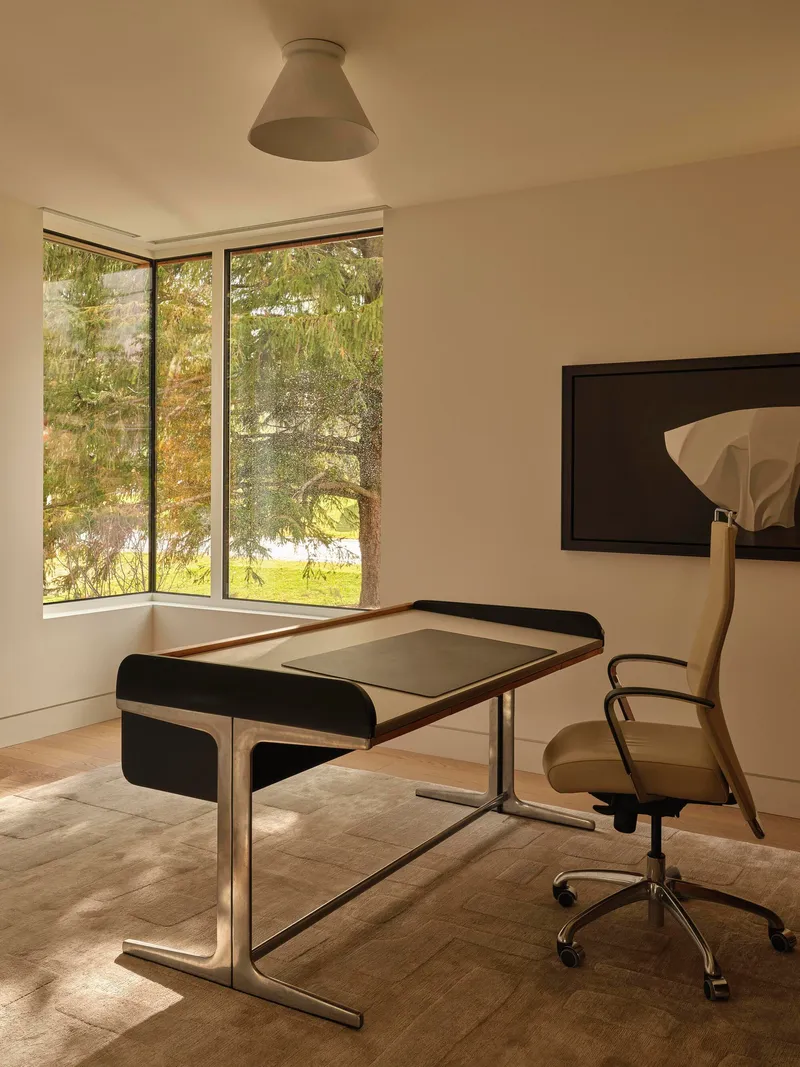
A corner study with a black-framed desk and a tall window overlooking the trees offers a quiet retreat within the plan. The textured wall panel behind one of the vanities catches reflected ocean light in a way that turns a functional surface into something nearly sculptural. These are small moments, but they accumulate into an experience of the house that rewards close looking.
Plans and Drawings
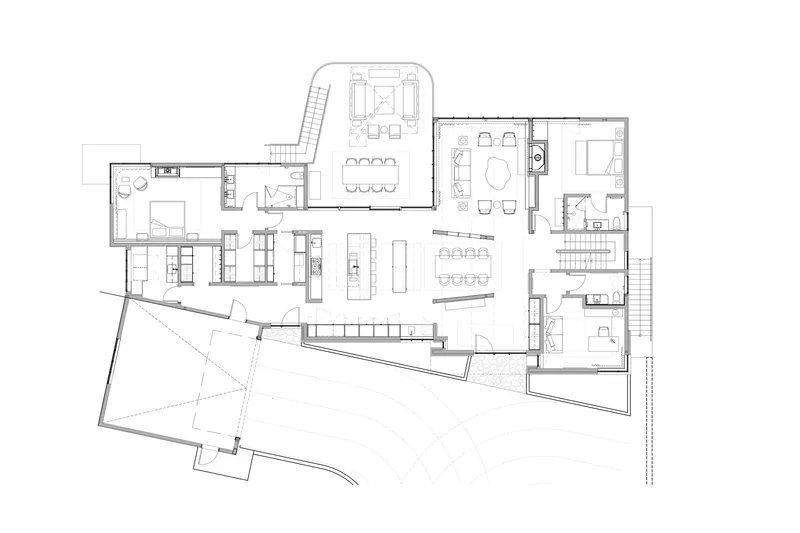
The floor plan reveals the logic behind the compound strategy. An angled garage volume breaks away from the main body of the house, creating an irregular footprint that responds to the shape of the lot and the orientation of the shoreline. Open living areas flow toward the water while service and private spaces tuck into the landward volumes. The plan confirms what the photographs suggest: the house is organized around sightlines to the bay, with every major room enjoying a direct connection to light and landscape.
Why This Project Matters
The Georgian Bay cottage replacement is a genre that rarely produces architecture worth publishing. Most families opt for overscaled lake houses that obliterate the character of the original building and its site. &Pierre's approach inverts that tendency. By fragmenting the volume, grounding the walls in local stone, and cladding the roofs in cedar that will age alongside the landscape, the house establishes a material continuity with the bay that most new construction in the region ignores.
The aging-in-place brief adds another layer of seriousness. Designing for long-term accessibility is often treated as a technical checkbox, but here it shapes the fundamental character of the circulation, the softness of the handrails, and the absence of thresholds. The house does not look like an accessible building; it simply works as one. That integration of care into form, without compromise or announcement, is the project's most durable contribution.
Georgian Bay Beach House, designed by &Pierre with Don Schmitt and Gio Tassone Architects. Georgian Bay, Ontario, Canada. 350 m² (3,780 sq. ft.). Completed 2026. Built by Valley View Construction. Photography by Riley Snelling.
About the Studio
Share Your Own Work on uni.xyz
If projects like this are the kind of work you want to make, uni.xyz is a place to publish your own, find collaborators, and enter design competitions.




Popular Articles
Popular articles from the community


Co-Life: Senior Housing Design That Reconnects Older Adults With the City
Co-Life reimagines senior housing design through healing gardens, shared streets, workshops, and a sustainable community across generations.

The Musturak Paradise: Senior Living Architecture for a Connected Future in Temara, Morocco
The Musturak Paradise reimagines senior living architecture in Temara via private homes, social spaces, culture, community, and shared care.

Hill & Cross Opera: Sculptural Opera House Architecture Shaped by Tallinn’s Landscape and Identity
Hill & Cross Opera reimagines opera house architecture in Tallinn through its sculptural hill, civic plaza, glass wave and a luminous cross.

Play: Fragments of Their World
Familiar architecture becomes modular playground design, creating safe spaces where displaced children can learn, connect, imagine and play.


Similar Reads
You might also enjoy these articles

Bao Huynh Watercolor Atelier: A Serene Art Retreat in Hội An
Bao Huynh Watercolor Atelier in Hội An blends multifunctional art spaces, sustainable design, local materials, and family-friendly living in a serene environment.

Atelier Macri Concept Store Interior Design by CASE-REAL
Atelier Macri store features a "ko" counter, walnut wood details, cork displays, blending retail, gallery, and seamless customer experiences.

Manuel Vargas Izquierdo Stadium and High-Performance Sports Center: Architectural Excellence in Jalpa de Méndez
The Manuel Vargas Izquierdo Stadium blends sustainable design, inclusive sports facilities, and cultural-inspired architecture, revitalizing Jalpa de Méndez’s public spaces.

KAKR Buluh Awar Hall: Revitalizing Community and Ecology Through Bamboo Architecture
Community built bamboo hall revitalizes Buluh Awar village, empowering youth, restoring ecology, celebrating vernacular craftsmanship through sustainable architecture and culture.


Explore Residential Building Competitions
Discover active competitions in this discipline


Challenge to design mud housing for contemporary communities


Design challenge to reuse E-waste
Comments (0)
Please login or sign up to add comments
No comments yet. Be the first to comment!