
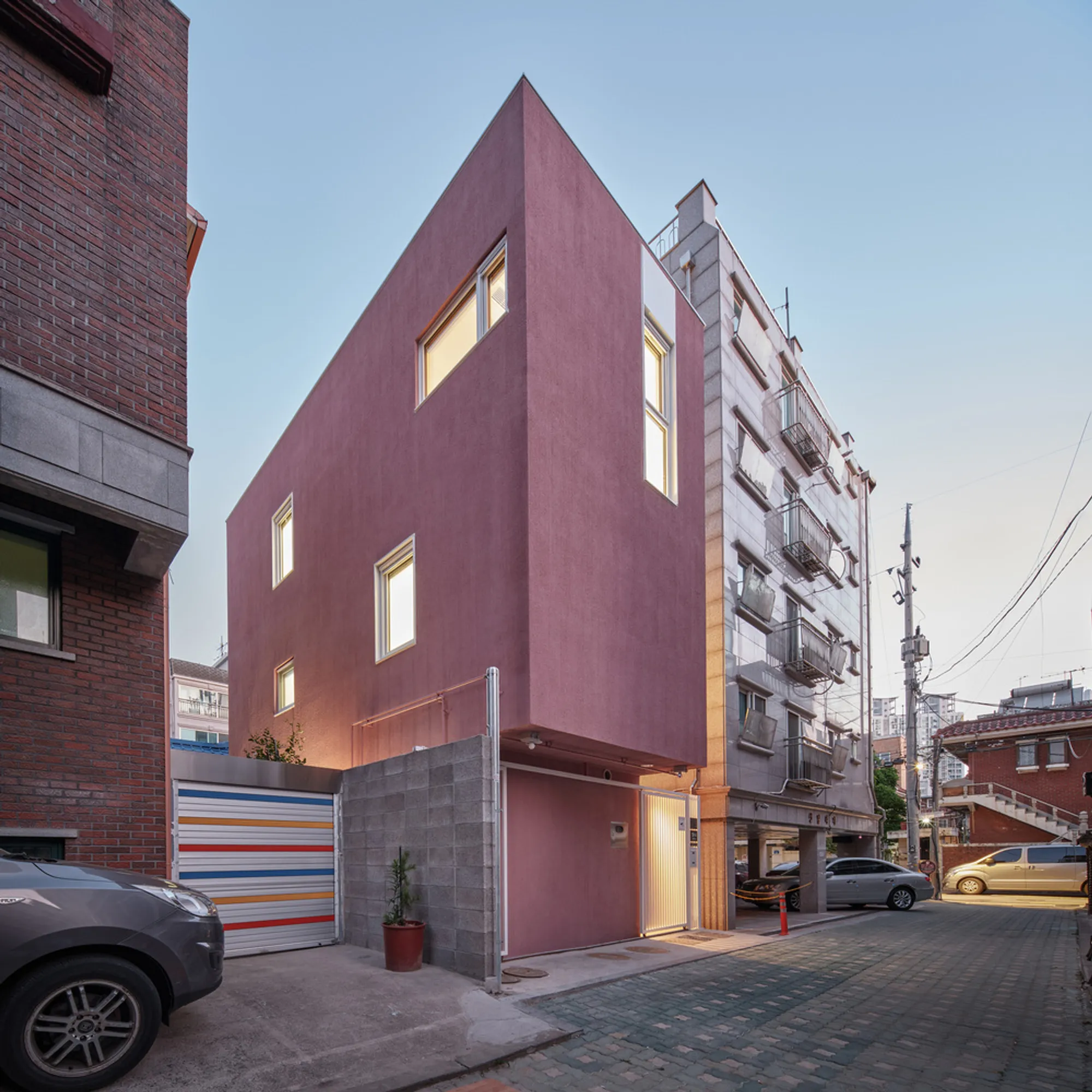
Pink Oasis House: A Narrow Infill Tower in Seoul
TIUM Architects designed a four-storey dusty pink house on a narrow Seoul plot with a skylight staircase, side courtyard, and birch plywood interiors.


In a dense Seoul neighbourhood of brick apartments and grey concrete, a dusty pink tower rises four storeys. Pink Oasis House, designed by TIUM Architects, is a narrow infill house on a tight urban plot. The pink is not a gimmick. It is a deliberate colour choice: warm enough to soften the grey context, muted enough to age gracefully, and specific enough to give the house an identity in a street where every other building is brown or grey.
The house is built for a single family on a plot so narrow that every floor is essentially one room wide. TIUM Architects stacked the programme vertically: entrance and parking at ground, dining and kitchen on the second floor, living room on the third, and bedrooms above. A staircase runs through the centre, lit from a skylight at the top. The side courtyard, a gap barely wider than a person, brings light and planting to the dining room.
The Street: Pink in Context
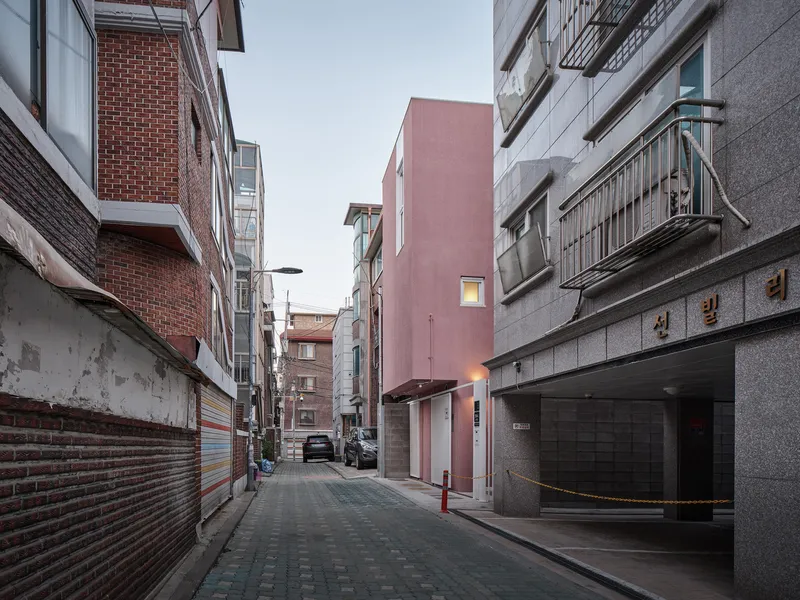
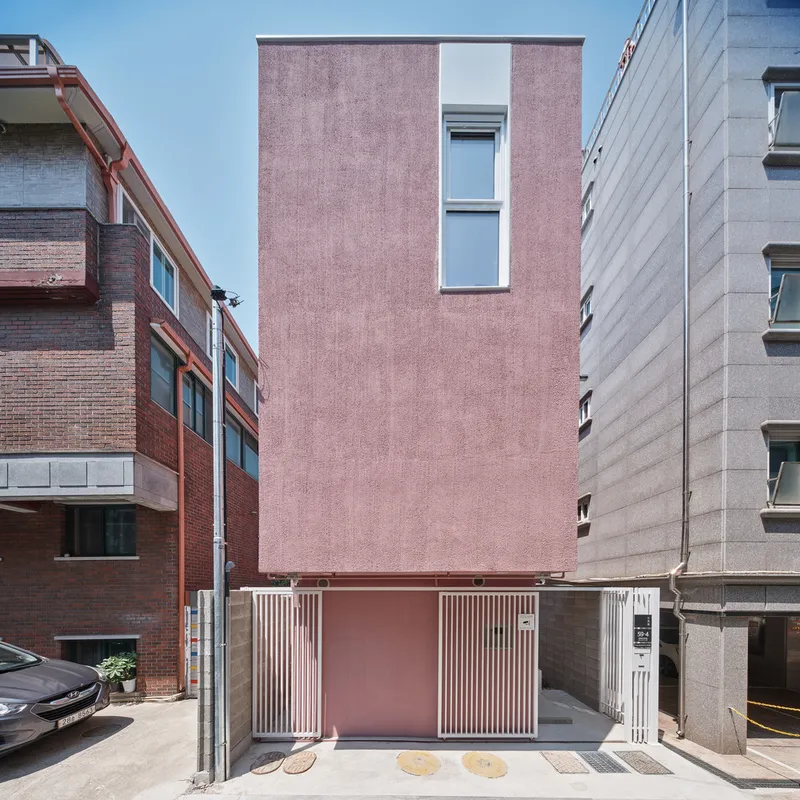
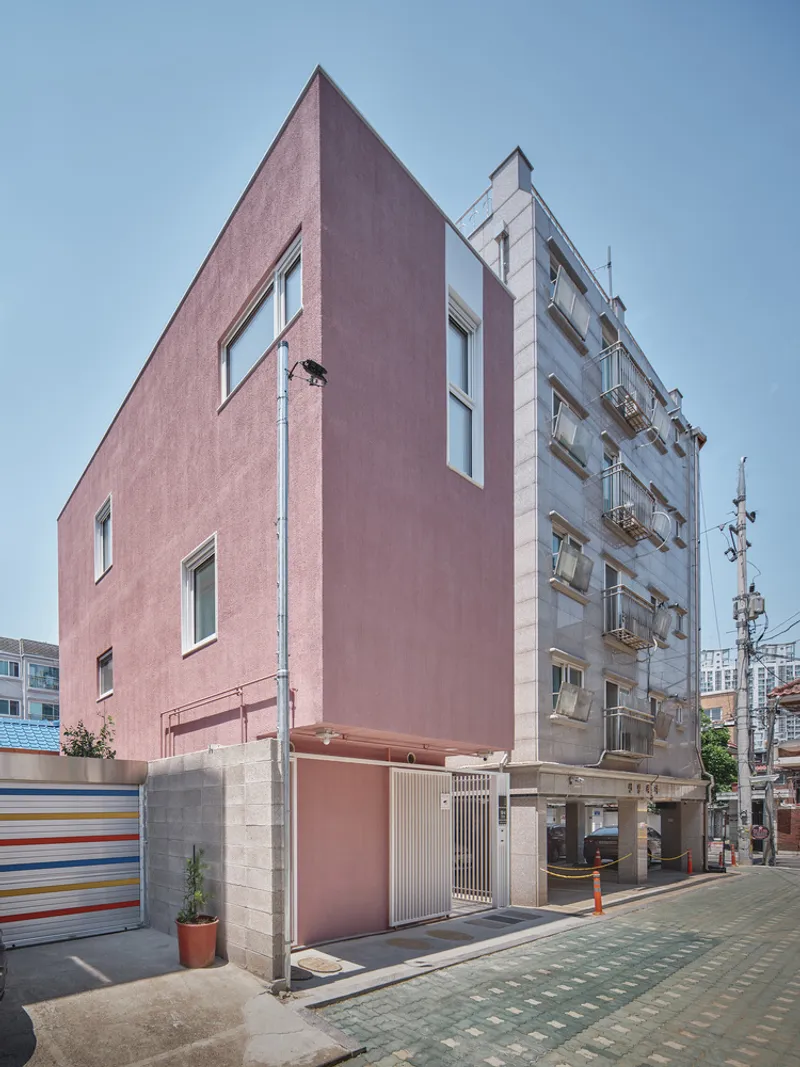
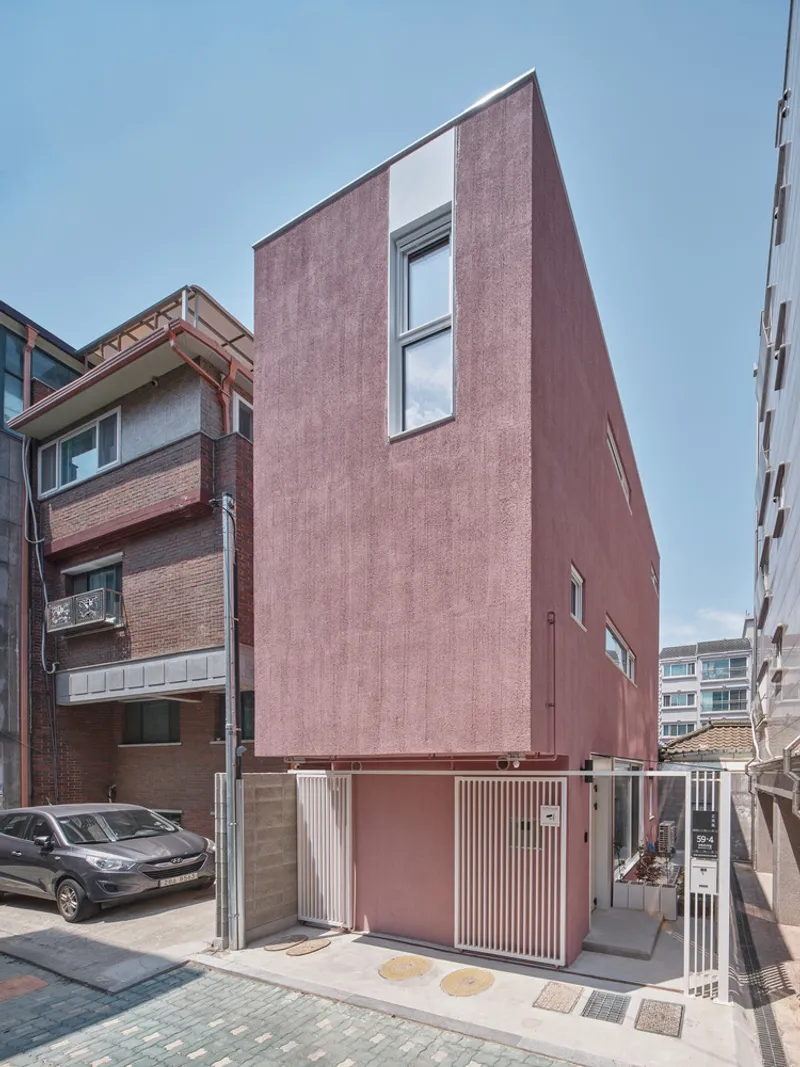
The alley photographs are the best introduction. The pink house sits between a brown brick apartment block and a grey rendered building. Korean signage is visible on the neighbouring ground floors. The pink is not bright or saturated. It is a dusty rose, closer to terracotta than to bubblegum. The narrow vertical windows are the only openings on the front facade, giving the house a closed, private face to the street. The concrete base with the garage door is grey, grounding the pink volume above.
Dusk: The House as Lantern
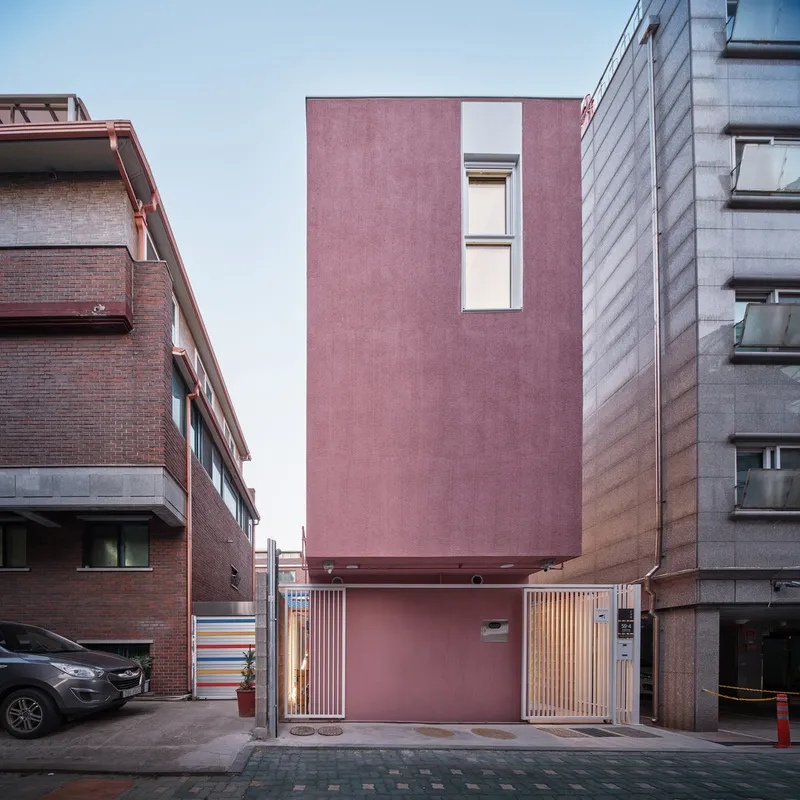
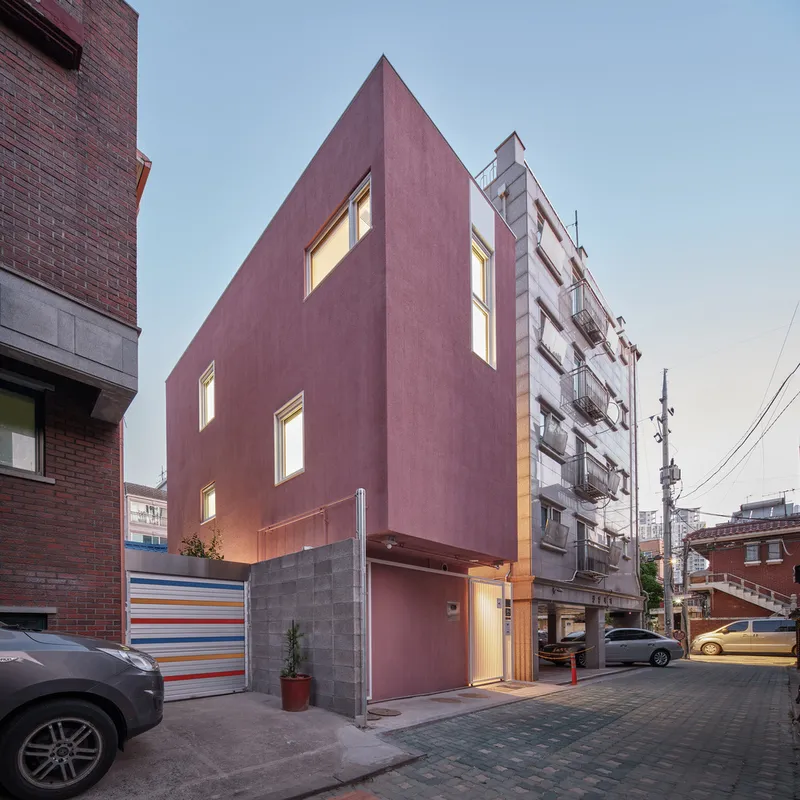
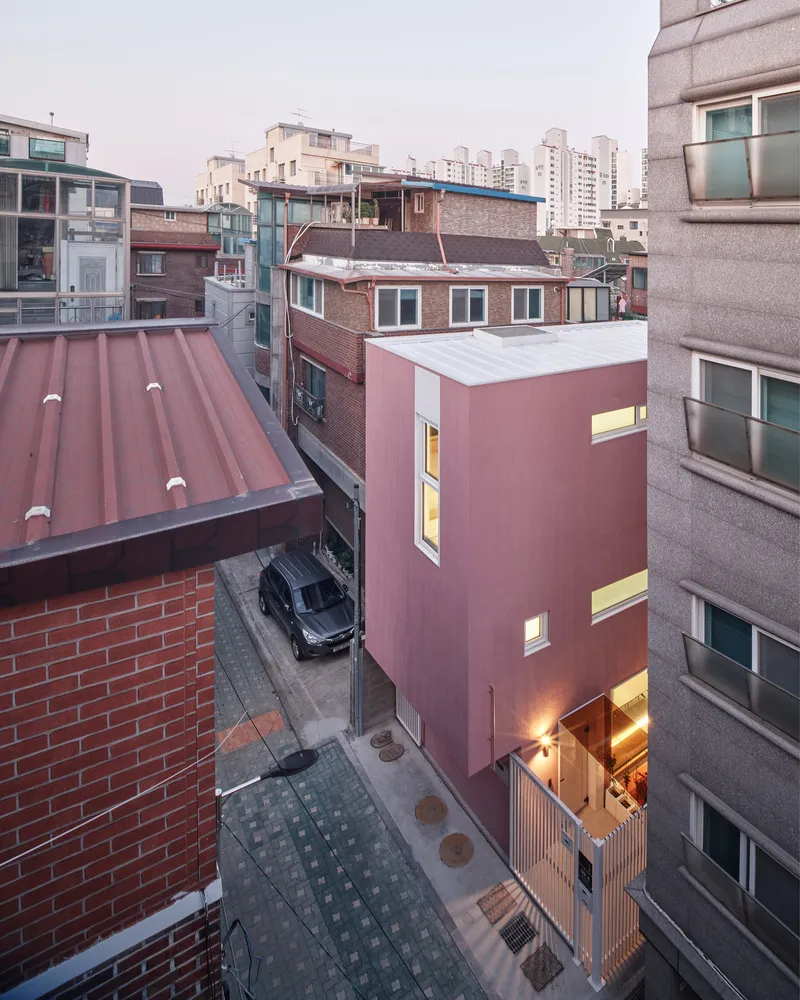
At dusk, the house transforms. The pink facade catches the last daylight while the windows glow warm from within. From the rooftop of a neighbouring building, the pink house is the only warm-coloured volume in a sea of grey and brown roofs. The angular top of the tower creates a silhouette that is distinct from the flat-roofed apartments around it. This is the quality that justifies the colour: at night, the pink house is the one you can find.
Entry and Ground Floor
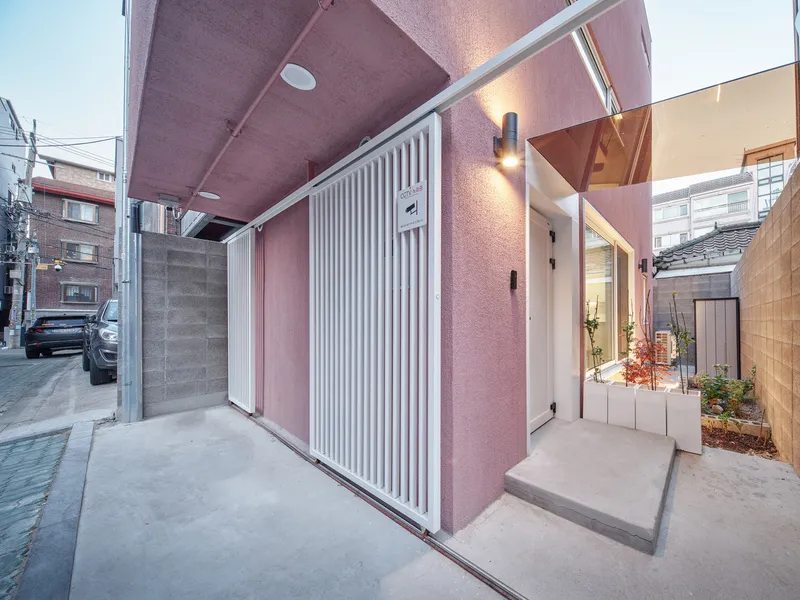
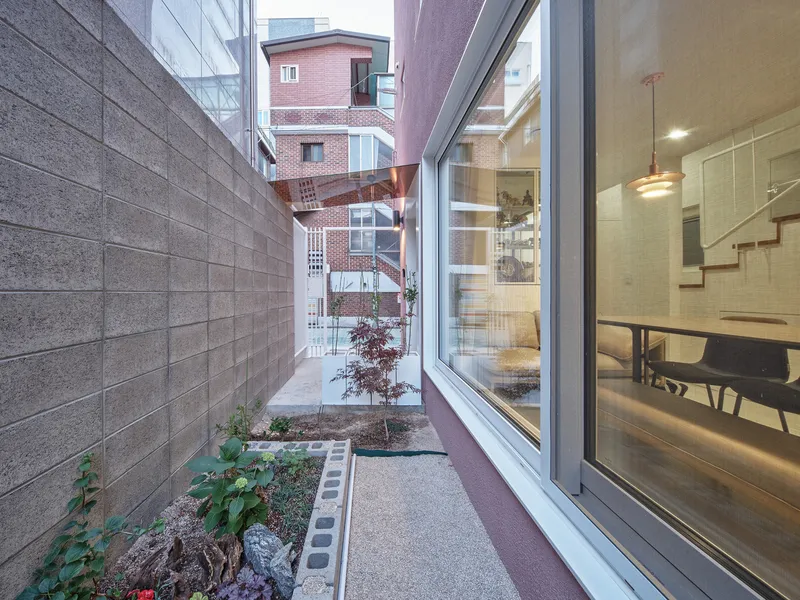
The entry is at ground level under the pink rendered soffit. A white slatted gate opens to a small planted garden along the side of the house. This narrow gap between the pink wall and the concrete block neighbour wall is the side courtyard: barely wide enough for a person, but planted with shrubs and visible from the dining room through a large glass door. The courtyard is the house's only connection to the ground, and it works because it brings plants, light, and air to an otherwise landlocked plan.
Dining and Kitchen
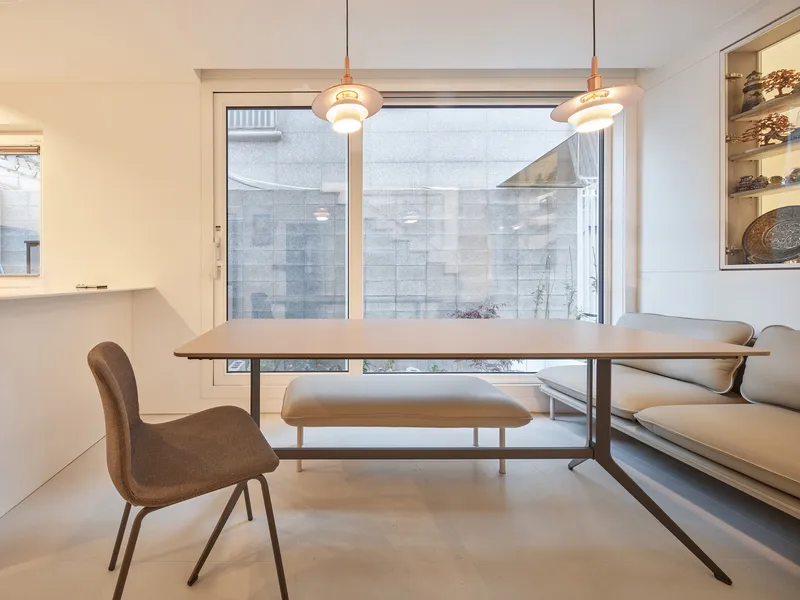
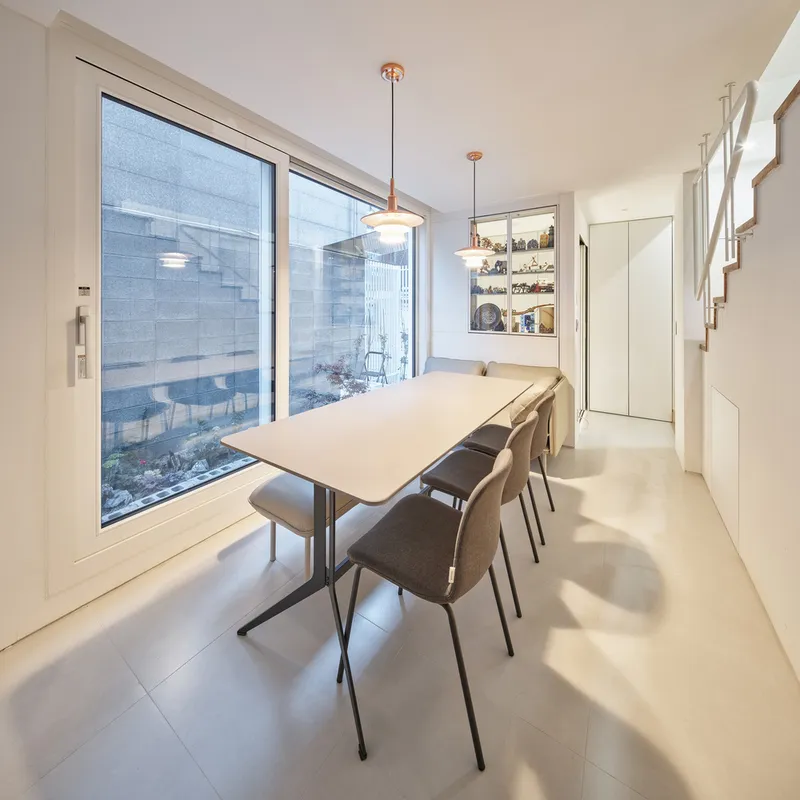
The dining room on the second floor is the social heart. A white table with a steel frame sits with a bench and a leather chair. Two pendant lights hang above. The large sliding glass door opens to the side courtyard, bringing in light and a view of the garden. The staircase is visible at the right edge of the room. The material palette is white, light timber, and steel. The room is small but not cramped because the courtyard window extends the visual space.
Living Room and Staircase
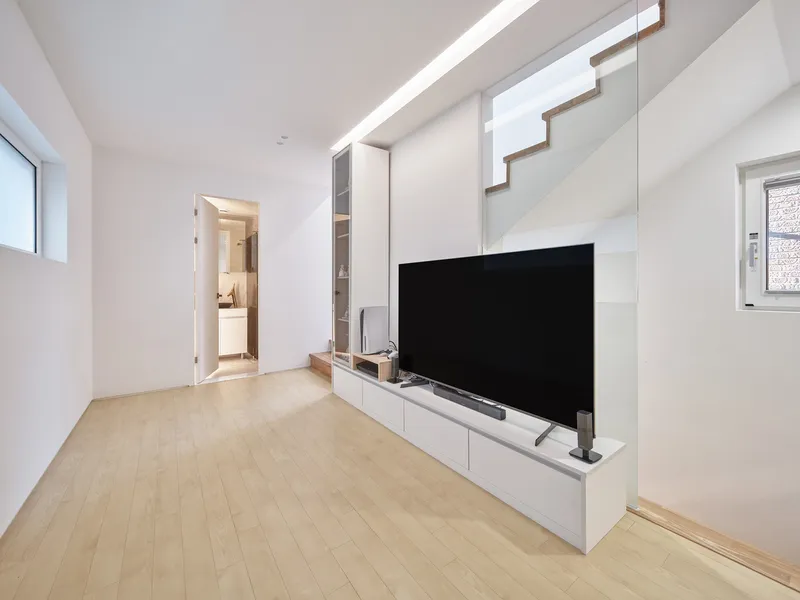
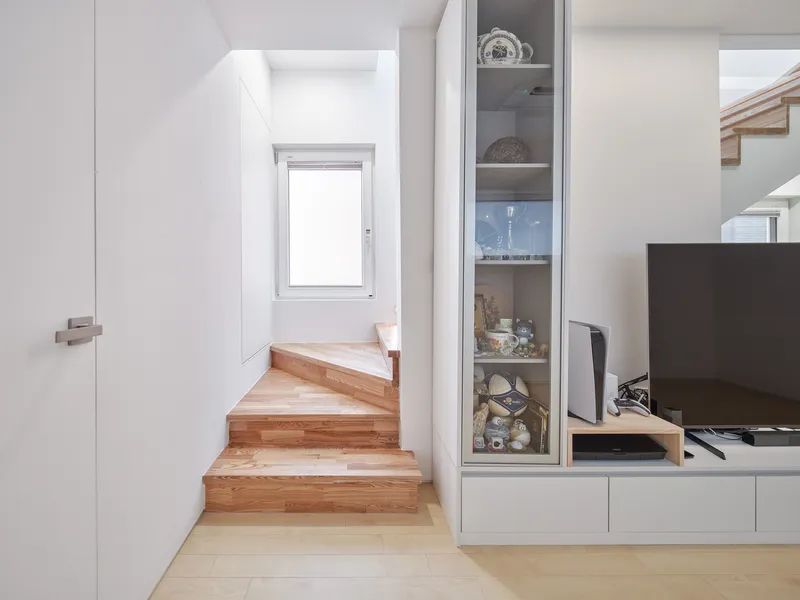
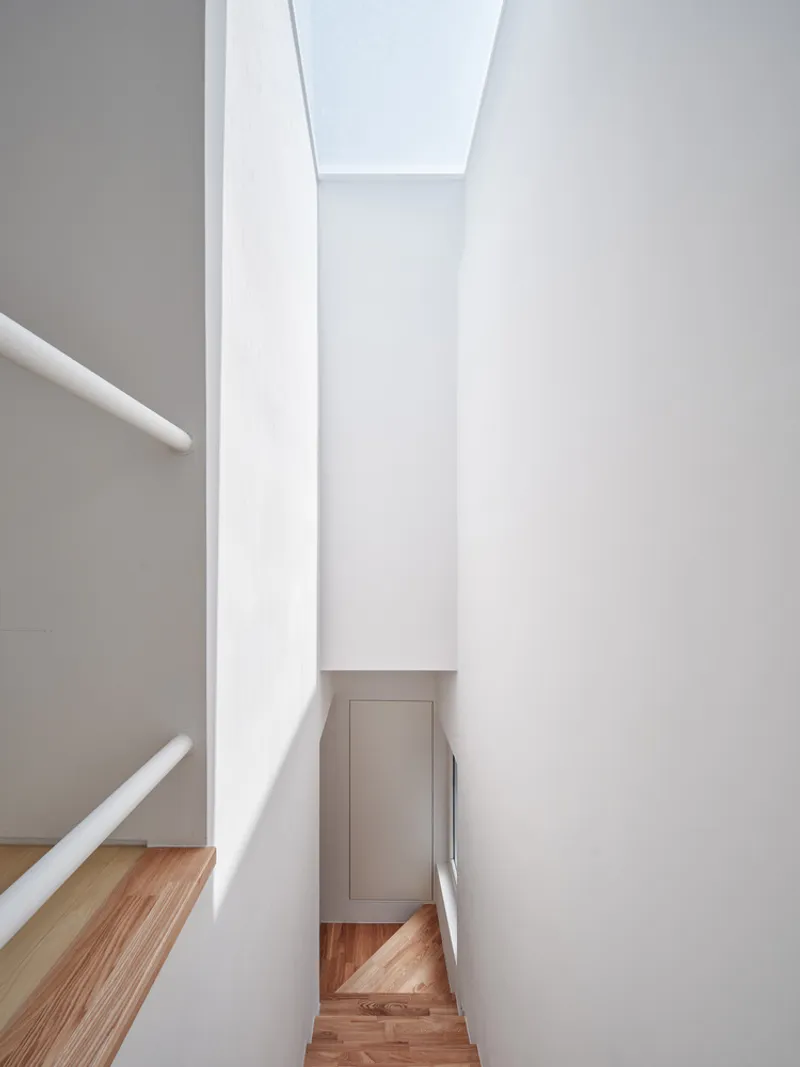
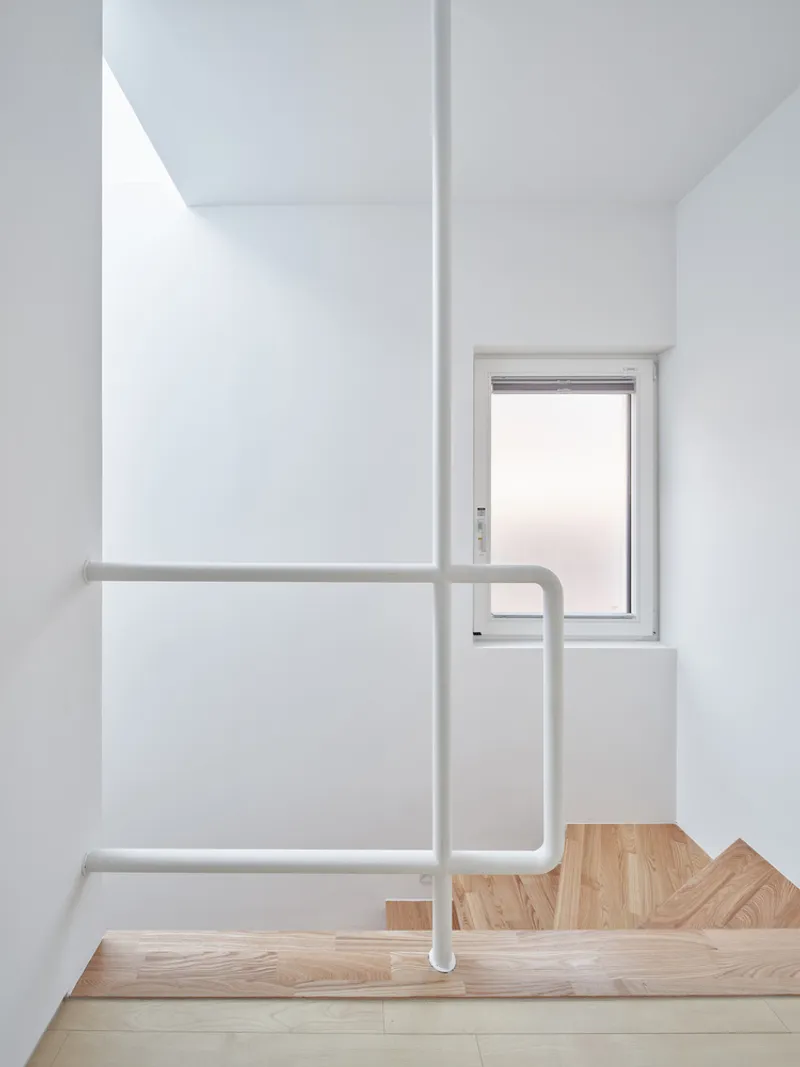
The living room on the third floor has white walls, a TV on a low white cabinet, a linear ceiling light, and an angular white stair balustrade that gives the room its character. The timber floor is light oak. The staircase is the most important architectural element in the house: it runs from the ground floor to the roof, narrowing as it rises, with white metal railings and timber treads. At the top, a skylight floods the stairwell with daylight that washes down the white walls. In a house this narrow, the stair is not just circulation. It is the light well.
Plywood Room and Bathroom
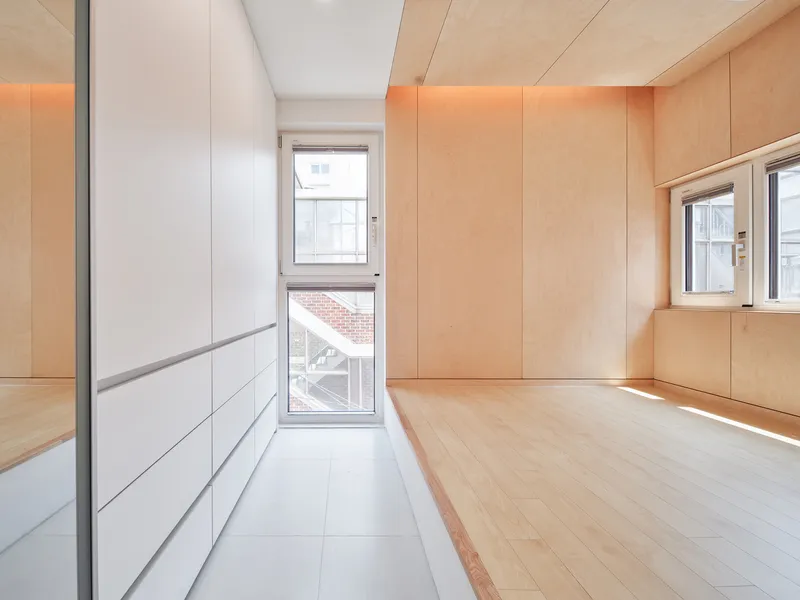
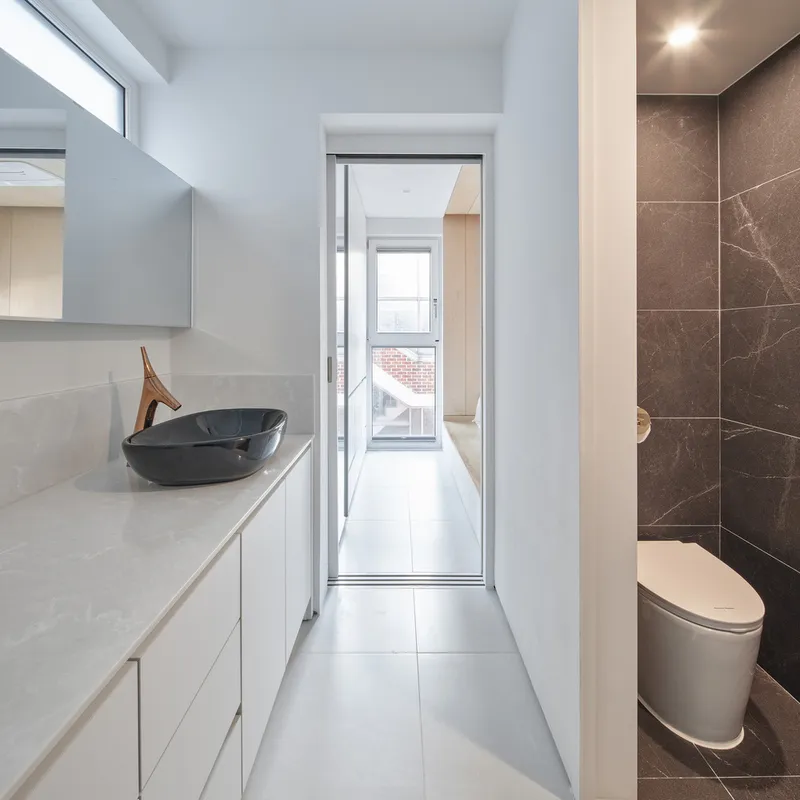
One of the upper rooms is lined entirely in warm birch plywood: walls, ceiling, and built-in storage. Recessed LED strips run along the ceiling edge, giving the room a warm glow. A glass door opens to a small balcony. This is the warmest room in the house, a contrast to the white floors below. The bathroom has a white counter with a dark stone vessel basin, grey stone wall tiles, and a narrow window at the end. The materials are restrained: white, grey stone, and timber. Nothing is unnecessary.
Model and Section
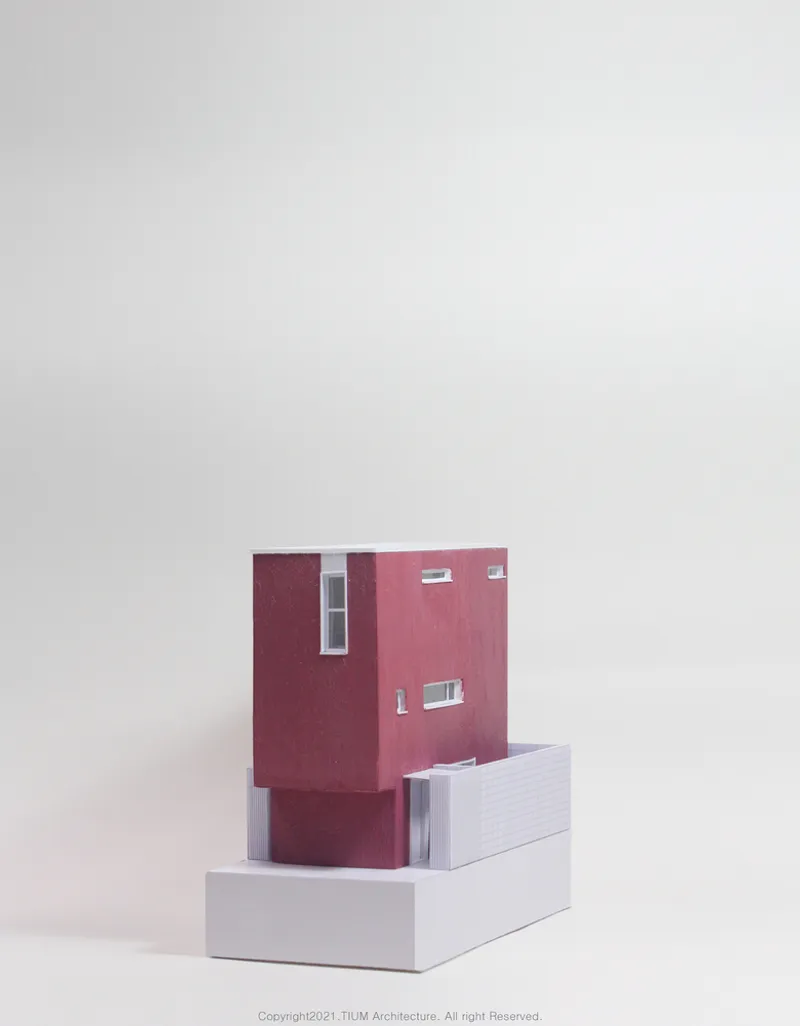
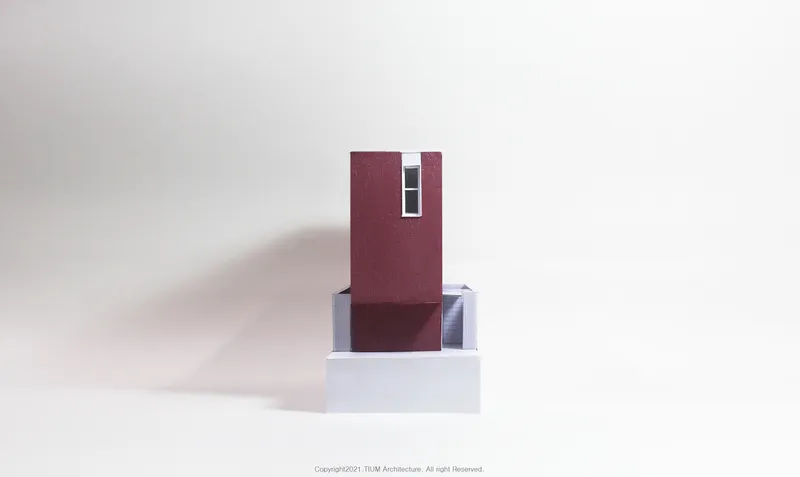
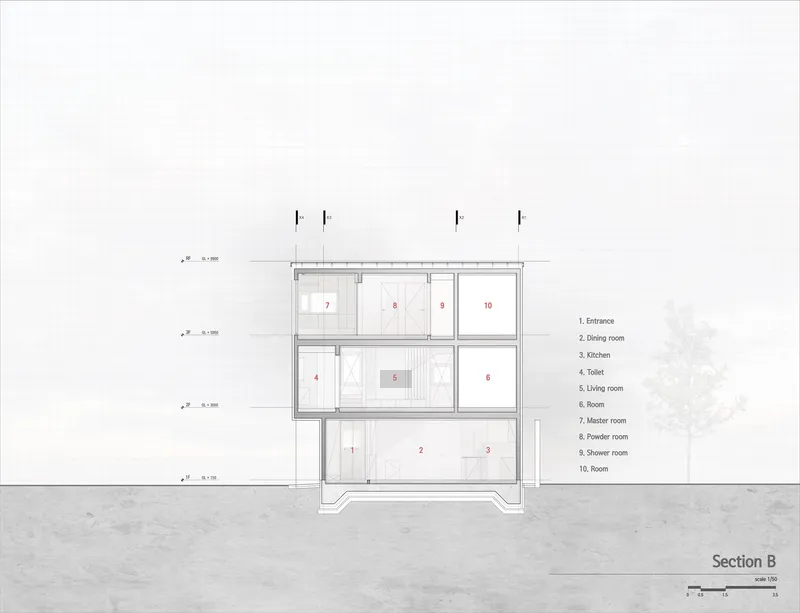
The physical models show the massing clearly: a pink upper volume sitting on a grey and white base, the angular top giving the tower its distinctive profile. The section reveals the vertical stacking: entrance at ground, dining and kitchen on the second level, living room on the third, dressing room and shower on the fourth, with the staircase rising through the centre and the skylight at the top. Four storeys, one room per floor, one staircase, one skylight.
Why This Project Matters
Infill houses on narrow urban plots are one of the hardest briefs in residential architecture. The site is tight. The neighbours are close. The light is limited. The budget is small. TIUM Architects solved every problem with one move: stack the rooms vertically, run a skylight-lit staircase through the centre, and paint the exterior pink. The colour gives the house identity. The skylight gives it light. The side courtyard gives it air. The vertical plan gives each room its own floor and its own character.
If you are designing a narrow infill house, a vertical dwelling, or any project on a tight urban site, Pink Oasis House is worth studying for how colour, a single skylight, and a side courtyard can make a four-storey tower feel like a home.
About the Studio
Share Your Own Work on uni.xyz
If you are working on infill housing, narrow-plot architecture, or urban residential design, uni.xyz is a place to publish your work and connect with a global design community.
Project credits: Pink Oasis House by TIUM Architects. Seoul, South Korea. Photographs: Hanul.



Popular Articles
Popular articles from the community


Co-life: Sustainable Architecture for Age-Friendly Community Living
Co-life reimagines sustainable architecture for seniors through courtyards, rammed earth, shared gardens, and spaces designed for belonging.

Conexión: Biophilic Design Reimagines High-Rise Living in Hong Kong
Conexión reimagines high-rise living in Hong Kong through biophilic design, green facades, shared spaces, daylight, water and nature within.

The Earth Pod: 3D Printed Homes for Resilient Refugee Communities
The Earth Pod reimagines refugee housing through 3D printed homes made from clay, combining resilience, self-sufficiency, and rapid shelter.

Play: Fragments of Their World
Familiar architecture becomes modular playground design, creating safe spaces where displaced children can learn, connect, imagine and play.


Similar Reads
You might also enjoy these articles


Hodi-Mandai Geram
Project Function: Preservation and revitalization of the Intangible heritage and socio-spatial identity of the Hodi by Housing, Cultural Memory Center, Sacred Grove, landscape, local tourism economy


Olio Towers: A Mid-Rise for Performers That Fuses Housing, Rehearsal, and Stage
Located blocks from Houston's Theater District, this modular tower stacks living units around a central performance atrium.

Oasis: Modular Green Housing Carved into Dhaka's Urban Fabric
A shortlisted Plugin Housing entry reclaims unauthorized settlements in Dhaka with stepped concrete volumes, green roofs, and ventilation-driven design.

Black Hole: A Floating Megastructure for the Post-Physical Era
Emiliano Mazzarotto envisions a spherical, self-scaling arena where e-sports, digital hotels, and holographic stadiums replace traditional public space.


Explore Green Oasis Competitions
Discover active competitions in this discipline



Challenge to reimagine the Iron Throne


Photograph architecture without architects


Illustrate the lost glory of Angkor Wat - Render Challenge


Design challenge to reuse E-waste
Comments (0)
Please login or sign up to add comments
No comments yet. Be the first to comment!