

PIXA: One Steel Module, Infinite Public Landscapes
A modular pavilion system pairs lightweight steel frames with organic fabric canopies to generate scalable, shade-rich public spaces.


What if a single structural unit could become a bus shelter, a beach canopy, a children's play zone, and a community gathering hall, all without changing its core construction? PIXA proposes exactly that: a modular pavilion system built from repeatable steel frames and organic perforated fabric skins, designed to scale from an intimate vaulted shelter to an expansive public landscape simply by aggregating identical modules. The architecture never tries to be monumental. Instead, it treats repetition as a generative force, letting clusters of lightweight arches produce spatial richness far beyond what any single unit could achieve alone.
Designed by Hermann Kamte and published on uni.xyz, PIXA is an experimental investigation into modular logic, asking how simple architectural elements, when rotated, replicated, and connected, can respond to wildly different social and environmental contexts. Parks, urban plazas, transport nodes, beaches, and event grounds all sit within PIXA's operational range, and the project makes a convincing case that none of these programs require a fixed typology to succeed.
Beneath the Arches: Light, Play, and Living Shadow

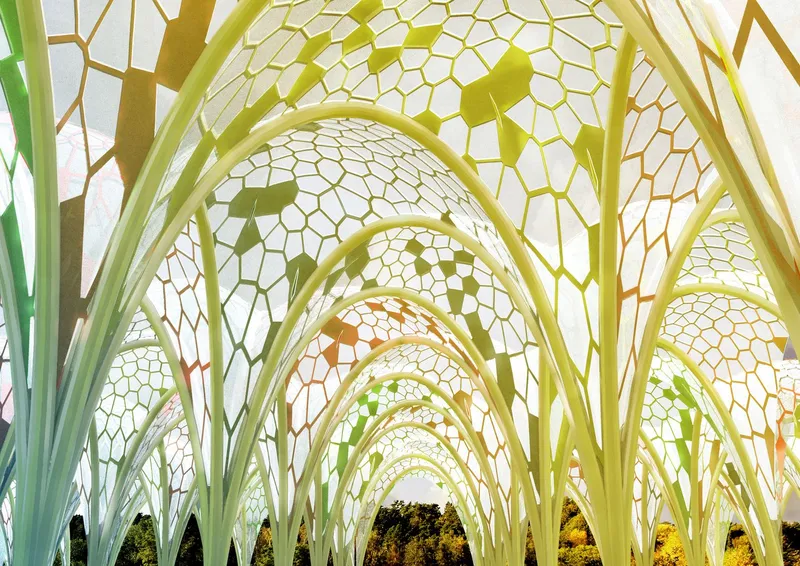
Step under a PIXA canopy and the first thing you notice is the light. The translucent fabric envelope, layered over a steel skeleton of arching ribs, filters daylight into shifting cellular patterns that move across the ground as the sun tracks overhead. The interior view shows families and children at ease on open grass beneath the vaulted lattice, the structure framing activity without constraining it. There are no walls, no thresholds to negotiate. The architecture defines space through shade rather than enclosure, maintaining full visual continuity with the surrounding landscape while offering tangible comfort.
The perspective through the repeated vaulted arches reveals PIXA's spatial depth. Hexagonal cellular panels punctuate the canopy, each one balancing translucency with opacity to modulate solar protection. As modules connect, the repeated arches create a rhythmic corridor of dappled light, a condition that feels almost forest-like. The perforated fabric is not merely decorative; it reinforces structural rhythm across modules while producing the dynamic shadow play that transforms the pavilion from static object into responsive environment.
Aggregation Logic: From Single Unit to Urban Canopy
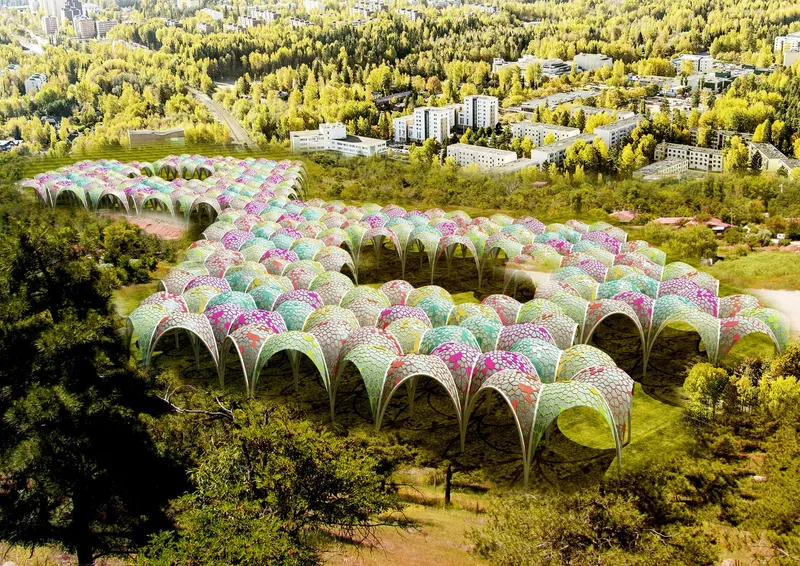
The aerial view of PIXA across a forested clearing makes the aggregation strategy legible at a glance. Individual vaulted pavilions, each capped with cellular colored canopies, cluster into formations that read as both distinct units and continuous ground. Small groupings produce intimate shelters; larger assemblies merge into sweeping canopies capable of hosting community events. The key insight here is that no bespoke connection detail is required. The same module, rotated and repositioned, generates density gradients that respond to program rather than imposing it.
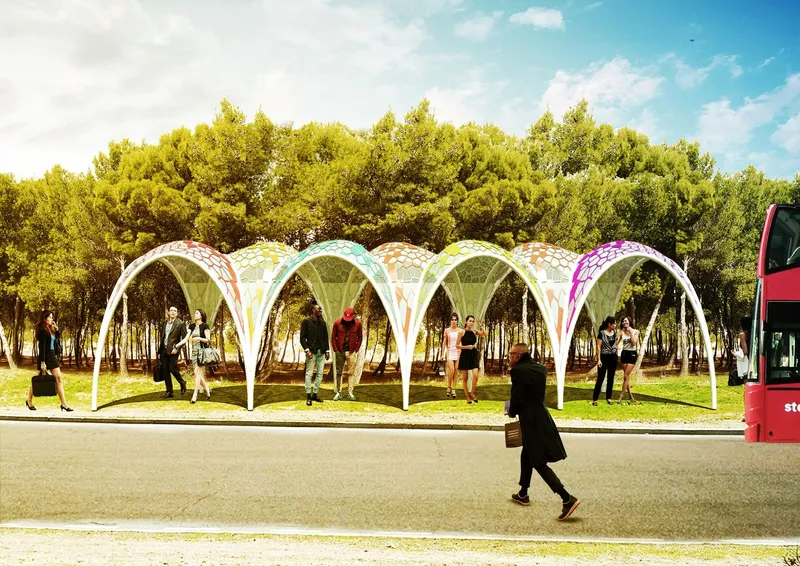
At street level, the system proves equally versatile. The arched canopy structure sits comfortably alongside a passing bus and pedestrian traffic, functioning as transit infrastructure without looking like a standard bus stop. This adaptability across scales and contexts, from a park clearing to an urban sidewalk, is where PIXA's modular logic earns its value. The lightweight steel framework means assembly and disassembly remain practical, positioning the system for both temporary installations and longer-term urban interventions.
The Hexagonal Canopy as Fabric Architecture
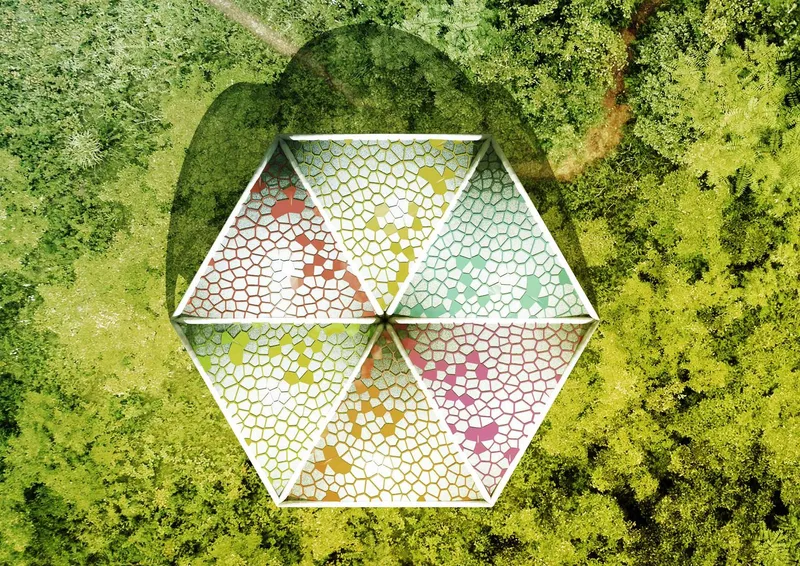

Seen from above, a single hexagonal pavilion reveals the material strategy at its most precise. Colored cellular panels, stretched across the steel frame, merge visual permeability with solar protection. The chromatic variation is not arbitrary; different fabric colors help define functional zones within larger installations, creating identity and orientation while maintaining a cohesive architectural language. Surrounded by greenery, the unit reads as a lightweight intervention that touches the landscape gently.
The overhead view of visitors beneath a single vaulted unit exposes the structural clarity of the system: arching ribs radiate from the center, supporting the cellular canopy like an open umbrella. The fabric works as an active architectural element, defining shelter without creating enclosure, offering comfort without blocking the breeze. By challenging conventional notions of what a wall or roof must be, PIXA reframes fabric not as a secondary skin but as the primary spatial tool, one that shapes experience through filtered light and permeable boundaries.
Why This Project Matters
PIXA argues that modularity is not a limitation but a design amplifier. Where many modular systems sacrifice spatial quality for efficiency, this project demonstrates that a single, well-considered unit can produce genuine architectural diversity through aggregation alone. The combination of steel frames and organic fabric keeps the system lightweight and deployable, while the interplay of light and shadow gives each configuration a sensory identity that shifts throughout the day. The result is architecture that feels alive without relying on mechanical systems or digital facades.
For public space design, PIXA offers a practical provocation. Cities need flexible infrastructure: structures that can host a morning market, an afternoon play session, and an evening concert without being redesigned each time. By stripping the pavilion down to its essential components, a repeatable frame and a responsive skin, Hermann Kamte shows that the most adaptable architecture may also be the simplest. PIXA positions the modular unit not as a building block for uniformity, but as a seed for complex, socially engaged environments.
View the Full Project
About the Designers
Designer: Hermann Kamte
Enter a Design Competition on uni.xyz
uni.xyz runs architecture and design competitions year-round that reward proposals with spatial conviction and real site intelligence.
Project credits: PIXA by Hermann Kamte.


Popular Articles
Popular articles from the community


Manzana Morphosis: Stretching Barcelona's Grid into a Living Landscape for 2050
A radical reworking of the Eixample manzana turns density into a tool for generous public space, vertical ecology, and environmental performance.

Tsunami Convergenics: Turning Catastrophic Ocean Forces into Underwater Housing Infrastructure
A speculative underwater settlement off the coast of Onagawa, Japan, treats tsunamis and typhoons as energy sources rather than threats.

Opera on the Sea: Driftwood Logic Shapes a Timber Opera House on Estonia's Coast
Trevor Orgill's opera house translates the entangled drift of floating timber into a civic building where wood, water, and music converge.

Opera by the Sea Estonia: Three Shells Dissolving Architecture into Tallinn's Coastline
A winning opera house proposal replaces monumental form with interconnected shells that blur the boundary between building, park and Baltic Sea.

Similar Reads
You might also enjoy these articles
Sustainable Architecture Design: Embracing Nature and Modernity at Villa Solsidan
The article explores Villa Solsidan by AndrénFogelström, showcasing its sustainable architecture design and integration with the natural surroundings in Saltsjöbaden, Sweden.
Scientific and Educational Monitoring Center of the Yenisei, Krasnoyarsk
Architecture as an instrument for ecological research, education, and environmental awareness along Russia’s largest river.
Development of Andretta Artist’s Village, Palampur, Himachal Pradesh, India
Reimagining Andretta as a living cultural landscape where art, architecture, and community converge to shape a global creative village.
Street Children Rehabilitation Center: A Model of Social Architecture for Community Rehabilitation
An inclusive social architecture project that transforms streets into nurturing environments, restoring dignity, identity, and opportunity for vulnerable children.

Explore Public Architecture Competitions
Discover active competitions in this discipline

Design challenge to equip cities with modern furniture

Packaging challenge - Design meets sustainability
Comments (0)
Please login or sign up to add comments
No comments yet. Be the first to comment!