
Ponto de Apoio Stacks Offices and an Auditorium on Top of a Mushroom Cold Chamber in Brazil
A steel-framed administrative building in Sorocaba rises above an industrial cold storage floor, blending transparency with pragmatism.


Yuri Cogumelos is a company you would not immediately associate with architectural ambition. Based in the Jardim Novo Mundo district of Sorocaba, São Paulo state, the firm imports Japanese technology to grow shiitake mushrooms in controlled environments, using blocks of sawdust and bran instead of traditional tree logs. When it came time to build an administrative headquarters on its production campus, the brief was anything but standard: a 140-seat auditorium, open-plan offices, a mezzanine, a kitchen, and meeting rooms, all stacked above a ground-floor cold storage chamber. The design by Ponto de Apoio, led by architects Fernando Taborda and Regina Kikuchi, was originally conceived in 2007, then shelved for over a decade before being constructed in 2019 with expanded programmatic demands.
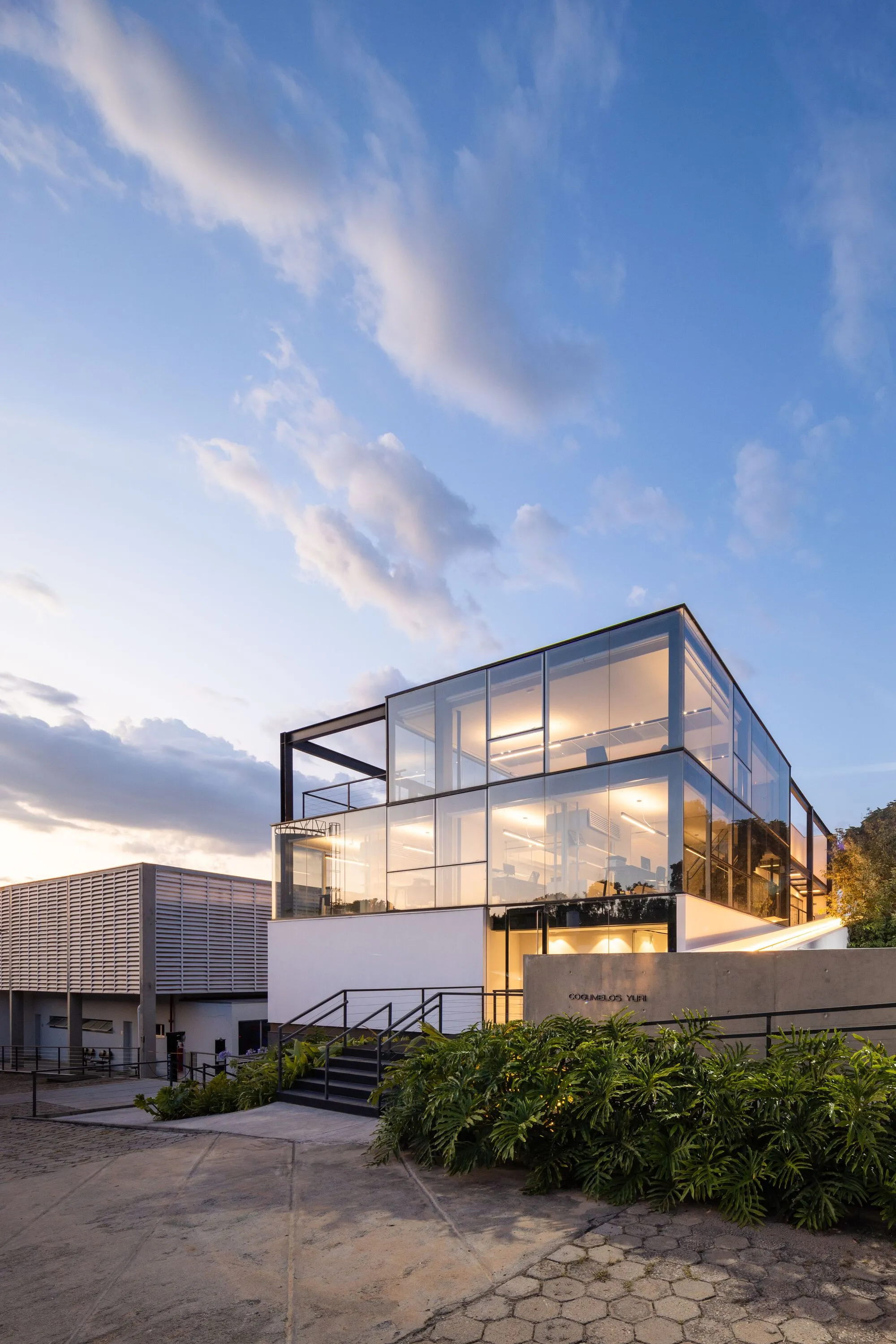
What makes this project genuinely interesting is its refusal to segregate the industrial from the administrative. Rather than tucking offices into a separate pavilion and leaving the cold chamber to its crates, Ponto de Apoio treats the entire 950-square-meter section as a single vertical organism. The cold room is the foundation, quite literally. Above it, a bolted steel frame wraps the upper floors in floor-to-ceiling glass, turning what could have been a forgettable agribusiness shed into a lantern-like volume that glows against the surrounding fields at dusk. The hybrid program drives the architecture, and the result is more compelling than either function would have been alone.
Glass Over Concrete: A Deliberate Contrast


The building reads as two distinct volumes pushed together. A solid white stucco base, housing the cold chamber and service functions, anchors the composition to the ground. Above it, the steel-framed glass box appears almost weightless, its mullions and cross-bracing visible through the glazing like a drawing of its own structure. At twilight the upper volume becomes a backlit cage, exposing the staircase, ceiling grilles, and interior partitions to anyone approaching from the campus roads.
The contrast is blunt and effective. There is no attempt to smooth the transition between opaque base and transparent top with gradient screens or decorative cladding. The stucco wall simply stops, and the glass begins. It is a legible diagram of program: sealed storage below, open workspace above.
The Auditorium as Acoustic Island


Fitting a 140-seat auditorium into a mid-rise administrative building on a tight industrial site is a real problem, and the architects solve it with a thick exposed concrete wall that separates the tiered seating volume from the adjacent offices. The wall is not just structural; it provides the acoustic mass needed to isolate the auditorium from the day-to-day noise of an open-plan workplace. Clerestory windows run along the top, pulling daylight into the space without compromising the visual focus of the raked timber seats facing forward.
The auditorium has its own independent access via an external ramp, which means the space can function for community events or client presentations without disrupting the rest of the building. It is a smart operational decision, not just a spatial one. Board-formed concrete gives the walls texture without requiring finishes, and the warm timber seating introduces the only significant material warmth in the entire project.
Vertical Circulation and the Double-Height Lobby
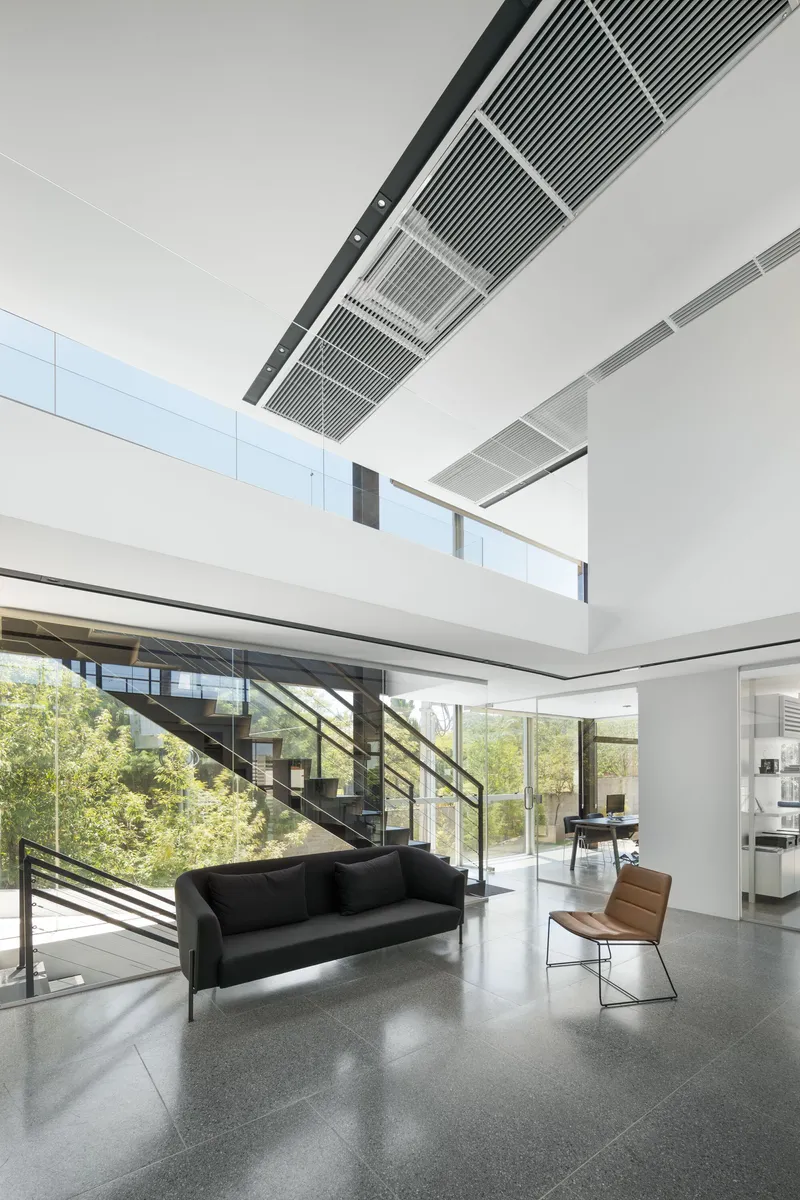
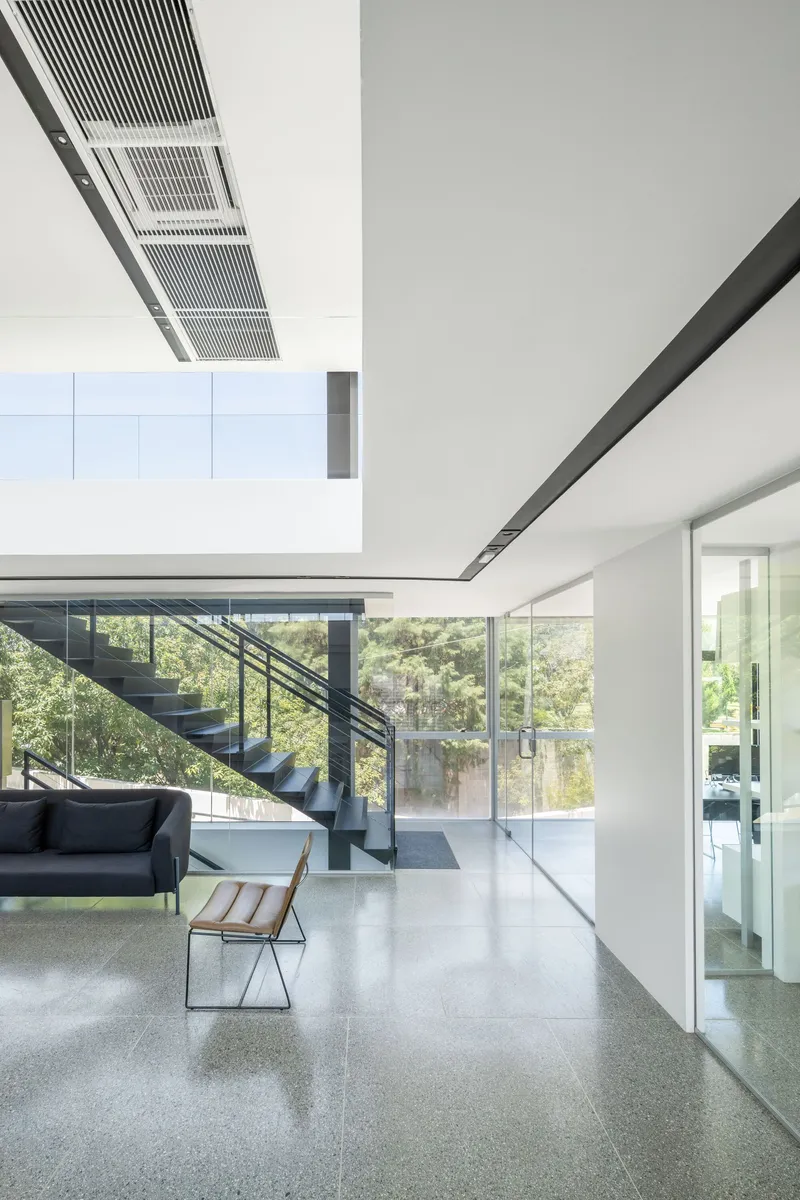

The diagonal steel staircase is the building's spine, threading through a double-height lobby finished in polished terrazzo and topped with linear ceiling grilles. The stair is visible from outside through the glass skin, which turns it into an animated element of the facade. People moving between floors become part of the building's expression, a decision that reinforces the transparency theme without any forced symbolism.
At the upper gallery level, a glass balustrade allows views back down into the double-height space and out to an exterior terrace. The mezzanine, built with a cast-in-place ribbed slab rather than precast panels, is structurally distinct from the floors below, a pragmatic choice that allowed it to cantilever where needed without the dimensional constraints of prefabrication.
Working in a Greenhouse
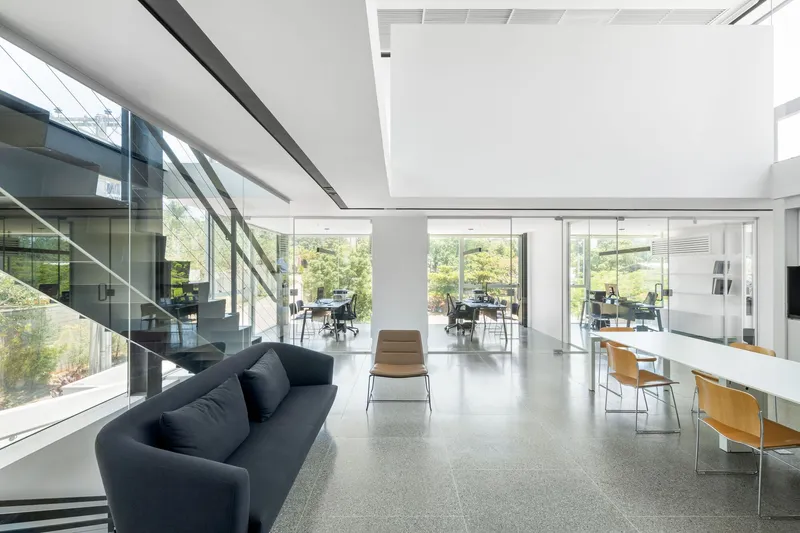
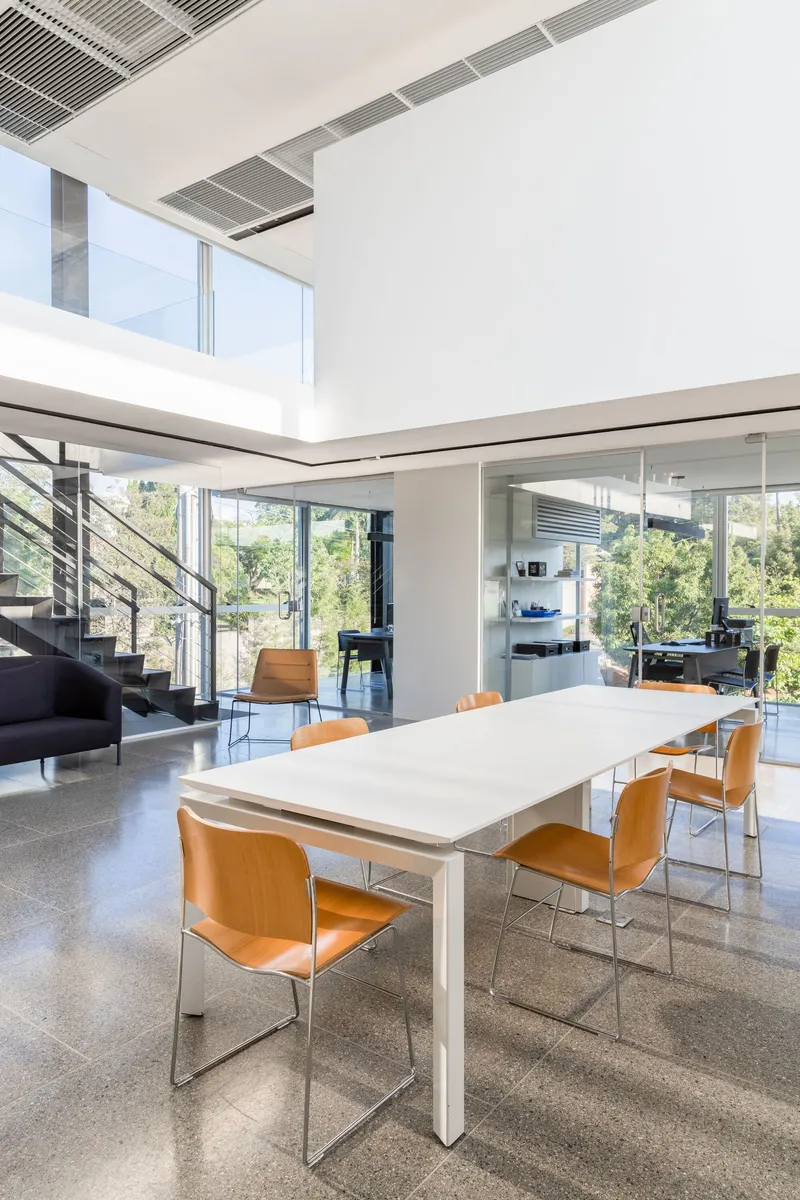

The open-plan office floors live entirely within the glass envelope, with full-height glazing on multiple sides overlooking the campus gardens. There is something almost paradoxical about a mushroom company, whose product thrives in dark, humid, controlled environments, choosing to house its people in maximum daylight and openness. The contrast feels intentional. The conference area sits beneath a skylight punched through the concrete ceiling, flooding the white table and polished floor with direct sun.
The dining and kitchen areas on the upper levels are finished with restraint: white cabinetry, a black countertop backsplash, high-level windows that wash the ceiling in diffused light. Integrated ceiling grilles manage ventilation without exposed ductwork, keeping the interiors clean. Nothing here is luxurious, but everything is precise.
Louvered Screens and the Campus Edge


A horizontal louvered screen flanks one side of the building, creating a courtyard entry passage between it and the glazed volume. The louvers provide solar control and visual privacy where the glass facade faces service areas, but they also give the building a second material register beyond glass and stucco. From aerial views, the louvered wing reads as a distinct bar set among palm trees, anchoring the composition to the landscape while the glass box floats above it.
The upper-level timber deck offers outdoor space adjacent to the offices, an amenity that acknowledges the tropical climate of interior São Paulo state. It is a small move with real impact on daily use, extending the usable area beyond the air-conditioned envelope.
The Cold Chamber Below

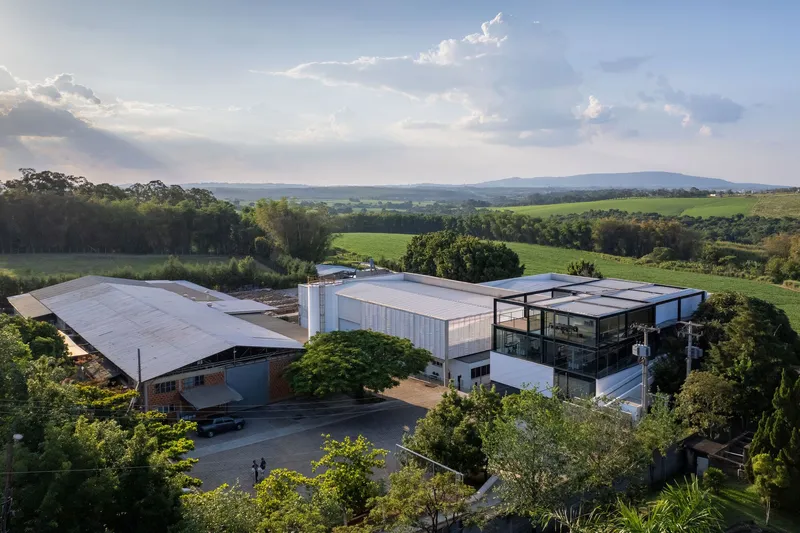
It is worth remembering what sits beneath all this glass and steel. The ground floor cold chamber, stacked floor to ceiling with colored plastic crates, is the reason the building exists. The precast concrete slab above it doubles as both structural floor for the offices and thermal barrier for the refrigerated volume. In the aerial view, the administrative building is just one piece of a larger industrial complex of metal-roofed production and storage sheds, surrounded by green fields. The architectural ambition is concentrated here, in this single volume, rather than spread thinly across the campus.
Plans and Drawings
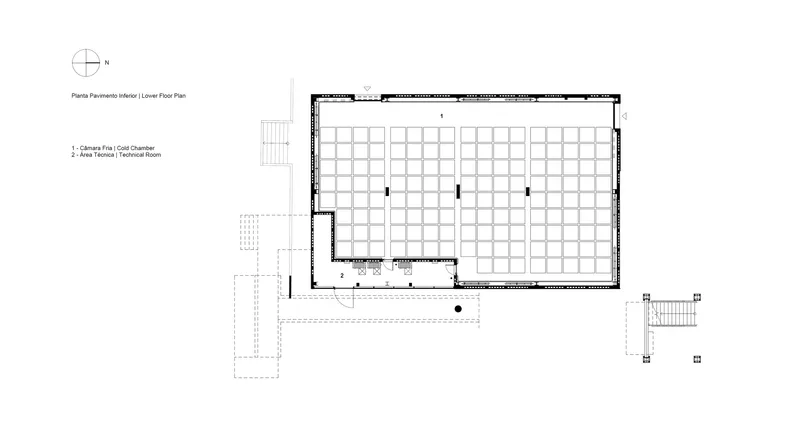

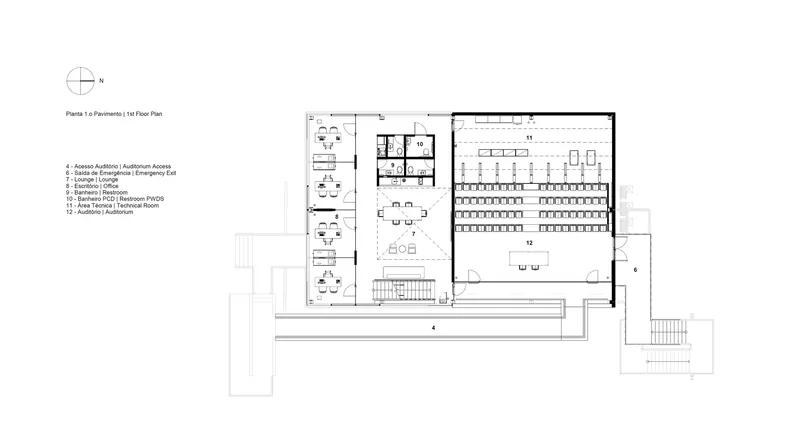

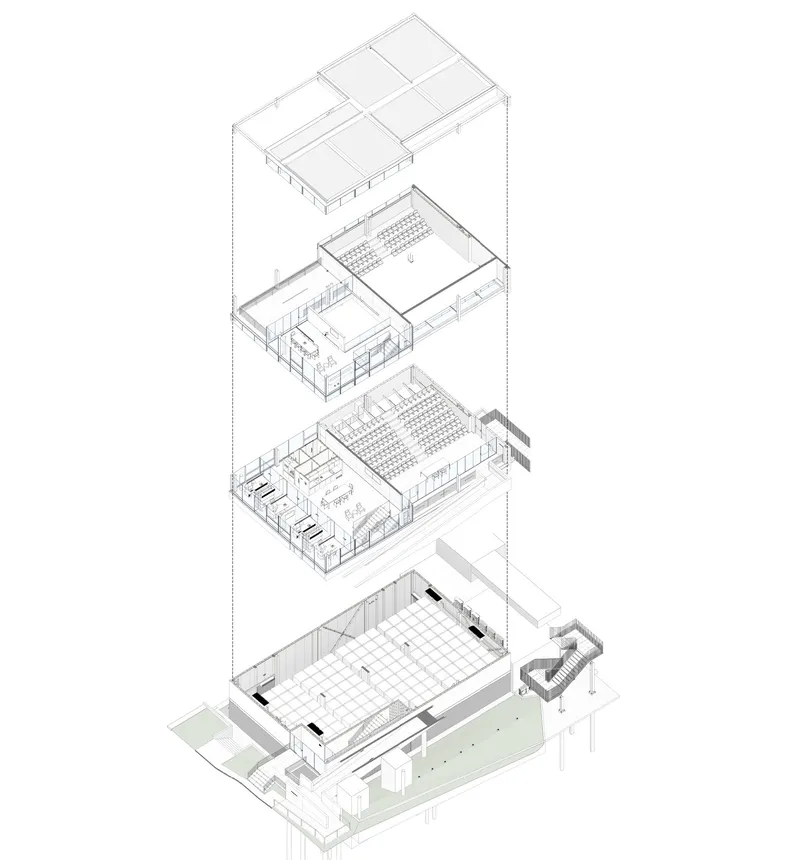
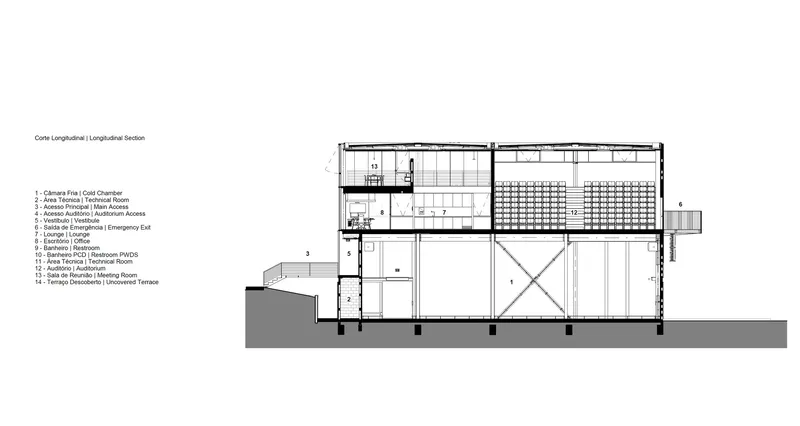


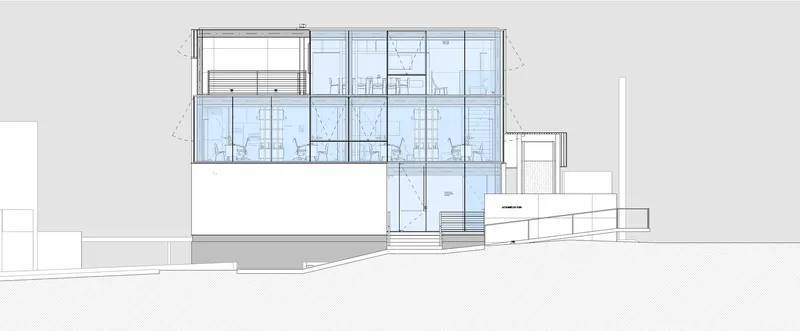
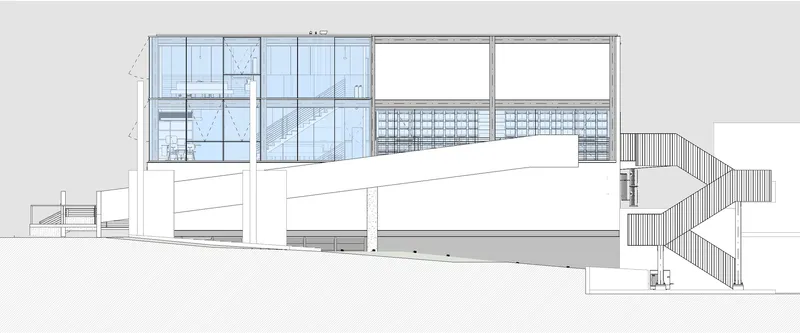
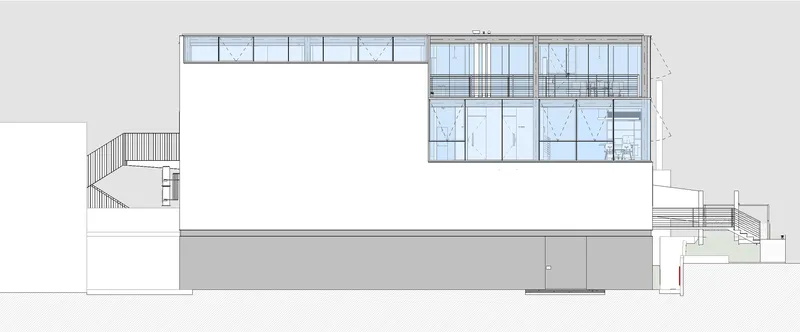


The floor plans make the vertical stacking strategy explicit. The lower floor is almost entirely given over to the storage grid, with perimeter walls and minimal internal partitions. The ground level introduces the entry vestibule and stair. One floor up, the auditorium occupies roughly half the plan, with ancillary rooms and circulation filling the remainder. The mezzanine level is the most spatially complex, with the meeting room and tiered seating area sharing the plan. The exploded axonometric is the most revealing drawing: four levels, each with a distinct program, threaded together by a single circulation core.
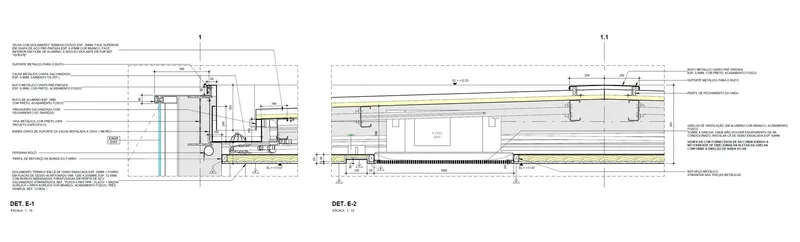
Cross sections confirm how the auditorium's sloped seating is carved into the building's section, creating a wedge-shaped volume that pushes the ceiling height higher at the back of the room. The longitudinal section shows the mezzanine hovering above the main office floor, with the auditorium volume dropping below. The construction detail drawing of the roof assembly, with its insulation layers and structural supports, reveals the thermal performance demands of stacking conditioned office space above a cold chamber.
Why This Project Matters
The Yuri Mushroom Administrative Building is a case study in what happens when architects take an unpromising brief seriously. A cold storage facility with offices and an auditorium on a tight industrial site in Sorocaba is not the kind of commission that generates magazine covers, yet Ponto de Apoio found genuine architecture in the constraints. The vertical stacking of incompatible programs, refrigerated storage below, transparent workspace above, produces a section that is more interesting than most purpose-built office buildings. The twelve-year gap between initial design and construction did not dilute the idea; if anything, the added programmatic demands sharpened it.
The building also challenges the assumption that industrial architecture must be utilitarian to its core. Yuri Cogumelos could have built a prefab box and called it done. Instead, the company invested in a steel-and-glass volume that communicates openness and precision, qualities that align with its Japanese-derived production methods. The architecture becomes part of the brand. For a mushroom company that replaced traditional log cultivation with engineered sawdust blocks, a building that replaces traditional industrial construction with a bolted steel frame and floor-to-ceiling glass is entirely consistent.
Yuri Mushroom Administrative Building by Ponto de Apoio (Fernando Taborda and Regina Kikuchi). Jardim Novo Mundo, Sorocaba, São Paulo, Brazil. 950 m². Completed 2019. Photography by André Mortatti.
About the Studio
Share Your Own Work on uni.xyz
If projects like this are the kind of work you want to make, uni.xyz is a place to publish your own, find collaborators, and enter design competitions.


Popular Articles
Popular articles from the community


Co-Life: Senior Housing Design That Reconnects Older Adults With the City
Co-Life reimagines senior housing design through healing gardens, shared streets, workshops, and a sustainable community across generations.
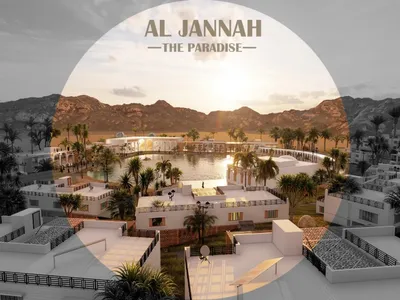
AL-JANNAH: Sustainable Architecture and Permaculture for Afghan Widows
AL-JANNAH uses sustainable architecture and permaculture to create resilient oasis of housing, learning, work and renewal for Afghan widows.

Hill & Cross Opera: Sculptural Opera House Architecture Shaped by Tallinn’s Landscape and Identity
Hill & Cross Opera reimagines opera house architecture in Tallinn through its sculptural hill, civic plaza, glass wave and a luminous cross.

Co-life: Sustainable Architecture for Age-Friendly Community Living
Co-life reimagines sustainable architecture for seniors through courtyards, rammed earth, shared gardens, and spaces designed for belonging.
Similar Reads
You might also enjoy these articles

Bao Huynh Watercolor Atelier: A Serene Art Retreat in Hội An
Bao Huynh Watercolor Atelier in Hội An blends multifunctional art spaces, sustainable design, local materials, and family-friendly living in a serene environment.

Atelier Macri Concept Store Interior Design by CASE-REAL
Atelier Macri store features a "ko" counter, walnut wood details, cork displays, blending retail, gallery, and seamless customer experiences.

Manuel Vargas Izquierdo Stadium and High-Performance Sports Center: Architectural Excellence in Jalpa de Méndez
The Manuel Vargas Izquierdo Stadium blends sustainable design, inclusive sports facilities, and cultural-inspired architecture, revitalizing Jalpa de Méndez’s public spaces.

KAKR Buluh Awar Hall: Revitalizing Community and Ecology Through Bamboo Architecture
Community built bamboo hall revitalizes Buluh Awar village, empowering youth, restoring ecology, celebrating vernacular craftsmanship through sustainable architecture and culture.

Explore Architecture Competitions
Discover active competitions in this discipline



Challenge to reimagine the Iron Throne


Photograph architecture without architects


Illustrate the lost glory of Angkor Wat - Render Challenge


Design challenge to reuse E-waste
Comments (0)
Please login or sign up to add comments
No comments yet. Be the first to comment!