
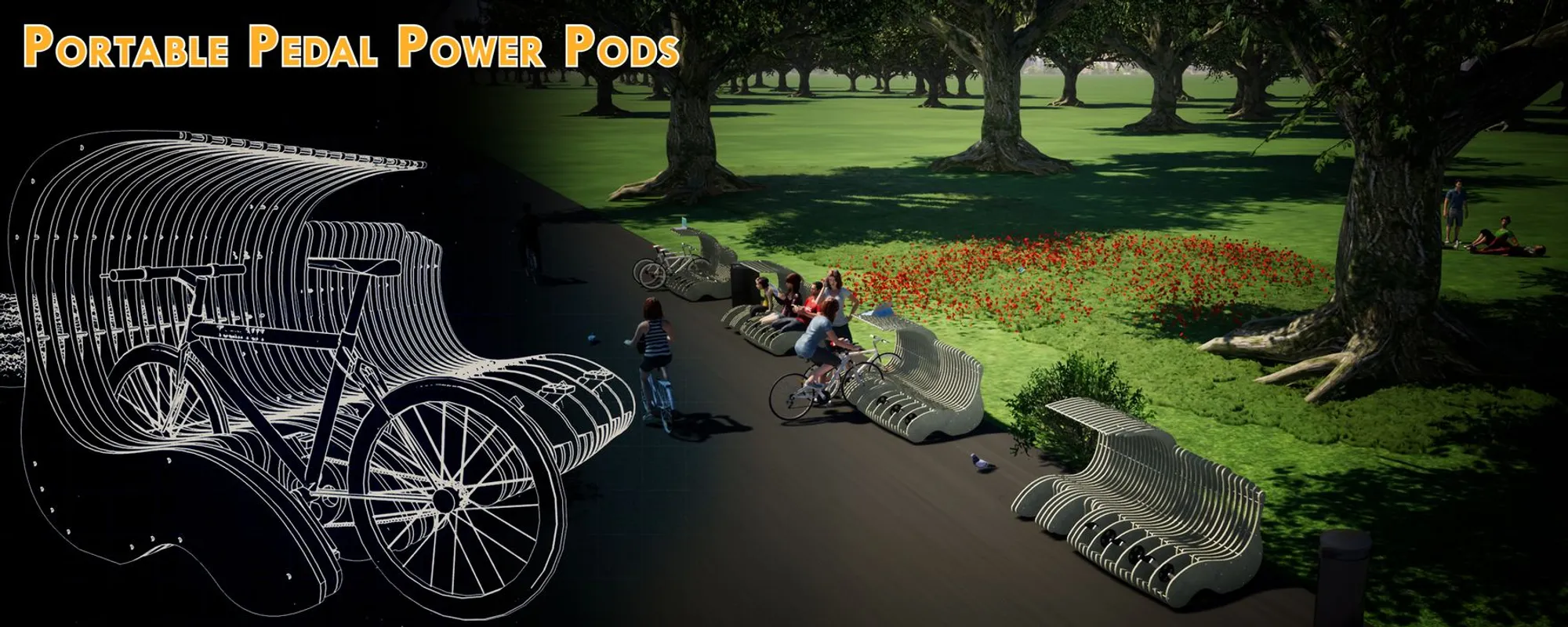
Portable Pedal Power Pods: Urban Furniture That Turns Cycling into Connectivity
Recycled HDPE pods merge pedal-powered energy harvesting, WiFi hotspots, and ergonomic seating into scalable public infrastructure.


What if a park bench could charge your phone, lock your bike, connect you to WiFi, and fight obesity all at once? The Portable Pedal Power Pods propose exactly that: a piece of urban furniture that converts human kinetic energy into usable electricity while doubling as a public fitness station, device charging hub, and secure bicycle lockup. It is a deliberately absurd stack of functions packed into a single ribbed structure made from recycled plastic, and the ambition is what makes it worth taking seriously.
Designed by Sean Johns and Nadia Lazaridou, the project tackles three intertwined global problems: rising energy consumption, urban air pollution, and sedentary lifestyles. The pods are conceived as scalable, modular units that can be deployed across parks, plazas, and university campuses. Drawing on precedents like Sheila Kennedy's Soft Rockers and Paola Mora's solar charging stations, Johns and Lazaridou push the concept further by folding ergonomic exercise into the energy generation loop itself.
Ribbed Canopies on a Public Plaza
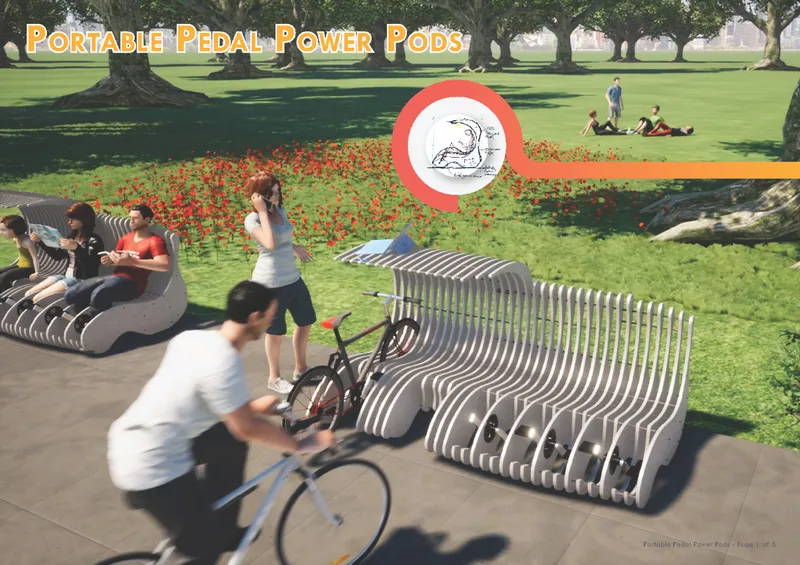
The hero rendering places the pods on a paved urban plaza beneath spring trees, with people cycling, resting, and socializing around the structures. The ribbed canopy form is immediately legible as something between a piece of furniture and a small pavilion. It shelters users while signaling its function through its recumbent bicycle geometry. The image makes a strong case for how the pods could become social anchors in public space, not just utilitarian objects but gathering points that invite interaction.
From Precedent Research to a Circular Design Framework
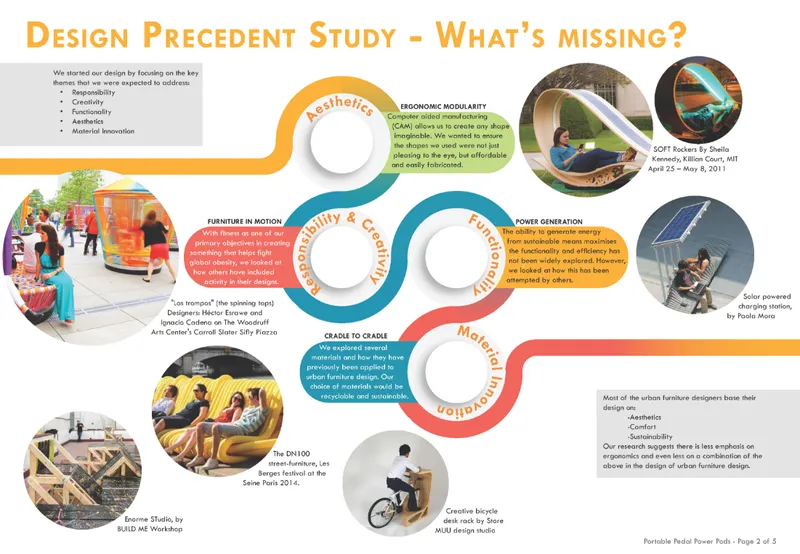
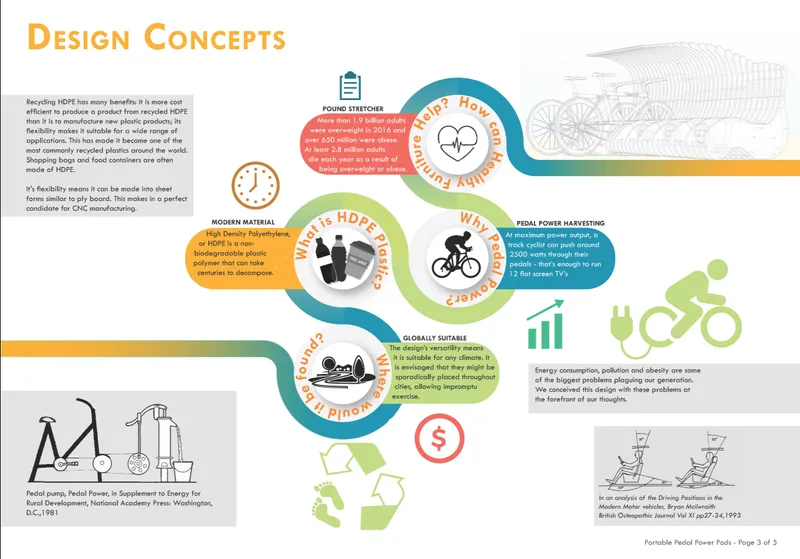
The design precedent study maps the project's intellectual foundations across five themes: aesthetics, ergonomics, material innovation, power generation, and responsibility. Reference images from existing solar furniture and modular urban installations establish the lineage, but the second diagram is where the designers' own synthesis emerges. Sketch drawings and icons lay out the core propositions: recycled materials as the primary construction medium, pedal power harvesting as the energy source, and global suitability as the scaling ambition. Together, these diagrams reveal a methodical design process that moves from observation to proposition with clarity.
Recumbent Ergonomics and Multi-Position Use
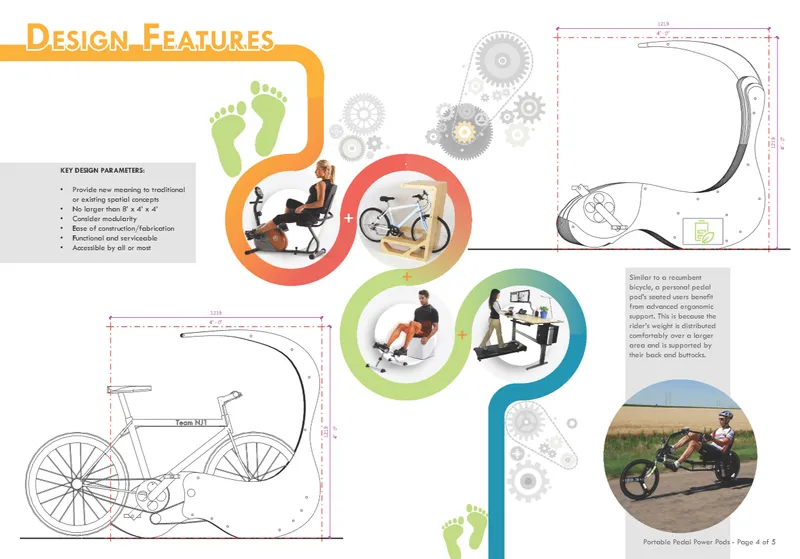
The features board presents elevation drawings of the recumbent bicycle station alongside photographs of users in various positions. Inspired by recumbent bicycles, the seating geometry supports the back and legs during pedaling, lowering the barrier to impromptu exercise. The designers claim cyclists can generate up to 2500 watts at peak output, enough to power multiple devices or small appliances, with harvested energy stored in rechargeable batteries for later use. The multi-position documentation is a smart move: it demonstrates that the pod is not a single-posture machine but a flexible piece of furniture that accommodates resting, charging, and active pedaling.
Exploded Assembly: HDPE Ribs, Charging Slots, and Bike Docking
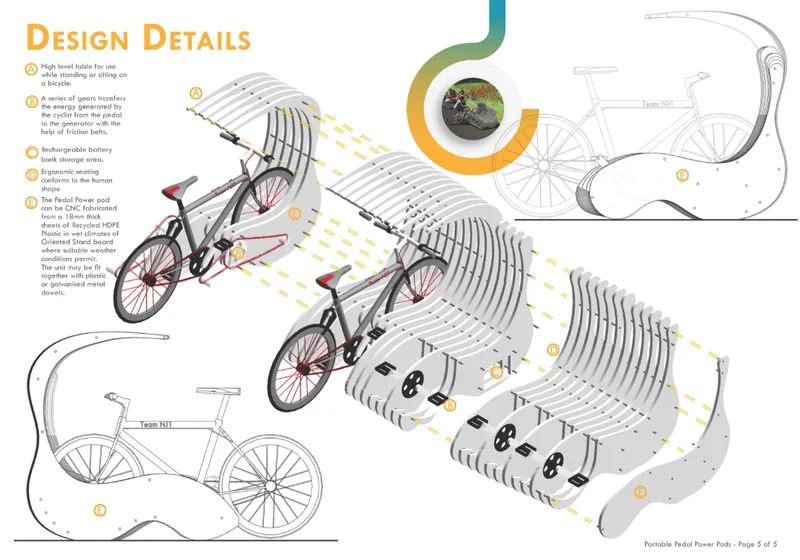
The exploded axonometric drawing is the most technically revealing image in the set. It breaks the pod into its constituent layers: the ribbed canopy structure, integrated charging slots, and bicycle docking mechanisms, each annotated with detail callouts. The construction relies on recycled HDPE (High-Density Polyethylene), a material chosen for its cost-effectiveness, wide availability, and compatibility with CNC manufacturing. By using recycled plastics as the primary structural material, the project aligns with circular economy principles while keeping fabrication accessible. The modularity visible in the exploded view confirms the designers' claim that units can be scaled and adapted to different site conditions without custom engineering.
Why This Project Matters
The Portable Pedal Power Pods work as a provocation about what urban furniture could be if designers stopped treating benches, bike racks, charging stations, and exercise equipment as separate procurement categories. Johns and Lazaridou compress all four into a single object, and in doing so, they force a conversation about how public infrastructure budgets, health outcomes, and energy policy intersect at the scale of a single piece of street furniture. The recycled HDPE construction keeps the material story honest, avoiding the greenwashing trap of high-tech composites that cost more carbon to produce than they save.
The real test for a concept like this is whether the multifunctionality holds up under the messy realities of public use: maintenance cycles, vandalism, weather exposure, and the question of whether people will actually pedal. But the strength of the proposal lies in its refusal to be modest. With over 1.9 billion adults overweight globally and urban pollution levels still climbing, the argument for embedding exercise and clean energy generation into everyday public space is hard to dismiss. Whether or not the pod reaches production, its logic points toward a future where sitting in a park is no longer a passive act.
View the Full Project
About the Designers
Designers: Sean Johns, Nadia Lazaridou
Enter a Design Competition on uni.xyz
uni.xyz runs architecture and design competitions year-round that reward proposals with spatial conviction and real site intelligence.
Project credits: Portable Pedal Power Pods by Sean Johns, Nadia Lazaridou.




Popular Articles
Popular articles from the community


AL-JANNAH: Sustainable Architecture and Permaculture for Afghan Widows
AL-JANNAH uses sustainable architecture and permaculture to create resilient oasis of housing, learning, work and renewal for Afghan widows.

Riyadh For All: Intergenerational Urban Design for Active Aging in Rabat
Riyadh For All reimagines urban design in Rabat with intergenerational co-living, adaptive courtyards, and Moroccan cultural exchange today.

Hill & Cross Opera: Sculptural Opera House Architecture Shaped by Tallinn’s Landscape and Identity
Hill & Cross Opera reimagines opera house architecture in Tallinn through its sculptural hill, civic plaza, glass wave and a luminous cross.

The Musturak Paradise: Senior Living Architecture for a Connected Future in Temara, Morocco
The Musturak Paradise reimagines senior living architecture in Temara via private homes, social spaces, culture, community, and shared care.


Similar Reads
You might also enjoy these articles
The Musturak Paradise: Senior Living Architecture for a Connected Future in Temara, Morocco
The Musturak Paradise reimagines senior living architecture in Temara via private homes, social spaces, culture, community, and shared care.

The Leaf Center: Cultural Center Architecture for Social Integration in Amsterdam
Cultural center architecture becomes a bridge at The Leaf Center, connecting international students with Amsterdam through art and exchange.

Conexión: Biophilic Design Reimagines High-Rise Living in Hong Kong
Conexión reimagines high-rise living in Hong Kong through biophilic design, green facades, shared spaces, daylight, water and nature within.

Wander to Wonder: Modular Playground Design for Children in Kutupalong Refugee Camp
Wander to Wonder uses modular playground design to create flexible, imaginative play spaces for children in Kutupalong refugee camp.

Explore Urban Furniture Competitions
Discover active competitions in this discipline



Design challenge to equip cities with modern furniture


Packaging challenge - Design meets sustainability
Comments (0)
Please login or sign up to add comments
No comments yet. Be the first to comment!