
Practice on Earth and ARC Z Architects Launch a Scaffold Shipyard into Shanghai's Art Season
Three brightly colored pavilions built from industrial scaffolding reactivate a decommissioned shipyard on Fuxing Island for SUSAS 2025.


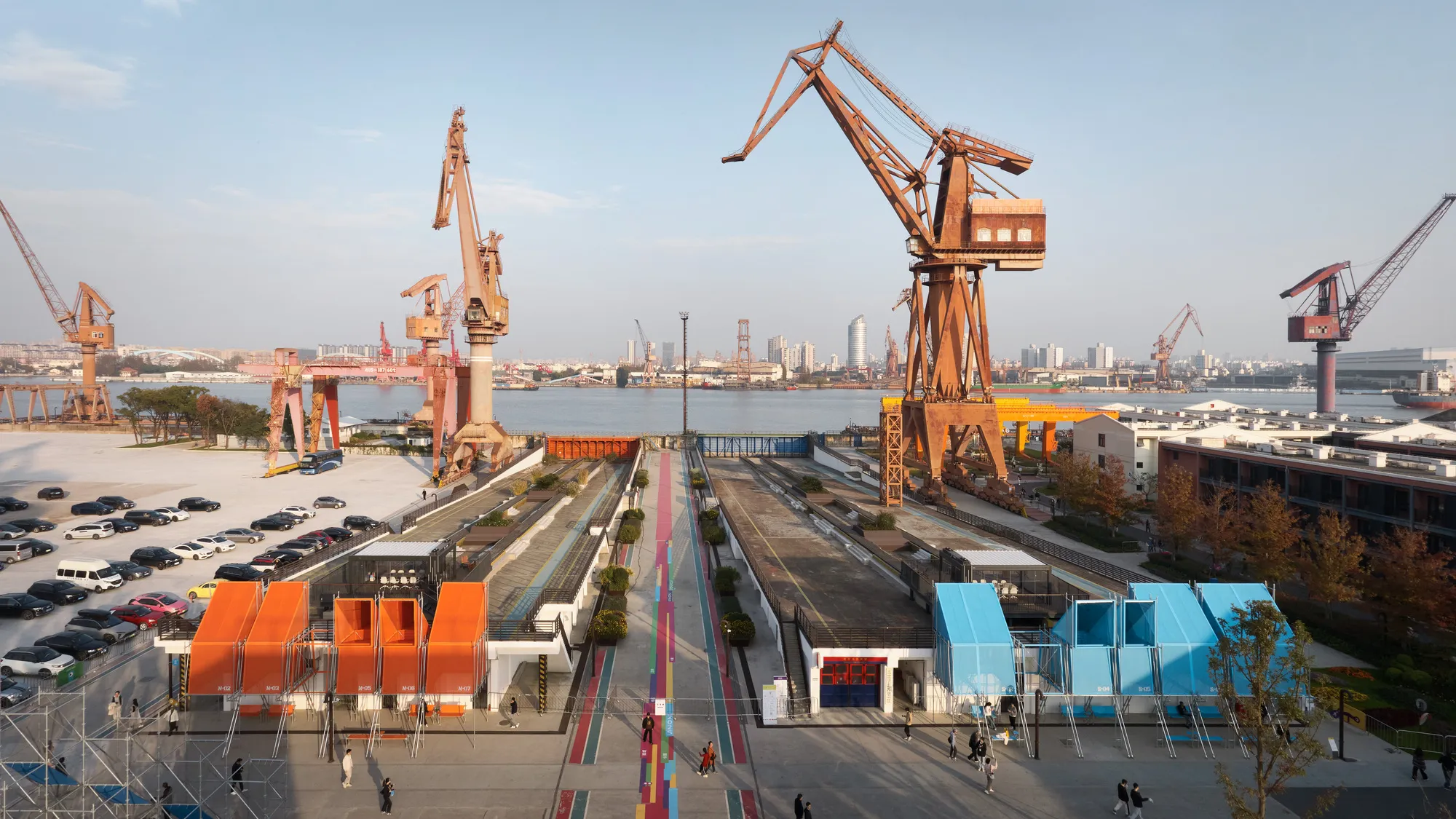
Fuxing Island in Shanghai carries the residual weight of China's shipbuilding history. For SUSAS 2025, the Shanghai Urban Space Art Season, Practice on Earth and ARC Z Architects placed three pavilions directly onto the former shipyard's plaza, threading lightweight scaffold structures between the colossal gantry cranes that still punctuate the waterfront. The installation, titled "The Day of Launching," treats the act of building as spectacle: exposed joints, translucent polycarbonate skins, and a vivid tricolor palette of orange, blue, and white that refuses to blend quietly into its industrial backdrop.
What makes the project genuinely interesting is its refusal to be precious. Led by Haotian Wu, Cloe Yun Wang, and Zi Meng, the team borrowed the visual and structural logic of construction scaffolding, the most temporary and overlooked element of any building site, and promoted it to finished architecture. The result is a 90 square meter cluster that reads simultaneously as furniture, shelter, and urban signal. It is both a commentary on the shipyard's industrial past and a working piece of public infrastructure: people sit, swing, walk through, and look up.
Industrial Ground, Colorful Interruption


From above, the project's strategy is immediately legible. Three distinct volumes, each assigned a primary color, occupy a linear stretch of the shipyard plaza like cargo that never quite made it onto the ship. The surrounding context is relentlessly horizontal: long warehouse roofs, planted rows of trees, and the rail tracks that once served the dockyard. Against that ground, the pavilions register as deliberate anomalies, bright nodes that pull pedestrians along the promenade.
The proximity to the harbor cranes is not incidental. Those cranes are heritage objects now, too large and expensive to remove, and the installation uses them as compositional anchors. The orange canopies echo the cranes' lattice geometry at a human scale, creating a visual dialogue between the infrastructure of production and the infrastructure of leisure.
The Orange Canopy: Sawtooth Shelter


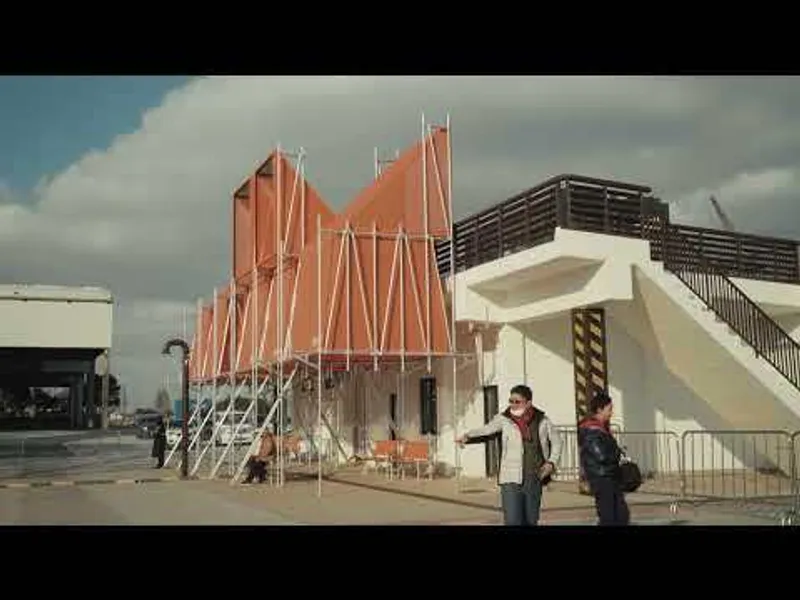
The largest pavilion borrows its profile from the factory sawtooth roof, a form deeply embedded in the site's memory. Translucent orange panels are angled across tubular steel scaffolding to create a canopy that filters light without blocking it. At dusk, the panels glow warmly, turning the structure into a lantern visible across the waterfront. During the day, the quality underneath is gentler: a diffused amber wash that makes the plaza feel like a covered market.
The scaffolding poles remain entirely exposed, complete with their couplers and cross bracing. Nothing is clad or concealed. The honesty of the joints reinforces the installation's core argument: that the process of construction is itself a spatial experience worth celebrating, not something to be hidden behind drywall.
Structural Joints as Ornament
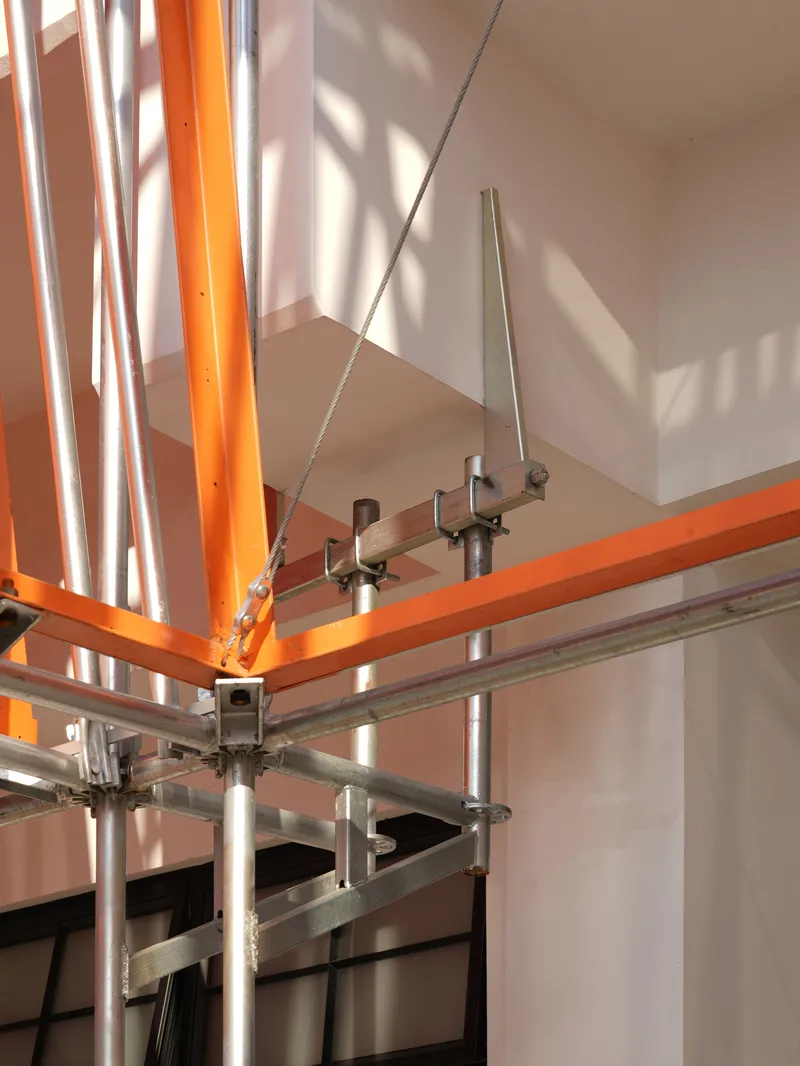
A close look at the connection details reveals a careful choreography of steel tubes, swivel couplers, and tensioned cable bracing. Orange members meet silver ones at angles that appear casual but are dimensionally precise. The triangulated facade panels, with their white diagonal bracing set against orange sheet metal, recall the lateral bracing systems of the shipyard cranes overhead, scaled down and turned into an architectural surface.
By treating every bolt and cable as a visible element, the designers align themselves with a long tradition of high-tech honesty. But the palette and the roughness push it closer to construction-site vernacular than Pompidou polish. It feels provisional and confident at the same time.
The Blue Pavilion: Containers Reimagined


The blue pavilion takes the shipping container, perhaps the most overused trope in contemporary temporary architecture, and strips it back to its frame. Stacked modules with open doors and triangular gable ends create a structure that is part chapel, part warehouse bay. Blue polycarbonate panels fill some openings while others remain void, allowing sightlines through the structure toward the cranes and the river beyond.
The gable profile is an unexpected move. It softens the modular grid and introduces a domestic silhouette into an industrial landscape. Visitors sit on built-in benches within the lower modules, occupying the container volume in a way that makes the unit's scale feel surprisingly intimate, closer to a room than a box.
Inhabiting the Framework


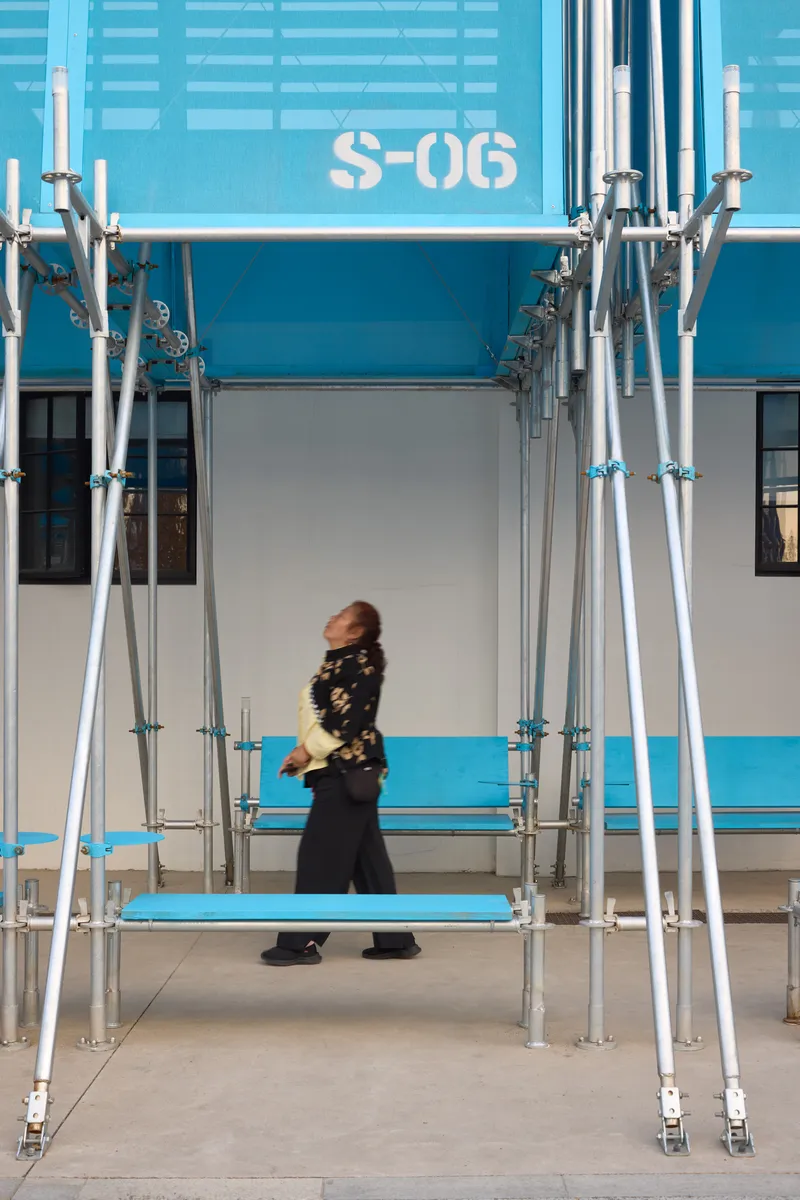
For all its formal ambition, the installation works because people use it. Benches line covered walkways where the scaffold framework doubles as a pergola. The blue canopy overhead casts a cool shadow, a welcome counterpoint to the amber glow of the orange pavilion. Visitors pause, sit, read, talk. The numbered modules ("S-06" is visible on one) suggest a logistical system, as if each bay has been catalogued and shipped to site, reinforcing the industrial narrative.
The furniture is integral to the scaffold system, not an afterthought. Planks span between tubes at seating height, and the rhythm of the structural grid determines the spacing. It is a reminder that the most effective public installations do not just attract attention; they give people a reason to stay.
Play and Spectacle at Dusk

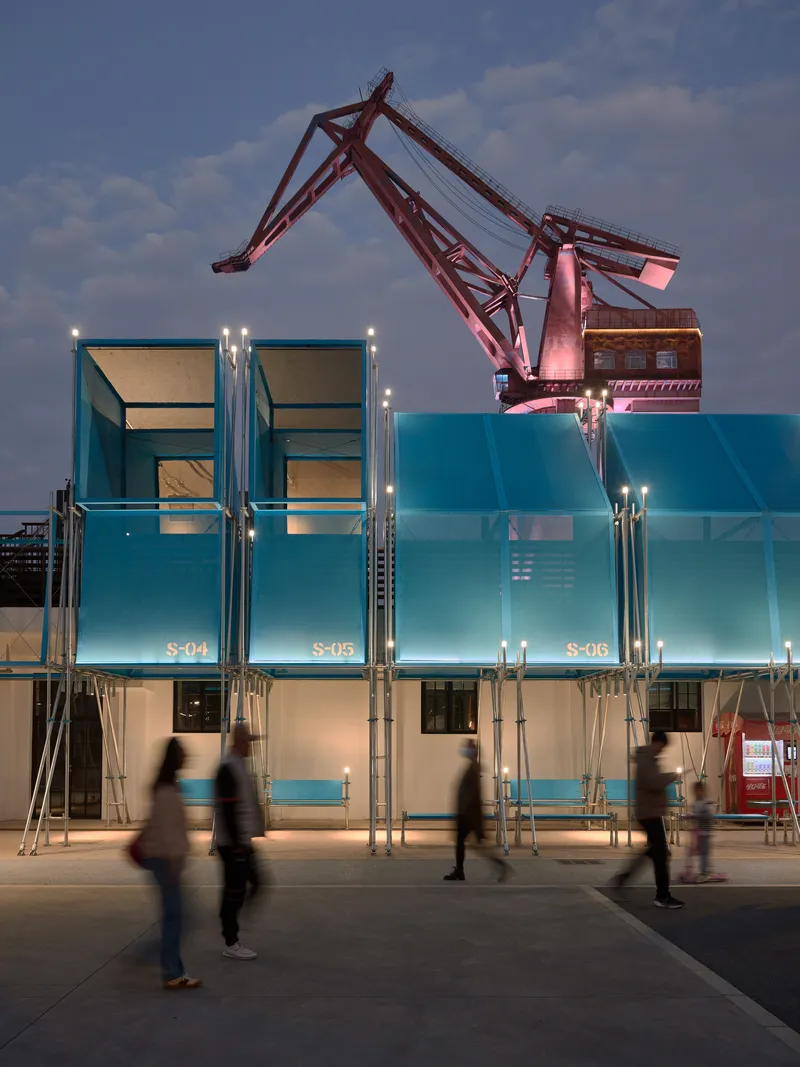
A scaffold swing stands in front of the blue modules, a simple gesture that does enormous work. It turns the installation from something you walk past into something you interact with. At dusk, the crane overhead is illuminated in pink, and the white and blue volumes glow softly against the darkening sky. The scene oscillates between playground and stage set.
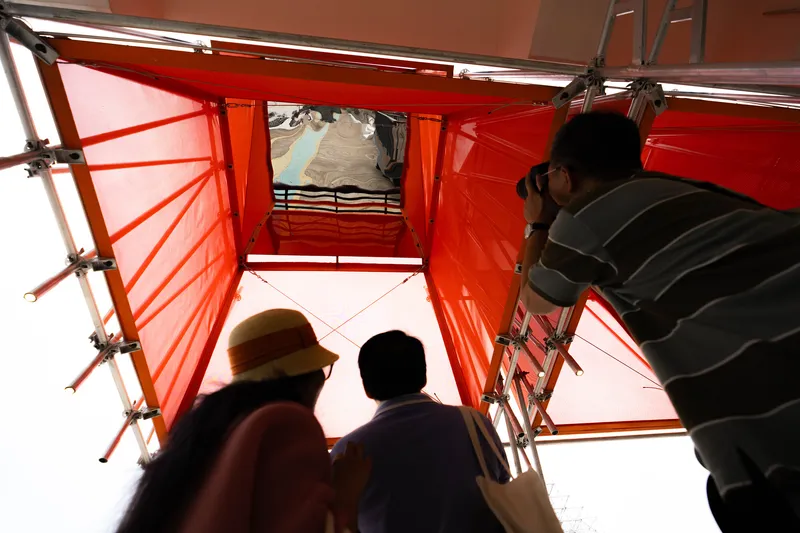
Looking straight up through the red scaffolding tower, visitors encounter translucent panels framing the sky in a kaleidoscope of warm light. It is the installation's most photogenic moment, but it also reveals the spatial logic: the scaffold tubes converge toward a point, pulling the eye upward and creating a vertical counterpoint to the relentlessly flat shipyard.
Framing the Waterfront
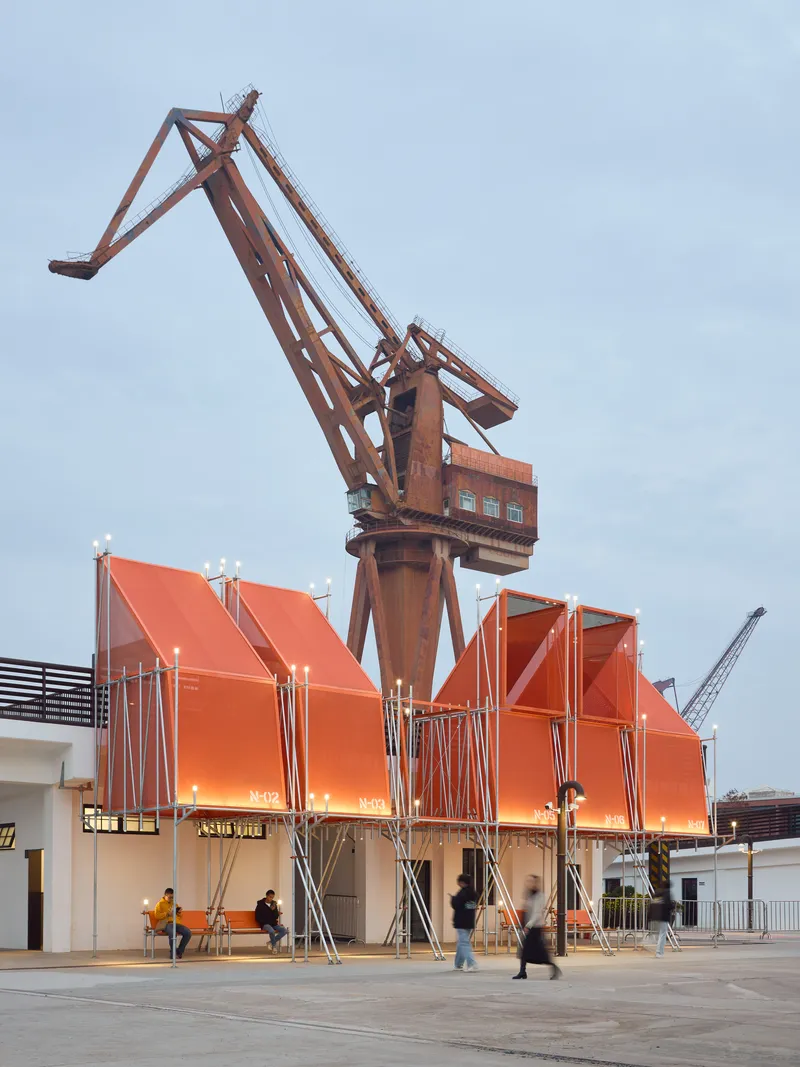


One of the most effective qualities of the project is its porosity. The open frames of both the orange and blue pavilions constantly direct the eye outward, toward the harbor cranes, the river, and the wider industrial landscape. Walking through the installation is less like entering a room and more like picking up a series of viewfinders. Each bay isolates a different slice of the waterfront, reframing the familiar.
From overhead, the blue pavilion modules read as a miniature urban plan, with pathways between them and autumn trees pressing in from the edges. The installation does not try to erase the existing landscape; it intensifies awareness of it.
Plans and Drawings


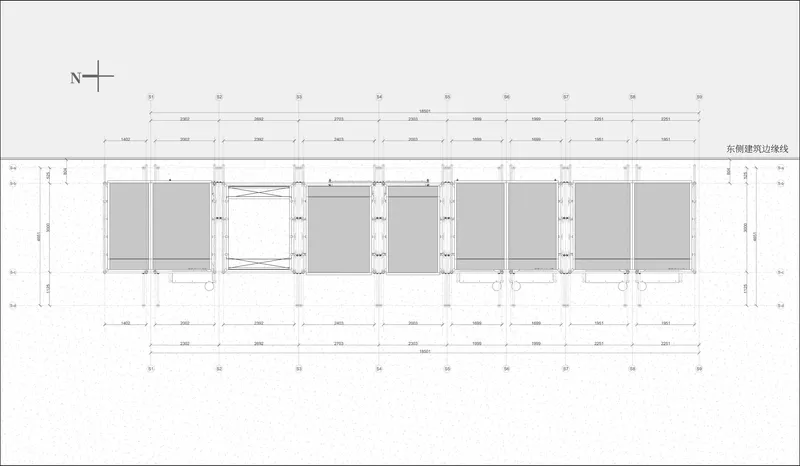
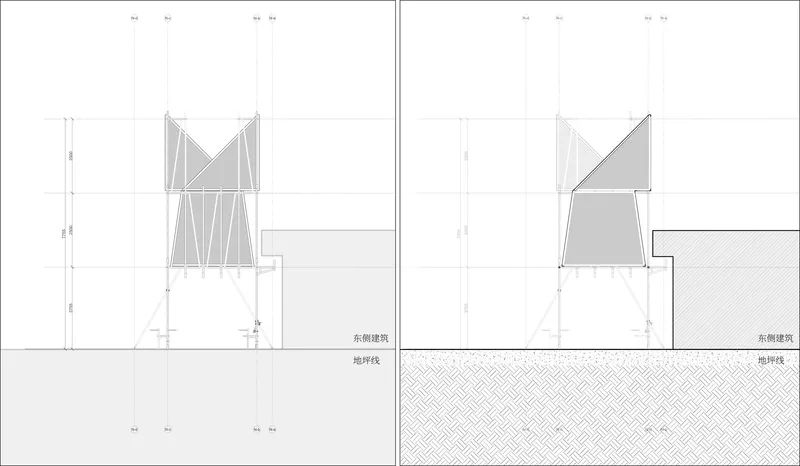

The technical drawings confirm the rigor behind the apparent informality. Elevation studies show the modular frame system with its alternating solid and void panels, diagonal bracing, and integrated bench seating. Plan drawings reveal a clear structural grid, with three-bay and five-bay configurations dimensioned precisely. A section through the orange canopy exposes the angled roof geometry and hints at a subterranean volume below grade, suggesting that the installation engages the ground plane more deeply than its lightweight appearance implies.
The construction details of the braced column assemblies are particularly telling. Cable stays, swivel couplers, and dimensional lumber are specified with the care of a permanent building, despite the project's temporary status. The drawings argue that impermanence is not an excuse for imprecision.
Why This Project Matters
"The Day of Launching" succeeds because it operates at two registers simultaneously. As urban scenography, it transforms a dormant shipyard into an active public destination, using color and form to draw people in and scaffolding logic to let them linger. As critical commentary, it asks why the materials and methods of construction are so rarely considered worthy of being the finished product. The scaffolding pole, the cable brace, the coupler joint: these are the elements that build every city, yet they are almost never allowed to remain visible once the "real" architecture arrives.
Practice on Earth and ARC Z Architects have produced an installation that is temporary in tenure but precise in execution. It treats Fuxing Island's industrial heritage not as a problem to solve or a backdrop to decorate, but as a living vocabulary to extend. In a city undergoing constant reinvention, this 90 square meter project makes a proportionally outsized case for honesty, lightness, and the spatial potential of things we usually throw away.
The Day of Launching by Practice on Earth and ARC Z Architects. Lead architects: Haotian Wu, Cloe Yun Wang, Zi Meng. Location: Fuxing Island, Shanghai, China. Area: 90 m². Year completed: 2025. Photography by Qingyan Zhu and Action Media.
About the Studio
Share Your Own Work on uni.xyz
If projects like this are the kind of work you want to make, uni.xyz is a place to publish your own, find collaborators, and enter design competitions.




Popular Articles
Popular articles from the community


Riyadh For All: Intergenerational Urban Design for Active Aging in Rabat
Riyadh For All reimagines urban design in Rabat with intergenerational co-living, adaptive courtyards, and Moroccan cultural exchange today.

The Earth Pod: 3D Printed Homes for Resilient Refugee Communities
The Earth Pod reimagines refugee housing through 3D printed homes made from clay, combining resilience, self-sufficiency, and rapid shelter.

The Musturak Paradise: Senior Living Architecture for a Connected Future in Temara, Morocco
The Musturak Paradise reimagines senior living architecture in Temara via private homes, social spaces, culture, community, and shared care.
EW PARK: Sustainable Architecture Reimagines the Future of Urban Parking
EW PARK reimagines city parking as a modular wooden tower combining automation, solar energy, electric mobility, and adaptable urban design.


Similar Reads
You might also enjoy these articles

Bao Huynh Watercolor Atelier: A Serene Art Retreat in Hội An
Bao Huynh Watercolor Atelier in Hội An blends multifunctional art spaces, sustainable design, local materials, and family-friendly living in a serene environment.

Atelier Macri Concept Store Interior Design by CASE-REAL
Atelier Macri store features a "ko" counter, walnut wood details, cork displays, blending retail, gallery, and seamless customer experiences.

Manuel Vargas Izquierdo Stadium and High-Performance Sports Center: Architectural Excellence in Jalpa de Méndez
The Manuel Vargas Izquierdo Stadium blends sustainable design, inclusive sports facilities, and cultural-inspired architecture, revitalizing Jalpa de Méndez’s public spaces.
KAKR Buluh Awar Hall: Revitalizing Community and Ecology Through Bamboo Architecture
Community built bamboo hall revitalizes Buluh Awar village, empowering youth, restoring ecology, celebrating vernacular craftsmanship through sustainable architecture and culture.


Explore Installations Competitions
Discover active competitions in this discipline


Challenge to design a portable theatre


Challenge to design a portable music platform


Challenge to design an open learning module for the elderly
Comments (0)
Please login or sign up to add comments
No comments yet. Be the first to comment!