

Prentiss Balance Wickline Architects Wrap a Family Home Around a Boulder in the Cascades
A 2,400-square-foot timber-clad hillside house in Mazama, Washington lets a massive rock dictate its entire floor plan.


Most architects talk about responding to site. Fewer let a client's napkin sketch of a boulder become the generative idea for an entire house. The Hillside Residence in Mazama, Washington, does exactly that: a 2,400-square-foot home for a family of five whose L-shaped plan literally wraps around the largest rock on a steep, forested lot strewn with glacial boulders. Designed by Prentiss Balance Wickline Architects, the house treats its constrained, sloping site not as an obstacle but as the primary author of form.
What makes the project worth studying is its refusal to flatten the problem. The lot is long, narrow, and drops steeply through dense conifers. There was, by the architects' own account, only one viable place to put a building. Rather than blast or grade, the team tucked a garage into the hillside beneath the main living level, stepped the house across three levels, and let two perpendicular wings form a plan that embraces the boulder so closely its face grazes the exterior wall. The result is a home that reads as a series of timber-clad volumes hovering among the trees, anchored to the slope by concrete and steel.
Nestled, Not Imposed
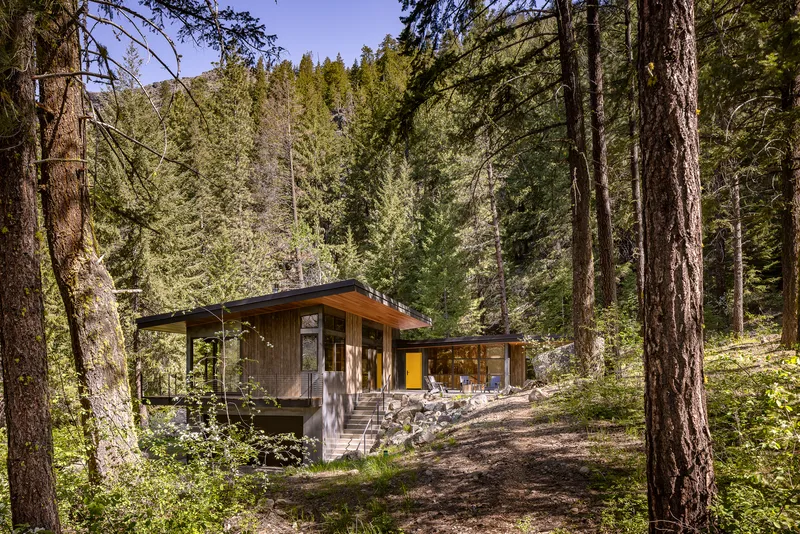
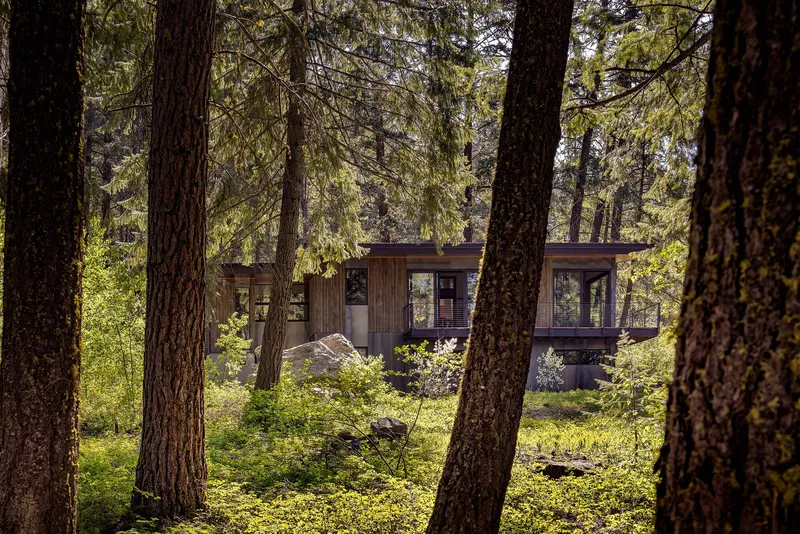
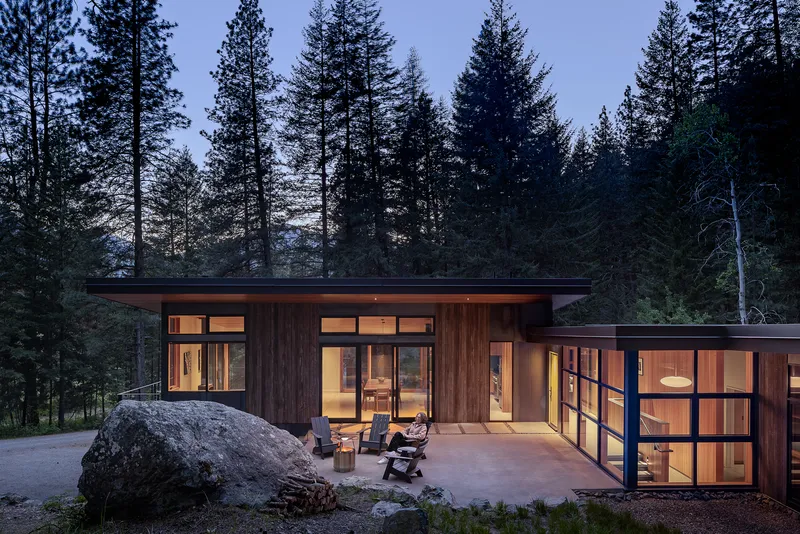
Seen from a distance through the trunks of ponderosa pines, the house barely registers as a foreign object. Its flat roofs stay below the tree canopy, and its wood-clad volumes are scaled to read as a cluster rather than a monolith. That restraint is strategic: a single large mass on this slope would have required significant excavation and would have walled off views from its own interior. By breaking the program into smaller, connected pieces, the architects let forest light and air circulate through the plan.
At dusk, the strategy reveals its second payoff. The glazed walls glow from within, and the separate volumes read as lanterns scattered among the trees. It is a house that earns its presence through proportion rather than gesture.
The Boulder as Co-Designer
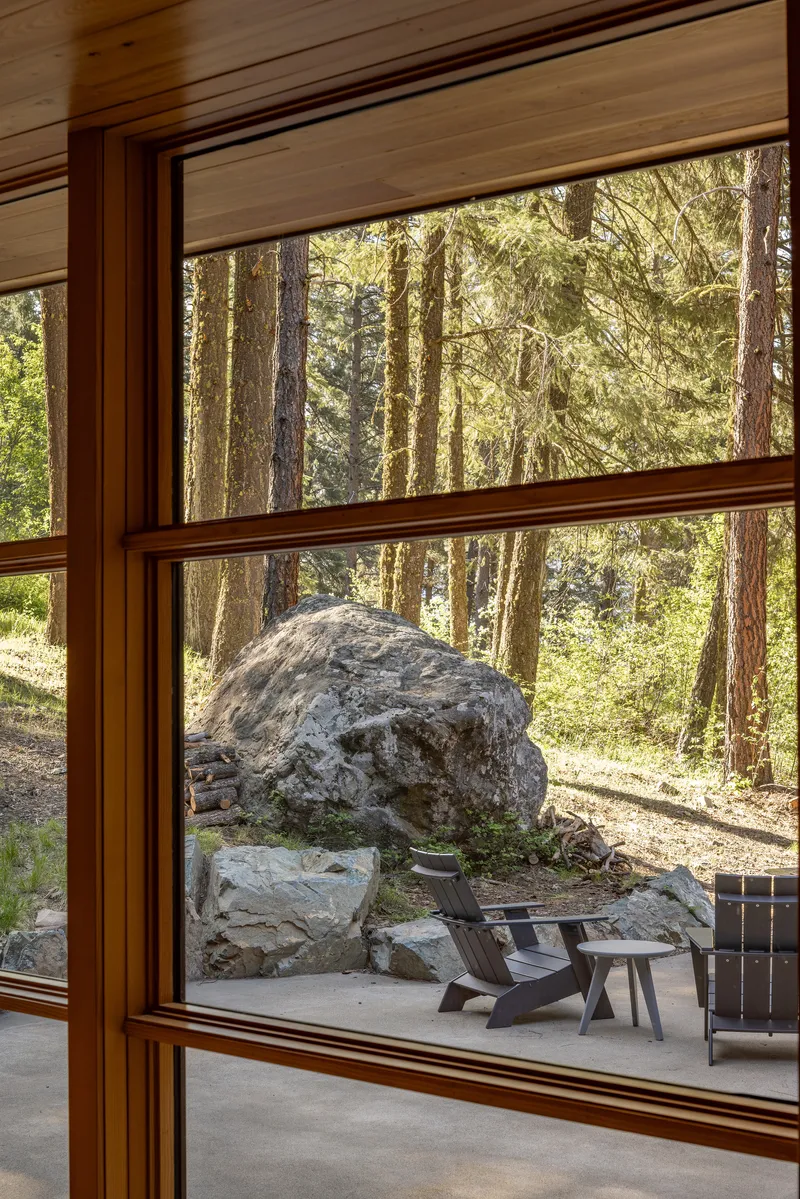
The clients' original sketch showed a U-shaped plan hugging the site's largest boulder. That impulse survived the design process intact. One of the most compelling moments in the house is a timber-framed window that looks directly onto the rock's weathered face, with the concrete patio and conifers stretching beyond. The boulder is not a landscaping accent dropped in after construction; it was there first, and the house acknowledges that hierarchy.
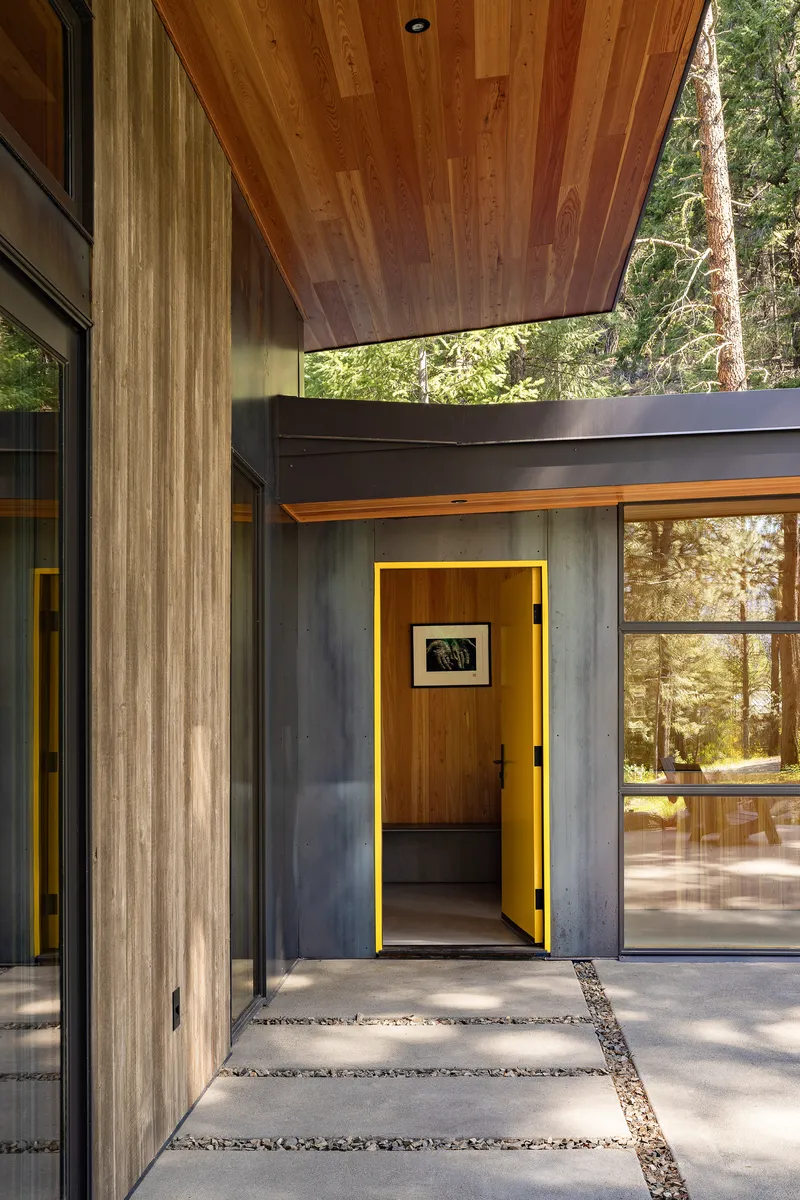
A covered courtyard with concrete pavers and a yellow-painted doorway sits between the two wings, creating an outdoor room that the boulder's mass partially shelters. The interplay between rough stone, weathered timber cladding, and poured concrete gives this threshold a material honesty that more manicured courtyards rarely achieve.
Concrete, Steel, and Douglas Fir
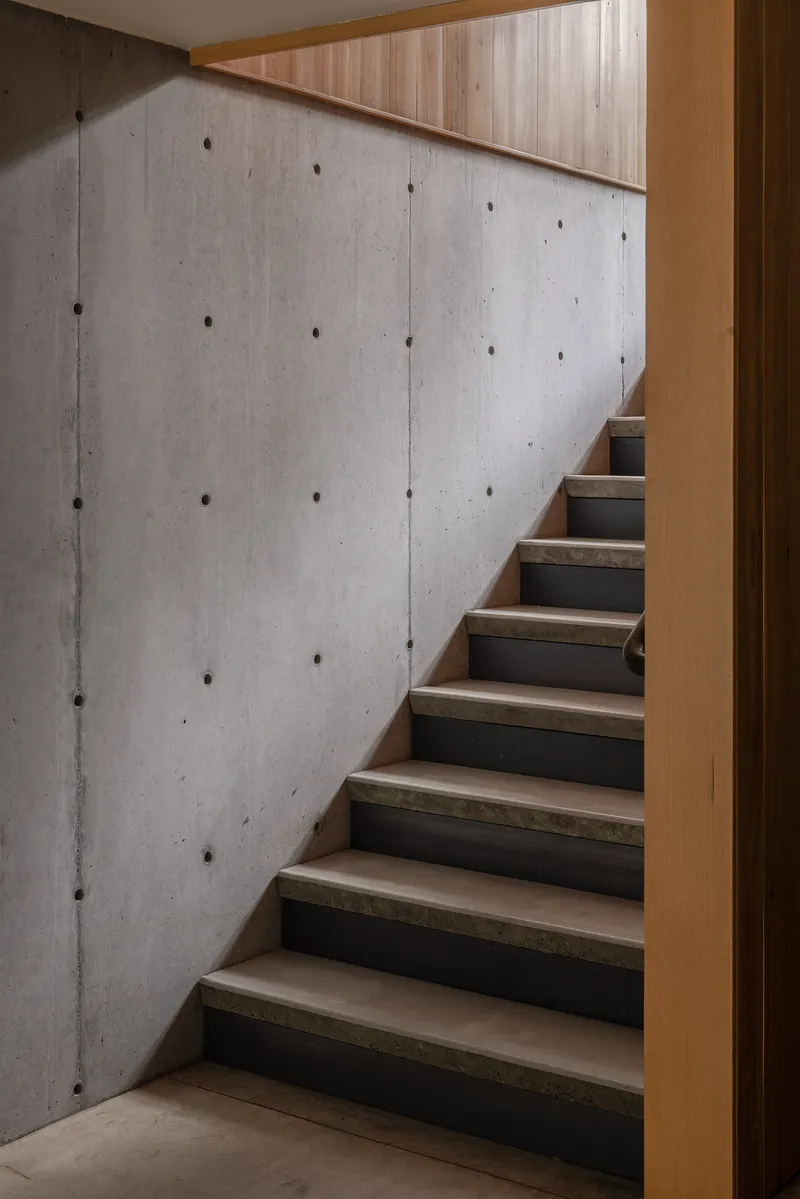
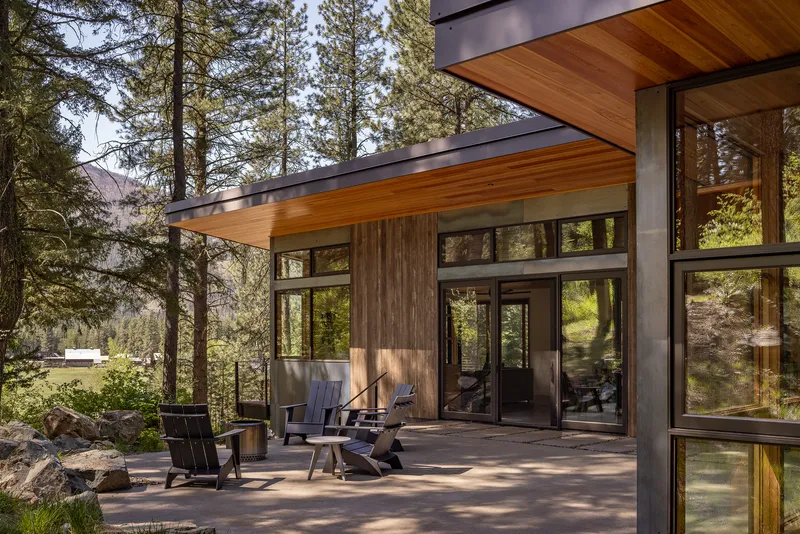
The material palette is tight: board-formed concrete, untreated steel, and Douglas fir. Each does a specific job. Concrete anchors the lower levels to the hillside and provides thermal mass against Mazama's wide temperature swings. Steel appears in structural connections, stair frames, and railings, always left raw so it will patina alongside the surrounding landscape. Douglas fir lines ceilings, clads exterior volumes, and warms interior surfaces without veering into the cabin cliché.
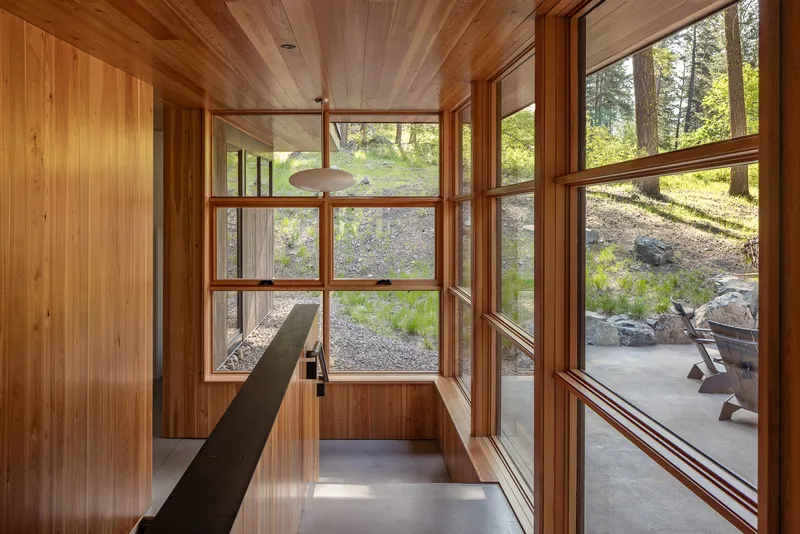
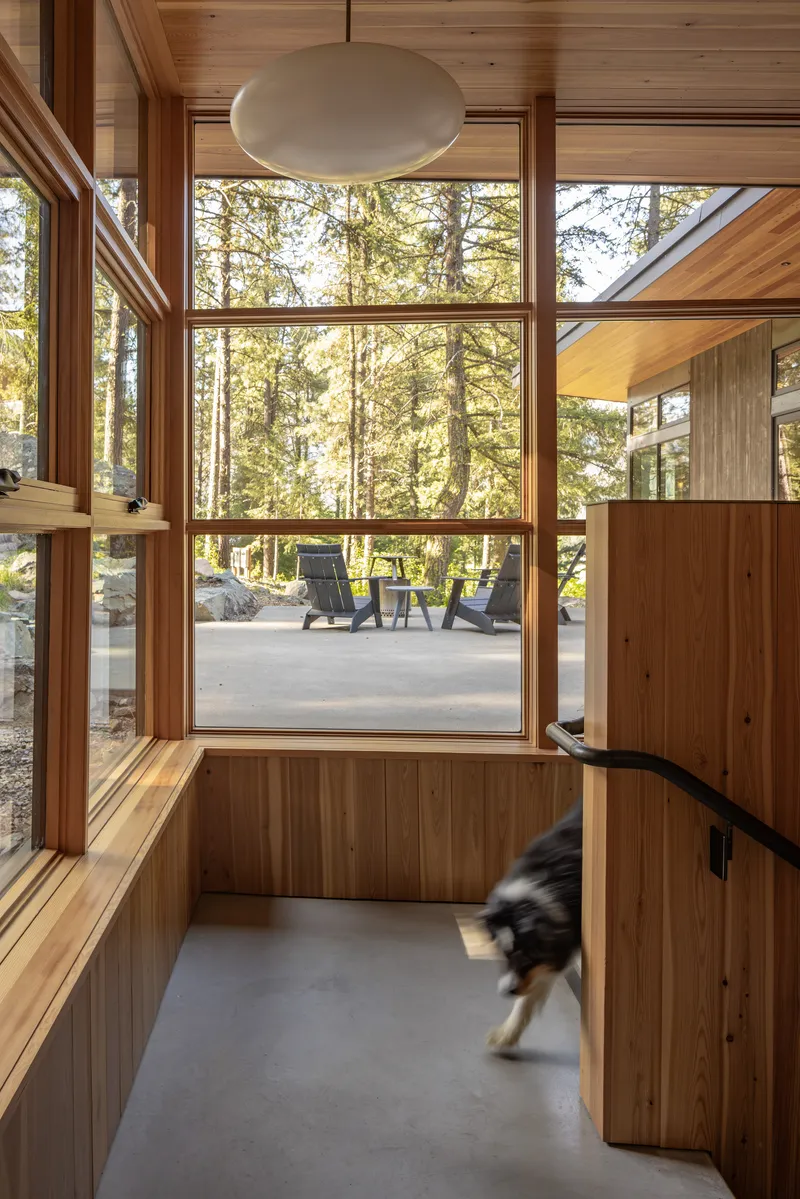
The staircase alongside the board-formed concrete wall is a quiet showpiece. Tie holes left from the formwork are exposed, and the steel stringers bolt directly into the concrete face. Nothing is hidden, and nothing needs to be. A glass-walled hallway extends toward the patio, turning circulation into a continuous experience of the forest rather than a corridor to endure.
Living Under a Timber Canopy
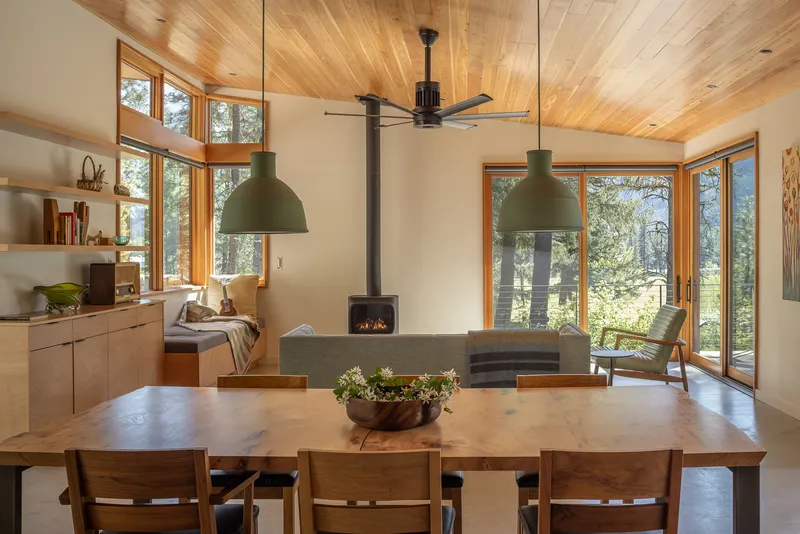
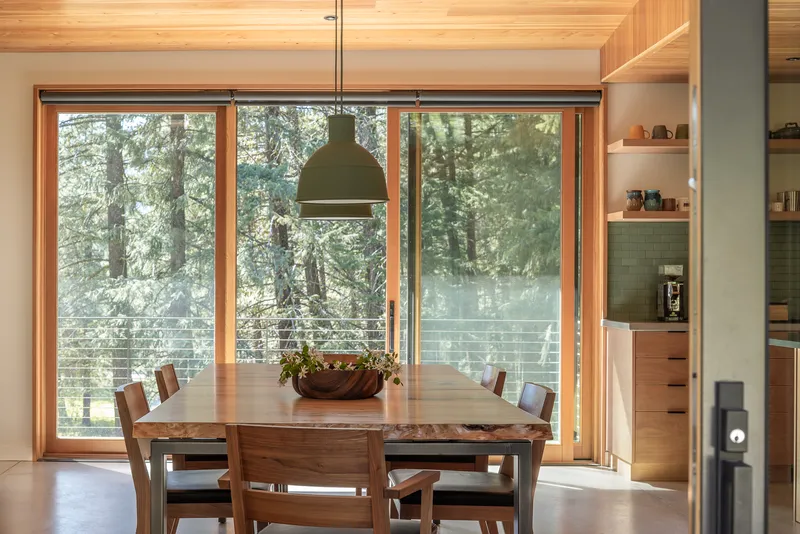
The main living and dining space occupies the upper wing, where a vaulted Douglas fir ceiling with clerestory windows pulls daylight down into the room without sacrificing the sense of shelter. A wood-burning stove anchors the seating area, and the ceiling's warm tone makes the space feel compressed and protective even as floor-to-ceiling glazing opens it to the forest on two sides.
In winter, with bare branches filtering gray light, the dining area reads as an extension of the landscape. Large glazed doors could swing open in summer to merge indoor and outdoor dining. The sloping roofs extend outward to cover decking that wraps the home, creating a sheltered transition zone between conditioned space and wilderness. It is a simple move, but it triples the amount of usable living area during dry months.
A Kitchen That Earns Its Color
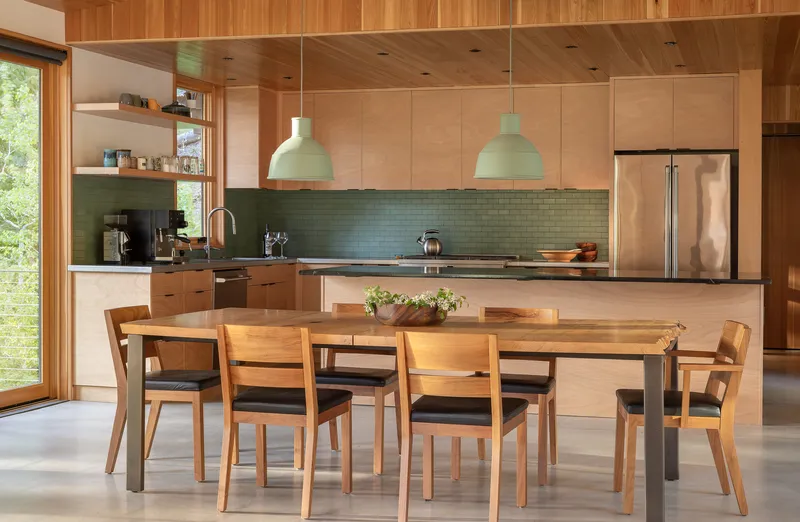
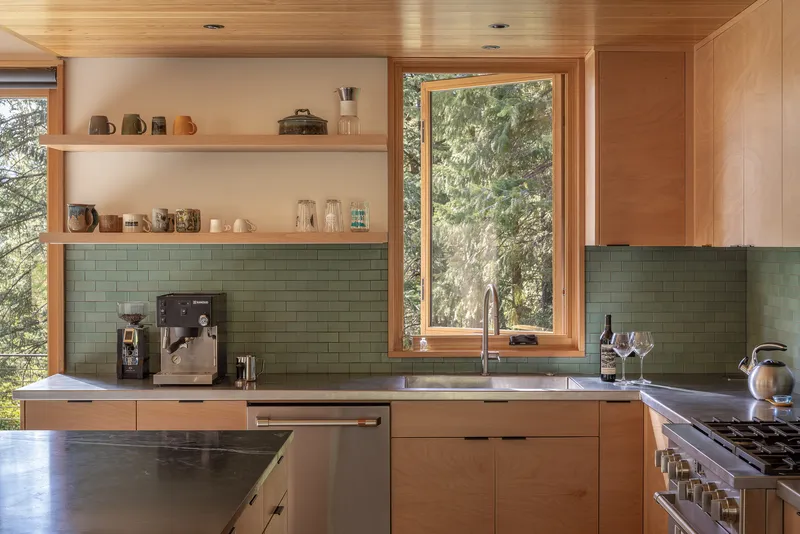
The kitchen introduces the only deliberate color in the house: sage green subway tile on the backsplash. Against light wood cabinetry and pale pendant fixtures, the green reads as an echo of the conifers visible through every window rather than a decorative indulgence. A casement window above the counter frames a single pine trunk, collapsing the distance between cooking and forest.
The restraint matters. White walls throughout the interior let the timber ceilings and the landscape do the visual work. The green tile is the one moment where the architects say something explicit about color, and because it is isolated, it carries real weight.
Sleeping, Bathing, and Looking Out
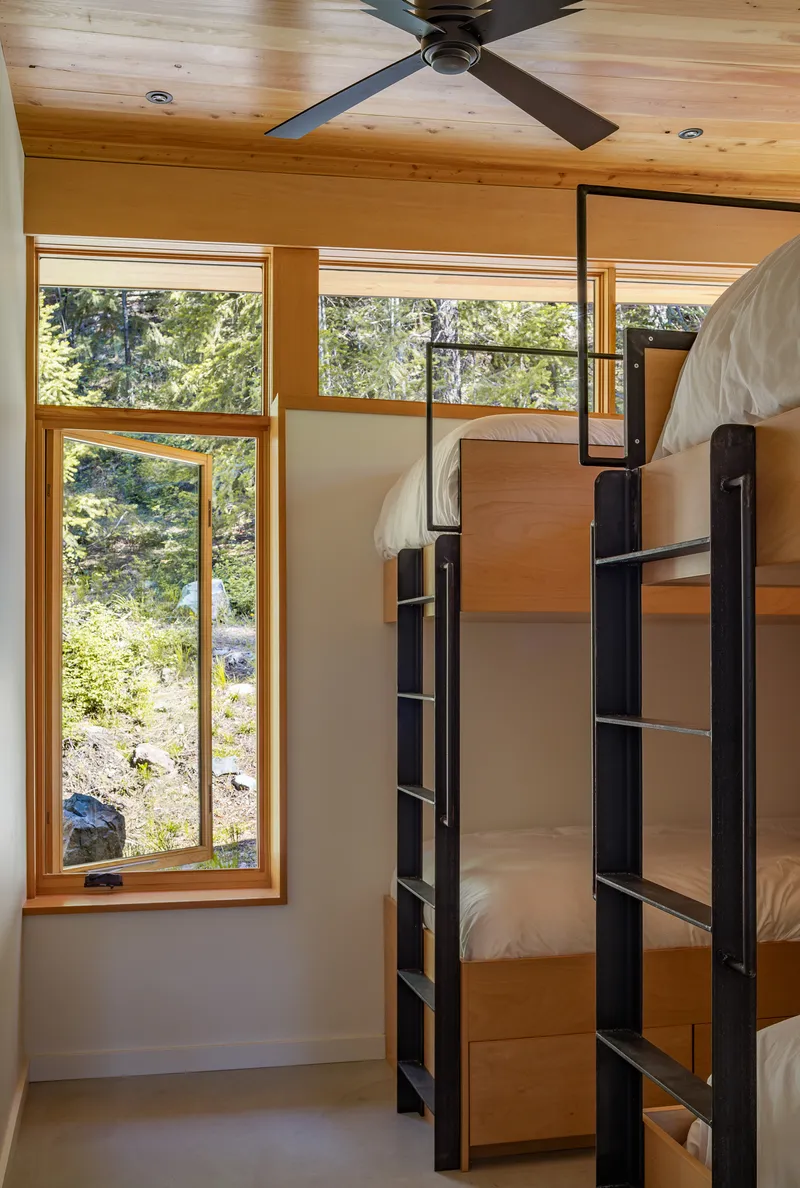
For a family of five in 2,400 square feet, efficient sleeping arrangements are not optional. The bunk room solves the problem with steel ladder frames and timber-clad walls, giving three kids their own berths without consuming a disproportionate share of the floor plan. It is compact, well-ventilated, and, frankly, the kind of room that makes children want to stay at the house forever.
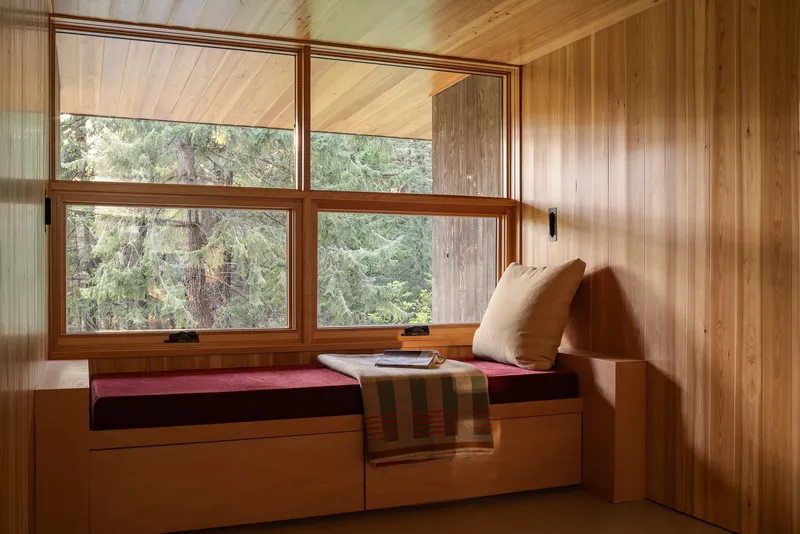
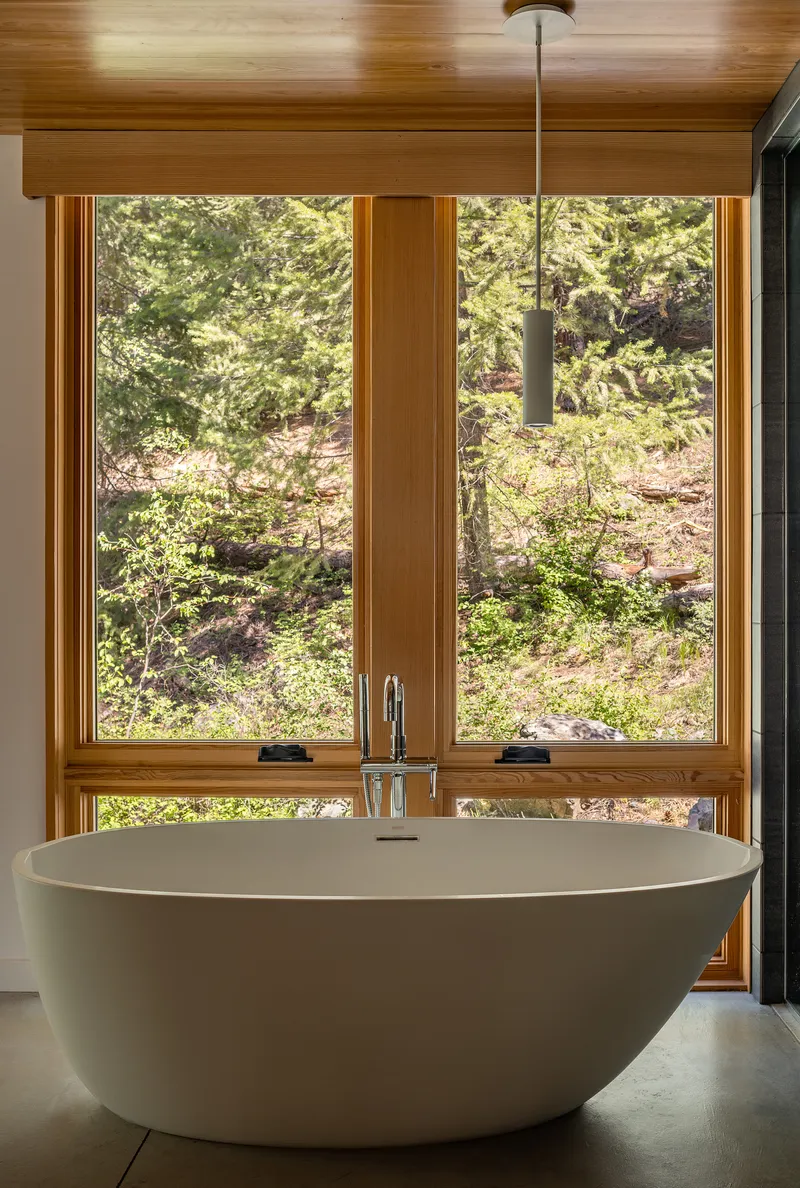
Elsewhere, a built-in window seat with storage drawers beneath transom windows creates a reading nook that doubles as guest seating. The freestanding bathtub beneath a corner window overlooking the wooded hillside is the house's most luxurious moment, but it earns that luxury through framing rather than finish. The view is the amenity; the tub is just the vehicle.
Plans and Drawings
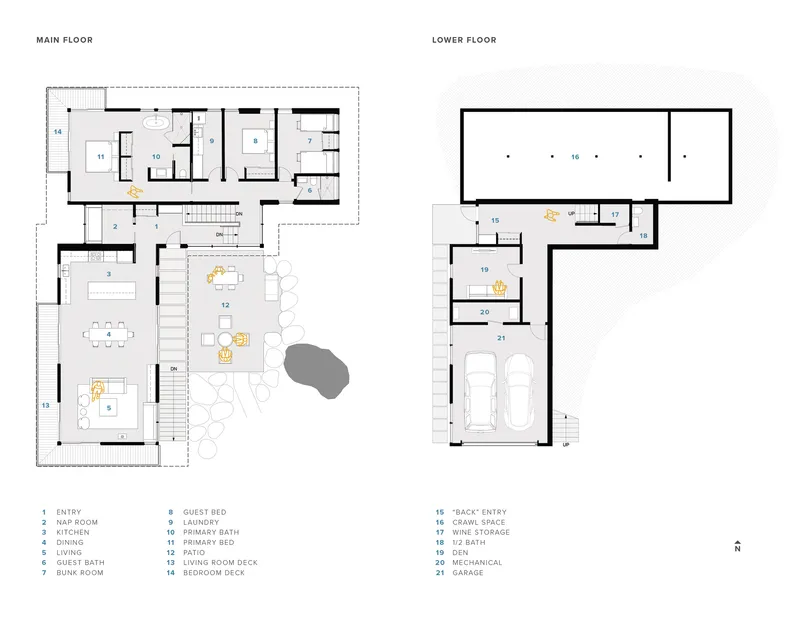
The floor plan confirms what the photographs suggest: two perpendicular wings form an L that cradles the boulder at their junction. The lower level tucks the garage into the hillside, solving a steep-site access problem that would otherwise require a long, expensive driveway cut. Living spaces occupy the upper wing, bedrooms the lower, and the covered courtyard sits at the hinge. The plan is long and narrow by necessity, but that constraint produces a house in which every room has at least two exposures and no point is far from the outdoors.
Why This Project Matters
The Hillside Residence is a useful corrective to two tendencies in contemporary mountain-house design. The first is the impulse to clear a pad, pour a slab, and pretend the site is flat. The second is the opposite extreme: a performative deference to nature that results in a building so timid it barely functions. This house does neither. It takes a strong position on the slope, organizes itself around an immovable rock, and uses concrete, steel, and timber with enough confidence to hold its own against the landscape without trying to dominate it.
Credit belongs to all three firms for keeping the material palette honest and the plan legible. At 2,400 square feet for five people, the house is also genuinely compact by the standards of its genre. That discipline, as much as the boulder or the trees, is what makes it worth returning to. The Hillside Residence proves that constraint, whether imposed by a slope, a budget, or a rock, is still the best collaborator an architect can have.
Hillside Residence by Prentiss Balance Wickline Architects. Mazama, United States. 2,400 sq ft. Completed 2025. Photography by Andrew Pogue.
About the Studio
Prentiss Balance Wickline Architects
Share Your Own Work on uni.xyz
If projects like this are the kind of work you want to make, uni.xyz is a place to publish your own, find collaborators, and enter design competitions.


Popular Articles
Popular articles from the community


Opera on the Sea: Driftwood Logic Shapes a Timber Opera House on Estonia's Coast
Trevor Orgill's opera house translates the entangled drift of floating timber into a civic building where wood, water, and music converge.


ETEH Reworks the Shared Spaces of São Domingos School in Brazil Around Timber, Color and Hanging Plants
At São Domingos School in Brazil, 436 m² of hall, refectory and library are recast with timber joinery, a yellow and blue code and trailing greenery.
Manzana Morphosis: Stretching Barcelona's Grid into a Living Landscape for 2050
A radical reworking of the Eixample manzana turns density into a tool for generous public space, vertical ecology, and environmental performance.

graciastudio Turns a Viewless Tijuana Lot Inward Around a Courtyard of Concrete, Timber and Trees
In Tijuana, Jorge Gracia's GA2 House stacks a timber-clad private floor over exposed concrete and replaces a missing view with a planted interior patio.

Similar Reads
You might also enjoy these articles

LAVA Architecten Gives Vocational Education a Sawtooth-Roofed Face on a Mechelen School Campus
In Mechelen, Belgium, a 2,053 m² STEM school on a 6×6 m grid turns workshops and classrooms into rooms that can be rearranged as teaching changes.

KEMA Studio Turns a Derelict Marvila Attic into a 60 m² Lighthouse Apartment Above Lisbon
In Lisbon's Marvila district, a rebuilt roof, four skylights and two plywood volumes turn an unlivable attic into a bright home facing the Tagus.

Pixel Gardens: One Repeated Module Stacked Into a Terraced Social Housing Tower for Famagusta
Salem Bader's shortlisted housing tower builds a vertical neighbourhood from one repeated module, offsetting units to carve terraces, light and air.

Bao Huynh Watercolor Atelier: A Serene Art Retreat in Hội An
Bao Huynh Watercolor Atelier in Hội An blends multifunctional art spaces, sustainable design, local materials, and family-friendly living in a serene environment.


Comments (0)
Please login or sign up to add comments
No comments yet. Be the first to comment!