

Preserving bees: Designers propose bee-centers to protect the dwindling bee population in Asheville, USA.
Result for 'To Bee' - Sustainable Design challenge, out now.


It is a lesser-known fact that one-third of the world’s food production is dependent on bees. Bees are flying insects that are the most prominent pollinators in the wild. They are generally associated with the ability to produce honey, but this is done only by honey bees, which are just one of the 16,000 known species of bees.
The social species of bees live in hives that produce beeswax, royal jelly, pollen, and so on, for pollinating crops. Beekeeping for honey has been practiced since ancient times. Bee pollination is essential for not just ecology but the economic development of nations, and this has made apiaries or bee yards more popular.
But the population of bees has been declining in the last few years. The pace of disappearance is consistent with mass extinction and at this rate, many species may vanish within a few decades. This loss will pose a huge problem for humans, as it is estimated that if the bees go extinct, the human species can survive only four more years.
Can the realization of the impact of the loss of bees on humankind, change our approach to life?
The number of beehives has dropped by more than half of their original quantity. Natural causes such as parasites and invasive species aside, the major cause for their decline is human activities. Global warming, harmful pesticide use, and urbanization have affected the population of bees living in every part of the world.
Packs of bees, both domesticated and wild, are disappearing at an alarming rate. The issues of climate change and biodiversity loss are interconnected. The clustering of humans in dense cities has left no space for greenery to grow and thrive. Due to this loss of habitat, some bee colonies try to reside in human colonies but are seen as disruptions due to their swarming nature.
The commercial value of bees has pushed people to practice beekeeping, maintaining bee colonies in artificial hives. This production has ensured the survival of some species. But exploitation and improper construction of these hives can cause negative effects on the bee population in apiaries.
How can we preserve and nurture the remaining bee population through collective effort?
Apiaries are well-established businesses but their output must be monitored to ensure the well-being of the resident bee colonies.
Aside from financial gain, the role of apiaries in growing bee numbers in nature must be advocated.
Brief: Challenge was to design a bee center that will focus on rehabilitating the dwindling population of bees.
In this facility, the bees will inhabit natural habitats recreated by humans, in semi-open enclosures. These habitats will be maintained with artificial technology, if and when needed. The bees will have the freedom to build their own hives and produce at their own pace. The visitors will be able to interact with bees under supervision.
The aim of the center will be to preserve, preach and spread awareness among the local population, regarding the loss of bees in wildlife. Sustainable strategies must be adopted to create a healthy environment for both the bees and the visitors. The center will be symbolic of the shift in preservation techniques where bees are enabled to grow and live naturally, with the least human intervention.
Some of the Best competition projects are as follows:
Winning Project: Nature Flow

Fig: 1 Floor Plan
Description: The current project for the Beekeeping Center aims to design a research and production complex where problems with bee populations are solved. The main task is to promote the importance of bees and at the same time specialists to search for and find the reasons for the disappearance of bees and the possibilities for their timely rescue.
-----------------------
People’s Choice: Eco-friendly Bee-siness
By: Sofia Bukareva

Fig: 2 Functional Zone
Description: Concept of the multi-level bee center with the apiary on the rooftop.
-----------------------
Editor’s Choice: To BEE
By: Mihail Tilev

Fig: 3 Section plan and View
Description: A project that aims to leave an imprint on people about bee problems.

Follow us on social media: Facebook | Instagram | LinkedIn | Twitter | Youtube
References (3)


Popular Articles
Popular articles from the community


GROUP A Strips a 1969 Rotterdam Harbor Headquarters to Its Frame and Wraps It in Timber Louvers
In Rotterdam's M4H harbor district, Ferro Offices reuses a 1969 frame, adds one timber storey and reaches BREEAM-NL Outstanding.

longwave studio Reorganizes a 112 m² Tainan Apartment Around the Daily Routines of a Family and Two Cats
In Tainan, Taiwan, birch plywood, rust-red furniture and a freestanding plaster wall link arrival, storage, work and family life in one apartment.

LT2A and OPEN Architectes Thread a Brick and Glass High School Through a Wooded Belgian Campus
In Braine-l'Alleud, a 3,000 m² wing for Collège Cardinal Mercier pairs pale brick with a glazed colonnade, deferring to a small chapel and a dense wood.

David Ortega Stacks a Two-Story Mexico City Penthouse Around a Steel Stair and a Pergola-Shaded Roof Terrace
In Colonia Roma, a 300 m² penthouse uses oak joinery, a planted steel stair and a slatted roof pergola to make a new-build apartment feel like a house.

Similar Reads
You might also enjoy these articles


Aquadapt: An Underwater Habitat That Rewrites Its Rooms by the Hour
Curved modules ring the seabed while one shell shifts from breakfast room to cinema, farm and football pitch as residents' needs change.

Play: Fragments of Their World: Remembered Architecture Rebuilt as a Modular Playground for Refugee Camps
Tom Gardner abstracts domes, arches and towers from the homelands of displaced families into a kit of child-scaled play parts for camp settlements.
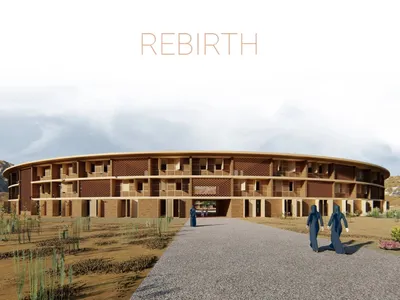
REBIRTH: A Circular Settlement Where Afghan Widows and Their Children Rebuild Life Together
A shortlisted Resile entry turns the circle into a protective ring of timber and brick, gathering homes, classrooms and gardens around a shared landscape.
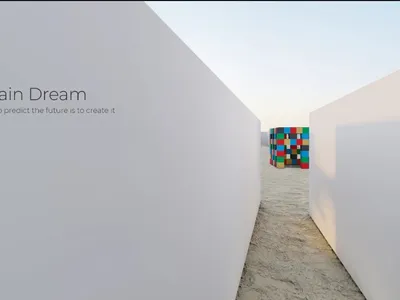
The Main Dream: A Recycled Plastic Kit That Lets Refugee Children Build Their Own Playground
Thirty-centimetre interlocking cubes that connect on three axes turn play into construction, letting children author the spaces they occupy.


Comments (0)
Please login or sign up to add comments
No comments yet. Be the first to comment!