
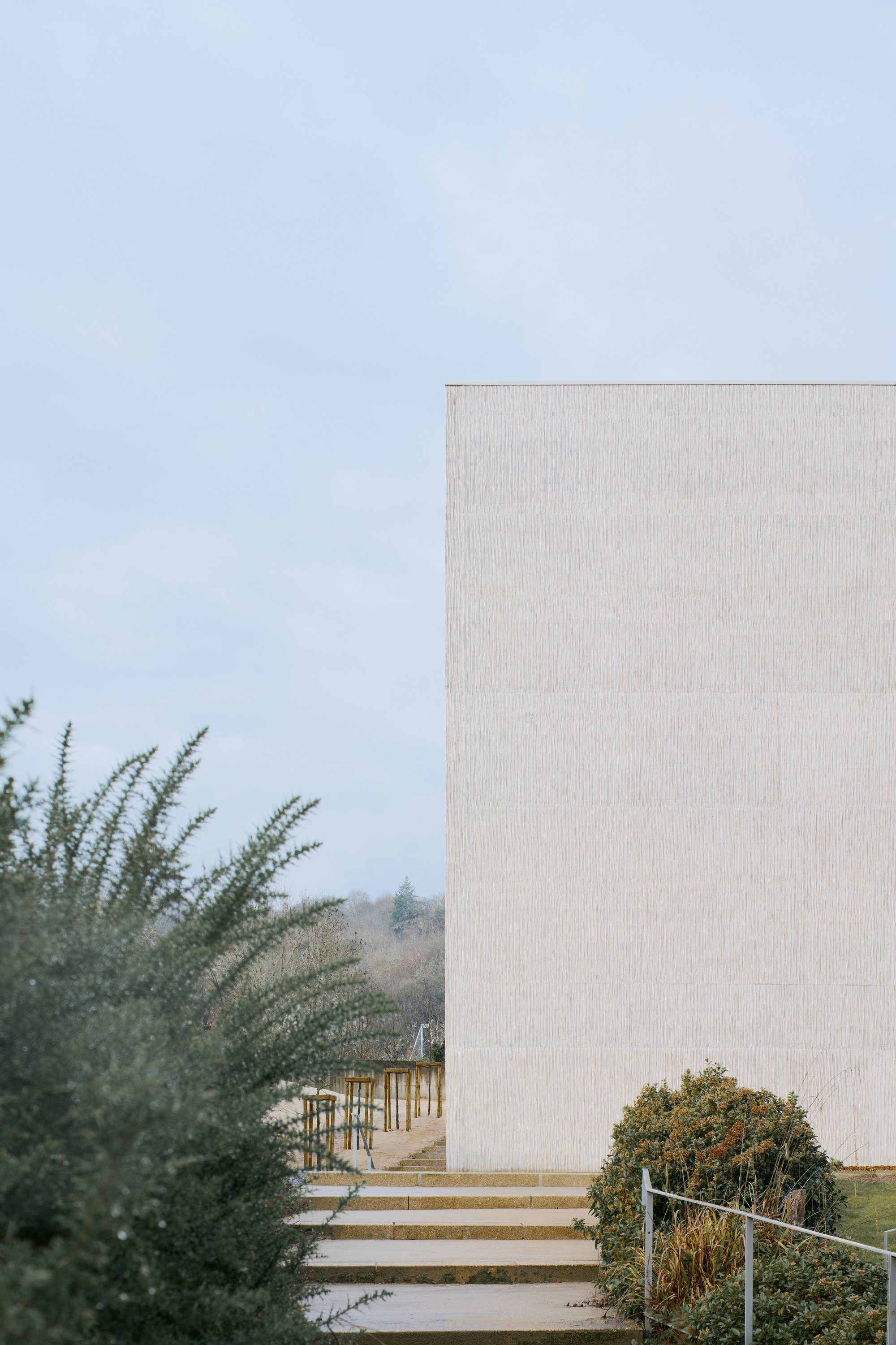
Projectiles Grows a Fossil-Like Museum Extension from the Tapestry Gardens of Aubusson
A fluted concrete monolith emerges from landscaped terraces in central France, housing 530 square meters of exhibition space across four rooms.

Aubusson has been synonymous with tapestry weaving since the fourteenth century, when its royal manufactory turned the valley town in the upper Creuse into a center of textile craft. The town sits on a granite base carved by the Creuse and Beauze rivers, flanked by two wooded hillsides and dotted with historic monuments, the Clock Tower at its center a remnant of the protective wall that once encircled the settlement. Projectiles has completed a 1,800 square meter extension to the existing tapestry museum on the site of the former National School of Decorative Art, and the result is a building that treats architecture itself as a kind of weaving: a monolithic concrete volume whose fluted surface carries vegetal imprints drawn from the motifs of Aubusson tapestries, as if the building were a fossil slowly revealed by the landscape around it.
What makes the project genuinely interesting is the refusal to treat the extension as a neutral container. Projectiles conceived the scheme primarily as a lush, landscaped garden from which architecture emerges, reversing the typical hierarchy between building and site. The historical link between carpets and gardens, a connection embedded in the etymology and iconography of tapestry making, becomes the organizing idea. The extension sits at the highest point of the site, offering views toward the Clock Tower and the valley panorama to the north. Visitors loop through four exhibition rooms distributed across two levels, connected by intertwined stair flights that produce theatrical sightlines both upward and downward, before returning to the main museum reception via a covered gallery along the existing building.
A Monolith in the Garden
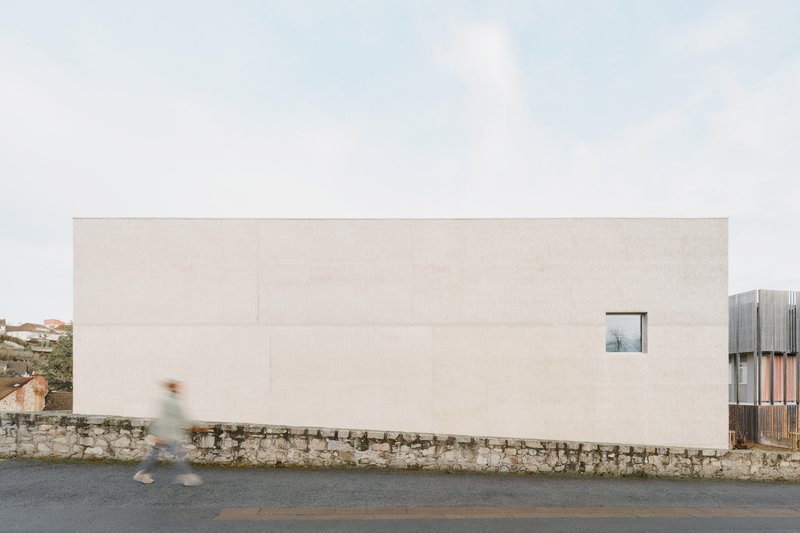
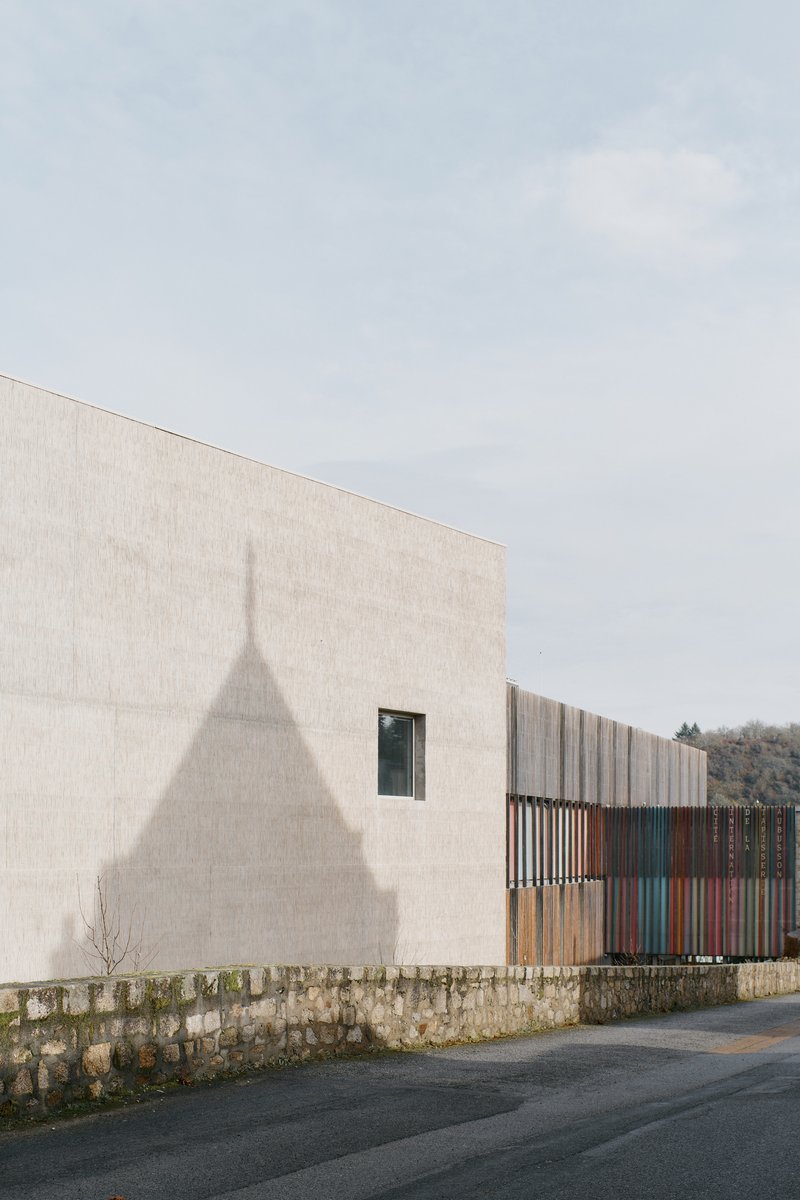
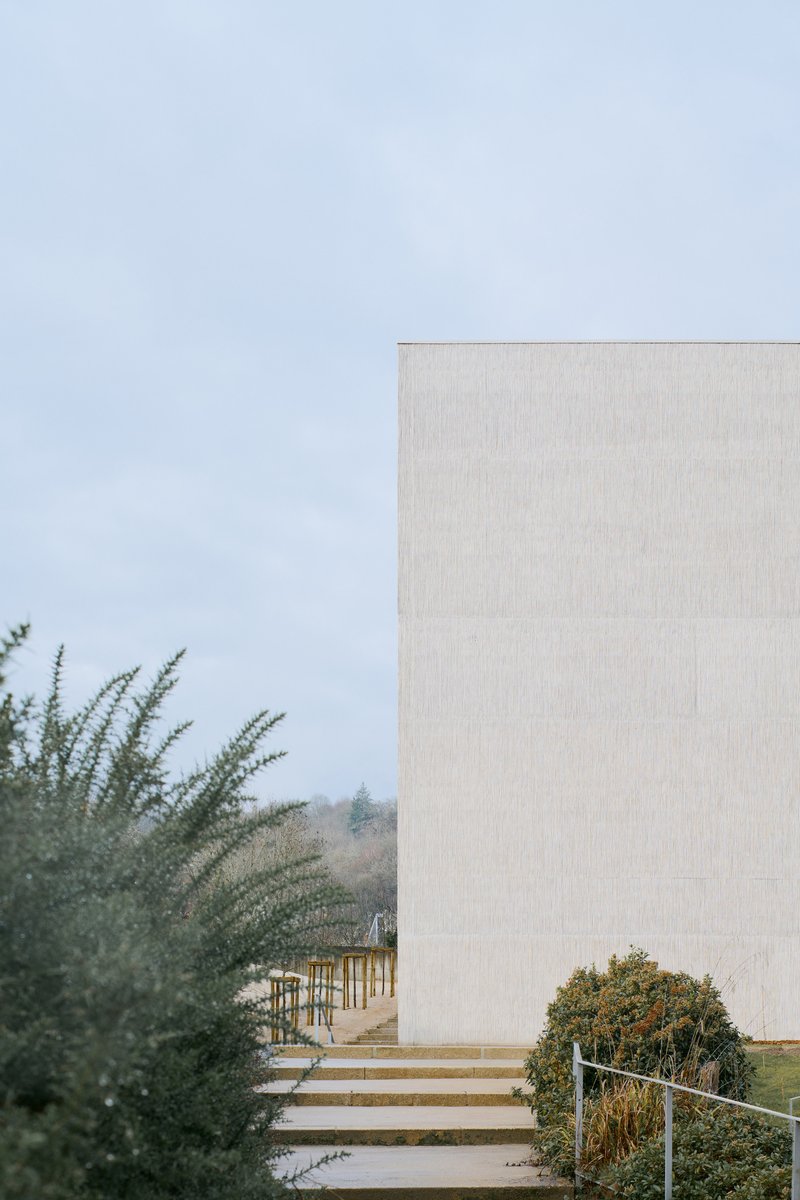
The extension reads as a single mass rising from wide exterior steps and planted shrubs, its pale concrete surfaces catching light and shadow in ways that shift throughout the day. A shadow of the Clock Tower cast across the facade in one view underscores the dialogue between old and new Aubusson. The building's position at the crest of the site gives it a quiet authority without competing with the town's historic silhouette.
This is a building that earns its presence through restraint. The palette is limited to concrete and stone, with a low retaining wall anchoring the volume to the terrain. A single recessed window punctuates the facade, suggesting the interior program without revealing it. Projectiles understood that in a town defined by centuries of craft, the most powerful architectural gesture is often the simplest one.
Fluted Concrete and Vegetal Traces
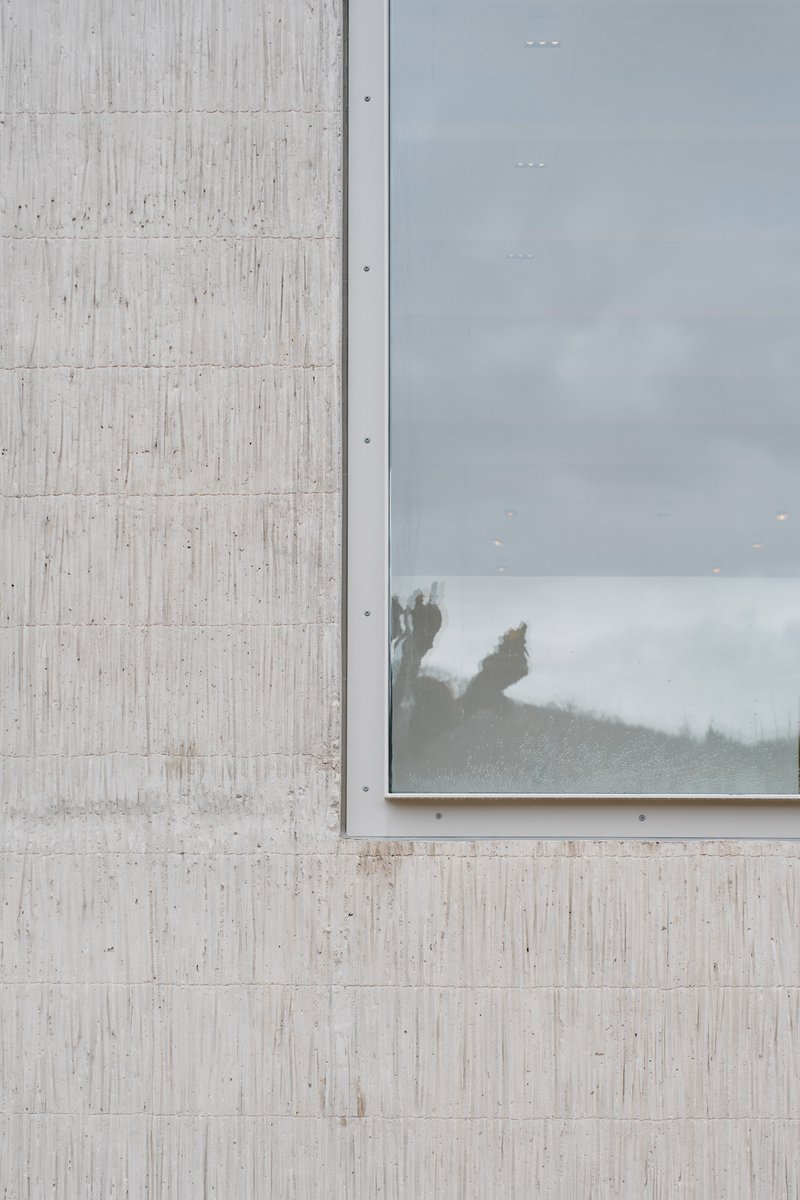
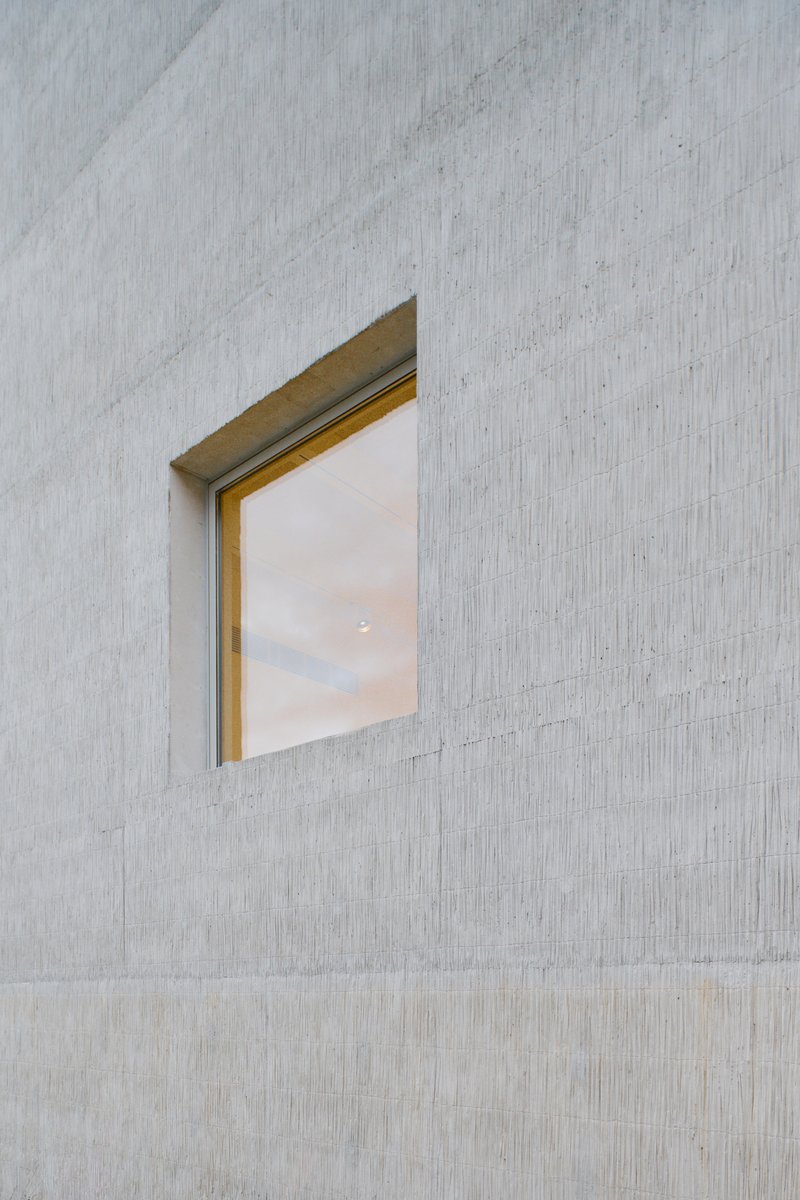
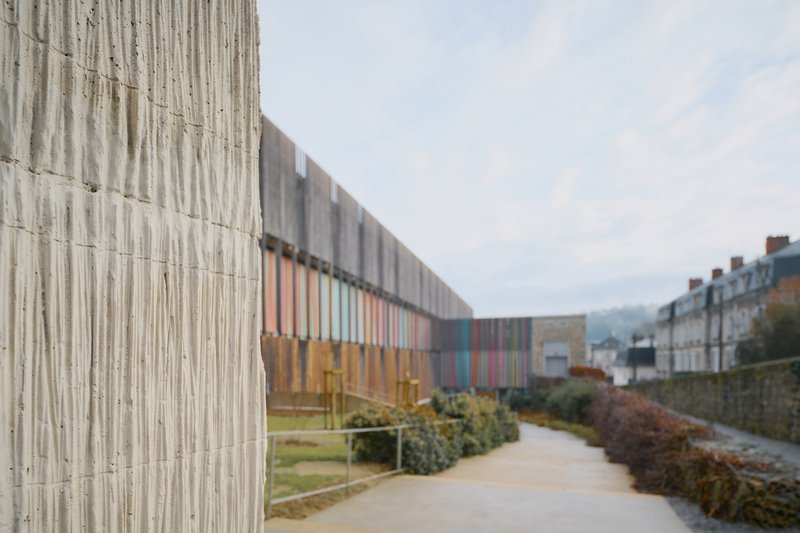
Up close, the concrete reveals itself. Board-formed textures run vertically across the facade, their fluted ribs varying in thickness to produce cast shadows that change with the angle of the sun. Brass-framed windows sit within deep reveals, their proportions recalling the careful framing of a tapestry panel. The formwork impressions are deliberate: Projectiles describes the surface as bearing vegetal prints extracted from the motifs of Aubusson tapestries, including those from Maison Hamot, turning the building's skin into a register of the town's craft heritage.
The detail of metal meeting concrete is handled with precision. Reflections of trees and overcast sky in the window glass soften the monolith's severity, pulling the landscape back into the architecture at every junction. It is a strategy that recalls the way tapestries themselves absorb and reinterpret the natural world.
Landscape as Threshold
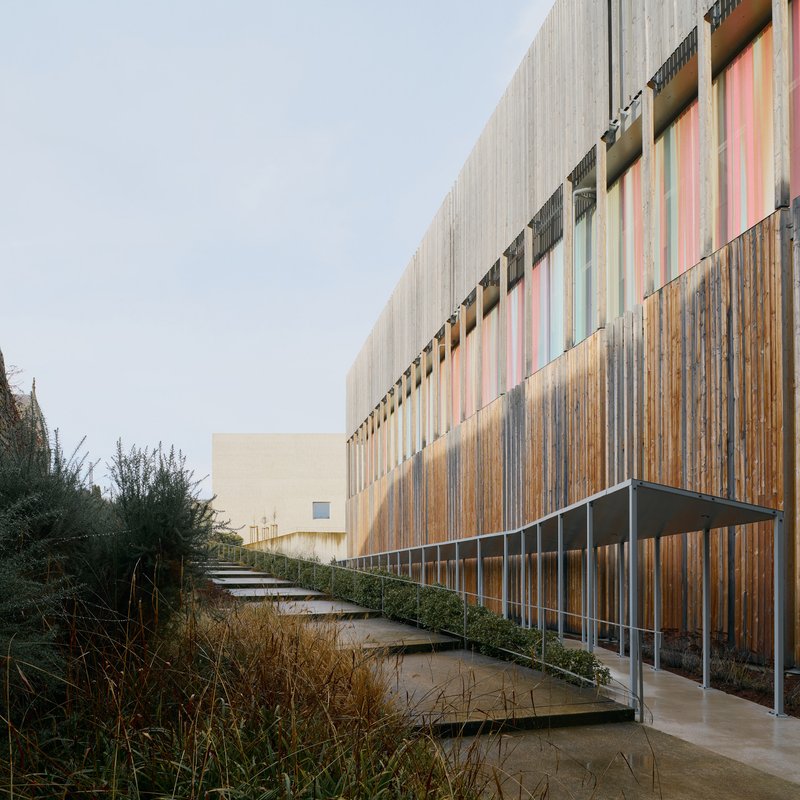
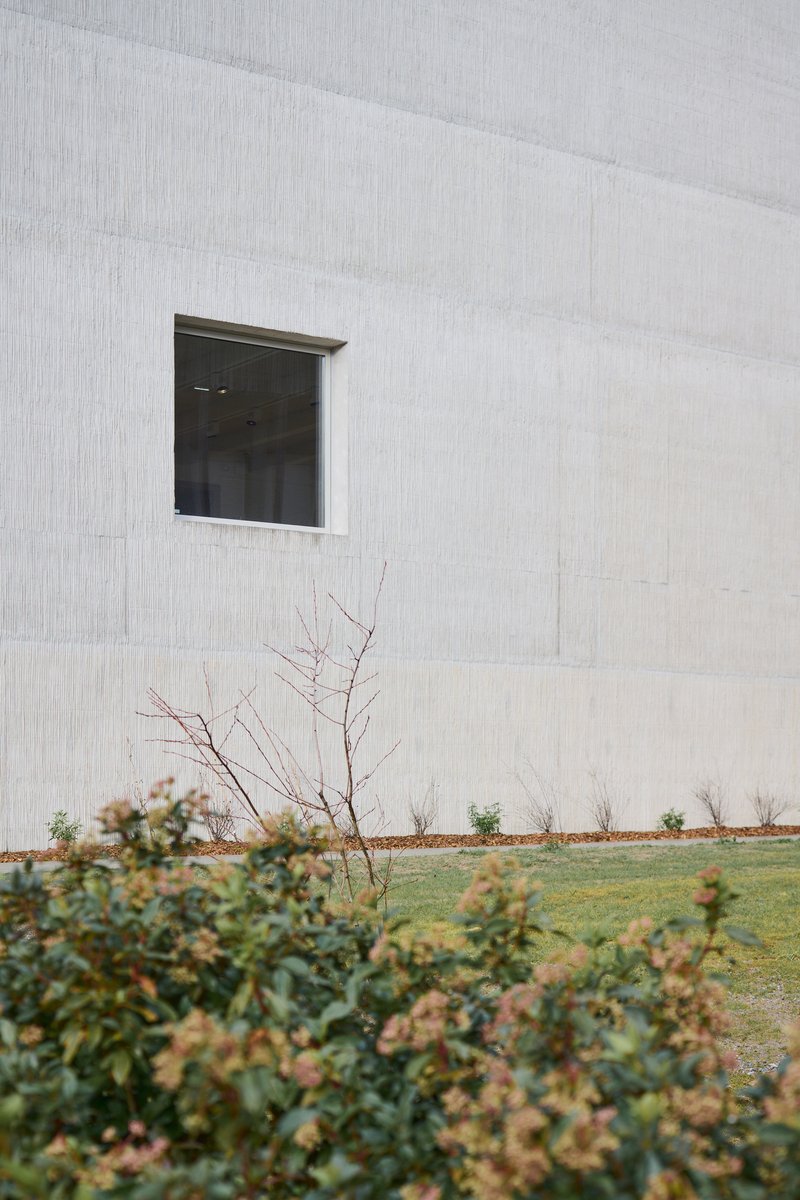
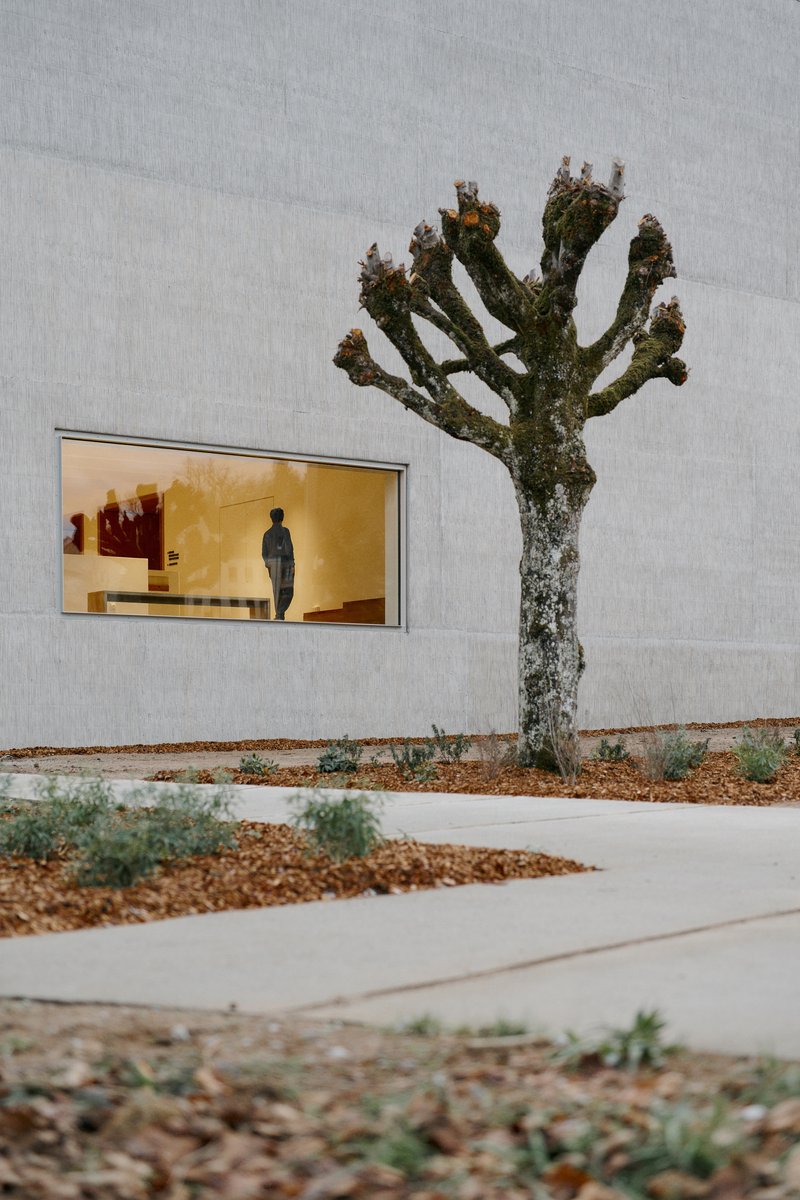
The approach to the extension is mediated entirely through landscape. Stone steps, planted grasses, and mulched beds establish a sequence that slows the visitor down before any door is reached. The existing ENAD building's weathered timber and colorful vertical panel facade sits alongside the new volume, and the transition between the two is handled through garden rather than corridor. A square window set above a garden bed with bare shrubs offers a composed view that belongs as much to the exterior promenade as to the interior galleries.
At dusk, an illuminated window beside a pollarded tree in the courtyard transforms the extension into a lantern within the garden. The planting strategy, with its mix of grasses, shrubs, and deciduous trees, ensures the building will look different in every season, a quality that reinforces the idea of architecture as something grown rather than imposed.
The Stairwell as Theater
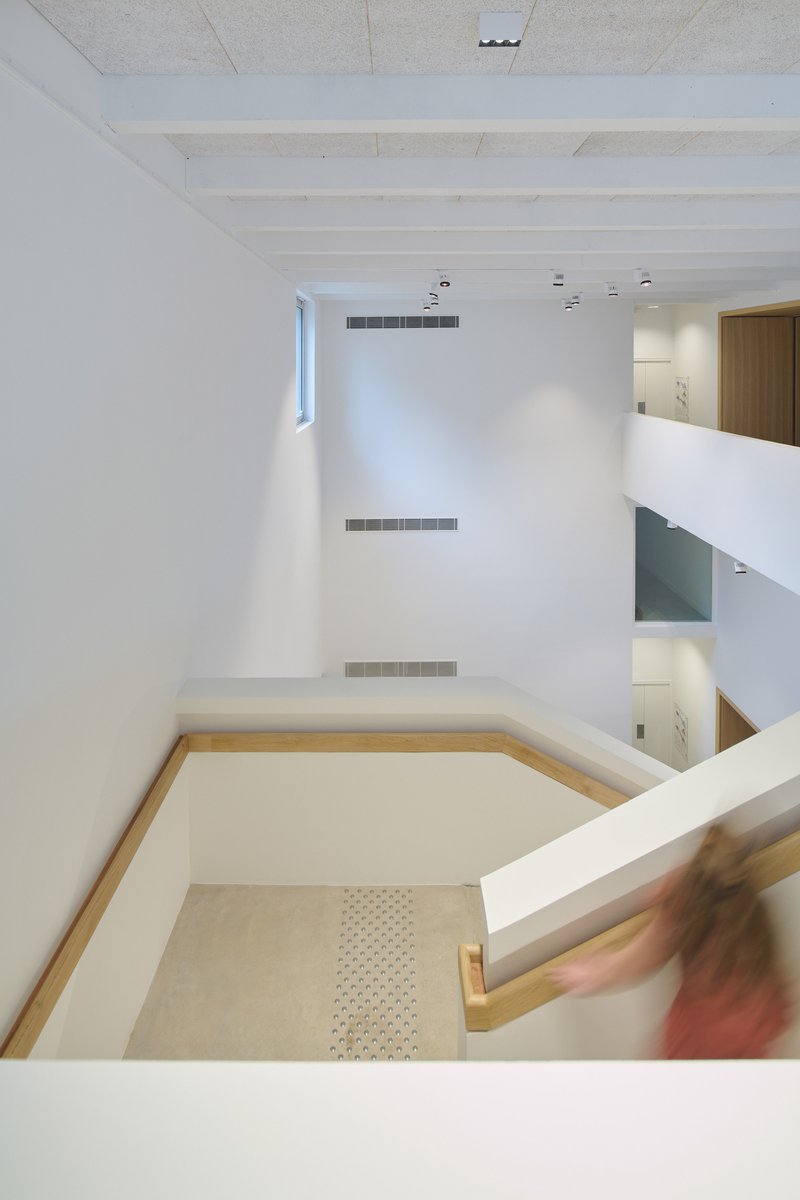
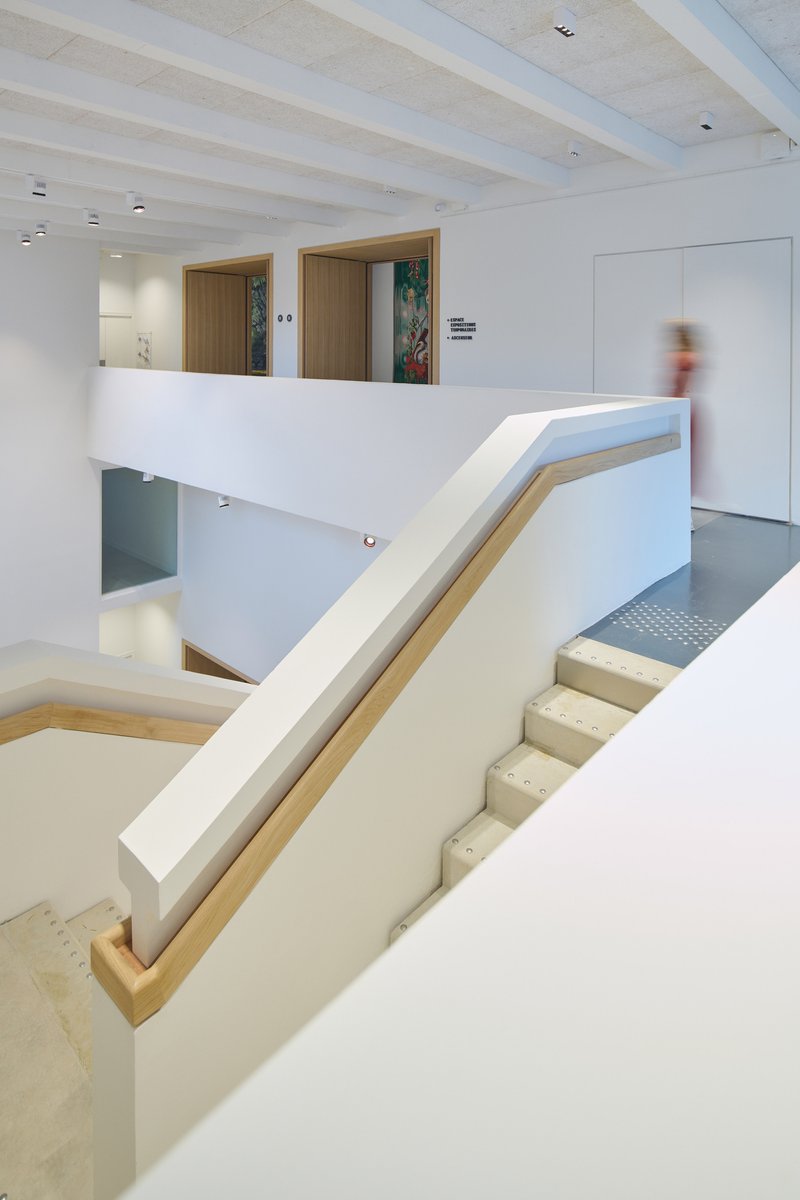
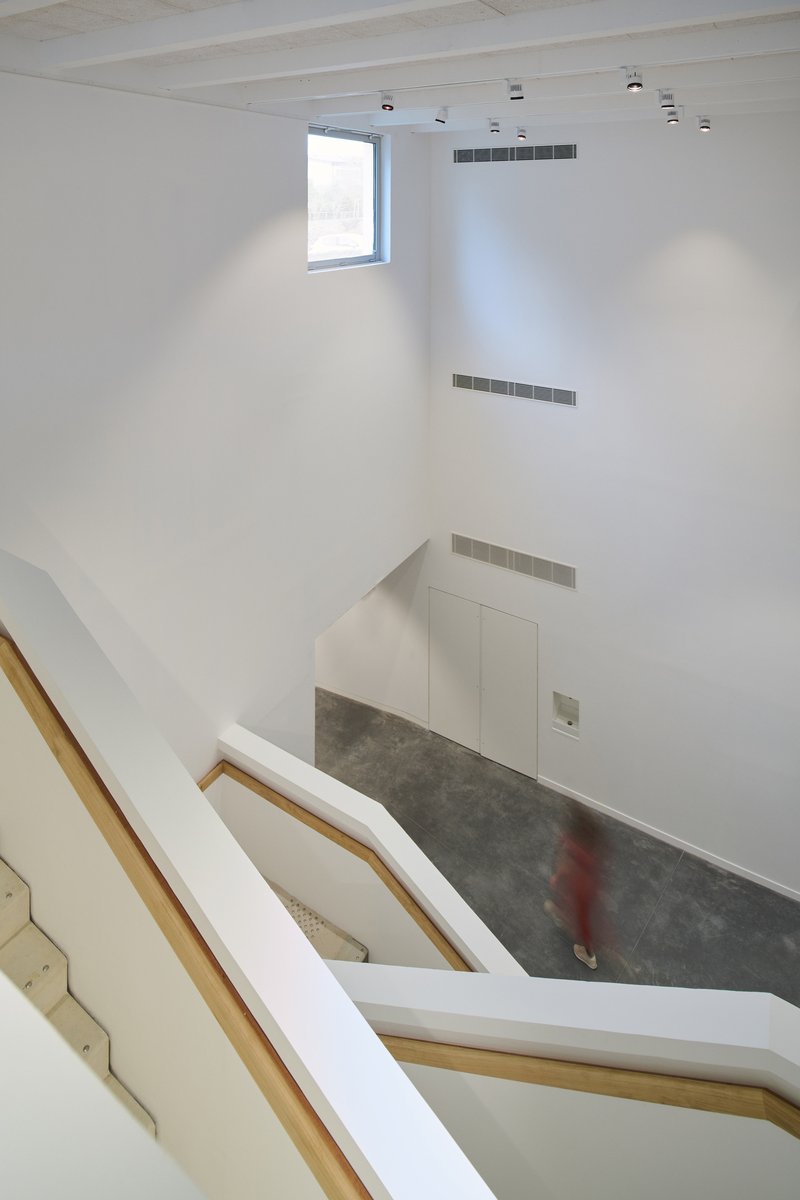
The intertwined stair flights at the core of the extension are the building's most dynamic spatial move. Looking down through the stairwell reveals angled handrails, white walls, and figures moving between levels, creating a sense of choreographed movement that makes circulation itself a form of exhibition. Timber handrails provide tactile warmth against the otherwise mineral palette, and the geometry of the flights produces diagonal sightlines that connect the upper exhibition rooms to the entrance hall below.
Projectiles treats vertical movement as a deliberate pause between gallery experiences. Rather than tucking stairs into a service core, the firm positions them at the center of the plan, where they generate the kind of social encounter and spatial surprise that a museum needs to stay engaging over repeated visits.
Gallery Rooms: Concrete Above, Craft on the Walls
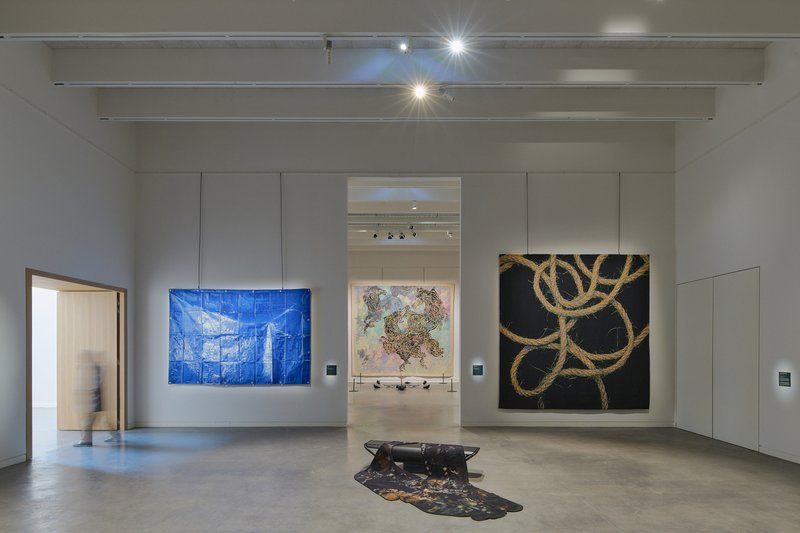
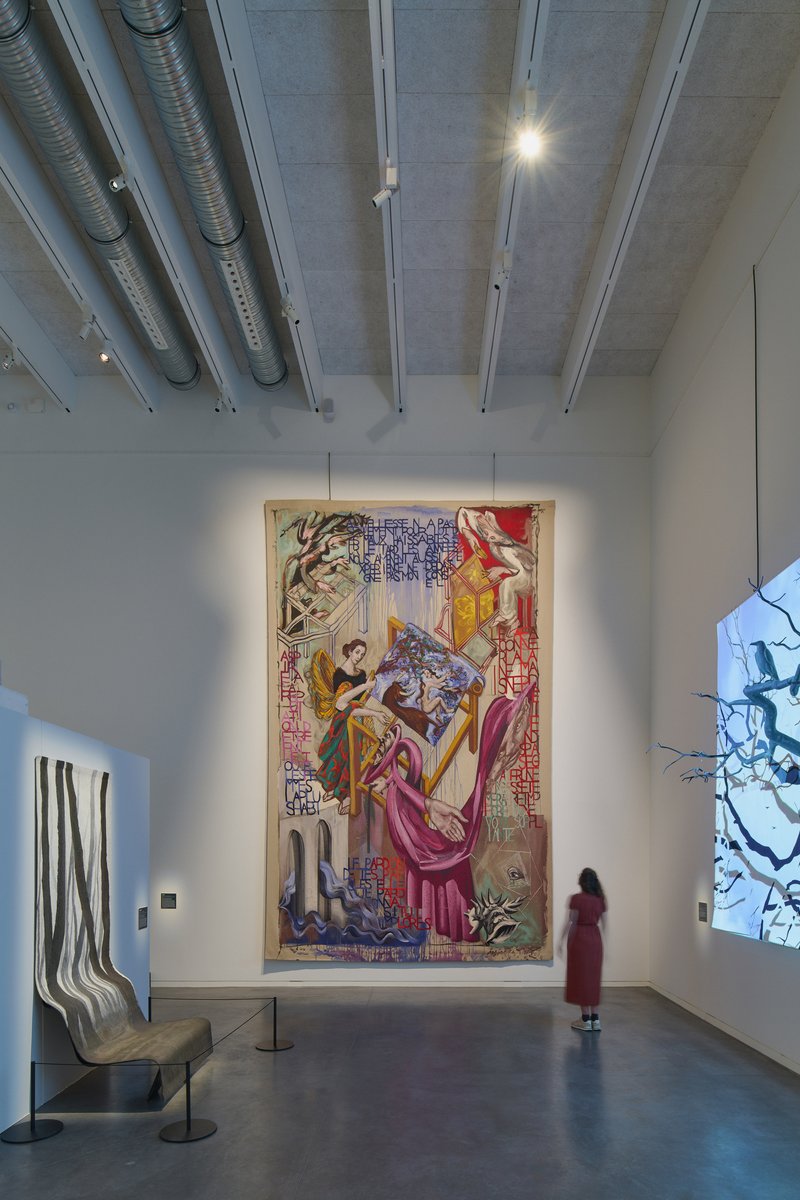
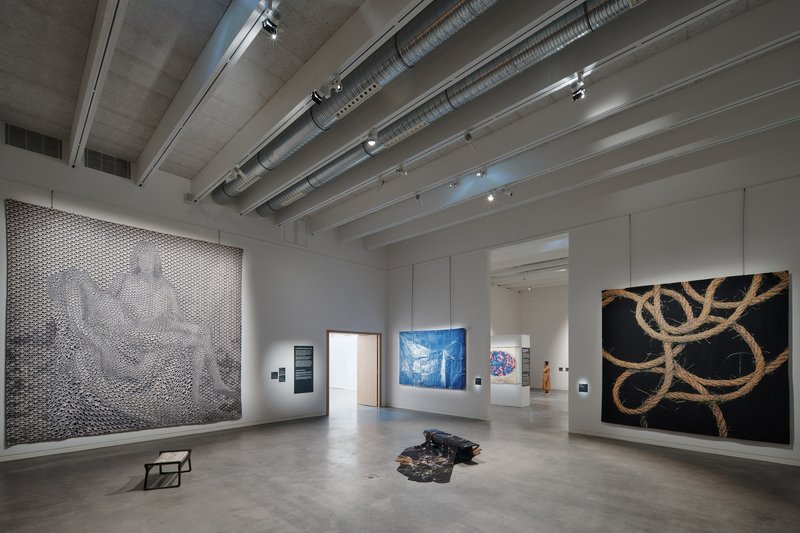
The four exhibition rooms across two levels share a common language: polished concrete floors, white walls, and exposed concrete ceiling panels with track lighting and visible mechanical systems. The ceilings are honest about their structure, with rectangular panels and exposed ductwork giving the rooms a slightly industrial edge that prevents them from feeling overly precious. Large tapestries and textile artworks hang against the white surfaces, their color and texture amplified by the neutrality of the enclosure.
The decision to leave mechanical systems visible is a quiet statement about craft. In a museum dedicated to the handmade, showing the building's own systems refuses the polite fiction of effortless architecture. Visitors can see how the building works while they study how tapestries are woven, and the parallel is not lost.
Framing Views and Daylight
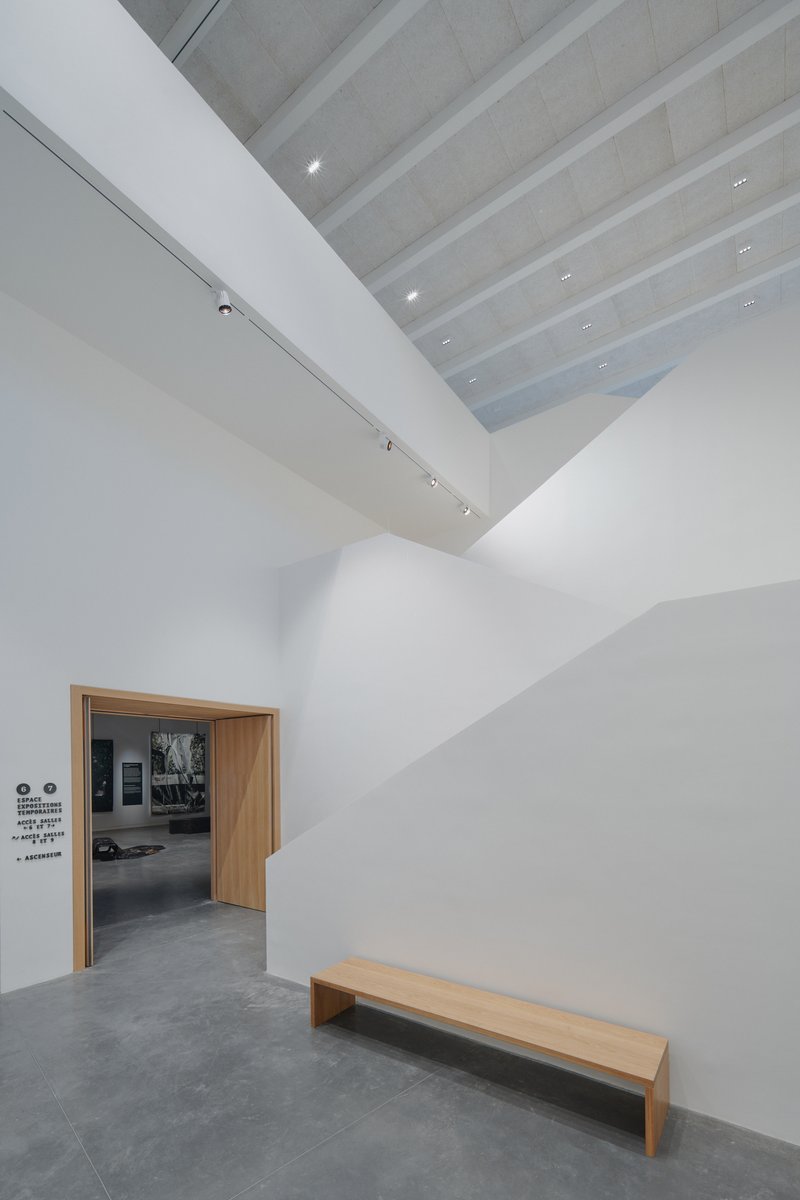
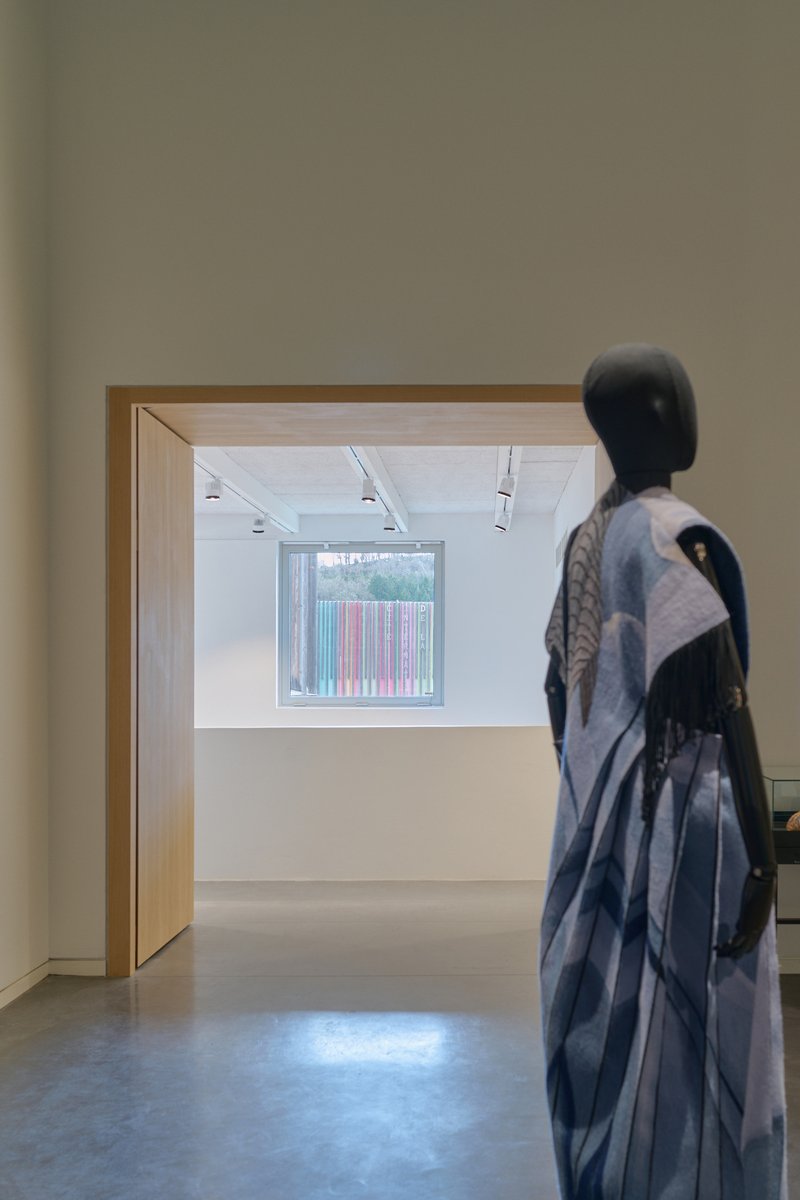
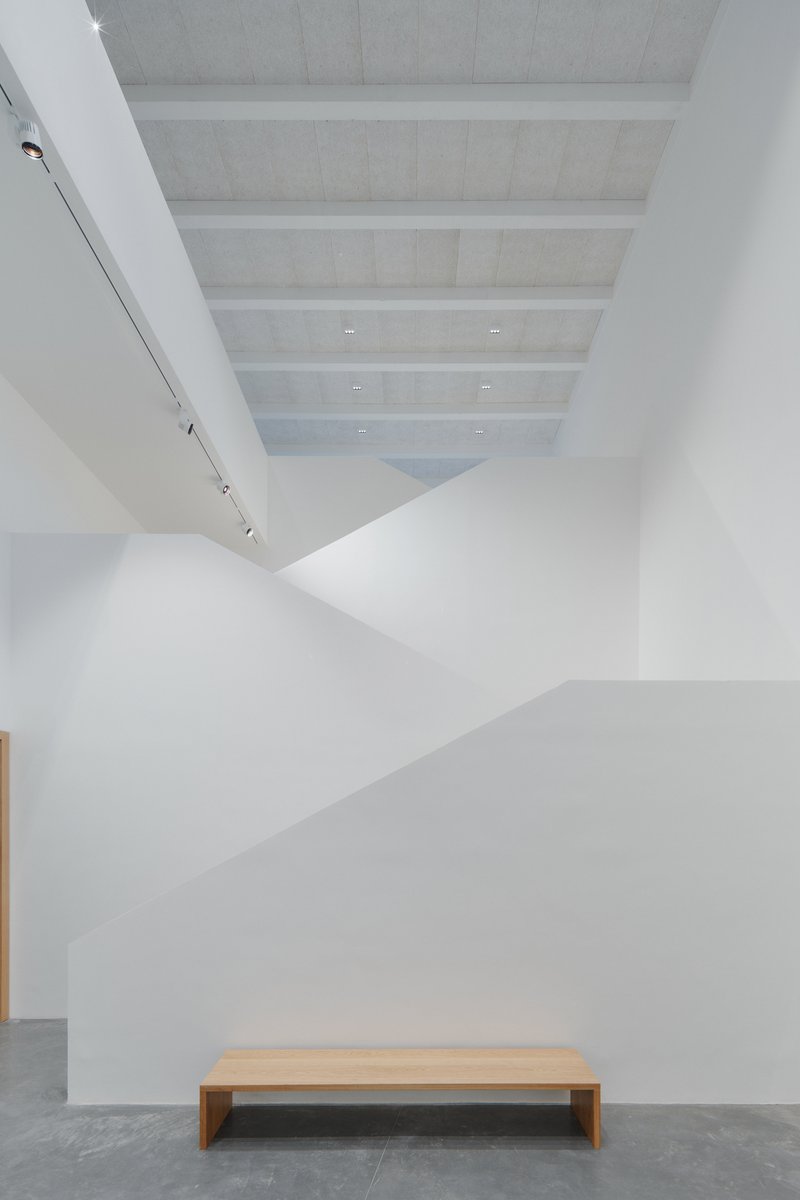
Natural light enters through carefully controlled openings: a ribbed skylight above a timber bench at one gallery entrance, a large picture window framing the wooded horizon of the valley, and angled ceiling planes that bounce daylight into otherwise enclosed rooms. These moments of transparency are strategic, placed at thresholds and transition points where visitors pause before entering the next sequence of exhibition space.
A view through a timber doorway, with a sculpture in the foreground and trees beyond, captures the project's essential ambition: to make the landscape of Aubusson a constant presence within the museum, so that the act of looking at tapestries and the act of looking at the valley become inseparable experiences.
Corridors and Circulation Loop
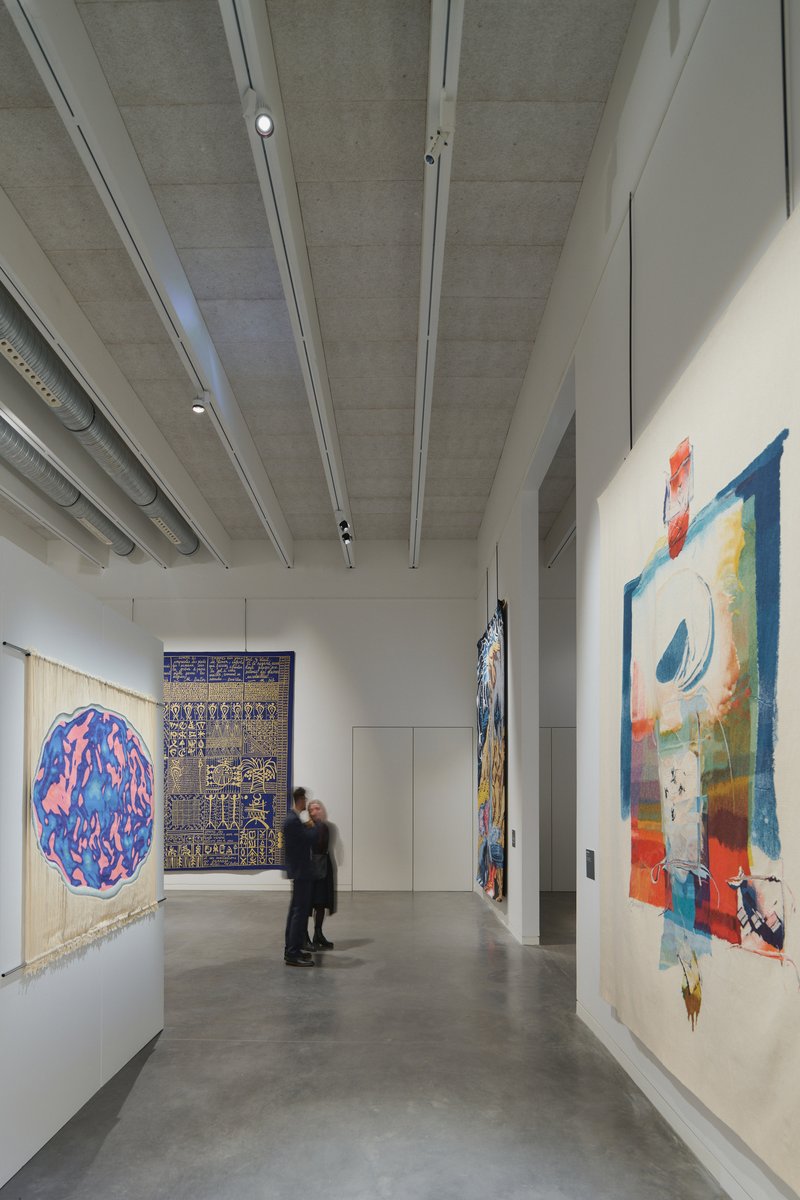
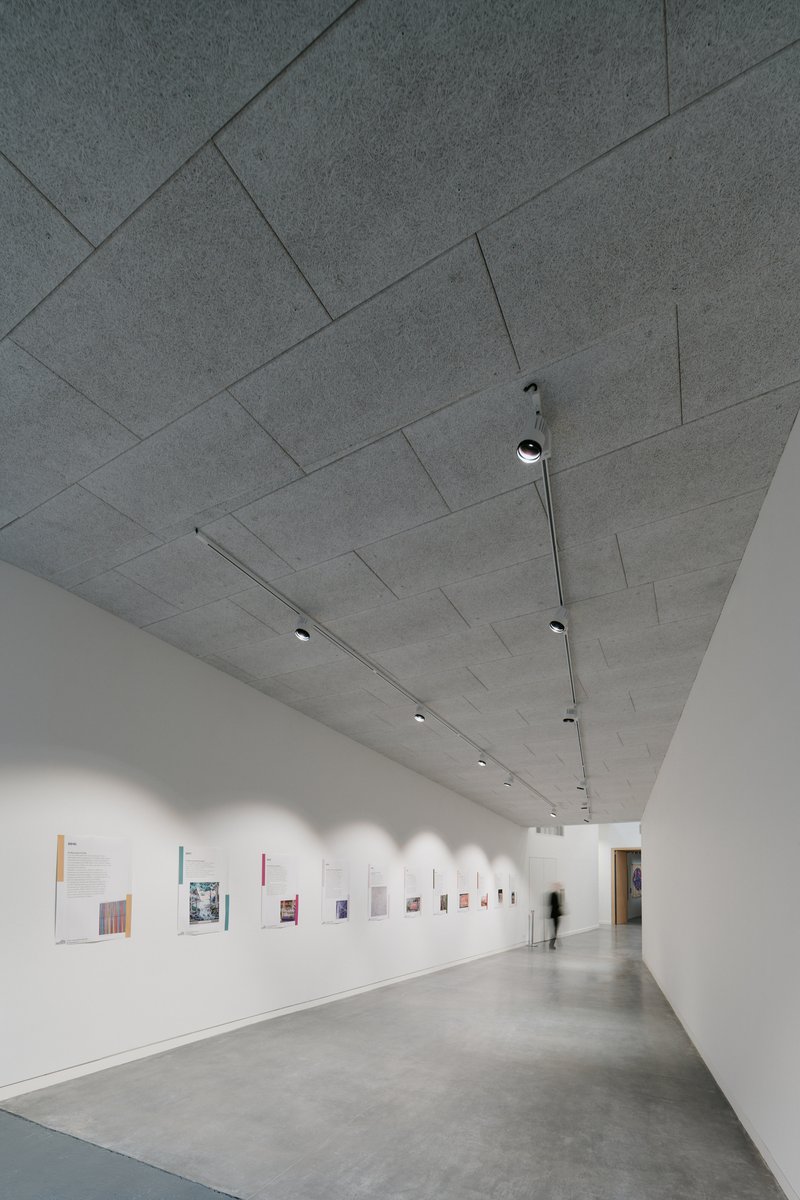
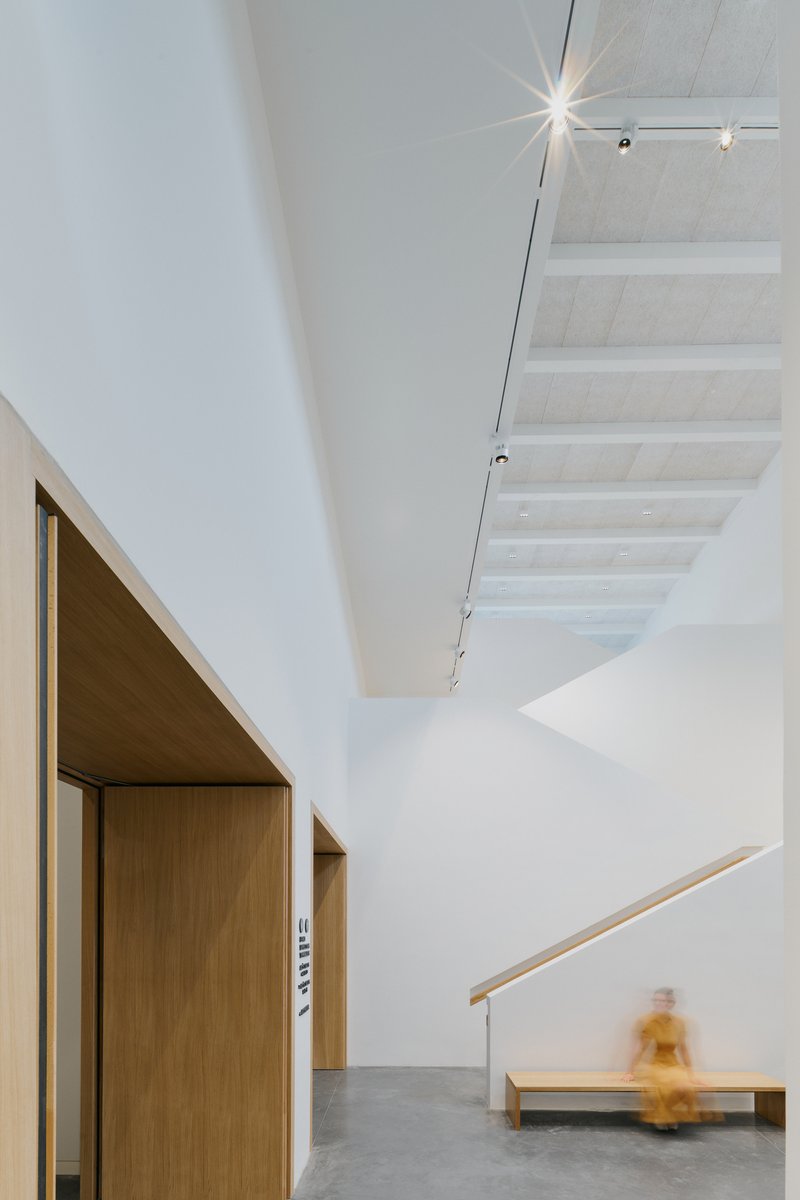
The circulation strategy is a loop that can be experienced in either direction. Visitors descend to a lower-level entrance hall, pass through the first two exhibition rooms, ascend via the monumental staircases or elevator to the upper level, and return to the main museum reception through a covered gallery along the existing building. Corridors are not dead space here; they function as secondary galleries, with small framed works hung along white walls and pendant lighting casting warm pools on the concrete floor.
Timber doorways punctuate the corridors, providing a rhythm of enclosure and release that keeps the visitor oriented without the need for signage. The material contrast between timber and concrete recurs throughout, establishing a tactile dialogue that echoes the relationship between warp and weft in the tapestries on display.
Exhibition Flexibility
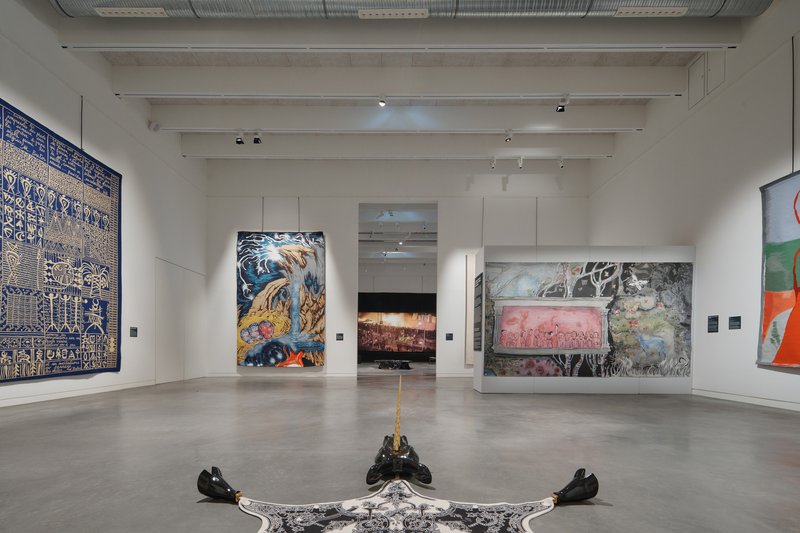
With 530 square meters dedicated to temporary exhibitions, the rooms need to accommodate everything from large-scale textile installations to intimate displays of historical fragments. The central hall serves as a transitional space, a decompression chamber between the two upper exhibition rooms. White ceiling beams and floor sculptures coexist beneath hanging artworks arranged around doorways, suggesting a curatorial flexibility that the architecture supports without dictating.
Plans and Drawings
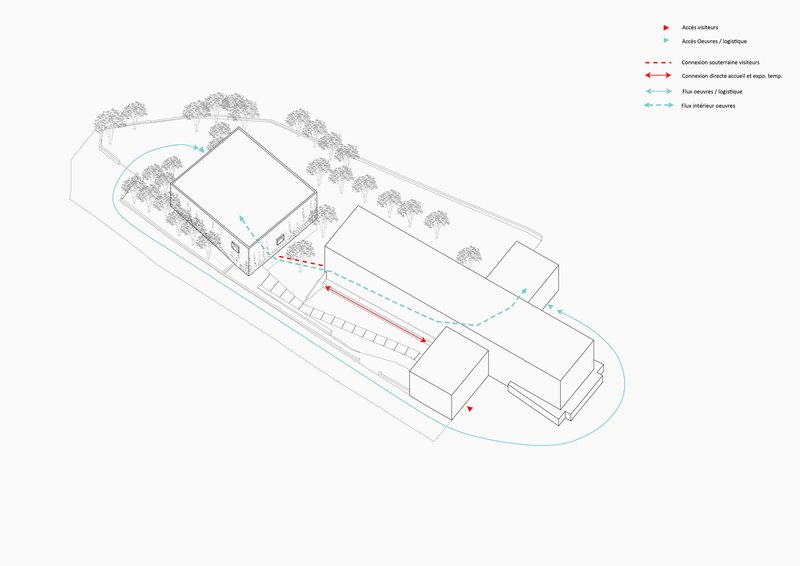
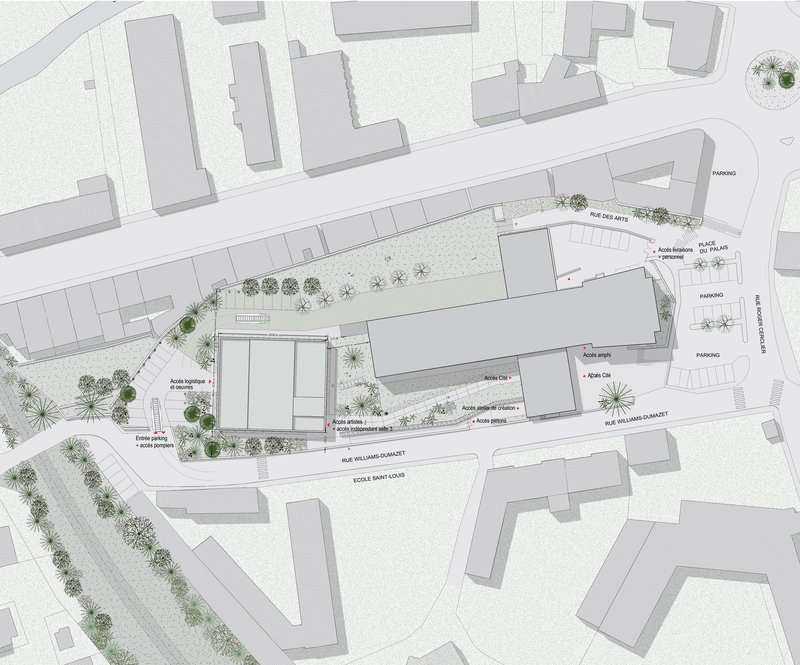
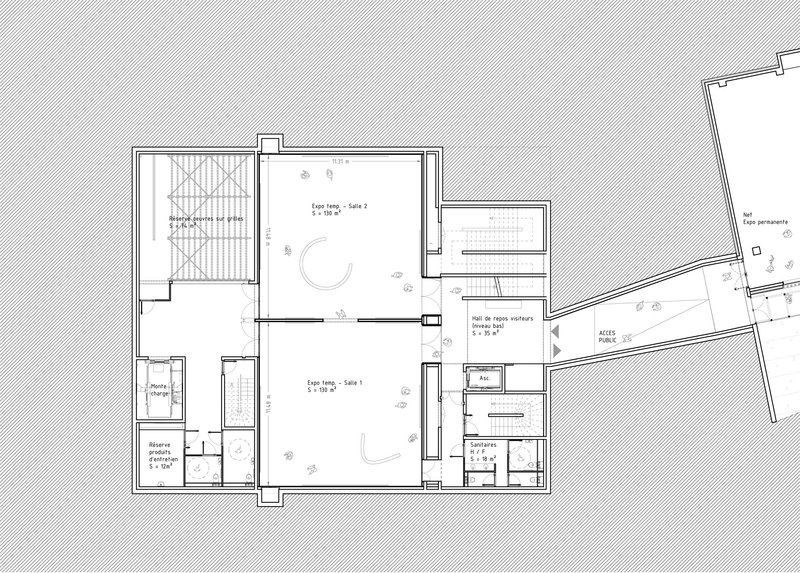
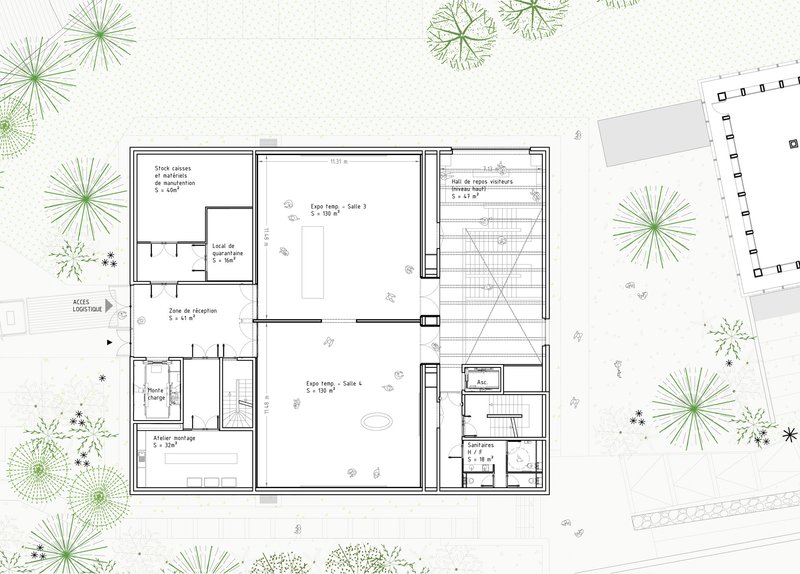
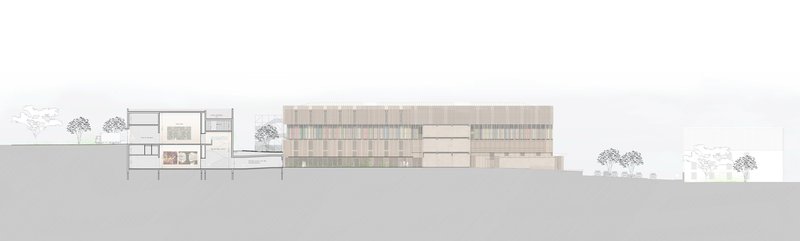
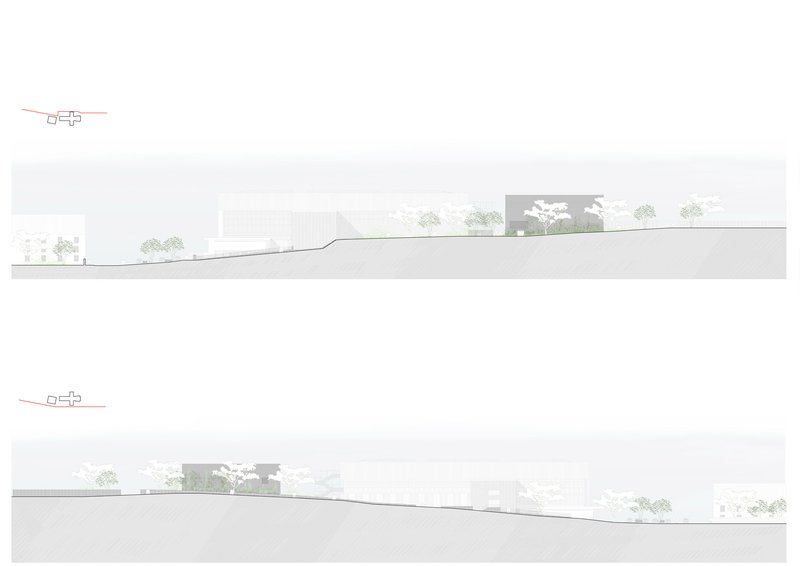
The axonometric diagram reveals the site circulation strategy clearly: the extension connects to the existing museum via underground access while maintaining its own garden-level identity. The site plan shows the building footprint nested within courtyard spaces, parking areas, and planting zones, confirming that landscape is not decorative but structural to the project's logic. Floor plans indicate two large exhibition spaces flanking a central corridor with service rooms, while landscape elements and outdoor terraces surrounded by trees blur the boundary between inside and out.
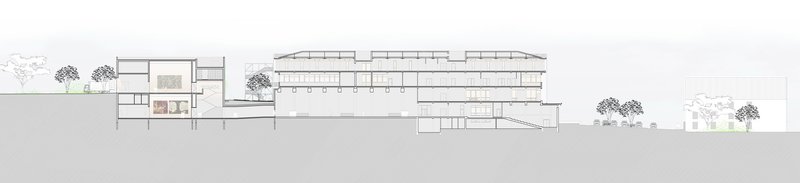
The section drawings are particularly revealing. They show the horizontal building volume with clerestory windows sitting within the sloping terrain, its interior floor levels stepping with the topography. The striped facade composition, visible in section, demonstrates how the fluted concrete reads as a continuous surface wrapping a complex interior. Two further sections illustrate the building embedded into the landscape with surrounding vegetation, confirming that the extension is as much an act of earthwork as it is of architecture.
Why This Project Matters
Museum extensions in historic towns frequently default to one of two modes: deferential invisibility or assertive contrast. Projectiles sidesteps both by treating the building as something that belongs to the landscape first and the town second. The garden-centric approach is not a romantic gesture but a disciplined design strategy that resolves complex programmatic requirements, including four levels of logistics, storage, and technical spaces accessed from the west facade, within a form that reads as effortless from the public garden. The concrete monolith, with its tapestry-derived surface imprints, turns material craft into architectural language without resorting to literal mimicry.
For a town whose identity has been defined by six centuries of weaving, the extension offers a new kind of cultural infrastructure: one that links the act of making to the act of looking, and connects the interior experience of viewing tapestries to the exterior experience of inhabiting the Creuse valley. The circulation loop, the intertwined stairs, the framed views of wooded hillsides, all of these moves ensure that the building is not merely a container for art but a spatial argument about the continuity between craft, landscape, and architecture. Aubusson deserved exactly this kind of attention, and Projectiles delivered.
The Aubusson Tapestry Museum Extension, designed by Projectiles with Base (landscape), Batiserf Ingénierie (structure), Louis Choulet (flood engineering), Bureau Michel Forgue (construction economics), Abraxas (lighting), Aïnu (conservation), and Orfea acoustique (acoustics). Located in Aubusson, France. 1,800 m². Completed 2026. Photography by Sylvain Jouve.
About the Studio
Share Your Own Work on uni.xyz
If projects like this are the kind of work you want to make, uni.xyz is a place to publish your own, find collaborators, and enter design competitions.




Popular Articles
Popular articles from the community

The Flow: Coffee Shop Interior Design Where Time, People, and Process Intertwine
The Flow reimagines Viennese coffee culture through arched forms, warm interiors, music, reading, work, and social gathering.

Cro&Co Architecture Builds a 150-Meter Tower on Top of a Seven-Lane Highway in La Défense
Trinity Tower reimagines the office high-rise as a bioclimatic organism threaded with terraces, trees, and public ground in Paris's business district.
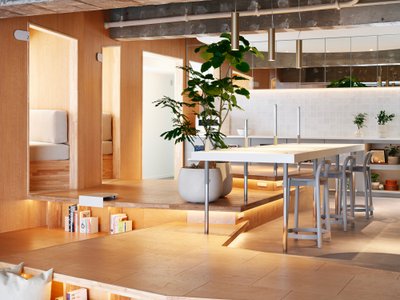
R/URBAN DESIGN OFFICE Carves a Communal Living Room from a Tokyo Corporate Dormitory
In Shinagawa's Oi district, a 35-year-old reinforced concrete tower becomes a 49-unit rental residence with shared spaces that redefine cohabitation.
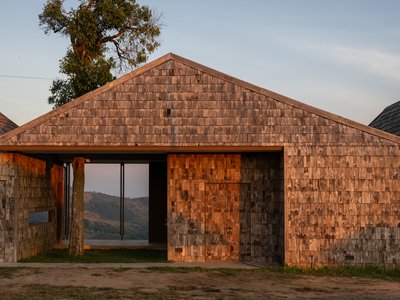
S.O.S Architects Scatters a Cluster of Timber Pavilions Across a Chiang Rai Hillside
The Wood Cabin arranges shingled gabled volumes along the slopes of Doi Chang, framing mountain vistas from every room and courtyard.


Similar Reads
You might also enjoy these articles
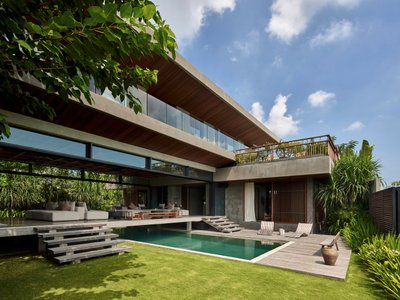
Freebird Residence by Alexis Dornier: A Tropical Modernist Sanctuary in Bali
Floating living pavilion above pool anchors H-shaped tropical villa, blending Japanese minimalism, sustainable strategies, lush landscape, and sculptural interiors.
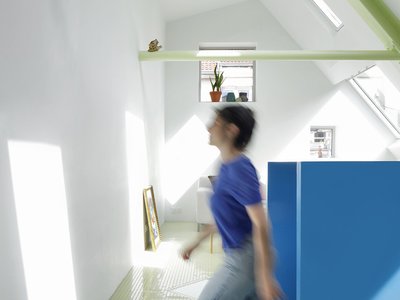
127af Flips a Tiny Bagnolet Rowhouse Upside Down with a Handcrafted Roof Extension
A 55-square-meter terraced house on the edge of Paris gains a luminous upper living floor through lightweight timber and steel.
1.61 Design Workshop Wraps a 600-Square-Meter Café in Vietnam in Sculptural Burgundy Drama
Reden Café & Bistro pairs a helical staircase, mosaic floors, and deep red interiors to rethink Vietnamese hospitality space.

The Unbound Brain: A School Shaped by Cognitive Architecture
Cylindrical learning pods radiate like neurons from a central cortex, turning the floor plan into a spatial model of human thought.


Explore Cultural Architecture Competitions
Discover active competitions in this discipline




The Global Benchmark for Architecture Dissertation Awards


The Global Benchmark for Graduation Excellence


Challenge to design public laboratory


Bring back Drive In's
Comments (0)
Please login or sign up to add comments
No comments yet. Be the first to comment!