

Studio Vincent Eschalier Converts a Haussmann Building in Provence into a Hybrid Showroom
Behind wrought iron balconies and limestone facades, a multi-brand showroom merges retail, hospitality, and wellness under vaulted stone ceilings.


The Haussmann building is one of the most recognizable architectural signatures in France, yet its ground floors and basements often languish as underused commercial shells. In Provence, Studio Vincent Eschalier has taken one such building and peeled it open, threading a multi-brand showroom through its limestone columns, barrel vaults, and courtyard gardens without disguising any of them. The result is a space that functions simultaneously as retail floor, café, co-working lounge, and wellness suite, all organized around the building's original structural logic rather than imposed on top of it.
What makes the project genuinely interesting is the refusal to flatten the existing fabric into a neutral backdrop. Every stone column, every vaulted corridor, every arched threshold is left legible and then carefully counterpointed with contemporary insertions: terrazzo islands, fluted walnut cabinetry, brushed metal skins, and curved plaster ceilings. The approach is neither restoration nor gut renovation. It is a negotiation, and a convincing one.
Street Presence: Limestone, Brass, and Restraint
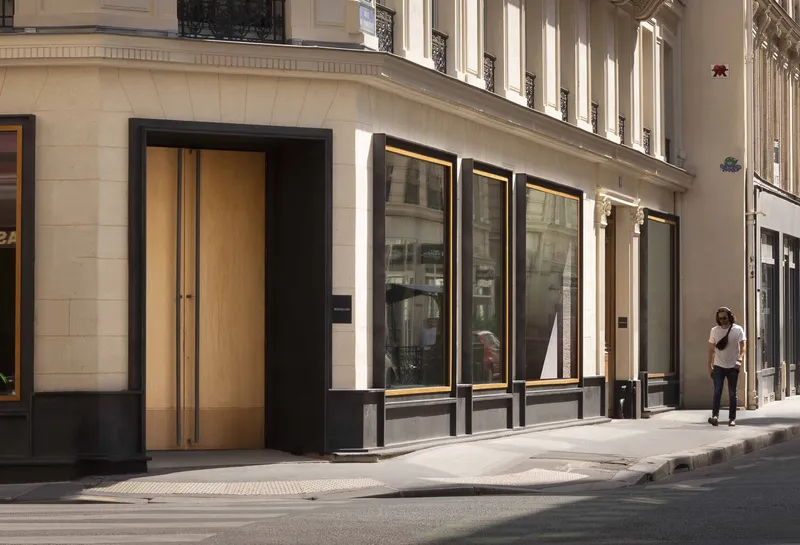
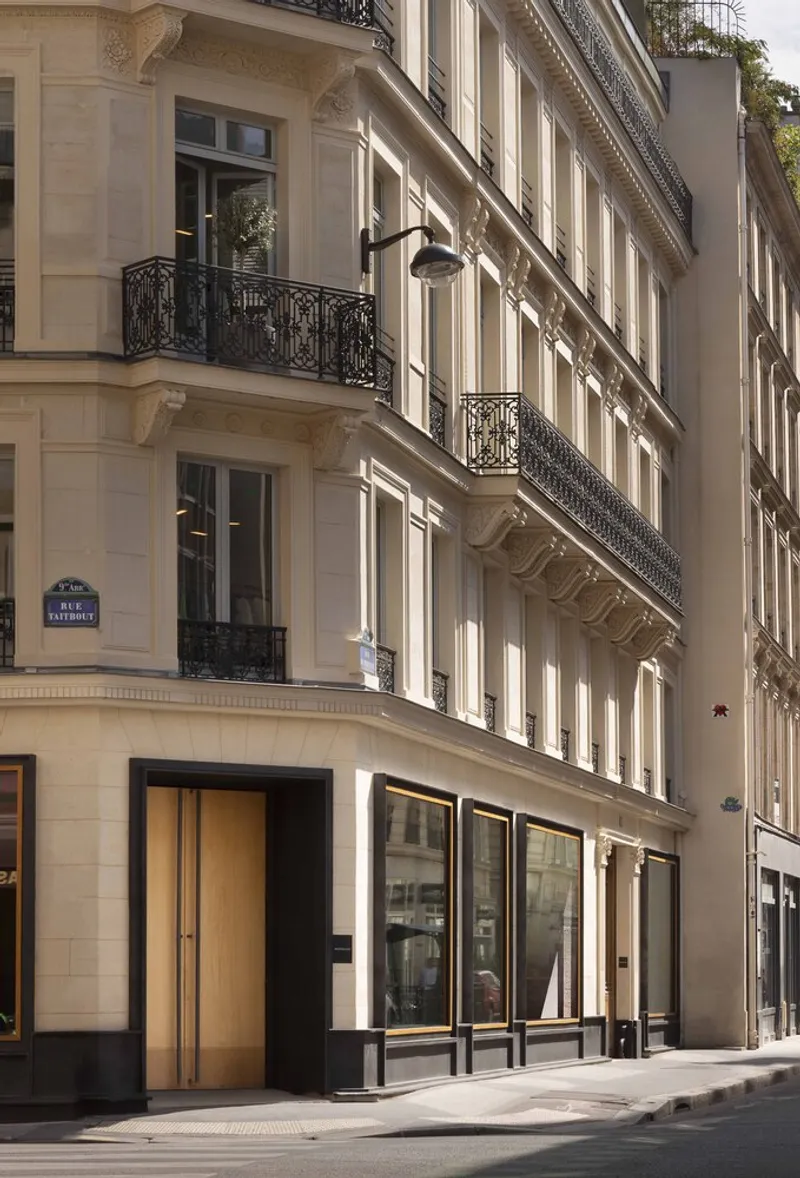
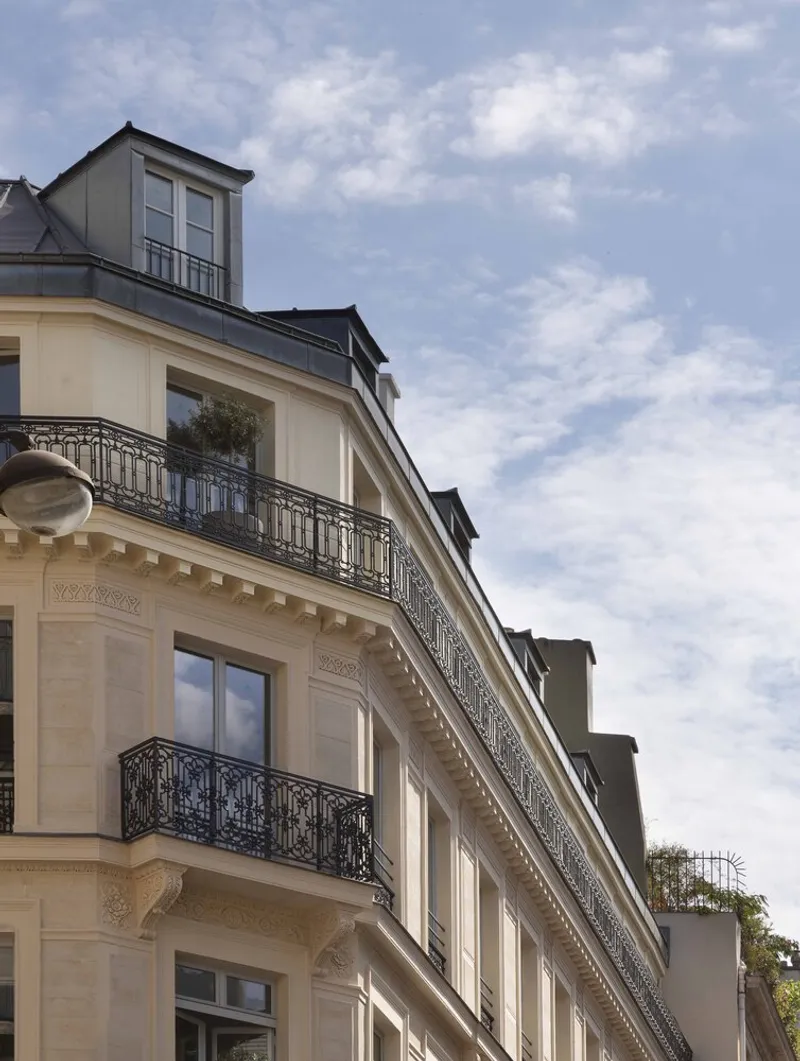
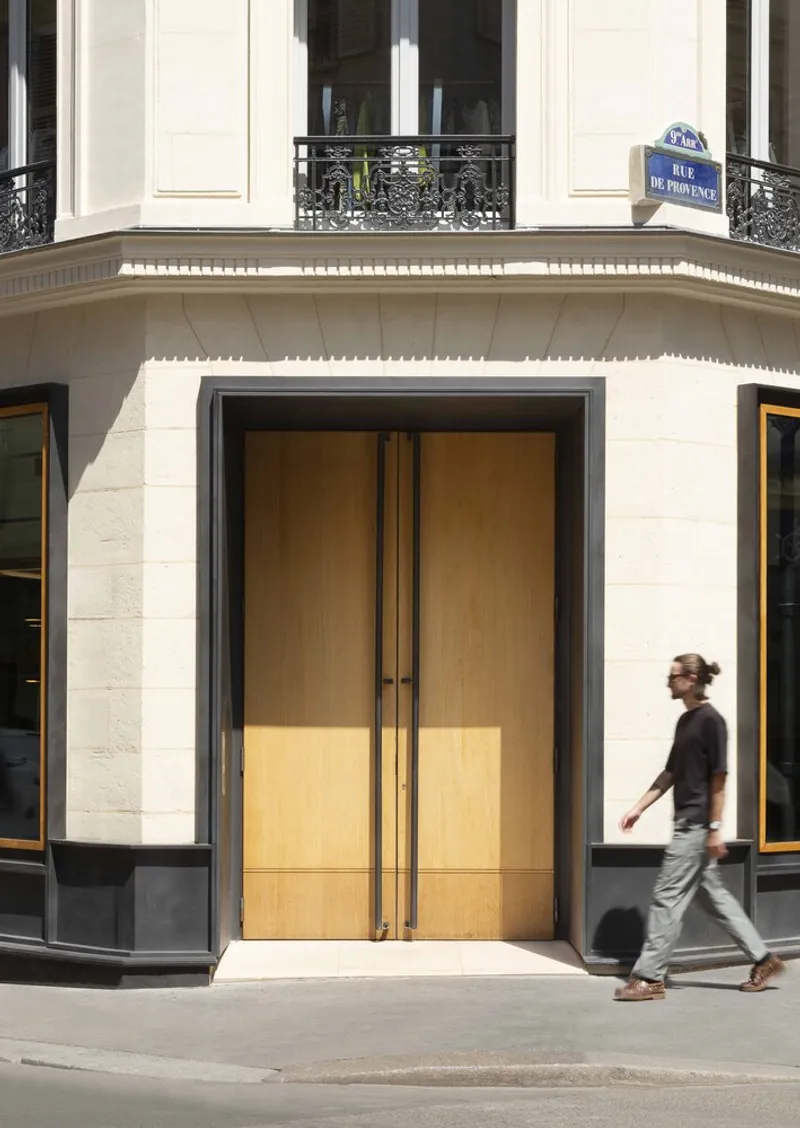
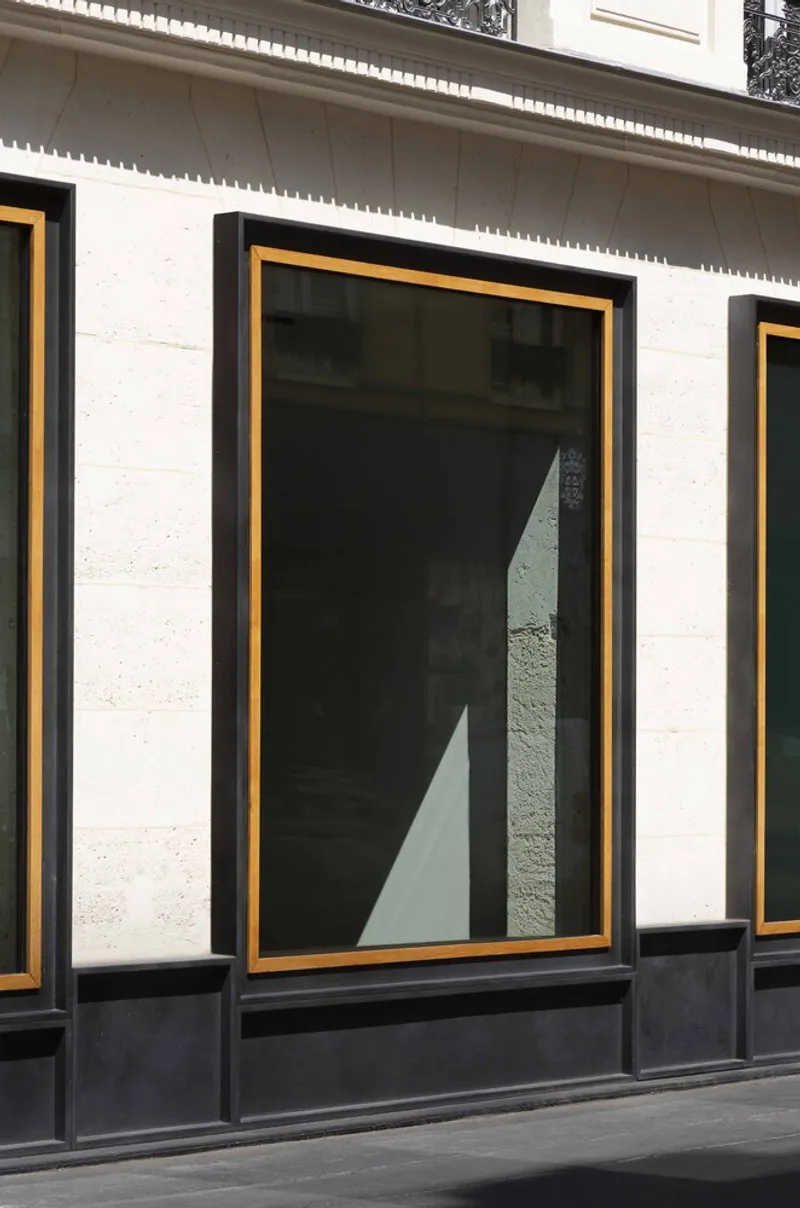
From the street, the intervention barely announces itself. The ground floor storefront is set into the existing limestone ashlar base with black-framed glazing and new timber double doors that read as period-appropriate insertions rather than grafts. Wrought iron balconies and mansard dormers continue their business overhead, giving no hint that the interior has been radically rethought. A corner entrance finished in brass cladding provides the only conspicuous contemporary note, catching passing light and framing a discreet invitation to enter.
The decision to keep the facade almost untouched is strategic. In a historic Provençal streetscape, any loud intervention would read as intrusion. Here, understatement is the entry strategy, and it works. Pedestrians walk past without realizing the depth of what lies behind the stone.
Material Dialogues: Terrazzo, Stone, and Walnut

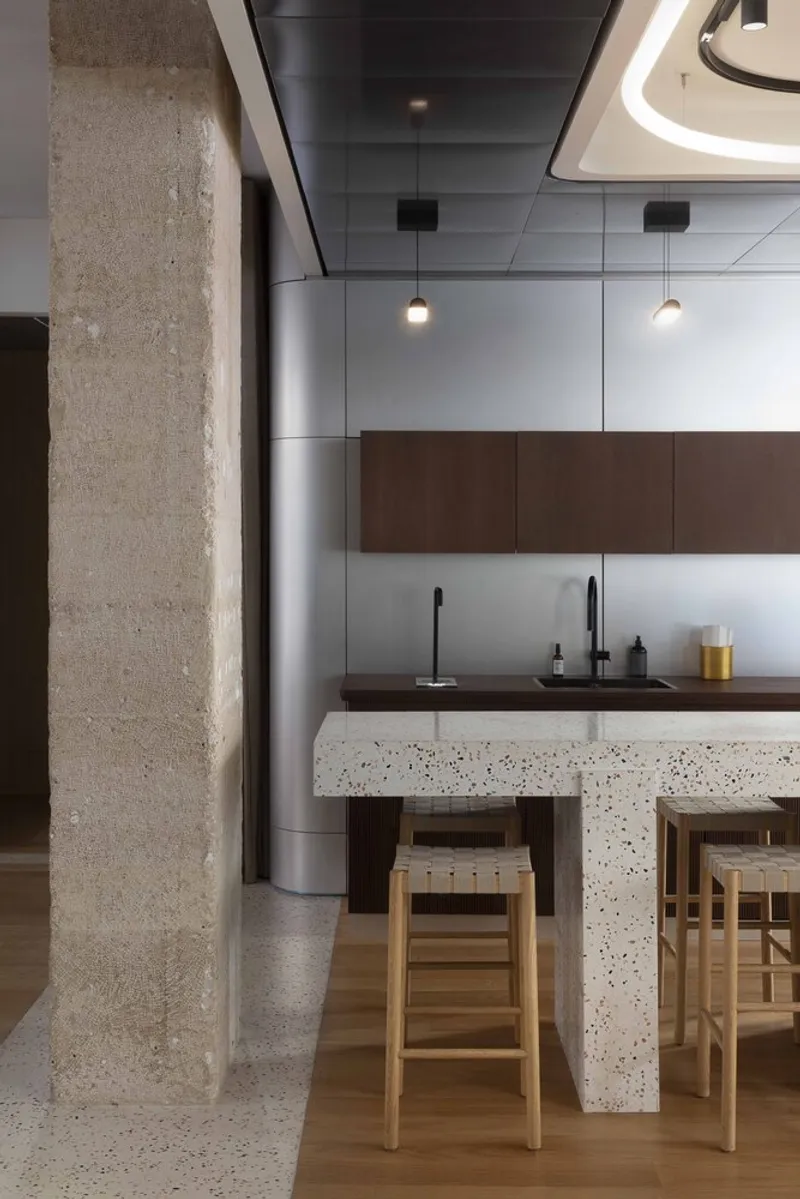
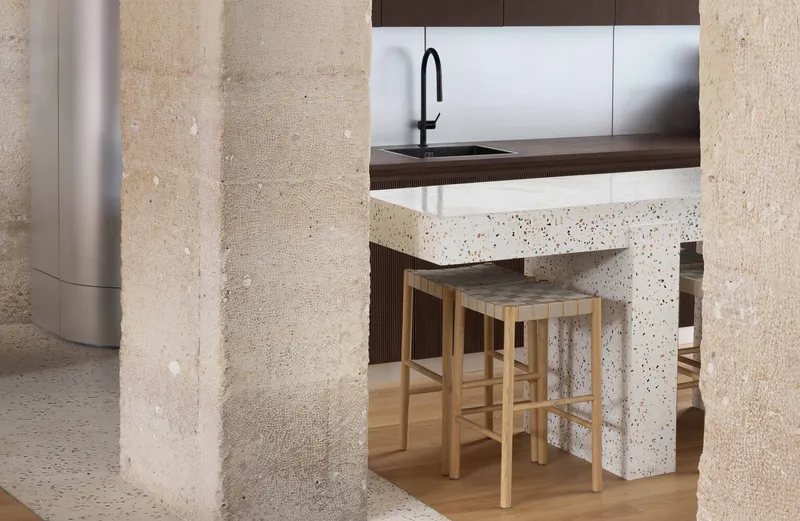
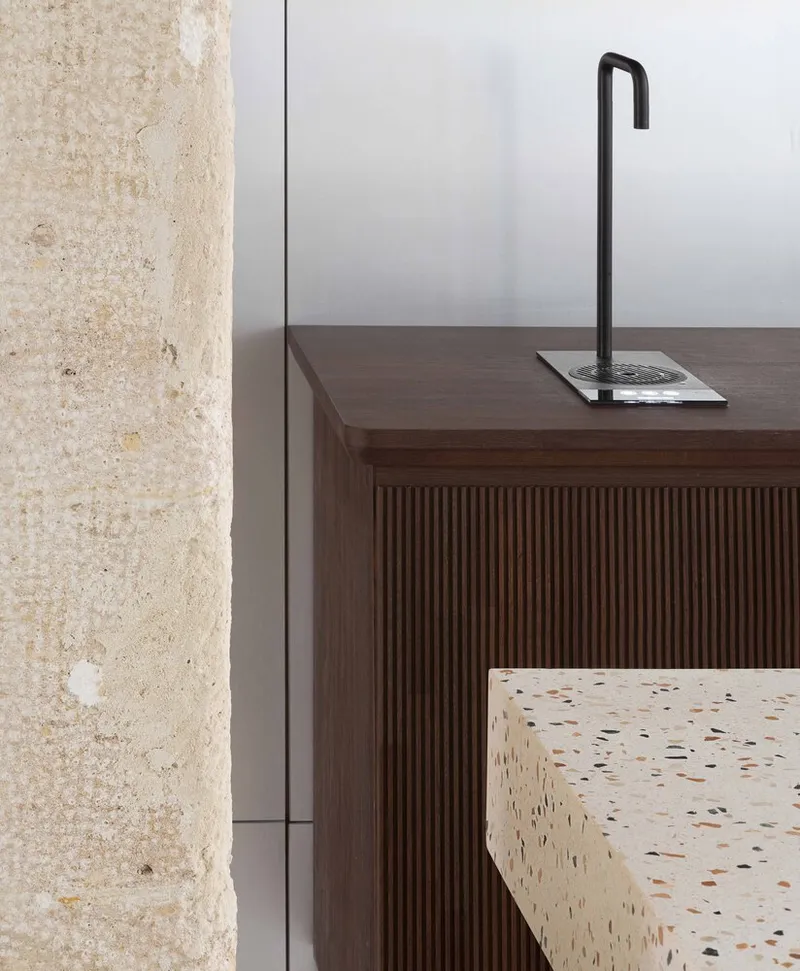
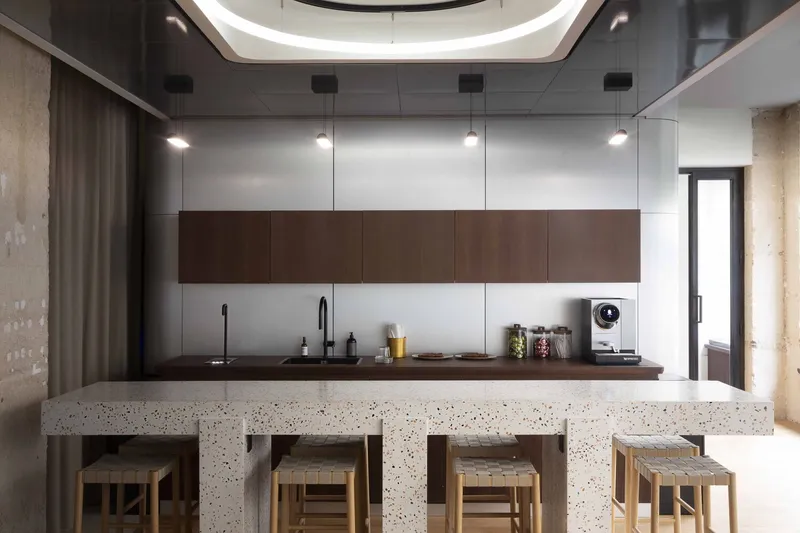
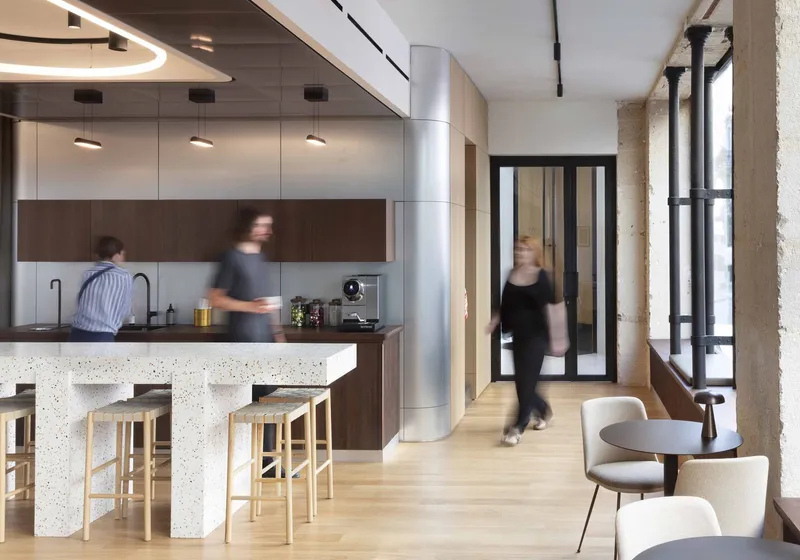
The central terrazzo island is the gravitational core of the showroom's ground floor. It sits between two rough stone columns, its waterfall edge and fluted walnut base offering a textural contrast that is deliberate and precise. Timber stools tuck beneath it, and suspended lighting above draws attention down to the surface, which doubles as a café counter and casual gathering point. The terrazzo's aggregate reads as a quieter echo of the exposed masonry: mineral against mineral, one polished, the other raw.
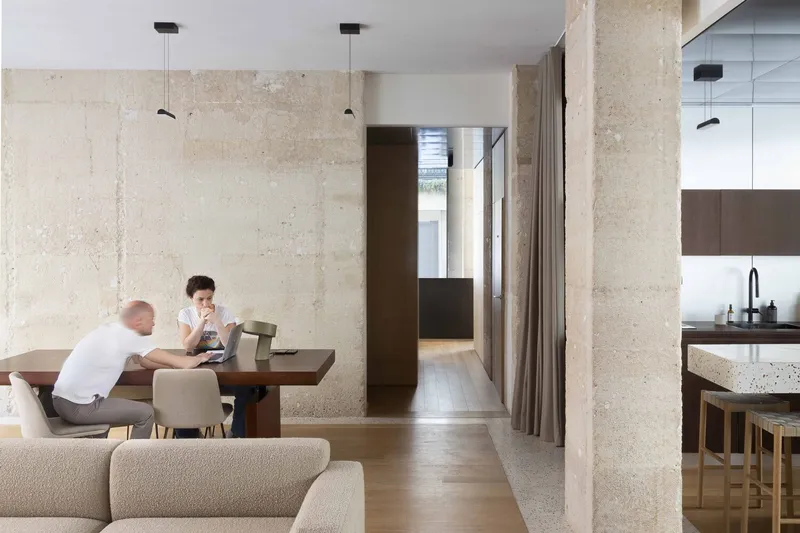
Walnut cabinetry and blonde oak herringbone flooring provide warmth against the cool mass of stone. A close look at the kitchen counter reveals the care in detailing: matte black hardware against fluted walnut, a textured column left bare beside the smooth countertop. Nothing is accidental. The palette is restrained to four or five materials, rotated and recombined across every room.
Living and Working Under Curved Light
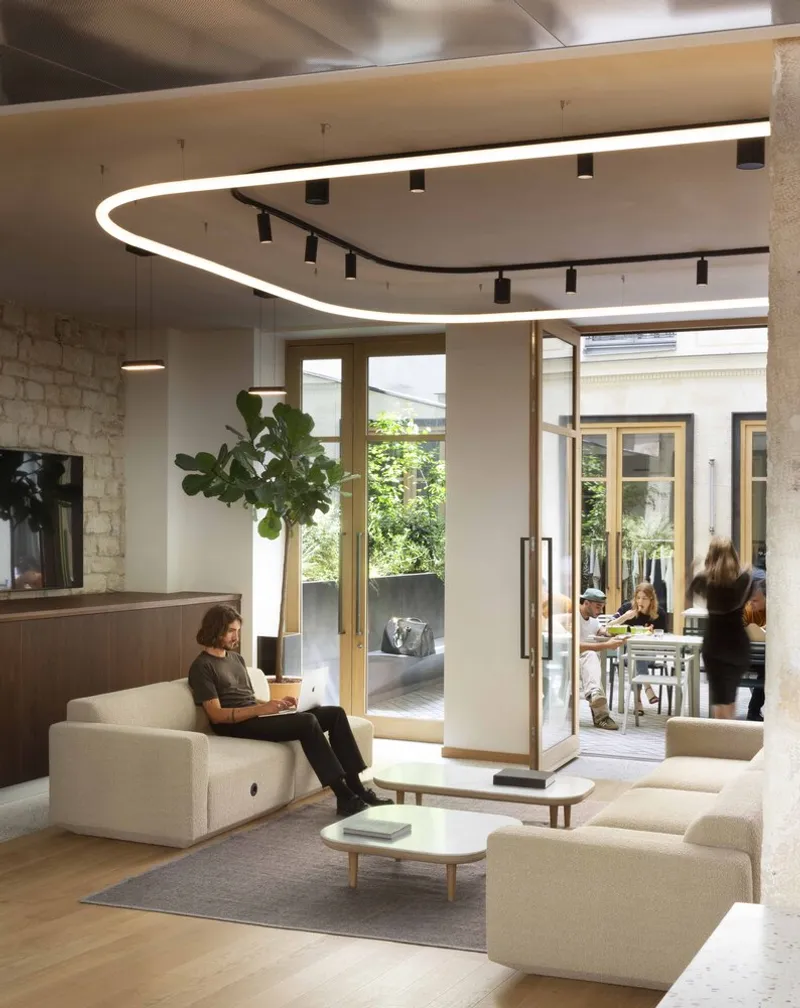
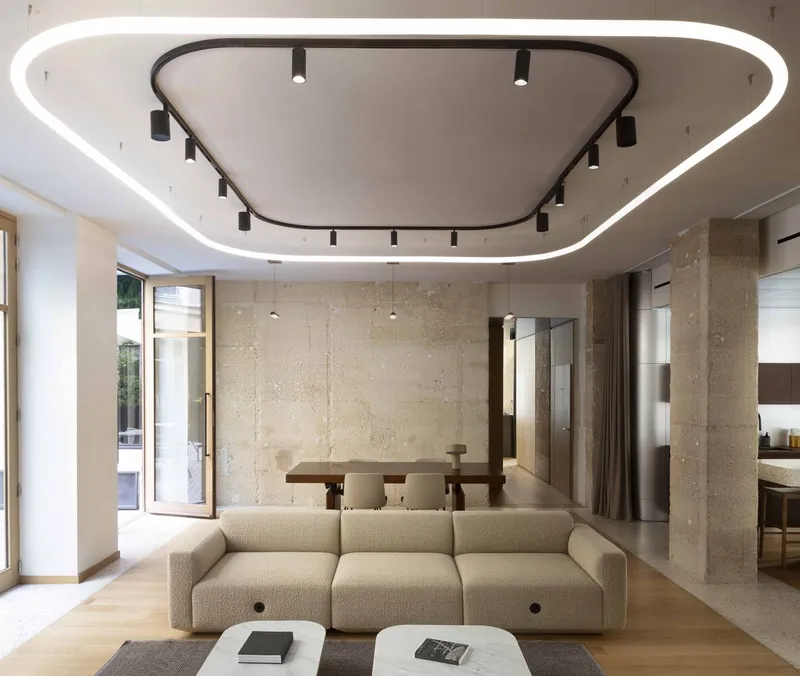
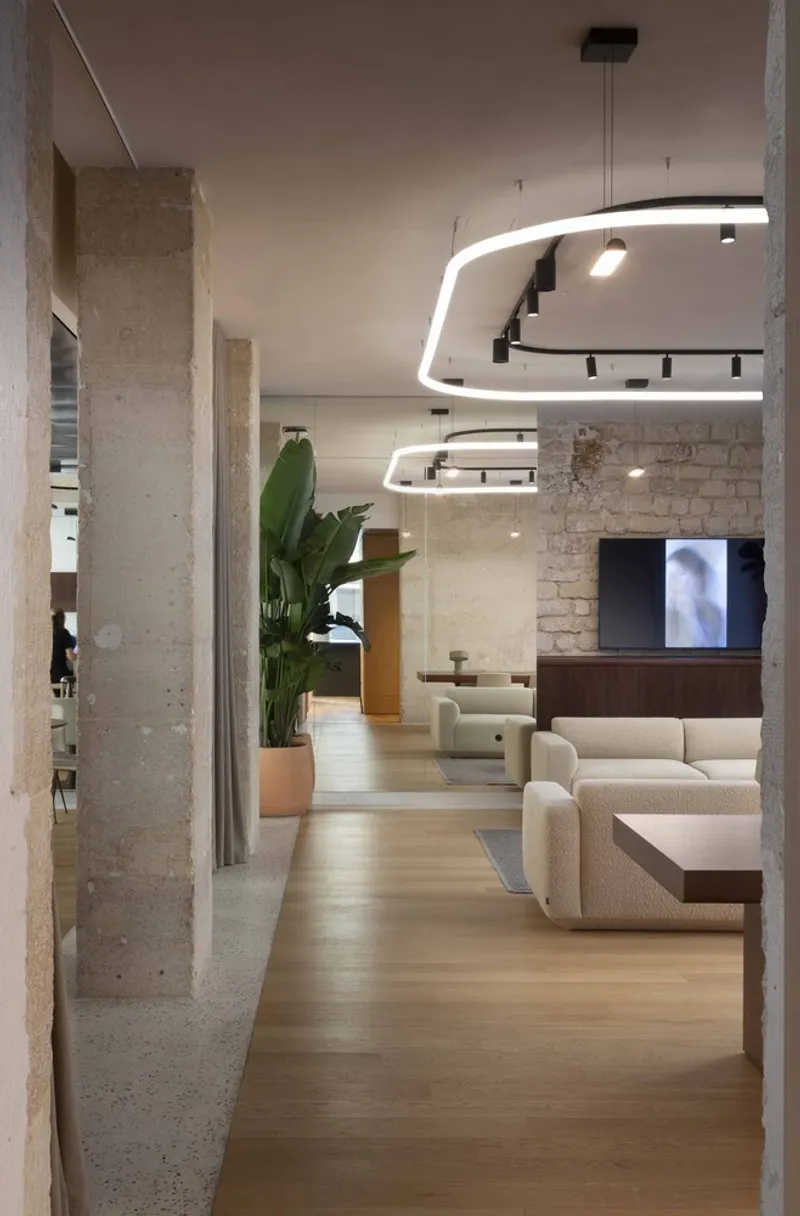
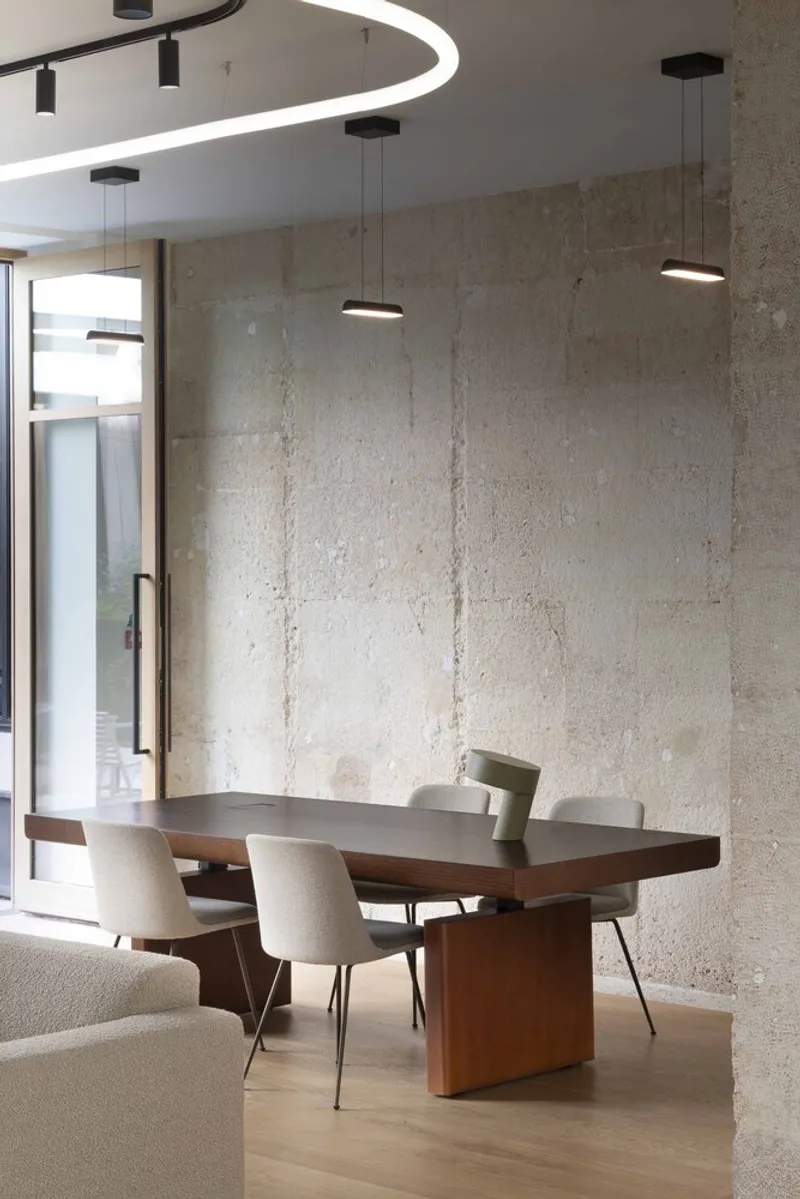
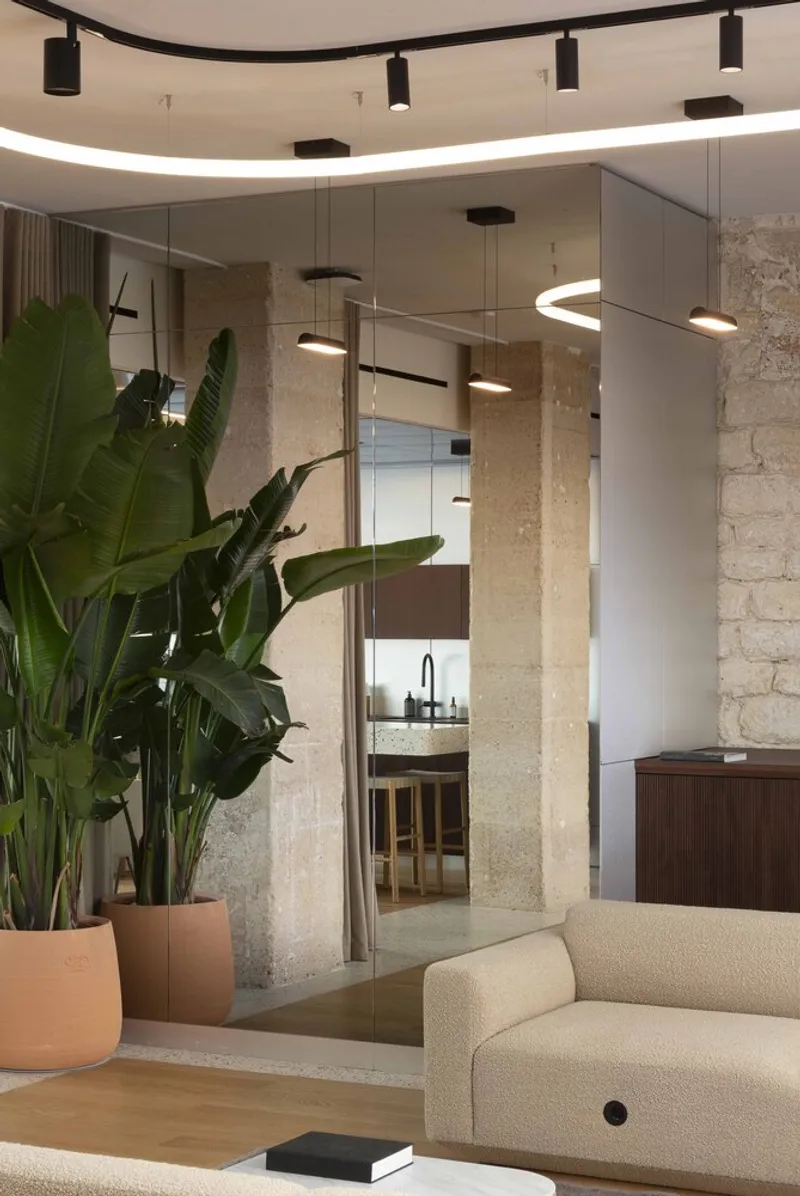
Throughout the upper floors and lounge areas, Eschalier introduces curved ceiling fixtures that become spatial organizers. In the living area, a rounded recessed fixture hovers over a walnut dining table, its warm glow creating an intimate zone within a larger open plan. In the lounge, a similar curved element marks the threshold between interior and courtyard, its illumination pulling the eye toward the greenery beyond the glass doors.
These ceiling elements are not decorative afterthoughts. They define territory in rooms that could easily feel formless, establishing zones for dining, conversation, and display without any walls. The co-working area benefits from the same logic: seating clusters gather beneath suspended lighting and beside the terrazzo counter, creating a café ambiance that feels neither corporate nor chaotic.

The Courtyard as Green Room
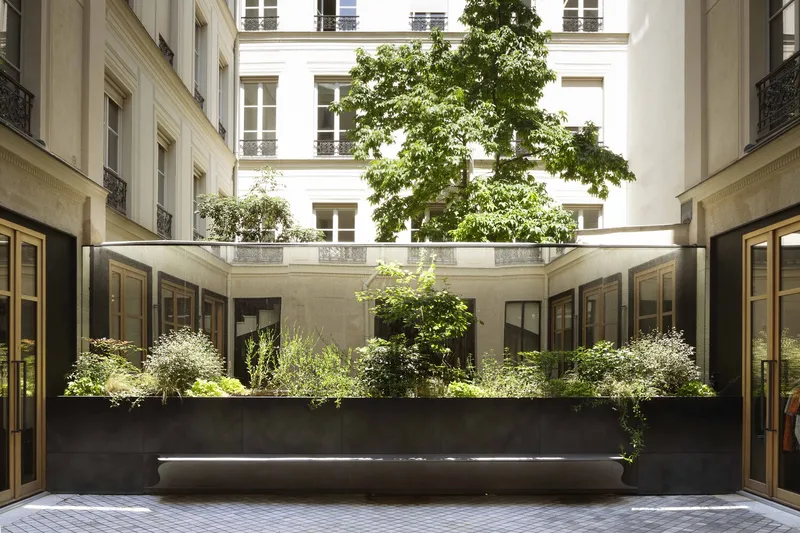
A raised black planter bed sits in the interior courtyard, holding a mature tree and white flowering shrubs that bring soft, diffused light and air into the plan. In a Haussmann building, the courtyard is the respiratory system: it ventilates, it illuminates, it provides psychological relief from deep floor plates. Eschalier treats it as an extension of the showroom, visible through glass doors from the lounge, keeping the boundary between built and planted deliberately thin.
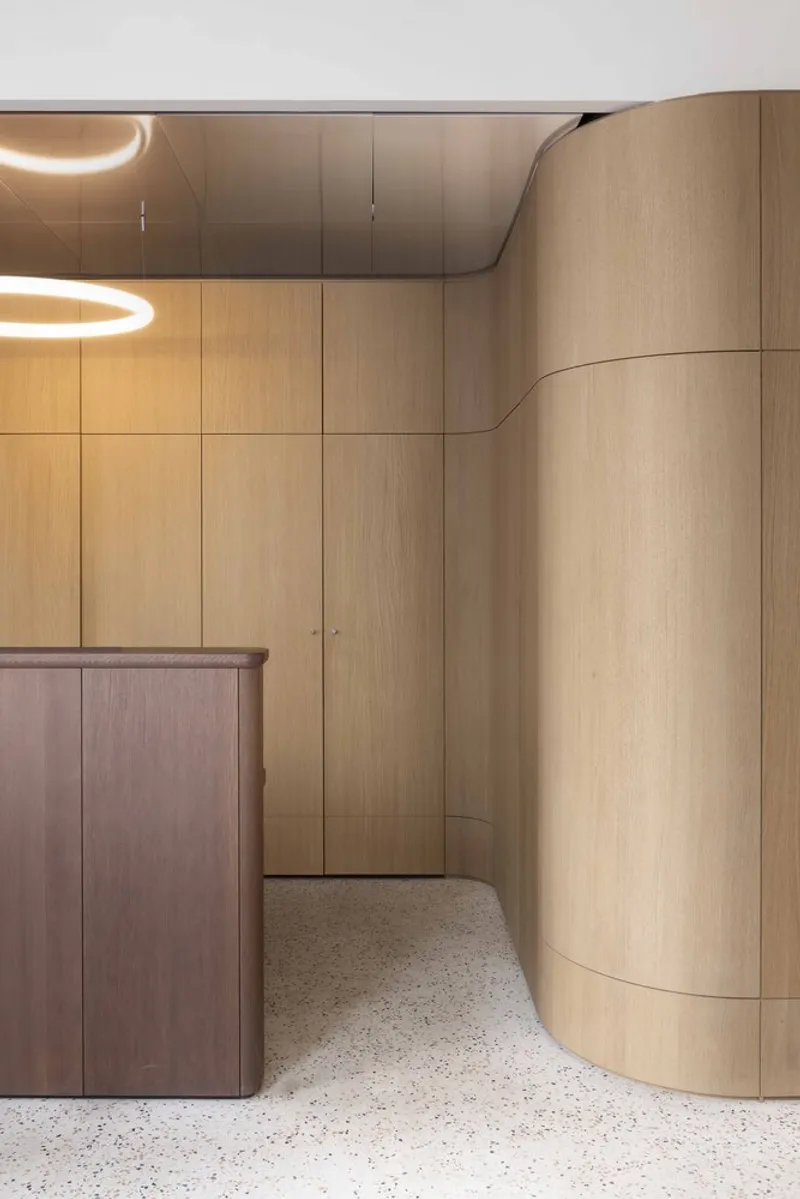
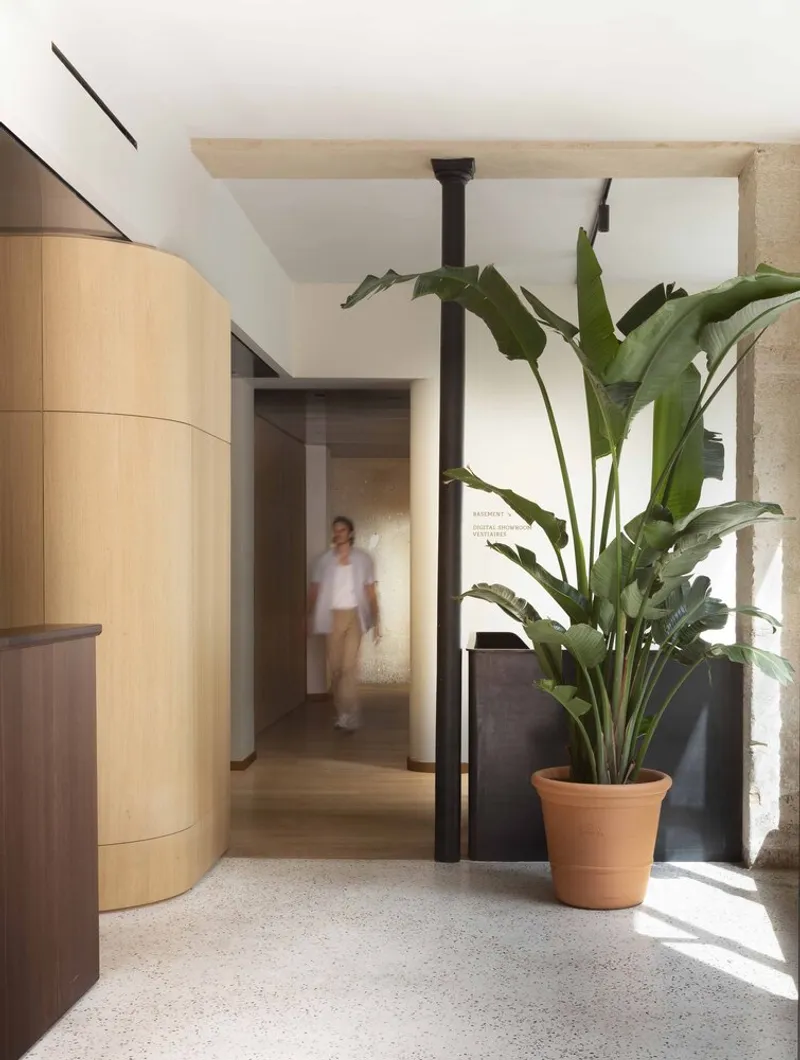
The curved timber wall of the entrance hall channels visitors past a potted palm and into the main volume, establishing from the first steps that this is a space where organic forms and living material are as present as stone and steel.
Retail Layers: Sneakers, Stone, and Herringbone
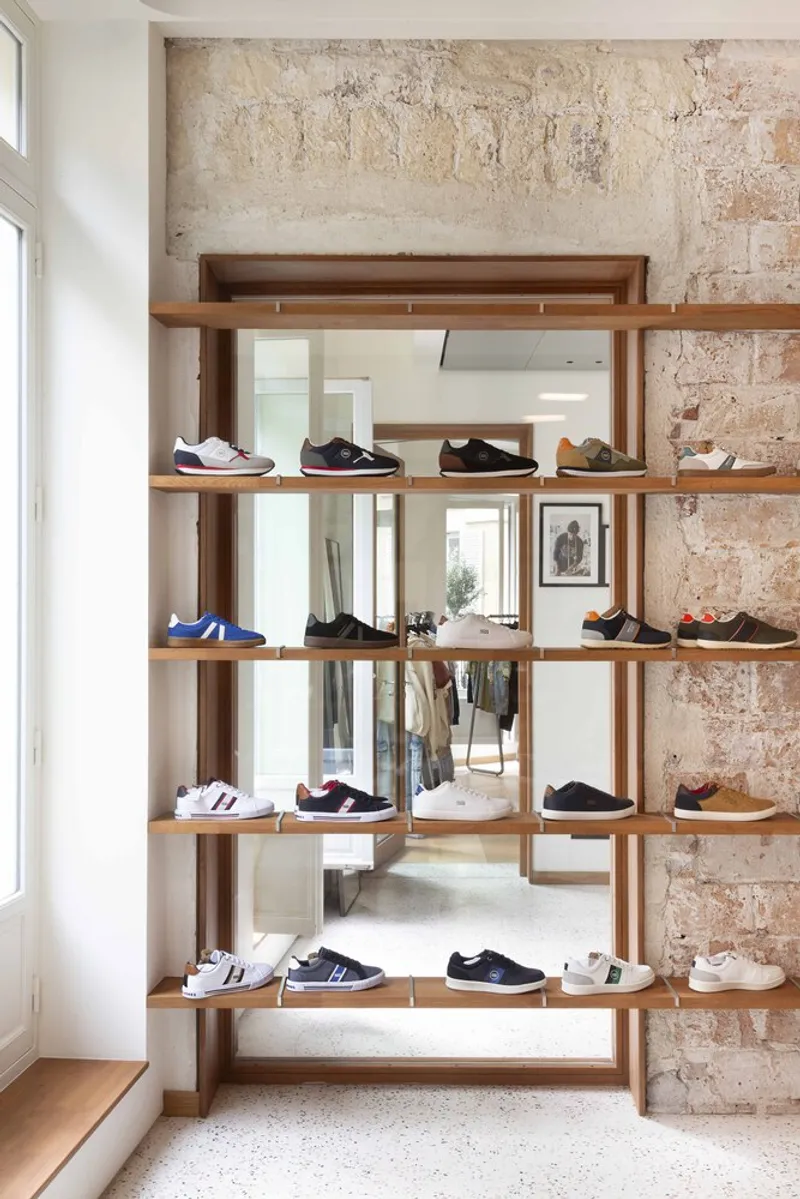
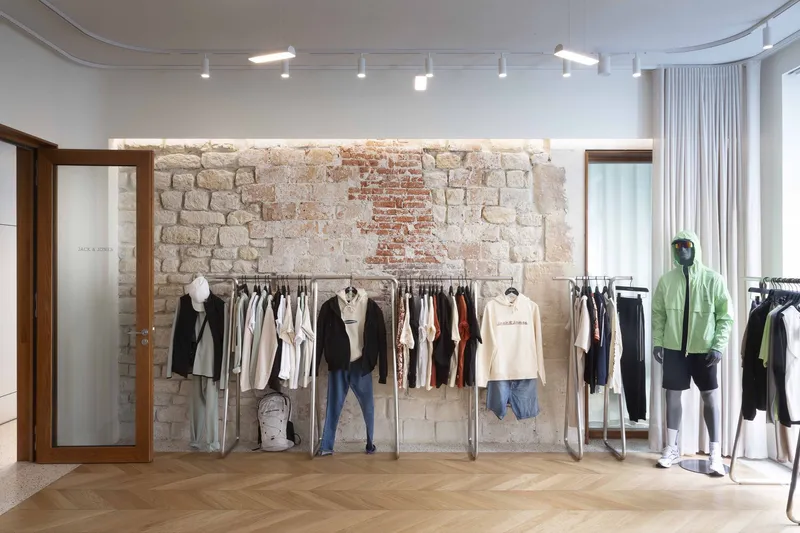
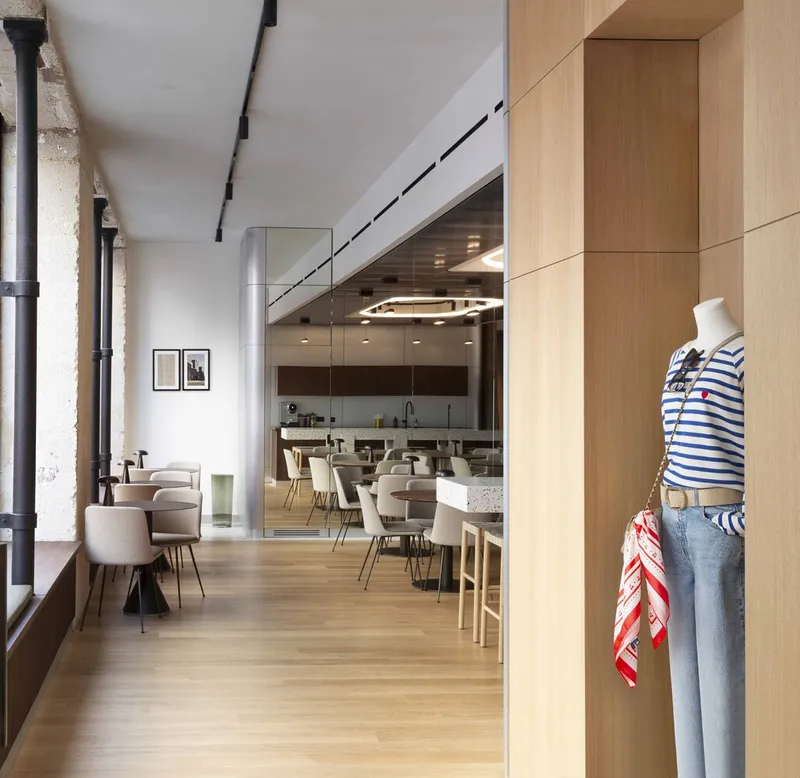
The retail zones lean into the building's raw surfaces. A timber shelving unit displays sneakers against an exposed masonry wall, daylight falling in from a side window and throwing soft shadows across the products. In another room, clothing racks line up beneath exposed stone and brick, with herringbone oak flooring underfoot grounding the space in a domestic warmth that high-end retail rarely achieves.
Walking deeper into the plan, blonde wood flooring leads past exposed stone columns toward café seating under black track lighting. The program blurs: are you shopping, eating, or simply passing through a gallery? The ambiguity is the point, and the original structure facilitates it by offering a sequence of rooms connected through arched openings rather than one open loft.
Vaults and Metal: The Lower Levels
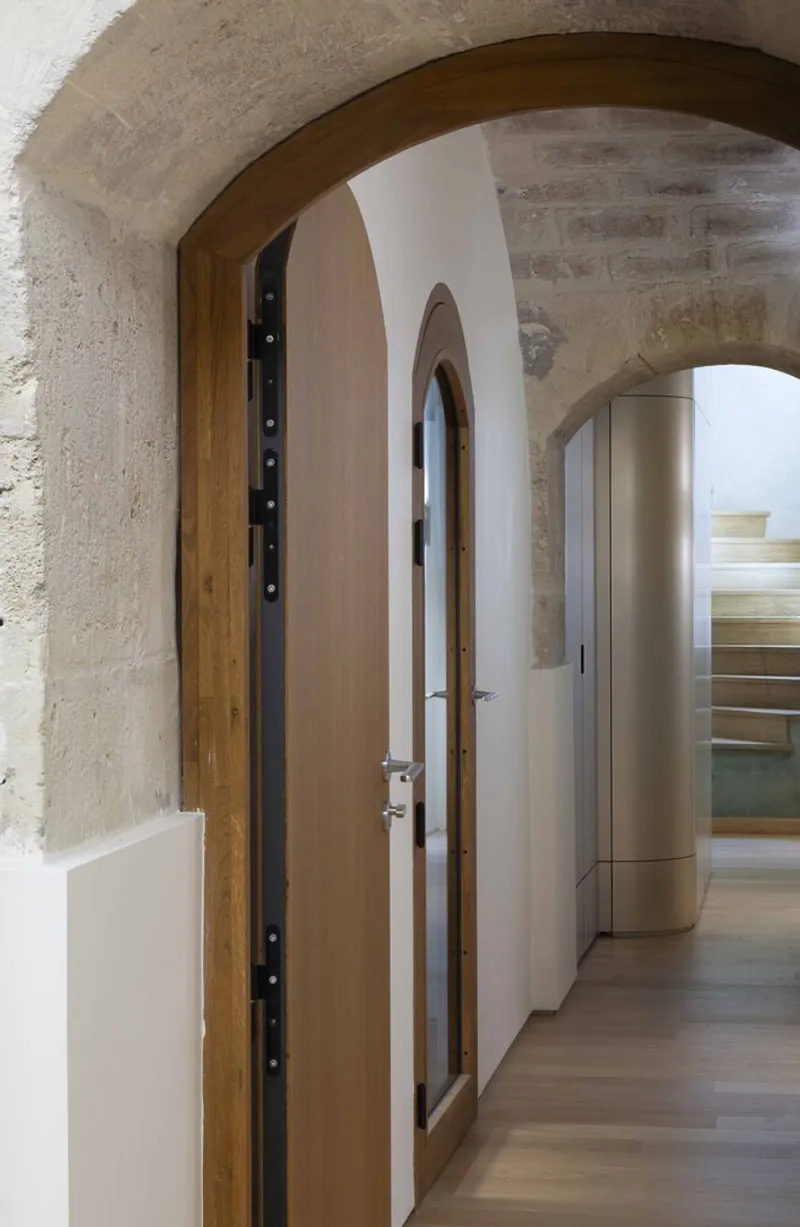
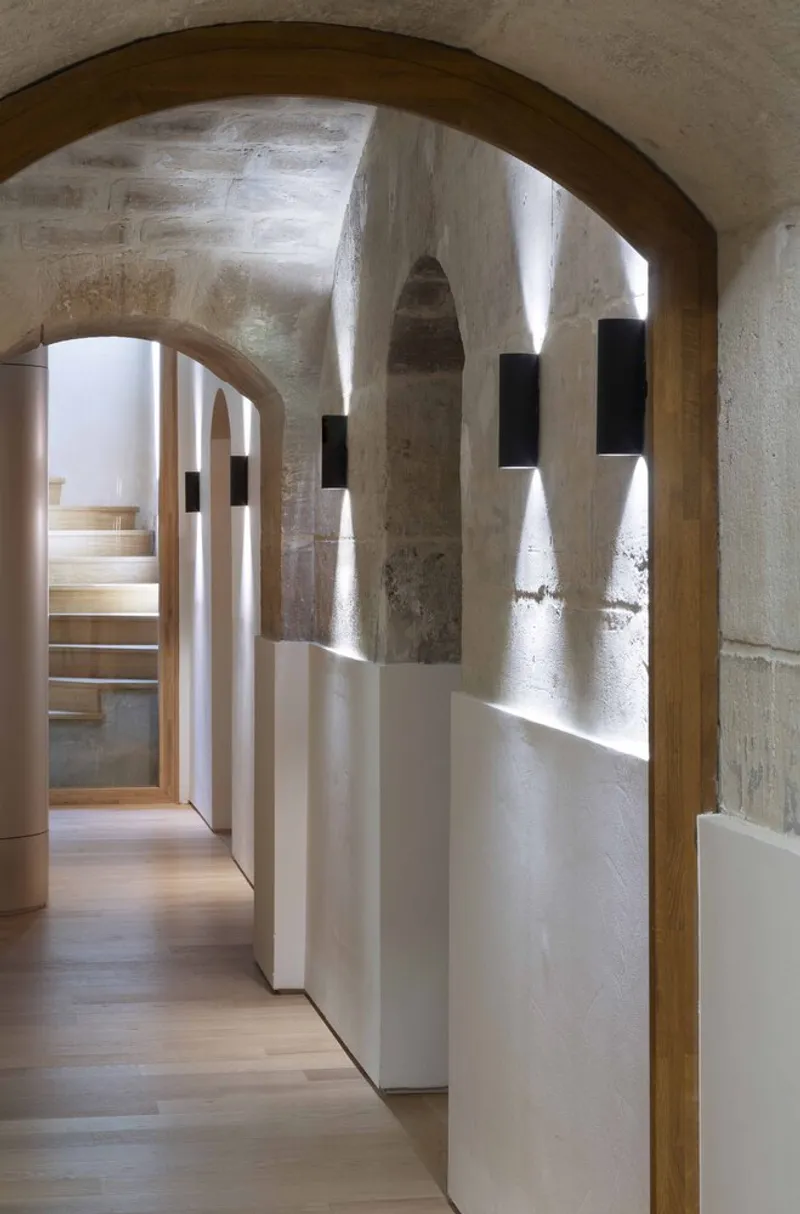
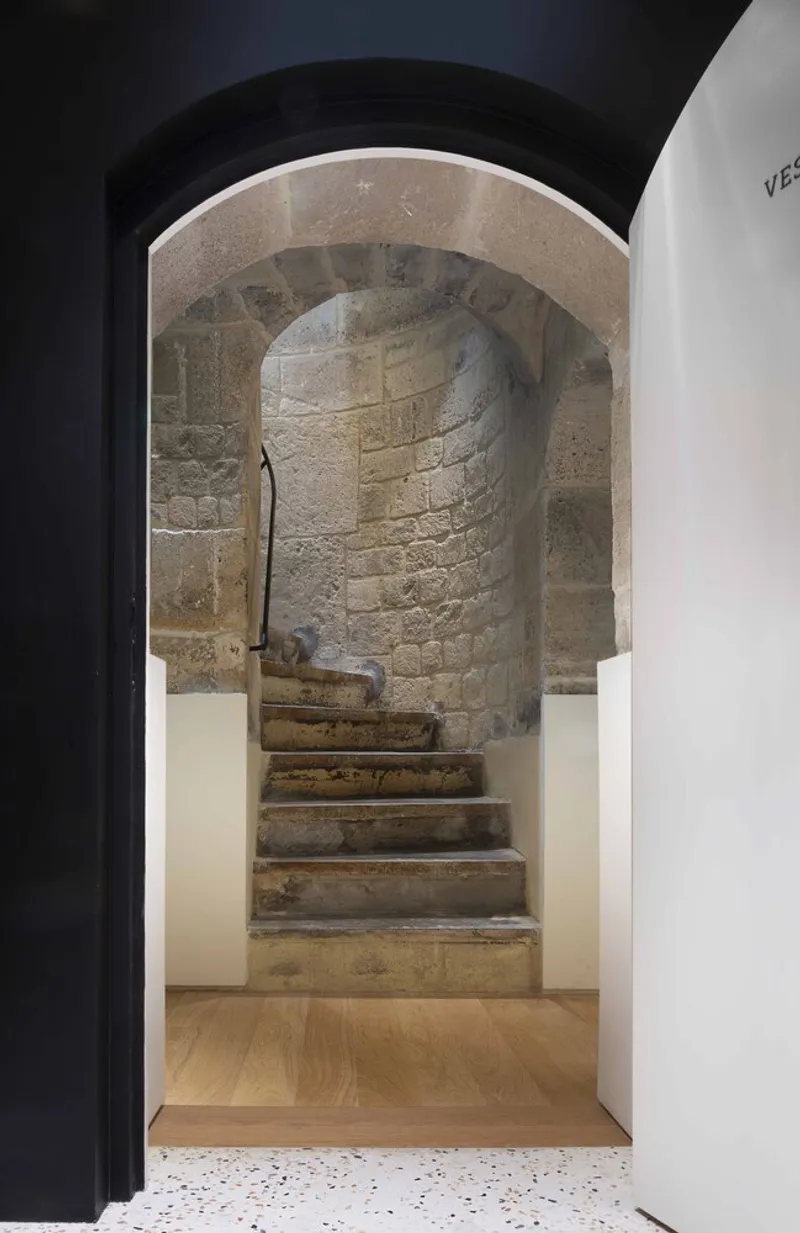
Descending into the building's lower levels reveals barrel-vaulted stone ceilings, arched corridors, and a worn spiral staircase that predates the Haussmann intervention above by what looks like a century or more. Here, Eschalier introduces curved brushed metal panels that line the walls, reflecting the masonry vaults in a soft, distorted shimmer. The contrast between ancient stone and polished aluminum is sharp but not combative. Each material amplifies the other: the metal looks more contemporary for being next to limestone, the stone more ancient for being next to metal.
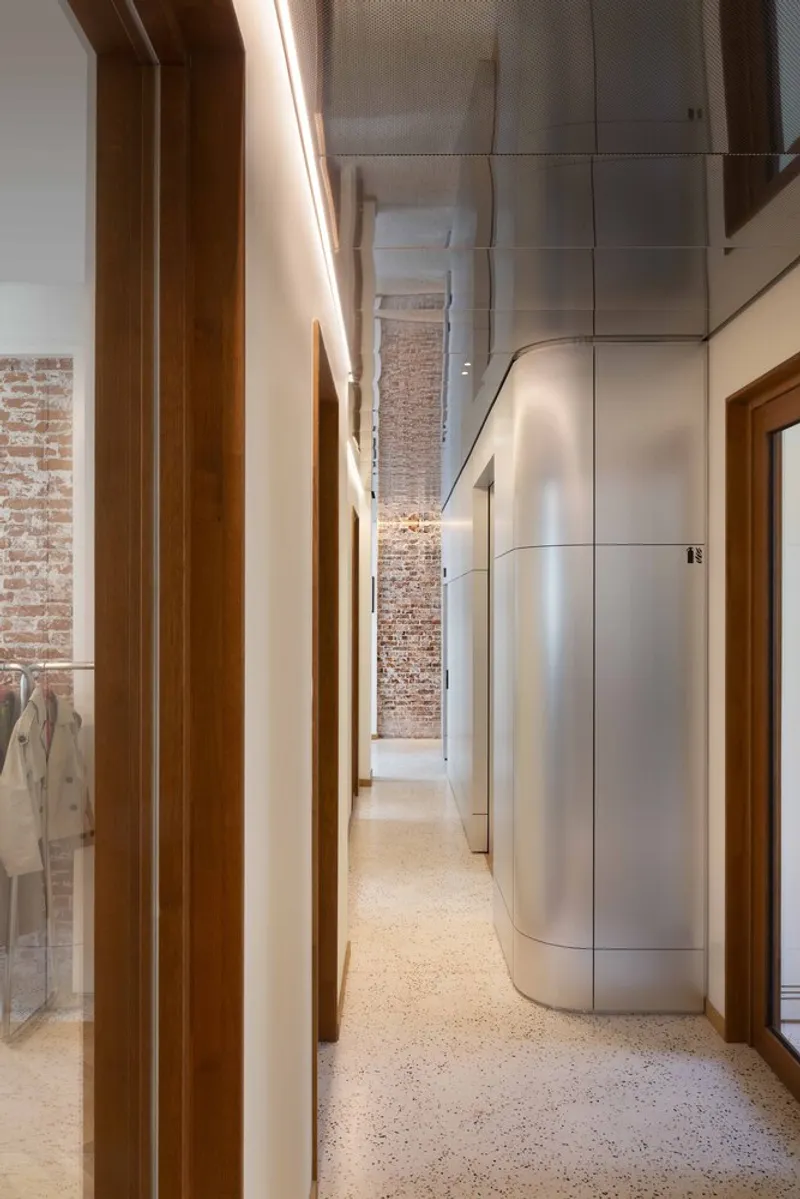
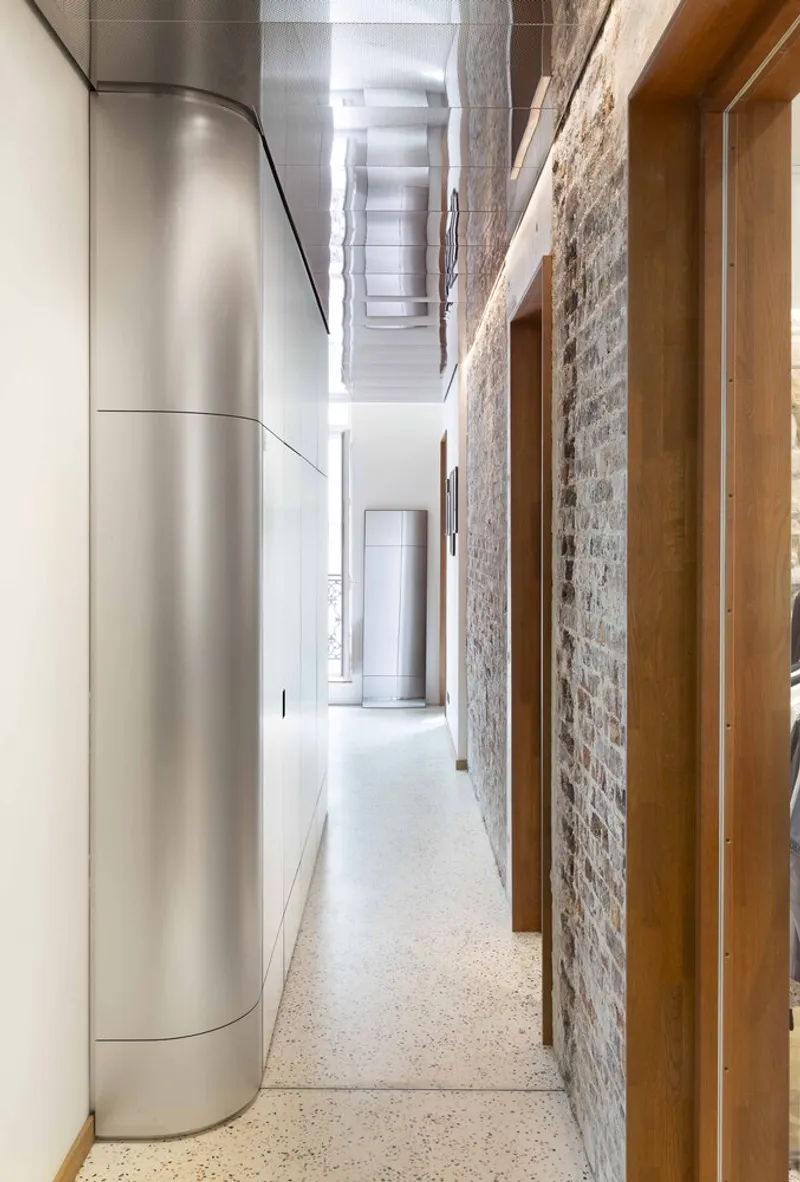
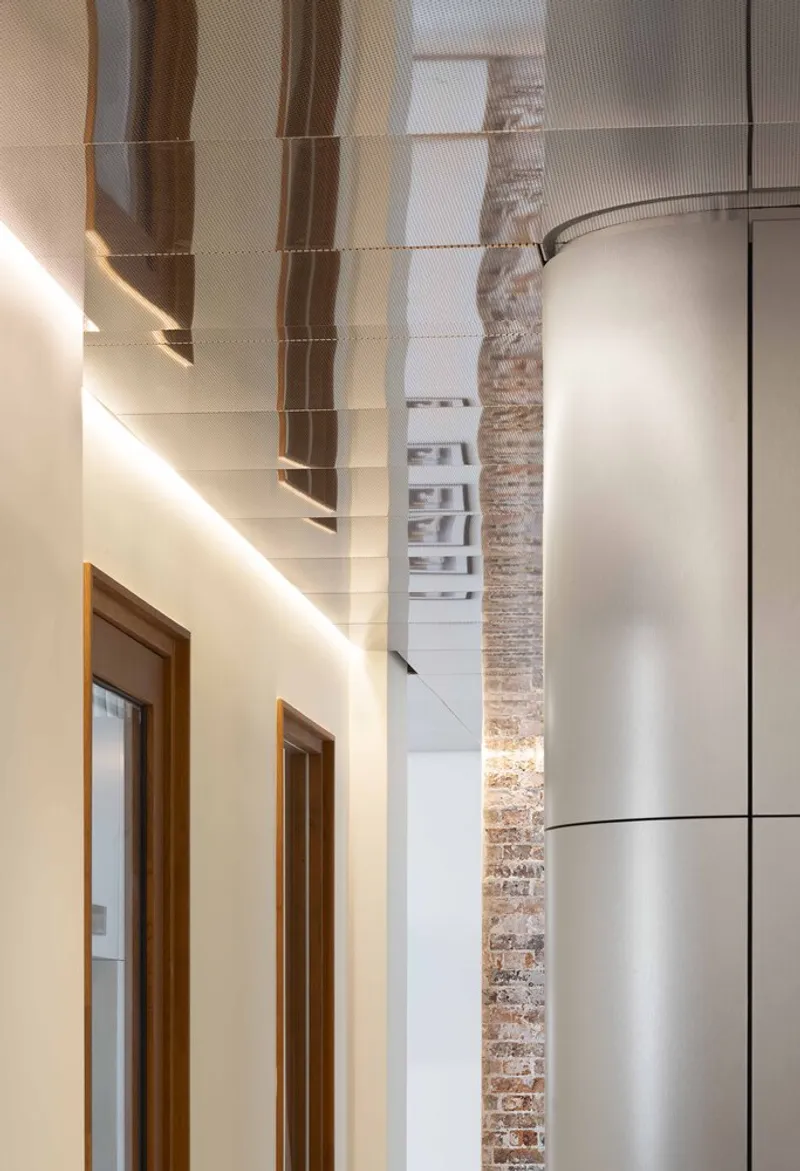
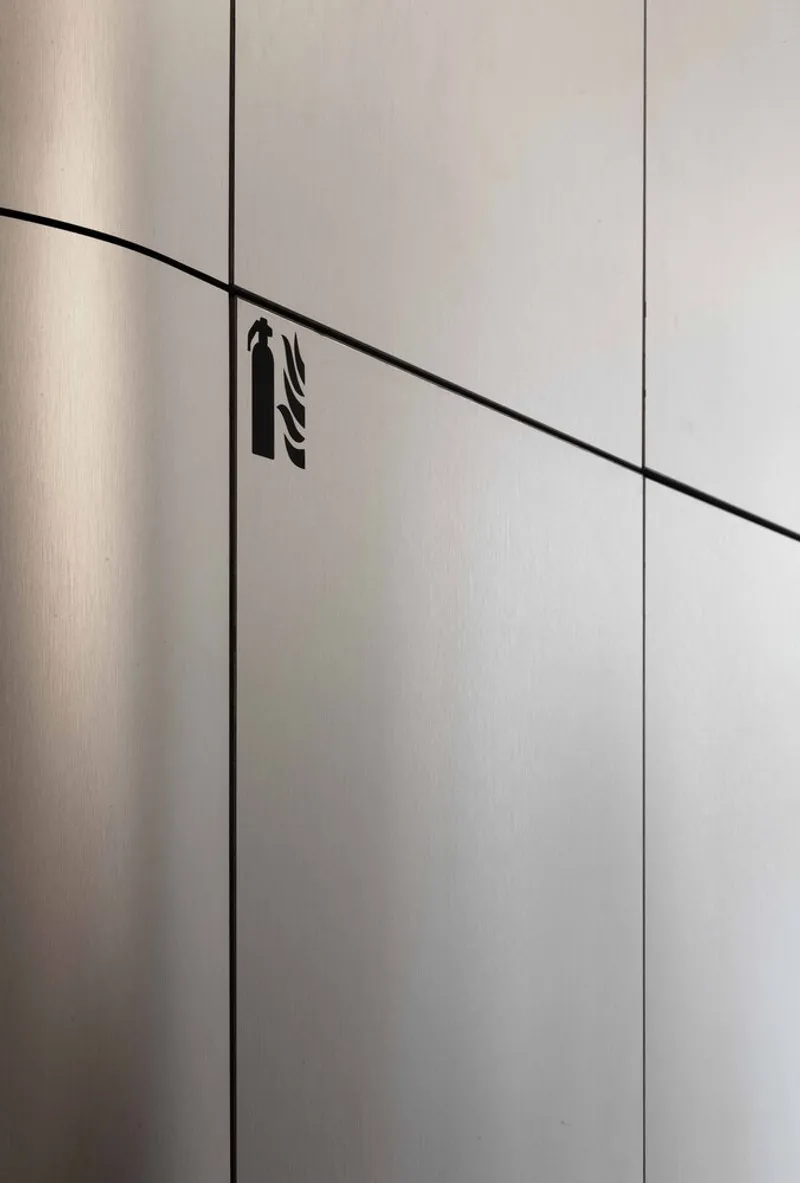
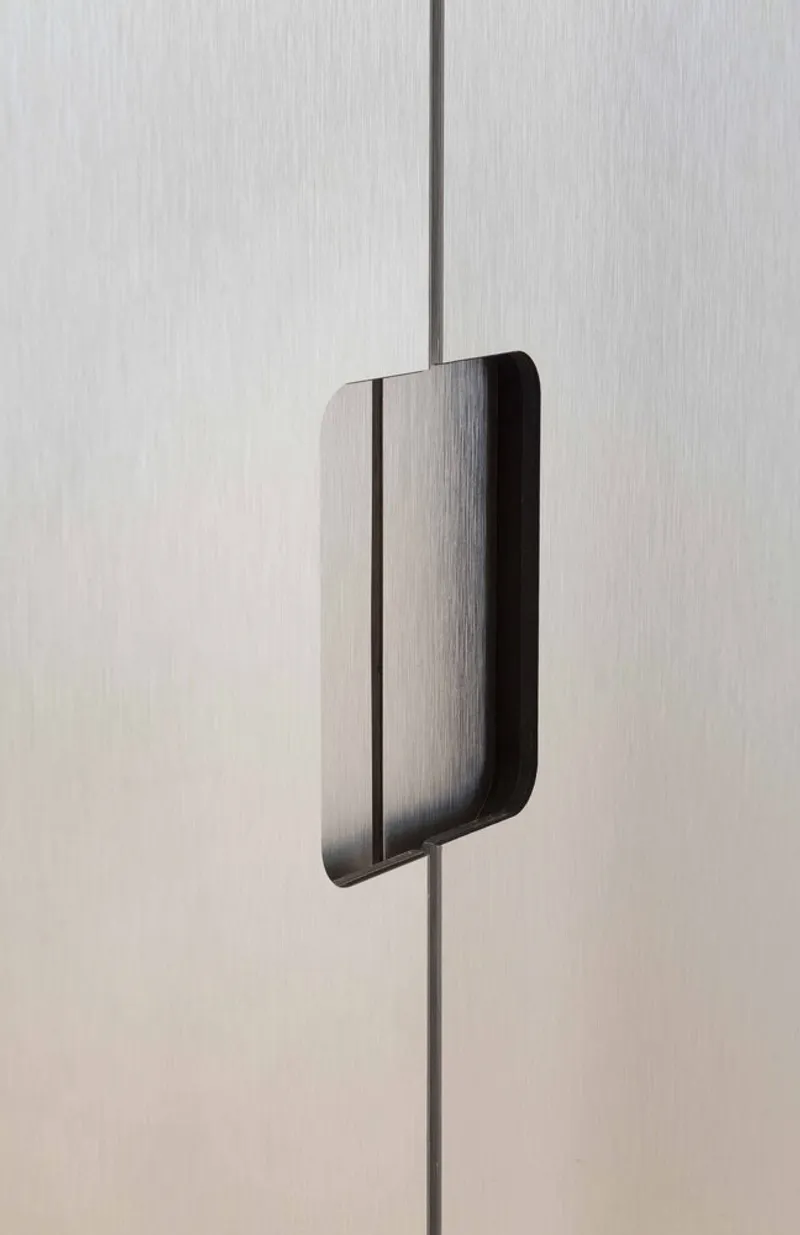
The metalwork detailing is meticulous. Panel joints are expressed rather than hidden, with small wayfinding icons like a stairs symbol aligned to diagonal seams. Door pulls are rounded and flush-mounted, sitting on the aluminum surface with a mechanical precision that plays well against the rough brick and timber door frames they adjoin. The corridor between metal and brick becomes one of the most photogenic sequences in the project, a passage that could belong to a science fiction set were it not anchored by 18th century masonry on one side.
Wellness Under the Arches
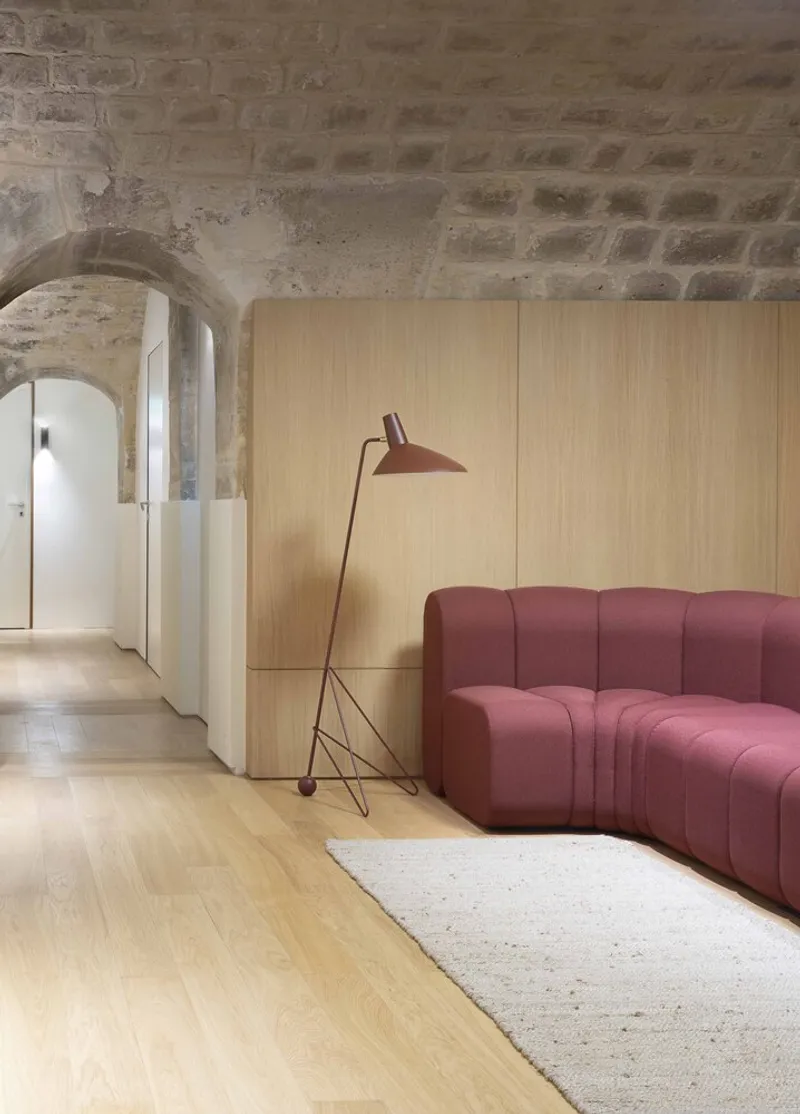
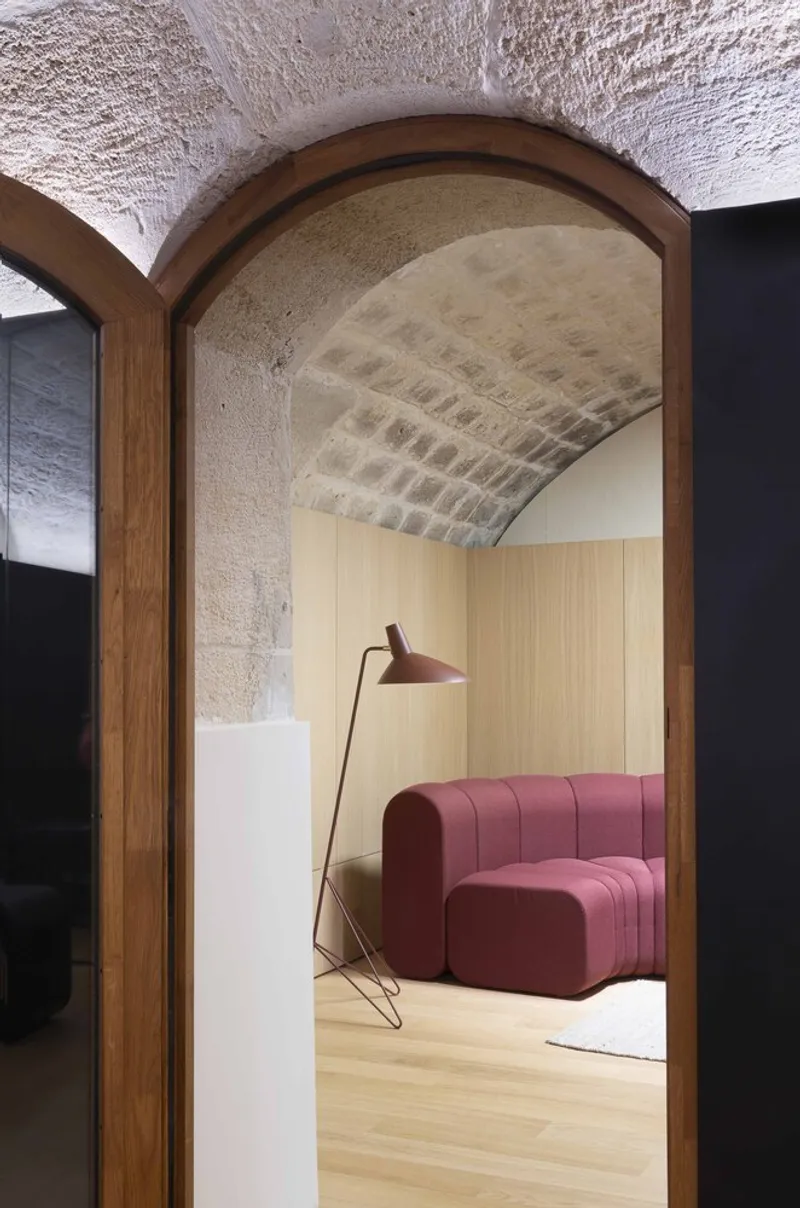
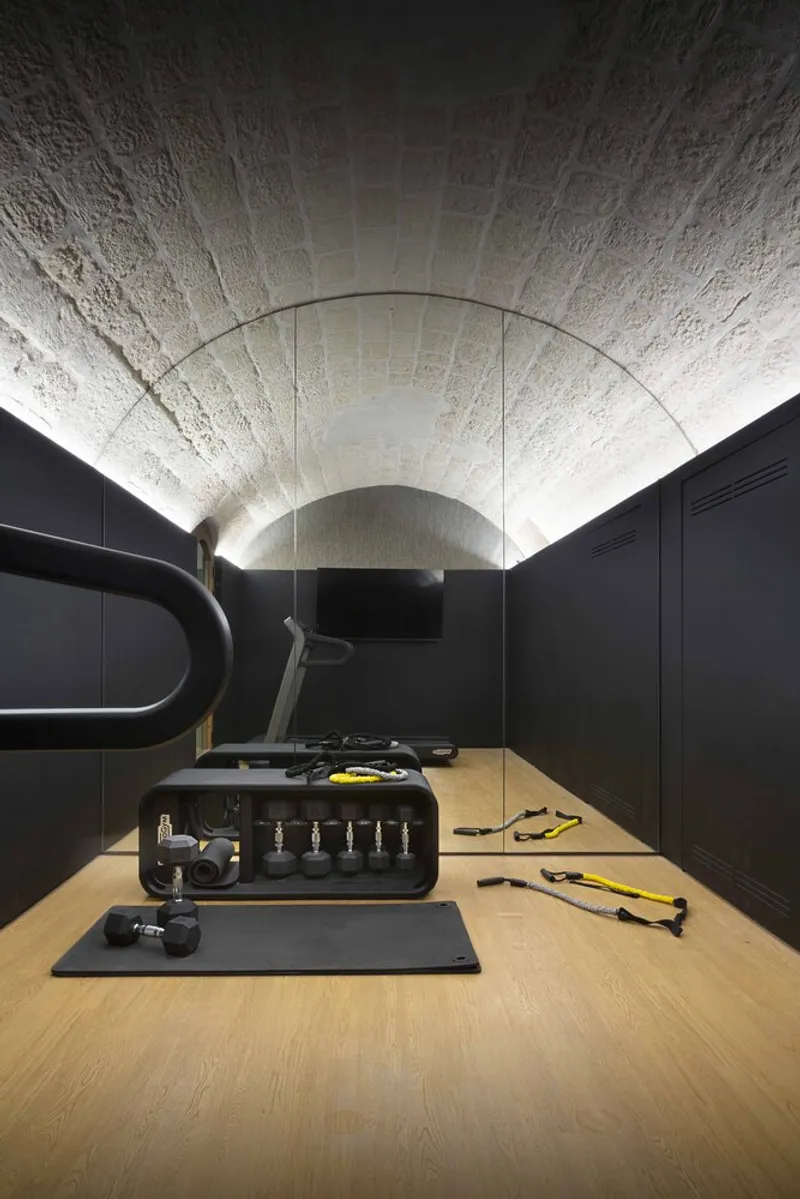
The deepest rooms house a fitness area and shower suite tucked under barrel-vaulted stone ceilings. A pink upholstered sofa placed beneath an arched opening with a floor lamp creates a lounge that feels more like a private apartment than a gym anteroom. The fitness equipment sits under the vaults, flanked by black cabinetry that recedes into shadow, allowing the stone to dominate.
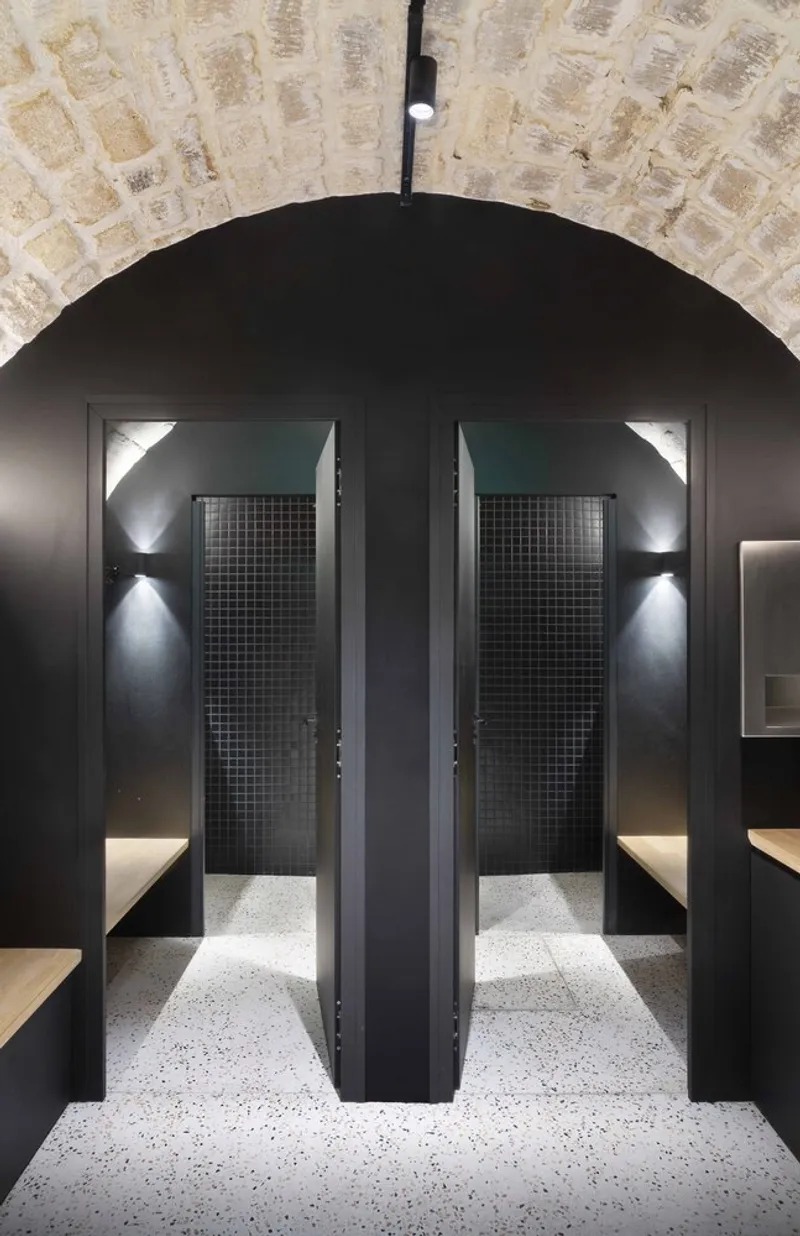
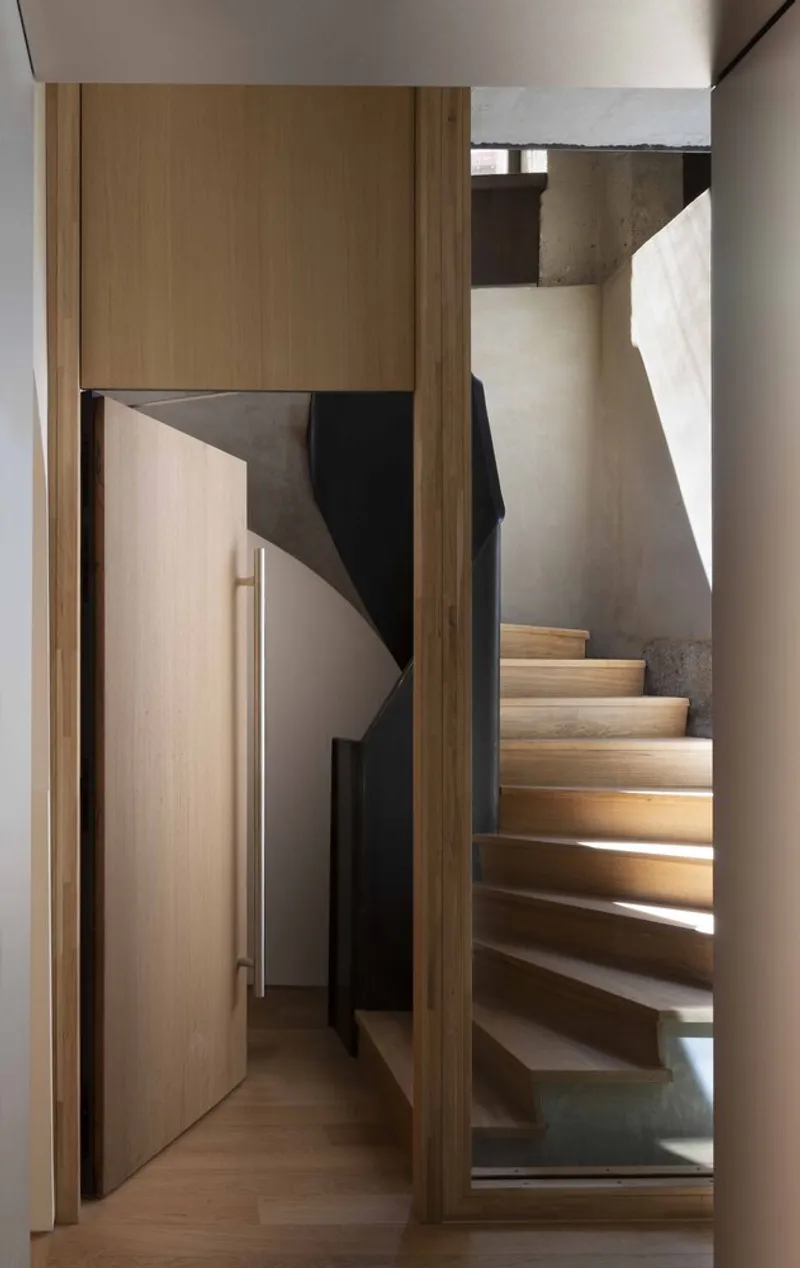
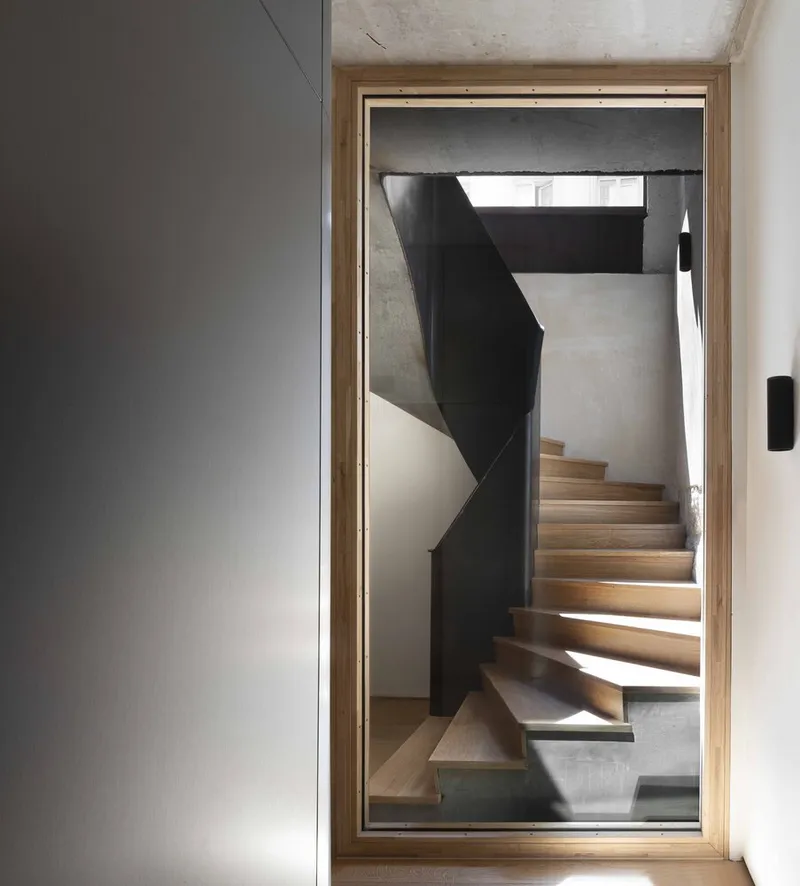
Shower enclosures are framed by a black-painted arched passage, their mesh glass doors catching wall sconce light. The timber-framed stairwell, with illuminated treads rising alongside a concrete wall, provides vertical connection between these subterranean rooms and the showroom above. It is a transition that reinforces the building's sectional depth: from street to vault, from commerce to retreat.
Structural and Spatial Details
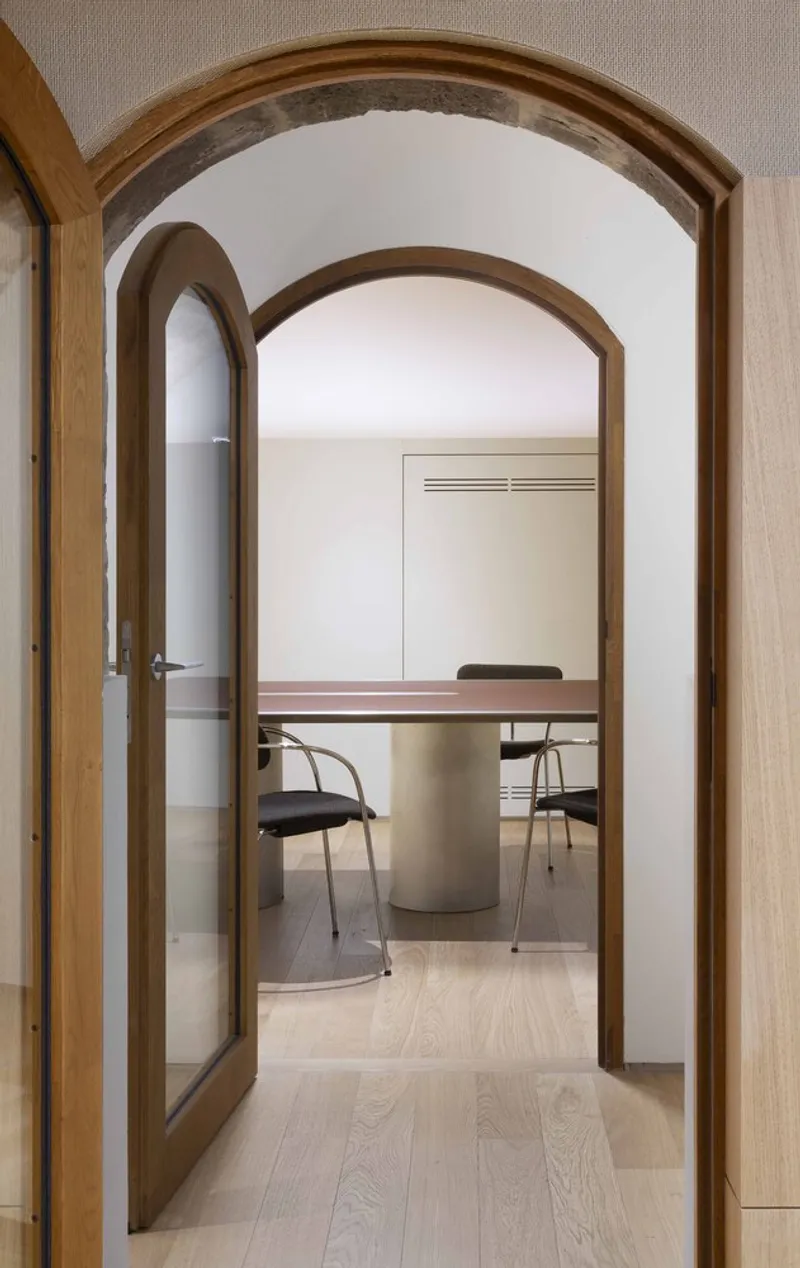
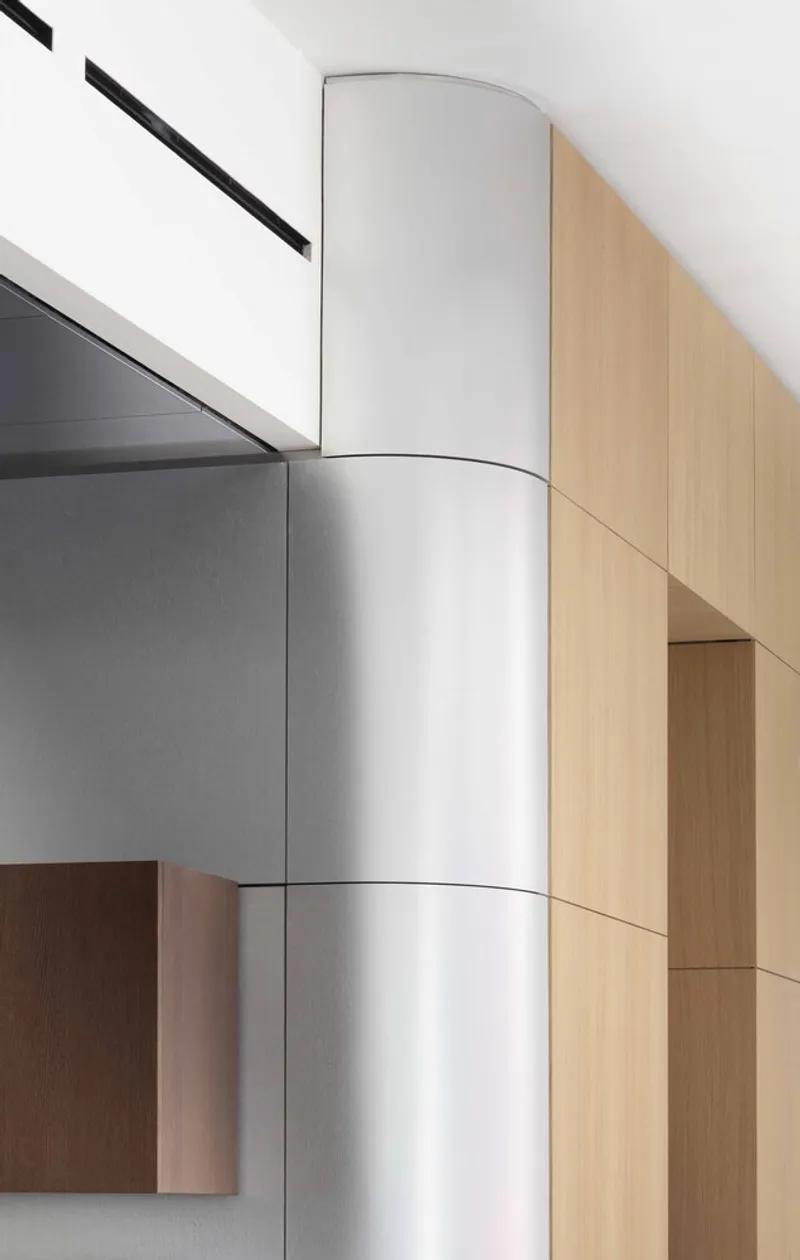
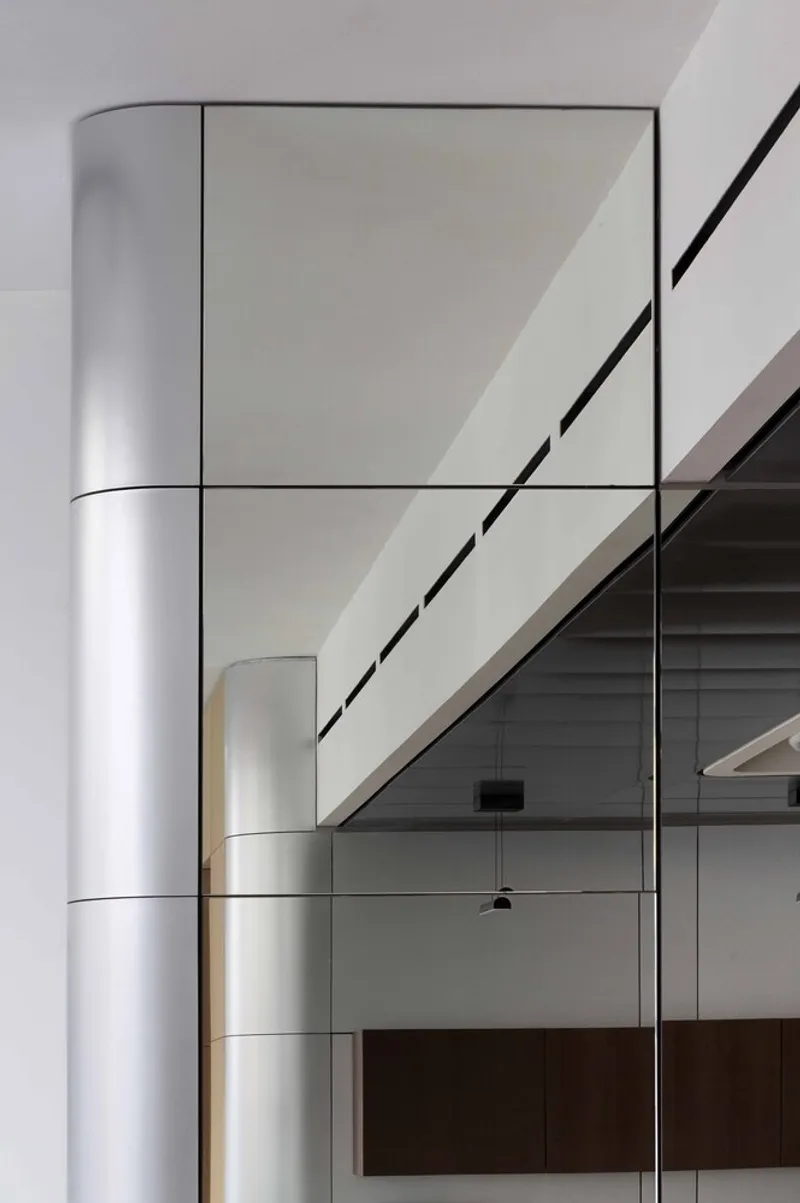
A timber-framed arched doorway opens into a meeting room anchored by a cylindrical concrete-base table, its geometry echoing the white cylindrical columns visible elsewhere. Those columns, with horizontal joint lines between timber and grey paneled walls, are the kind of detail that rewards close inspection: the transition from one material to another is handled as a moment, not a problem to conceal. Beside a glass-railed staircase, a linear skylight washes one such column in daylight, pulling the eye upward and reinforcing the vertical axis that connects all levels of the building.
Why This Project Matters
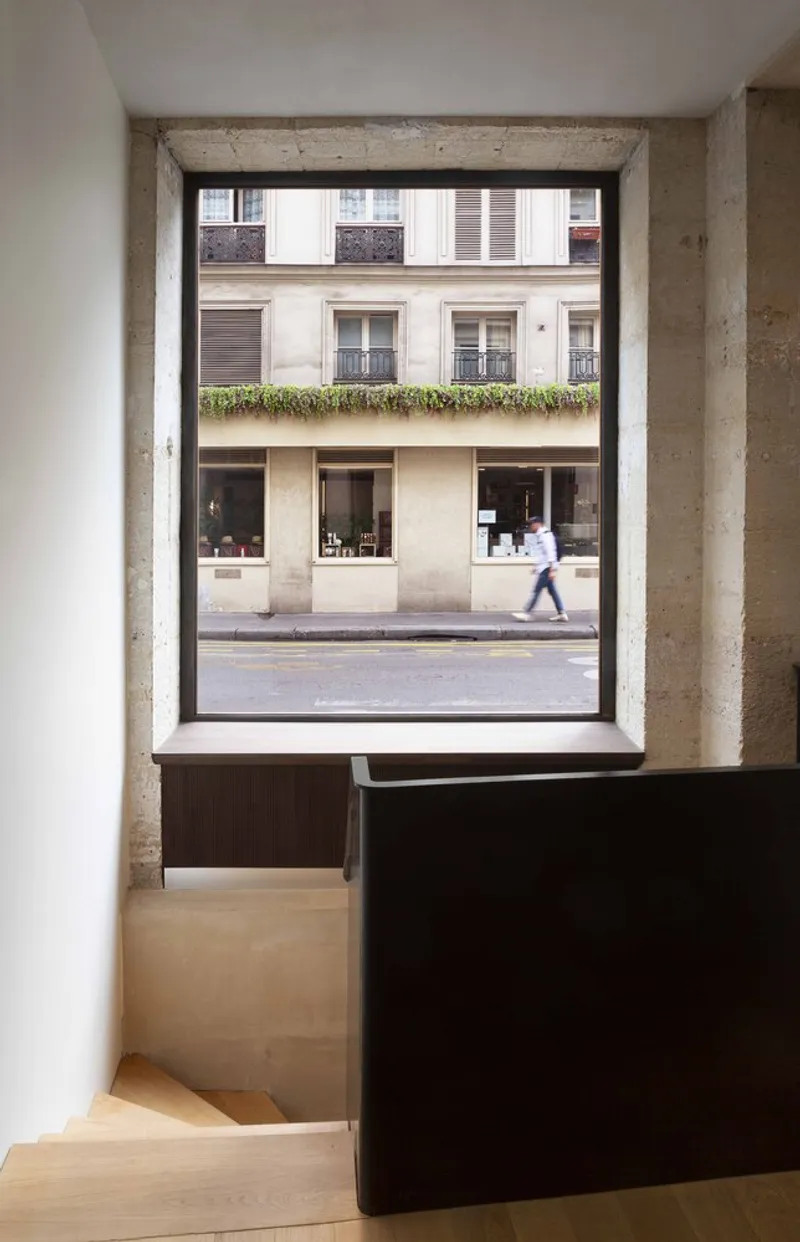
The Provence Showroom matters because it refuses the two most common approaches to working with historic buildings: timid conservation that treats every surface as untouchable, and aggressive insertion that treats the existing fabric as packaging to be ripped away. Eschalier threads between these poles with a material intelligence that reads as genuinely earned. Every intervention responds to what is already there, whether that is a stone column, a barrel vault, or a deep window recess. The palette is small, the moves are legible, and the hierarchy is clear: structure first, then atmosphere, then program.
Beyond technique, the project is also a compelling model for adaptive reuse in the retail and hospitality sector. By layering showroom, café, co-working, and wellness into a single Haussmann shell, it creates a destination that does not depend on any single function to justify its existence. If the retail market shifts, the spaces can absorb new programs because they are defined by architecture, not fit-out. That durability, grounded in stone and light rather than branding, is what separates a renovation that will last from one that will need another renovation in five years.
Provence Showroom by Studio Vincent Eschalier, Provence, France.
About the Studio
Share Your Own Work on uni.xyz
If projects like this are the kind of work you want to make, uni.xyz is a place to publish your own, find collaborators, and enter design competitions.



Popular Articles
Popular articles from the community


Co-Life: Senior Housing Design That Reconnects Older Adults With the City
Co-Life reimagines senior housing design through healing gardens, shared streets, workshops, and a sustainable community across generations.

The Musturak Paradise: Senior Living Architecture for a Connected Future in Temara, Morocco
The Musturak Paradise reimagines senior living architecture in Temara via private homes, social spaces, culture, community, and shared care.
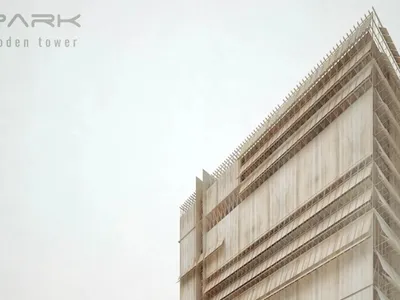
EW PARK: Sustainable Architecture Reimagines the Future of Urban Parking
EW PARK reimagines city parking as a modular wooden tower combining automation, solar energy, electric mobility, and adaptable urban design.

Hill & Cross Opera: Sculptural Opera House Architecture Shaped by Tallinn’s Landscape and Identity
Hill & Cross Opera reimagines opera house architecture in Tallinn through its sculptural hill, civic plaza, glass wave and a luminous cross.

Similar Reads
You might also enjoy these articles


Hodi-Mandai Geram
Project Function: Preservation and revitalization of the Intangible heritage and socio-spatial identity of the Hodi by Housing, Cultural Memory Center, Sacred Grove, landscape, local tourism economy


Olio Towers: A Mid-Rise for Performers That Fuses Housing, Rehearsal, and Stage
Located blocks from Houston's Theater District, this modular tower stacks living units around a central performance atrium.

Oasis: Modular Green Housing Carved into Dhaka's Urban Fabric
A shortlisted Plugin Housing entry reclaims unauthorized settlements in Dhaka with stepped concrete volumes, green roofs, and ventilation-driven design.

Black Hole: A Floating Megastructure for the Post-Physical Era
Emiliano Mazzarotto envisions a spherical, self-scaling arena where e-sports, digital hotels, and holographic stadiums replace traditional public space.


Explore Showrooms Competitions
Discover active competitions in this discipline



Challenge to reimagine the Iron Throne


Photograph architecture without architects


Illustrate the lost glory of Angkor Wat - Render Challenge


Design challenge to reuse E-waste
Comments (0)
Please login or sign up to add comments
No comments yet. Be the first to comment!