
Provencher_Roy and Yelle Maillé Expand a 1926 Montreal Sanatorium with a Sunlit Hospital Wing
A 16,252-square-metre addition to Sacré-Coeur de Montréal Hospital revives the original building's commitment to daylight and nature.


Hospitals grow by accretion. A wing here, a corridor there, a mechanical penthouse nobody planned for. Over nearly a century, Hôpital du Sacré-Cœur de Montréal followed that pattern faithfully, accumulating volumes until its original logic, a sanatorium designed by Dalbé Viau and Alphonse Venne in 1926 to channel sunlight toward tuberculosis patients, was buried under decades of pragmatic additions. The new 16,252-square-metre wing by Provencher_Roy and Yelle Maillé et associés architectes doesn't just add more floor area. It tries to restore the founding premise: that a hospital's architecture can be therapeutic, and that light and landscape are not luxuries but medical instruments.
What makes this project worth studying is how literally it reads the history of its site and then translates that reading into contemporary construction. The original 1926 building placed two wings for tubercular patients at angles calculated to capture maximum sunlight. The new addition borrows the L-shaped wing configuration and the alternating rhythm of solid wall and glass to achieve a similar goal with modern performance standards, balancing LEED-driven envelope efficiency against the imperative to flood interiors with daylight. It is a rare case in which a hospital expansion project treats its heritage context not as a design constraint but as an operating manual.
Facade as Energy Strategy

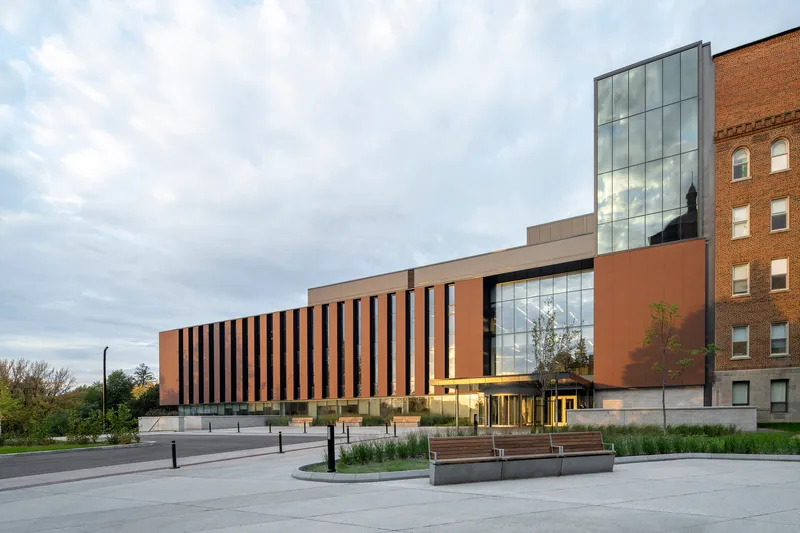
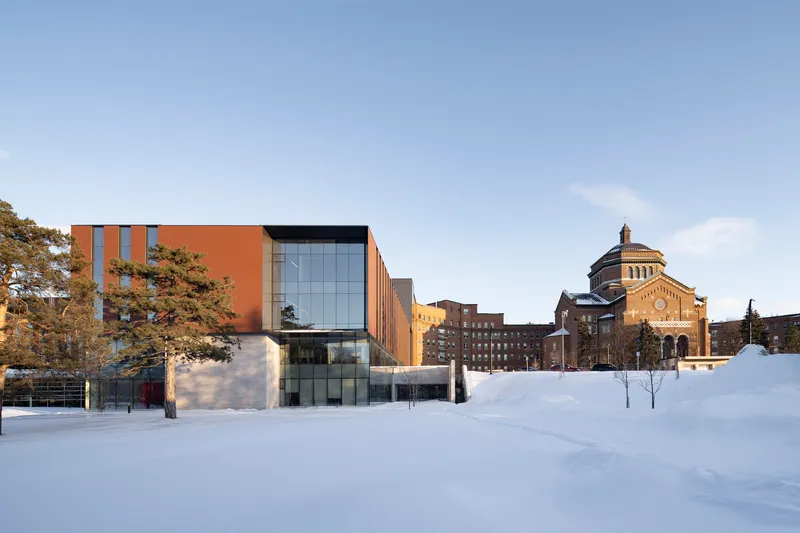
The defining gesture of the addition is its facade: alternating vertical bands of copper-toned solid masonry and glass curtain wall that wrap the patient block like a barcode. The composition does two things at once. First, it echoes the materiality and vertical proportions of the original heritage building without mimicking it. The masonry is deliberate, not decorative, tying the new wing to the 1926 brick volumes visible across the campus. Second, the banding solves an energy problem. By interleaving opaque insulated panels with glazing, the architects achieve a high-performance envelope that still delivers the natural light healthcare environments demand.
Seen at dusk or in winter light, the facade gains a quiet authority. The copper panels warm as the light shifts, while the glass strips glow from within. It is a controlled palette, two materials and a rhythm, but the proportional system keeps it from feeling monotonous. The solid-to-glass ratio changes subtly across the length of the wing, responding to program: more glass where waiting rooms and lounges need views, more masonry where mechanical shafts and service corridors sit behind.
Campus Legibility from Above
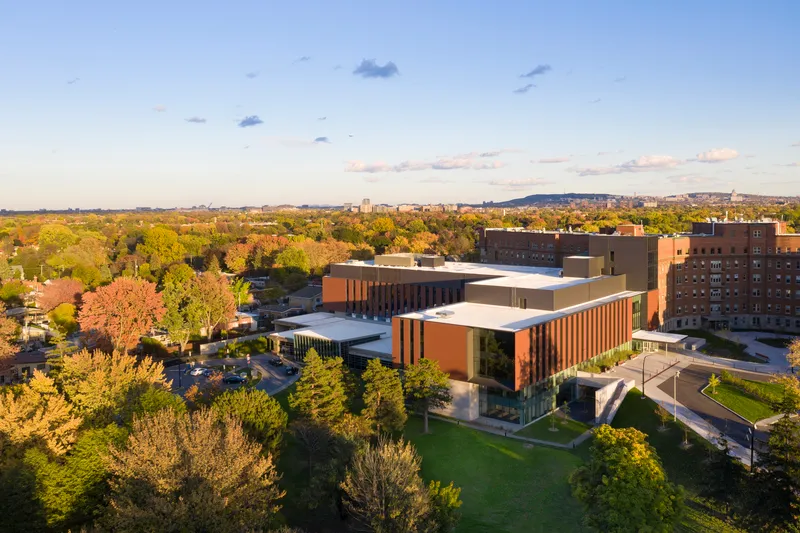
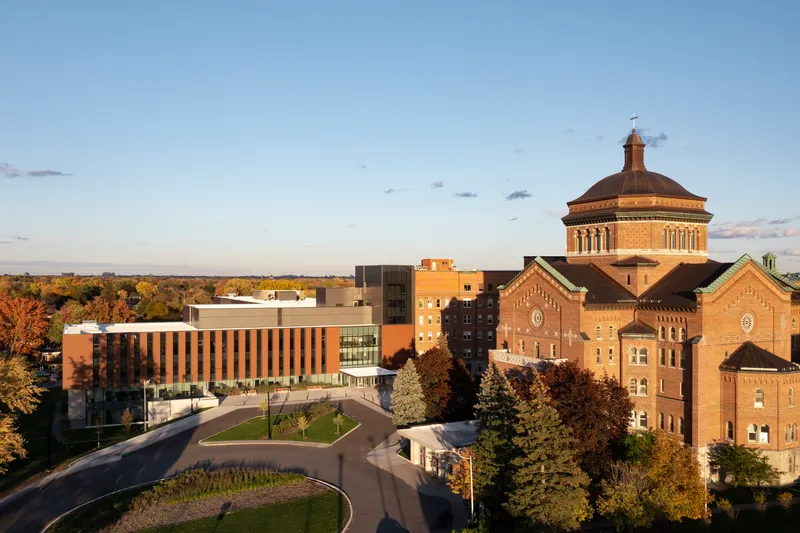
The aerial views reveal the real complexity of this project. Sacré-Cœur is not a single building; it is a campus that has grown outward from its original footprint in Cartierville over the course of nearly a hundred years. The new volumes sit among existing structures and a mature autumn tree canopy, and the white roofs read cleanly against the foliage, giving the addition a distinct identity without shouting over its neighbours. The L-shaped plan is clearly legible from above, and you can trace the long circulation artery that stitches the historic brick buildings to the new wing.
The site strategy is generous. Rather than consuming every available square metre of ground plane, the design preserves and extends the pastoral character that distinguished Sacré-Cœur from downtown hospitals when it was first built far from the city centre. Landscaped zones with greenery and public seating occupy the gaps between volumes, reinforcing a campus reading that treats the outdoors as an extension of the therapeutic program.
Interiors Built Around Daylight
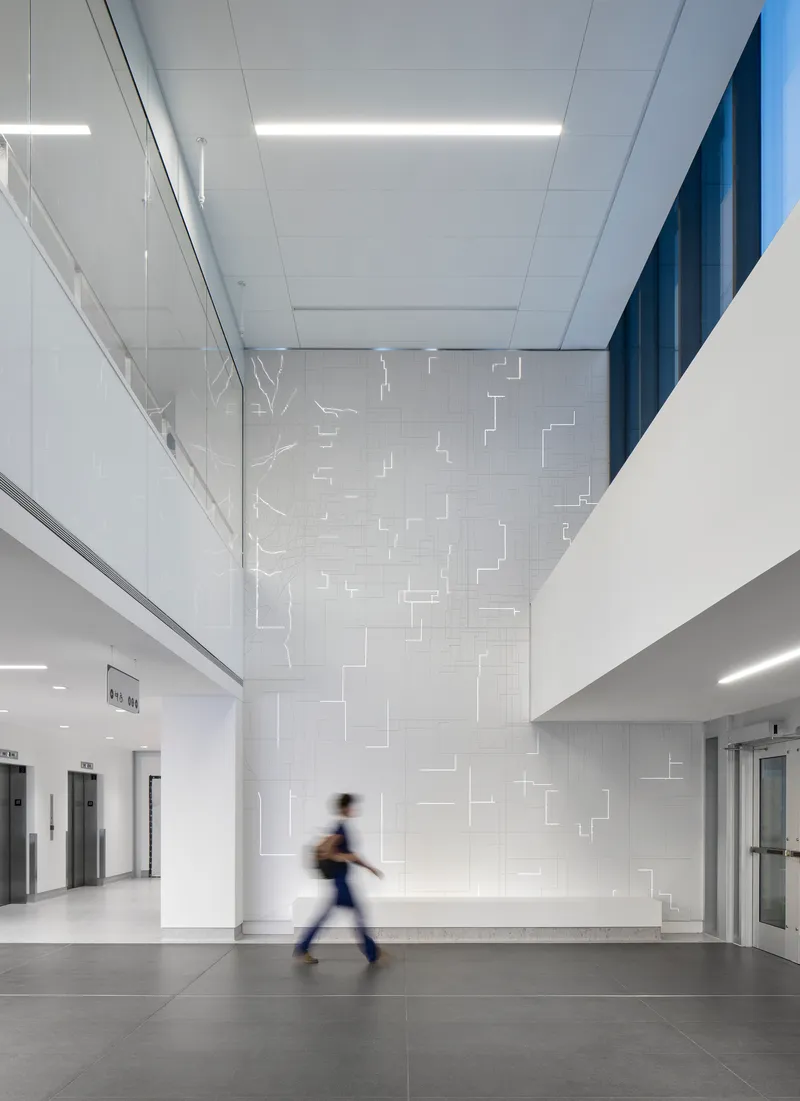


Inside, the design argument is consistent: daylight first, everything else second. The double-height lobby with its white geometric relief wall acts as a light well, pulling illumination deep into the plan. Waiting areas line up against floor-to-ceiling windows that look out onto green landscape, turning what is typically the most anxious room in any hospital into something closer to a lounge. A classroom or meeting space on an upper level opens onto a landscaped courtyard framed by the adjacent heritage brick building, establishing a visual dialogue between old and new that staff and patients experience daily.
The material palette inside is deliberately restrained. White tile, white casework, pale ceilings. The austerity is not cold; it is strategic. In a building that relies on natural light as a primary design element, neutral surfaces amplify that light rather than competing with it. The wood accents that appear in select interiors provide warmth without cluttering the visual field. For a building housing a trauma centre, maternity unit, endoscopy and cardiology departments, the calm is earned.
Clinical Corridors and Work Zones
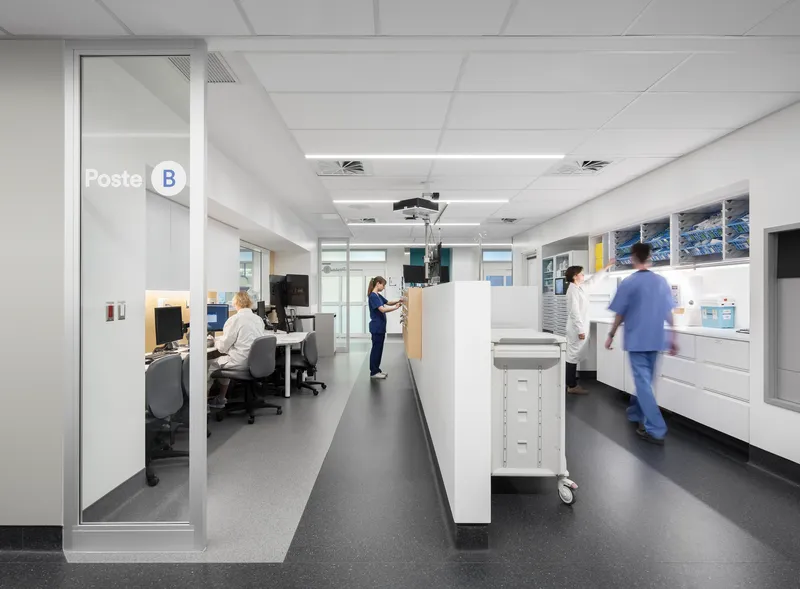

The workstation corridors and reception areas show the practical discipline required in healthcare architecture. Suspended tile ceilings conceal a dense matrix of mechanical, electrical, and plumbing infrastructure. White casework lines the corridors, keeping instruments and supplies within arm's reach while maintaining visual order. The blurred figures of medical staff moving through these spaces are a reminder that a hospital lives or dies by its circulation logic, and the long artery connecting the expansion to the existing campus is designed to minimize travel distances for caregivers.
Reception desks occupy one side of a corridor flooded with reflected light, an arrangement that gives administrative staff sightlines down the length of the wing. It is a quietly efficient layout that avoids the cul-de-sac problem plaguing many hospital additions, where new wings become dead ends rather than integrated circuits.
The Ground Plane and Landscape
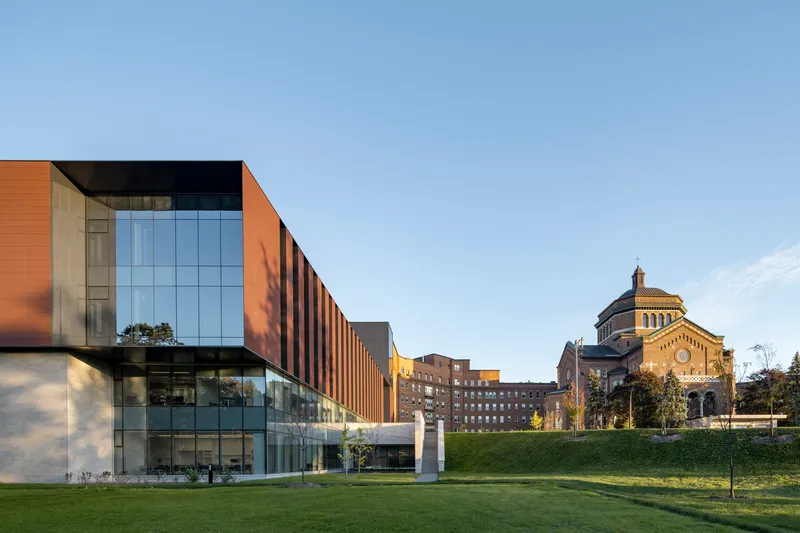
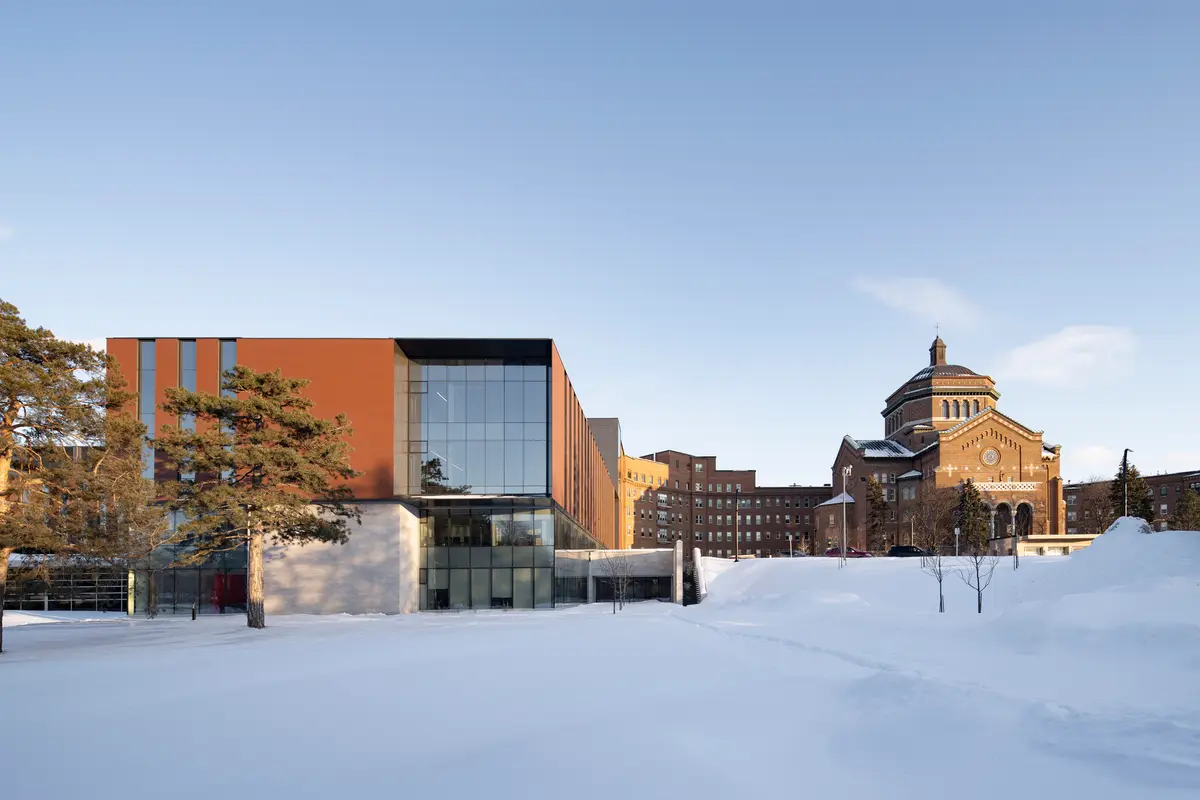
At ground level, the copper-toned upper volume appears to float above a glazed concrete base, a move that lightens the mass of the patient block and opens the lower levels outward toward landscaped gardens. Concrete plaza benches and low planting beds create an informal public realm between the building entrance and the street. The sloping lawn in front of the east facade, with the dome of the original chapel visible in the background, establishes a long view that ties the addition back to the institutional memory of the campus.
Landscape architect Vlan Paysages shaped these outdoor spaces as extensions of the interior waiting and lounge zones. Patients, families, and staff can move between indoor and outdoor seating without crossing a threshold that feels institutional. For a hospital originally conceived as a place where fresh air and sunlight were the primary treatments, this continuity between inside and out is not just aesthetic. It is a direct lineage.
Plans and Drawings
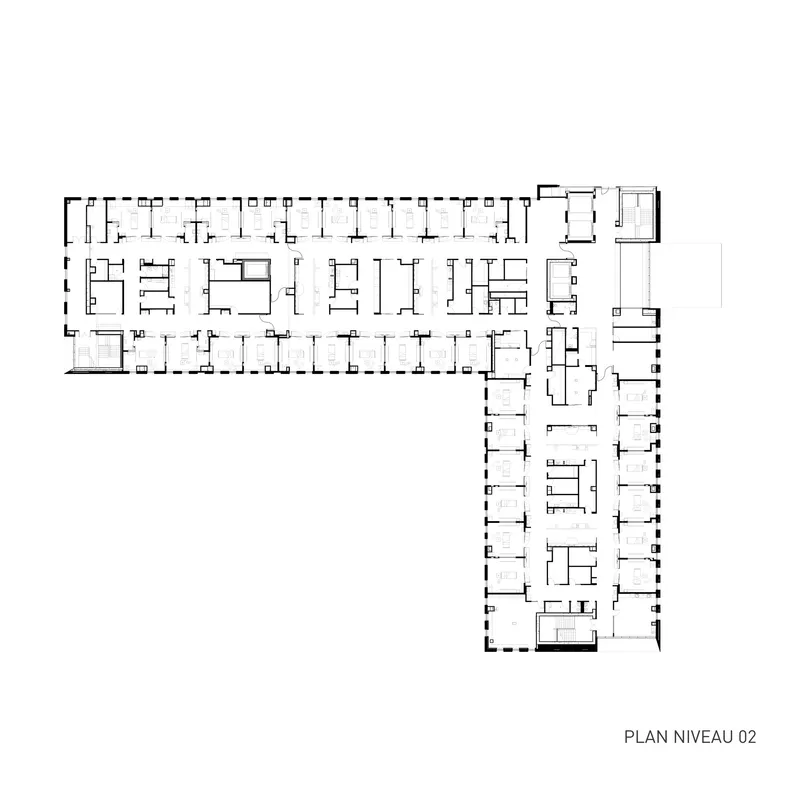
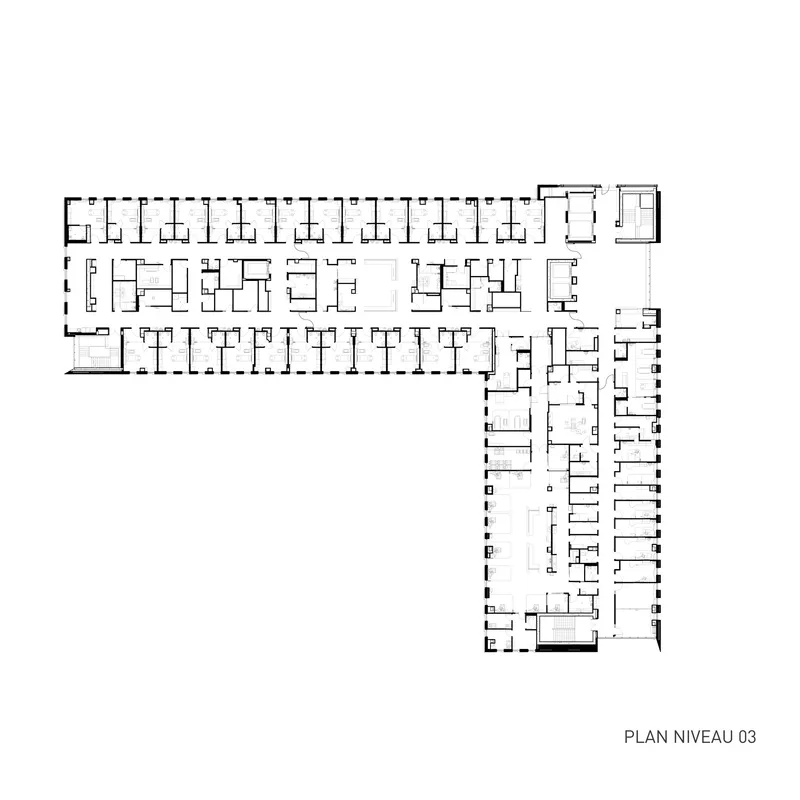


The floor plans across multiple levels confirm the L-shaped configuration: a long wing of repetitive patient rooms along the perimeter, served by a perpendicular circulation bar that connects to the existing campus. The cellular room layout places every patient bed adjacent to an exterior wall, guaranteeing daylight and a view. The ground floor plan reveals a more open arrangement, with communal waiting zones, cafes, and lounges organized around the landscaped courtyards.
The section drawing cuts through the central staircase and shows the cantilevered patient block hovering above the lighter, more transparent lower floors. The structural logic is clear: heavier, more private program sits above, while the ground plane remains porous and public. The two axonometric drawings are especially revealing. One isolates the new massing in pink, making legible how much building has been added and exactly where it sits relative to the existing structures. The curved facade fragment visible in the axonometric corresponds to the earlier emergency department expansion that Provencher_Roy completed in 2008, showing how the firm has shaped this campus over more than a decade.
Why This Project Matters
Hospital expansions rarely attract architectural attention because the constraints, infection control, code compliance, equipment logistics, are so punishing that most projects default to the cheapest possible box. Sacré-Cœur resists that gravity. By grounding its design decisions in the specific history of the site, a 1926 sanatorium that treated sunlight as medicine, the architects found a framework that justified every move: the banded facade, the L-shaped plan, the landscaped courtyards, the transparent ground plane. None of it is arbitrary. All of it traces back to a clear reading of what the campus was meant to be.
The larger lesson is about institutional time. Provencher_Roy first worked on this campus with the 2008 emergency department. Fourteen years later, they returned alongside Yelle Maillé to add this wing, and the design anticipates further growth. Buildings that serve public health operate on generational timescales, and the best hospital architecture is the kind that makes the next addition easier, not harder. By restoring the campus logic and leaving clear connection points for future wings, this project treats the hospital not as a finished object but as an ongoing infrastructure. That is exactly what it needs to be.
Sacré-Coeur de Montréal Hospital, designed by Provencher_Roy and Yelle Maillé et associés architectes. Located in Montréal, Canada. 16,252 m². Completed in 2022. Photography by Olivier Blouin and Stéphane Brügger.
About the Studio
Share Your Own Work on uni.xyz
If projects like this are the kind of work you want to make, uni.xyz is a place to publish your own, find collaborators, and enter design competitions.


Popular Articles
Popular articles from the community


Tenter Studio Steps a Valle de Bravo Holiday House Down a Slope Around a Void Built for Pausing
In Valle de Bravo, Mexico, two dark brick volumes descend a steep plot and frame a deliberate gap, keeping the landscape quiet rather than staged.

Some Thoughts Clamps Felt and Metal Together to Build a Modular Eyewear Store in Wuhan
A 98 m² MOLSION eyewear shop in Wuhan builds its displays from stacked red and grey felt modules held by custom triangular metal fasteners.

longwave studio Reorganizes a 112 m² Tainan Apartment Around the Daily Routines of a Family and Two Cats
In Tainan, Taiwan, birch plywood, rust-red furniture and a freestanding plaster wall link arrival, storage, work and family life in one apartment.

andblack design studio Wraps a Three-Generation Ahmedabad Home Around a Planted, Skylit Central Courtyard
In Ahmedabad, a 9,910 sq ft house uses exposed concrete, brick jali and a skylit green court to give three generations both distance and closeness.

Similar Reads
You might also enjoy these articles


LAVA Architecten Gives Vocational Education a Sawtooth-Roofed Face on a Mechelen School Campus
In Mechelen, Belgium, a 2,053 m² STEM school on a 6×6 m grid turns workshops and classrooms into rooms that can be rearranged as teaching changes.

KEMA Studio Turns a Derelict Marvila Attic into a 60 m² Lighthouse Apartment Above Lisbon
In Lisbon's Marvila district, a rebuilt roof, four skylights and two plywood volumes turn an unlivable attic into a bright home facing the Tagus.

Pixel Gardens: One Repeated Module Stacked Into a Terraced Social Housing Tower for Famagusta
Salem Bader's shortlisted housing tower builds a vertical neighbourhood from one repeated module, offsetting units to carve terraces, light and air.

Bao Huynh Watercolor Atelier: A Serene Art Retreat in Hội An
Bao Huynh Watercolor Atelier in Hội An blends multifunctional art spaces, sustainable design, local materials, and family-friendly living in a serene environment.

Explore Public Building Competitions
Discover active competitions in this discipline

Challenge to design locus for the upliftment of human rights

Design challenge to reuse E-waste
Comments (0)
Please login or sign up to add comments
No comments yet. Be the first to comment!