
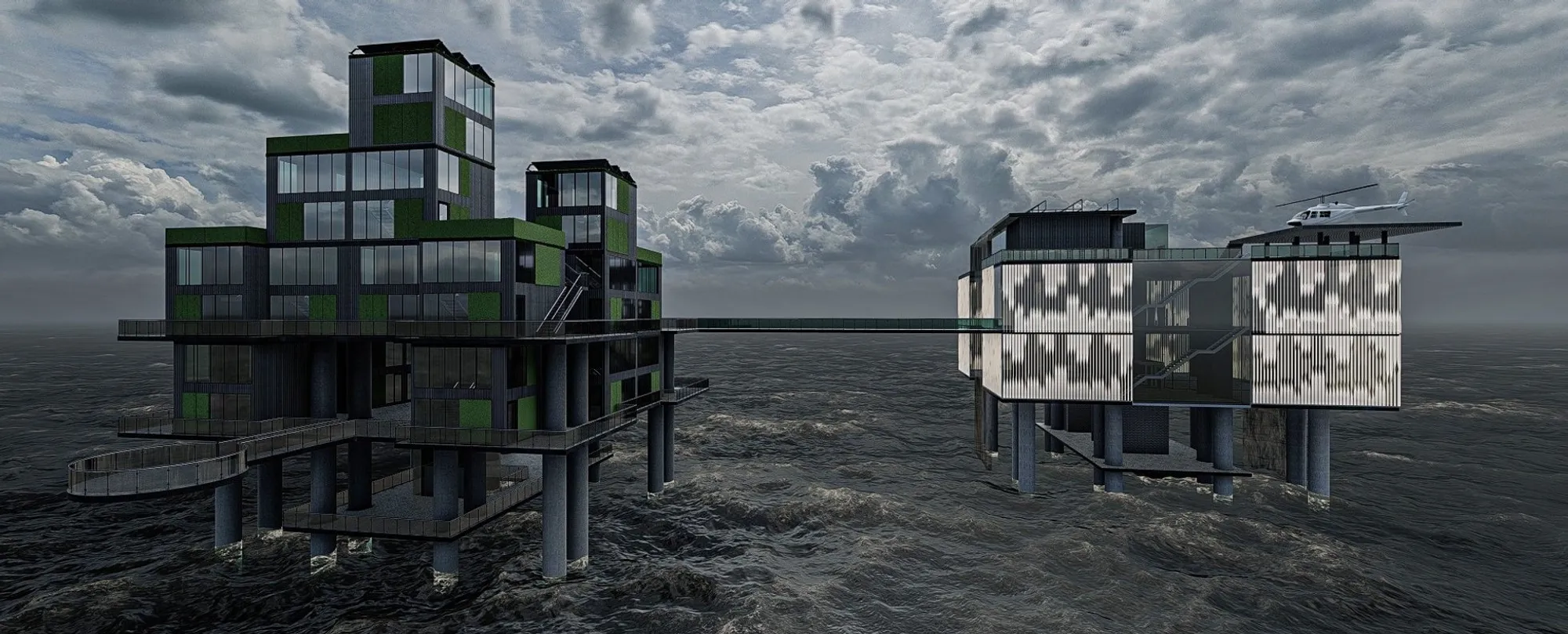
Proximity Island: Reimagining Offshore Infrastructure Through Adaptive Reuse Architecture
Adaptive reuse architecture reimagines abandoned oil rigs as floating museums and sustainable ocean living environments.


As the global conversation around sustainability, preservation, and climate responsibility intensifies, architecture is increasingly being challenged to rethink obsolete industrial structures. Proximity Island, designed by Darii Skrypyn and Yulia Piasta, proposes an ambitious vision for the future of abandoned offshore infrastructure through the lens of adaptive reuse architecture.
The project transforms decommissioned oil rigs into a floating cultural and residential ecosystem composed of a Water Museum and temporary housing facilities. Rather than demolishing these massive industrial platforms, the proposal explores how architecture can give them a second life, converting symbols of extraction into spaces of education, ecology, and human connection.
Positioned within the open sea, the intervention becomes both an architectural statement and an environmental manifesto. It demonstrates how industrial relics can evolve into regenerative public infrastructure capable of fostering awareness about ocean preservation and sustainable living.
Revitalizing Oil Rigs Through Sustainable Architecture
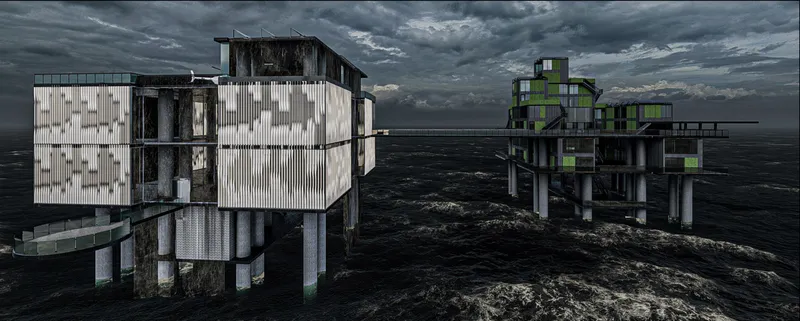
Across the world, thousands of offshore oil platforms are approaching abandonment. Their dismantling is often economically expensive and environmentally harmful. Proximity Island addresses this challenge by introducing a sustainable alternative rooted in adaptive reuse architecture and ecological restoration.
The project sees oil rigs not as waste, but as opportunities. Their existing structural systems become the foundation for new public functions, minimizing material consumption while extending the lifecycle of the infrastructure. The proposal advocates preservation over destruction, reinforcing the idea that architecture must evolve from extractive construction toward regenerative transformation.
The concept draws inspiration from the mythical Phoenix, symbolizing rebirth from destruction. In this case, the oil rig becomes a new architectural organism emerging from industrial decline.
Floating Architecture Connecting Humanity and the Ocean
One of the project’s most compelling ideas is the emotional and symbolic relationship between humans and water. The architects envision the museum not merely as an exhibition space, but as an immersive environment that reconnects visitors with the ocean ecosystem.
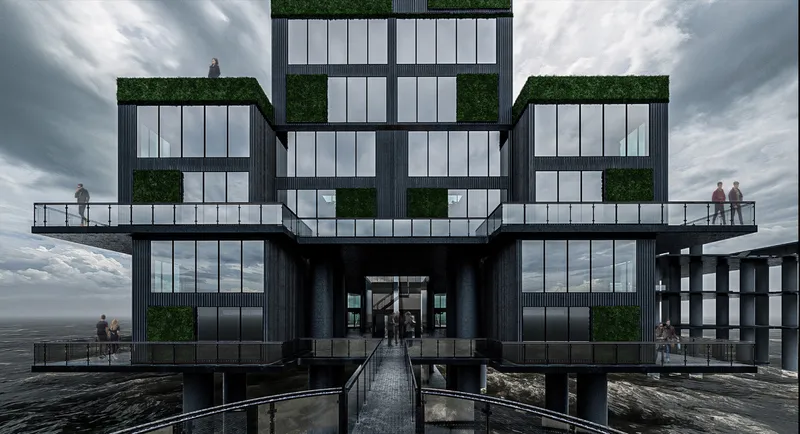
The Water Museum rises directly from the sea, creating a powerful architectural dialogue between industrial geometry and natural forces. Long bridges suspended above the water establish physical and psychological transitions between landless habitation and the vast openness of the ocean.
This floating architectural experience encourages visitors to reflect on humanity’s dependence on water while confronting the environmental consequences of industrialization. The ocean becomes both context and exhibit.
The project proposes that architecture can function as a medium for ecological awareness, transforming abandoned industrial structures into educational instruments for future generations.
The Water Museum: Architecture as Environmental Awareness
At the center of the proposal lies the Water Museum, a multi-level exhibition structure designed for temporary installations, marine research, lectures, and public engagement.
The museum includes:
- Flexible exhibition halls
- Observation decks overlooking the sea
- Underwater viewing chambers
- Restaurants and public terraces
- Research-oriented spaces
- Lecture and workshop areas
One of the project’s defining architectural gestures is the integration of cascading water systems across the façade. These waterfall elements create sensory interaction through sound, reflection, and movement, reinforcing the presence of water throughout the visitor experience.
Beneath the surface, underwater observation chambers allow visitors to experience marine life from within the ocean itself. This immersive spatial sequence transforms the museum into a living environmental narrative rather than a conventional gallery.
The architecture continuously blurs the boundaries between building and landscape, artificial platform and natural environment.
Temporary Housing Above the Ocean
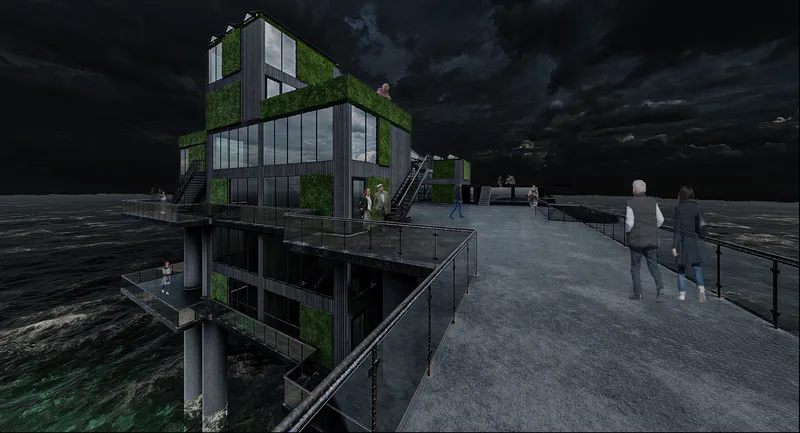
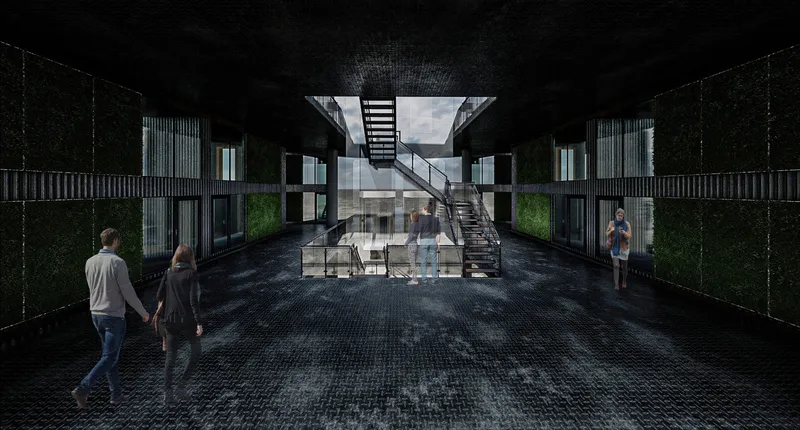
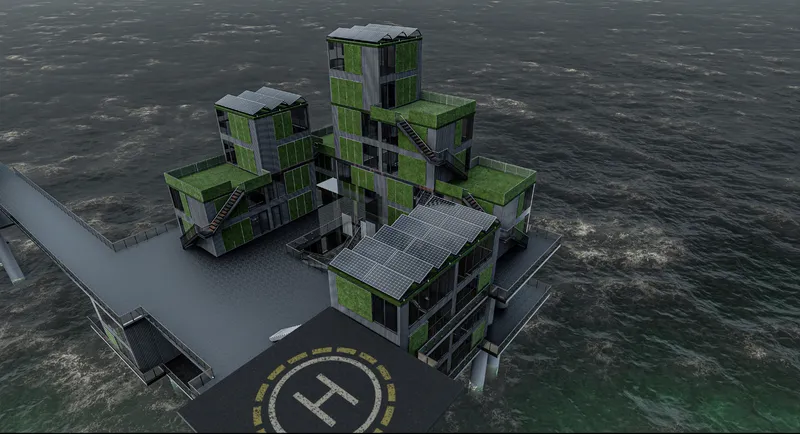
Adjacent to the museum platform is a residential structure designed to accommodate scientists, researchers, students, artists, and tourists. The housing complex introduces a modular system capable of supporting temporary long-term occupation in extreme offshore conditions.
The temporary housing platform contains approximately twenty modular living units arranged around communal circulation spaces and observation terraces.
Each unit includes:
- Living and sleeping areas
- Workspace
- Bathroom facilities
- Panoramic glazing
- Sustainable energy systems
- Solar collection infrastructure
The modular architecture allows flexibility while maintaining privacy for residents engaged in research or creative work. Shared public spaces encourage collaboration and interaction among occupants.
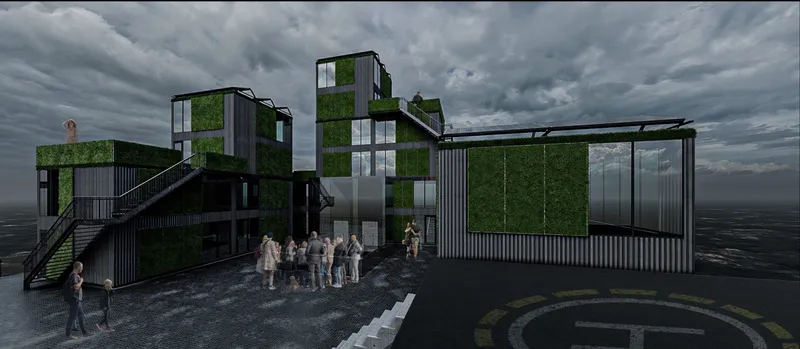
Green façades and planted surfaces soften the industrial character of the oil rig while improving environmental performance. The architecture intentionally contrasts heavy offshore engineering with lightweight ecological interventions.
Adaptive Reuse Architecture as Ocean Conservation Strategy
Beyond architecture, Proximity Island proposes a larger cultural shift in how society perceives obsolete infrastructure. Oil rigs are often viewed as symbols of environmental exploitation, yet the project suggests they can become instruments for restoration and education.
The proposal imagines future oceans populated not by abandoned industrial skeletons, but by floating research centers, educational facilities, ecological observatories, and cultural platforms.
This transformation introduces a new typology of floating adaptive reuse architecture, where former industrial systems evolve into spaces dedicated to preservation instead of extraction.
The project also highlights the potential for marine research and environmental monitoring, suggesting that offshore platforms could become critical infrastructure for studying climate change, ocean biodiversity, and ecological resilience.
Architectural Language and Spatial Identity
Visually, the architecture embraces a dramatic offshore atmosphere defined by dark skies, reflective surfaces, and monolithic forms emerging from the ocean horizon.
The museum platform utilizes layered façades, transparent glazing, and suspended circulation bridges to create spatial tension between solidity and openness. Waterfalls integrated into the structure generate a constantly changing exterior identity shaped by weather, light, and movement.
Meanwhile, the residential platform introduces greenery and modular compositions that create a softer and more habitable environment.
The contrast between the two structures reinforces the conceptual narrative:
- The museum symbolizes water and collective awareness
- The housing platform symbolizes human occupation and adaptation
Together, they form a connected ecosystem suspended above the sea.
A Vision for the Future of Offshore Architecture
Proximity Island demonstrates how adaptive reuse architecture can address environmental, social, and cultural challenges simultaneously. Instead of erasing industrial infrastructure, the project transforms it into a new public landscape dedicated to ecology, education, and sustainable habitation.
The proposal positions architecture as an active participant in environmental recovery. Through floating cultural spaces, modular housing, and immersive ocean experiences, the project redefines what offshore infrastructure can become in the coming decades.
By converting abandoned oil rigs into living architectural systems, Darii Skrypyn and Yulia Piasta present a compelling vision of a future where architecture no longer separates humanity from nature, but reconnects them through thoughtful transformation.



Popular Articles
Popular articles from the community


The Ocean Hive: Sustainable Architecture for a Self-Sufficient Civilization at Sea
The Ocean Hive imagines sustainable architecture at sea, where modular habitats, algae, wave power and ocean waste sustain a growing colony.

Hill & Cross Opera: Sculptural Opera House Architecture Shaped by Tallinn’s Landscape and Identity
Hill & Cross Opera reimagines opera house architecture in Tallinn through its sculptural hill, civic plaza, glass wave and a luminous cross.

The Musturak Paradise: Senior Living Architecture for a Connected Future in Temara, Morocco
The Musturak Paradise reimagines senior living architecture in Temara via private homes, social spaces, culture, community, and shared care.

Play: Fragments of Their World
Familiar architecture becomes modular playground design, creating safe spaces where displaced children can learn, connect, imagine and play.


Similar Reads
You might also enjoy these articles

Eco Chapel: A Green Architecture Pavilion Designed in Symbiosis with the Forest
Eco Chapel uses green architecture to weave prayer, learning and reuse into a forest pavilion shaped by modular hexagonal canopies for life.
Kaffeebühnen: Coffee Shop Architecture Designed as a Civic Stage Between Vienna’s City and Park
Kaffeebühnen turns coffee shop architecture into a civic stage, linking Vienna’s park edge, urban life, warm timber yards, and coffee craft.
Healing Façade: Sustainable Architecture for Reforestation, Community, and Sacred Ecology in Ethiopia
Healing Façade reimagines sustainable architecture as a living wall that restores soil, catches water and renews Ethiopia's forest churches.


Urban Forest: A Vertical Ecosystem for 5,000 Workers in Singapore's Changi Business Park
Radially stacked pods and layered green decks turn a 7-acre plot into 47 acres of ecological workspace projected for 2040.

Comments (0)
Please login or sign up to add comments
No comments yet. Be the first to comment!