
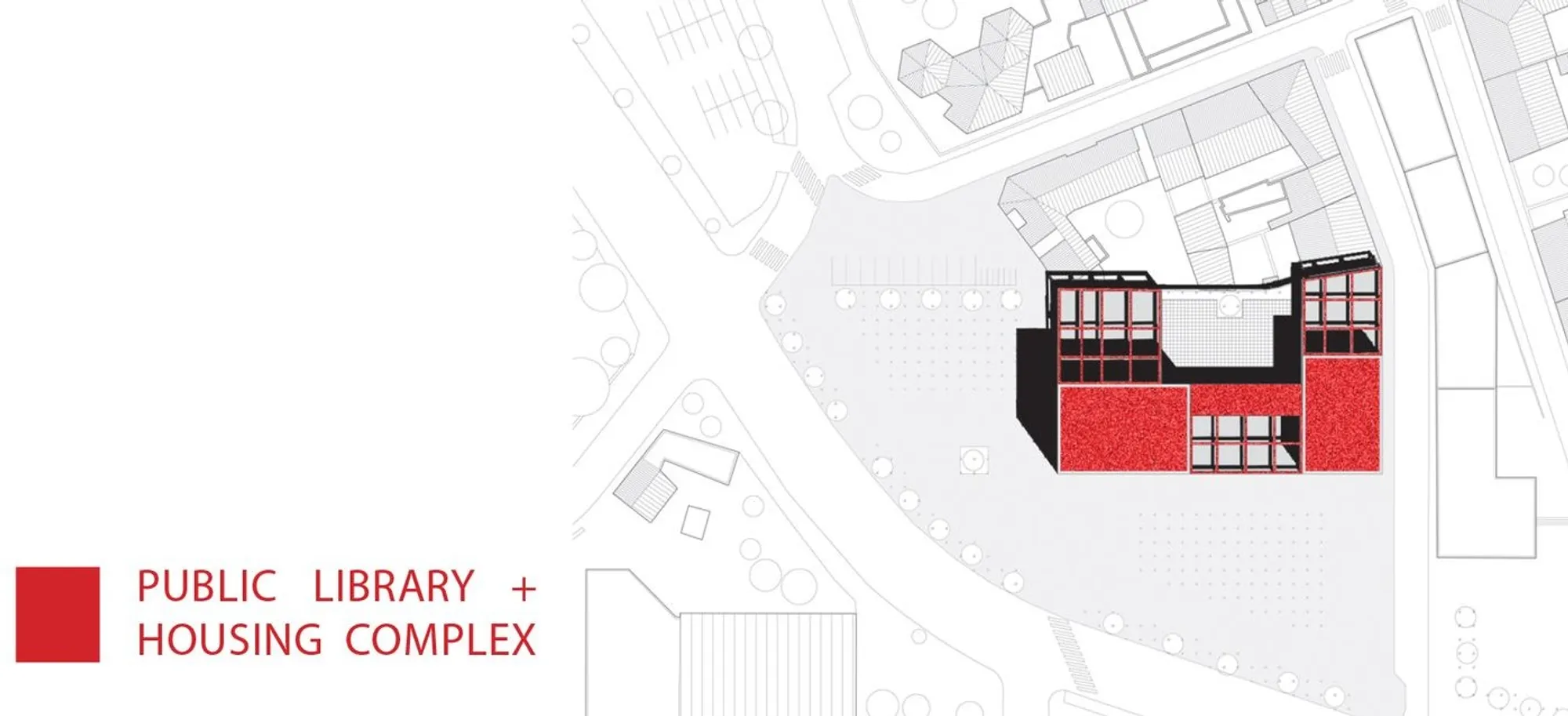
Public Library and Housing Complex, Saint-Étienne, France
Mixed-use architecture as a catalyst for social diversity across urban and domestic scales


Situated in Saint-Étienne, a former industrial city near Lyon, this Public Library and Housing Complex by Chloé Misery is an exploration of mixed-use architecture as a tool for social cohesion and urban regeneration. Positioned at the edge of the city and shaped by surrounding infrastructure, the project responds to fragmented urban flows by introducing a civic anchor that merges public culture with collective and mixed-generation housing.
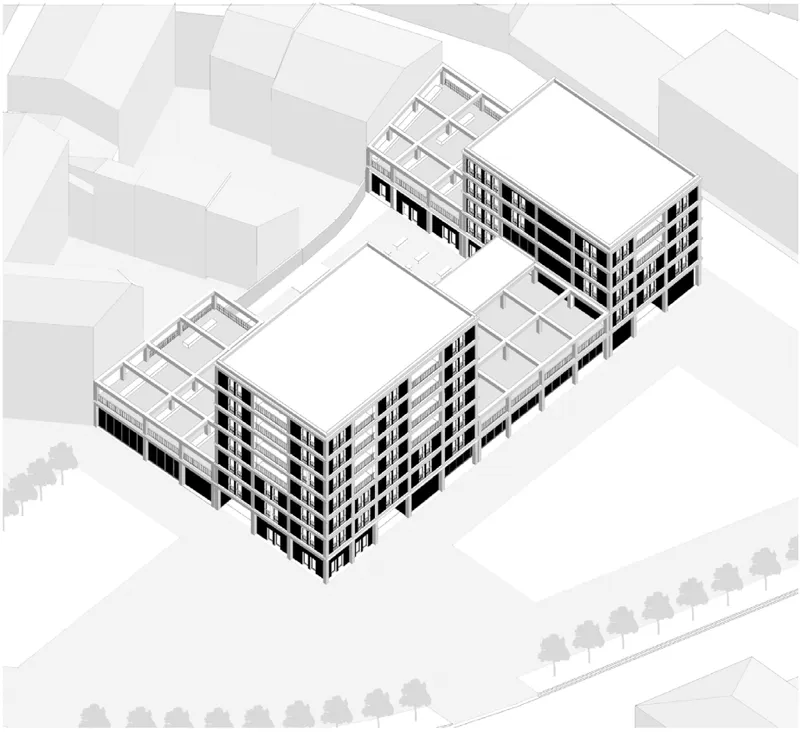
Rather than separating programs horizontally across the city, the proposal stacks them vertically allowing public, semi-public, and private functions to coexist within a single architectural framework. This strategy reinforces interaction between diverse user groups while redefining the role of architecture in post-industrial urban contexts.
Urban Context: Reconnecting a Fragmented City
Saint-Étienne’s urban fabric reflects its industrial past, marked by infrastructural barriers and mono-functional zones. The project site sits at a critical threshold, surrounded by highways and transitional urban conditions, making it both isolated and highly visible.
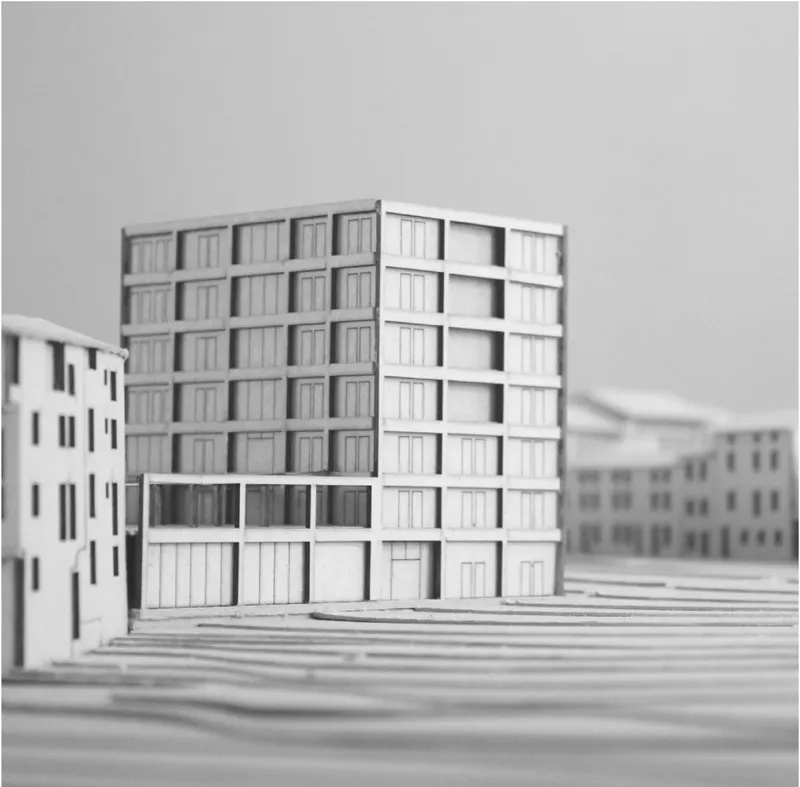
Through mixed-use architecture, the building becomes a pivot point within the city, reconnecting flows of movement and activity. Its massing responds to surrounding volumes while establishing a new landmark that signals civic presence. The architecture does not compete with its context; instead, it mediates between infrastructure, neighborhood scale, and public life.
Public Ground Floor: The Library as Urban Extension
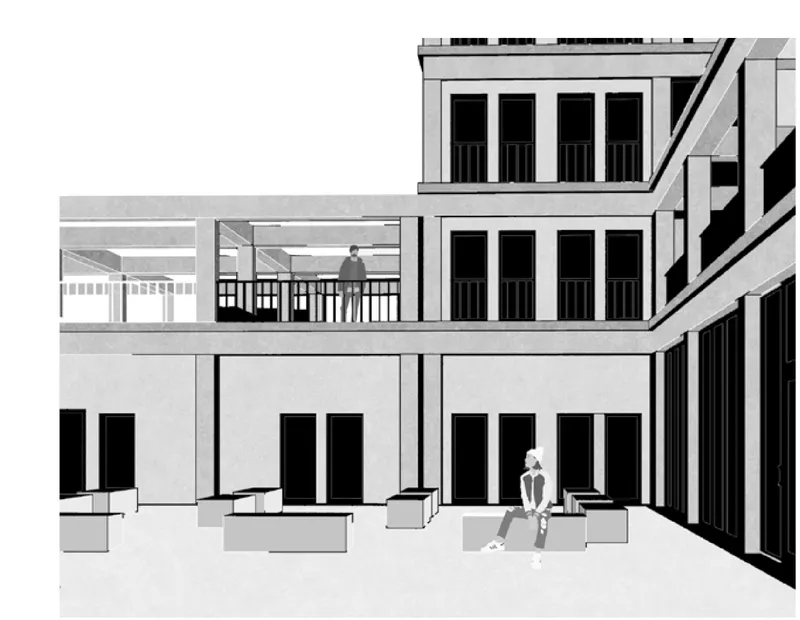
At ground level, the public library anchors the project. Conceived as an extension of the public realm, the library opens directly onto a patio that blurs the boundary between inside and outside. This space functions as an urban living room: inviting passersby, residents, and readers alike.
The transparency and accessibility of the library reinforce its civic role. More than a repository of books, it operates as a social condenser, supporting informal meetings, learning, and everyday interaction. In this way, mixed-use architecture is not merely programmatic layering but an experiential overlap of uses.
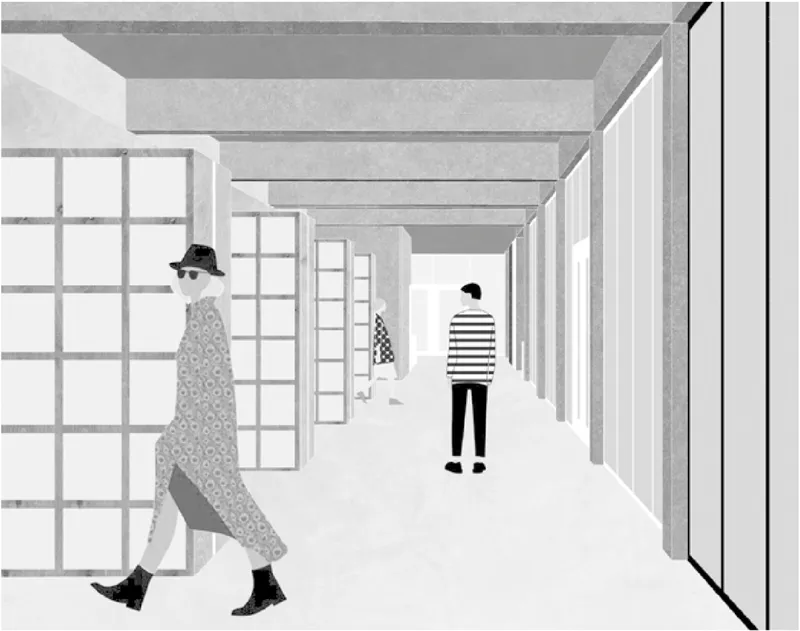
Vertical Integration: Housing Above the City
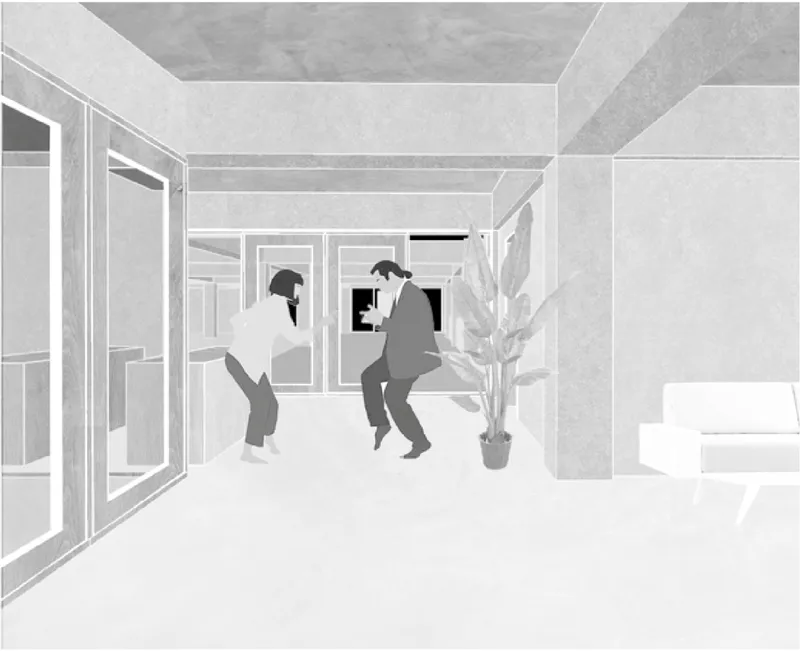
Above the public library, residential programs unfold vertically. The building accommodates both mixed-generation housing and collective housing, encouraging coexistence between different age groups and household types.
Common gardens and shared outdoor spaces act as connectors between housing clusters, fostering everyday encounters among residents. These intermediate spaces are essential to the project’s social ambition, offering moments of collectivity without compromising privacy.
The housing layouts prioritize flexibility, daylight, and clear circulation. From shared distribution spaces to individual apartments, the architecture transitions gradually from collective to domestic, reinforcing a sense of belonging at every scale.
From Urban Scale to Domestic Scale
One of the project’s defining qualities is its careful attention to scale. At the urban level, the building reads as a coherent mixed-use volume that structures public space. At the architectural level, it articulates distinct programs through subtle shifts in façade rhythm and section. At the domestic level, apartments are designed for comfort, adaptability, and everyday life.
Sections and elevations reveal how public, semi-public, and private layers interlock vertically. This sectional strategy is central to the project’s interpretation of mixed-use architecture, not as stacked isolation, but as spatial continuity.
Social Diversity Through Architecture
The core ambition of the project is to generate social diversity at both the urban and building scale. By combining a public library with mixed-generation and collective housing, the architecture creates conditions for interaction between different social groups who might not otherwise share space.
This diversity is not forced through form, but enabled through spatial organization, shared amenities, and everyday proximity. Architecture becomes a quiet framework for social exchange, supporting inclusion without spectacle.




Popular Articles
Popular articles from the community


The Musturak Paradise: Senior Living Architecture for a Connected Future in Temara, Morocco
The Musturak Paradise reimagines senior living architecture in Temara via private homes, social spaces, culture, community, and shared care.
AL-JANNAH: Sustainable Architecture and Permaculture for Afghan Widows
AL-JANNAH uses sustainable architecture and permaculture to create resilient oasis of housing, learning, work and renewal for Afghan widows.

Hill & Cross Opera: Sculptural Opera House Architecture Shaped by Tallinn’s Landscape and Identity
Hill & Cross Opera reimagines opera house architecture in Tallinn through its sculptural hill, civic plaza, glass wave and a luminous cross.

Riyadh For All: Intergenerational Urban Design for Active Aging in Rabat
Riyadh For All reimagines urban design in Rabat with intergenerational co-living, adaptive courtyards, and Moroccan cultural exchange today.


Similar Reads
You might also enjoy these articles

Eco Chapel: A Green Architecture Pavilion Designed in Symbiosis with the Forest
Eco Chapel uses green architecture to weave prayer, learning and reuse into a forest pavilion shaped by modular hexagonal canopies for life.
Kaffeebühnen: Coffee Shop Architecture Designed as a Civic Stage Between Vienna’s City and Park
Kaffeebühnen turns coffee shop architecture into a civic stage, linking Vienna’s park edge, urban life, warm timber yards, and coffee craft.
Healing Façade: Sustainable Architecture for Reforestation, Community, and Sacred Ecology in Ethiopia
Healing Façade reimagines sustainable architecture as a living wall that restores soil, catches water and renews Ethiopia's forest churches.


Urban Forest: A Vertical Ecosystem for 5,000 Workers in Singapore's Changi Business Park
Radially stacked pods and layered green decks turn a 7-acre plot into 47 acres of ecological workspace projected for 2040.

Explore Mixed-Use Competitions
Discover active competitions in this discipline


Challenge to design luxury tourism on rails


VR headsets Storefront design competition

Designing a staircase for a client
Comments (0)
Please login or sign up to add comments
No comments yet. Be the first to comment!