

Public Library in Sint-Martens-Latem by OFFICE Kersten Geers David Van Severen
Circular public library with saddle roof forms a civic living room, integrating structural shelving, reading garden, and community-focused cultural space.


The Public Library in Sint-Martens-Latem, designed by OFFICE Kersten Geers David Van Severen, redefines the role of a municipal library as a shared civic living space rather than a conventional institutional building. Completed in 2023, the 865-square-metre cultural building is conceived as a central gathering point for the community, reinforcing the library’s position as a social and cultural anchor within the village.
Located in Sint-Martens-Latem, Belgium, the project continues the architectural tradition of the cultural centre while establishing a strong identity for a new cluster of public buildings in the municipal core. The library acts as the first defining element of this ensemble, positioned along the main road and adjacent to the emerging municipal settlement.
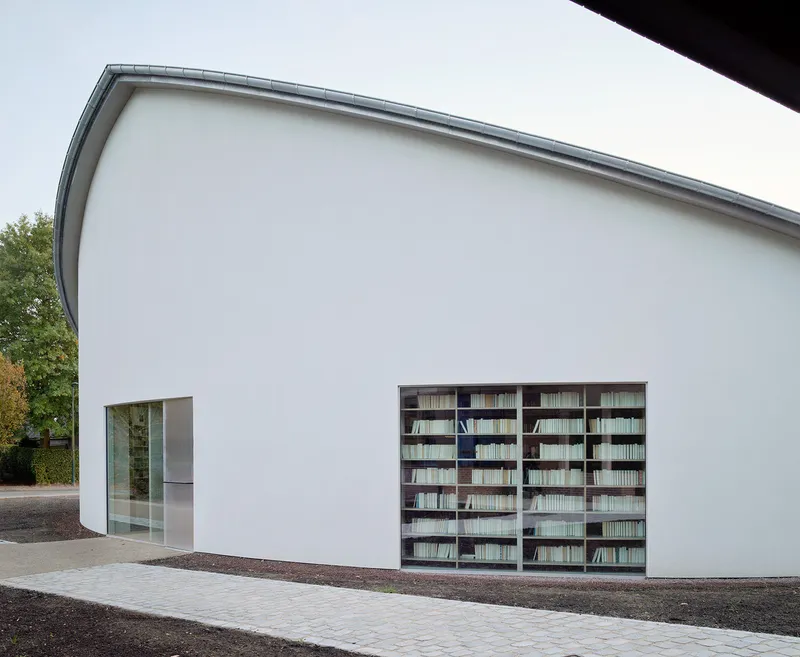
A Distinctive Architectural Form Rooted in Geometry
The building is defined by a saddle-shaped roof enclosed within a circular perimeter, a geometric gesture that gives the library an immediately recognizable presence. This circular plastered perimeter cuts through the roof form, creating a clear and legible architectural figure that anchors the site. The resulting volume reads as both monumental and approachable, balancing civic gravitas with domestic familiarity.
This rounded exterior defines the main interior space of the library, enclosing it as a unified and continuous room. Within this circular boundary, the architects introduce a square geometry, which organizes key programmatic elements and creates spatial contrast. This square form houses the reading garden and the polyvalent hall, offering moments of openness and flexibility within the otherwise enclosed volume.
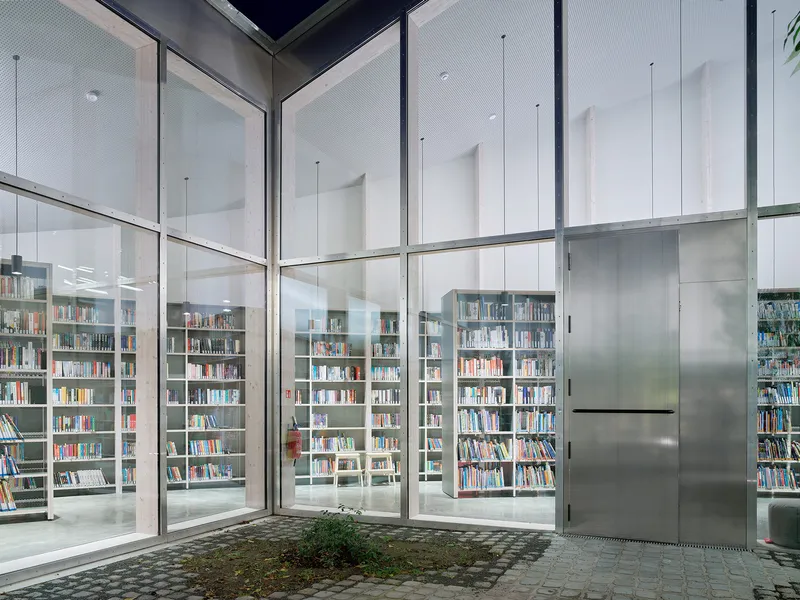
Interior as Structure: Shelving That Supports the Building
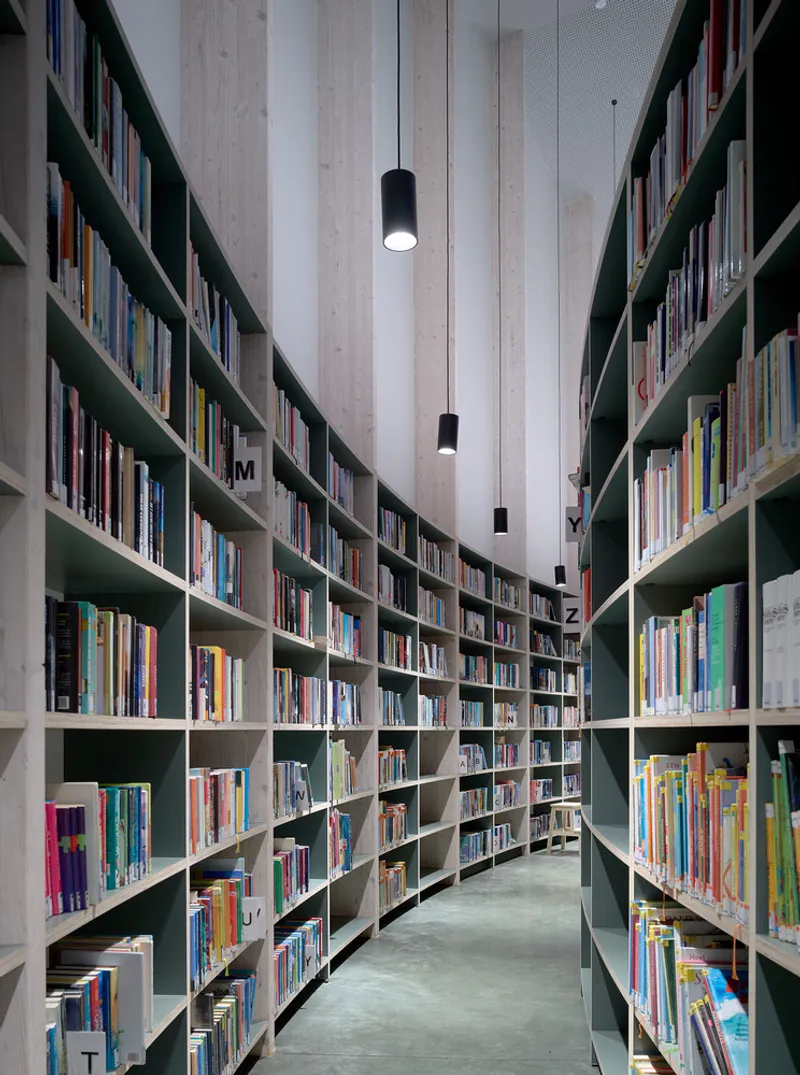
Inside the library, architecture and furniture merge into a single structural and spatial system. Wooden library cabinets line the interior perimeter, simultaneously functioning as book storage and as load-bearing elements that support the roof. This integration of structure and use reflects OFFICE’s characteristic approach to architectural clarity and material honesty.
The continuous cabinet wall also establishes a subtle separation between public library spaces and adjacent municipal functions, reinforcing functional boundaries without the need for additional partitions. The warm texture of the timber shelving contrasts with the smooth plastered exterior, creating an interior atmosphere that is intimate, tactile, and welcoming.

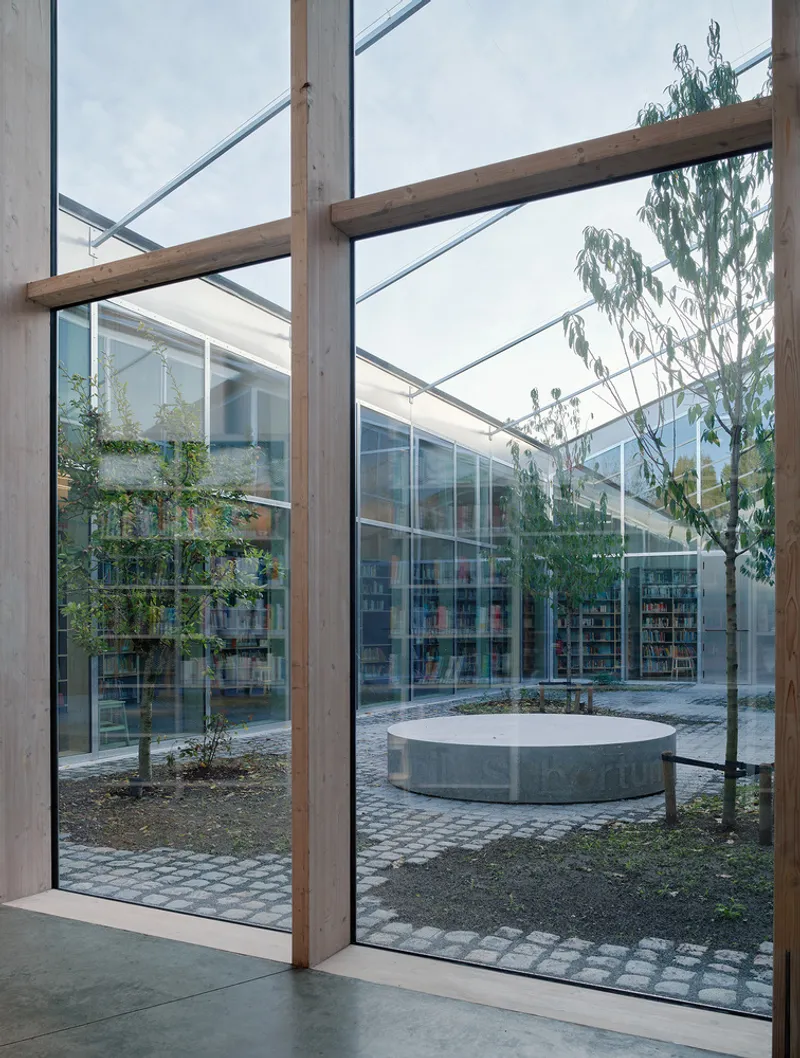
The Reading Garden: The Largest Room in the Largest House
At the core of the library lies the reading garden, described by the architects as “the largest room in the largest house of the municipality.” This central space operates as both a symbolic and functional heart of the building. It provides daylight, visual openness, and a place for quiet reading, reflection, and informal gathering.
The reading garden strengthens the idea of the library as a shared domestic interior for the entire community, rather than a silent, inward-facing institution. Adjacent to it, the polyvalent hall allows the building to accommodate events, exhibitions, and communal activities, ensuring year-round civic engagement.
Materiality, Light, and Civic Presence
The restrained material palette: plastered surfaces, timber cabinetry, and carefully detailed glazing, reinforces the building’s timeless quality. Natural light filters into the interior through strategically placed openings, animating the shelving and reading spaces throughout the day. The collaboration with manufacturers such as Sto, AGC, Deltalight, VMZINC, and James Jones & Sons contributes to the building’s refined material execution.
Landscape design by Landinzicht Landschapsarchitecten further integrates the library into its surroundings, reinforcing its role as a civic landmark while maintaining a human-scale relationship with the village fabric.
A Contemporary Model for Cultural Architecture
The Public Library in Sint-Martens-Latem exemplifies a contemporary approach to cultural and municipal architecture, where geometry, structure, and social use are inseparable. By transforming the library into a shared living room for the municipality, OFFICE Kersten Geers David Van Severen propose a model of public space rooted in clarity, permanence, and collective ownership.
All photographs are works of Bas Princen


Popular Articles
Popular articles from the community


Cube Design Draws an Ecological Corridor Between Two Shenzhen Hills with the Nankai Building
Beside Shenzhen's container docks, the Nankai Building pairs stacked balconies with a climbing green screen to connect two hillsides across its height.

Jaramillo Van Sluys Arquitectura and Urbanismo Turn a Demolished Registry Lot in Quito into an Orchard Plaza
In Quito's Centro Histórico, a 2,800 m² plaza exposes the San Agustín convent wall and redraws its lost Augustinian orchard in volcanic stone.

longwave studio Reorganizes a 112 m² Tainan Apartment Around the Daily Routines of a Family and Two Cats
In Tainan, Taiwan, birch plywood, rust-red furniture and a freestanding plaster wall link arrival, storage, work and family life in one apartment.

David Ortega Stacks a Two-Story Mexico City Penthouse Around a Steel Stair and a Pergola-Shaded Roof Terrace
In Colonia Roma, a 300 m² penthouse uses oak joinery, a planted steel stair and a slatted roof pergola to make a new-build apartment feel like a house.

Similar Reads
You might also enjoy these articles


Hodi-Mandai Geram
Project Function: Preservation and revitalization of the Intangible heritage and socio-spatial identity of the Hodi by Housing, Cultural Memory Center, Sacred Grove, landscape, local tourism economy


Olio Towers: A Mid-Rise for Performers That Fuses Housing, Rehearsal, and Stage
Located blocks from Houston's Theater District, this modular tower stacks living units around a central performance atrium.

Oasis: Modular Green Housing Carved into Dhaka's Urban Fabric
A shortlisted Plugin Housing entry reclaims unauthorized settlements in Dhaka with stepped concrete volumes, green roofs, and ventilation-driven design.

Black Hole: A Floating Megastructure for the Post-Physical Era
Emiliano Mazzarotto envisions a spherical, self-scaling arena where e-sports, digital hotels, and holographic stadiums replace traditional public space.

Explore Reading Room Competitions
Discover active competitions in this discipline

Challenge to reimagine the Iron Throne

Photograph architecture without architects

Illustrate the lost glory of Angkor Wat - Render Challenge

Bring back Drive In's
Comments (0)
Please login or sign up to add comments
No comments yet. Be the first to comment!