
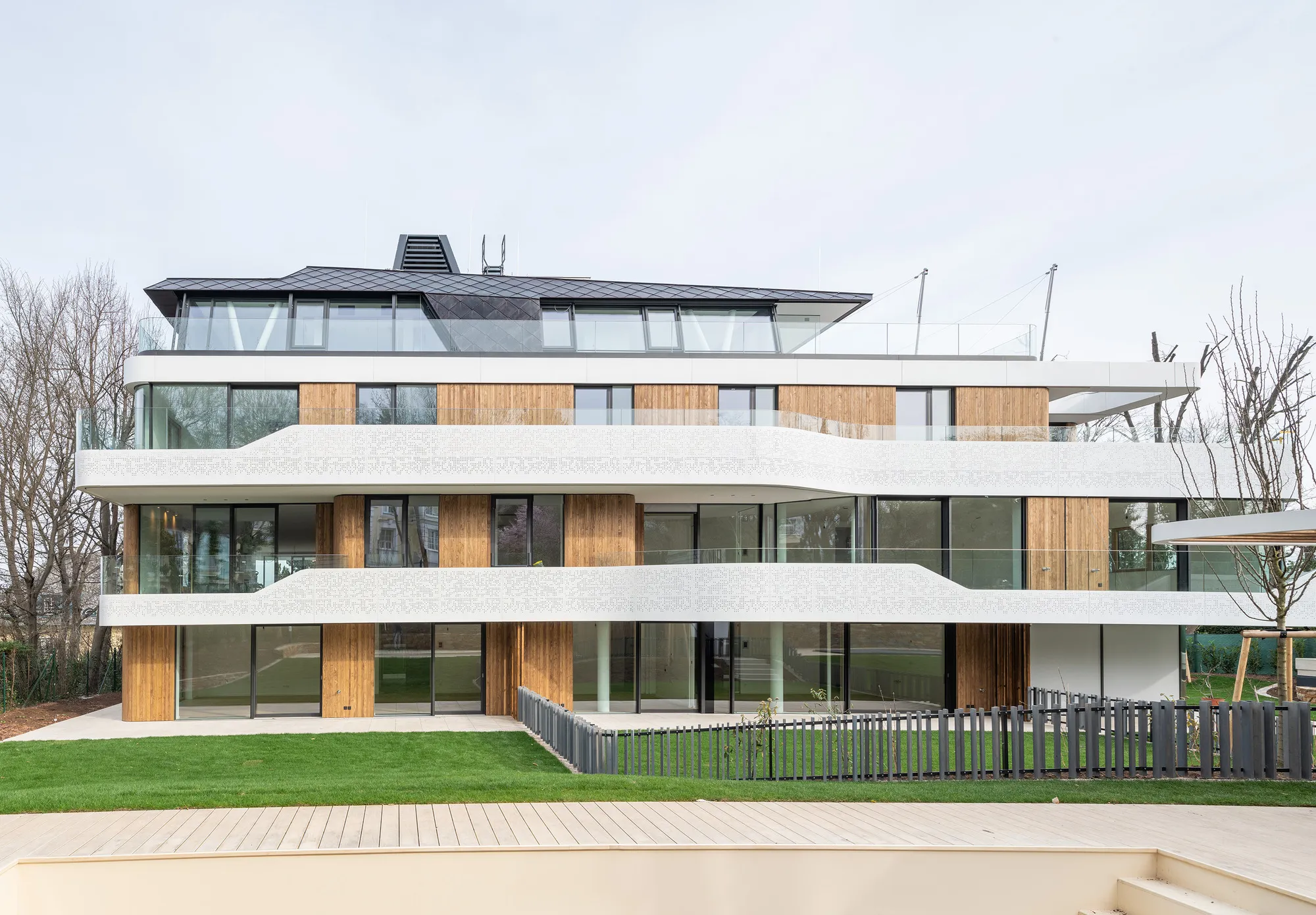
puk architekten Sculpts a Yacht-Like Residential Building at the Edge of a Viennese Park
Near the Pötzleinsdorfer Schlosspark, undulating terraces in brass, Accoya wood, and perforated metal blur the line between city and forest.


Vienna's 18th district, where Gründerzeit villas give way to meadows and hilly woodlands around the Pötzleinsdorfer Schlosspark, is not an easy place to insert a new apartment building. The territory demands something that respects the stately residential grain while acknowledging the landscape pressing in from every side. puk architekten, led on this project by managers Bernhard Meisnitzer and Edita Vinca, answered with a four-level volume whose stacked, curving terraces give it the profile of a vessel moored among the trees on Kalbeckgasse.
What makes the Schlosspark Residential Building genuinely interesting is the way it turns every apartment outward in three directions at once. Rather than stacking identical floor plates, the architects offset and sculpt each level so that balconies jut, retract, and wrap, yielding a layered silhouette that changes radically depending on your vantage point. The result is a building that reads as landscape from a distance and as a finely detailed object up close, its semitransparent balustrades, pre-blackened brass roof shingles, and Accoya wood cladding giving it a material warmth that most Viennese new-builds lack.
A Silhouette That Shifts with Every Step
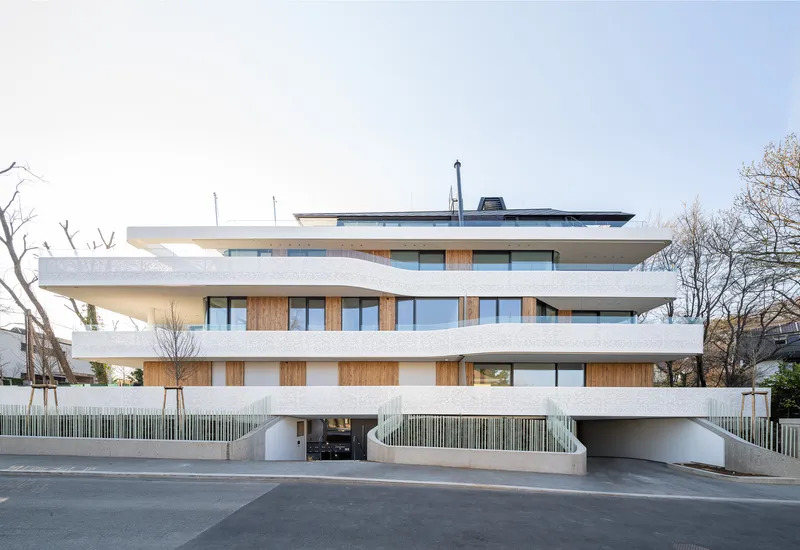
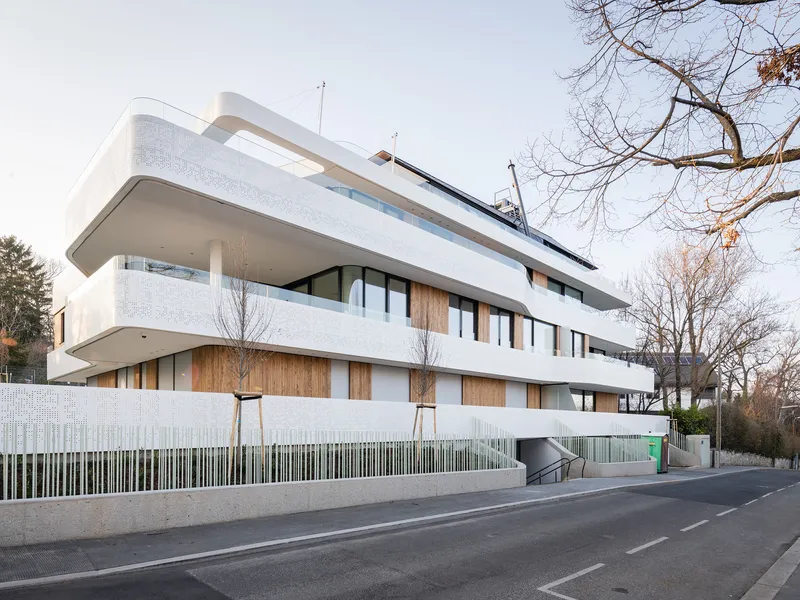
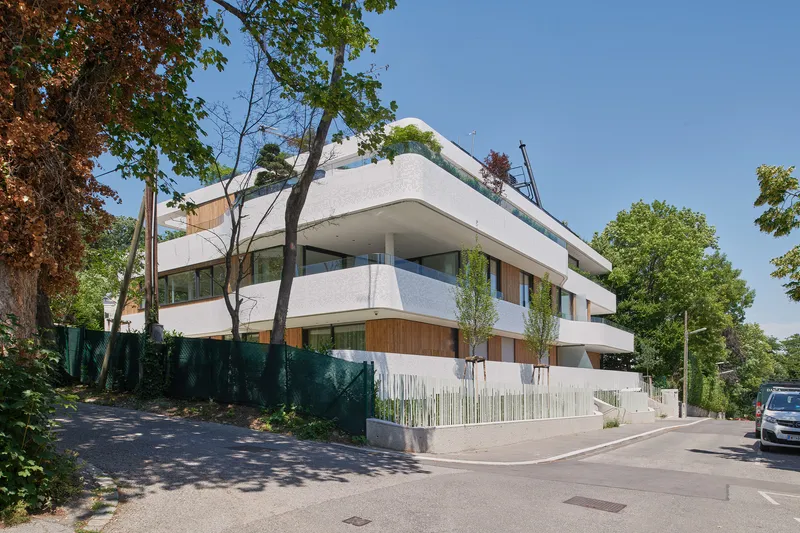
From the street, the building presents itself differently in each season and from each angle. In winter, bare branches expose the full geometry: concrete base walls anchor the composition while layered timber-clad volumes step back above. In summer, the canopy of mature trees nearly absorbs the upper floors. The perforated metal railings catch light rather than blocking it, so the terraces read as open-air rooms rather than conventional balconies.
The corner condition is particularly well handled. Rather than meeting the street with a flat facade, the building rounds its edges, reinforcing the nautical quality that puk architekten clearly pursued. Custom-made curved panorama windows track these corners, flooding interiors with light while keeping the external profile smooth and continuous.
Garden Facade and the Three-Direction Promise
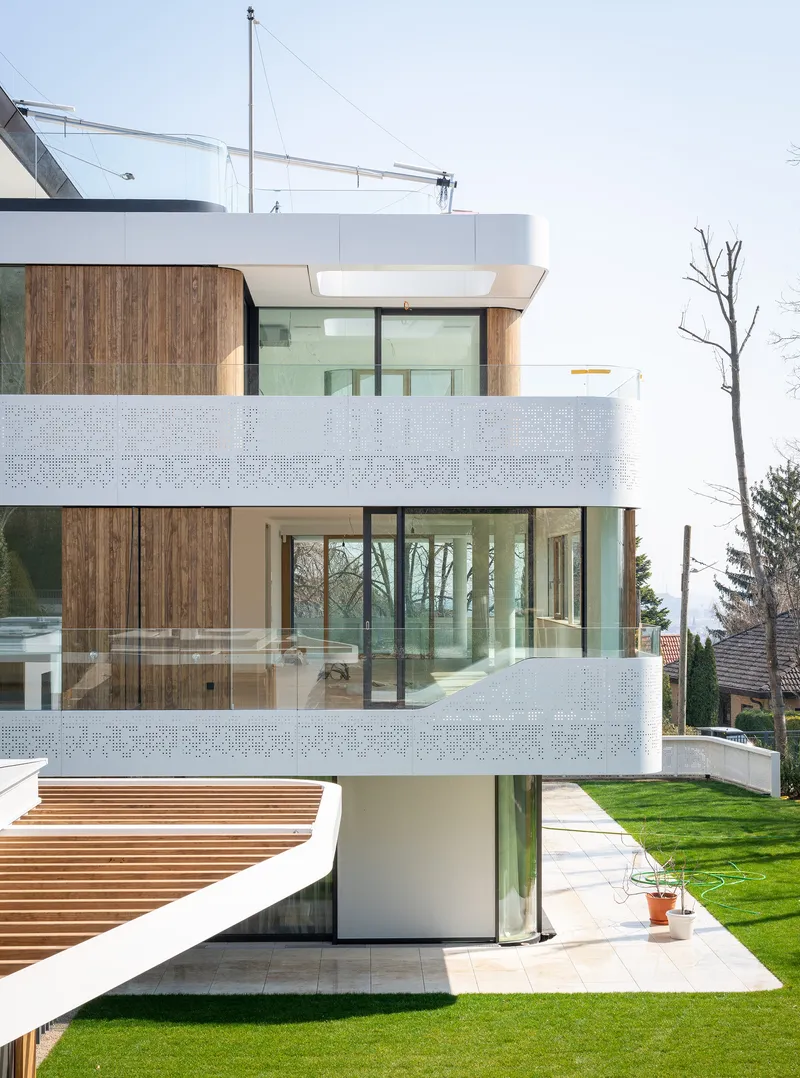
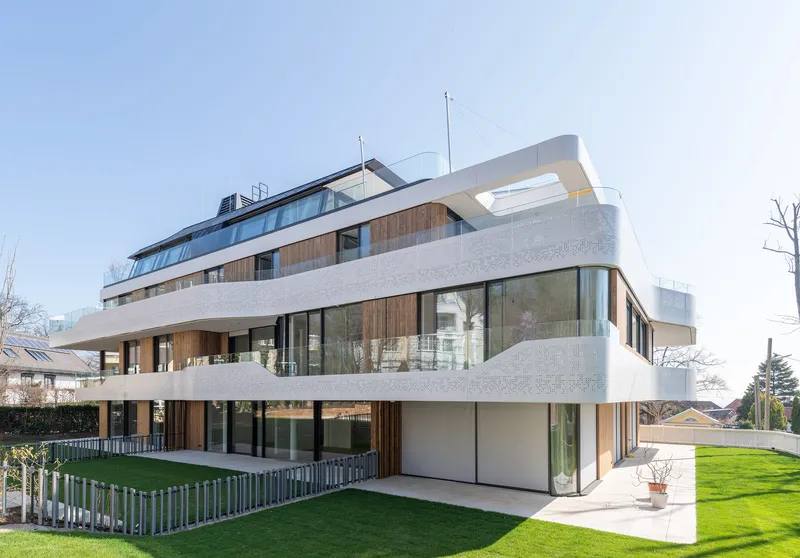
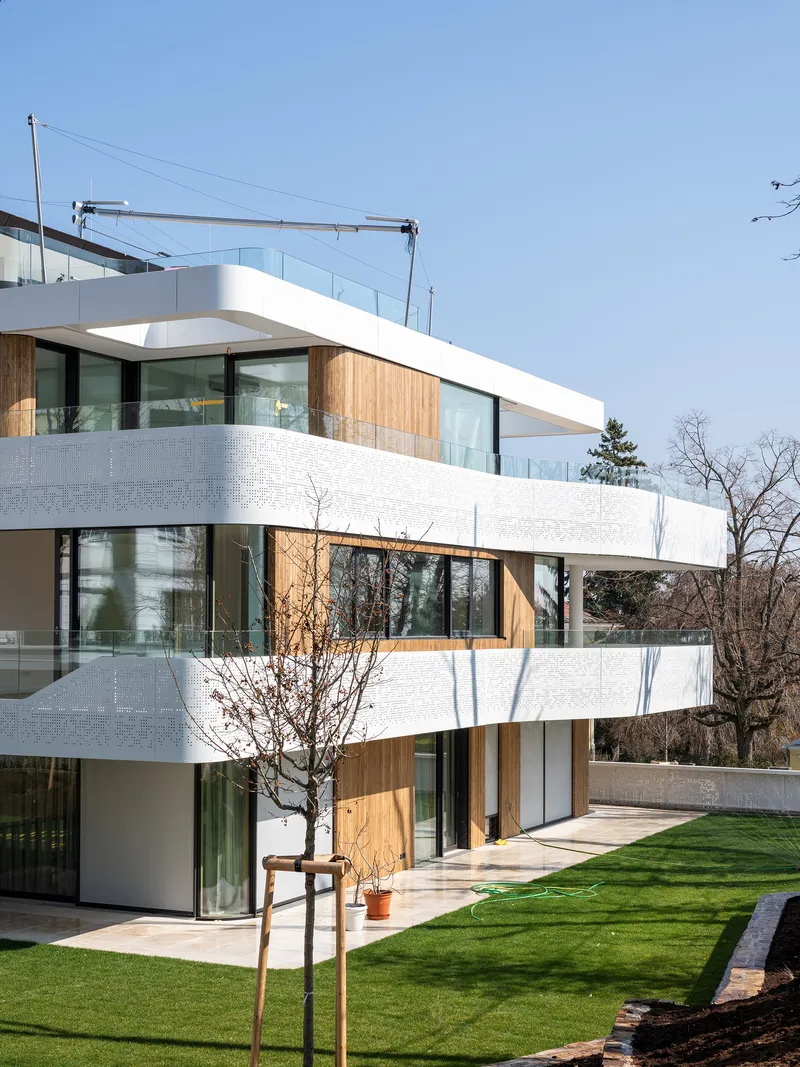
The garden elevation is where the building's logic becomes clearest. Three levels of stacked terraces, each slightly rotated or extended relative to the one below, produce a cascade of outdoor space that maximizes southern exposure while guaranteeing privacy between units. The perforated white balustrade panels unify the composition without making it feel heavy. Vertical timber cladding between these screens adds a residential warmth that anchors the building in its parkland context.
Most apartments achieve the claimed three-directional views because the plan is compact enough, and the floor plates varied enough, that living spaces reach two or even three exterior walls. Protected outdoor spaces range from recessed loggias to wide projecting terraces, so residents can choose between sun and shade without leaving their unit.
Terraces as Architecture, Not Afterthought
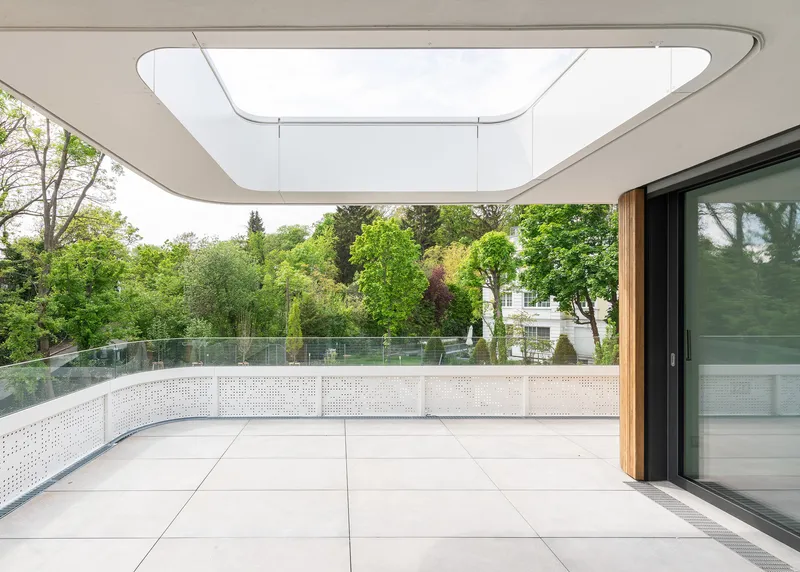
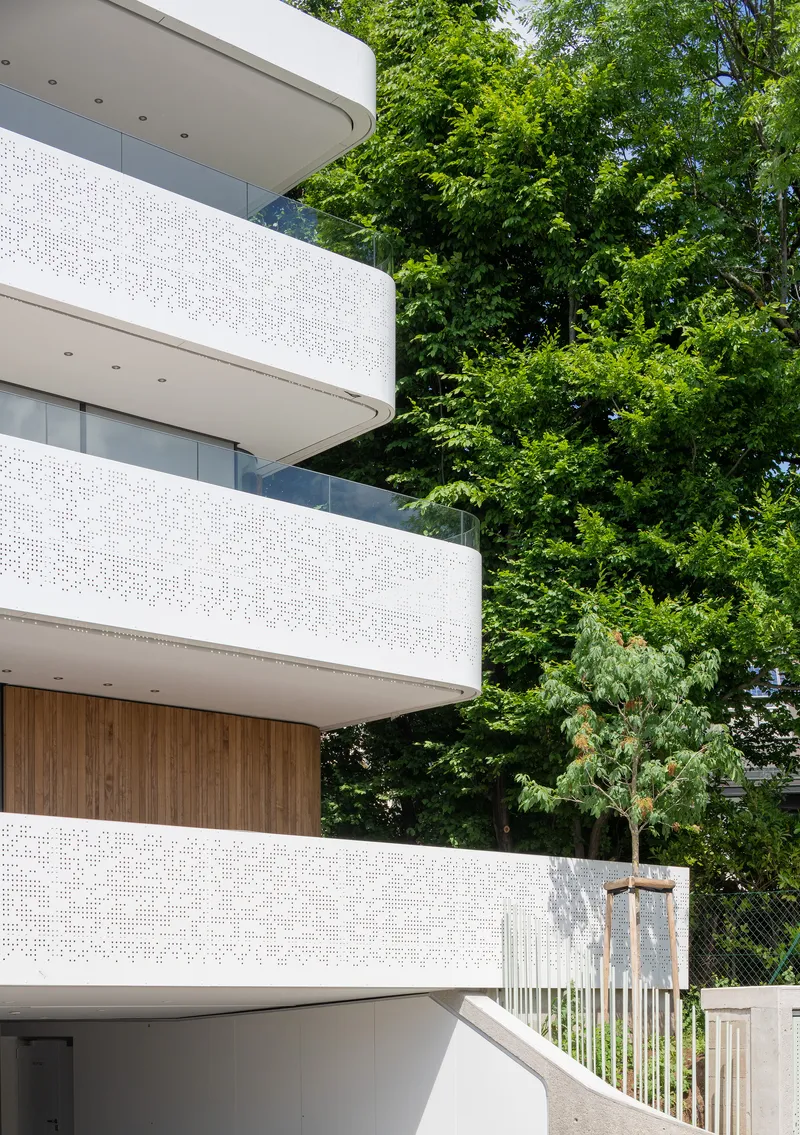
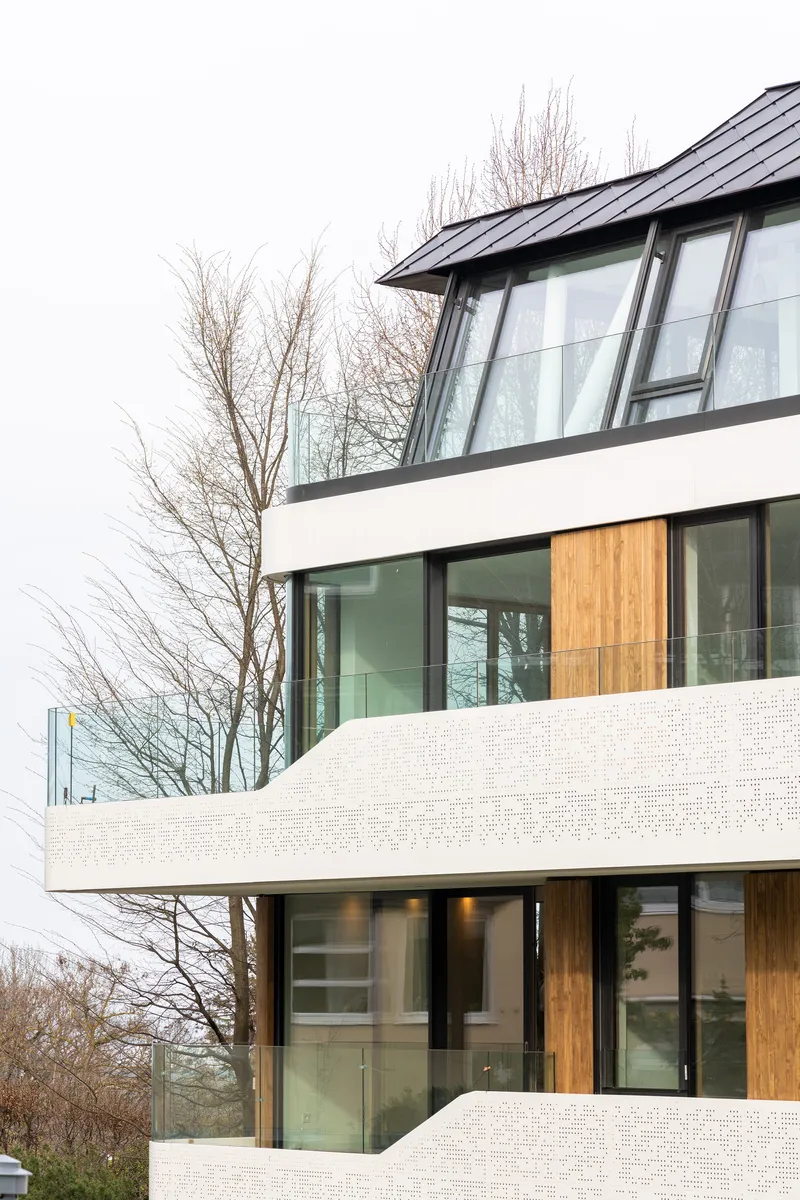
Too many residential projects treat balconies as bolt-on accessories. Here they are the architecture. The curved terrace photographed against the green canopy demonstrates how the perforated metal balustrade wraps continuously, creating a semi-enclosed outdoor room with recessed skylight openings that frame the sky above. The result is closer to a yacht's sun deck than a typical apartment balcony, and that comparison is not accidental.
At the upper levels, floor-to-ceiling glass sits flush with white brick terraces, erasing the boundary between inside and out. The close-up views of the perforated screens reveal a pattern dense enough for wind protection but open enough to filter daylight into the apartments behind. It is a small detail, but it drives the entire reading of the building.
Ground Floor and Penthouse: Anchoring the Extremes
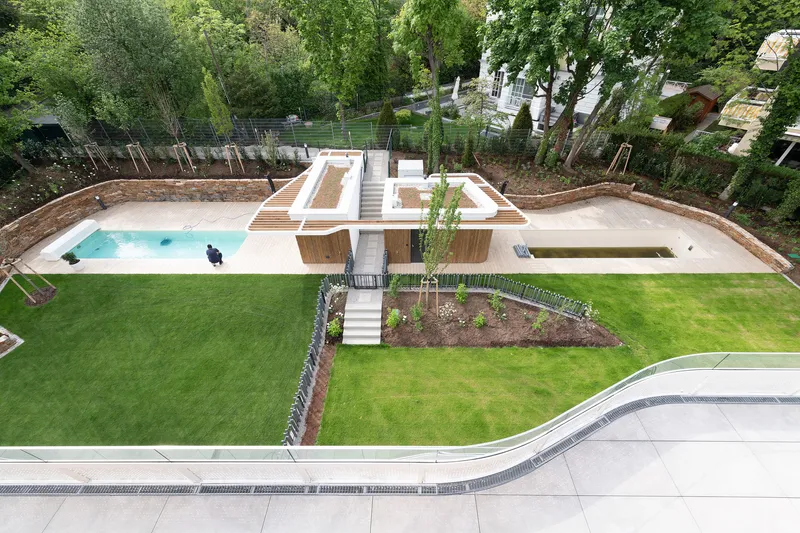
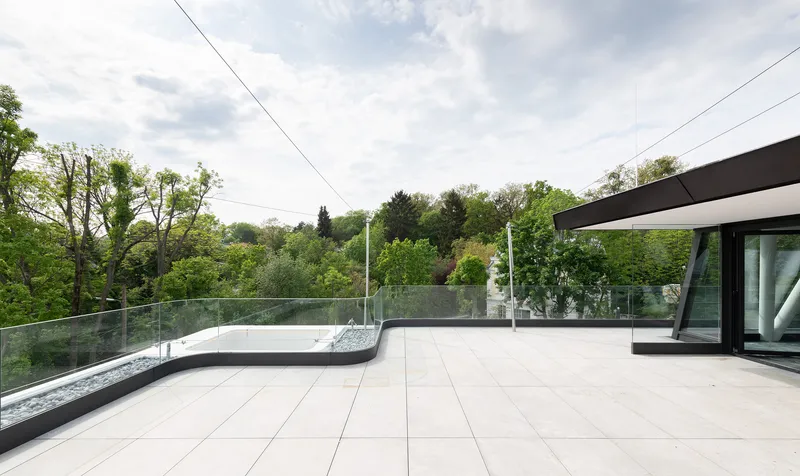
The building's program is bookended by two distinct living conditions. Ground-floor units sit slightly above street level with private yards, timber stairs descending through planted beds, and swimming pools tucked into the landscape. The aerial view of these terraced lawns shows how carefully the site has been graded to create intimate outdoor zones that feel like private gardens rather than shared amenity space.
At the top, the penthouse level wraps itself in a 360-degree terrace with glass balustrades, pale pavers, and uninterrupted views over the tree canopy to the surrounding hills. Where the lower floors negotiate privacy and proximity, the penthouse simply opens up to the city and the park in every direction. The copper roof overhead completes the composition with a material that will patina green over the years, eventually matching the treetops below.
Interiors and Circulation
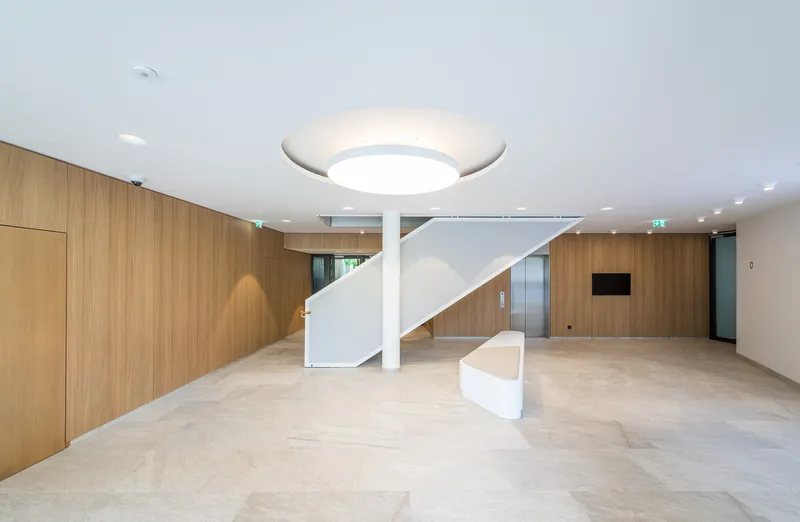
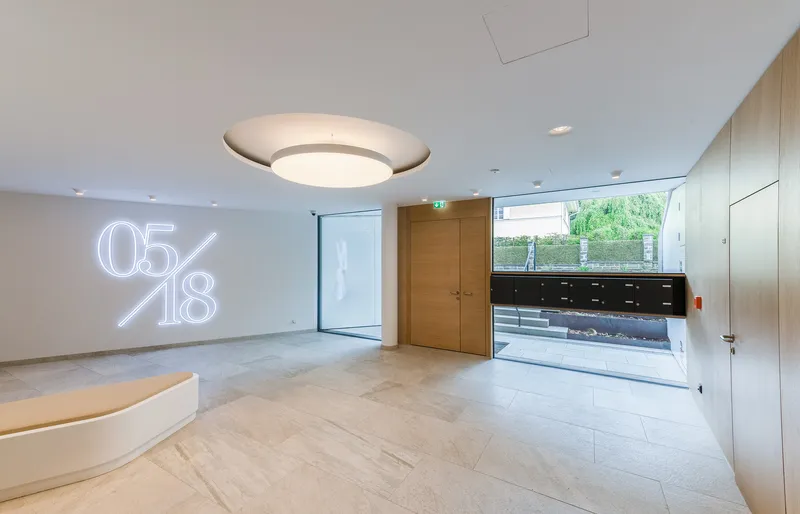
The entrance lobby sets a tone that is refined without being ostentatious. A curved white staircase wraps a circular column, its geometry echoing the rounded corners of the exterior. Timber-paneled walls bring warmth indoors, and a circular pendant light overhead reinforces the building's preoccupation with soft, flowing forms. The lobby's neon numerals and timber door suggest a hospitality-grade attention to detail that carries into the shared spaces.
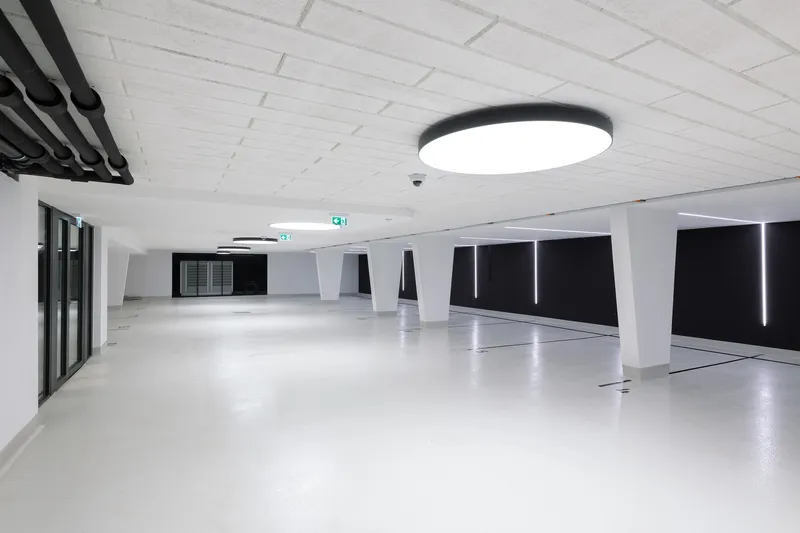
Below grade, the parking garage is clean and well lit, with angled columns and recessed black lighting panels that avoid the grim utilitarian feel typical of underground parking. It is a minor space programmatically, but its quality signals that puk architekten treated every level of the building with the same care.
Material Strategy: Brass, Accoya, and Perforated Metal
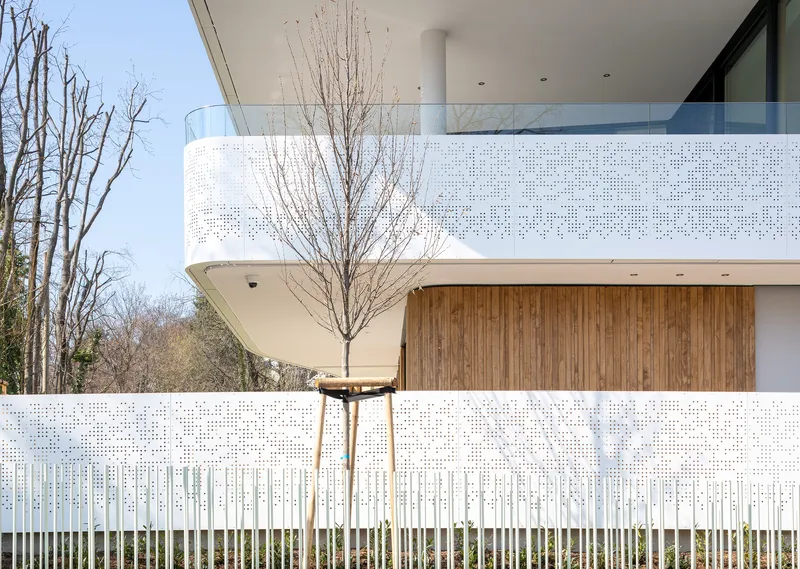
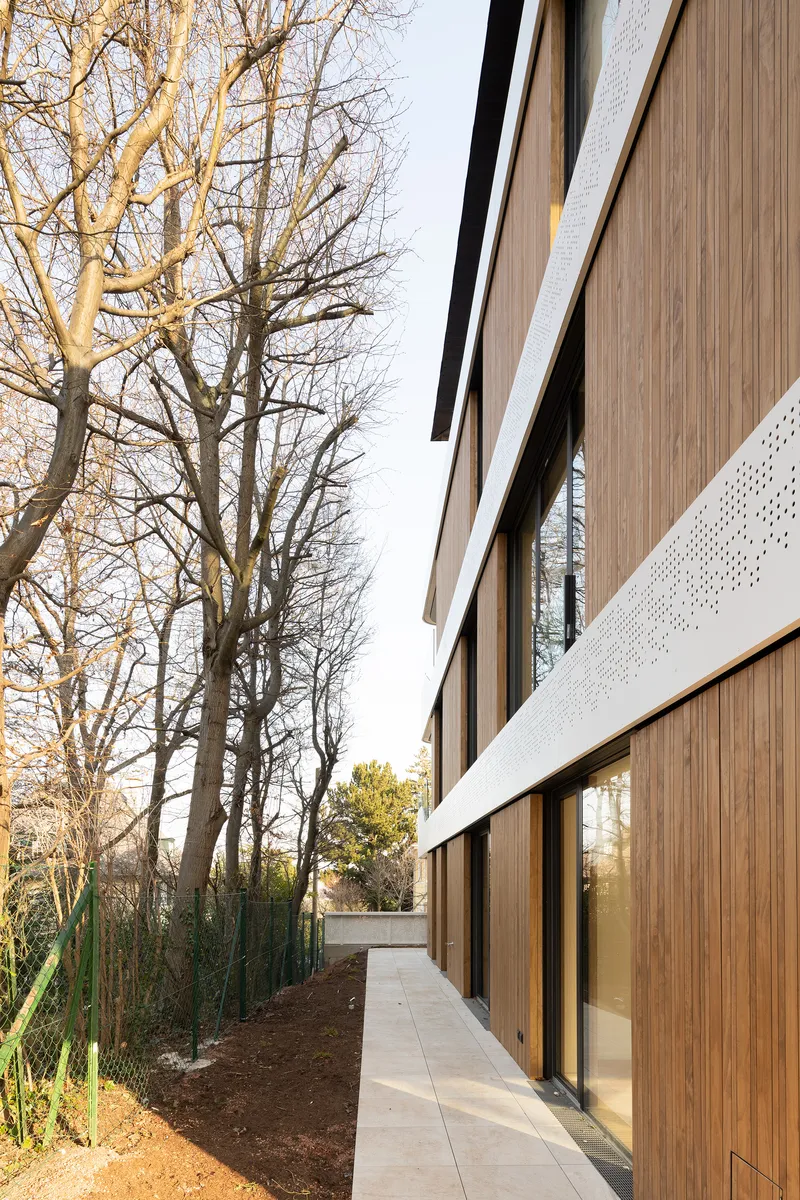
The material palette is narrow but well considered. Accoya wood cladding handles the primary facade surfaces, chosen for its dimensional stability and resistance to rot, both essential in Vienna's wet winters. The pre-blackened brass shingles that form the roof structure will age slowly, adding depth without the dramatic green patina of untreated copper. Perforated metal screens, white against the timber, operate as both balustrade and privacy filter.
The energy strategy pairs a photovoltaic system with air-to-water heat pumps and individual cooling systems for each unit. A central hot-water supply reduces redundancy. None of this is radical, but the combination is sensible for a mid-density residential building in a climate that demands both heating and occasional cooling.
Plans and Drawings
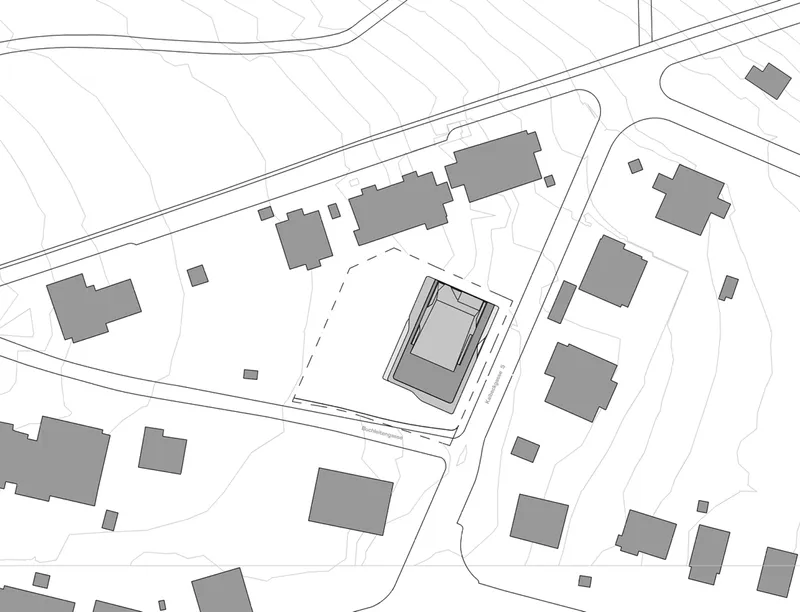
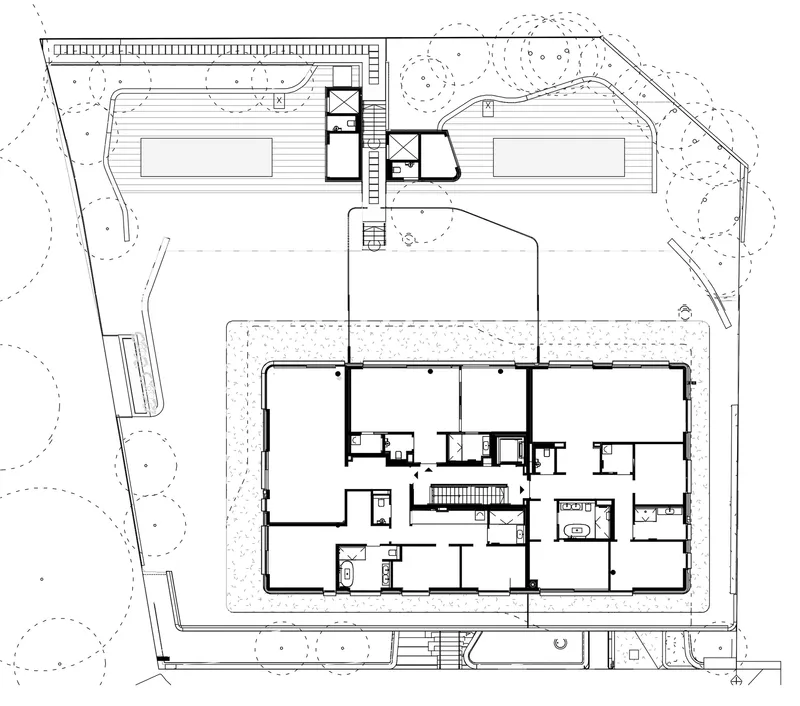
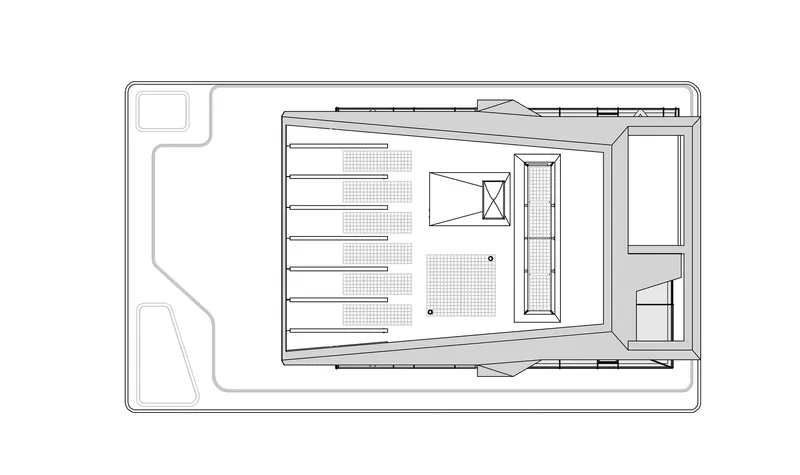
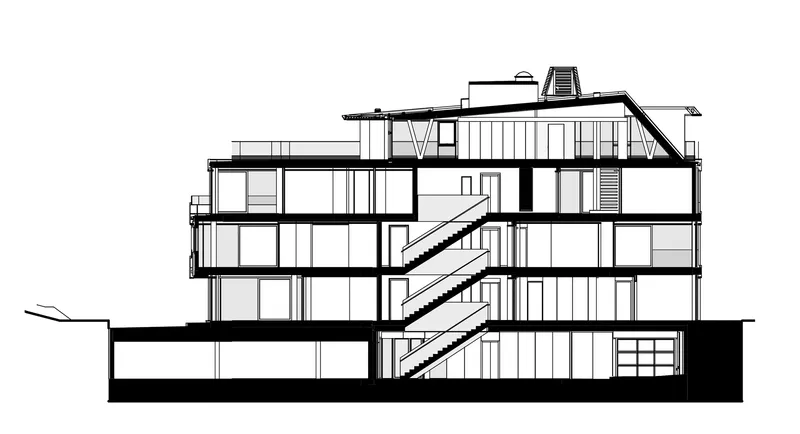
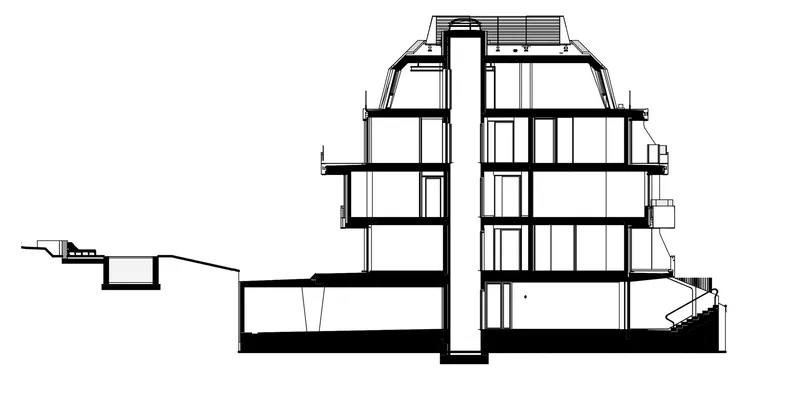
The site plans reveal two rectangular volumes connected by a central core, oriented to maximize garden frontage and minimize overlooking of neighbors. The roof plan shows parallel louver elements and a skylight over the central courtyard, confirming that natural light reaches down into the shared circulation. The two section drawings are the most telling: they expose the four-story structure's stepped terraces and the way the basement level knits both volumes together below grade, creating a continuous underground parking and services floor that frees the landscape above for planting and pools.
Why This Project Matters
The Schlosspark Residential Building succeeds because it treats the edge condition between city and park as an opportunity rather than a constraint. In a neighborhood defined by 19th-century villas, puk architekten did not mimic historical forms or retreat into minimalist anonymity. Instead, they produced a building with a strong, specific identity: curved, layered, and deeply engaged with its outdoor spaces. Every apartment is designed to feel like it has more outside than inside, and the material choices ensure the building will settle gracefully into its wooded setting over time.
For practices working on similar edge sites, the lesson here is about generosity. The architects gave away floor area to terraces, sacrificed repetitive efficiency for three-directional views, and invested in custom metalwork and curved glazing that most developers would have value-engineered out. The payoff is a building that rewards its residents with a quality of life that a conventional apartment block simply cannot deliver. Vienna's housing tradition is rightly celebrated, but projects like this remind us that the tradition is still evolving.
Schlosspark Residential Building by puk architekten (project managers: Bernhard Meisnitzer, Edita Vinca). Located in Wien, Austria. 1,503 m². Completed 2021. Photography by Lukas Schaller.
About the Studio
Share Your Own Work on uni.xyz
If projects like this are the kind of work you want to make, uni.xyz is a place to publish your own, find collaborators, and enter design competitions.


Popular Articles
Popular articles from the community


Conexión: Biophilic Design Reimagines High-Rise Living in Hong Kong
Conexión reimagines high-rise living in Hong Kong through biophilic design, green facades, shared spaces, daylight, water and nature within.

Co-life: Sustainable Architecture for Age-Friendly Community Living
Co-life reimagines sustainable architecture for seniors through courtyards, rammed earth, shared gardens, and spaces designed for belonging.

The Musturak Paradise: Senior Living Architecture for a Connected Future in Temara, Morocco
The Musturak Paradise reimagines senior living architecture in Temara via private homes, social spaces, culture, community, and shared care.

Co-Life: Senior Housing Design That Reconnects Older Adults With the City
Co-Life reimagines senior housing design through healing gardens, shared streets, workshops, and a sustainable community across generations.
Similar Reads
You might also enjoy these articles

Bao Huynh Watercolor Atelier: A Serene Art Retreat in Hội An
Bao Huynh Watercolor Atelier in Hội An blends multifunctional art spaces, sustainable design, local materials, and family-friendly living in a serene environment.

Atelier Macri Concept Store Interior Design by CASE-REAL
Atelier Macri store features a "ko" counter, walnut wood details, cork displays, blending retail, gallery, and seamless customer experiences.

Manuel Vargas Izquierdo Stadium and High-Performance Sports Center: Architectural Excellence in Jalpa de Méndez
The Manuel Vargas Izquierdo Stadium blends sustainable design, inclusive sports facilities, and cultural-inspired architecture, revitalizing Jalpa de Méndez’s public spaces.

KAKR Buluh Awar Hall: Revitalizing Community and Ecology Through Bamboo Architecture
Community built bamboo hall revitalizes Buluh Awar village, empowering youth, restoring ecology, celebrating vernacular craftsmanship through sustainable architecture and culture.

Comments (0)
Please login or sign up to add comments
No comments yet. Be the first to comment!