
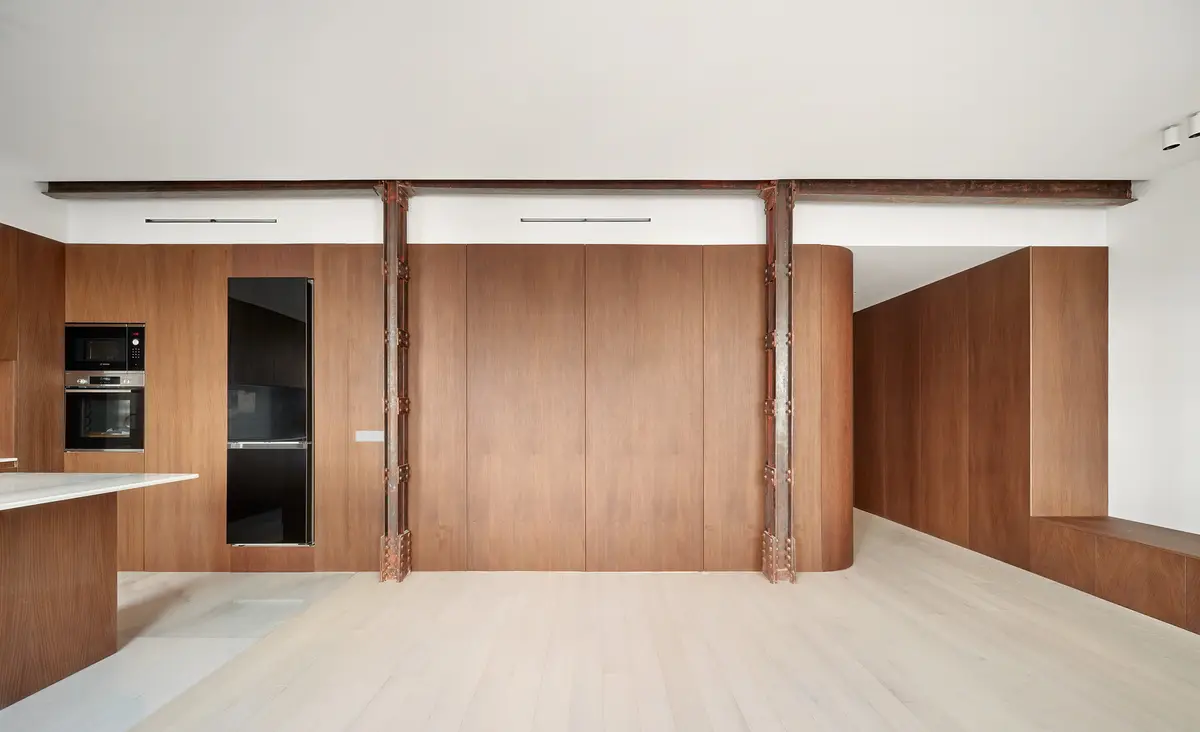
Pulso Arquitectos Carves a Madrid Apartment Around Exposed Steel Columns and Walnut Millwork
In Madrid's Chamberí neighborhood, a family home finds its rhythm between raw industrial structure and warm timber surfaces.


Most apartment renovations in Madrid's Chamberí neighborhood follow a familiar script: tear out the old partitions, lay new flooring, install a white kitchen. Pulso Arquitectos took a different path with Reforma Galileo, a project on Calle Galileo that treats the existing structure not as something to conceal but as a compositional anchor. Two riveted steel columns and the beam they carry remain fully exposed, painted a warm rust-red that becomes the single strongest visual element in the open plan. Everything else, from the walnut cabinetry to the curved transitions between rooms, responds to these columns as though choreographed around them.
What makes the project genuinely interesting is the decision to compress all the apartment's complexity into a single walnut-clad volume that acts simultaneously as wall, storage, and spatial divider. On one side, the family lives openly: cooking, dining, lounging. On the other, bedrooms, a bathroom, and a flexible telework space tuck away. The result is not merely an open plan but a legible hierarchy of shared and private life, achieved without drywall partitions and without sacrificing acoustic comfort. Completed in 2022 at roughly 1,300 euros per square meter, the project demonstrates that a carefully considered material palette can do more spatial work than a generous budget.
Steel Bones Left in View
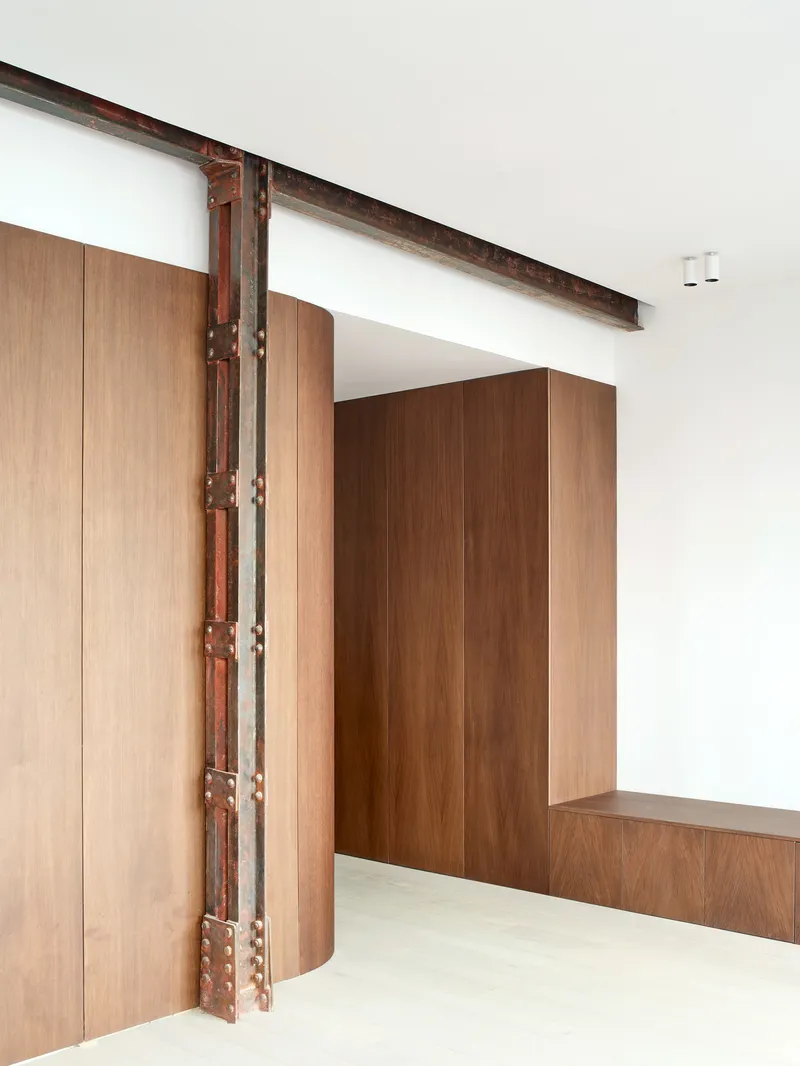
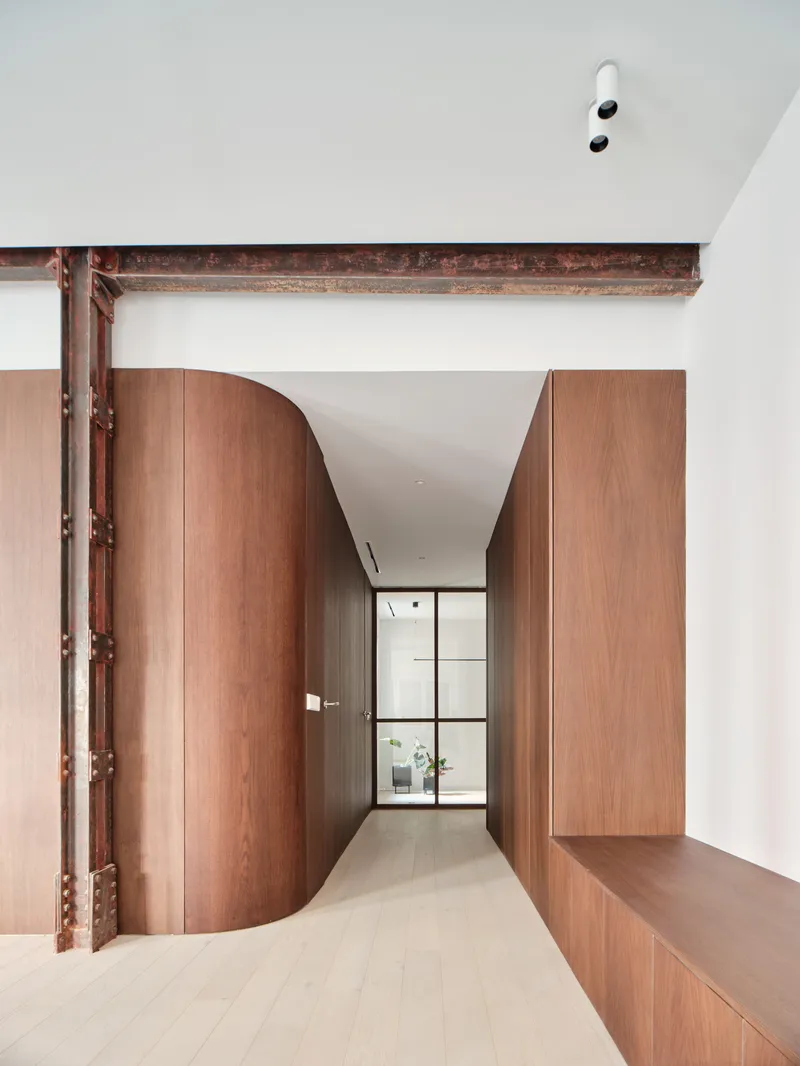
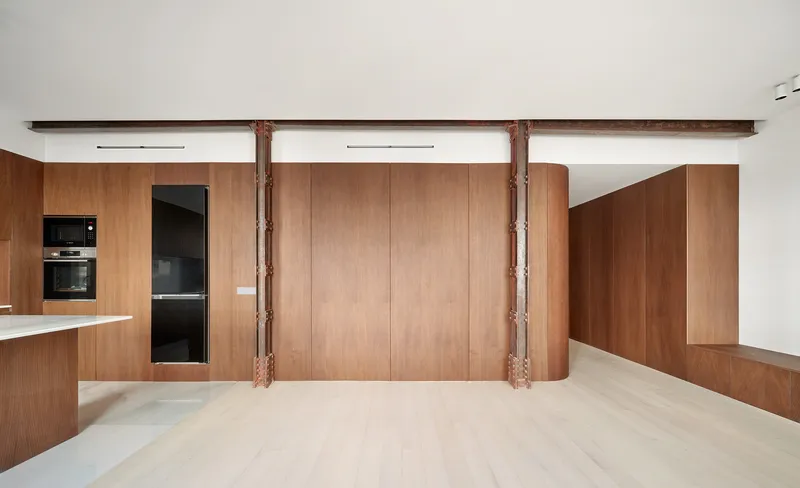
The exposed steel columns are riveted, industrial, and unapologetically out of register with the warm wood that surrounds them. Pulso Arquitectos let the contrast speak for itself rather than trying to harmonize it. The columns mark the boundary between the kitchen zone and the living area, structuring circulation without closing anything off. Their rust-red finish reads as deliberate, almost furnishing-like, turning what might have been an engineering constraint into a design decision that gives the apartment its character.
The beam running between the two columns does double duty as a visual datum line, establishing a horizontal reference that the curved walnut millwork plays against. Stand at one end of the open plan and the columns frame a sequence of views: kitchen island, living area, corridor beyond. They are not ornamental. They are the spatial logic of the apartment made visible.
The Walnut Volume as Organizer
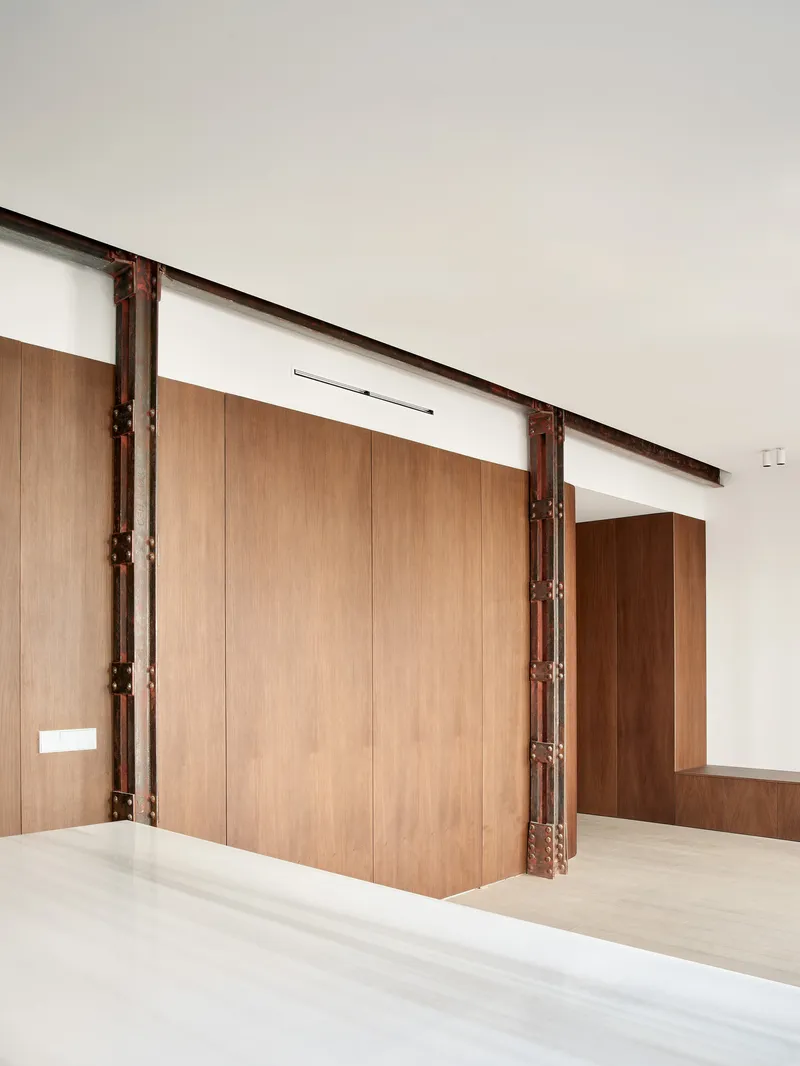
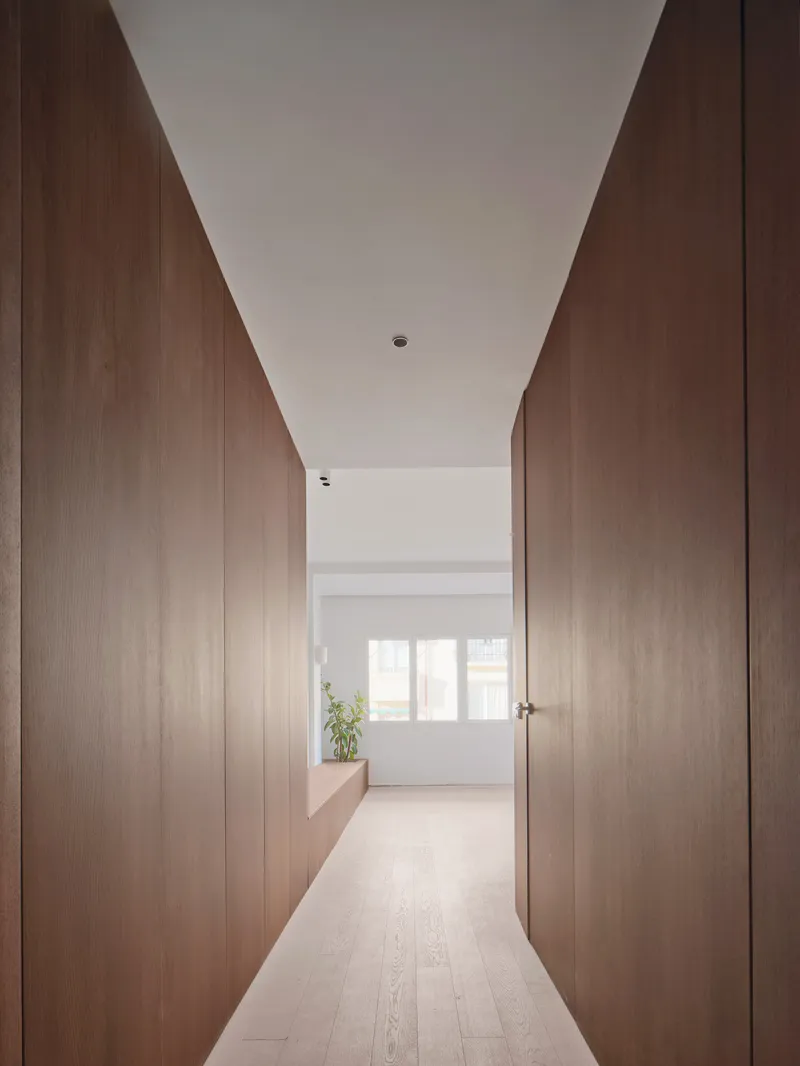
If the steel columns are the skeleton, the walnut-clad furniture wall is the musculature. Pulso Arquitectos designed every piece of custom millwork in the apartment, from kitchen cabinetry to wardrobes to the large glass partition. The walnut volume runs through the center of the plan, thick enough to absorb storage on both sides, and shaped with curves at every transition point. Rather than ending in sharp corners, the wood bends gently into corridors and doorways, a move that recalls the interiors of Louis Kahn's Esherick House, which the studio cites as a reference.
The effect is that you never feel like you are passing through a doorway in the conventional sense. You are sliding along a continuous timber surface that widens, narrows, or opens into glass as the program demands. The stained and lightened oak flooring reinforces this continuity, its pale tone stepping back so the walnut walls can command attention.
Curves at Every Threshold
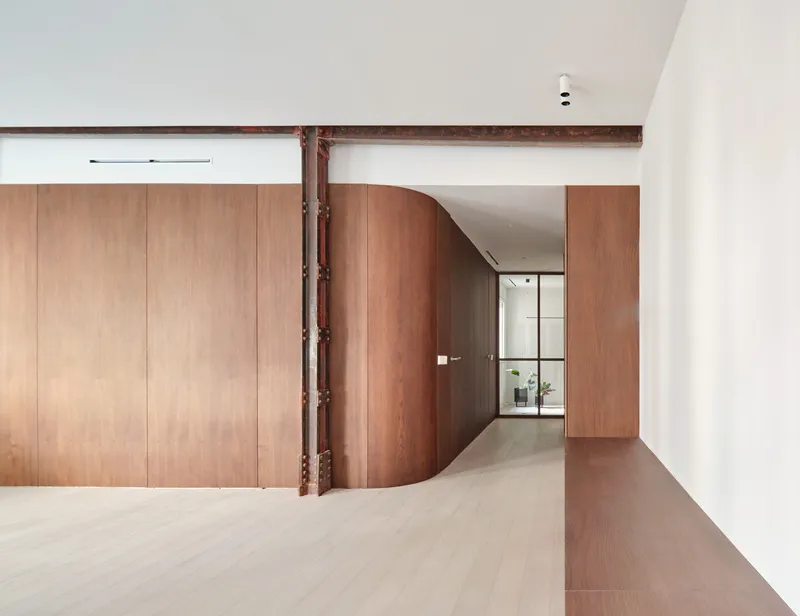
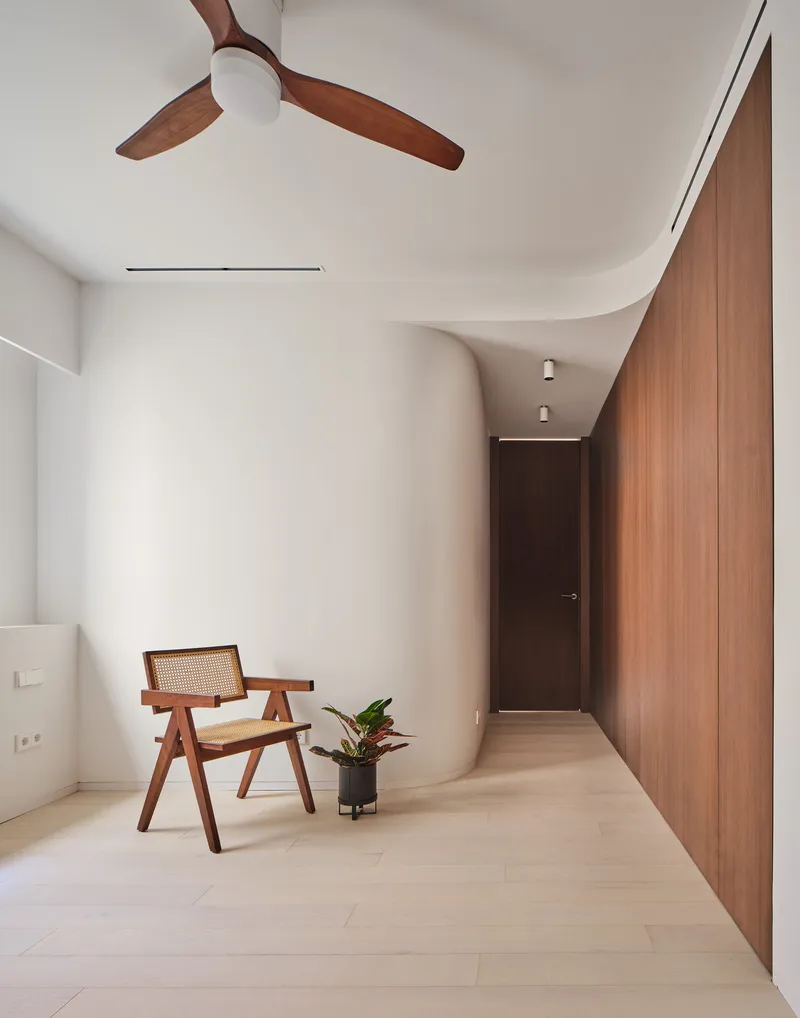
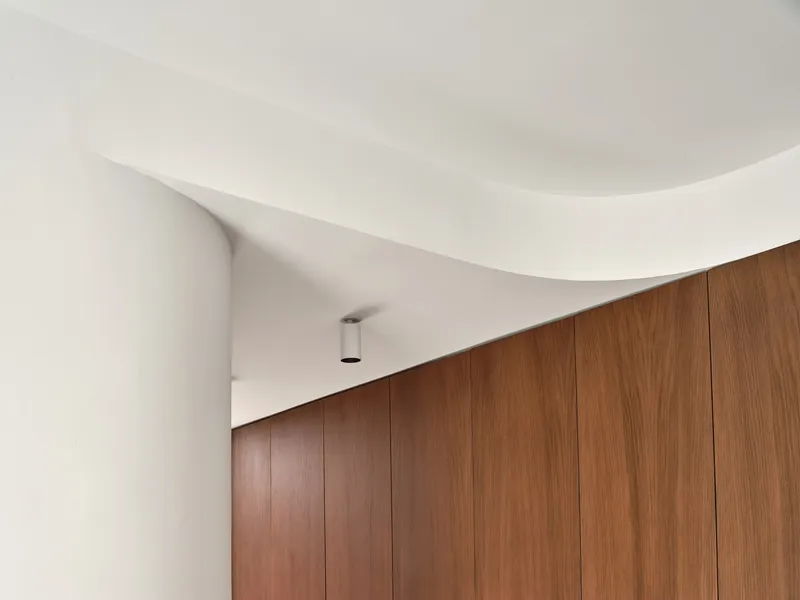
Curved lines appear at almost every point where one space meets another. A corridor wall bends smoothly into the bedroom. The ceiling meets a walnut panel in a soft radius rather than a hard joint. Even the cabinetry in the hallway swells outward rather than sitting flat. The curves are not decorative flourishes; they are functional softeners that keep circulation fluid in what could otherwise feel like a series of tight corridors.
In the bedroom, the curved white wall flows into the corridor without a door frame interrupting the line. A wooden ceiling fan hangs overhead, low-tech and practical, a reminder that the project keeps one foot firmly in the everyday. The recessed lighting at the walnut-to-ceiling junction is precise, casting an indirect wash that accentuates the curve without dramatizing it.
Kitchen and Living in Dialogue
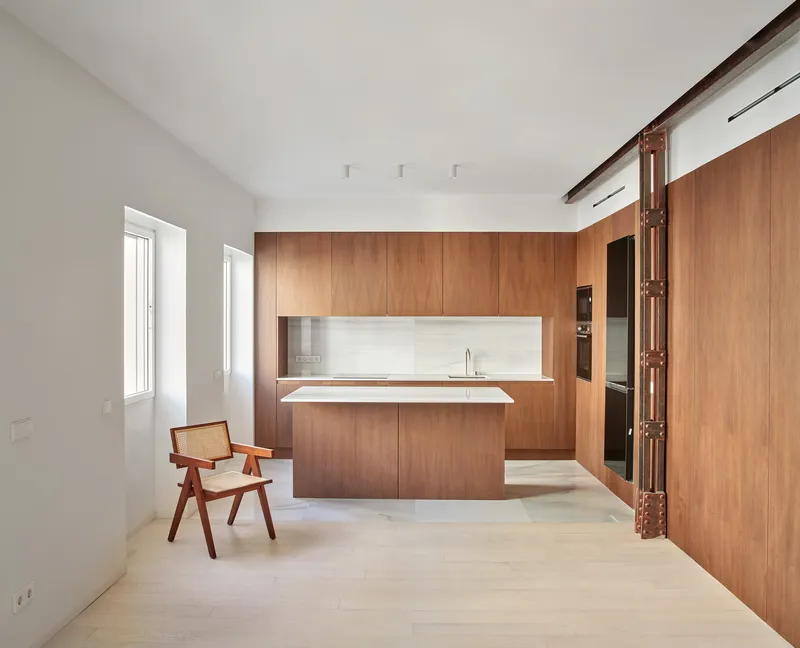
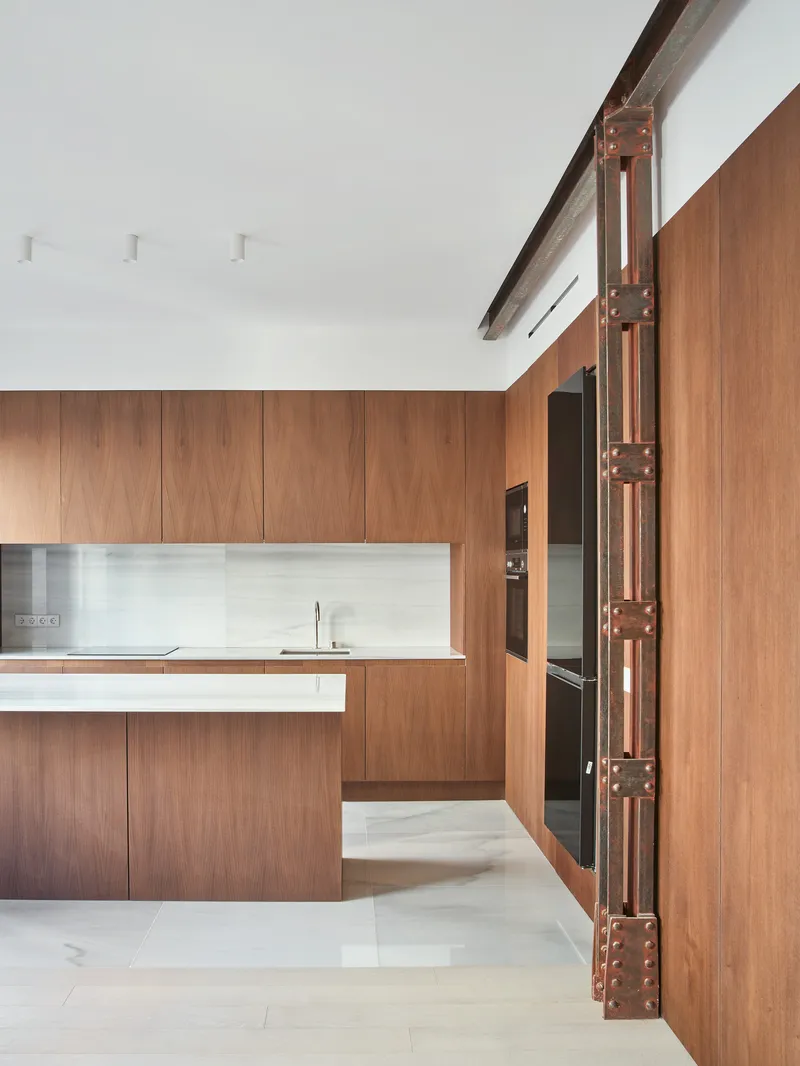
The kitchen occupies one end of the open plan, defined by its white marble countertop and natural marble flooring, a deliberate material shift from the oak that runs through the rest of the apartment. The island sits between the two steel columns, framed by them as though in a vitrine. Wood-clad cabinetry wraps the backsplash and continues into the island's base, tying the kitchen back to the walnut language of the living zones.
Two windows flood the cooking area with natural light, and a single wooden chair placed beside the counter suggests that this is as much a place to sit and talk as it is to prepare food. The design enables what Pulso Arquitectos calls the simultaneous and shared use of three social spaces: cooking, dining, and lounging all happen within sight of each other, connected by the open plan but given enough material differentiation to feel like distinct moments.
Glass as a Soft Boundary
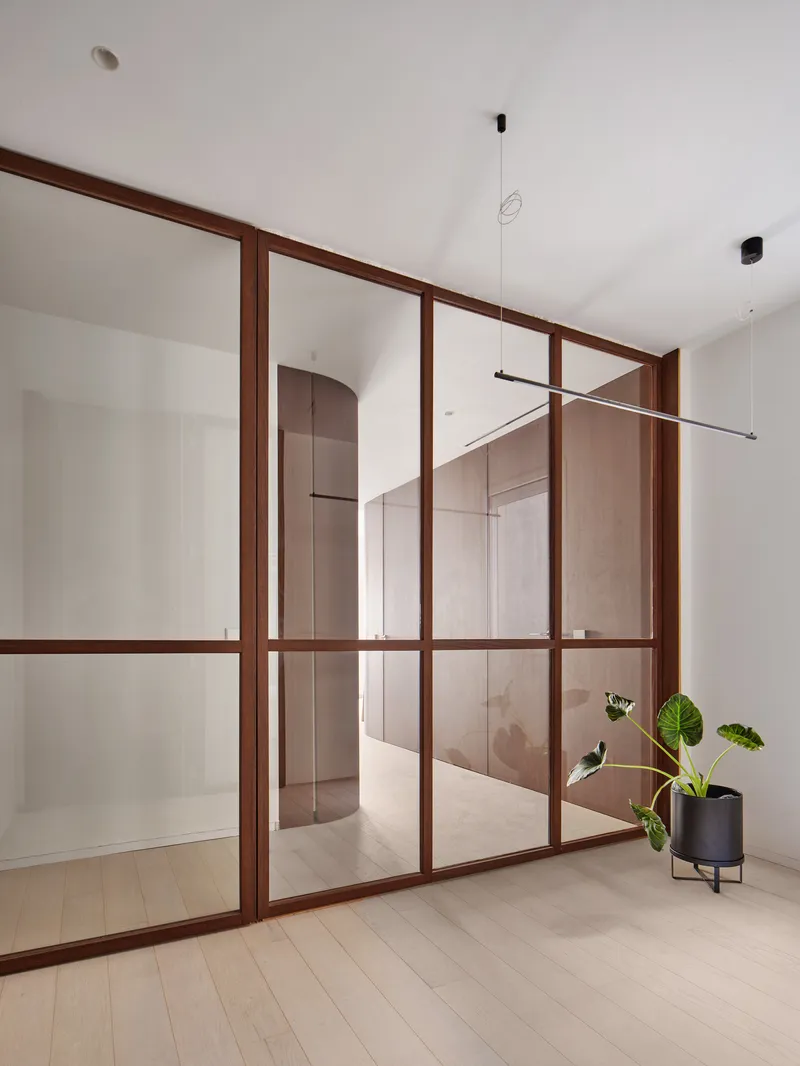
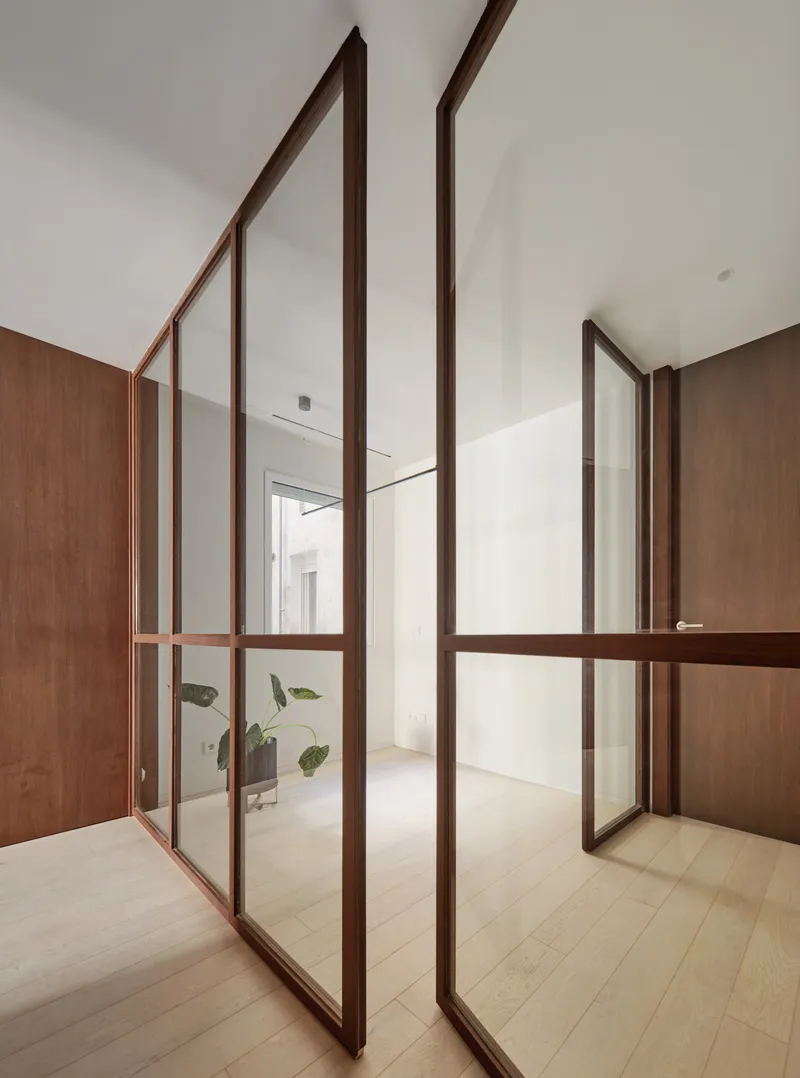
A large glass partition with a slender timber frame separates one room from the social core without severing visual connection. Pendant lights and planters appear through the glazing, dissolving the boundary between the two zones. The timber frame is deliberately thin, almost disappearing, so the glass reads as a plane of light rather than a wall. This partition is part of the flexible telework space, which can convert into a third bedroom when needed.
The decision to use glass rather than solid partitions keeps daylight flowing through the depth of the plan, compensating for the fact that natural light enters from only two sides. It also means the apartment feels larger than its footprint suggests, a critical move in the dense fabric of Chamberí where apartments are often deep and narrow.
Furnishing as Architecture
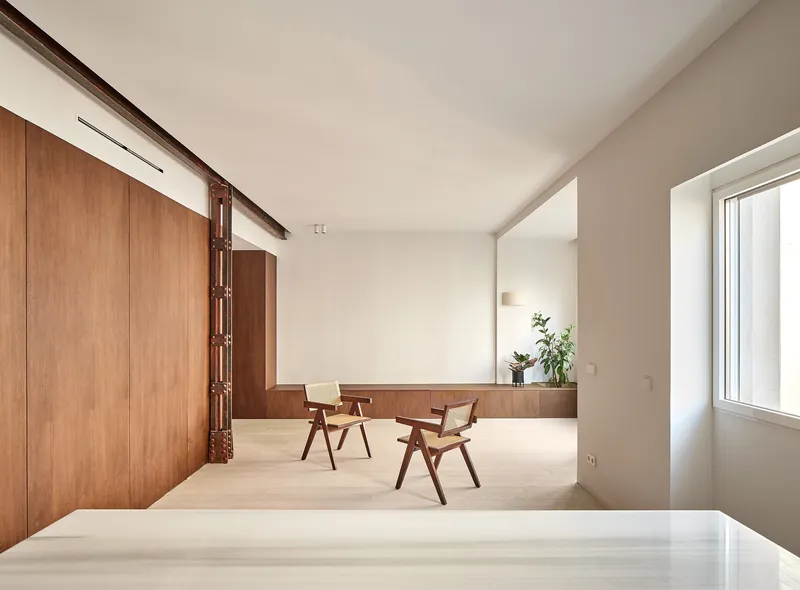
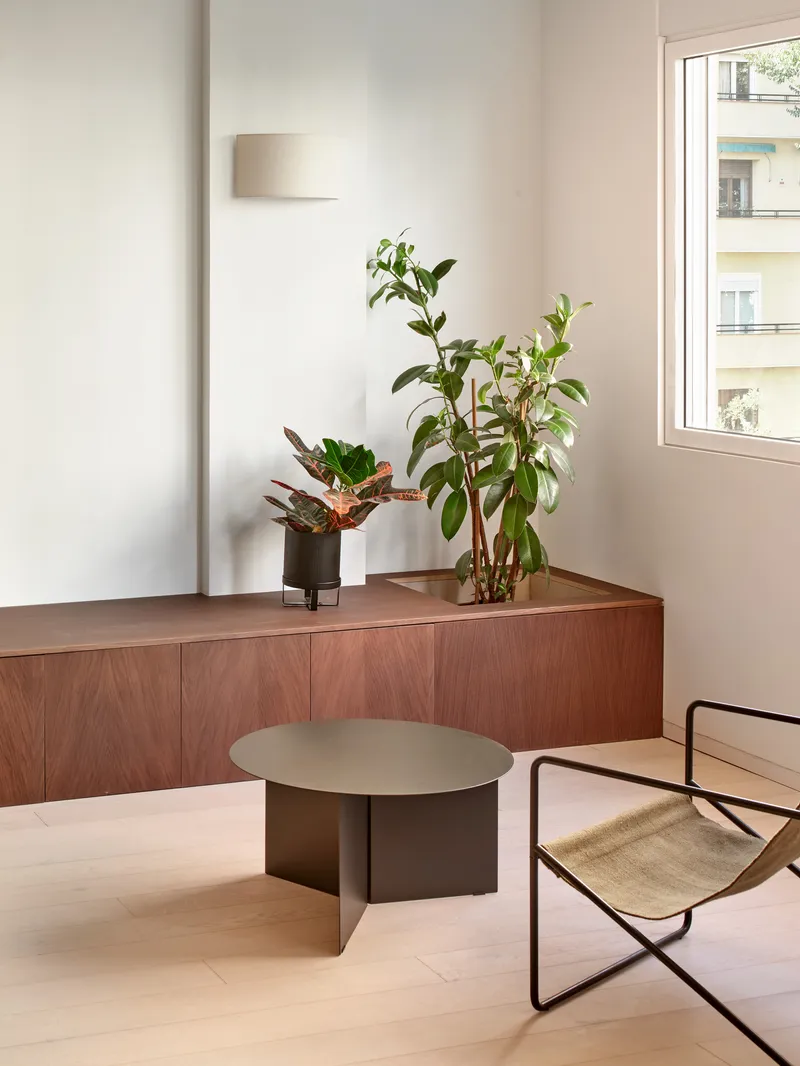
Pulso Arquitectos designed every piece of furniture in the apartment. This is not an unusual claim for a residential renovation, but here the furniture and the architecture are genuinely inseparable. The low timber bench in the living area, the curved sideboard by the window, the kitchen island: all share the same walnut finish and the same rounded geometry. Remove one and the spatial logic weakens.
The sideboard beside the window, framed by potted plants and a view of neighboring apartment buildings, captures the project's tone perfectly. It is domestic, unpretentious, and carefully made. The view outward reminds you that this is not a standalone house but an apartment embedded in a dense urban block, designed for a family navigating daily routines in a city that does not hand out square meters generously.
Plans and Drawings
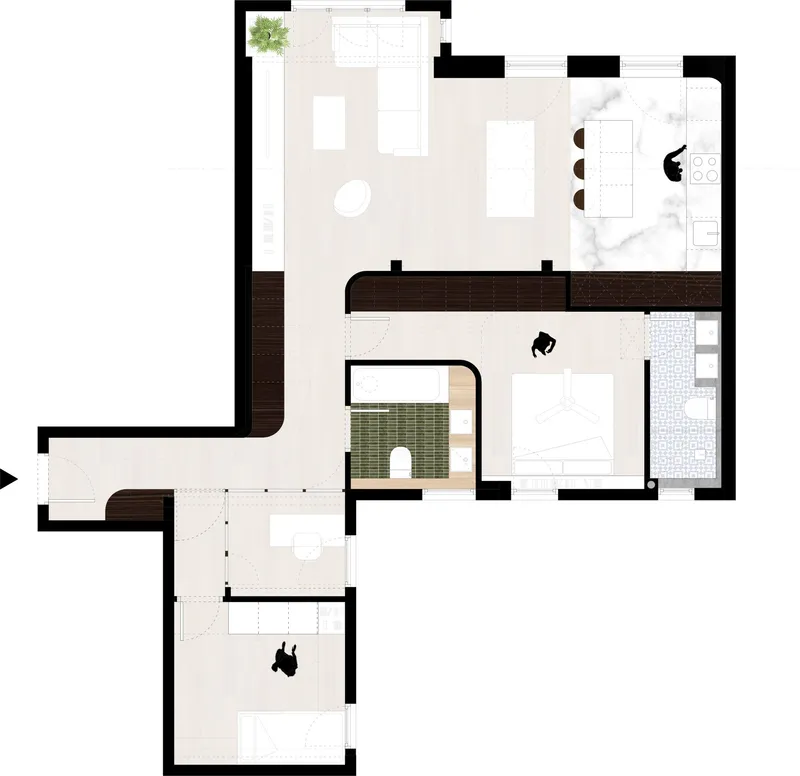
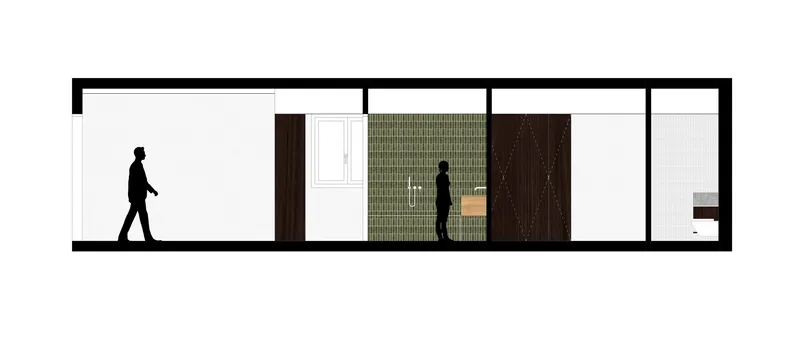
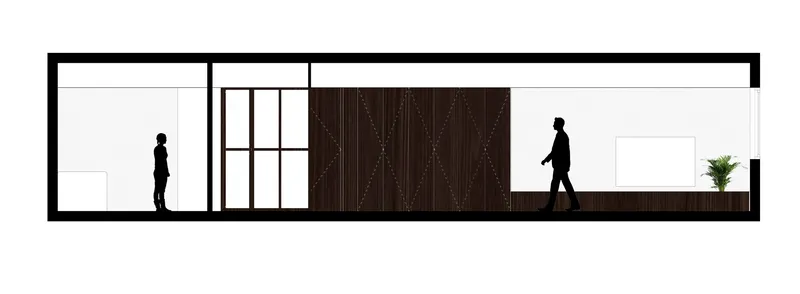
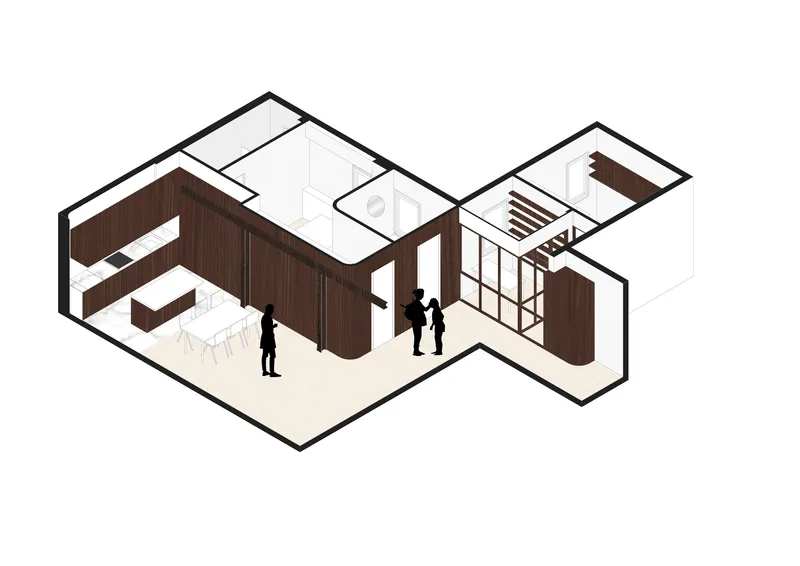
The floor plan confirms what the photographs suggest: the walnut volume sits at the center of the apartment like a thick spine, with the open social zone on one side and private rooms on the other. The sections reveal how the green-tiled bathroom and walnut millwork create distinct spatial episodes within a compact envelope. The axonometric drawing is the most revealing, showing how the custom furniture pieces lock together with the structural columns to form a single integrated system rather than a collection of separate interventions.
Why This Project Matters
Reforma Galileo is a quiet argument against the all-white, open-plan renovation that has dominated European apartment refurbishments for a decade. Pulso Arquitectos introduces material warmth, structural honesty, and spatial specificity into a typology that too often defaults to generic neutrality. The exposed steel columns are a risk that pays off: they give the apartment a backbone and a narrative that no amount of clever storage solutions could provide on their own.
At a construction cost of roughly 1,300 euros per square meter, the project sits comfortably in the mid-range for Madrid. What distinguishes it is not lavish spending but disciplined decision-making: a limited palette of walnut, oak, marble, and steel, deployed with enough consistency to make every room feel like part of the same conversation. For anyone attempting a family apartment renovation in a historic European city, Reforma Galileo offers a model worth studying closely.
Reforma Galileo by Pulso Arquitectos, located in Madrid, Spain. Completed in 2022. Photography by José Hevia.
About the Studio
Share Your Own Work on uni.xyz
If projects like this are the kind of work you want to make, uni.xyz is a place to publish your own, find collaborators, and enter design competitions.


Popular Articles
Popular articles from the community


Cube Design Draws an Ecological Corridor Between Two Shenzhen Hills with the Nankai Building
Beside Shenzhen's container docks, the Nankai Building pairs stacked balconies with a climbing green screen to connect two hillsides across its height.

graciastudio Turns a Viewless Tijuana Lot Inward Around a Courtyard of Concrete, Timber and Trees
In Tijuana, Jorge Gracia's GA2 House stacks a timber-clad private floor over exposed concrete and replaces a missing view with a planted interior patio.


Singing Woman: An Opera House That Performs Before the Curtain Rises
Ovidiu Cristian Pavel's conceptual opera house translates Estonia's choral identity into a sculpted waterfront landmark facing the Baltic Sea.

The Amber Palace Opera: A Geological Fiction Surfaces on Tallinn's Baltic Waterfront
Pierre Brillard reimagines a Baltic legend as a public landscape, opera house, and waterfront promenade rooted in Tallinn's coastal identity.

Similar Reads
You might also enjoy these articles

LAVA Architecten Gives Vocational Education a Sawtooth-Roofed Face on a Mechelen School Campus
In Mechelen, Belgium, a 2,053 m² STEM school on a 6×6 m grid turns workshops and classrooms into rooms that can be rearranged as teaching changes.

KEMA Studio Turns a Derelict Marvila Attic into a 60 m² Lighthouse Apartment Above Lisbon
In Lisbon's Marvila district, a rebuilt roof, four skylights and two plywood volumes turn an unlivable attic into a bright home facing the Tagus.

Pixel Gardens: One Repeated Module Stacked Into a Terraced Social Housing Tower for Famagusta
Salem Bader's shortlisted housing tower builds a vertical neighbourhood from one repeated module, offsetting units to carve terraces, light and air.

Bao Huynh Watercolor Atelier: A Serene Art Retreat in Hội An
Bao Huynh Watercolor Atelier in Hội An blends multifunctional art spaces, sustainable design, local materials, and family-friendly living in a serene environment.

Explore Re-Generative Competitions
Discover active competitions in this discipline

Challenge to reimagine the Iron Throne

Photograph architecture without architects

Illustrate the lost glory of Angkor Wat - Render Challenge

Design challenge to reuse E-waste
Comments (0)
Please login or sign up to add comments
No comments yet. Be the first to comment!