

PURA
Viewing deck with watch tower

The searching for a concept for this project in this unusual location began with a discussion on how to design a project with functional data in a way that does not destroy the beauty of the surrounding landscape. I started my research by looking for the most distinctive elements landscape as well as local architecture. The main concept was to create object which refers to mountains, craters surrounding it, as well as domed shapes in local architecture.
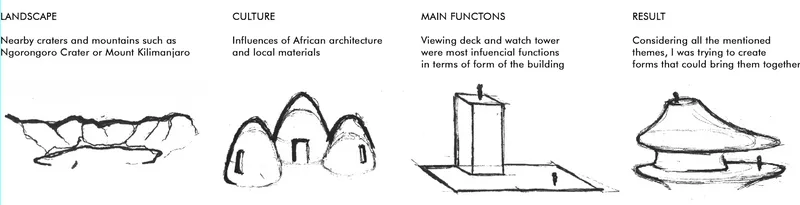
From the functions specified in the program of the project, I chose two that, in my opinion, could have the greatest impact on the shape of the building - the viewing deck and watch tower. Then, I began considerations on how we can close this function, in a form that will correspond with the mentioned references to local architecture and landscape.
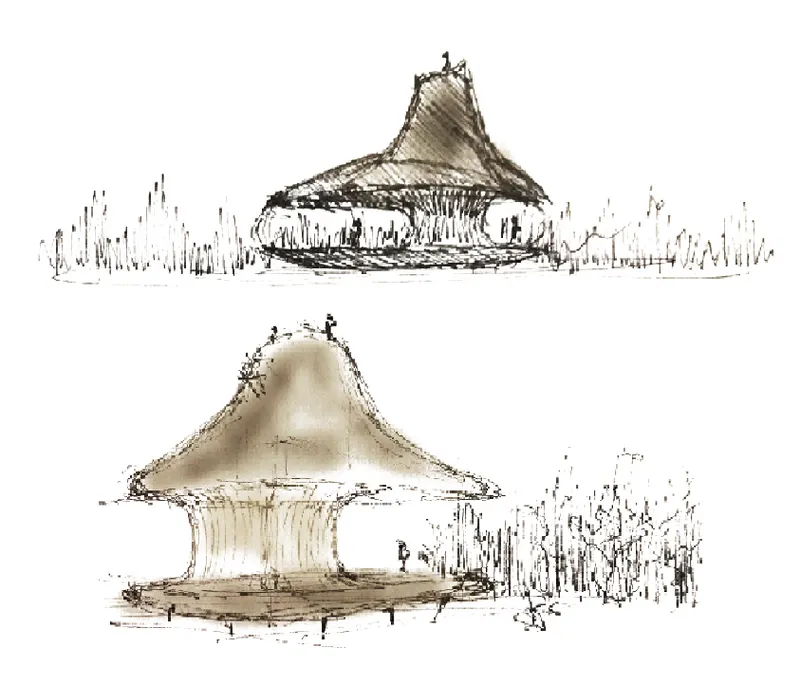
After determining the initial direction of the project development, I started to sketch forms that would be able to meet the functional requirements as well as the conceptual assumptions that I set at the beginning.
Considering all the above-mentioned factors, I found that the building must be surrounded by a viewing deck, which will allow visitors to observe this amazing landscape from every possible angle. In this case it was natural that the required function should be placed in the center of the planned object.
After many attempts at functional planning, it was possible to create an object that combines the above-mentioned functions in a logical way and the watch tower is integrated with the object in a manner consistent with the entire shape, creating an object with interesting proportions referring to both the Ngorongoro Crater and local architectural influences. I decided to chose local materials to create this facility, such as bamboo wood, local wood, and the walls created by a popular local method called SUPERADOBE using local soil.
After selecting the materials from which I wanted to create building, I began to wonder how to use them to obtain the desired effect. I wanted the object to be close to invisible from longer distances and to blend in with its natural surroundings. I decided to create a light bamboo roof structure, which would ensure adequate stiffness of the structure, and yet it was perceived as light and translucent as much as possible. Then I decided to cover it with bamboo stalks in irregular way that would resemble the surrounding vegetation and their branches. Another important assumption was to design a system that would allow us to recover rainwater that is so important to us. I decided to create a transparent membrane through which sunlight would enter to the inside of the facility, but also allow rainwater to be obtained and directed inside the building, where it is filtered and goes to the refreshment area.
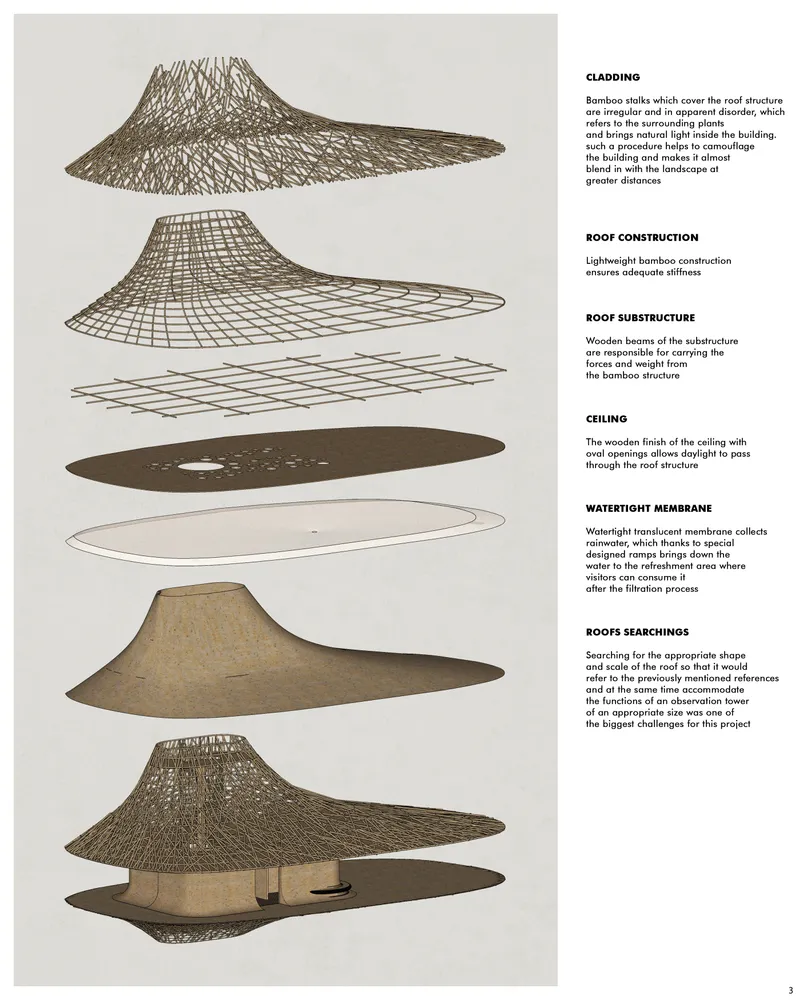
As a result of these works, it was possible to create an object whose form refers to the landscape and local architectural influences, and at the same time is able to blend into its surroundings thanks to the use of an interesting roof structure, which thanks to its light form and translucency blends into its surroundings. By that methods it was possible to minimize the interference of this object with its surroundings and at the same time to create a building that intrigues and interests from closer distances. The solution for collecting rainwater brings the project closer to sustainability in architecture, and the use of local materials and construction technologies will ensure that it is possible and as easy to build as it was possible in this particular case considering interesting form of the facility.

Popular Articles
Popular articles from the community


Singing Woman: An Opera House That Performs Before the Curtain Rises
Ovidiu Cristian Pavel's conceptual opera house translates Estonia's choral identity into a sculpted waterfront landmark facing the Baltic Sea.
Temporary Home for Dogs: A Reversed Zoo Rethinks Animal Shelter Architecture
In Bucharest, a sinuous corridor and freed landscape flip the logic of containment, designing a shelter that works to make itself unnecessary.

Opera on the Sea: Driftwood Logic Shapes a Timber Opera House on Estonia's Coast
Trevor Orgill's opera house translates the entangled drift of floating timber into a civic building where wood, water, and music converge.

Manzana Morphosis: Stretching Barcelona's Grid into a Living Landscape for 2050
A radical reworking of the Eixample manzana turns density into a tool for generous public space, vertical ecology, and environmental performance.

Similar Reads
You might also enjoy these articles

Shakur's House: Exposed Brick as an Interior Organiser in a 168 m² Mashhad Residence
Brick moves indoors in this Mashhad residence, where masonry walls, glass partitions and teal planes sequence a compact home without closing it off.

Day and Night Park: A Time-Based Urban Newsstand in Beijing
A temporary urban newsstand in Beijing blending travel, light, and reading through poetic colors, compact form, and community-focused design.

Modernist Patio Renovation in El Masnou, Barcelona by Oliver Segura Arquitectura + Cebrià Arquitectura
Modernist patio renovation blending tradition and innovation with a movable pool, leveled floors, and Catalan materials in El Masnou.

Alto Residencial Coop: Cooperative Housing Development in Santiago de Compostela by Carbajo Barrios Arquitectos
A linear cooperative housing complex blending white volumes and perforated metal façades, enhancing community living, natural light, privacy, and urban integration.


Comments (0)
Please login or sign up to add comments
No comments yet. Be the first to comment!