
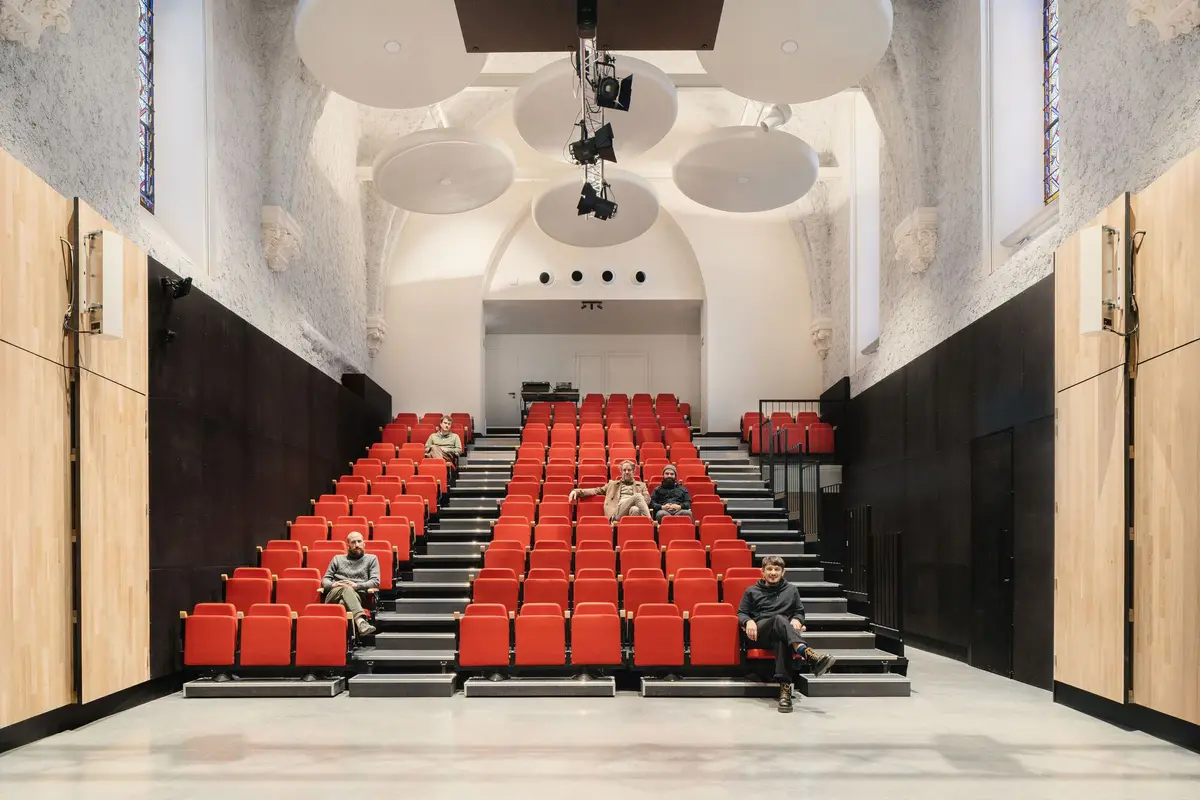
PWA and AUMMA Retrofit a French Convent Chapel into a Civic Performance Hall
In Saint-Félicien, two studios prove that designing with what already exists can produce the most compelling cultural spaces.


Convent chapels are among the most loaded building types in France. They carry centuries of liturgical acoustics, structural ambition, and civic memory, all wrapped in stone walls that resist casual alteration. At the Saint-Joseph convent in Saint-Félicien, PWA and AUMMA took on exactly this challenge, converting the chapel into a working performance hall without gutting the qualities that made it worth saving in the first place.
The guiding principle here is refreshingly straightforward: design with what already exists. That means the rough stone walls stay exposed, the stained glass windows keep casting colored light across the nave, and every new insertion reads as a deliberate, reversible layer rather than a permanent overwrite. The result is a 342 square meter space that holds both a 21st-century auditorium and the spiritual weight of its origins, without one canceling out the other.
Arriving Through Stone

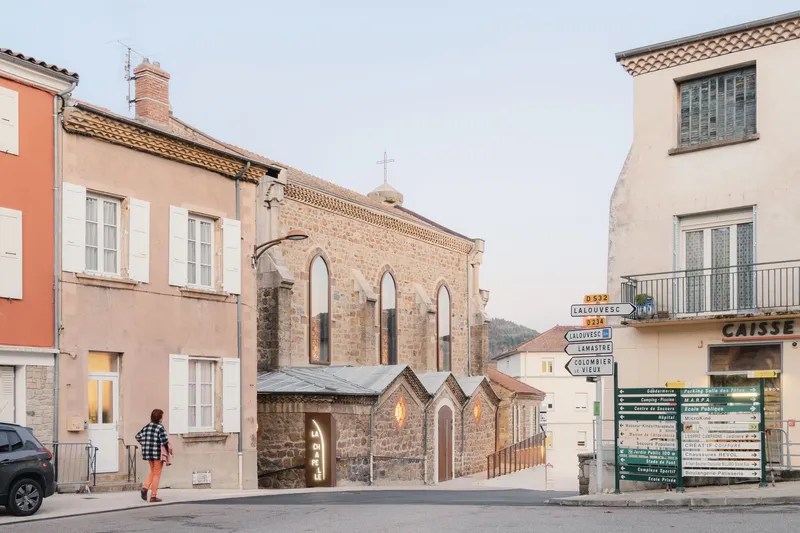

The chapel sits nestled between residential buildings, and the approach is deliberately understated. At dusk, warm light spills through the arched entry, turning the facade into a kind of lantern on a quiet street. There is no aggressive signage, no cantilevered canopy announcing a cultural institution. The stone does the talking.
A courtyard paved in a checkerboard pattern creates a transitional zone between the town and the interior, grounding visitors before they cross the threshold. PWA and AUMMA clearly understood that the procession matters as much as the destination. The worn texture of the masonry is left unpolished, its imperfections read as credentials rather than flaws.
Floating Discs and Theatrical Infrastructure
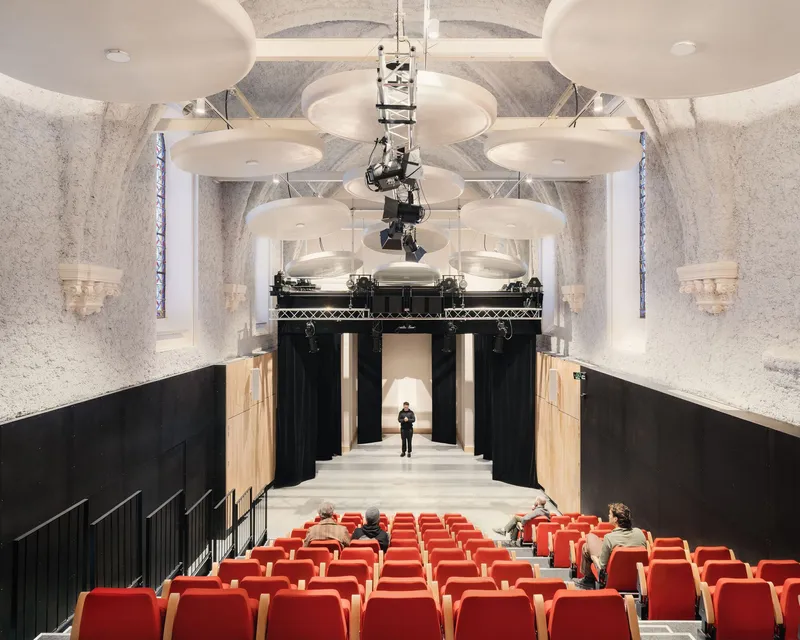
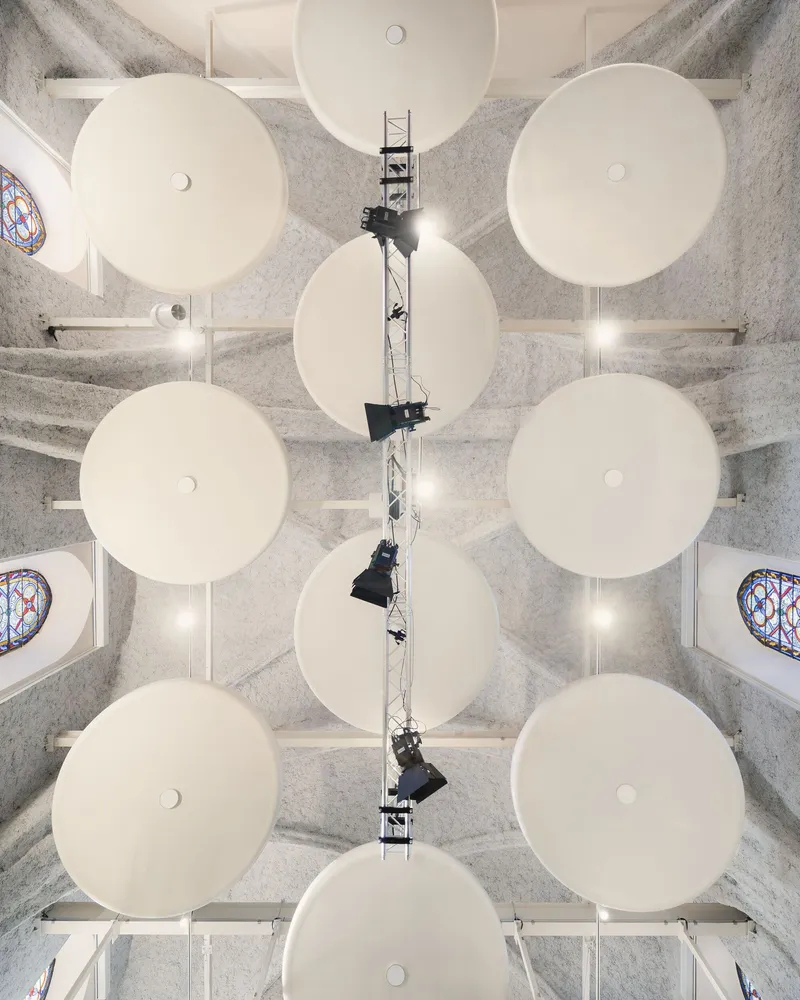

The most striking intervention is the array of white circular acoustic panels suspended from a lighting rig above the auditorium. Nine discs, arranged in a grid, float beneath the chapel's ceiling like oversized communion wafers. They are plainly functional, controlling reverberation in a space that was designed for Gregorian chant rather than amplified speech, but they also create a powerful visual rhythm when seen from below.
Below these panels, rows of red seats fill the nave. The color is bold and unapologetic, a clear signal that this is now a civic performance space. Theatrical rigging and lighting bars run overhead, coexisting with the original stone arches. The tension between the raw masonry and the precision of the technical equipment is what gives this room its character: sacred geometry meets backstage pragmatism.
Stained Glass as Active Material


Too many adaptive reuse projects treat stained glass as decoration to be preserved under glass or obscured behind drywall. Here, the windows remain active participants in the interior atmosphere. Colored light washes across bare stone walls and carved capitals, shifting through the day. The architects seem to have recognized that this light is not ornament; it is infrastructure, shaping mood and focus as effectively as any theatrical gel.
Along one wall, timber paneling and a black mezzanine provide a contemporary counterpoint. The dark steel framing is deliberately recessive, letting the stained glass command the room. It is a smart hierarchy: the oldest elements get the most visual authority, while the newest ones do the hardest work.
Gallery and Threshold Spaces


Beyond the main auditorium, secondary rooms serve as gallery and circulation spaces. Pale timber floors and linear black ceiling slats create a restrained material palette that refuses to compete with the stone walls visible through arched doorways. White double doors punctuate these rooms, offering a sense of domestic scale inside what was once a monastic enclosure.
The transition from weathered stone arch to smooth gallery floor is handled without fuss. There is no dramatic reveal, no gratuitous contrast. You simply walk through one era into the next, and the building holds both without strain. It is the kind of spatial generosity that old buildings offer when architects resist the urge to overdesign.
The Exterior After Dark

At twilight, the building reveals its dual identity most clearly. Empty arched windows on the upper facade remain unglazed, framing the sky. Below, illuminated chapels glow against the darkening stone. The effect is simultaneously ruin and renewal, a building that wears its history on its surface while demonstrating that it is very much alive.
Why This Project Matters
France is full of decommissioned religious buildings searching for second lives, and the default approach tends toward either museum-grade preservation or wholesale conversion that erases the original character. PWA and AUMMA chart a third path here, one where every new element is legible as an addition and every original element retains its voice. The floating acoustic discs, the red seating, the steel mezzanine: none of these pretend to be old, and none of them apologize for being new.
What makes the Saint-Félicien chapel compelling is its refusal to resolve the tension between sacred and secular, between permanence and performance. The building holds both registers at once, and the architecture is stronger for it. In a discipline that often treats adaptive reuse as a problem of surfaces, this project argues that the real work is spatial and atmospheric, a matter of tuning what is already there rather than replacing it.
La Chapelle Renovation, Saint-Félicien, France. Architects: PWA and AUMMA. Area: 342 m². Completed: 2025. Photography: Vladimir de Mollerat du Jeu.
About the Studio
Share Your Own Work on uni.xyz
If projects like this are the kind of work you want to make, uni.xyz is a place to publish your own, find collaborators, and enter design competitions.


Popular Articles
Popular articles from the community


Hill & Cross Opera: Sculptural Opera House Architecture Shaped by Tallinn’s Landscape and Identity
Hill & Cross Opera reimagines opera house architecture in Tallinn through its sculptural hill, civic plaza, glass wave and a luminous cross.

The Musturak Paradise: Senior Living Architecture for a Connected Future in Temara, Morocco
The Musturak Paradise reimagines senior living architecture in Temara via private homes, social spaces, culture, community, and shared care.

ALGAL REALM: A Bio-Integrated Lunar Habitat Design for Life Beyond Earth
ALGAL REALM reimagines lunar habitat design with algae-powered life support, 3D-printed regolith, and vertical living for a lunar future.

Co-life: Sustainable Architecture for Age-Friendly Community Living
Co-life reimagines sustainable architecture for seniors through courtyards, rammed earth, shared gardens, and spaces designed for belonging.

Similar Reads
You might also enjoy these articles

Bao Huynh Watercolor Atelier: A Serene Art Retreat in Hội An
Bao Huynh Watercolor Atelier in Hội An blends multifunctional art spaces, sustainable design, local materials, and family-friendly living in a serene environment.

Atelier Macri Concept Store Interior Design by CASE-REAL
Atelier Macri store features a "ko" counter, walnut wood details, cork displays, blending retail, gallery, and seamless customer experiences.

Manuel Vargas Izquierdo Stadium and High-Performance Sports Center: Architectural Excellence in Jalpa de Méndez
The Manuel Vargas Izquierdo Stadium blends sustainable design, inclusive sports facilities, and cultural-inspired architecture, revitalizing Jalpa de Méndez’s public spaces.

KAKR Buluh Awar Hall: Revitalizing Community and Ecology Through Bamboo Architecture
Community built bamboo hall revitalizes Buluh Awar village, empowering youth, restoring ecology, celebrating vernacular craftsmanship through sustainable architecture and culture.

Explore Renovation Competitions
Discover active competitions in this discipline

Design Challenge - Contemporary interpretation of a religious complex

Bring back Drive In's
Comments (0)
Please login or sign up to add comments
No comments yet. Be the first to comment!