
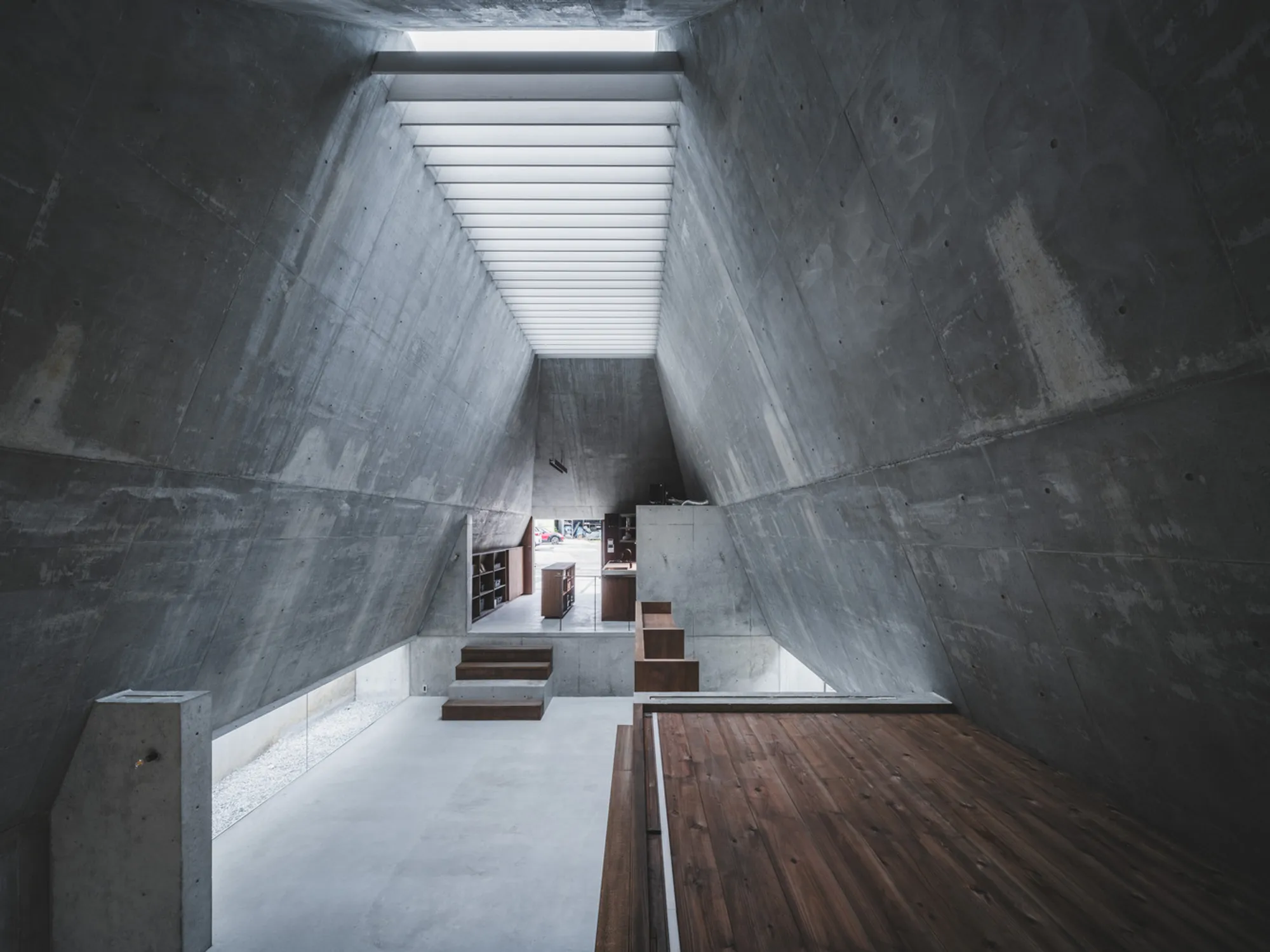
IGArchitects Buries a Concrete Pyramid in an Okinawan Neighborhood to Outlast Its Own Purpose
An 83-square-meter house in Okinawa, Japan, channels the permanence of traditional island tombs through a monolithic pyramidal form lit from above.


On a narrow, sloping lot in Okinawa hemmed in by apartment blocks and a cemetery whose vegetation had begun to swallow the site, IGArchitects completed Pyramid Hut in 2024. At just 83 square meters, the house reads as something closer to a land form than a dwelling: a square-based concrete pyramid lifted off Ryukyu limestone by stepped retaining walls, its only generous opening a skylight slicing the apex. The shape is not decorative. It is a direct response to a site with almost no useful frontage, a climate defined by violent wind and rain, and an ambition to create architecture that holds its presence long after its occupants move on.
What makes the project genuinely interesting is the way it inverts Okinawan convention. Post-war concrete construction on the island typically favors large openings to pull in tropical light and air. IGArchitects went the other direction, enclosing the house almost entirely and flooding it from above. The reference point is not the modern Okinawan home but the traditional Okinawan tomb: a monolithic structure built to endure for generations, serving as a place of gathering and reverence. The architects wanted the house to function the same way, and the pyramid is their bet on permanence.
A Monolith on a Contested Site
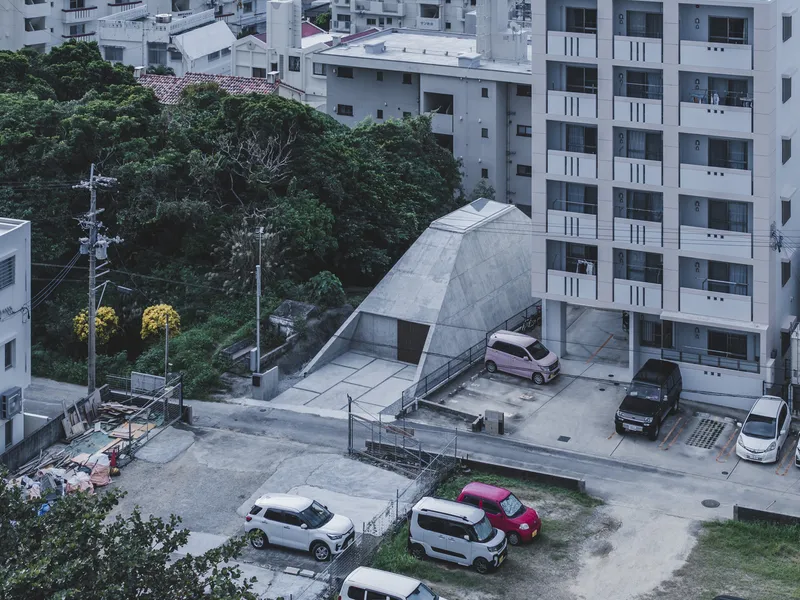


Seen from above, Pyramid Hut looks almost accidental, as though a geological fragment lodged itself between apartment towers and tree canopy. The cemetery next door functions less like a formal burial ground and more like an unmanaged forest, with vegetation that had crept across the property line before construction began. Three sides face other buildings. The architects' decision to close the envelope and orient the house inward was not stylistic restraint; it was the only workable option.
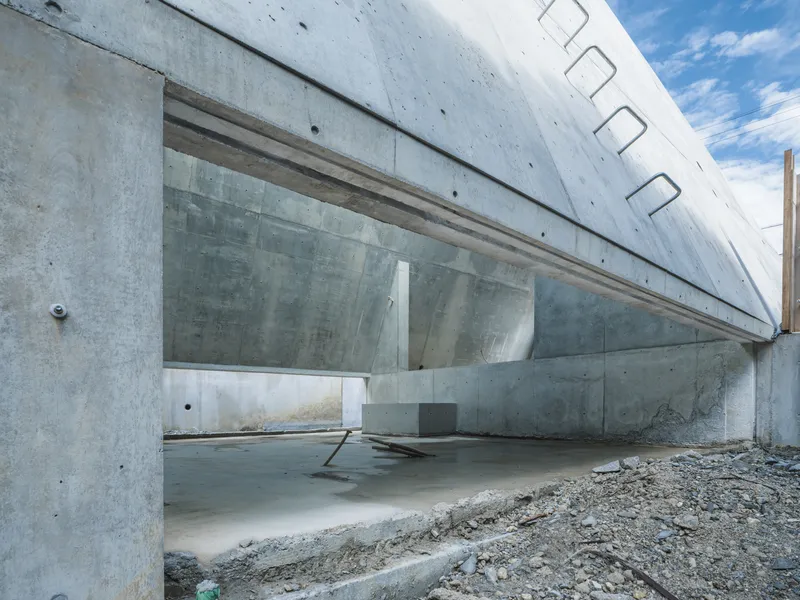
The pyramid sits on two rows of stepped earth-retaining walls that double as the foundation. These walls negotiate the site's gentle slope and raise the living volume above grade, protecting against erosion and establishing a clear threshold between the house and the overgrown landscape around it. The structure appears to hover above the limestone, giving it the quality of an object placed rather than built.
Concrete Shell, Timber Interior


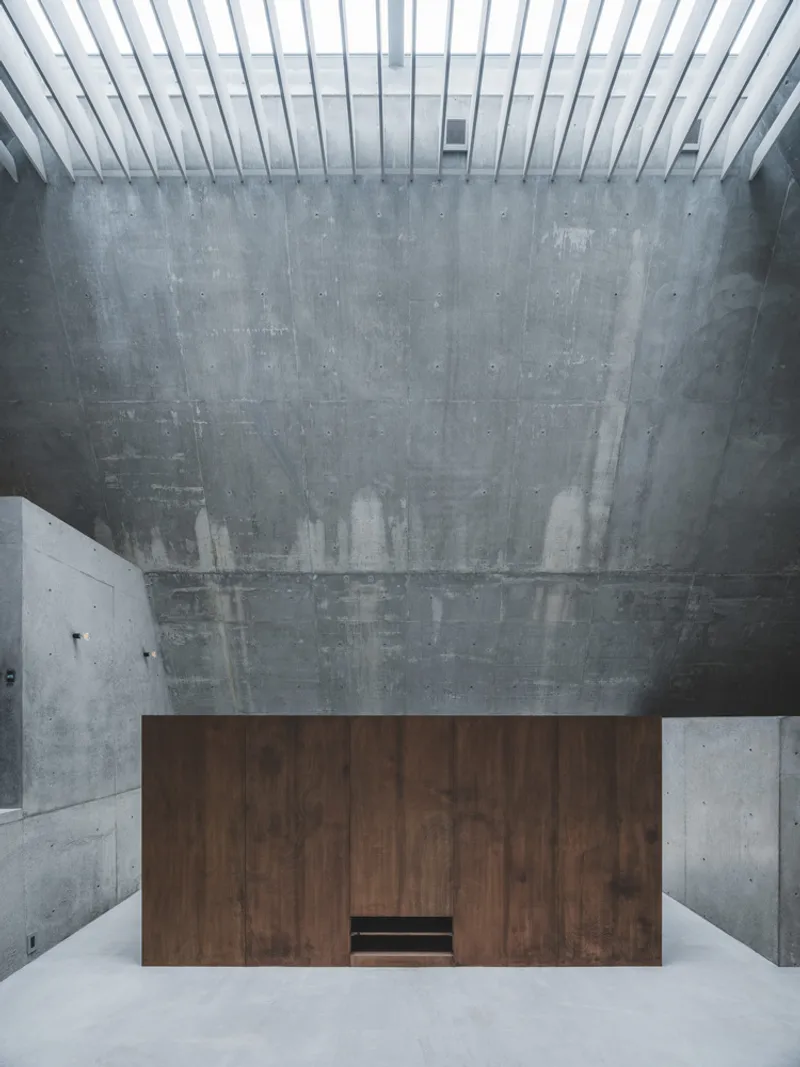
The central idea of the interior is a wooden living environment inserted inside a concrete ruin. Timber cabinetry, kitchen surfaces, and sleeping alcoves sit beneath the raw board-formed concrete walls like furniture placed inside a cave. The contrast is stark and deliberate. Concrete carries the weight, the weather, and the sense of mass. Wood handles the human scale: warmth, texture, the places you actually touch.
A linear skylight runs the length of the pyramid's peak, washing the sloped walls in shifting daylight throughout the day. Small windows at the base and rear add supplementary views to the outside, but the dominant experience is vertical. You look up. Light falls down. The converging walls make a room that feels taller than its modest footprint would suggest.
Split Levels Carved from a Slope
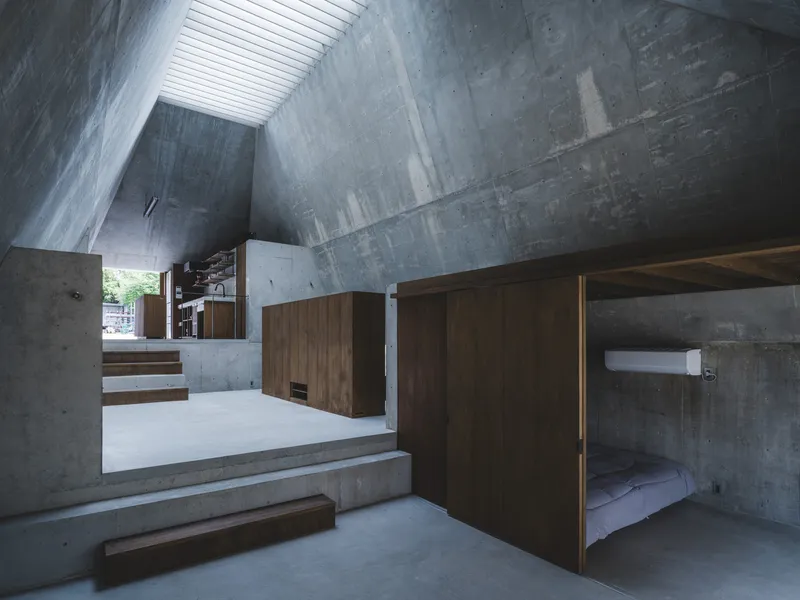

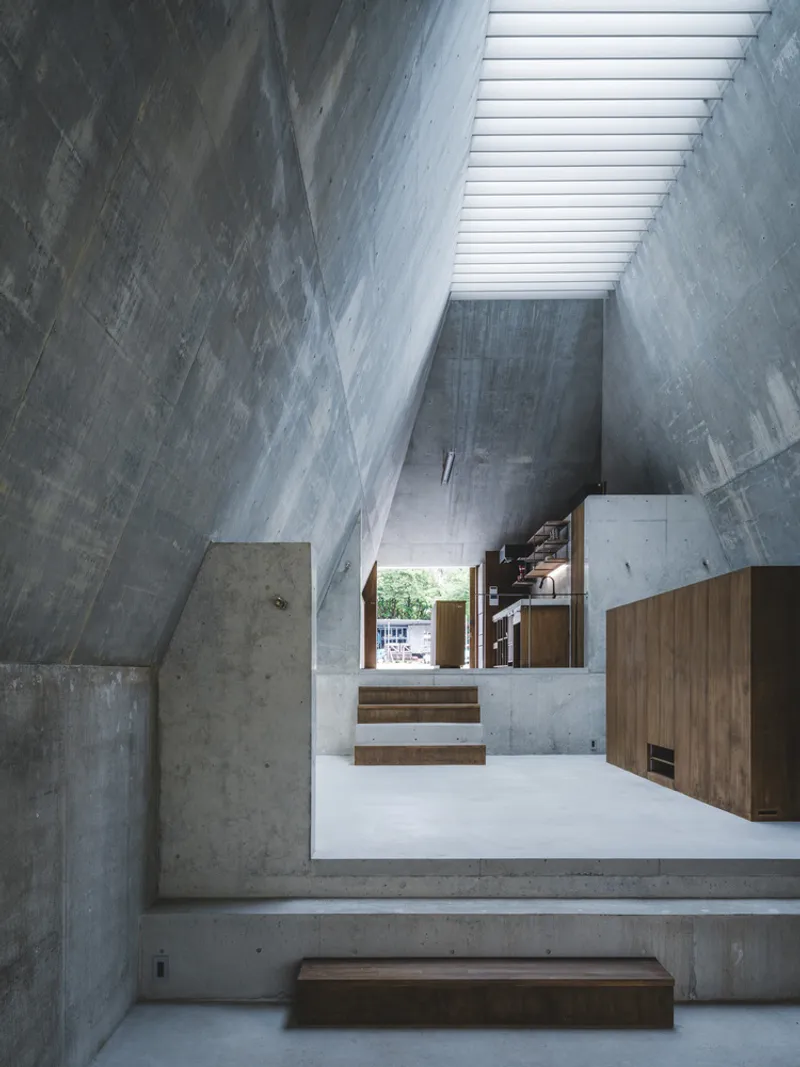
The interior is organized into three levels that follow the site's natural grade. The highest level at the street side holds the entrance and bathroom, consolidating plumbing into one zone. One meter below sits the living and dining area with an integrated study, the most open and light-filled space thanks to the skylight overhead. The lowest level at the rear contains the bedroom and private rooms, tucked deepest into the pyramid's tapered volume.
The split-level arrangement does more than accommodate topography. It creates psychological separation within a very compact plan. Moving through the house means moving downward, from public to private, from daylight to enclosure. The concrete steps between levels act as thresholds in the absence of corridors or doors.
The Threshold Sequence

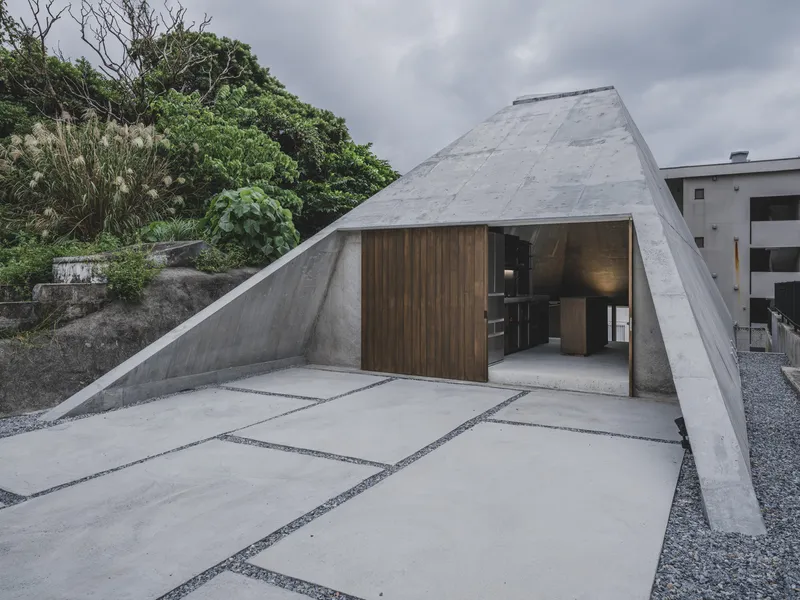

Arrival is not casual. A gravel courtyard with concrete paving slabs leads to a sloping canopy that compresses the approach before the timber doors open to reveal the stepped interior. The entrance courtyard mediates between the street and the private world inside, establishing a decompression zone that the tight site would not otherwise provide.
The covered terrace at the base of the pyramid, with floating concrete steps and a glazed wall, functions as a secondary threshold between indoor and outdoor space. It is the one moment where the house permits a horizontal view outward, framed by greenery and the angled roof plane above.
Materiality and Light
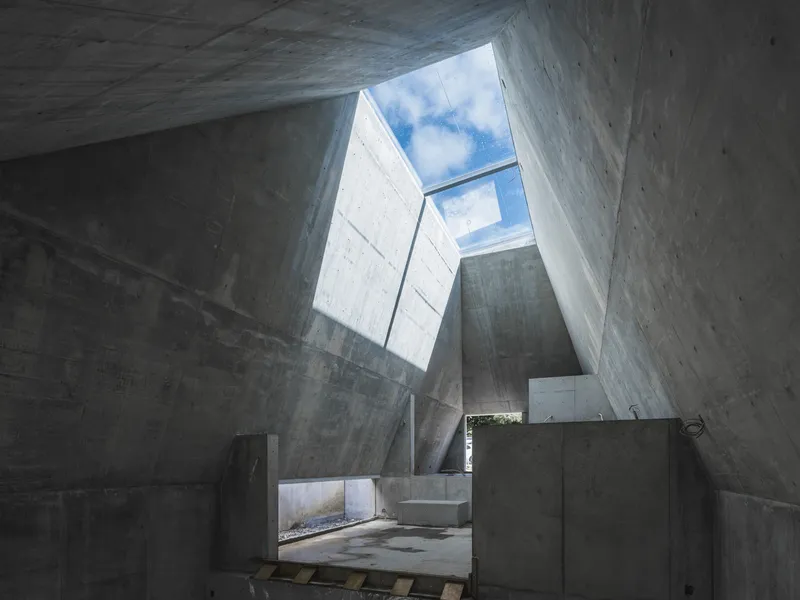

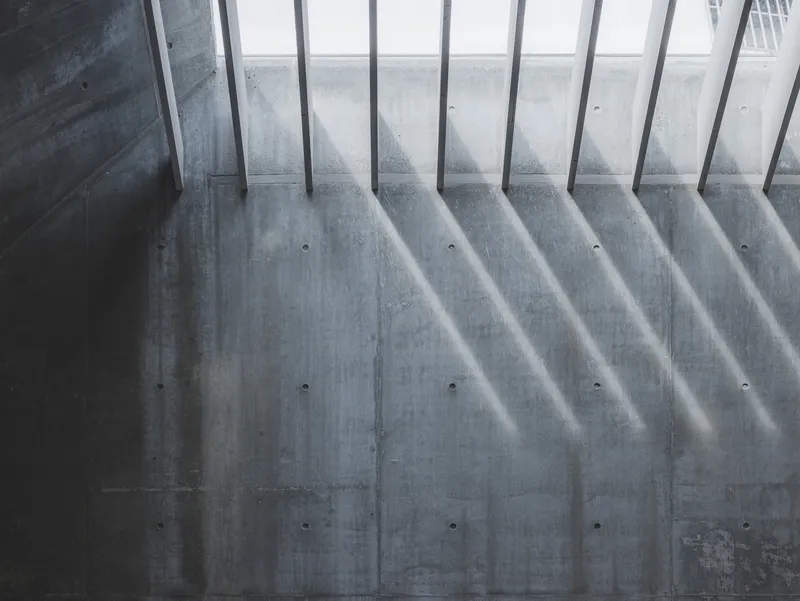
The board-formed concrete carries the memory of its formwork across every surface. Diagonal shadows from steel railings cross the walls in patterns that shift hourly, adding temporal texture to the otherwise static mass. The clerestory glazing at the apex frames sky and clouds as a kind of controlled landscape painting, perpetually changing.
The decision to use concrete was practical as much as poetic. The material became Okinawa's default after post-war rebuilding in the 1950s, and its performance against typhoons and humidity is proven. IGArchitects leaned into that tradition but stripped away the large openings that typically accompany it, producing something that feels both local and alien at the same time.
Living Under the Pyramid


The kitchen occupies the heart of the plan, with a timber island and concrete counters positioned beneath the angular ceiling where the skylight is most effective. It is the brightest room in the house and the one that best illustrates the architects' ambition: a warm, functional domestic space carved out of a monumental shell.
The sleeping area at the lowest level takes the opposite approach. A timber-clad Murphy bed folds against a dark partition wall beneath the most compressed portion of the pyramid. Glazed doors open to a planted garden at the rear, offering the only ground-level connection to the outside. The contrast between this intimate alcove and the soaring living space one level up gives the small house a range of spatial experiences that belies its 83 square meters.
Plans and Drawings
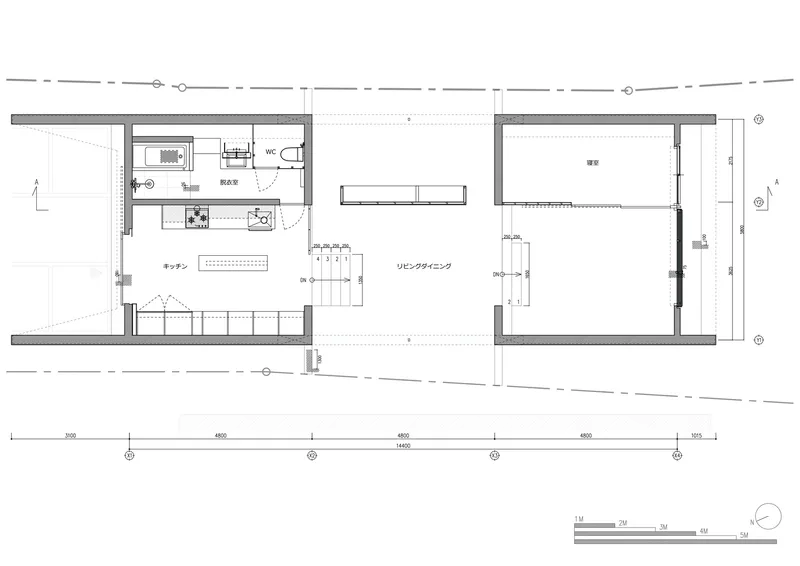

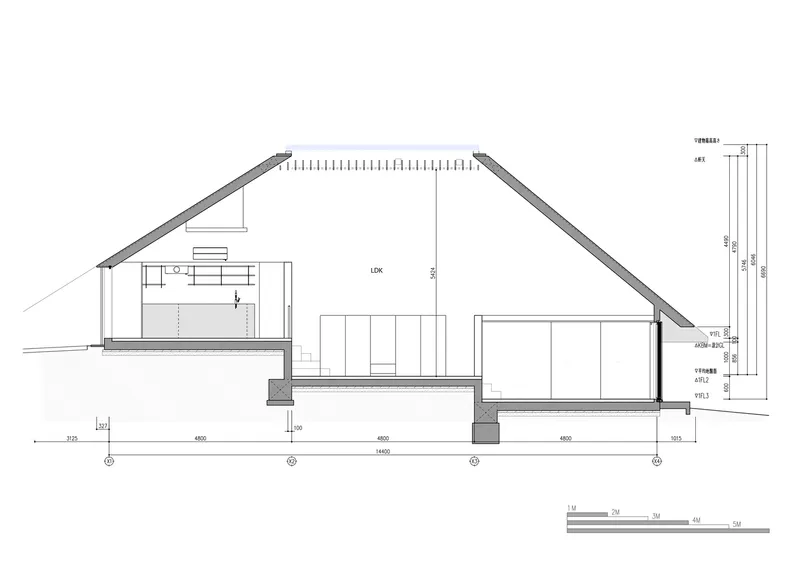

The section drawings reveal how much the pyramid's apparent simplicity conceals. The split-level floor plates create three distinct living zones within a single sloping volume, while the skylight runs continuously along the ridge. The floor plan shows a remarkably efficient layout: kitchen, living, and study on the middle level; bathroom and entry on the upper; bedroom on the lower. Every square meter is accounted for. The four elevations confirm the house's geometric discipline, each face presenting a steeply pitched triangle with minimal fenestration.
Why This Project Matters
Pyramid Hut is not a novelty project. Its shape is the logical outcome of a constrained site, a demanding climate, and a philosophical commitment to durability. The architects wanted to build something that would still feel significant even if it were no longer a house, and the result is a structure that already reads as both dwelling and monument. The 14-month construction period and the acknowledged difficulty of building a pyramidal concrete shell underscore that this was not the easy path. It was the committed one.
In a region where concrete homes are common and large openings are the default, IGArchitects produced a house that respects the local material tradition while rejecting its spatial conventions. The move to close the walls and open the roof is simple in concept but radical in effect. It turns a tight, compromised lot into a space defined by sky rather than by its neighbors, and it does so with a form that has been accumulating cultural authority for about five thousand years.
Pyramid Hut by IGArchitects, Okinawa, Japan. 83 m². Completed 2024. Structure design by Yousuke Misaki EQSD. Construction by FUN SHARE Ltd. Photography by Ooki Jingu.
About the Studio
IGArchitects
Official website of IGArchitects, one of the studios behind this project.
igarchitects.jpShare Your Own Work on uni.xyz
If projects like this are the kind of work you want to make, uni.xyz is a place to publish your own, find collaborators, and enter design competitions.



Popular Articles
Popular articles from the community


The Ocean Hive: Sustainable Architecture for a Self-Sufficient Civilization at Sea
The Ocean Hive imagines sustainable architecture at sea, where modular habitats, algae, wave power and ocean waste sustain a growing colony.

Hill & Cross Opera: Sculptural Opera House Architecture Shaped by Tallinn’s Landscape and Identity
Hill & Cross Opera reimagines opera house architecture in Tallinn through its sculptural hill, civic plaza, glass wave and a luminous cross.

AL-JANNAH: Sustainable Architecture and Permaculture for Afghan Widows
AL-JANNAH uses sustainable architecture and permaculture to create resilient oasis of housing, learning, work and renewal for Afghan widows.

The Earth Pod: 3D Printed Homes for Resilient Refugee Communities
The Earth Pod reimagines refugee housing through 3D printed homes made from clay, combining resilience, self-sufficiency, and rapid shelter.


Similar Reads
You might also enjoy these articles


Hodi-Mandai Geram
Project Function: Preservation and revitalization of the Intangible heritage and socio-spatial identity of the Hodi by Housing, Cultural Memory Center, Sacred Grove, landscape, local tourism economy


Olio Towers: A Mid-Rise for Performers That Fuses Housing, Rehearsal, and Stage
Located blocks from Houston's Theater District, this modular tower stacks living units around a central performance atrium.

Oasis: Modular Green Housing Carved into Dhaka's Urban Fabric
A shortlisted Plugin Housing entry reclaims unauthorized settlements in Dhaka with stepped concrete volumes, green roofs, and ventilation-driven design.

Black Hole: A Floating Megastructure for the Post-Physical Era
Emiliano Mazzarotto envisions a spherical, self-scaling arena where e-sports, digital hotels, and holographic stadiums replace traditional public space.

Explore Architecture Competitions
Discover active competitions in this discipline



Challenge to reimagine the Iron Throne


Photograph architecture without architects


Illustrate the lost glory of Angkor Wat - Render Challenge


Design challenge to reuse E-waste
Comments (0)
Please login or sign up to add comments
No comments yet. Be the first to comment!