
πr²: A Cemetery Where Cremated Remains Nourish Living Memorials
Flexel Studio reimagines urban burial as a regenerative landscape where ashes decompose beneath vertical pikes, feeding seeds that bloom into living monume


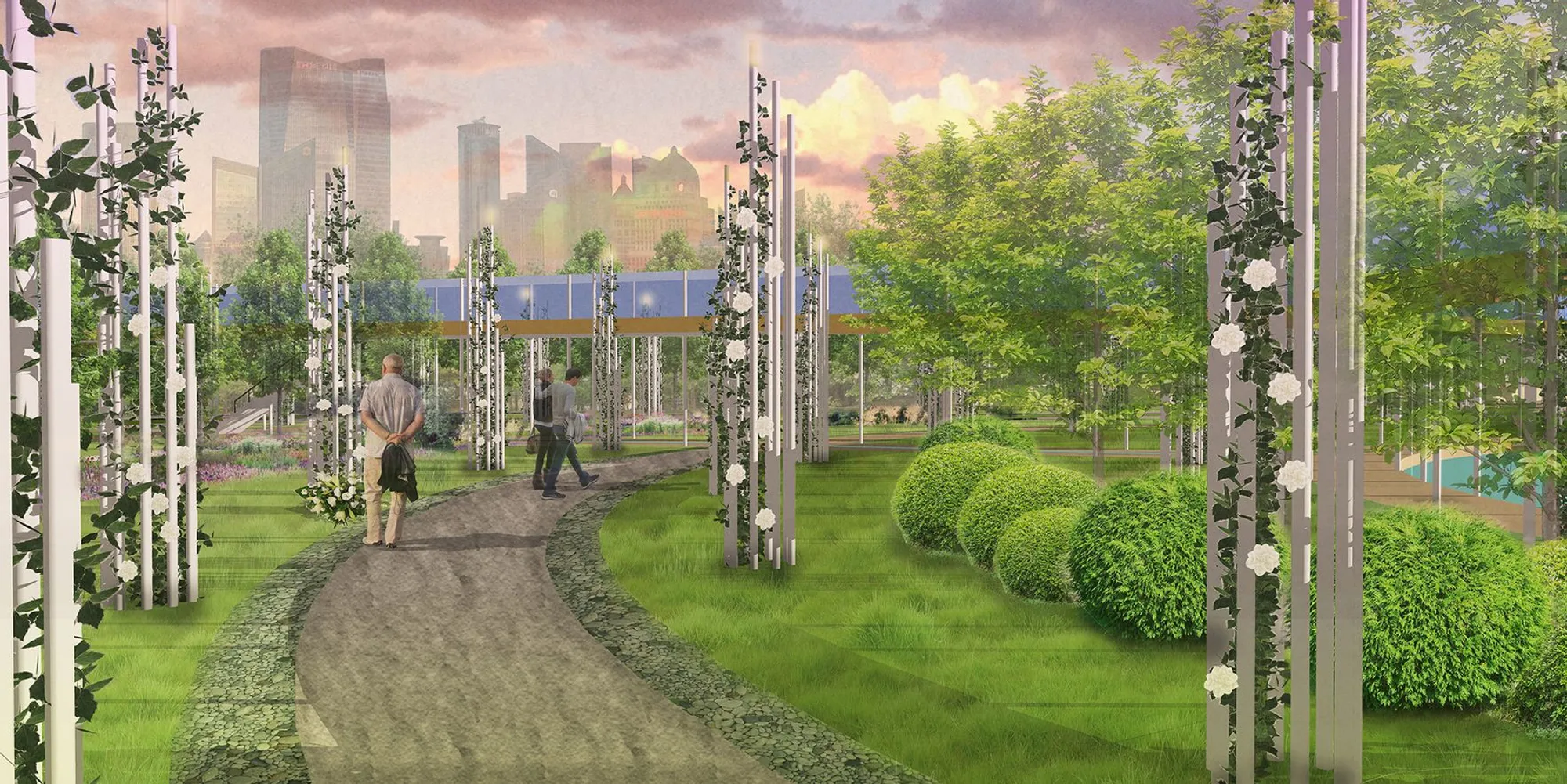
What if a cemetery could photosynthesize? In πr², cremated remains are buried alongside seeds beneath vine-wrapped vertical pikes. Over time, the organic material decomposes, its nutrients absorbed into the soil, eventually feeding plants that bloom into flowers. The grave marker is not a slab of granite but a living organism, its growth a literal expression of the person it memorializes. The formula in the title is both spatial instruction and philosophical premise: the area of a circle, applied to the cycles of life and death.
Designed by Flexel Studio, the πr² project confronts a real urban pressure: rapid urbanization in cities like Shanghai has left diminishing space for traditional burial grounds. Rather than treating this as a logistical problem to be solved with vertical columbaria or off-site relocation, the designers reframe the cemetery as regenerative infrastructure. The project title encodes its dual thesis: "Circle of Life" refers to the individual's journey, while "Occupation of Life" addresses the meaning and impact of that journey. Both ideas collapse into the geometric formula πr², which also governs the site's concentric layout.
Timber Walkways Over Reflecting Pools
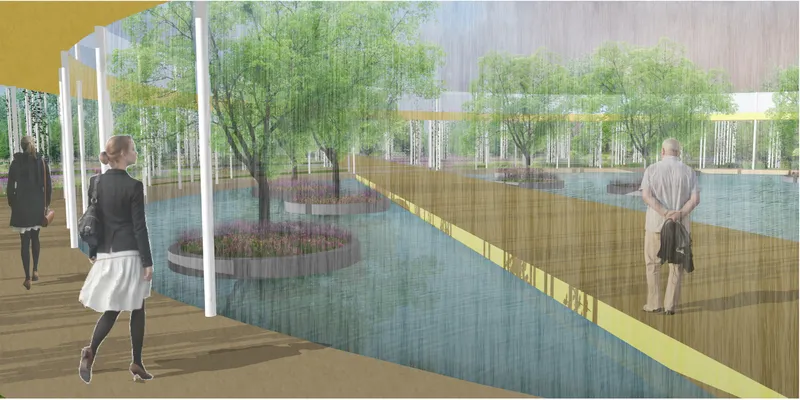
The rendering above reveals the project's experiential core: a covered walkway with timber decking extending over a reflecting pool, flanked by birch trees. Visitors move through this space not as mourners navigating rows of headstones but as participants in a landscape that is actively growing around them. The water feature serves multiple roles: it mirrors the sky to expand the sense of openness, creates an acoustic buffer from the surrounding city, and reinforces the circular geometries that define the plan. The birch trunks, slender and white, provide vertical rhythm without enclosure, keeping sightlines open across the memorial grounds.
An Elevated Pavilion Among Birch Columns
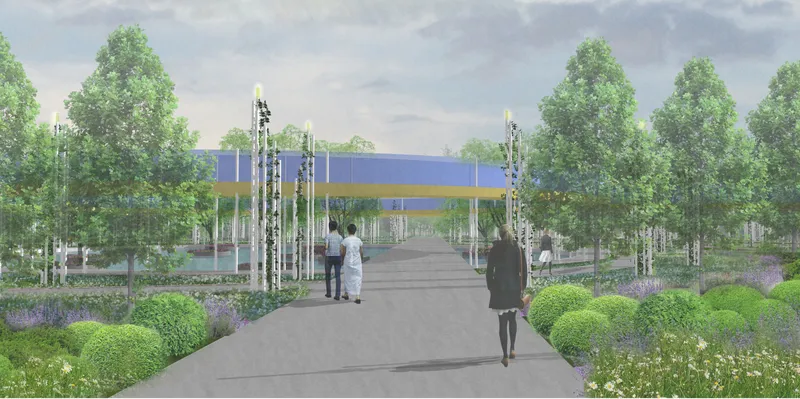
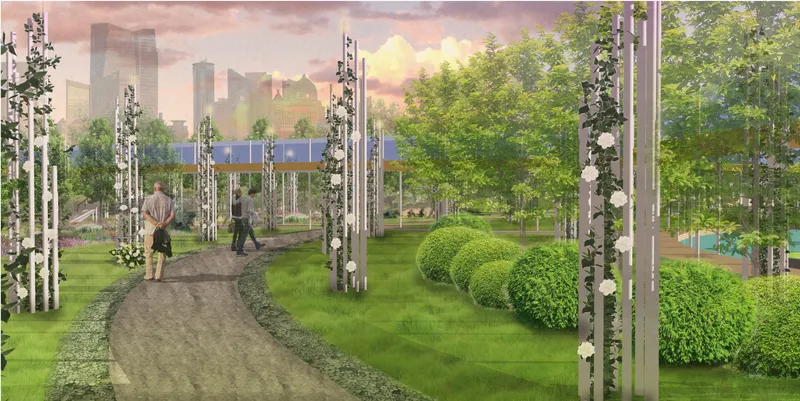
The elevated pavilion, banded in blue horizontal planes and supported by white birch columns, acts as the site's primary gathering and viewing point. From this raised position, visitors gain a comprehensive view of the memorial landscape, a deliberate inversion of the typical cemetery experience where perspective is limited to the immediate grave. The design supports both solitary reflection and communal remembrance. Mounded shrubs, deciduous trees, and flowering species compose the ground plane below, their arrangement structured enough to feel intentional yet loose enough to read as a garden rather than a grid.
The second view, captured against a sunset sky, emphasizes the horizontal structure floating above a birch grove and sculpted plantings. There is a deliberate quietness to the material palette: timber, white bark, green foliage, water. Nothing competes for attention. The architecture recedes into the landscape rather than dominating it, which is precisely the point. The memorial is not the building; it is the ecosystem the building supports.
Concentric Geometry and the Two-Level Circulation System
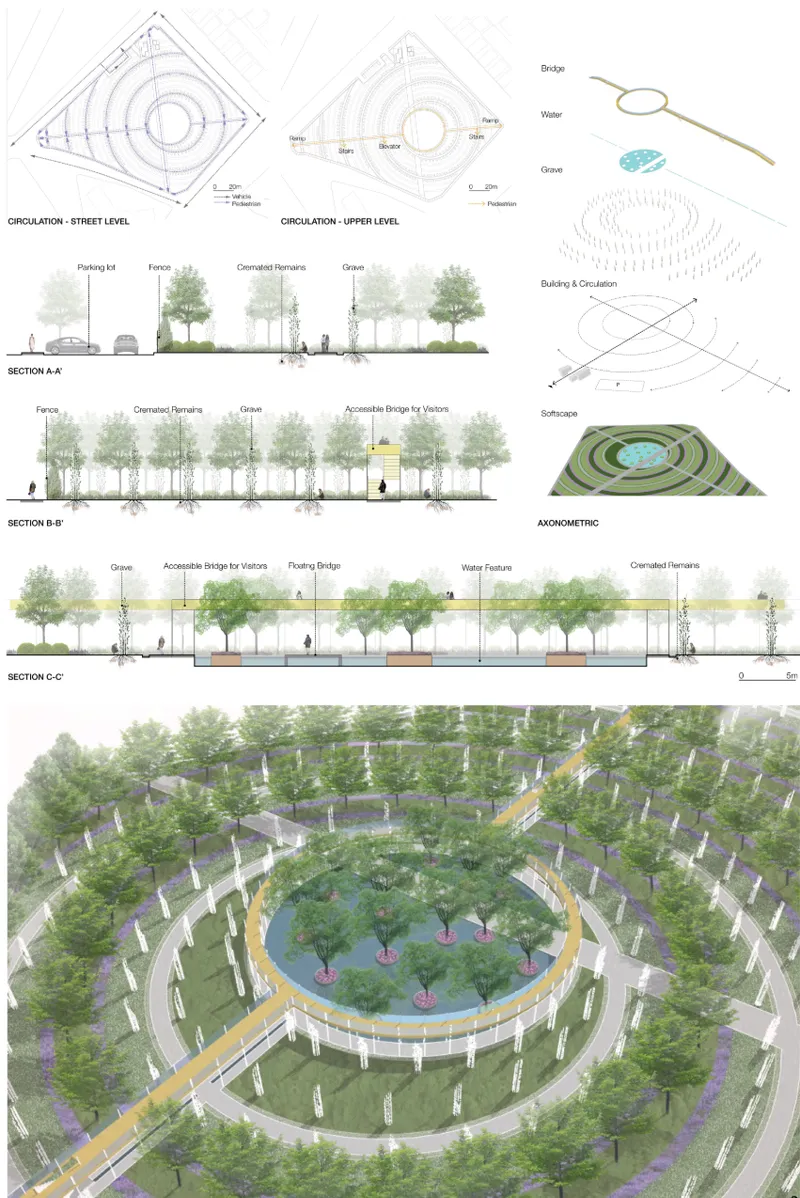
The presentation board reveals the project's organizational logic in full. Concentric circles, radial paths, and round water features structure the plan, reflecting both the symbolism of eternity and the spatial patterns found in Chinese urban environments such as roundabouts and circular pedestrian zones. This is not arbitrary formalism; the geometry serves functional needs. A two-level system separates the memorial grounds from circulation areas. Bridges, ramps, elevators, and stairs ensure accessibility for visitors of all ages and physical abilities. The section drawings make clear how the elevated walkways provide overlook points while keeping foot traffic away from the planted burial zones, protecting the regenerative process below.
The axonometric views and aerial rendering show how the landscape is curated with evergreen hedges, deciduous trees, flowering species, and structured shrubbery. These are not ornamental choices but functional ones: the biodiversity sustains the nutrient cycle that transforms cremated remains into living plant matter. The burial process itself follows a five-stage sequence: planting a seed with cremated remains beneath a vine-wrapped pike, decomposition, nutrient transfer to surrounding soil, the resulting bloom as a living monument, and finally regeneration as family members plant anew. Each stage is spatially accommodated within the concentric rings.
Secular Sacred Space for a Polymorphous Future
One of the project's more provocative positions is its stance on faith. Flexel Studio envisions spiritual practice becoming increasingly polymorphous, integrated into everyday life rather than confined to doctrinal institutions. πr² responds by offering a space that is spiritual without being religious, sacred without being exclusionary. There are no chapels, no denominational markers. The architecture's spiritual register comes entirely from its relationship with natural processes: decomposition, growth, bloom, renewal. The deceased's memory becomes, as the designers describe it, "embedded in the DNA of the ecosystem."
Why This Project Matters
Urban land scarcity and environmental consciousness are forcing a rethinking of funerary architecture worldwide. Most responses have been technocratic: denser columbaria, digital memorials, bio-cremation facilities. πr² is distinct because it treats the cemetery not as a problem to be minimized but as an opportunity to generate ecological value. The design proposes that the dead can literally feed the living landscape, turning a site of loss into one of ongoing biological production. That is a genuinely new proposition for urban cemetery design.
What makes Flexel Studio's work compelling is the discipline with which the concept is carried through every scale: from the chemical process of nutrient transfer in soil, to the pike-and-vine burial unit, to the concentric site plan, to the accessible two-level circulation system. The formula πr² holds the project together not as a gimmick but as a generative constraint. It shapes the plan, names the philosophy, and reminds visitors that every circle, whether a life or a garden, is defined by its radius of influence.
View the Full Project
About the Designers
Designer: Flexel Studio
Enter a Design Competition on uni.xyz
uni.xyz runs architecture and design competitions year-round that reward proposals with spatial conviction and real site intelligence.
Project credits: πr² by Flexel Studio.




Popular Articles
Popular articles from the community


Conexión: Biophilic Design Reimagines High-Rise Living in Hong Kong
Conexión reimagines high-rise living in Hong Kong through biophilic design, green facades, shared spaces, daylight, water and nature within.

The Ocean Hive: Sustainable Architecture for a Self-Sufficient Civilization at Sea
The Ocean Hive imagines sustainable architecture at sea, where modular habitats, algae, wave power and ocean waste sustain a growing colony.

Riyadh For All: Intergenerational Urban Design for Active Aging in Rabat
Riyadh For All reimagines urban design in Rabat with intergenerational co-living, adaptive courtyards, and Moroccan cultural exchange today.

The Earth Pod: 3D Printed Homes for Resilient Refugee Communities
The Earth Pod reimagines refugee housing through 3D printed homes made from clay, combining resilience, self-sufficiency, and rapid shelter.


Similar Reads
You might also enjoy these articles

Bao Huynh Watercolor Atelier: A Serene Art Retreat in Hội An
Bao Huynh Watercolor Atelier in Hội An blends multifunctional art spaces, sustainable design, local materials, and family-friendly living in a serene environment.

Atelier Macri Concept Store Interior Design by CASE-REAL
Atelier Macri store features a "ko" counter, walnut wood details, cork displays, blending retail, gallery, and seamless customer experiences.

Manuel Vargas Izquierdo Stadium and High-Performance Sports Center: Architectural Excellence in Jalpa de Méndez
The Manuel Vargas Izquierdo Stadium blends sustainable design, inclusive sports facilities, and cultural-inspired architecture, revitalizing Jalpa de Méndez’s public spaces.

KAKR Buluh Awar Hall: Revitalizing Community and Ecology Through Bamboo Architecture
Community built bamboo hall revitalizes Buluh Awar village, empowering youth, restoring ecology, celebrating vernacular craftsmanship through sustainable architecture and culture.

Explore Vertical Cemetery Competitions
Discover active competitions in this discipline



Design Challenge - Contemporary interpretation of a religious complex


Challenge to design locus for the upliftment of human rights


Design challenge to reuse E-waste
Comments (0)
Please login or sign up to add comments
No comments yet. Be the first to comment!