
RA Design Studio Wraps a 60-Meter Brick Screen Around Sun and Trees in Ahmedabad
A marketing office in Gujarat's first smart district uses jaali walls, corrugated metal, and existing trees to stay cool without concrete framing.


Most marketing offices for real estate developments are afterthoughts: prefab boxes dropped onto cleared sites that get demolished the moment the last unit sells. RA Design Studio, led by Radhika Savani Dutt and Arpit Dutt, rejected that logic entirely. Their 900 m² office for a developer in WAPA (West Ahmedabad Premium Arena), Gujarat's first planned smart district, is built almost entirely from 90% recyclable red brick, corrugated metal sheets, and raw stone. Every component is designed to be continued or upcycled when the surrounding high-rise residential projects reach possession. Nothing here is disposable, and nothing pretends to be permanent either.
What makes the project genuinely compelling is its central argument: that a construction-site office should look and feel like construction, not like a polished showroom parachuted in from another world. The corrugated metal sheets reference the barricades that surround every building site in India. The brick is left unplastered, the stone unpolished. But within that rawness, the architects have embedded a sophisticated climate strategy. A 60-meter-long recycled brick wall, built without concrete support, wraps the building with parametric jaali (perforated) patterns calibrated to the sun's daily arc. The result is a workspace that Ahmedabad's brutal summers cannot bake and its mild winters gently warm.
The 60-Meter Jaali Wall
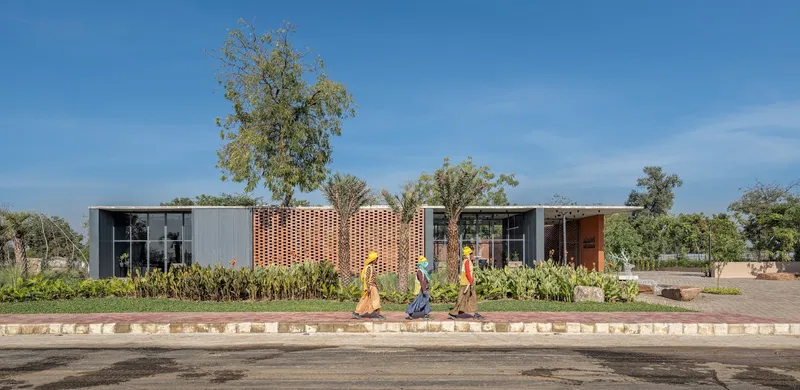
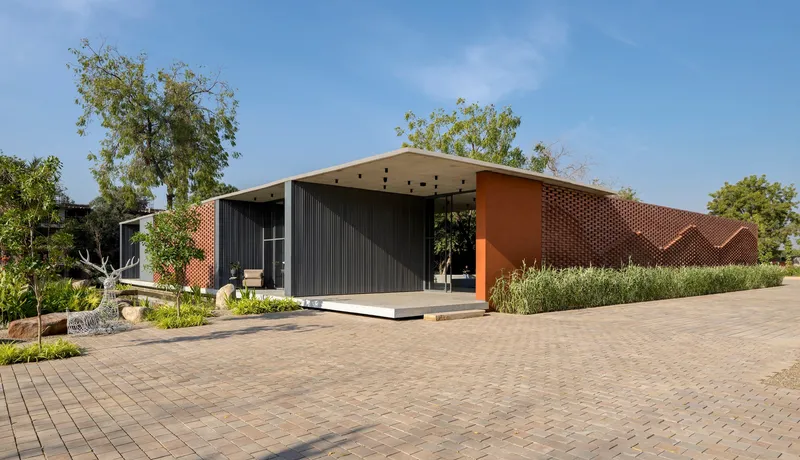
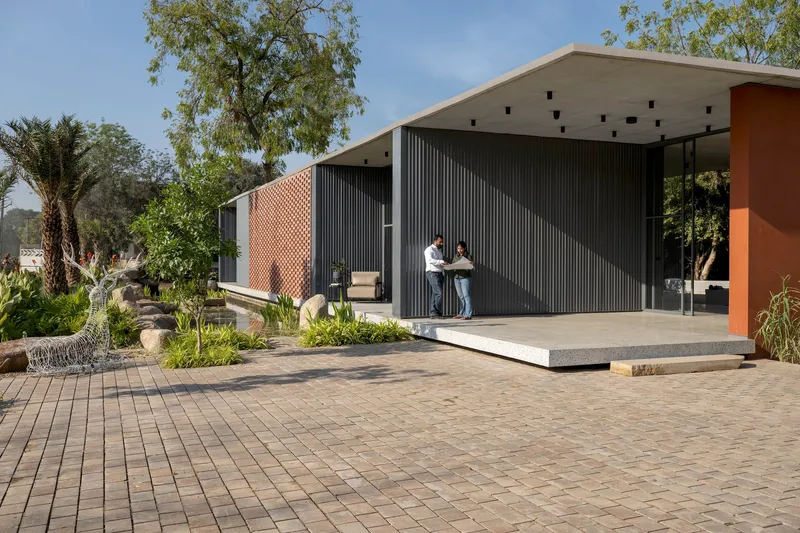
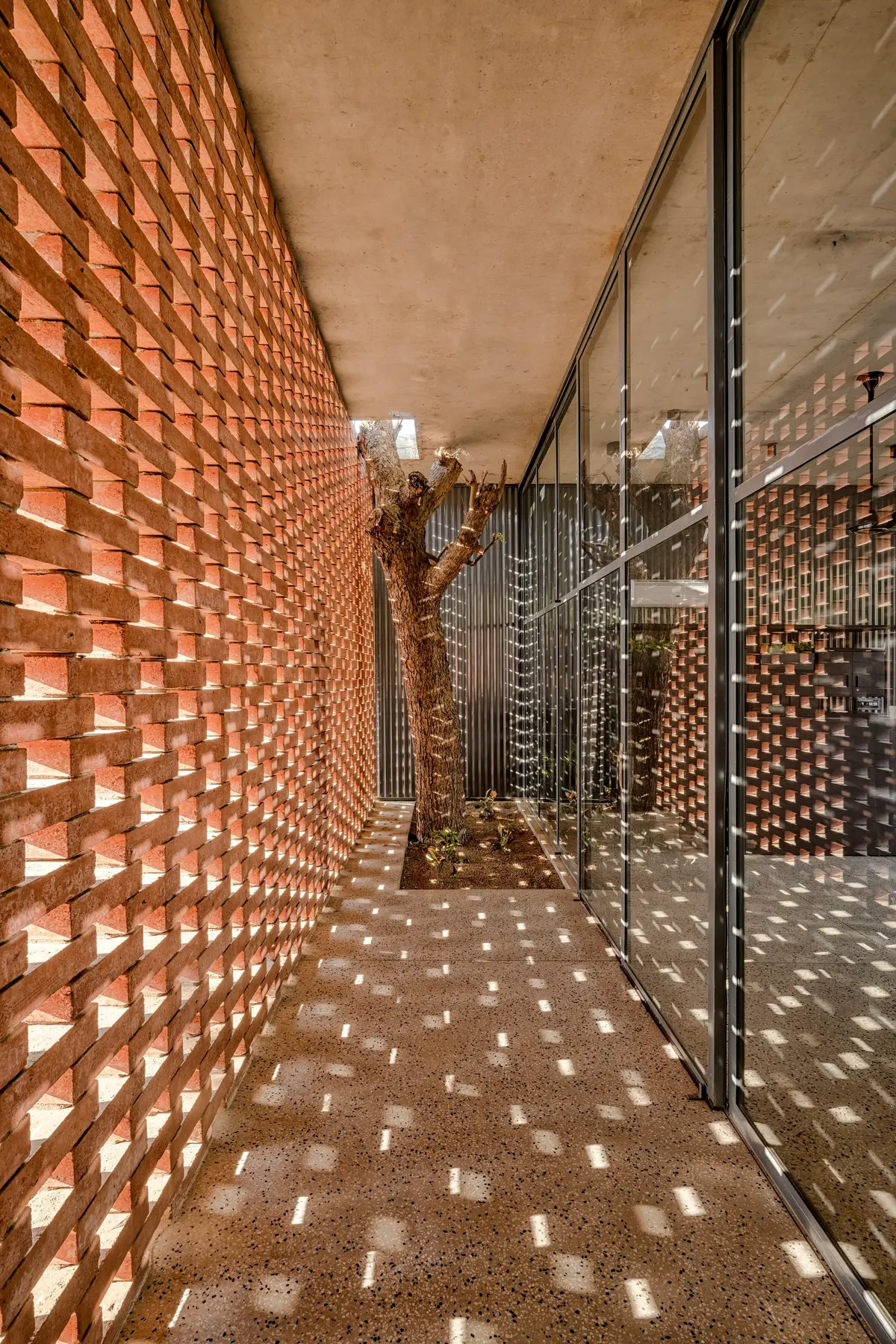
The defining gesture is the long, zigzagging perforated brick wall that fronts the main road. From the street, it reads as a single undulating surface, but its openings are anything but uniform. The perforation pattern shifts across the wall's length, calibrated so that morning light enters more freely on the east-facing sections while the punishing afternoon sun on the west is broken into fine, scattered fragments. It is parametric design in the most literal sense: the parameter is the sun, and the variable is brick rotation.
Structurally, the wall is remarkable. Sixty meters of recycled brick standing without concrete framing is a quiet engineering achievement. The zigzag geometry provides its own lateral bracing, turning what could be a fragile screen into a self-supporting enclosure. When the office is eventually decommissioned, the bricks can be reclaimed and laid again elsewhere, completing a material cycle that most temporary buildings never even consider.
Courtyards and Existing Trees

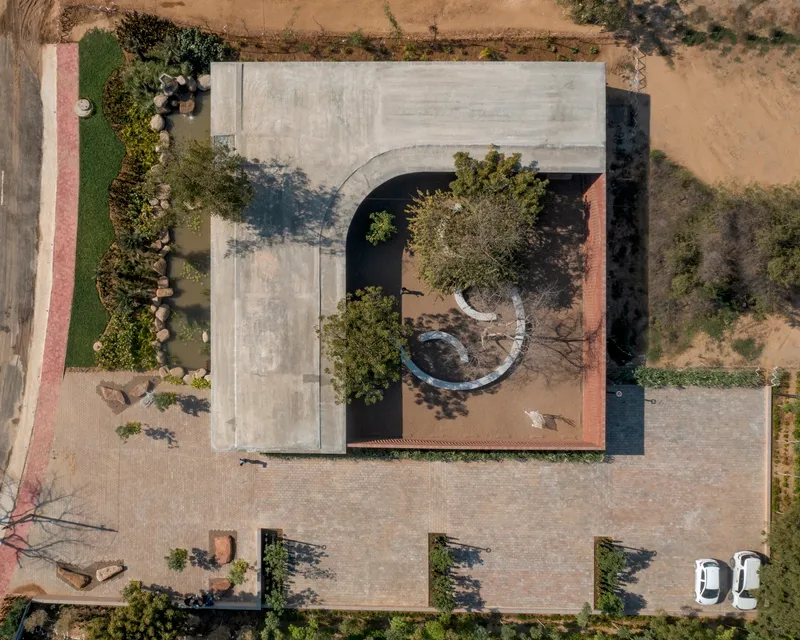

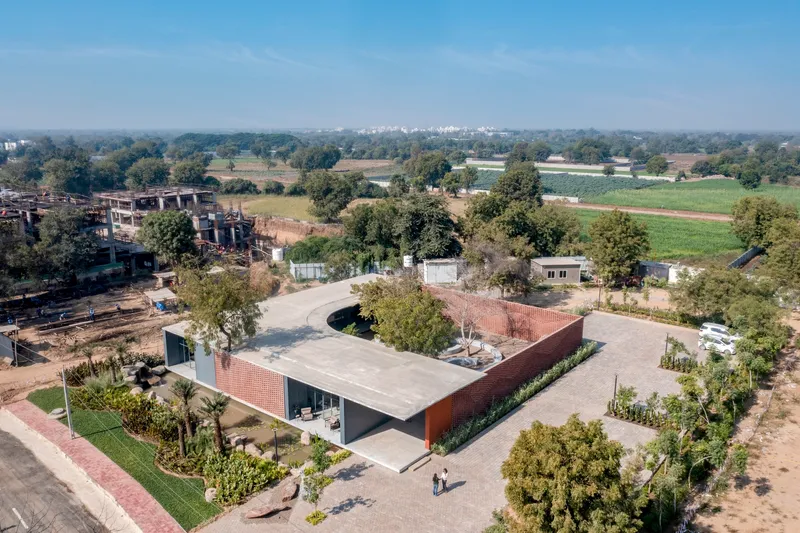
The site sat amid the dusty chaos of a district under construction, with 360-degree views of cranes and heavy vehicles, but it held a few clusters of mature trees. RA Design Studio chose to keep every one of them, punching circular concrete planters through the building's footprint where necessary and leaving others outside as shading devices. The plan is organized around three curved courtyard volumes that give each cluster of trees its own room, turning liabilities (obstructions to a simple floor plate) into the primary spatial experience.
Seen from the drone, the curved roof cutouts register as soft, organic interruptions in an otherwise rectilinear plan. At ground level, the courtyards create microclimates: gravel floors absorb less heat than concrete, circular benches invite informal meetings under canopy shade, and the perforated brick walls filter breezes without blocking them. The transition from indoors to outdoors is practically seamless, mediated only by steel-framed glazing that slides open entirely.
Corrugated Metal as Interior Language
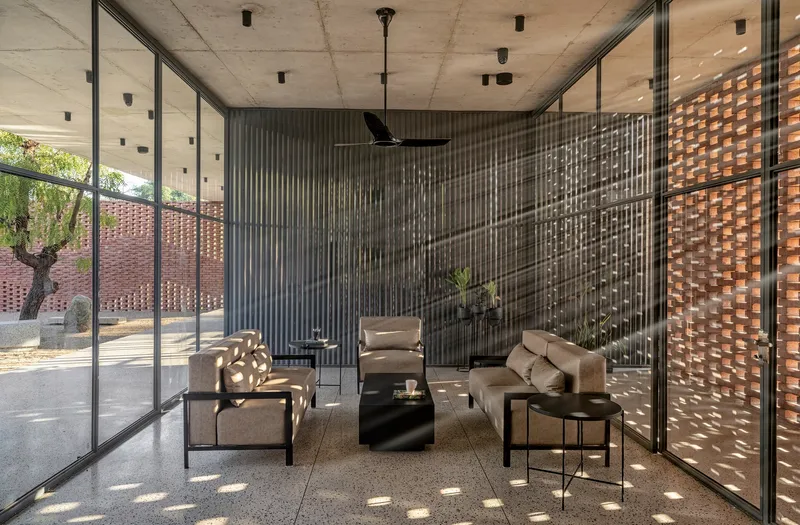
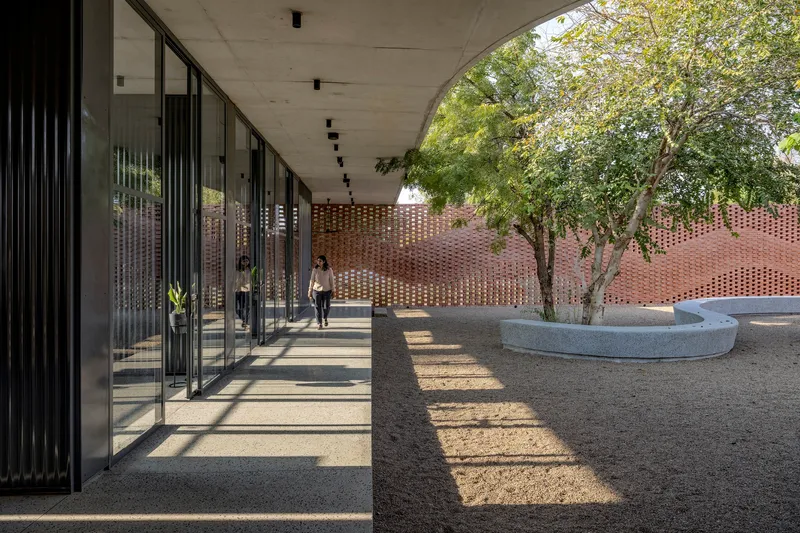
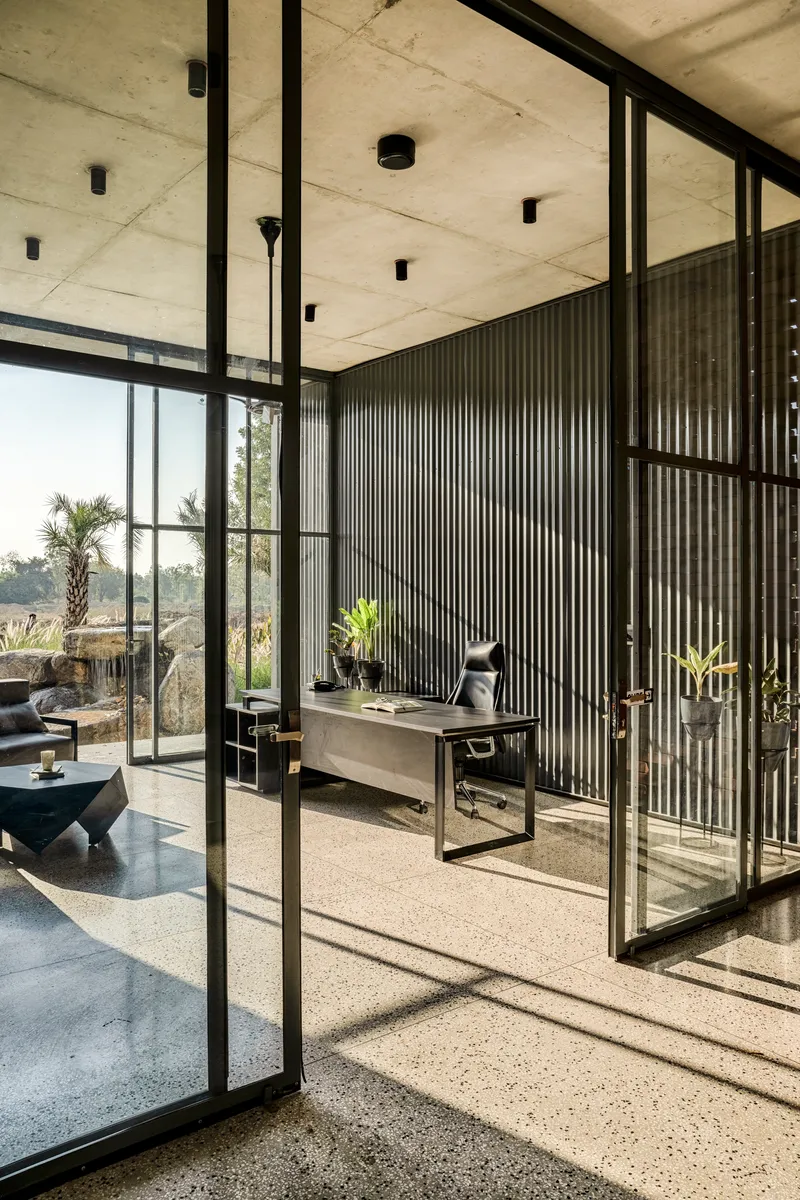
Inside, corrugated metal does more than clad walls. It becomes a screen, a partition, and a light filter. In the main workspace, sheets of it separate zones without closing them off, their ridges casting striped shadow patterns that shift throughout the day. The covered walkway along the courtyard uses vertical metal fins to similar effect: the shadows on the concrete floor look like a barcode slowly scanning as the sun moves overhead.
The material choice is deliberately unrefined. Corrugated metal is the default material of construction barriers across India, and by pulling it inside and treating it as architecture, the designers collapse the usual hierarchy between temporary infrastructure and finished building. The conference room takes this furthest: black corrugated walls meet floor-to-ceiling glazing, so occupants sit simultaneously inside a construction-coded enclosure and within full visual contact with the courtyard's trees.
Light, Shadow, and Dusk

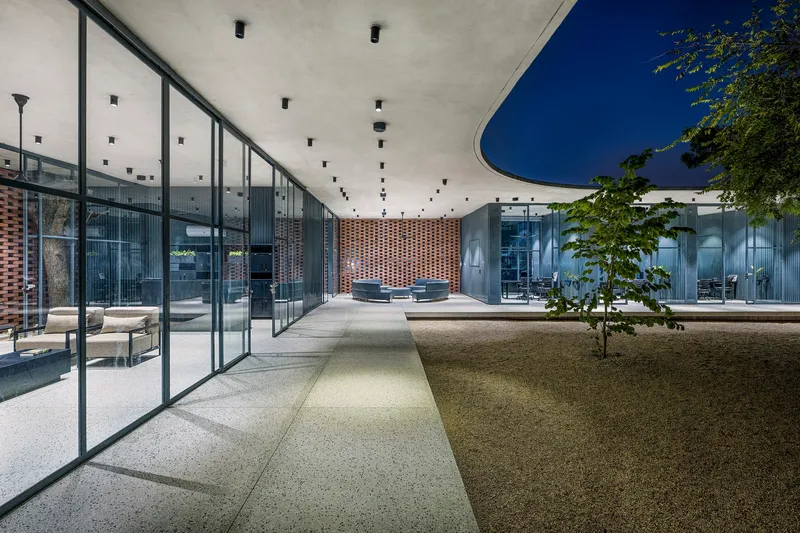

The best test of any jaali design is what it does to light at different hours. Here, the corridors flanking the brick screen become instruments of time. At midday, the perforations throw a scattered, almost pointillist pattern across polished terrazzo floors. By late afternoon, the dots elongate into ellipses and stretch toward the courtyard. At dusk, strip lighting embedded in the terraced gravel seating reverses the equation: warm artificial light glows outward through the same perforations, turning the wall into a lantern visible from the road.
Ahmedabad's climate demands that buildings manage heat aggressively, and the jaali wall's performance is not merely atmospheric. The perforations allow continuous cross-ventilation while screening direct solar gain. The architects describe the result as "winter-sweet and summer-cool," a characterization borne out by the building's minimal reliance on mechanical cooling despite sitting on an exposed site without boundary walls or neighboring shade.
Courtyard Furniture and Landscape

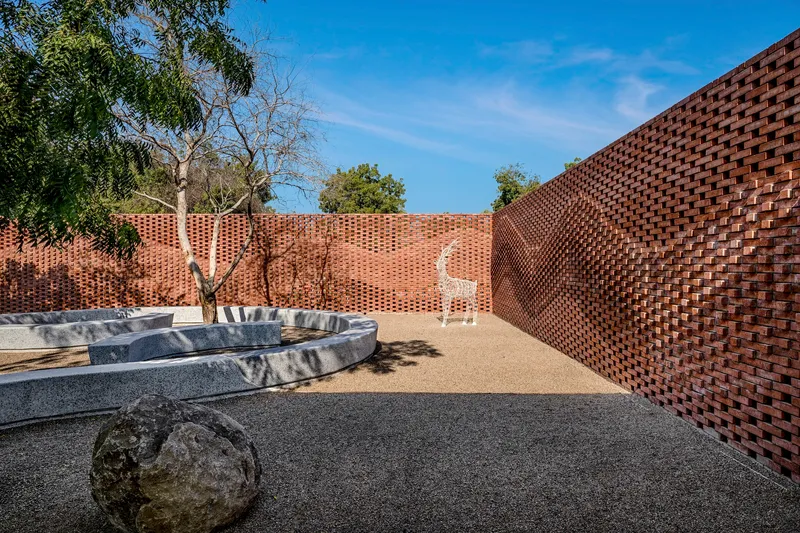

The gravel courtyards are kept deliberately spare. There is no lawn to irrigate, no decorative planting demanding maintenance on a construction site. Instead, raw stone benches sit beneath existing canopies, and circular concrete planters double as seating edges. The enclosed courtyard ringed by the undulating brick wall functions almost like a cloister: a contemplative pocket carved out of a landscape of dust and machinery.
Under the curved concrete roof overhang, glazed walls dissolve the boundary between indoor workspace and courtyard. The mature tree beside the carved stone bench in image 15 predates the building by decades, and the decision to design around it rather than remove it gives the office a sense of rootedness that no newly planted sapling could replicate.
The Conference Room

The conference room sits at the junction of two material worlds. Its dark corrugated metal walls create a moody, focused interior, while the full-height glazing opens directly onto a courtyard with trees. Meetings happen in a kind of controlled tension between enclosure and exposure, between the industrial palette of the building and the organic presence of vegetation just beyond the glass. It is one of the clearest demonstrations that rawness and refinement are not opposites but complements.
Plans and Drawings
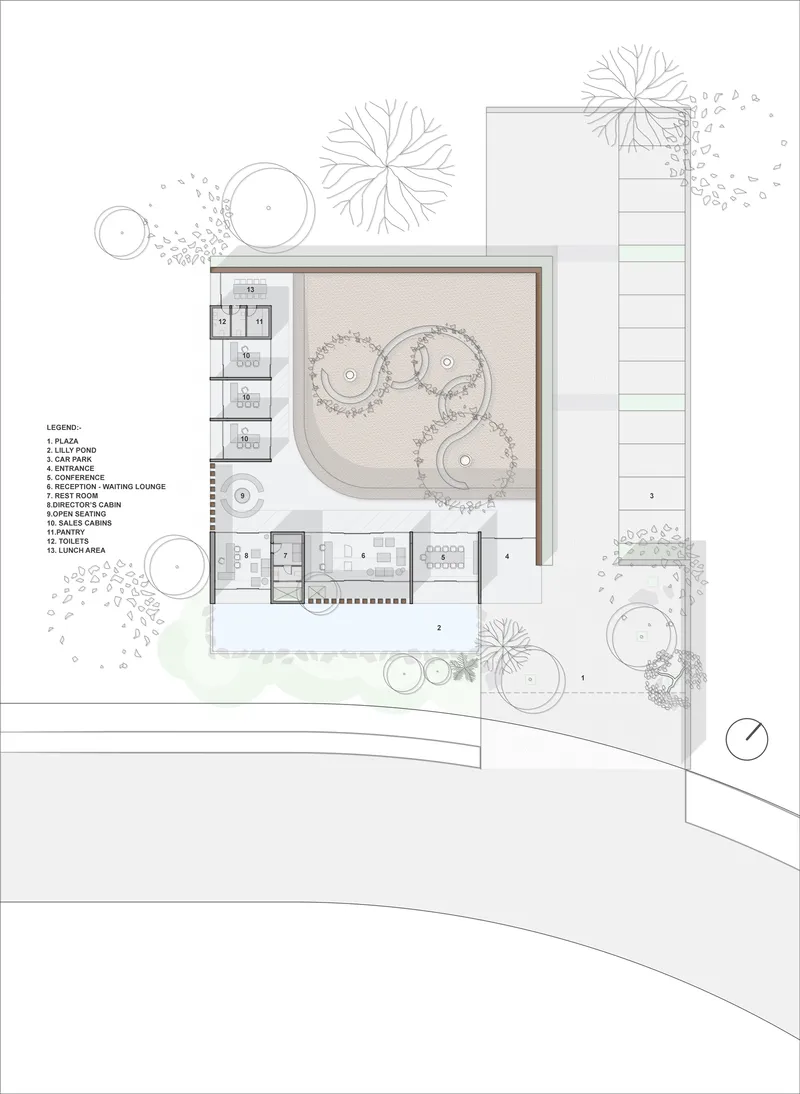
The site plan reveals how deliberately the three curved courtyard volumes are positioned within the rectangular building footprint. Each courtyard corresponds to an existing tree cluster, and the building's circulation wraps around them, so movement through the office always involves passing through filtered light and vegetated space. The plan also makes visible the zigzag geometry of the main brick wall, which reads on paper as a simple fold pattern but produces complex spatial effects at full scale.
Why This Project Matters
Temporary architecture is usually either cheap and ugly or expensive and wasteful. RA Design Studio's marketing office refuses both options. By building with materials that can be dismantled and reused, the project treats impermanence as a design constraint rather than an excuse for low ambition. The 60-meter brick wall alone is a provocation: who builds a structurally self-supporting, parametrically perforated jaali screen for a building that may last only a few years? The answer, apparently, is someone who believes that even a construction-site office should take the sun seriously.
More broadly, the project offers a model for how Indian offices in hot-arid climates can perform without heavy mechanical systems. The combination of perforated brick screens, cross-ventilation through courtyards, and the shade of existing trees achieves comfort through geometry and material rather than through energy expenditure. In a rapidly developing district like WAPA, where every adjacent site is building upward with glass and concrete, this low-slung, brick-and-metal pavilion is a pointed counter-argument: that building smart does not require building tall, and that the most sophisticated technology on site might be a well-placed hole in a wall.
Marketing Office by RA Design Studio (Radhika Savani Dutt, Arpit Dutt), Ahmedabad, India. 900 m², completed 2022. Photography by Vinay Panjavani.
About the Studio
Share Your Own Work on uni.xyz
If projects like this are the kind of work you want to make, uni.xyz is a place to publish your own, find collaborators, and enter design competitions.


Popular Articles
Popular articles from the community


LT2A and OPEN Architectes Thread a Brick and Glass High School Through a Wooded Belgian Campus
In Braine-l'Alleud, a 3,000 m² wing for Collège Cardinal Mercier pairs pale brick with a glazed colonnade, deferring to a small chapel and a dense wood.

Juan García Correa, John González and Claudia Rueda Sink a Circular Amphitheater into a Manizales Engineering Building
On the La Nubia campus in Manizales, Colombia, the S1 Building folds labs and offices into a hillside of ramped lawns that double as a campus route.

Jaramillo Van Sluys Arquitectura and Urbanismo Turn a Demolished Registry Lot in Quito into an Orchard Plaza
In Quito's Centro Histórico, a 2,800 m² plaza exposes the San Agustín convent wall and redraws its lost Augustinian orchard in volcanic stone.

longwave studio Reorganizes a 112 m² Tainan Apartment Around the Daily Routines of a Family and Two Cats
In Tainan, Taiwan, birch plywood, rust-red furniture and a freestanding plaster wall link arrival, storage, work and family life in one apartment.

Similar Reads
You might also enjoy these articles


LAVA Architecten Gives Vocational Education a Sawtooth-Roofed Face on a Mechelen School Campus
In Mechelen, Belgium, a 2,053 m² STEM school on a 6×6 m grid turns workshops and classrooms into rooms that can be rearranged as teaching changes.

KEMA Studio Turns a Derelict Marvila Attic into a 60 m² Lighthouse Apartment Above Lisbon
In Lisbon's Marvila district, a rebuilt roof, four skylights and two plywood volumes turn an unlivable attic into a bright home facing the Tagus.

Pixel Gardens: One Repeated Module Stacked Into a Terraced Social Housing Tower for Famagusta
Salem Bader's shortlisted housing tower builds a vertical neighbourhood from one repeated module, offsetting units to carve terraces, light and air.

Bao Huynh Watercolor Atelier: A Serene Art Retreat in Hội An
Bao Huynh Watercolor Atelier in Hội An blends multifunctional art spaces, sustainable design, local materials, and family-friendly living in a serene environment.

Comments (0)
Please login or sign up to add comments
No comments yet. Be the first to comment!