

Rabelais Books and Theatre by IWMW: A Monastic Bookstore and Theatre in the Heart of Seoul
A poetic bookstore-theatre hybrid in Seoul blending literature, performance, and monastic architecture within a restored 1950s triangular building.


Nestled within the dense urban fabric of Seoul, South Korea, the Rabelais Books and Theatre by IWMW is a poetic transformation of a 1950s building into a hybrid cultural space that blurs the boundaries between literature, architecture, and performance. With a modest footprint of 154 square meters, this architectural project reimagines the role of a bookstore—not just as a place of commerce or reading, but as a sacred refuge, a creative laboratory, and an intimate performance venue.


A Hidden Sanctuary in the City
Located on a triangular plot deep within one of Seoul’s older neighborhoods, the building offers a unique spatial sequence that unfolds like a narrative. The site is quietly anchored by a peach tree in a courtyard, whose seasonal blooms gently contrast the fast-paced city outside. The building itself, having undergone various renovations over decades, retains its original stone façade—a layer of history the architects chose to preserve and repair as a grounding architectural element.
Accessed through a narrow path that curves dramatically from the main road, visitors are led on a spatial journey that transitions from public to private, from bustling to serene. This spatial choreography enhances the sense of discovery and relief, qualities central to the project’s design intent.
A Bookstore, Theatre, and Creative Monastery
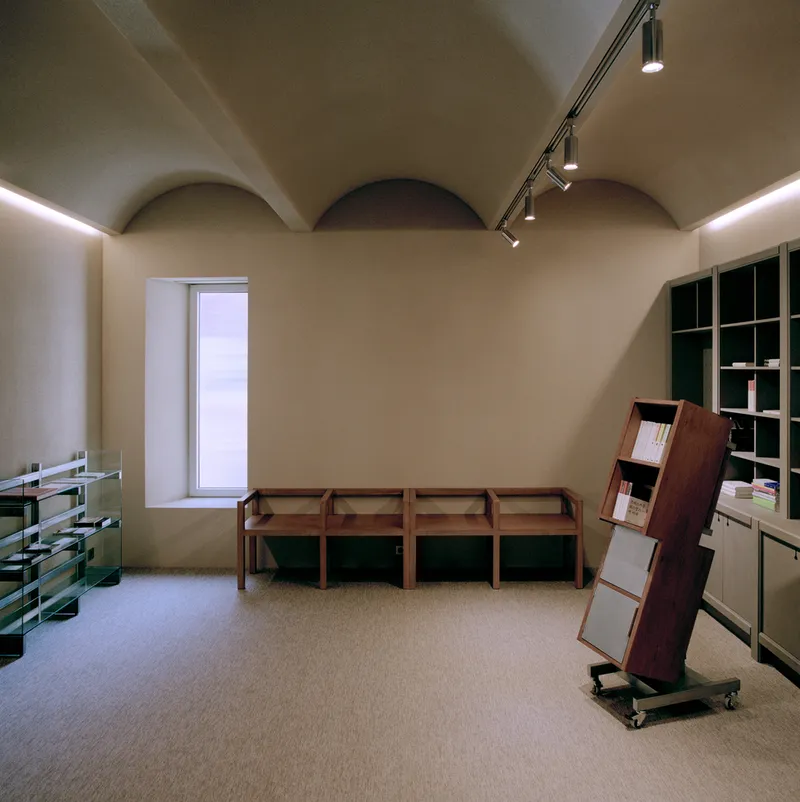
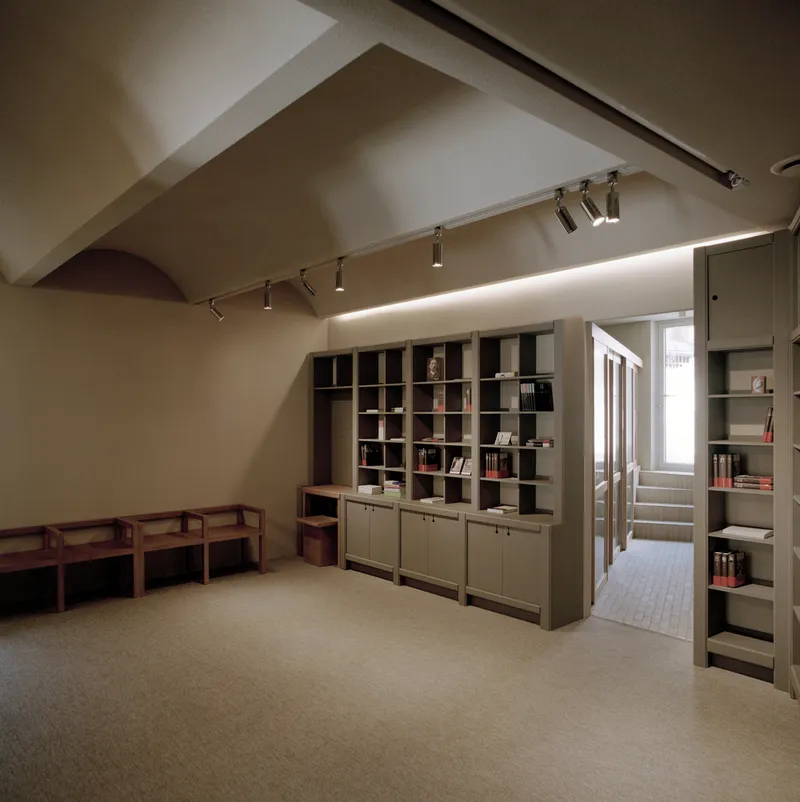
The client—a literary scholar and occasional performer—envisioned a space that could function as both a disguised bookstore and a contemplative workspace, evoking the ambiance of a monastery within a cave. The architecture honors this vision through a layered experience that transitions from a conventional bookstore to a soaring, vaulted chamber for writing, translating, and dreaming during the day—and for informal gatherings, readings, and performances at night.
From the exterior, the building presents itself as a humble bookstore. Upon entry, however, the ground floor reveals a tripartite sequence:
- The Entrance Bookstore: Doubles as a ticket booth for the small theatre within, while also serving as a display window for passersby.
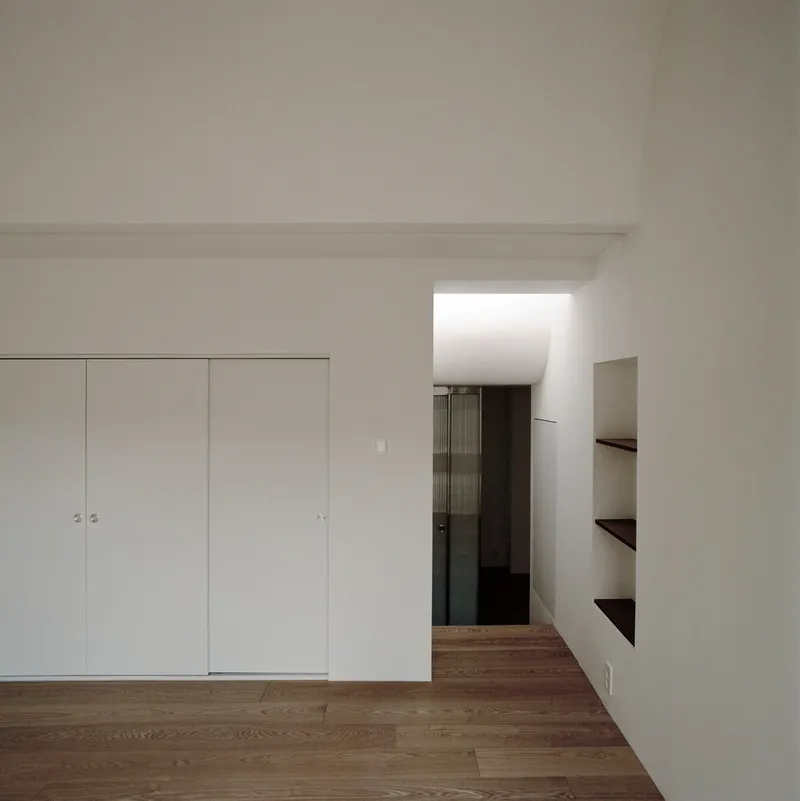
- The Cave Bookstore: Hidden behind a curtain, this vaulted space is designed as the heart of the building—a contemplative and ceremonial area that recalls the spiritual quietude of ancient sanctuaries.
- The Working Space: Opens onto a private courtyard, connecting the client to nature and offering a respite from the city.
This narrative of spatial progression culminates in the courtyard, where demolition of existing sheds allowed for the creation of a peaceful garden anchored by the peach tree. Remnants of the original structures remain as architectural ornaments, retaining a sense of memory and transition.


Light, Material, and Atmosphere
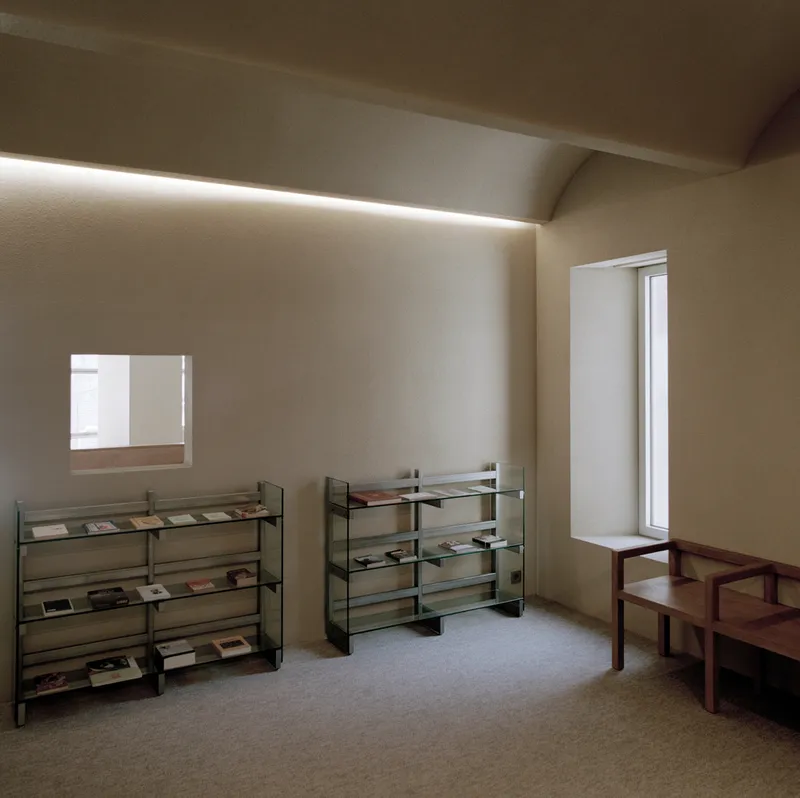
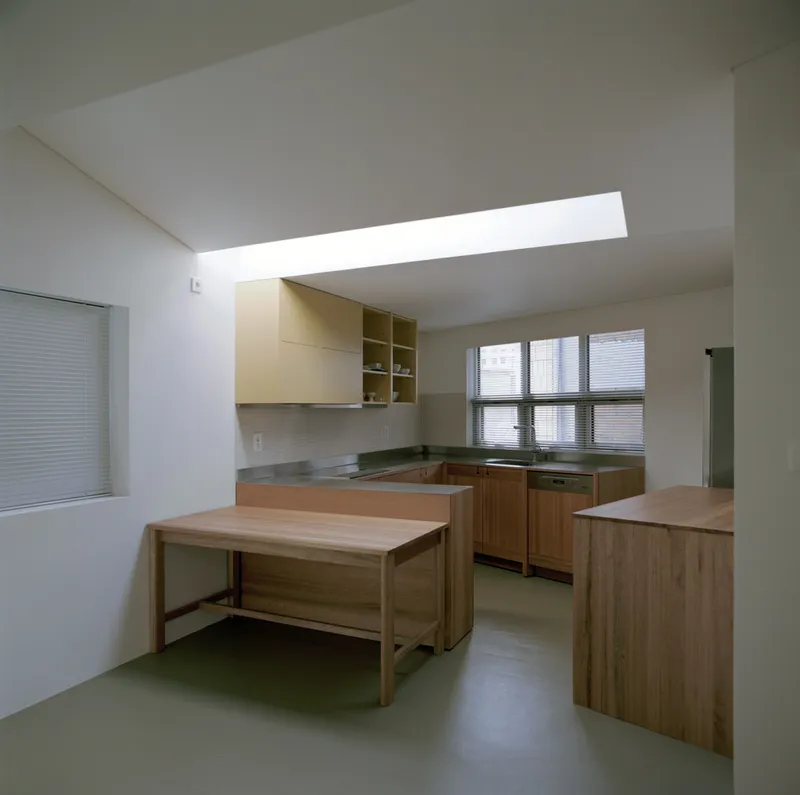
The interior is punctuated by carefully designed vaulted ceilings, providing vertical relief and evoking ecclesiastical architecture. Light is skillfully introduced through both restored windows and newly added skylights, particularly on the upper floor where tall surrounding buildings limit daylight access. Here, a secondary workspace for the client enjoys views of the garden and terrace, extending the project's themes of introspection and retreat.
Materials were chosen for their raw and timeless quality, including stone, brick, and dark wood, adding to the cave-like serenity. The new glass façade, subtly set back from the original, also serves a functional role by improving pedestrian flow and inviting curiosity from the street.

A Theatre of Books and Memories
More than a bookstore or a small theatre, Rabelais Books and Theatre is an architectural allegory—a place where books become actors, and spaces perform. It embodies a dialogue between old and new, between literature and space, and between the city and the individual. IWMW’s intervention is quiet yet profound, offering a blueprint for how adaptive reuse and poetic spatial thinking can enrich our urban environments.




Popular Articles
Popular articles from the community


Hill & Cross Opera: Sculptural Opera House Architecture Shaped by Tallinn’s Landscape and Identity
Hill & Cross Opera reimagines opera house architecture in Tallinn through its sculptural hill, civic plaza, glass wave and a luminous cross.

AL-JANNAH: Sustainable Architecture and Permaculture for Afghan Widows
AL-JANNAH uses sustainable architecture and permaculture to create resilient oasis of housing, learning, work and renewal for Afghan widows.

EW PARK: Sustainable Architecture Reimagines the Future of Urban Parking
EW PARK reimagines city parking as a modular wooden tower combining automation, solar energy, electric mobility, and adaptable urban design.

Riyadh For All: Intergenerational Urban Design for Active Aging in Rabat
Riyadh For All reimagines urban design in Rabat with intergenerational co-living, adaptive courtyards, and Moroccan cultural exchange today.

Similar Reads
You might also enjoy these articles


Hodi-Mandai Geram
Project Function: Preservation and revitalization of the Intangible heritage and socio-spatial identity of the Hodi by Housing, Cultural Memory Center, Sacred Grove, landscape, local tourism economy


Olio Towers: A Mid-Rise for Performers That Fuses Housing, Rehearsal, and Stage
Located blocks from Houston's Theater District, this modular tower stacks living units around a central performance atrium.

Oasis: Modular Green Housing Carved into Dhaka's Urban Fabric
A shortlisted Plugin Housing entry reclaims unauthorized settlements in Dhaka with stepped concrete volumes, green roofs, and ventilation-driven design.

Black Hole: A Floating Megastructure for the Post-Physical Era
Emiliano Mazzarotto envisions a spherical, self-scaling arena where e-sports, digital hotels, and holographic stadiums replace traditional public space.

Explore Cultural Architecture Competitions
Discover active competitions in this discipline



Challenge to reimagine the Iron Throne


Photograph architecture without architects


Illustrate the lost glory of Angkor Wat - Render Challenge


Bring back Drive In's
Comments (0)
Please login or sign up to add comments
No comments yet. Be the first to comment!