

PMA Madhushala Stages a Brick-and-Concrete Duet Around a Performance Courtyard for a Musical Family in Solapur
In Solapur, Maharashtra, a multigenerational home pairs a vaulted brick wing with a concrete cuboid around a stepped courtyard that doubles as a stage.


Most houses designed around a hobby treat it as a room: a studio, a den, a soundproofed box at the end of a corridor. PMA Madhushala took a different route in Solapur. For a family of six, a couple, their two children and the grandparents, whose children study classical music, the studio made the whole house the instrument. Rangmanch, Hindi and Marathi for "stage", sits on a 355 m² urban plot with roughly 185 m² of built area. Its living room, kitchen-dining, study and family space step down toward a shared courtyard whose steps double as seating for recitals.
What makes the project worth your attention is how it arrived at its form. The first scheme was a clean L-shaped plan, closed to the neighbours on the north and east and opening south-west toward the views. Then Vastu Shastra, which the family follows, asked for the primary bedroom in the south-west corner. Rather than bending the L, the architects dropped a solid concrete cuboid in front of it. The house became a conversation between two volumes. The team frames this as a jugalbandi, the classical duet in which two musicians trade phrases. Read through that lens, the constraint did not compromise the design. It produced it.
Two Volumes, One Duet
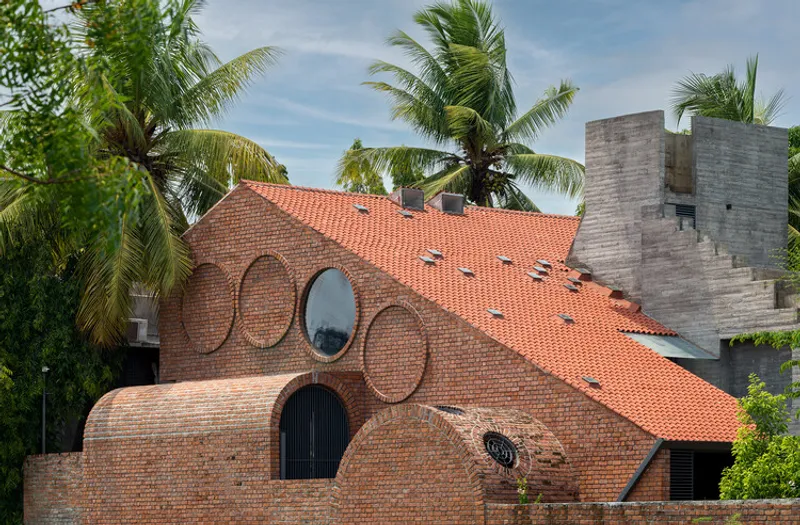
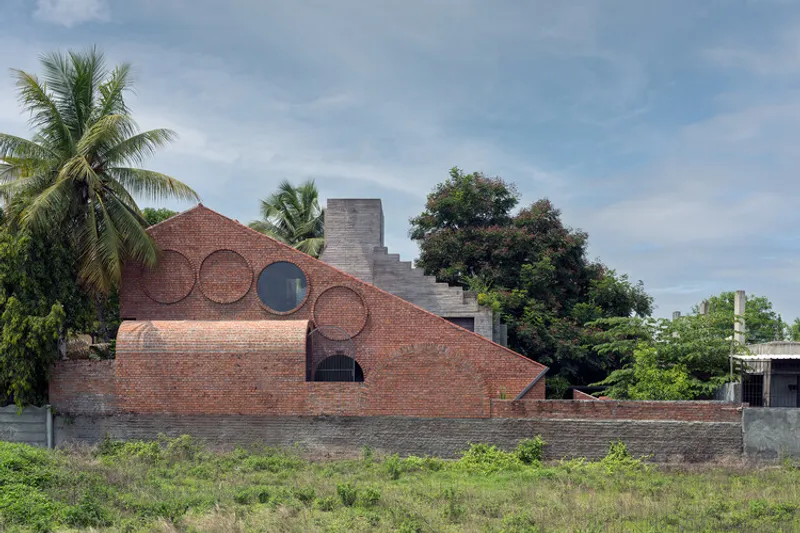
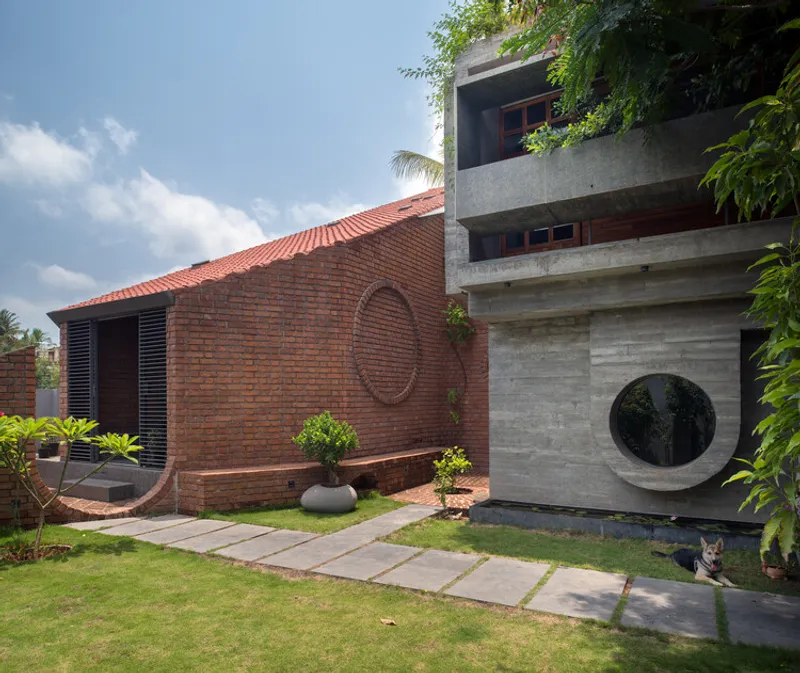
From the street the two characters are easy to tell apart. The brick wing wears a terracotta tiled roof, a gable punched with round windows and barrel-vaulted bays that recall the courtyard wadas of Maharashtra. Behind it, the board-marked concrete block rises in hard planes and stepped edges. The contrast is not subtle, and it should not be. A duet only works when both voices are distinct.
What keeps this from becoming a simple collage of old and new is the shared vocabulary of the circle. The brick wall carries a circular relief, and the concrete block answers with a single round window. The geometry crosses the material divide. This is how the two blocks read as partners rather than neighbours who happen to share a lot.
The Concrete Cuboid and the Threshold
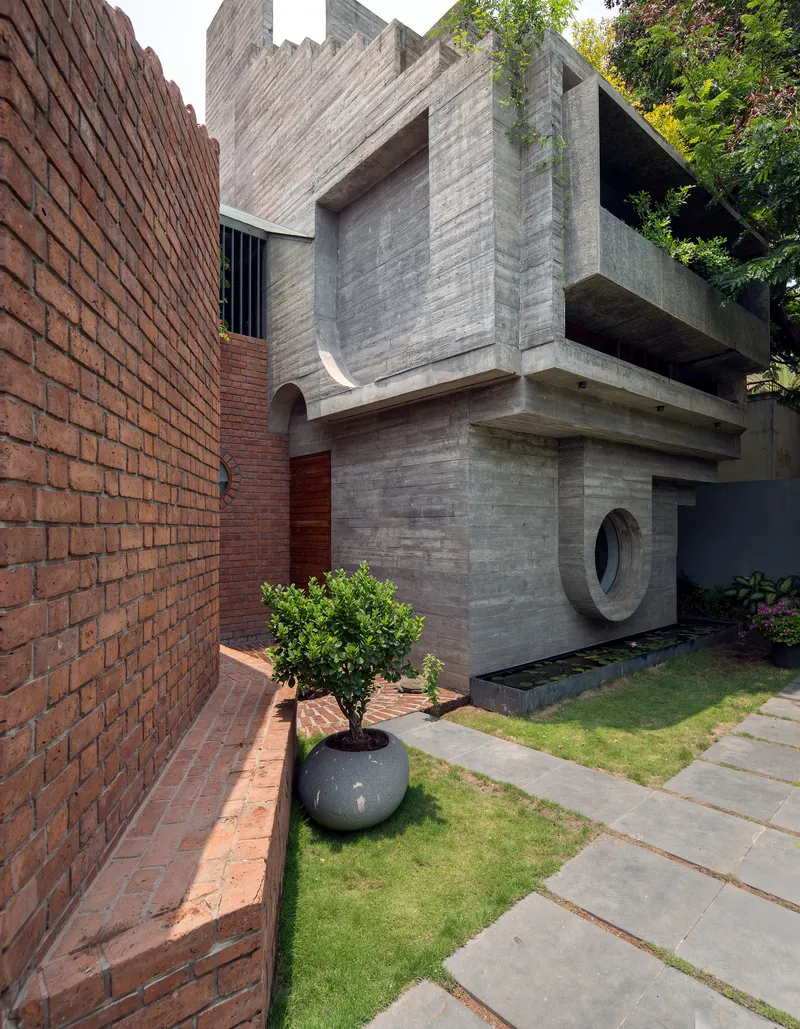
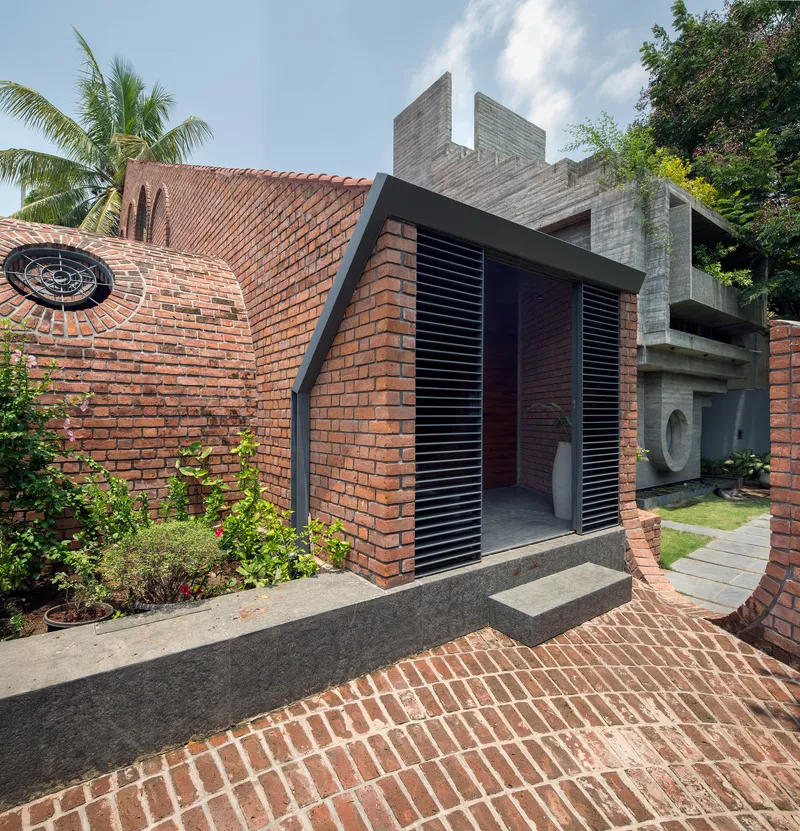
Up close, the concrete volume is quieter than you might expect. The board-formed surface carries the grain of its timber shuttering, which softens what could have been a blank, defensive mass on the house's most exposed corner. The porthole window is a careful move. It gives the south-west bedroom its view without turning the elevation into a glazed showcase facing the street.
The entry belongs firmly to the brick side. A porch screened with louvred steel panels and a stone step leads in from a curved brick-paved forecourt. Arrival is filtered rather than ceremonial, and that suits a home whose real public face sits inside, around the courtyard.
A Courtyard That Performs
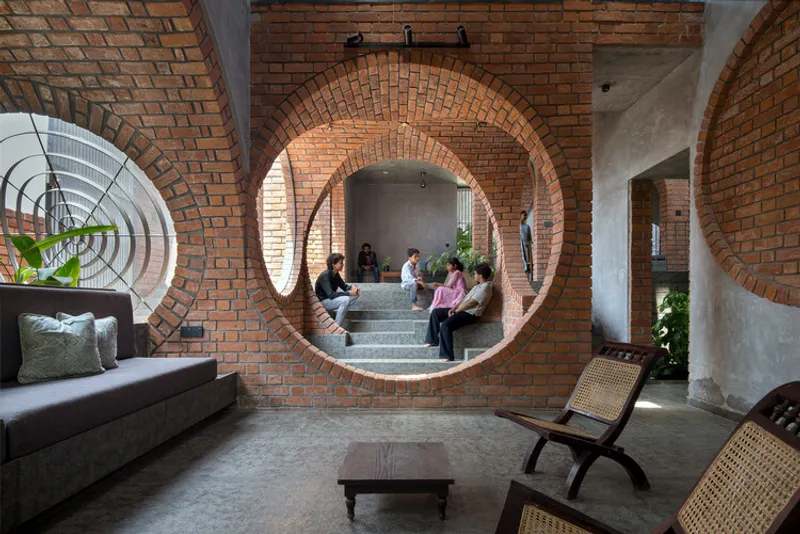
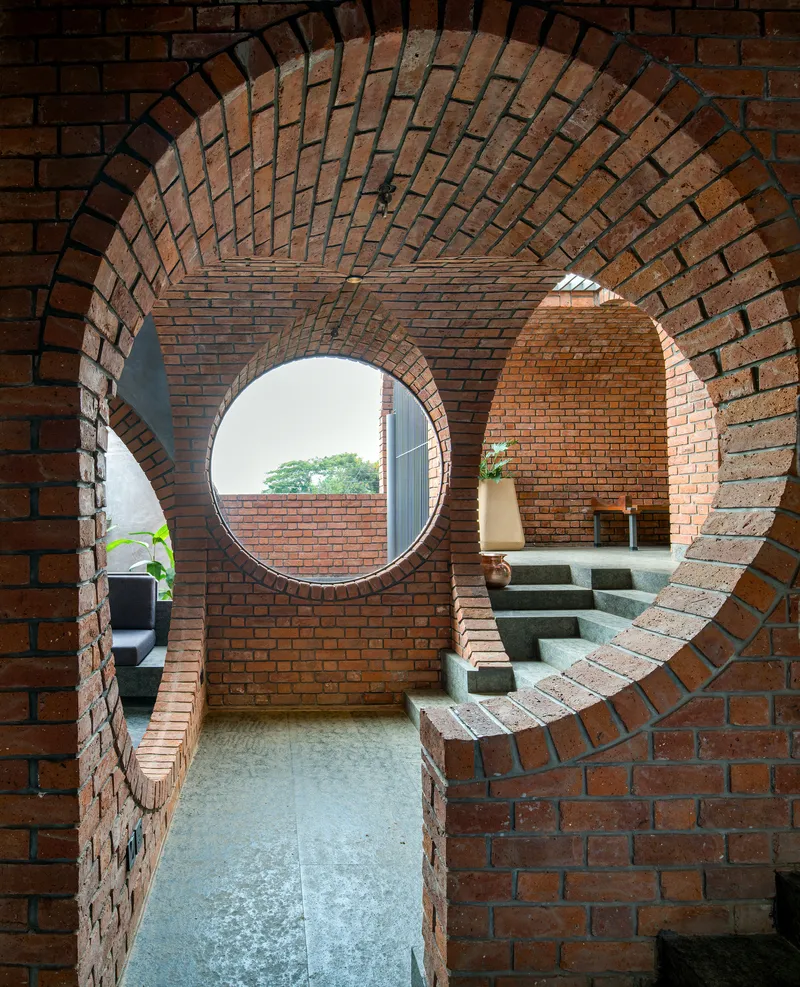
The open-to-sky gap between the two blocks is the project's thesis. Here the courtyard steps down in stone, and circular brick openings frame the risers like proscenium arches. On an ordinary afternoon it is a place to sit with tea beside the sofa and cane chairs. On a concert evening it becomes a small auditorium. The architecture asks for no conversion between the two modes, and that is the point.
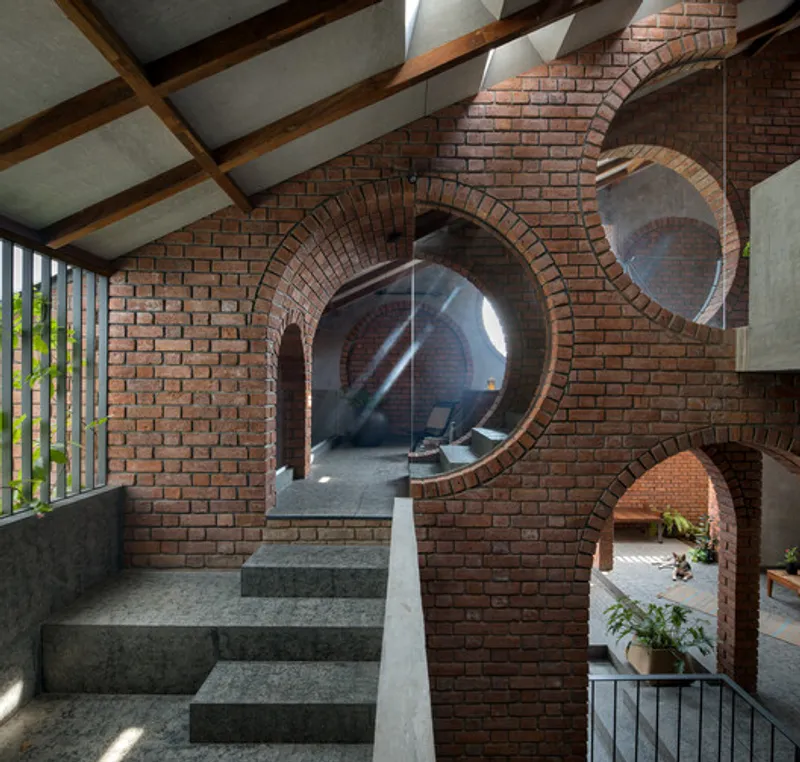
The courtyard also does the climatic work. According to the project description, the southern edge acts as a wind catcher, pulling air across a waterbody that cools it before it moves through the house. Skylights and vertical openings keep it circulating. Under the timber-framed pitched roof over the stair, slanting sunlight confirms that daylight is being steered as deliberately as air. In a city with Solapur's heat, that matters more than any formal gesture.
Living Under the Arches
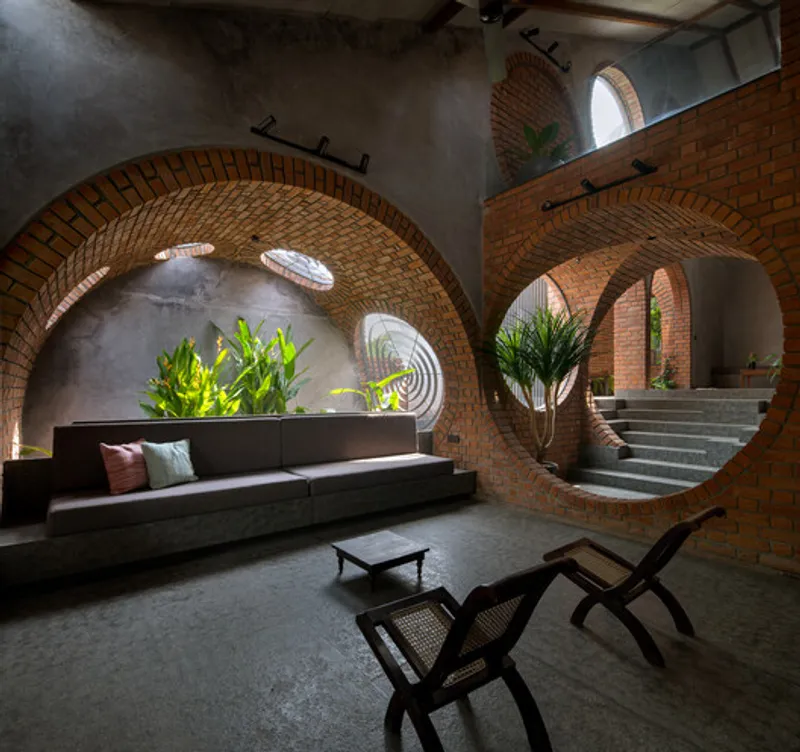
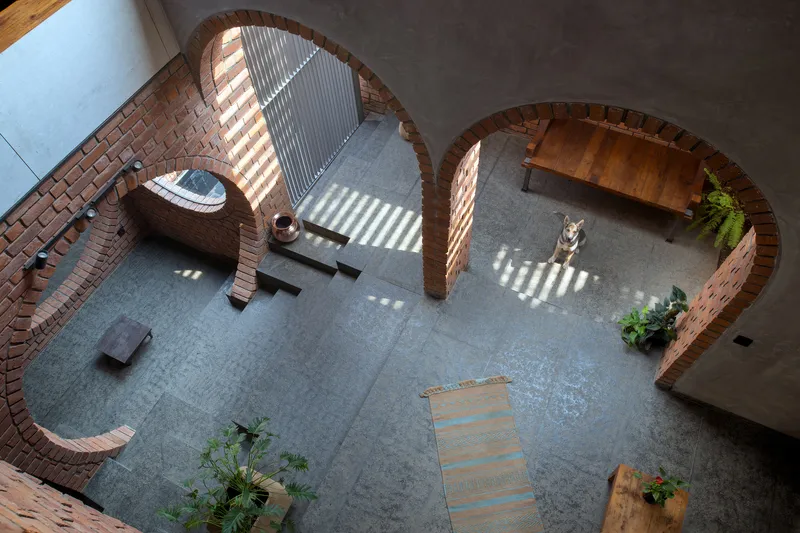
Inside the L-shaped wing, the brick arches stop being a façade motif and become the structure of daily life. The living room sits beneath large circular openings that frame plants and daylight. A built-in sofa anchors the room, so furniture stays minimal and the walls do the defining. Seen from above, the arches throw striped shadows across the stone floor, and the space reads as a sequence of thresholds rather than a single box.
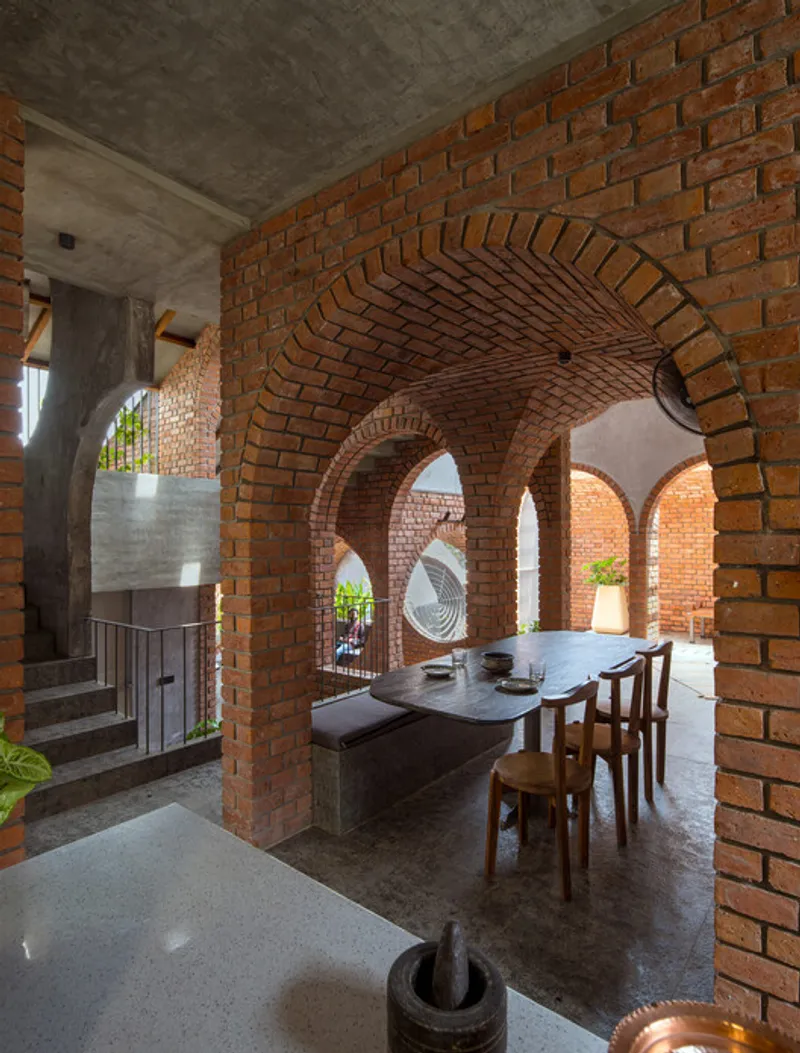
The dining area continues the rhythm, opening through brick arches beside the concrete stair. A mortar and pestle on the counter is a small detail, but it says something true about the house. This is a working family home, not a gallery, and the arches are scaled to tables and chairs rather than to photographs.
Staggered Levels and Long Sightlines
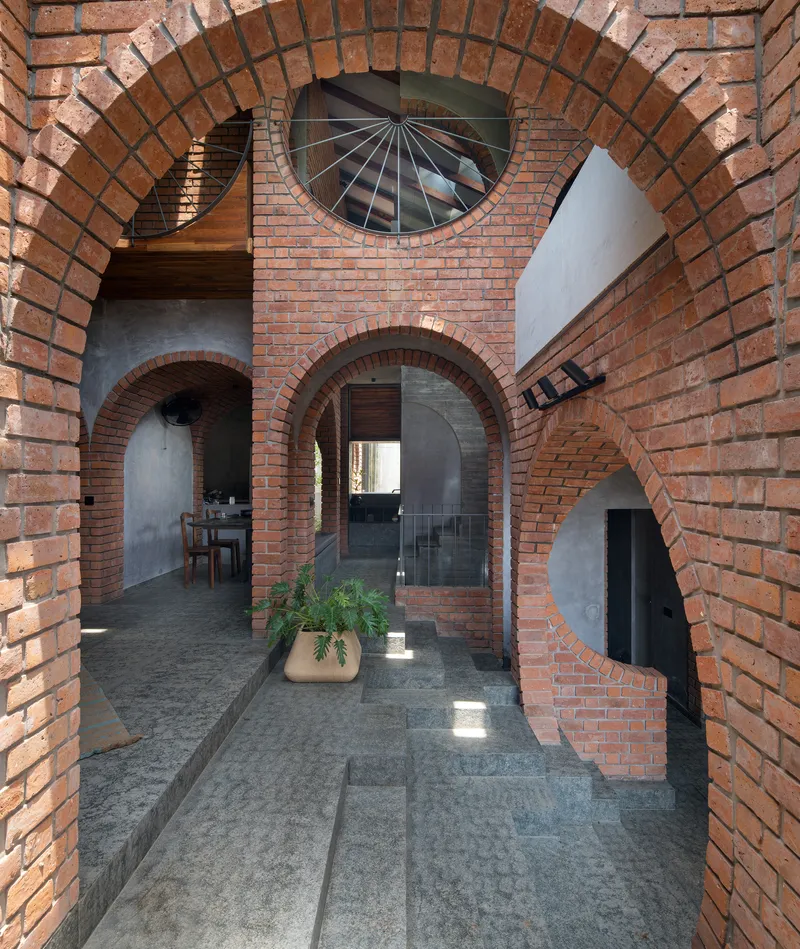
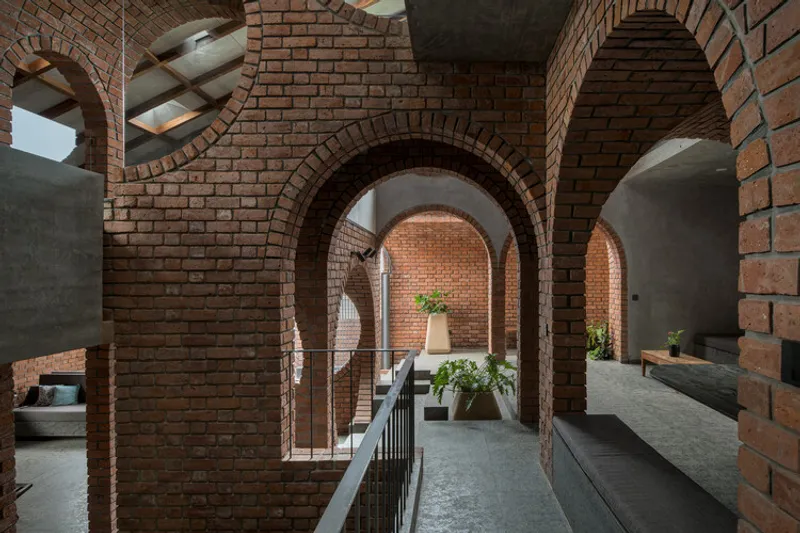
Splitting the program across staggered levels is the move that makes a 185 m² house feel generous. Looking through nested arches and a round skylight, your eye travels past granite steps to the dining table beyond. An upper walkway lined with layered arches and a black railing overlooks the lower floors. Every room borrows space from the ones above and below it.
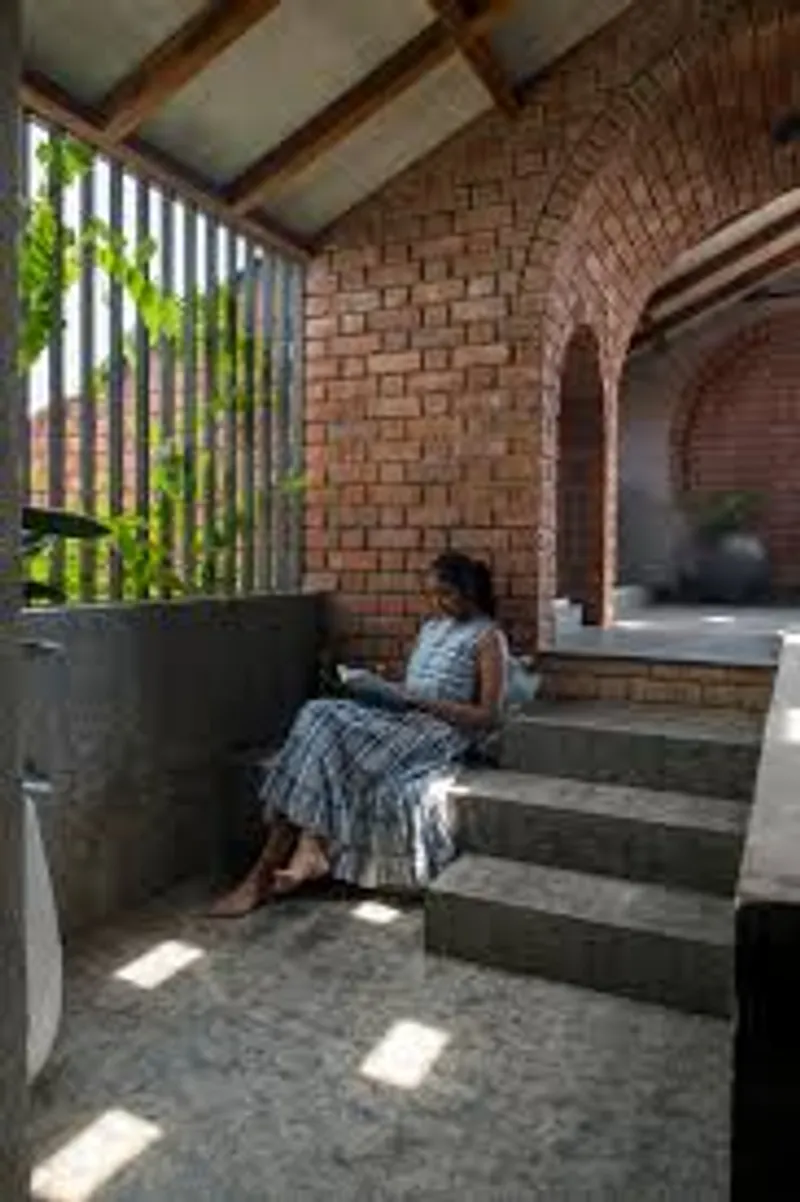
For a multigenerational household this has a social logic as well as a spatial one. Grandparents, parents and children can occupy different levels and still hear and see one another. A practice session drifts through the whole section. The stair, where a timber-slatted screen and climbing vines filter the light, becomes a place to stop and read rather than a corridor you rush through.
Plans and Drawings
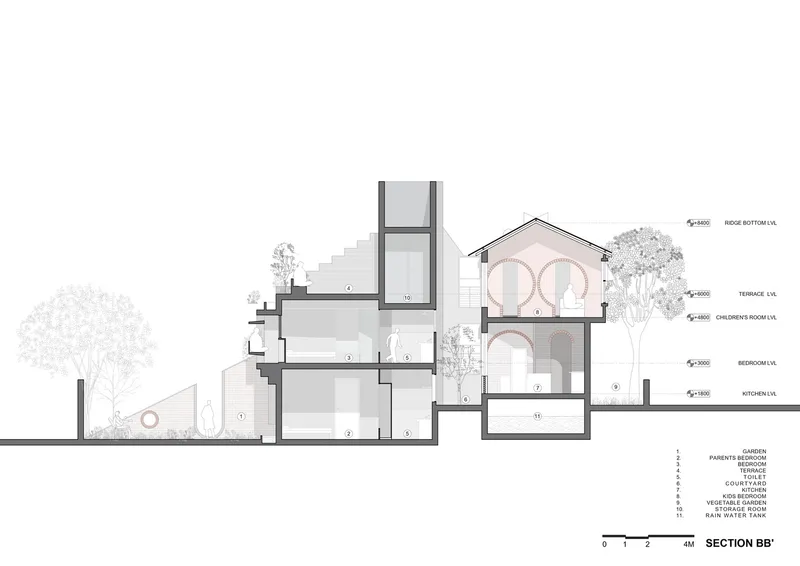
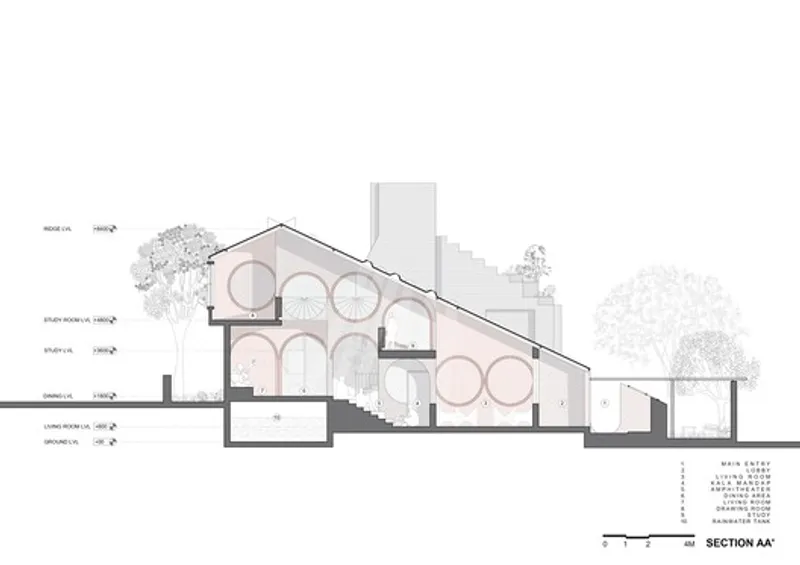
The sections explain what the photographs only hint at. Section BB' shows bedrooms stacked against the courtyard, the kitchen set into the stepped middle levels and a pitched-roof kids' bedroom at the top. A rainwater tank sits below grade. The second section traces the circular and arched openings through every floor and makes clear how the void carries light and air down the full height of the house.
Why This Project Matters
Rangmanch House shows how to treat a cultural rule as a design generator rather than a box to tick. Vastu's demand for a south-west bedroom could have produced an awkward appendage. PMA Madhushala turned it into the second voice of a duet, and the open-to-sky space that resulted became both the climatic engine and the social heart of the home. Commentators have placed the language somewhere between Indo-Brutalism and the vernacular. That is a fair reading, but the more useful lesson is procedural: let the constraint argue with the plan, then build the space where they meet.
It also makes a quiet case for programming houses around how families actually spend time together. A stepped courtyard that serves as a living room extension, a recital hall and a cooling device is a better use of a tight urban plot than three single-purpose rooms. For practitioners working in hot Indian cities, the combination of hand-made brick, board-formed concrete, a courtyard and a wind-catching edge is a replicable kit. The music is what gives this version its particular character.
Rangmanch House by PMA Madhushala (design team: Rohan Panvel, Divya Jyoti, Prasanna Morey), Solapur, Maharashtra, India. Built area: 185 m² on a 355 m² plot. Completed: 2024. Photography: Hemant Patil Photography.
About the Studio
Share Your Own Work on uni.xyz
If projects like this are the kind of work you want to make, uni.xyz is a place to publish your own, find collaborators, and enter design competitions.


Popular Articles
Popular articles from the community


Singing Woman: An Opera House That Performs Before the Curtain Rises
Ovidiu Cristian Pavel's conceptual opera house translates Estonia's choral identity into a sculpted waterfront landmark facing the Baltic Sea.


FCC Arquitectura Expands a Portuguese Granite House with a Board-Marked Concrete Wing
In Portugal, JV House pairs a cleaned-up whitewashed and granite dwelling with a timber-shuttered concrete extension, courtyards and a garden pool.

David Ortega Stacks a Two-Story Mexico City Penthouse Around a Steel Stair and a Pergola-Shaded Roof Terrace
In Colonia Roma, a 300 m² penthouse uses oak joinery, a planted steel stair and a slatted roof pergola to make a new-build apartment feel like a house.

Opera on the Sea: Driftwood Logic Shapes a Timber Opera House on Estonia's Coast
Trevor Orgill's opera house translates the entangled drift of floating timber into a civic building where wood, water, and music converge.

Similar Reads
You might also enjoy these articles

Cube Design Draws an Ecological Corridor Between Two Shenzhen Hills with the Nankai Building
Beside Shenzhen's container docks, the Nankai Building pairs stacked balconies with a climbing green screen to connect two hillsides across its height.

Praksis A and Studio Sted Bend a Red Timber Cabin Across the Granite of Norway's Southern Coast
On the southern Norwegian coast, a 105 m² cabin follows the rock on slender posts, pairing red cladding outside with pine, brick and plywood within.
David Ortega Stacks a Two-Story Mexico City Penthouse Around a Steel Stair and a Pergola-Shaded Roof Terrace
In Colonia Roma, a 300 m² penthouse uses oak joinery, a planted steel stair and a slatted roof pergola to make a new-build apartment feel like a house.

PARALELA and LB2 Thread a Public Walkway Through the Base of a Las Condes Residential Tower
In Las Condes, Santiago, the Hamlet Building gives its fenceless ground floor to a 70-metre wooded passage linking two streets and the metro.

Explore Blocs Competitions
Discover active competitions in this discipline

Challenge to reimagine the Iron Throne

Photograph architecture without architects

Illustrate the lost glory of Angkor Wat - Render Challenge

Design challenge to reuse E-waste
Comments (0)
Please login or sign up to add comments
No comments yet. Be the first to comment!