
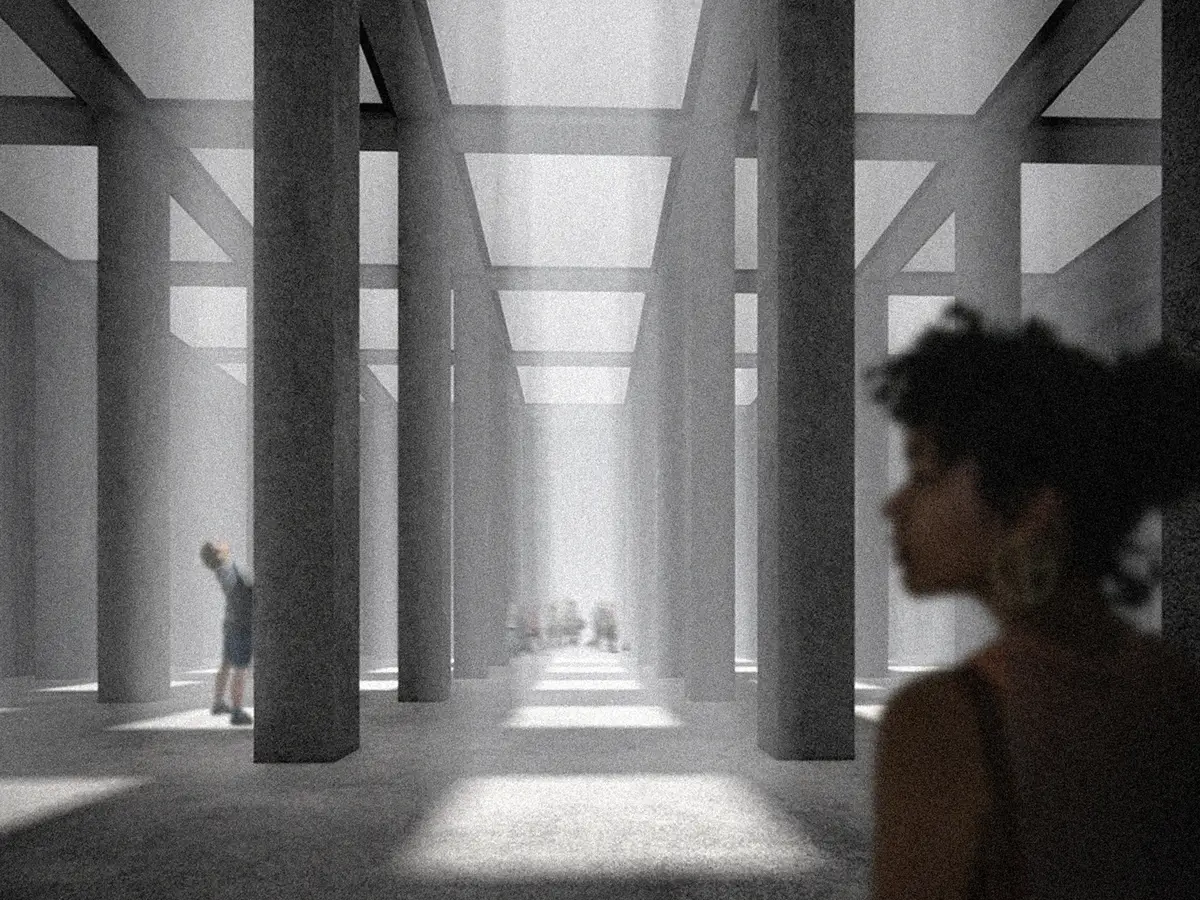
Re-visiting Cappadocia
A testament for subterranean legacy
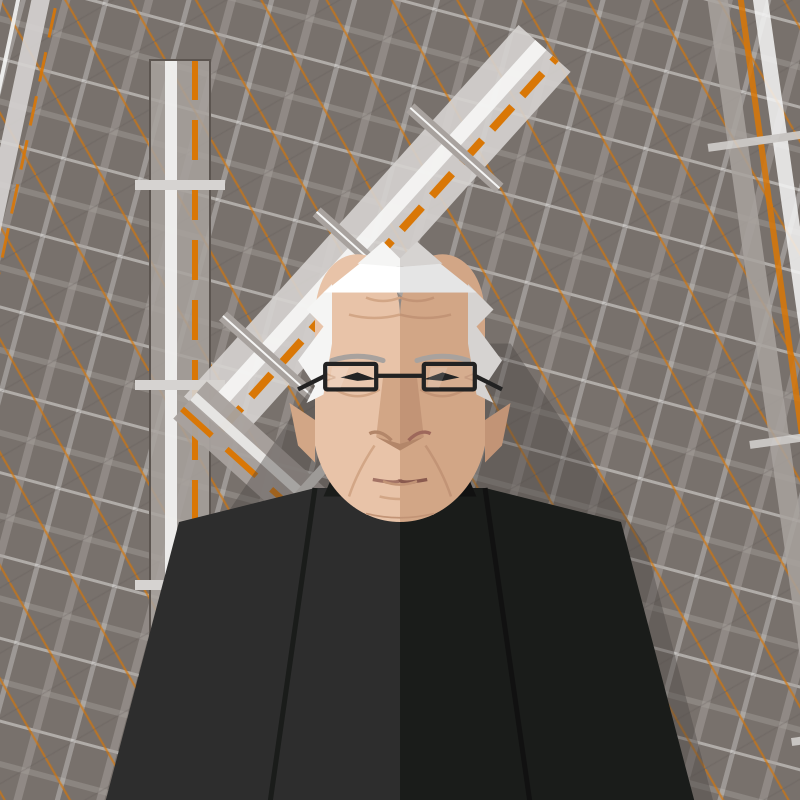
The legacy of various underground systems in Anatolia; derives its power and beauty from the primal and fundamental instinct of survival. This raw and honest desire from the medieval era, inspired different contemporary designs and designers to learn, reshape and develop the subterranean living until this idea can re-adapt itself to be the solution.
When the medieval motives and practices of the Christian monks of Anatolia intersects with the brief of the competition to reveal the poetic beauty of subterranean architecture, it creates a stark contradiction. The concept of being hidden and unseen inhibits the flamboyant, bold potential of the design. That prioritizes the functionality of the underground space over the lyrical experience. To regain the bold design motive, once more, a primal and raw instinct of humanity can be taken into the center of attention; curiosity.
The proposal uses the architectural elements on the ground to hint at the subterranean experience without dominating the invisible. The sculptural approach on the ground creates a billboard effect on the visitors passing by to attract people to the museum. The distinctive recurring theme of underground structures in various typologies can be quoted as "Architecture of subtraction rather than construction." This design idea creates a dialect between the visible and invisible or, in more conventional terms, "solid and void."
What makes the subterranean architecture feel different and somehow thrilling to experience can be the contrast of designing the non-existent to exist in space. The stereotomic values of underground architecture create a unique structural and spatial language. The proposal has a particular translator of this language to create dynamic transitions between spaces. The main substracted open-air sunken area called "the Rift" reveals the unknown or invisible to a visitor. Rift inverts the entire solid void dynamic in a specific space. The experience of sub-terra reverses in a sudden transition.
The dialect between the display and what is displayed blends into one another in the alt museum. "Alt," meaning under in Turkish, gives a contemporary understanding of Anatolia's medieval underground phenomenons. The poetic land of Cappadocia delivers a unique silhouette to the area. This silhouette inspired the designs above the ground features. The geometric properties of the volcanic area present a rich environment both above and below the ground. After the analysis of the complex 3d configuration, the abstraction process creates geometrically powerful and consistent resultants. The site-specificity of Cappadocia creates difficulties in re-enacting the culture of spaces like the underground city of Derinkuyu or Gümüşler Monastery. This theoretical basis rationalizes the method of analyzing the spatial experience with an abstracted formal study to achieve the essence of these spaces rather than imitating the existing formative features in a different urban site. ,
To use the conical abstraction for the silhouette of fairy chimneys as a practical architectural element, the three-dimensional configuration of the shape was required to be analyzed both as solid and void. The requirements on the underground environment, such as ventilation and light, are introduced to the project with this abstraction. While being functional on the underground, they also became the sculptural essence of the project above the ground, just as the chimneys of Cappadocia. The urban settlement around the site proposed a monotonous, residential area and somehow obsolete industrial and commercial patches. Even though the site is proximate to the main settlements of Kayseri and the historical area in Cappadocia, the surroundings do not contain either an urban or historical landmark.
Alt museum proposes a sculptural and contemporary landmark to an urban settlement; without being detached from the essence of testaments of the subterranean architectural heritage of Anatolia. The museum offers the spatial experience of the medieval past with dramatic spatial patterns.
The museum erects from the ground to hint at what is underneath the surface as a poetic reference, on the Southern face with the highway. But on the Northern area of the site, with the residential area of narrow streets and a dense urban pattern, the museum welcomes people into the place with the rift reaching out to the urban nature. The proposal reacts to the interconnection of the medieval Cappadocian city environment. The underground cities leak to the conventional city area through cracks and openings to create a one agglomerated sense of city both above and below the ground. Even though the proposal arouses interest with its incompatible formal and spatial experience, it is not protecting itself from the conventional urban area nearby. Alt museum alters the environment to stand out and still remain interconnected with the rest.

Popular Articles
Popular articles from the community


Little Red Riding Hood: Architectural Design as a Journey Through Fear, Light, and Storytelling
Little Red Riding Hood reimagines the fairy tale through architectural design shaped by fear, light, scale, memory, uncertainty, and choice.

Co-life: Sustainable Architecture for Age-Friendly Community Living
Co-life reimagines sustainable architecture for seniors through courtyards, rammed earth, shared gardens, and spaces designed for belonging.

Hill & Cross Opera: Sculptural Opera House Architecture Shaped by Tallinn’s Landscape and Identity
Hill & Cross Opera reimagines opera house architecture in Tallinn through its sculptural hill, civic plaza, glass wave and a luminous cross.
ALGAL REALM: A Bio-Integrated Lunar Habitat Design for Life Beyond Earth
ALGAL REALM reimagines lunar habitat design with algae-powered life support, 3D-printed regolith, and vertical living for a lunar future.

Similar Reads
You might also enjoy these articles

Day and Night Park: A Time-Based Urban Newsstand in Beijing
A temporary urban newsstand in Beijing blending travel, light, and reading through poetic colors, compact form, and community-focused design.

Modernist Patio Renovation in El Masnou, Barcelona by Oliver Segura Arquitectura + Cebrià Arquitectura
Modernist patio renovation blending tradition and innovation with a movable pool, leveled floors, and Catalan materials in El Masnou.

Alto Residencial Coop: Cooperative Housing Development in Santiago de Compostela by Carbajo Barrios Arquitectos
A linear cooperative housing complex blending white volumes and perforated metal façades, enhancing community living, natural light, privacy, and urban integration.

Vil Genis School by BPA ARCHITECTURE – Massy, France
Vil Genis School in Massy, France, features sustainable design, south-facing classrooms, community integration, accessible spaces, and modern educational architecture.

Comments (0)
Please login or sign up to add comments
No comments yet. Be the first to comment!