
Reconceptualizing Spaces for Future Dwelling: Modular Housing That Moves With Life
A vertical modular housing system where units expand, merge, relocate, and transform around a central core to counter urban sprawl.


What if your apartment could follow you to work? What if two families could merge their kitchens for a dinner party, then split back into private units by bedtime? These are not speculative provocations from a science fiction brief. They are the operating logic behind Reconceptualizing Spaces for Future Dwelling Habitat, a project that treats housing not as a fixed container but as a dynamic, relocatable system organized around a vertical structural core. Individual modules transform throughout the day, expand horizontally to accommodate growing families, and even travel along the core to bring residents closer to workplaces or social clusters.
Designed by Vinay Kumar, the proposal deliberately sidesteps the familiar future-housing tropes of floating ocean platforms or Martian colonies. Instead, it stays grounded on Earth, confronting the more immediate crisis: rapid urbanization, scarce land, and the stubborn inefficiency of fixed apartment layouts that sit half-empty for most of the day. The result is a vertically organized modular dwelling system constructed from reinforced carbon polymers, where every square meter earns its keep across time, activity, and social configuration.
Cylindrical Towers and the Courtyard as Social Anchor

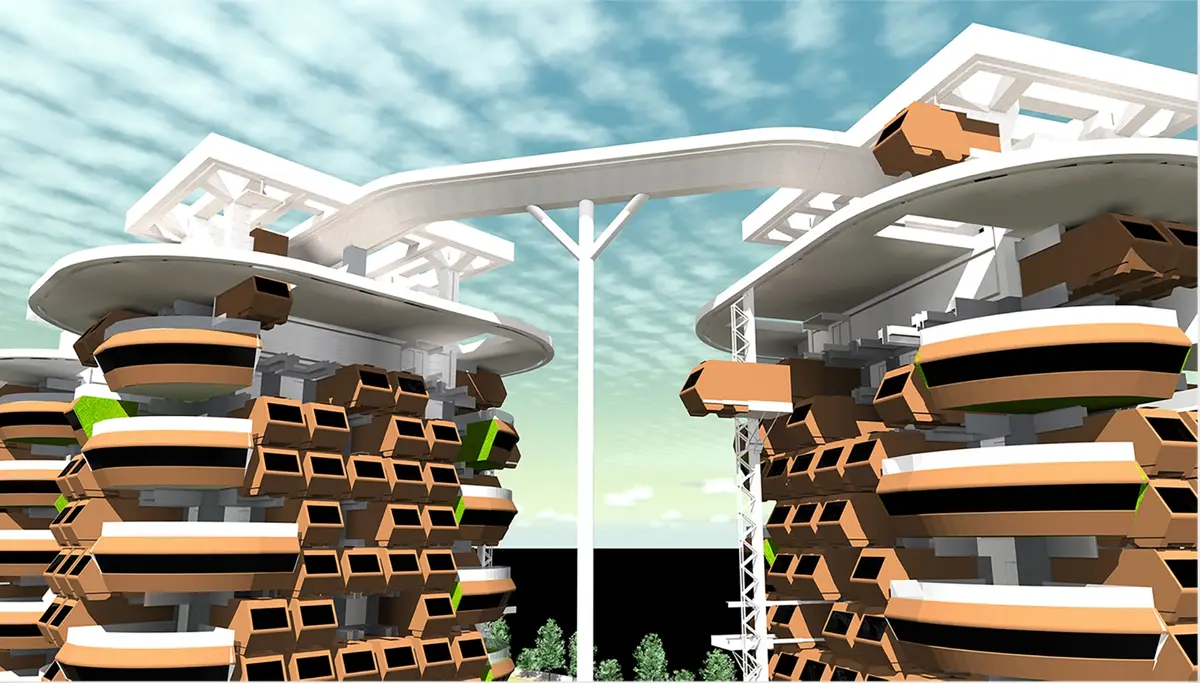
The opening rendering establishes the project's urban posture: cylindrical residential towers with spiraling balconies arranged around a central courtyard of stepped terracing. The courtyard is not decorative; it functions as the communal ground plane that compensates for the compact vertical footprint above. By pulling density upward and concentrating shared green space at the base, the scheme enacts what Kumar calls an "anti-sprawl strategy," reducing land consumption while preserving access to light, ventilation, and collective outdoor life.
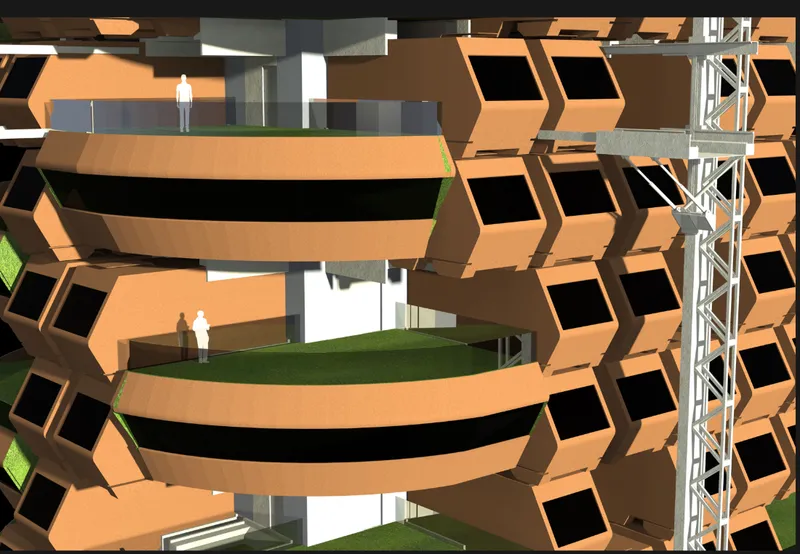
A closer view reveals the tectonic grammar of the stacked box-like residential units. Each module sits within a structural scaffolding frame that allows it to be attached, detached, or repositioned. Integrated green balconies soften the industrial character and introduce microclimatic regulation at the unit scale. The visual language is deliberately honest: you can read the system's logic from the outside, understanding immediately that these are independent components plugged into a larger framework rather than monolithic floors of a conventional tower.
Cantilevered Modules and the Central Truss Core
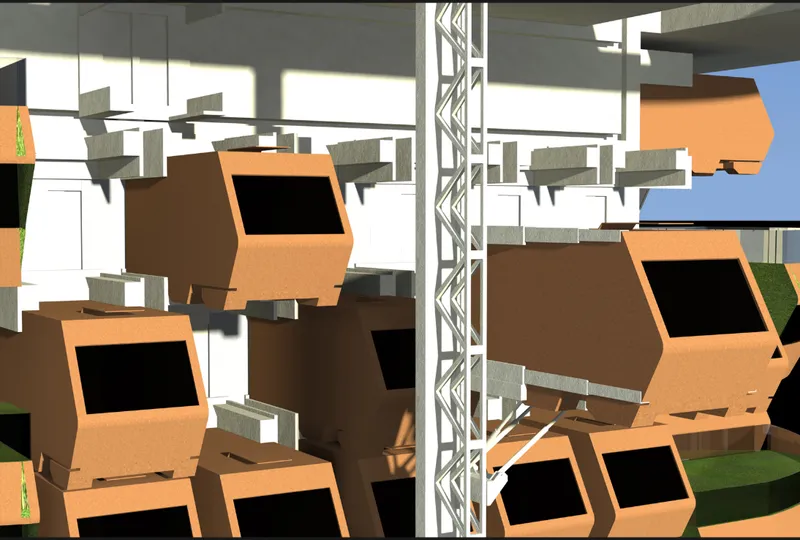
The structural heart of the project is a central steel truss core from which residential modules cantilever outward. This digital model, bathed in bright sunlight, makes the attachment logic legible: each unit connects to the core independently, meaning it can be added, removed, or shifted vertically without disrupting its neighbors. The cantilever expression also delivers practical benefits, allowing lower units to receive daylight unobstructed by the floors above and creating covered outdoor zones at each level.
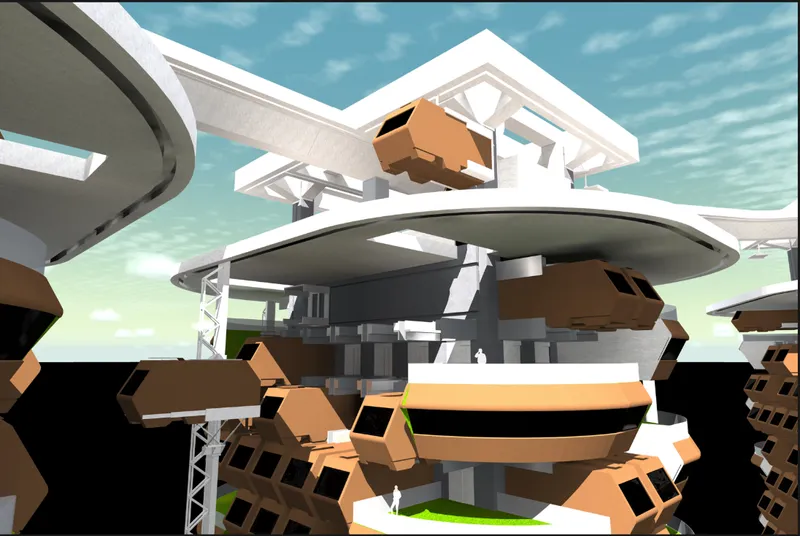
Looking upward through the radial roof structure, suspended residential pods hang within an exposed steel framework like habitable lanterns. The upward perspective emphasizes the vertical ambition of the scheme and the engineering confidence required to make it work. Modules constructed from reinforced carbon polymers keep the dead load low enough for the core to support frequent reconfiguration, a critical technical decision that enables the project's more radical social propositions around mobility and merging.
Street-Level Experience: Vegetation Meets Structure

At ground level, the tower cluster reads less like a machine and more like a living organism. Integrated vegetation cascades through the structural canopy, blurring the boundary between infrastructure and landscape. The white structural canopy provides shade and weather protection while visually unifying the multiple towers into a single precinct. This street-level rendering is important because it demonstrates that a system designed for maximum adaptability overhead can still produce a humane, welcoming public realm at the pedestrian scale.
Reading the System: Vertical Circulation and Planted Terraces
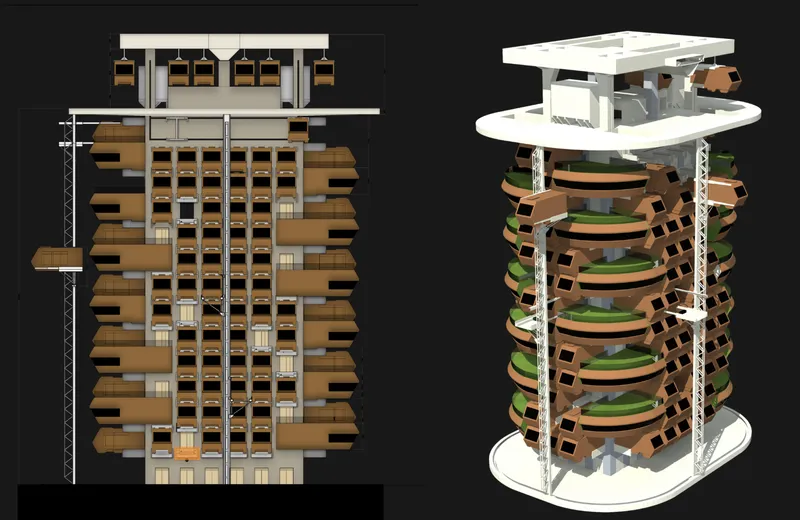
The elevation and axonometric drawing strips away the atmospheric rendering to expose the organizational logic in diagram form. The vertical circulation core anchors everything: residential units stack along it at varying intervals, while planted terraces punctuate the section to introduce communal green space at multiple heights. What the drawing communicates most effectively is scalability. The same core-and-module relationship could produce a four-story neighborhood cluster or a twenty-story urban tower depending on demand, making the system responsive to contexts ranging from suburban infill to high-density metropolitan sites.
Inside each module, the project proposes multi-adaptable interiors where flexible walls, foldable furniture, and reconfigurable partitions allow a single unit to serve as kitchen, living room, bedroom, or workspace at different times of day. Two modules can connect horizontally to create shared kitchens or dining areas; three or more can merge into collective living environments. Interiors are finished with fire-resistant, soundproof, and moisture-controlled layers, ensuring that flexibility does not come at the expense of comfort.
Why This Project Matters
Most future-housing proposals fall into one of two traps: they either fetishize technological novelty at the expense of livability, or they produce polite incremental improvements that fail to address the scale of the urban crisis. Kumar's project occupies a productive middle ground. The idea that a home could physically relocate along a vertical core to bring its occupant closer to work or family is genuinely radical, yet it is supported by a clear structural logic (carbon polymer modules, steel truss cores, mechanical repositioning systems) that keeps it tethered to buildability.
More importantly, the project reframes housing as a temporal problem, not just a spatial one. By designing modules that transform throughout the day and reconfigure across a lifetime, it challenges the assumption that a dwelling must be defined by its floor plan at the moment of construction. If cities are going to absorb billions more residents without devouring the landscape, they will need housing systems that think in time as much as in space. This proposal takes that challenge seriously.
View the Full Project
About the Designers
Designer: Vinay Kumar
Enter a Design Competition on uni.xyz
uni.xyz runs architecture and design competitions year-round that reward proposals with spatial conviction and real site intelligence.
Project credits: RECONCEPTUALIZING SPACES FOR FUTURE DWELLING HABITAT by Vinay Kumar.


Popular Articles
Popular articles from the community

Extended Shell: Retrofitting Kolkata's Balconies as Living Urban Thresholds
A modular retrofit system recovers the social and environmental intelligence of Kolkata's historic verandas for contemporary Park Street residents.

The Amber Palace Opera: A Geological Fiction Surfaces on Tallinn's Baltic Waterfront
Pierre Brillard reimagines a Baltic legend as a public landscape, opera house, and waterfront promenade rooted in Tallinn's coastal identity.

Cloaked Colonization: A Mobile Underwater Habitat That Moves Like a Fish
Micah Abaya's shortlisted EHC Pacific entry reimagines ocean settlement as a dispersed network of self-sustaining architectural organisms.

Opera by the Sea Estonia: Three Shells Dissolving Architecture into Tallinn's Coastline
A winning opera house proposal replaces monumental form with interconnected shells that blur the boundary between building, park and Baltic Sea.

Similar Reads
You might also enjoy these articles
Yenisei Monitoring Center: A Sun-and-Moon Sphere Anchors a Research Campus on Siberia's Great River
In Krasnoyarsk, shifting square blocks, a glazed central sphere and descending window rhythms turn river science into a public spectacle on the Yenisei.
Andretta Artist's Village: A Node-Based Masterplan That Lets the Hills Write the Plan
A cultural landscape strategy for Palampur's artist colony threads studios, residences and stages along a porous spine shaped by the Dhauladhar terrain.
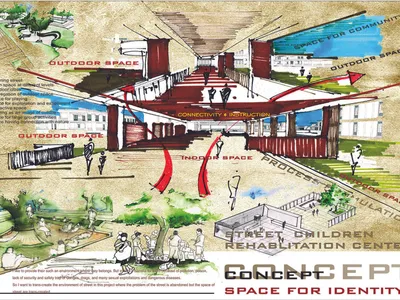
Street Children Rehabilitation Center: A Brick Campus That Eases Children From Street to Safety
A low-rise courtyard campus where learning streets, uthans and shaded verandahs stage a gradual passage from street into protective, family-scale life.
The NEON Culture: A Field of Pavilions Built for the 24-Hour City
Smaran Alva spreads galleries, stages, clubs and markets across a varied site, treating light, sound and ramped movement as the real building materials.

Comments (0)
Please login or sign up to add comments
No comments yet. Be the first to comment!