
Reconstruction Memory Hive: Turning Aleppo's Rubble into a Landscape of Collective Healing
A cluster of conical concrete structures built from war debris rises beside the Aleppo Citadel, weaving memory and renewal into urban space.


What if a city's rubble could become the raw material for its next monument? In Aleppo, one of the oldest continuously inhabited cities on Earth, the Reconstruction Memory Hive proposes exactly that: a dense cluster of conical, hive-like structures assembled from broken concrete and salvaged debris, each cone a "reconstruction cell" that visitors ascend in spirals, physically reenacting the emotional arc from destruction to renewal. The architecture borrows from Syria's vernacular vocabulary of beehive houses, domed shrines, and souk vaults, but recasts these forms as something entirely contemporary, a public landscape where memory is not merely preserved but inhabited.
Designed by Abdo Shahadeh and Ghaith Tish, the project is sited beside the iconic Aleppo Citadel, embedding itself in one of Syria's most symbolically charged locations. The Memory Hive treats the post-conflict city not as a blank slate awaiting reconstruction but as fertile ground for a new collective identity, one literally composed of the material fragments of what came before.
Spiraling Cones That You Walk Over, Through, and Into
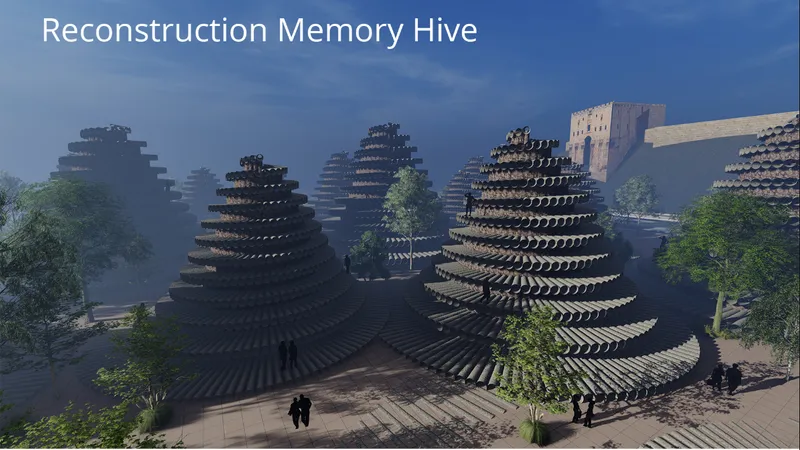
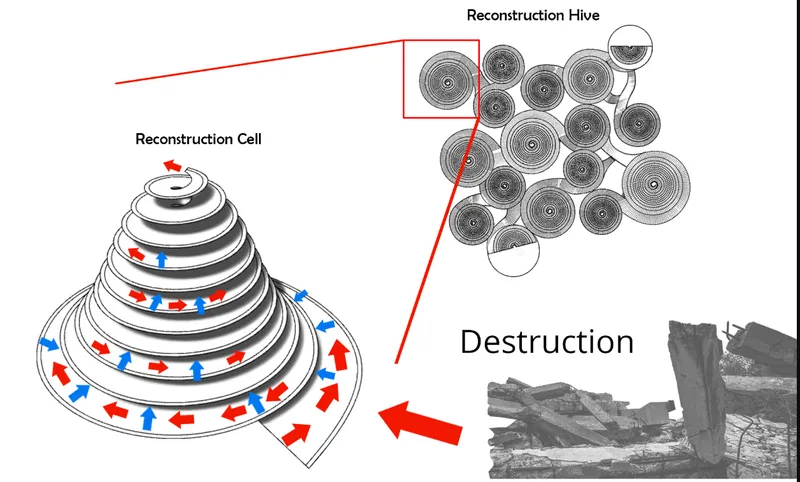
At dusk, the cluster reads almost like a geological formation: stepped conical towers with cantilevered tiers rising among trees, their silhouettes softened by pedestrians circulating along the outer spiral walkways. The project's conceptual diagram reveals a clear material logic. Destruction debris feeds into individual reconstruction cells, which then aggregate into the larger hive assembly. Rubble, broken concrete, and damaged city materials are not hidden; they become visible building components, integrating remnants of old Aleppo into the footprint of its future.
Each cell is a layered concrete cone composed of precast trunk-like elements arranged in a helical pattern. The lowest layers symbolize destruction; the uppermost represent rebuilding. Multiple cells connect to form an interconnected landscape of varying scale and function, with pathways weaving between them. The circulation is deliberately physical: visitors climb, rest, observe, and descend into dim, cavernous interiors that recall ancient Syrian spaces of contemplation.
Light as a Divine Gesture: The Construction Hope Skylight
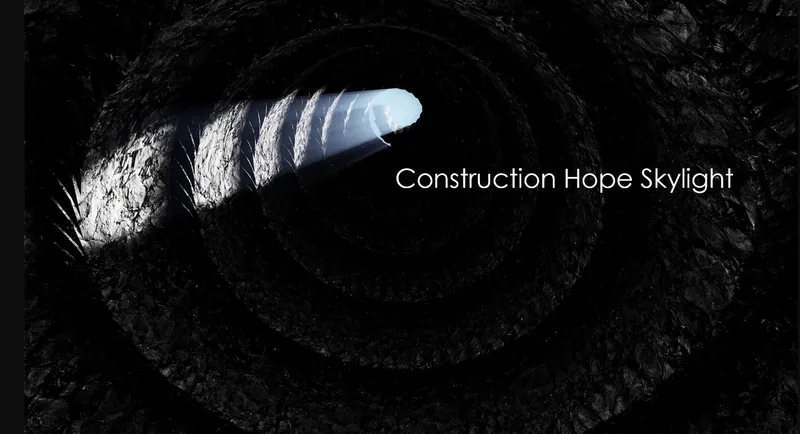
Look up from inside one of the cones and you see a spiraling circular opening pulling a shaft of sky down through dark, textured walls. Shahadeh and Tish call this the "Construction Hope Skylight," and it does precisely what its name promises. Light drops into the interior like a controlled revelation, transforming each cone into something between a ruin and a sanctuary. The effect draws directly from the light shafts found in traditional Syrian marketplaces, where narrow openings puncture dense stone canopies, symbolizing hope breaking through darkness.
The conceptual influences run deep. The designers cite whirling Sufi dervishes, whose circular motion represents spiritual ascension and healing, as a driver of the helical geometry. Ruined Syrian domes, fragments of cultural history that survived the conflict, inform the structural silhouette. These references never feel applied or decorative; they are embedded in the spatial sequence itself. Walking the spiral and then standing beneath the skylight reproduces the ritual arc from grief to something approaching grace.
Siting Memory Against the Citadel
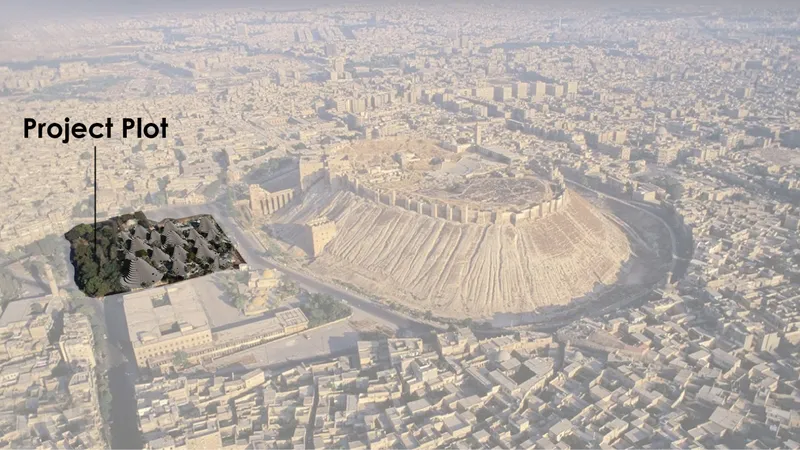
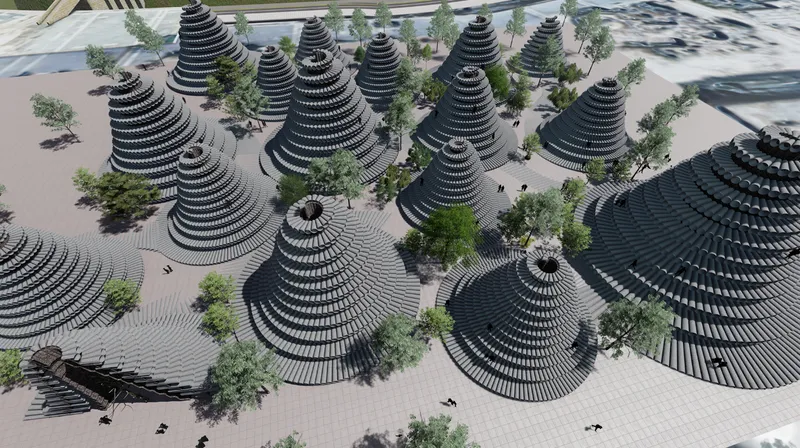
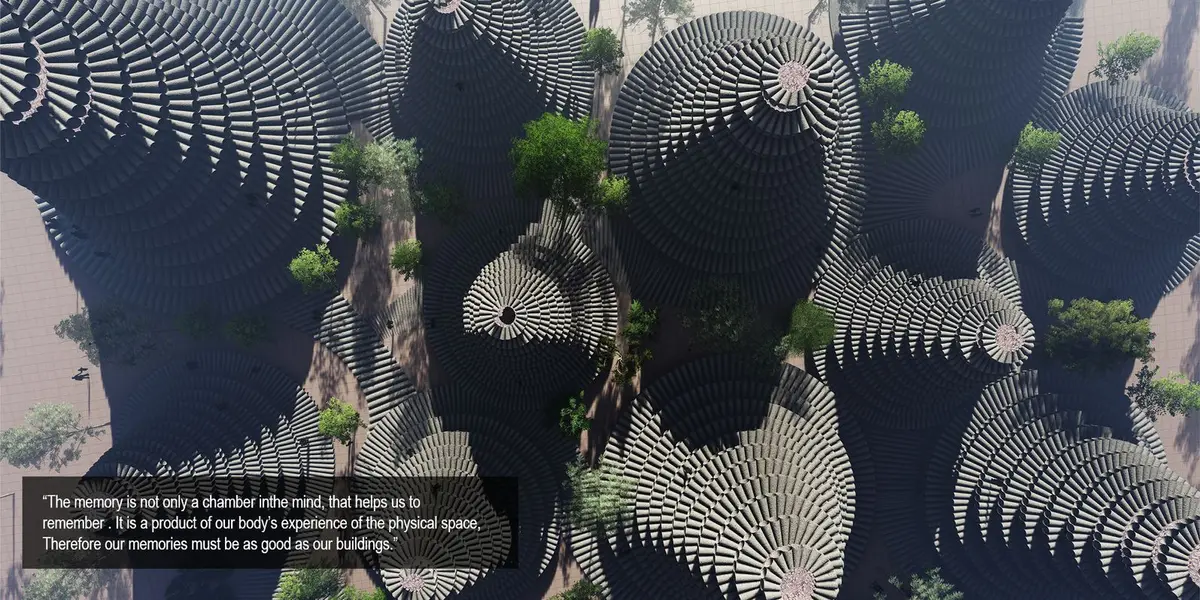
The aerial view makes the strategic siting unmistakable. A small forested plot nestled within Aleppo's dense urban fabric, adjacent to an amphitheater and within sight of the ancient Citadel. The proximity is the argument: the Citadel represents continuity, the Hive embodies transformation. Seen from above, the conical pavilions with their layered rings scatter across a paved plaza with trees between them, reading less like a single building and more like an urban landscape, a topography of memory inserted into the city's existing grain.
The programmatic distribution reinforces this reading. A monumental Reconstruction Apse marks the beginning of the visitor journey, confronting arrivals with loss and the remains of war. A sunken Reconstruction Shrine filters light through spiral layers for silent reflection. Open green areas forming a Reconstruction Park surround the hive as communal gathering grounds. Each cone holds a specific function, yet the connective tissue between them, the pathways and plazas and planted areas, is where public life actually reconstitutes itself.
Precast Helical Construction and the Logic of Assembly

The technical drawings expose the structural intelligence behind the poetic form. Sectioned views reveal how precast concrete elements stack in helical courses to generate each dome, with circulation pathways threading between cones at various levels. The system is modular: one reconstruction cell is the basic unit, scalable and repeatable, which allows the hive to grow organically rather than arriving as a single monolithic gesture. The helical arrangement also creates the stepped cantilevered profile visible from the exterior, giving the cones their distinctive terraced silhouette while providing structural depth at each tier.
There is a satisfying coherence to using precast elements made partly from reclaimed war debris to build a monument about reconstruction. The material cycle closes: what was destroyed returns as structure. The design begins with a single cell and ends with an urban hive, mirroring how communities themselves rebuild, one household, one story, one restored connection at a time.
Why This Project Matters
Post-conflict memorials tend to oscillate between two poles: abstract monuments that risk feeling disconnected from lived experience, and literal reconstructions that pretend destruction never happened. The Memory Hive refuses both options. By building with the material evidence of war and shaping it into a publicly accessible landscape of spirals, light shafts, and gathering spaces, Shahadeh and Tish propose a third path where remembrance and reconstruction are the same physical act.
The project's real strength lies in its refusal to be merely symbolic. You climb these cones. You descend into their interiors. You gather in the parks between them and look up through the skylights. The architecture does not just represent healing; it stages it spatially, making the body complicit in the narrative. For a city like Aleppo, where entire neighborhoods collapsed and public life fractured, that insistence on physical engagement is not a design flourish. It is the project's ethical core.
View the Full Project
About the Designers
Designers: Abdo Shahadeh, Ghaith Tish
Enter a Design Competition on uni.xyz
uni.xyz runs architecture and design competitions year-round that reward proposals with spatial conviction and real site intelligence.
Project credits: Construction Memory Hive by Abdo Shahadeh, Ghaith Tish.


Popular Articles
Popular articles from the community


The Amber Palace Opera: A Geological Fiction Surfaces on Tallinn's Baltic Waterfront
Pierre Brillard reimagines a Baltic legend as a public landscape, opera house, and waterfront promenade rooted in Tallinn's coastal identity.


ETEH Reworks the Shared Spaces of São Domingos School in Brazil Around Timber, Color and Hanging Plants
At São Domingos School in Brazil, 436 m² of hall, refectory and library are recast with timber joinery, a yellow and blue code and trailing greenery.

Aquadapt: An Underwater Habitat That Rewrites Its Rooms by the Hour
Curved modules ring the seabed while one shell shifts from breakfast room to cinema, farm and football pitch as residents' needs change.

David Ortega Stacks a Two-Story Mexico City Penthouse Around a Steel Stair and a Pergola-Shaded Roof Terrace
In Colonia Roma, a 300 m² penthouse uses oak joinery, a planted steel stair and a slatted roof pergola to make a new-build apartment feel like a house.

Similar Reads
You might also enjoy these articles
Aquadapt: An Underwater Habitat That Rewrites Its Rooms by the Hour
Curved modules ring the seabed while one shell shifts from breakfast room to cinema, farm and football pitch as residents' needs change.

Play: Fragments of Their World: Remembered Architecture Rebuilt as a Modular Playground for Refugee Camps
Tom Gardner abstracts domes, arches and towers from the homelands of displaced families into a kit of child-scaled play parts for camp settlements.
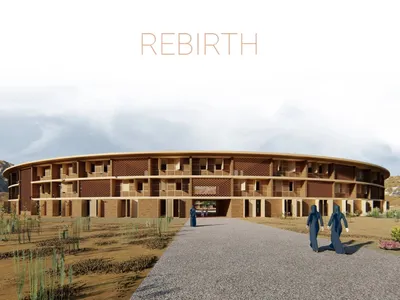
REBIRTH: A Circular Settlement Where Afghan Widows and Their Children Rebuild Life Together
A shortlisted Resile entry turns the circle into a protective ring of timber and brick, gathering homes, classrooms and gardens around a shared landscape.
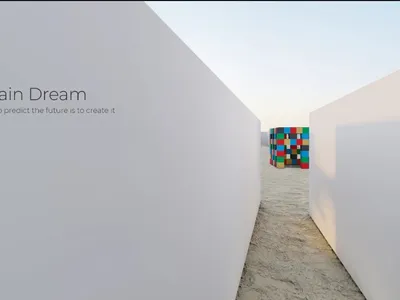
The Main Dream: A Recycled Plastic Kit That Lets Refugee Children Build Their Own Playground
Thirty-centimetre interlocking cubes that connect on three axes turn play into construction, letting children author the spaces they occupy.


Comments (0)
Please login or sign up to add comments
No comments yet. Be the first to comment!