

Recovering Through Incision: Surgical Urban Regeneration in São Paulo's Bela Vista
Strategic architectural incisions reconnect fragmented neighborhoods by transforming São Paulo's viaduct infrastructure into layered public landscapes.


What if a city could be healed the way a surgeon treats a body: not by removing entire organs, but by making precise cuts that restore circulation? Recovering Through Incision takes this premise literally, proposing a series of targeted architectural interventions in São Paulo's Bela Vista neighborhood that cut through infrastructural barriers, reconnect severed pedestrian networks, and transform dead space beneath viaducts into active public ground. The metaphor of incision is not decorative here. It structures everything from the site analysis, which reads urban dysfunction as symptoms, to the formal strategy, which inserts new connective tissue at exact points of fragmentation.
Designed by Marcos Bresser and entered into the UnIATA 2018 competition, the project operates in the northern portion of Bela Vista, a neighborhood defined by overlapping road infrastructures, dense residential and commercial development, and viaduct crossings that guarantee metropolitan mobility while severing local connections. Rather than proposing tabula-rasa redevelopment, Bresser works with what already exists, reactivating residual spaces and stitching together the urban layers that São Paulo's car-first infrastructure has torn apart.
Triangular Trusses as Pedestrian Bridges
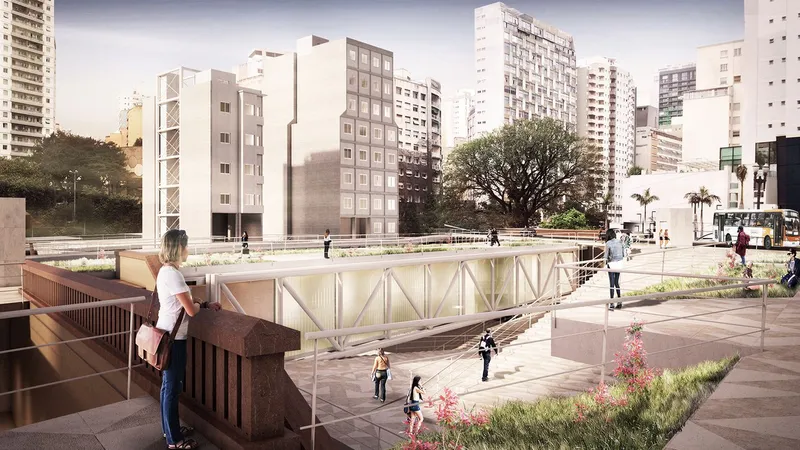
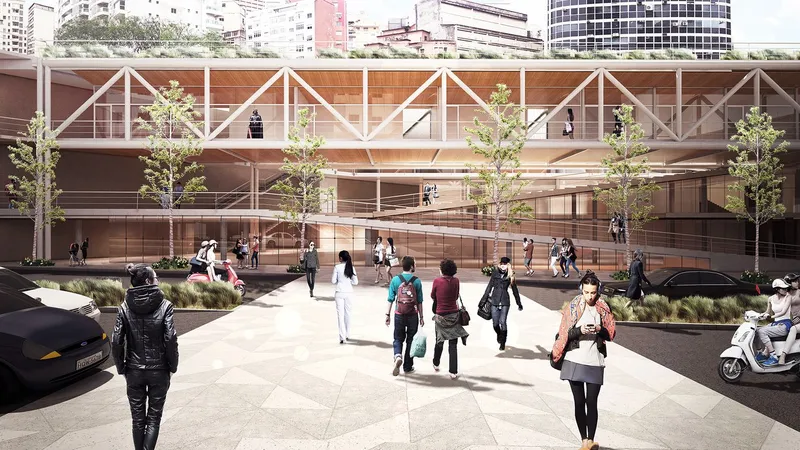
The project's most striking formal element is the white triangular truss system that spans between existing buildings and crosses over lower plazas, functioning simultaneously as structure and pedestrian infrastructure. These elevated bridges are not decorative additions; they are the incisions themselves, slicing through the gaps that viaducts and roadways have created at ground level. Below the trusses, planted beds and open plazas establish a new public datum, while the bridges overhead link upper levels of adjacent buildings into a continuous circulation network.
At street level, the architectural language remains deliberately restrained. Timber facades with diagonal white cross-bracing create a rhythm that signals the building's structural logic from the sidewalk. Planted beds soften the interface between architecture and street, contributing to microclimatic comfort in a neighborhood that analytical mapping identified as prone to urban heat island effects. The choice to keep the structural expression visible, rather than cladding it behind a polished skin, reinforces the project's commitment to legibility: you can see how the building works, and you can see where it invites you to walk.
A Triangular Aperture Over the Dense Urban Fabric
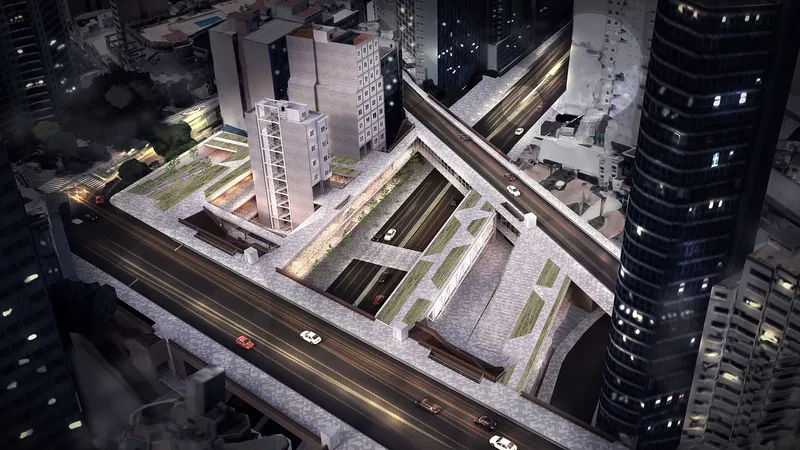
Seen from above at night, the project reveals a triangular roof opening that carves light and air into the dense urban block. Surrounding traffic flows along adjacent streets, underscoring the tension between the neighborhood's car-dominated infrastructure and the pedestrian sanctuary the project creates within. The triangular form is not arbitrary; it responds to the irregular geometries of Bela Vista's block structure, finding its shape in the residual territory between existing buildings and viaduct alignments.
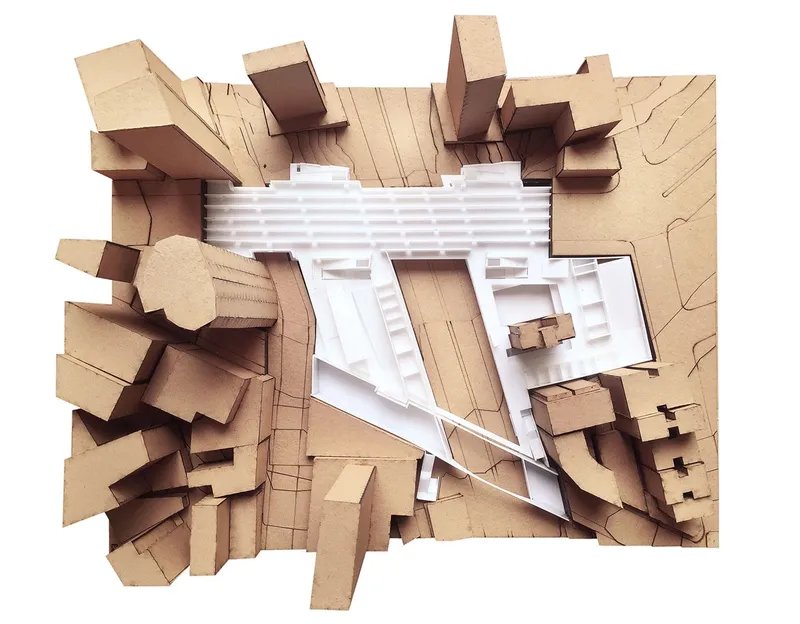
The physical model in top view confirms how precisely the intervention slots into the surrounding urban fabric. It does not erase or override the neighborhood's existing grain but occupies the leftover space that infrastructure produced, converting liability into asset. Bresser's analytical mapping of building density, institutional distribution, and parking concentration informed this placement, identifying exactly where the imbalance in spatial quality and public accessibility was most acute.
Structural Stitching Between Adjacent Buildings
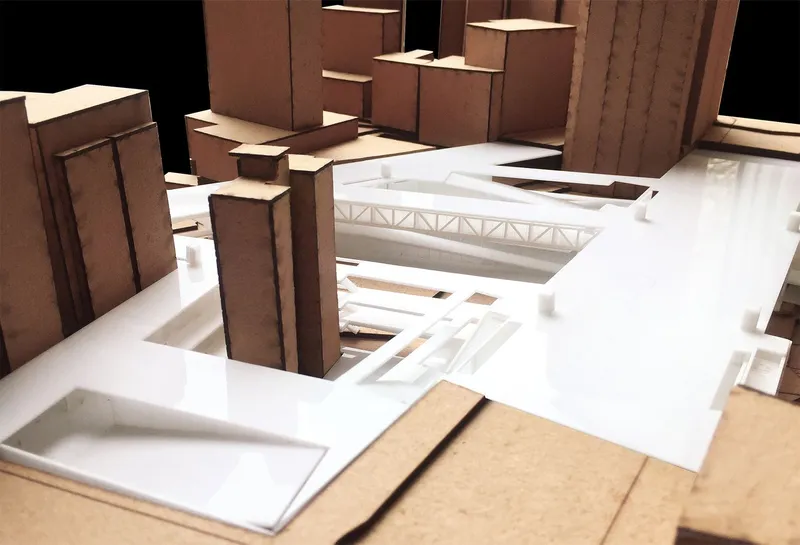
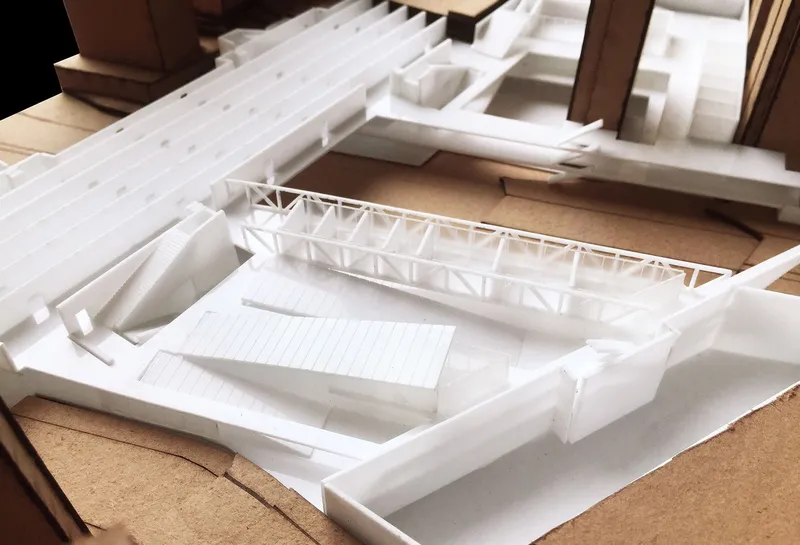
Close examination of the physical model reveals how the white truss structure spans between adjacent buildings, literally bridging the gaps in the urban block. The exposed structural members create a covered public space below: part market, part cultural hall, part connective corridor. The project distributes a diverse program across multiple ground levels, including commercial spaces such as markets and cafés, cultural facilities like auditoriums and media libraries, social infrastructure including basic health units and community support centers, and active recreation spaces with gyms and sports courts.
This programmatic layering is calibrated to visitor flow and spatial hierarchy. High-traffic programs occupy central connective zones where the trusses meet the viaduct corridors, while quieter functions sit in protected or transitional areas. The recessed courtyard volume visible in the model detail acts as a decompression space, allowing the intensity of urban circulation above to dissipate into a calmer register at lower levels. Vegetation integrated throughout softens the hard infrastructure, and ramps, bridges, and stair systems are designed as continuous public landscapes rather than isolated access points. The boundary between building and city dissolves by design.
Why This Project Matters
São Paulo's relationship with its own infrastructure is a problem shared by dense cities worldwide. Viaducts, overpasses, and highway corridors were built to move cars efficiently, and they succeeded, at the cost of fragmenting neighborhoods and producing vast tracts of residual, inhospitable space beneath them. Recovering Through Incision refuses to treat this as an irreversible condition. By reframing the viaduct not as a barrier but as a vector for transformation, Bresser demonstrates that the very infrastructure responsible for urban disconnection can become the armature for its repair.
What makes the project convincing is its refusal to operate at only one scale. The analytical diagnosis is genuinely urban, mapping heat islands and institutional gaps across the neighborhood. The architectural proposition is genuinely spatial, with sections that show how multi-level circulation, program, and vegetation interlock beneath and above existing structures. And the formal language, those emphatic triangular trusses, is genuinely communicative: it tells residents and passersby that something new has been inserted into their neighborhood, something that exists precisely to reconnect what was severed. For a thesis project, that is a remarkably complete proposition.
View the Full Project
About the Designers
Designer: Marcos Bresser
Enter a Design Competition on uni.xyz
uni.xyz runs architecture and design competitions year-round that reward proposals with spatial conviction and real site intelligence.
Project credits: Recovering Through Incision by Marcos Bresser UnIATA 2018 (uni.xyz).


Popular Articles
Popular articles from the community


Opera by the Sea Estonia: Three Shells Dissolving Architecture into Tallinn's Coastline
A winning opera house proposal replaces monumental form with interconnected shells that blur the boundary between building, park and Baltic Sea.

The Amber Palace Opera: A Geological Fiction Surfaces on Tallinn's Baltic Waterfront
Pierre Brillard reimagines a Baltic legend as a public landscape, opera house, and waterfront promenade rooted in Tallinn's coastal identity.

Faces of the Soviet Avant-Garde: Turning Moscow's Street Names into an Open-Air Museum
A network of sculptural installations across a Moscow residential district transforms forgotten architect names into spatial encounters with cultural memor

Temporary Home for Dogs: A Reversed Zoo Rethinks Animal Shelter Architecture
In Bucharest, a sinuous corridor and freed landscape flip the logic of containment, designing a shelter that works to make itself unnecessary.

Similar Reads
You might also enjoy these articles
Sustainable Architecture Design: Embracing Nature and Modernity at Villa Solsidan
The article explores Villa Solsidan by AndrénFogelström, showcasing its sustainable architecture design and integration with the natural surroundings in Saltsjöbaden, Sweden.
Scientific and Educational Monitoring Center of the Yenisei, Krasnoyarsk
Architecture as an instrument for ecological research, education, and environmental awareness along Russia’s largest river.
Development of Andretta Artist’s Village, Palampur, Himachal Pradesh, India
Reimagining Andretta as a living cultural landscape where art, architecture, and community converge to shape a global creative village.
Street Children Rehabilitation Center: A Model of Social Architecture for Community Rehabilitation
An inclusive social architecture project that transforms streets into nurturing environments, restoring dignity, identity, and opportunity for vulnerable children.

Explore Urban Intervention Competitions
Discover active competitions in this discipline

Challenge to reimagine the Iron Throne

Photograph architecture without architects

Illustrate the lost glory of Angkor Wat - Render Challenge

Design challenge to reuse E-waste
Comments (0)
Please login or sign up to add comments
No comments yet. Be the first to comment!