
Reflection on Public Interfaces: A Municipal Headquarters Recast as Shared Civic Ground in Hubballi
Shreya Mahabalshetti's thesis opens a closed municipal compound to the city, pairing reused colonial blocks with porous new civic volumes.


Most Indian municipal buildings tell citizens to wait outside. They are closed bureaucratic systems, built to administer rather than to receive, and the public meets them across counters and compound walls. Reflection on Public Interfaces asks whether that relationship can be redrawn in plan and section, and whether a city's governing seat can become the most generous public ground in town rather than its most guarded address.
The project is a thesis by Shreya Mahabalshetti, submitted to UnIATA 2019. It targets the Hubballi Dharwad Municipal Corporation (HDMC) complex in Karnataka. Hubballi Dharwad is the state's second-largest urban agglomeration after Bengaluru: Dharwad is its educational and cultural nucleus, and Hubballi is the commercial, industrial and transport engine of North Karnataka. The HDMC precinct sits at the centre of this activity. Nearly one lakh people cross the city centre daily, BRTS and KSRTC corridors run straight through the complex, and several bus stops lie within a 50-metre walk. Despite that traffic, the site's built-to-open ratio is roughly 80:20, and Mahabalshetti reads that imbalance as the problem the architecture must solve.
A Colonial Arcade Turned Toward the Plaza
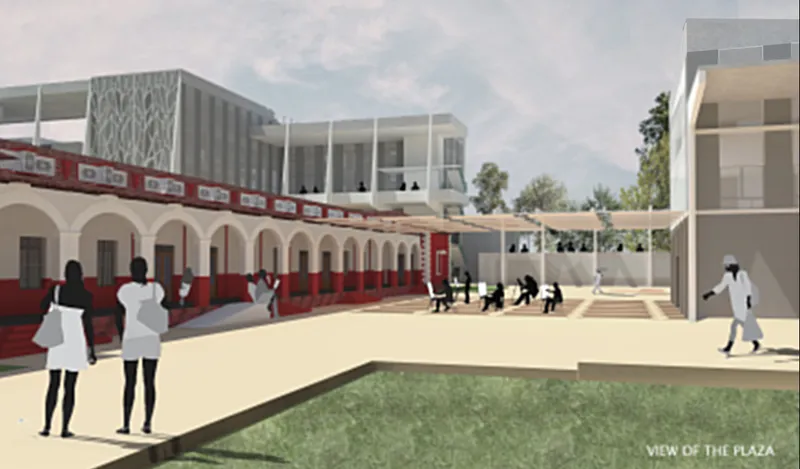
The opening render sets out the project's argument. A red arcaded building frames a paved court, people sit beneath a timber pergola, and a lone figure crosses the open ground in daylight. The red facade recalls the two British-period structures Mahabalshetti chose to keep, the Commissioner's Office and the J-Block administrative building, which are load-bearing masonry with sloped tiled roofs and red lime-plastered walls. These buildings date the precinct's administrative history to 1856. In this view, that history becomes a backdrop for loitering, shade and passage rather than a fence around officialdom.
The design move is restrained, and that restraint works in its favour. The thesis does not invent a new monument. It removes clutter until the existing arcade can face a usable open space, which is exactly what an 80:20 precinct lacks. The pergola carries much of the effort here: a light timber structure that gives shade without adding mass, so the court remains a place to stay and not just a gap between buildings.
Sections That Set Concrete Beside Tile
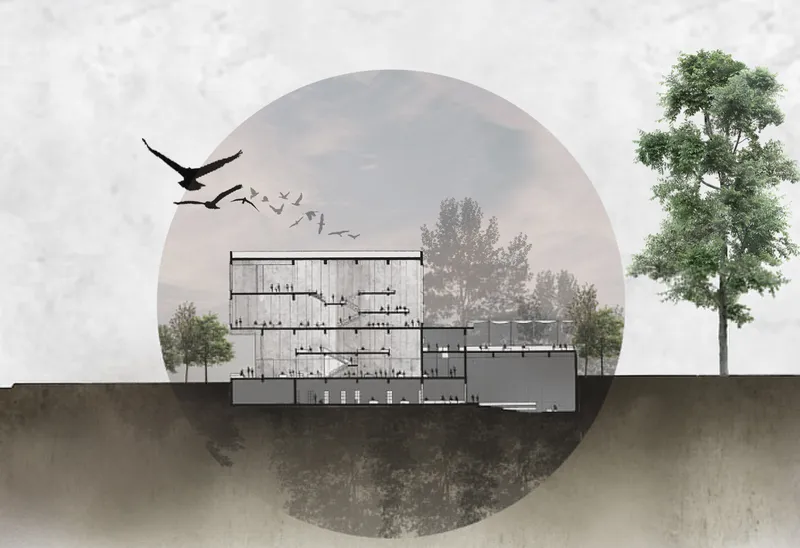
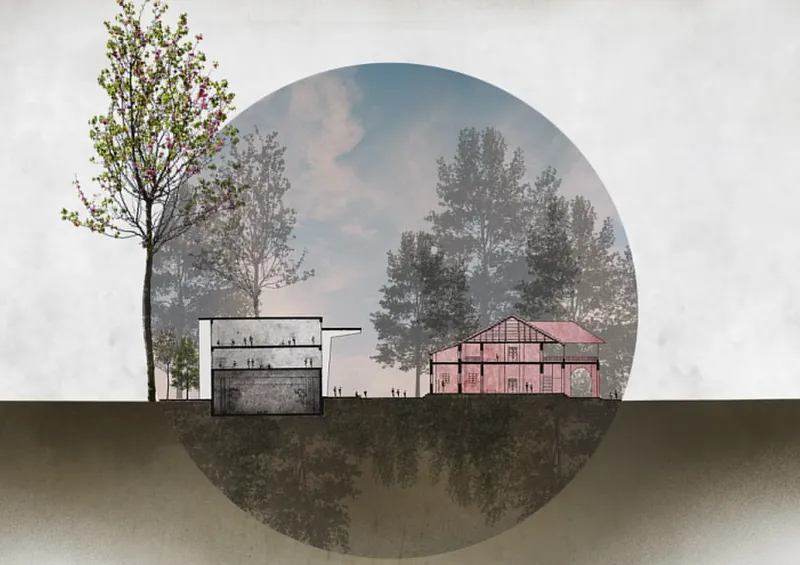
The paired sections make the relationship between new and old clear. In the first, a multi-storey block rises from a partly buried base, with stairs cutting through its height, so the building appears to settle into the ground instead of standing on it. In the second, a concrete volume sits next to a red pitched-roof building, with the two drawn at the same scale and given equal weight. The new work does not mimic the colonial vocabulary, and it does not overpower it either.
The presentation itself is worth noting. Each section sits inside a circular frame, with birds, tall trees and spring blossom. This is a deliberate graphic choice that places the civic building inside a landscape and a season rather than on a blank sheet. It supports the thesis claim that civic architecture should be read together with landscape and public space. The circle also softens the usual severity of a technical section, which suits a project about making institutions easier to approach.
Taking the Heritage Block Apart to Keep It
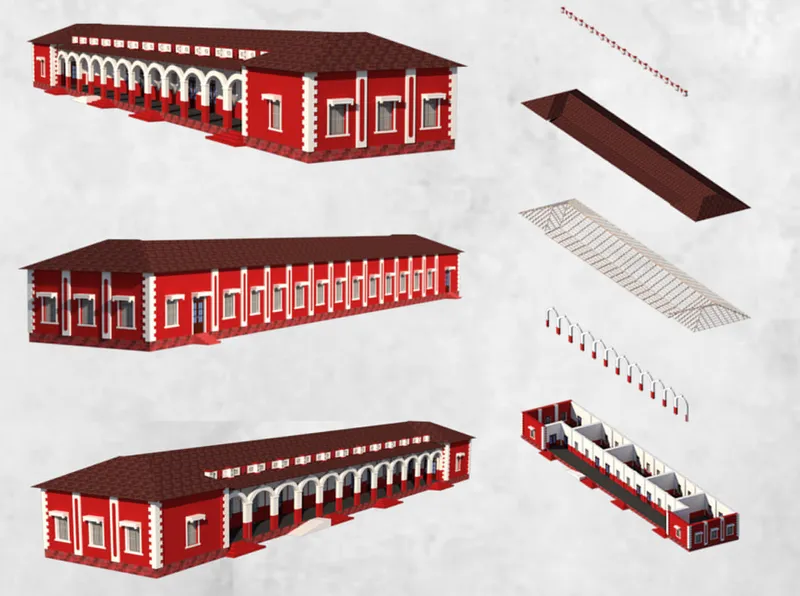
The axonometric studies treat the long red arcaded building as a structure to understand before reusing it. An exploded diagram separates roof, trusses, arches and floor plan into distinct layers. This shows the order of a colonial administrative building: a masonry base, a rhythm of arches, and a timber-trussed tiled roof above. The same reading underlies the decision to remove or repurpose the remaining structures. The source describes most existing rooms on site as small and poorly ventilated, with inadequate light, accessibility and workspace quality, so they are now unfit for public use.
Adaptive reuse is often claimed loosely. Here the exploded axonometric makes the claim testable. By isolating each layer, Mahabalshetti shows which parts of the building do structural and climatic work and which can take a new programme. That is the difference between preserving a facade and preserving a building.
Raised Volumes and a Leaf-Patterned Western Face
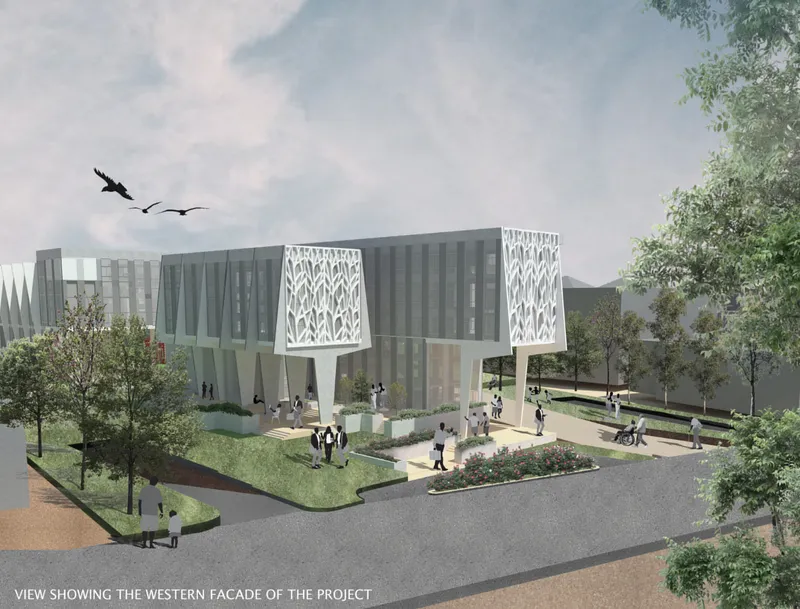
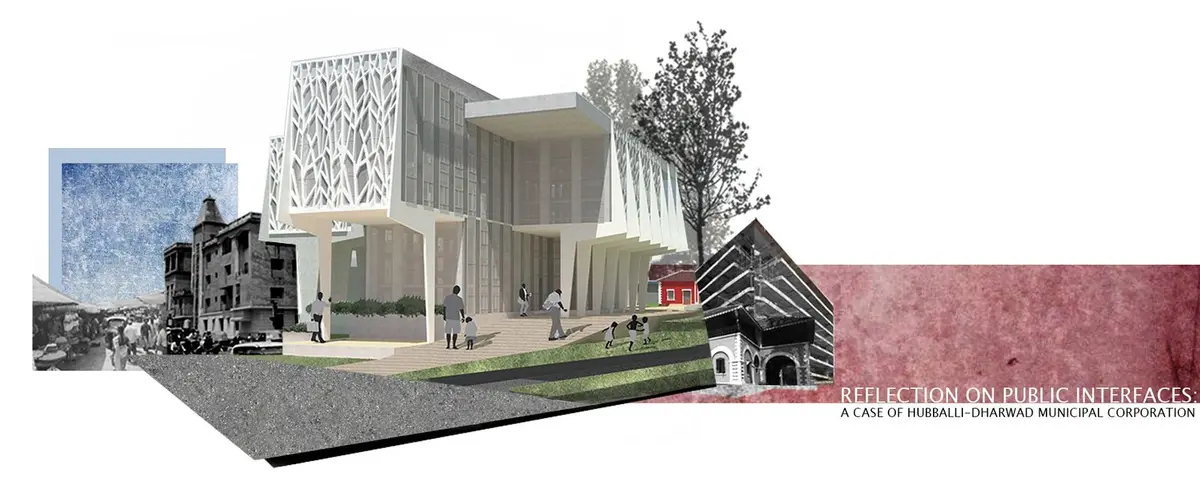
The western facade render shows the new civic architecture most fully. Volumes lift off the ground on slanted piers, leaving the lawns beneath them open, and the elevation is wrapped in panels with a leaf pattern. People occupy the grass below a cloudy sky. Raising the building frees the ground plane for the public, which directly supports the project's stated aim of a porous, transparent and accessible civic interface, the opposite of the closed compound it replaces.
The patterned panels on the western side carry the botanical motif from the drawings into the building itself, linking the new block to the trees and lawns around it. The slanted piers give the elevation a sense of movement that contrasts with the steady arcades of the heritage buildings. The new building stands on legs, while the old one sits on its masonry, and the space between the two is where the public is meant to gather.
Why This Project Matters
The thesis asks a direct question: can civic architecture shift the perception of power from government to people? Mahabalshetti answers spatially rather than rhetorically. She opens the ground, lifts the new volumes, keeps the colonial blocks that carry real history, and removes the rooms that only carry dysfunction. In a precinct crossed by bus corridors and roughly one lakh people a day, that redistribution of open space is a civic act in its own right.
The project stands out for treating heritage, landscape and governance as a single design problem instead of three separate briefs. Many student proposals for municipal buildings stop at the iconic object. This one starts from the figure-ground and works upward, and it presents its buildings in circular frames of trees, birds and blossom. Smaller Indian cities with their own aging administrative compounds would benefit from taking the same position: the town hall should be the place where the city pauses, not where it queues.
View the Full Project
About the Designers
Designer: Shreya Mahabalshetti
Enter a Design Competition on uni.xyz
uni.xyz runs architecture and design competitions year-round that reward proposals with spatial conviction and real site intelligence.
Project credits: Reflection on Public Interfaces: A Case of Hubballi, Dharwad Municipal Corporation by Shreya Mahabalshetti UnIATA 2019 (uni.xyz).


Popular Articles
Popular articles from the community


Aquadapt: An Underwater Habitat That Rewrites Its Rooms by the Hour
Curved modules ring the seabed while one shell shifts from breakfast room to cinema, farm and football pitch as residents' needs change.

Singing Woman: An Opera House That Performs Before the Curtain Rises
Ovidiu Cristian Pavel's conceptual opera house translates Estonia's choral identity into a sculpted waterfront landmark facing the Baltic Sea.

The Amber Palace Opera: A Geological Fiction Surfaces on Tallinn's Baltic Waterfront
Pierre Brillard reimagines a Baltic legend as a public landscape, opera house, and waterfront promenade rooted in Tallinn's coastal identity.


graciastudio Turns a Viewless Tijuana Lot Inward Around a Courtyard of Concrete, Timber and Trees
In Tijuana, Jorge Gracia's GA2 House stacks a timber-clad private floor over exposed concrete and replaces a missing view with a planted interior patio.

Similar Reads
You might also enjoy these articles
Healing Façade: A Modular Chapel System That Restores Ethiopia's Sacred Forests
Winner of the Eco-Chapel competition, this circular timber façade collects water from air to rebuild soil and reforest degraded Ethiopian landscapes.
Kaffeebühnen: Where Coffee Shop Architecture Becomes a Civic Stage in Vienna
A linear sequence of timber boxes, transparent shells, and open yards turns the Viennese café tradition into a public performance space.
Eco Chapel: A Modular Forest Pavilion That Grows Like the Landscape It Protects
Hexagonal timber modules weave through existing trees, turning a chapel into a living system for prayer, education, and reforestation.


Urban Forest: A Vertical Ecosystem for 5,000 Workers in Singapore's Changi Business Park
Radially stacked pods and layered green decks turn a 7-acre plot into 47 acres of ecological workspace projected for 2040.

Explore Civic Architecture Competitions
Discover active competitions in this discipline

Challenge to reimagine the Iron Throne

Photograph architecture without architects

Illustrate the lost glory of Angkor Wat - Render Challenge

Design challenge to reuse E-waste
Comments (0)
Please login or sign up to add comments
No comments yet. Be the first to comment!