

AP Valletta Shields an 18th-Century Maltese Palazzino with a Sculptural Softstone Screen
In Naxxar, Malta, a historic residence reclaims its privacy and Mediterranean identity against encroaching apartment blocks.


When high-rise apartment blocks began sprouting around an 18th-century palazzino in Naxxar, Malta, the building's garden and terrace lost their most essential quality: privacy. AP Valletta was brought in not to fortify the house but to reframe it, adding a perforated screen of Maltese softstone (franka) that works like a contemporary battlement. The screen is the headline move, but the deeper project is more subtle: a wholesale reconfiguration of a 500 m² residence that converts a former animal shelter into a living room, knits indoor and outdoor spaces together through a multi-tiered stone garden, and plants a green roof of native Mediterranean species on top.
What makes Naxxar House worth studying is its refusal to treat heritage and modernity as opposing forces. The screen wall is built by local craftsmen using traditional techniques, its undulating fins sculpted from the same regional limestone that constitutes the original fabric. It will develop a patina identical to the walls it extends. The architects describe their approach through the lens of scenography: light, scale, and perspective are calibrated to produce mood rather than mere compliance with a conservation brief. The result is a house that feels both fortified and porous, ancient and alert.
The Screen as Scenography
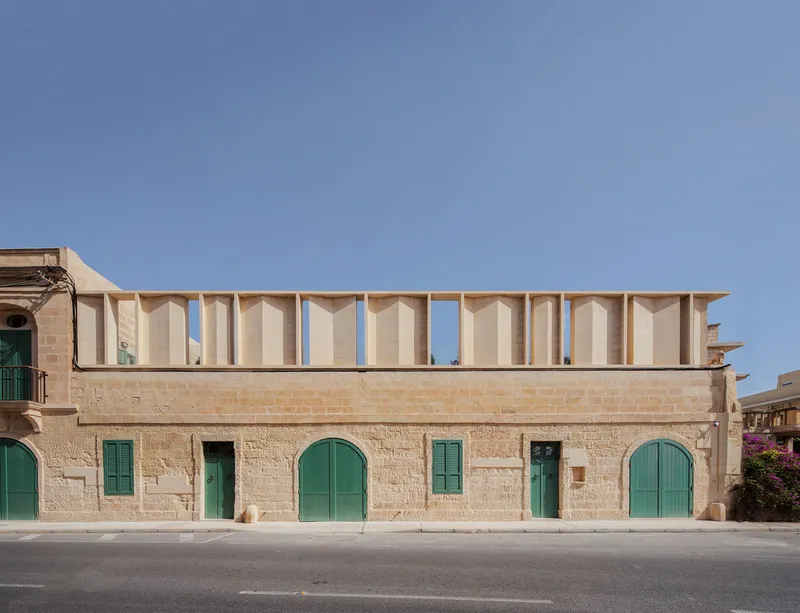

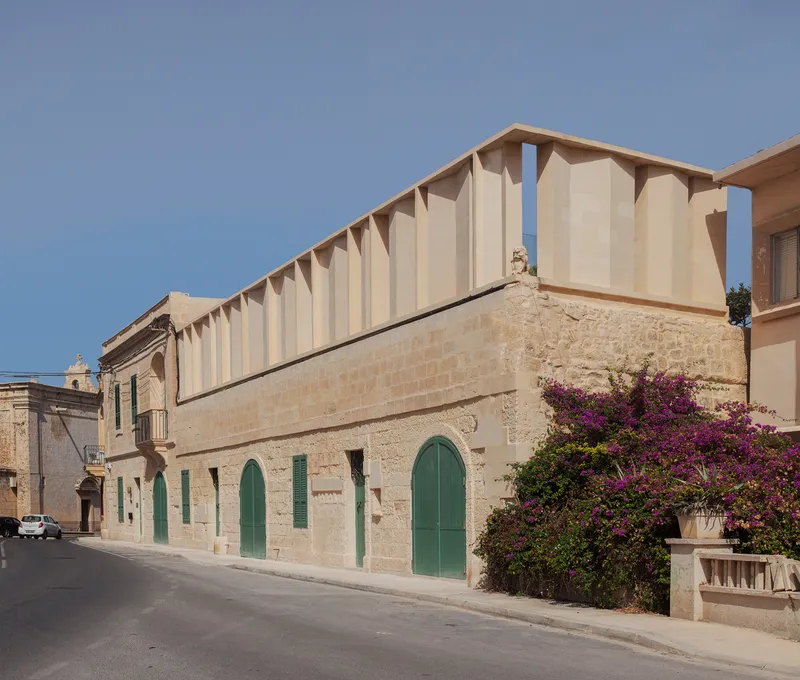
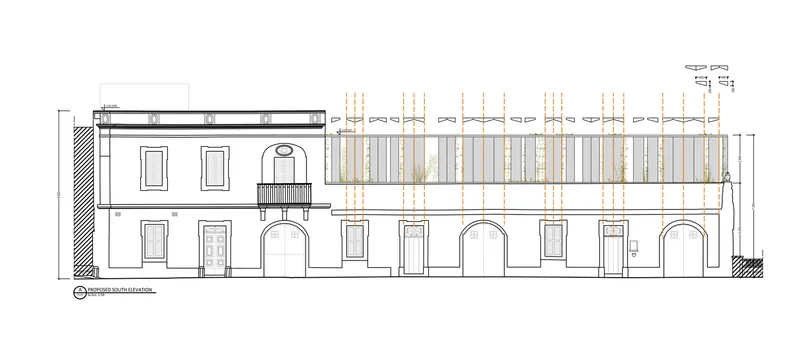
The privacy screen is the first thing you see from the street, and its reading changes with the light. During the day, the vertical limestone louvers appear solid, a series of tall folded walls replicating the rhythm of solid and void on the ground floor below. At dusk, the clerestory wall becomes almost translucent, the angled fins filtering amber light outward. AP Valletta conceived this element as scenographic, borrowing from theatrical staging techniques where the position of the viewer determines the image.
The variable angle and spacing of the fins do two things at once. They block sightlines from the surrounding apartment blocks, returning the terrace and garden to domestic life. And they introduce a constantly shifting play of light and shadow across the facade, giving the house a kinetic quality that a flat wall could never achieve. The timber colonnade that caps the roofline reinforces the layering, setting up a dialogue between the heavy mineral mass of the softstone and the lighter, warmer register of wood.
From Animal Shelter to Living Room
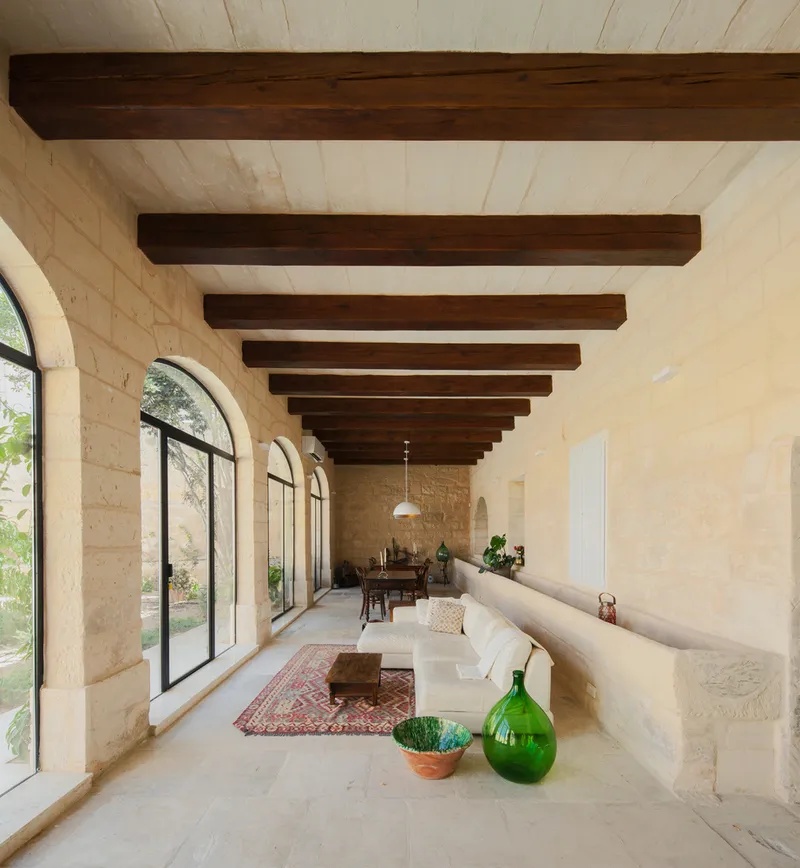
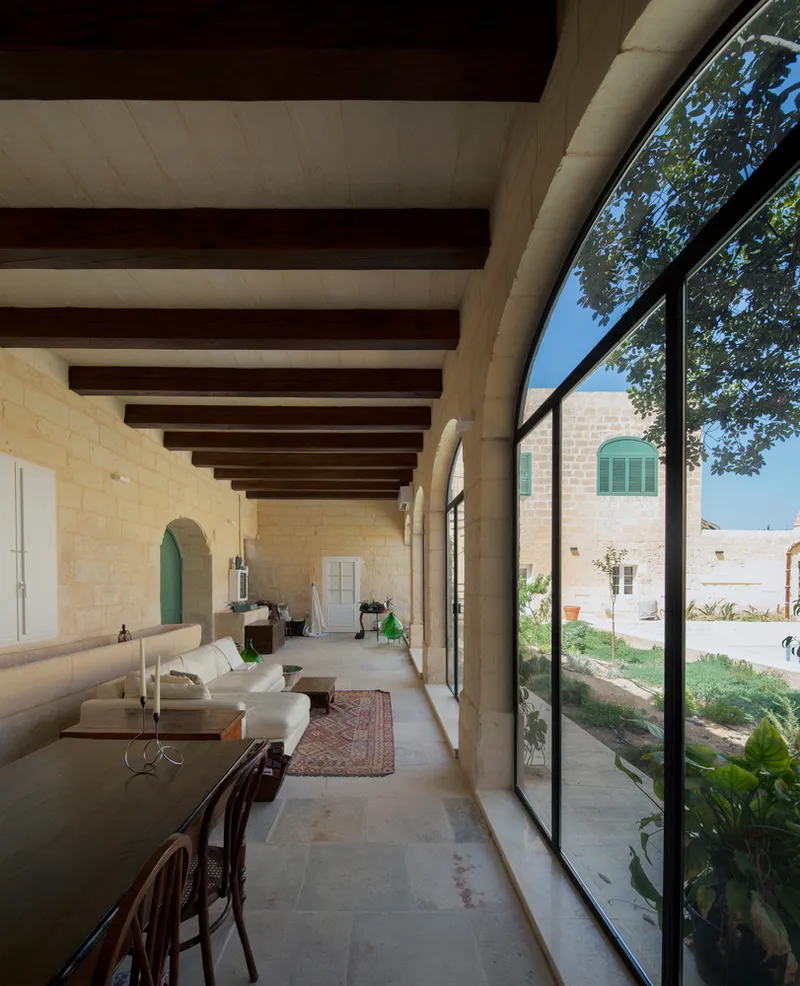
The loggia at the heart of the project was originally a farm structure where animals were sheltered. AP Valletta gutted the programmatic assumption but kept the bones: exposed timber beams span the full width, and arched openings on both sides connect the space to the courtyard and the main house. Full-height glazing on the garden side dissolves the boundary between inside and out, turning what was once a utilitarian enclosure into the most generous room in the house.
A second garden room was converted into a guest studio, further extending the habitable footprint without adding new volume. The strategy is one of reinterpretation rather than expansion. Every space in the original palazzino is asked to do something new, but nothing is demolished. Reclaimed traditional stone floor slabs were reintegrated throughout, reinforcing the material continuity that anchors the project.
The Pool Garden and Multi-Tiered Landscape
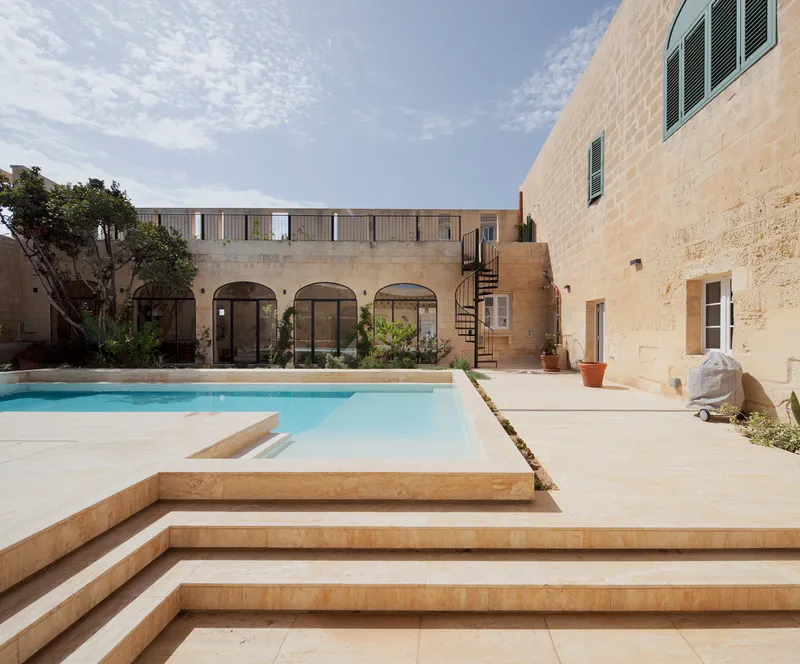
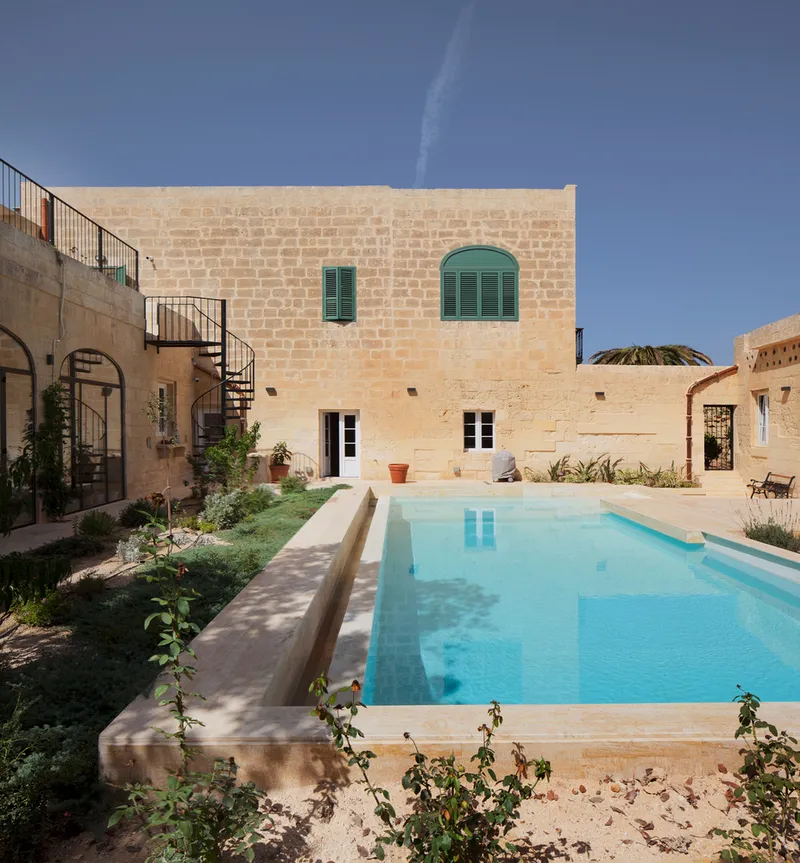
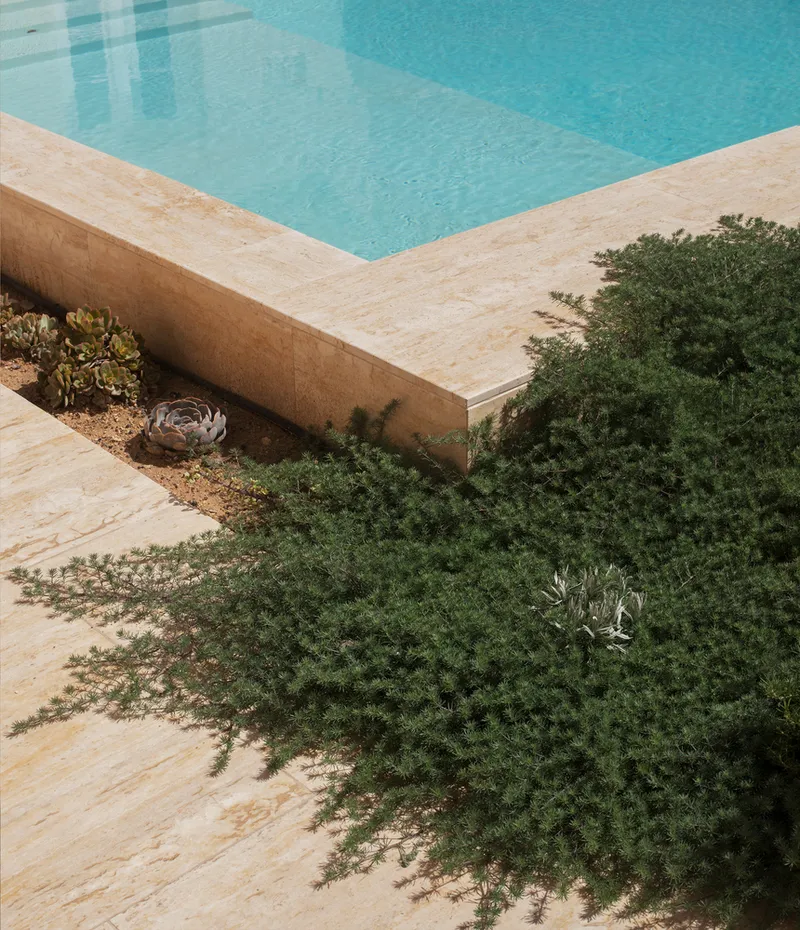
The courtyard pool is framed by old stone walls and Mediterranean fruit trees, its limestone coping flush with the surrounding paving. Horizontal and vertical stone planes emerge from the existing garden in tiers, creating a landscape that reads as geological rather than designed. Low ground-cover planting between paving joints softens the edges without cluttering the composition.
AP Valletta treats the garden not as leftover space but as a room without a ceiling. The arched colonnade beyond the pool extends the architectural language of the house into the landscape, while the limestone steps double as seating. The effect is a space that can accommodate a dinner party or a solitary swim with equal ease, the old stone walls providing a sense of enclosure that the surrounding apartment towers cannot disrupt.
Rooftop and Vertical Circulation
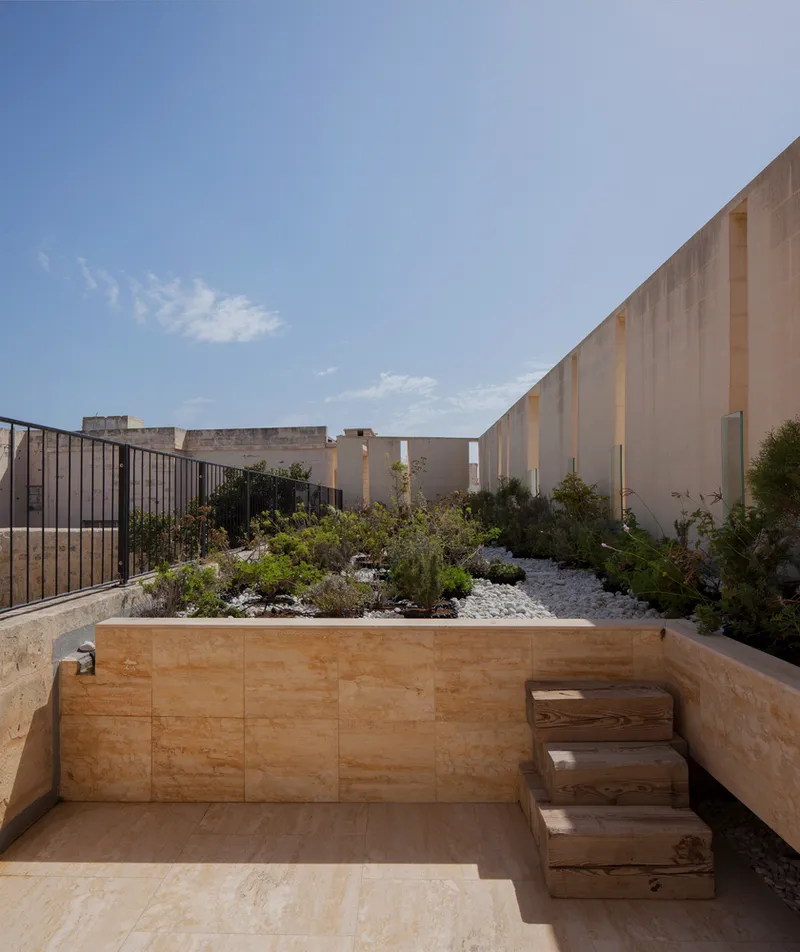

A spiral steel staircase connects the courtyard level to the roof terrace, its tight geometry threading between arched openings and planted beds. The staircase is the one overtly industrial element in the project, and its frankness is welcome. It signals that this is a working house, not a museum piece.
The roof terrace itself is protected by the timber colonnade parapet and planted with raised beds of native Mediterranean species. The green roof serves a dual purpose: it insulates the rooms below from Malta's intense summer heat, and it provides a habitat layer that connects the house to the island's ecology. From this vantage point, the screen wall reads as a crown rather than a barrier, its fins silhouetted against the sky.
Plans and Drawings
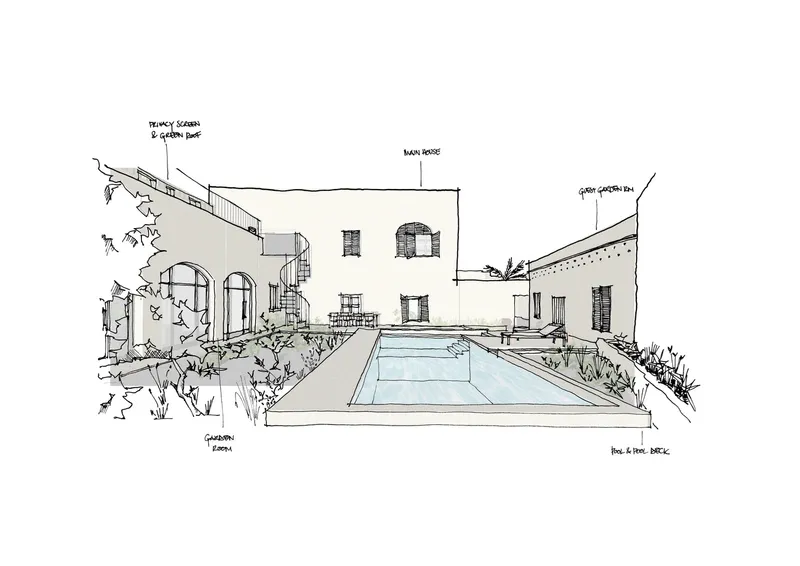

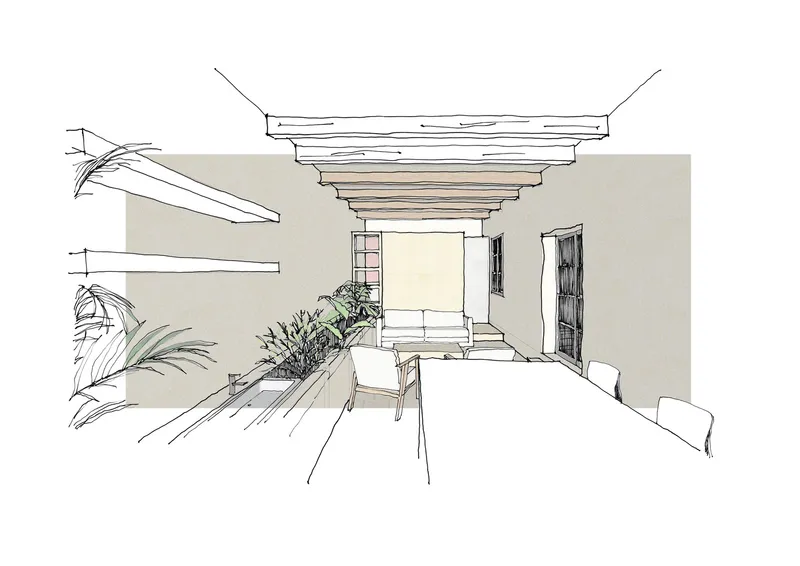
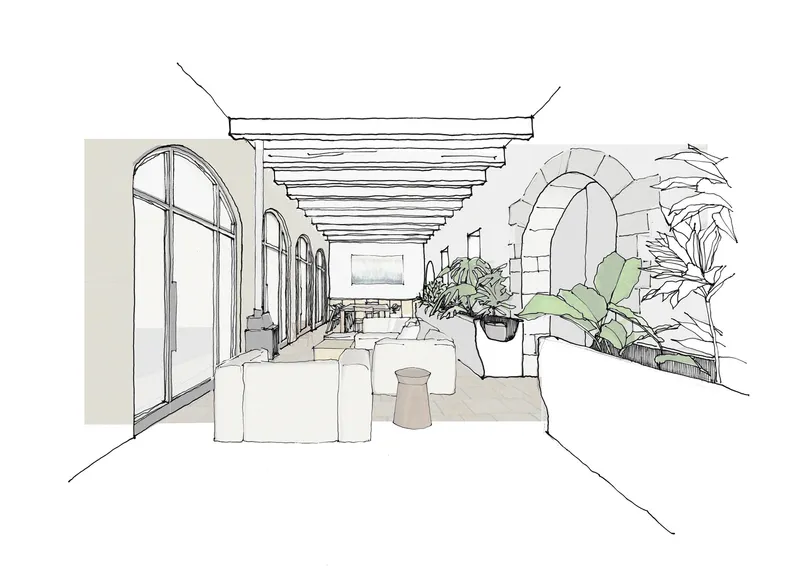


The perspective sketches reveal the architects' scenographic thinking in its purest form. Each drawing is composed like a stage set, with layered planes of stone, planting, and timber framing views through the house. The courtyard sketch showing the pool, spiral stair, and surrounding volumes makes legible the project's spatial logic: a sequence of outdoor rooms connected by thresholds rather than corridors.
The section through the green roof and screen wall is especially instructive. It shows the waterproofing layers, the depth of the planting substrate, and the precise relationship between the screen's fins and the terrace floor. The elevation drawing of the two-story facade with its arched openings and rooftop screening structure confirms how carefully the new intervention aligns with the proportional system of the original palazzino. Nothing is arbitrary; every dimension is calibrated to an existing rhythm.
Why This Project Matters
Naxxar House addresses a problem that is becoming common across the Mediterranean and beyond: how do you protect a low-rise historic property when the neighborhood around it densifies aggressively? AP Valletta's answer is neither nostalgic nor confrontational. The softstone screen is built from the same material and by the same methods as the original walls, so it will age into the building rather than away from it. The design grows from the house's character and from the architecture of adjacent historic defensive towers, grounding a contemporary intervention in centuries of local precedent.
More broadly, the project demonstrates that heritage refurbishment does not have to mean freezing a building in time. The loggia conversion, the green roof, the reclaimed stone floors: each move adds contemporary performance to an 18th-century structure without erasing its history. AP Valletta has produced a house that is simultaneously a careful restoration and a quiet provocation, proof that traditional construction methods can engage with the future as convincingly as they recall the past.
Naxxar House by AP Valletta. Located in Naxxar, Malta. 500 m². Completed in 2023. Photography by Julian Vassallo.
About the Studio
Share Your Own Work on uni.xyz
If projects like this are the kind of work you want to make, uni.xyz is a place to publish your own, find collaborators, and enter design competitions.




Popular Articles
Popular articles from the community


The Earth Pod: 3D Printed Homes for Resilient Refugee Communities
The Earth Pod reimagines refugee housing through 3D printed homes made from clay, combining resilience, self-sufficiency, and rapid shelter.

EW PARK: Sustainable Architecture Reimagines the Future of Urban Parking
EW PARK reimagines city parking as a modular wooden tower combining automation, solar energy, electric mobility, and adaptable urban design.

Co-life: Sustainable Architecture for Age-Friendly Community Living
Co-life reimagines sustainable architecture for seniors through courtyards, rammed earth, shared gardens, and spaces designed for belonging.

Conexión: Biophilic Design Reimagines High-Rise Living in Hong Kong
Conexión reimagines high-rise living in Hong Kong through biophilic design, green facades, shared spaces, daylight, water and nature within.


Similar Reads
You might also enjoy these articles


Hodi-Mandai Geram
Project Function: Preservation and revitalization of the Intangible heritage and socio-spatial identity of the Hodi by Housing, Cultural Memory Center, Sacred Grove, landscape, local tourism economy


Olio Towers: A Mid-Rise for Performers That Fuses Housing, Rehearsal, and Stage
Located blocks from Houston's Theater District, this modular tower stacks living units around a central performance atrium.

Oasis: Modular Green Housing Carved into Dhaka's Urban Fabric
A shortlisted Plugin Housing entry reclaims unauthorized settlements in Dhaka with stepped concrete volumes, green roofs, and ventilation-driven design.

Black Hole: A Floating Megastructure for the Post-Physical Era
Emiliano Mazzarotto envisions a spherical, self-scaling arena where e-sports, digital hotels, and holographic stadiums replace traditional public space.


Explore Architecture Competitions
Discover active competitions in this discipline



Challenge to reimagine the Iron Throne


Photograph architecture without architects


Illustrate the lost glory of Angkor Wat - Render Challenge


Design challenge to reuse E-waste
Comments (0)
Please login or sign up to add comments
No comments yet. Be the first to comment!