
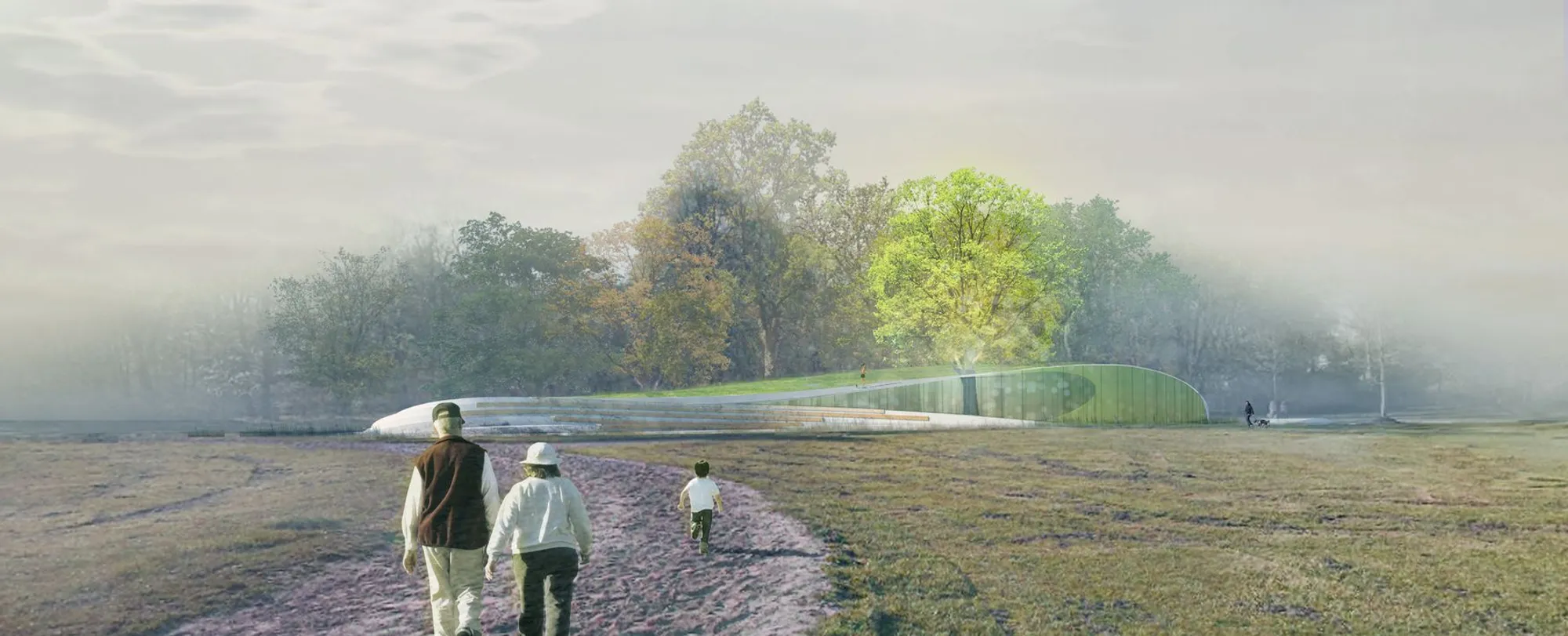
Back to Earth: A Senior Activity Center That Grows from the Landscape
A belt-like building weaves through existing trees, using gentle topography and biophilic design to reconnect the elderly with nature and community.


What if the best way to care for aging populations isn't to build facilities for them, but to build landscapes that pull them back into the life of a city? "Back to Earth" takes that premise seriously. The proposal reshapes the senior activity center from an institutional typology into a continuous, belt-like form that threads through a wooded site, preserving every existing tree while generating a series of sloped gathering spaces, amphitheaters, and interior gardens designed to spark intergenerational contact.
Designed by Xianrong Lan, He Peter, Zhiliang Yu, and Kunmao Yu, the project was shortlisted in the Huddle competition. The brief called for rethinking how communal architecture can address social isolation, and this team responded with a scheme rooted in three kinds of linkage: linking paths, linking nature, and linking society. Set within an established park landscape, the design refuses to clear the site. Instead, it treats the existing tree canopy as the primary structure around which architecture must negotiate its presence.
Soft Topography as Social Infrastructure
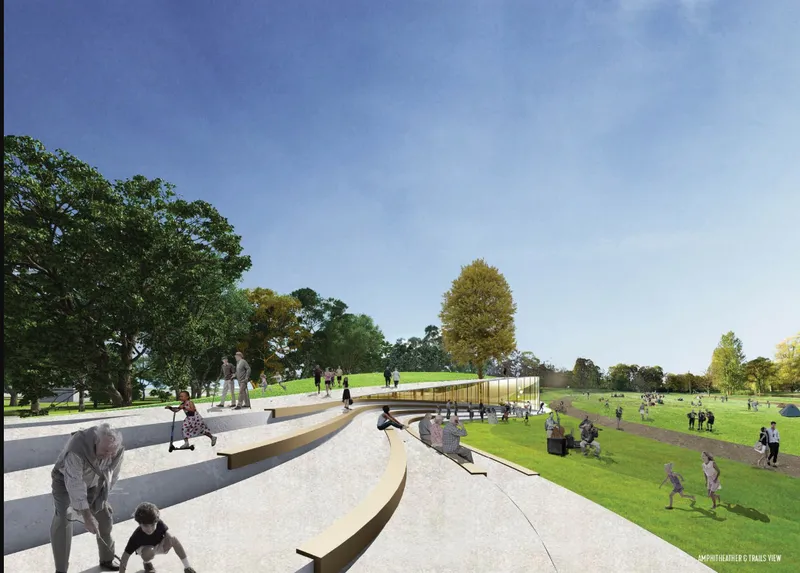
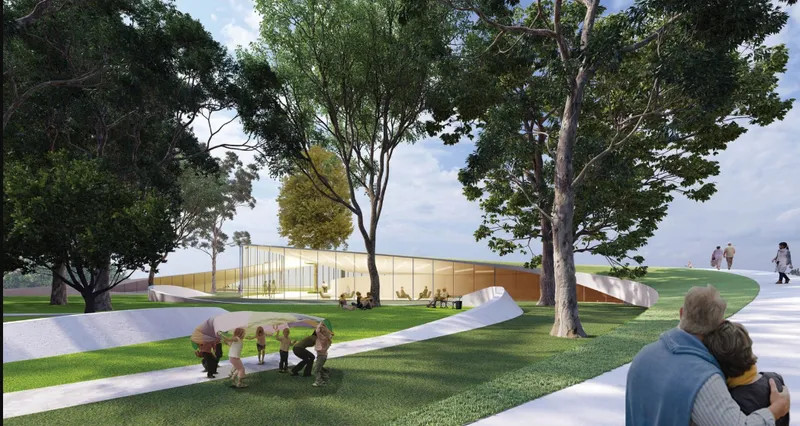
The amphitheater steps visible in the opening image are not decorative. They are the project's primary social mechanism: tiered concrete surfaces that descend gently into the park, creating zones where children can run, elders can sit, and families can gather without anyone being assigned a specific program. The soft-edged slopes replace the rigid zoning typical of senior centers with a topographic fluidity that accommodates everything from group celebrations to private reflection. Beyond the amphitheater, a long, low pavilion with a translucent golden facade sits among mature trees on a green lawn, its horizontal profile deliberately deferring to the tree canopy above.
The concept of "LINK" operates at every scale. Pedestrian paths flow through the building rather than terminating at its edges, so the architecture acts as a connective tissue for the larger park network. Sloped circulation paths ensure accessibility for all ages and mobility levels, while curated sight lines between interior and exterior spaces keep parents and grandparents visually connected to children playing in woodland playgrounds nearby.
Glazed Pavilions Embedded in Terrain
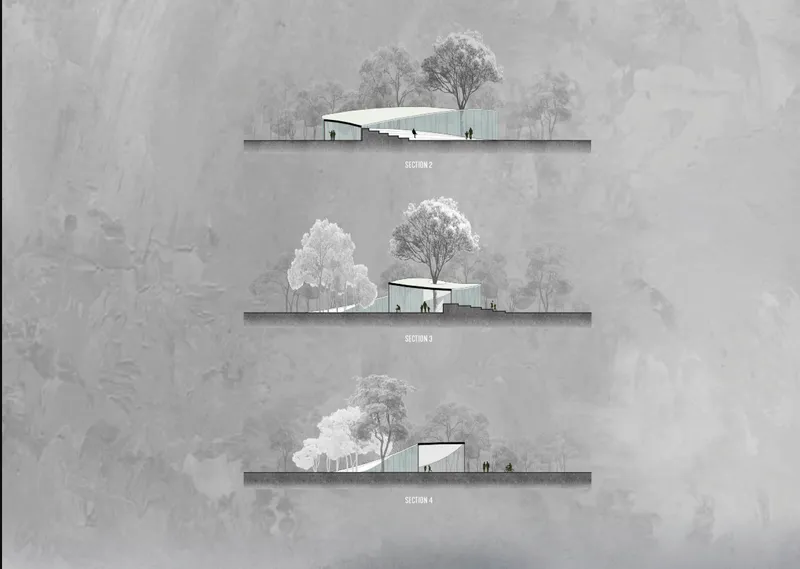
The section drawings reveal the project's most consequential move: three glazed pavilions partially buried into the sloping terrain, with trees growing above and around them. Rather than sitting on the ground, the architecture merges into it. A roof trail extends walking opportunities into the vertical plane, turning the building's upper surface into a continuation of the park. Below, operable curtain walls provide seasonal flexibility, opening interiors fully to the landscape in warm months and enclosing them during colder periods. The result is a building that breathes with its site rather than imposing upon it.
Tree Trunks Through the Ceiling
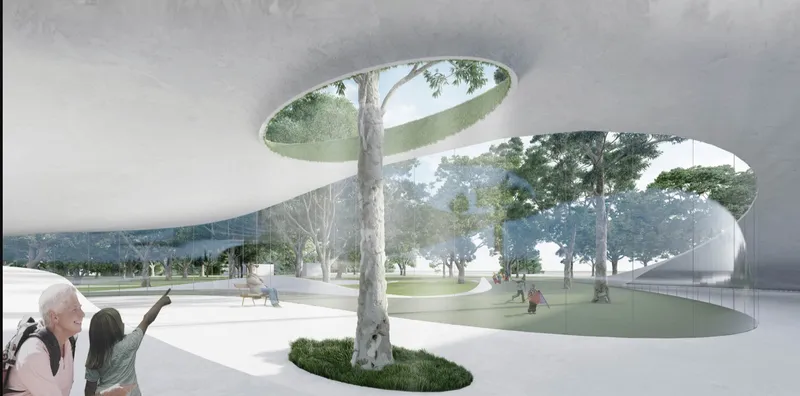
The interior view is striking. Circular skylights frame tree trunks that penetrate white, curved ceiling planes, so the distinction between inside and outside dissolves at the most literal level. This is biophilic design operating not as an applied aesthetic but as a structural commitment: the building was designed around these trees, not the other way around. A flexible interior garden creates visual and physical continuity with the surrounding woodland, offering elderly visitors the emotional well-being benefits of daylight, greenery, and natural ventilation without requiring them to navigate rough outdoor terrain.
A Lantern in the Park at Dusk
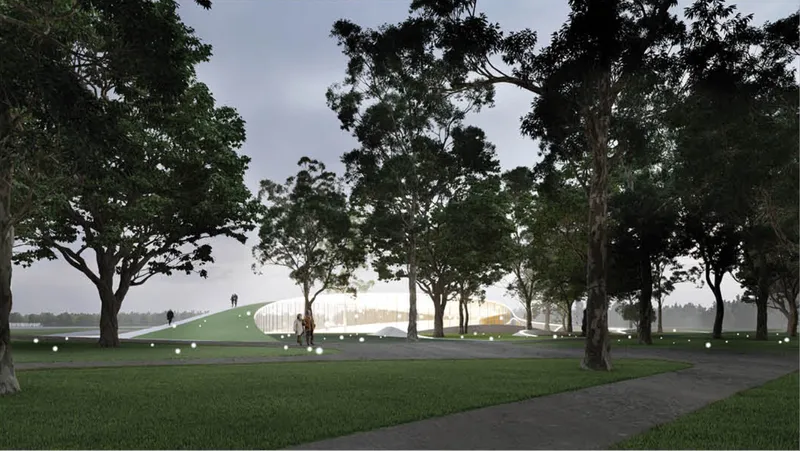
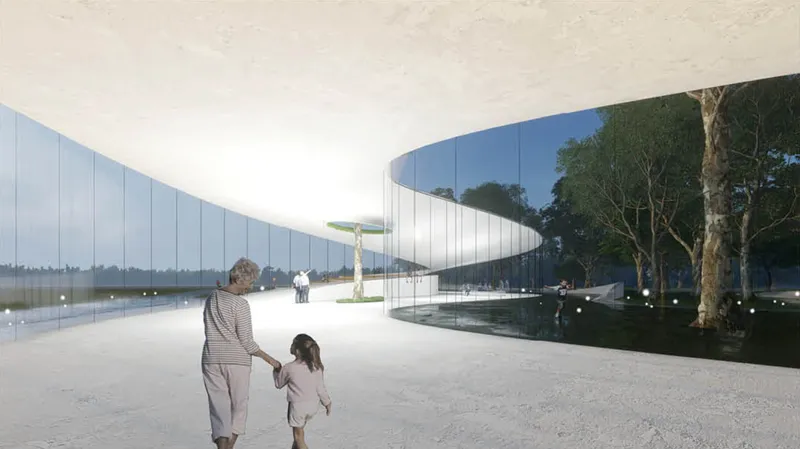
At twilight, the pavilions transform. The glass facades glow among the mature trees, ground lights dotting the lawn like constellations. The curving reflective glass wraps around existing trunks, creating a visual dialogue between the solidity of the trees and the transparency of the architecture. Visitors walk on white paving that reads as a continuation of the interior floor, further blurring thresholds. The nighttime imagery is more than atmospheric; it demonstrates that this is a place designed to be used across the full arc of a day, extending the social hours of a park that might otherwise empty after sunset.
The designers ground the project in a cultural observation: in traditional Chinese families, elders hold deep emotional and social significance, but modernization has diluted that role, leaving many seniors isolated. "Back to Earth" proposes architecture as a remedy. By creating spaces where intergenerational encounter happens naturally, through shared slopes and transparent boundaries rather than programmatic mandates, the building encourages empathy as a spatial condition rather than a policy directive.
Why This Project Matters
Senior centers are too often designed as warehouses for a demographic category. They separate the elderly from the rhythms of urban life under the guise of specialized care. "Back to Earth" rejects that premise entirely. Its belt-like form, its preservation of every existing tree, its sloped amphitheaters and operable walls all serve a single argument: that the best architecture for aging populations is architecture that refuses to segregate them. The building is a piece of park infrastructure, not a facility dropped into a park.
What makes this entry particularly compelling within the Huddle brief is its restraint. The team did not reach for spectacular form or parametric complexity. They built the project's logic around what was already there: the trees, the topography, the pedestrian network, the daily patterns of families using a public park. The result is a proposal that feels both inevitable and generous, a kind of architecture that heals by getting out of its own way.
View the Full Project
About the Designers
Designers: Xianrong Lan, He Peter, Zhiliang Yu, Kunmao Yu
Enter a Design Competition on uni.xyz
uni.xyz runs architecture and design competitions year-round that reward proposals with spatial conviction and real site intelligence.
Project credits: LINK by Xianrong Lan, He Peter, Zhiliang Yu, Kunmao Yu Huddle (uni.xyz).




Popular Articles
Popular articles from the community


Riyadh For All: Intergenerational Urban Design for Active Aging in Rabat
Riyadh For All reimagines urban design in Rabat with intergenerational co-living, adaptive courtyards, and Moroccan cultural exchange today.

Hill & Cross Opera: Sculptural Opera House Architecture Shaped by Tallinn’s Landscape and Identity
Hill & Cross Opera reimagines opera house architecture in Tallinn through its sculptural hill, civic plaza, glass wave and a luminous cross.

Co-life: Sustainable Architecture for Age-Friendly Community Living
Co-life reimagines sustainable architecture for seniors through courtyards, rammed earth, shared gardens, and spaces designed for belonging.

The Musturak Paradise: Senior Living Architecture for a Connected Future in Temara, Morocco
The Musturak Paradise reimagines senior living architecture in Temara via private homes, social spaces, culture, community, and shared care.
Similar Reads
You might also enjoy these articles

Day and Night Park: A Time-Based Urban Newsstand in Beijing
A temporary urban newsstand in Beijing blending travel, light, and reading through poetic colors, compact form, and community-focused design.

Modernist Patio Renovation in El Masnou, Barcelona by Oliver Segura Arquitectura + Cebrià Arquitectura
Modernist patio renovation blending tradition and innovation with a movable pool, leveled floors, and Catalan materials in El Masnou.

Alto Residencial Coop: Cooperative Housing Development in Santiago de Compostela by Carbajo Barrios Arquitectos
A linear cooperative housing complex blending white volumes and perforated metal façades, enhancing community living, natural light, privacy, and urban integration.
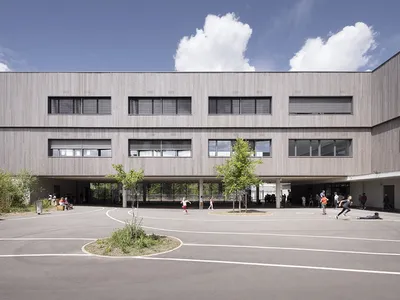
Vil Genis School by BPA ARCHITECTURE – Massy, France
Vil Genis School in Massy, France, features sustainable design, south-facing classrooms, community integration, accessible spaces, and modern educational architecture.



Comments (0)
Please login or sign up to add comments
No comments yet. Be the first to comment!