
REIMS 502 Stacks a Pink Commercial Building Around Courtyards and Vaults in Querétaro
A pandemic-era commercial building in Santiago de Querétaro layers brick vaults, steel staircases, and perforated screens across a narrow urban lot.


On a tight lot in Santiago de Querétaro, REIMS 502 has built a commercial building that refuses to behave like one. ROSADOCE, completed in 2024, is a four-level structure that trades the sealed glass box of retail convention for something far more porous: brick vaults, perforated block screens, timber ceilings, planted courtyards, and a rooftop terrace capped with twin barrel arches. Designed during the pandemic by Eduardo Reims Hernández and Andrea Maldonado Verduzco, the project is explicitly a rethinking of what commercial space can feel like when air, light, and vegetation are treated as non-negotiable elements of the program.
What makes it genuinely interesting is how much architectural ambition is packed into just 840 square meters on a sliver of land wedged between neighbors. Rather than stacking identical floor plates, REIMS 502 organizes the building as a vertical sequence of distinct atmospheres connected by a sculptural red steel staircase that threads through the section like a spine. Each level has its own material character and its own relationship to daylight, whether filtered through horizontal brise-soleil louvers, perforated block walls, or the open sky of the rooftop garden. The result reads less like a single building and more like a small vertical neighborhood.
A Layered Facade That Earns Its Color
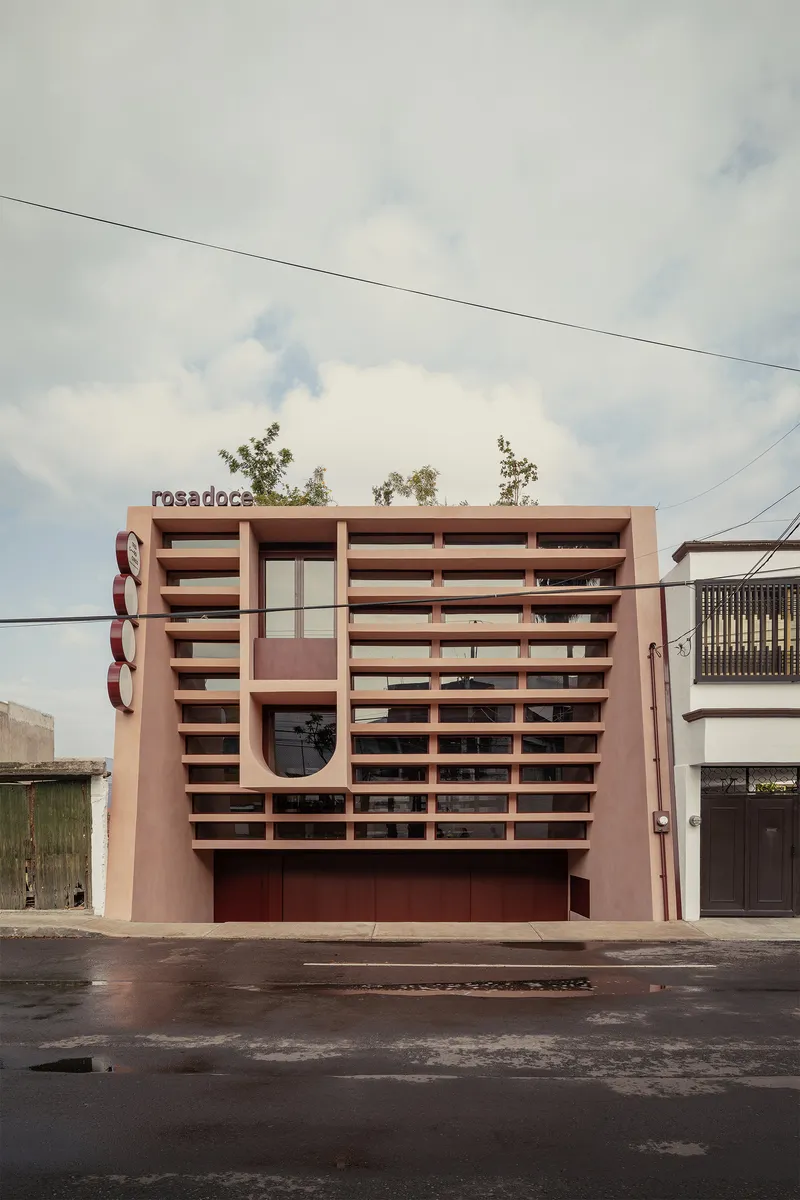
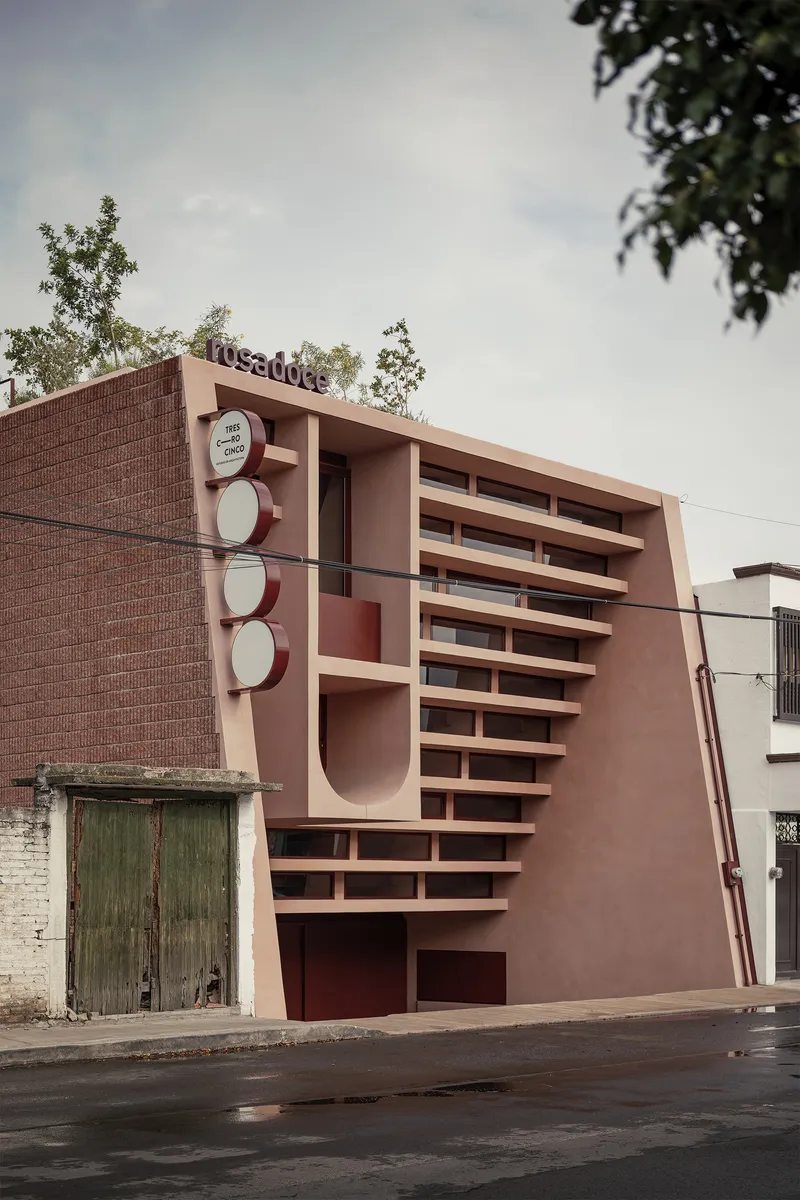
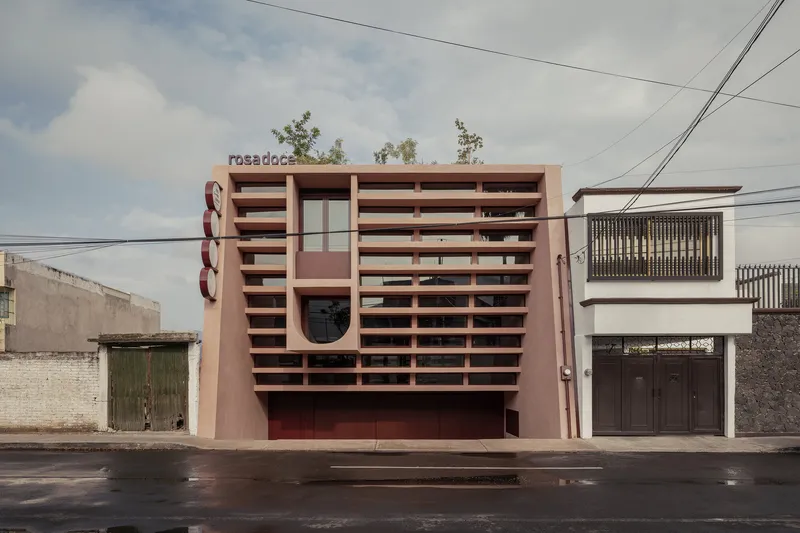
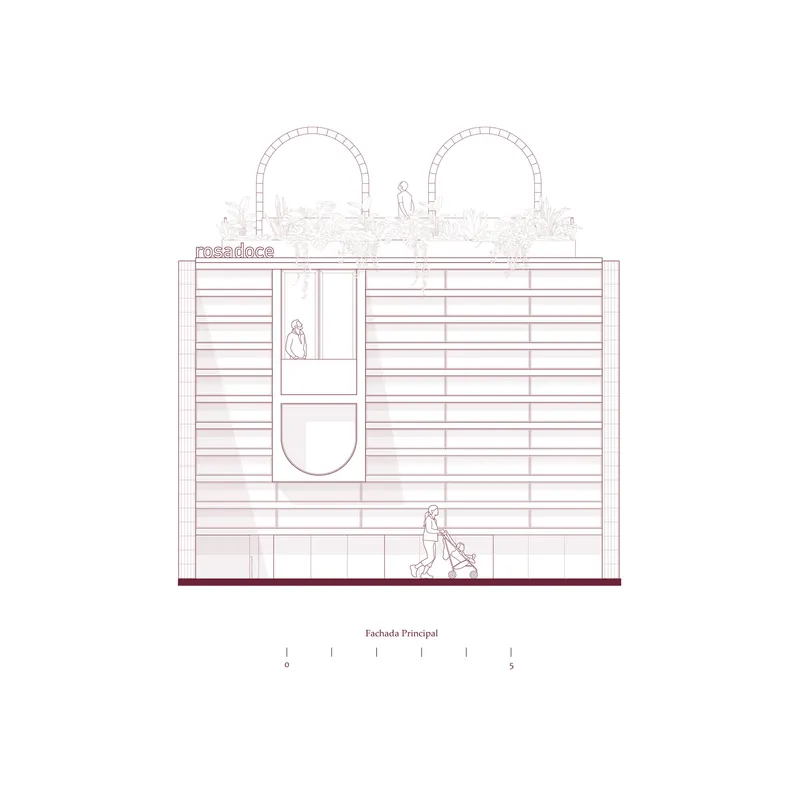
The street elevation is the building's calling card, and it works hard. Horizontal louvers in terracotta and pink tones wrap the facade in a brise-soleil screen that manages solar gain while giving the building a warm, striated presence against an otherwise unremarkable residential streetscape. The pink stucco beneath, punctuated by circular motifs, plays well against a flanking brick wall, grounding the contemporary composition in a material palette that feels regional rather than imported.
Critically, the louvers are not decorative. On a west-facing facade in central Mexico, they are doing real work. The layering of screen, stucco, and glazing behind creates a thick facade section that buffers interior spaces from direct sun while still allowing generous views out. It is a straightforward climate strategy executed with enough formal discipline to double as the building's identity.
The Red Steel Spine
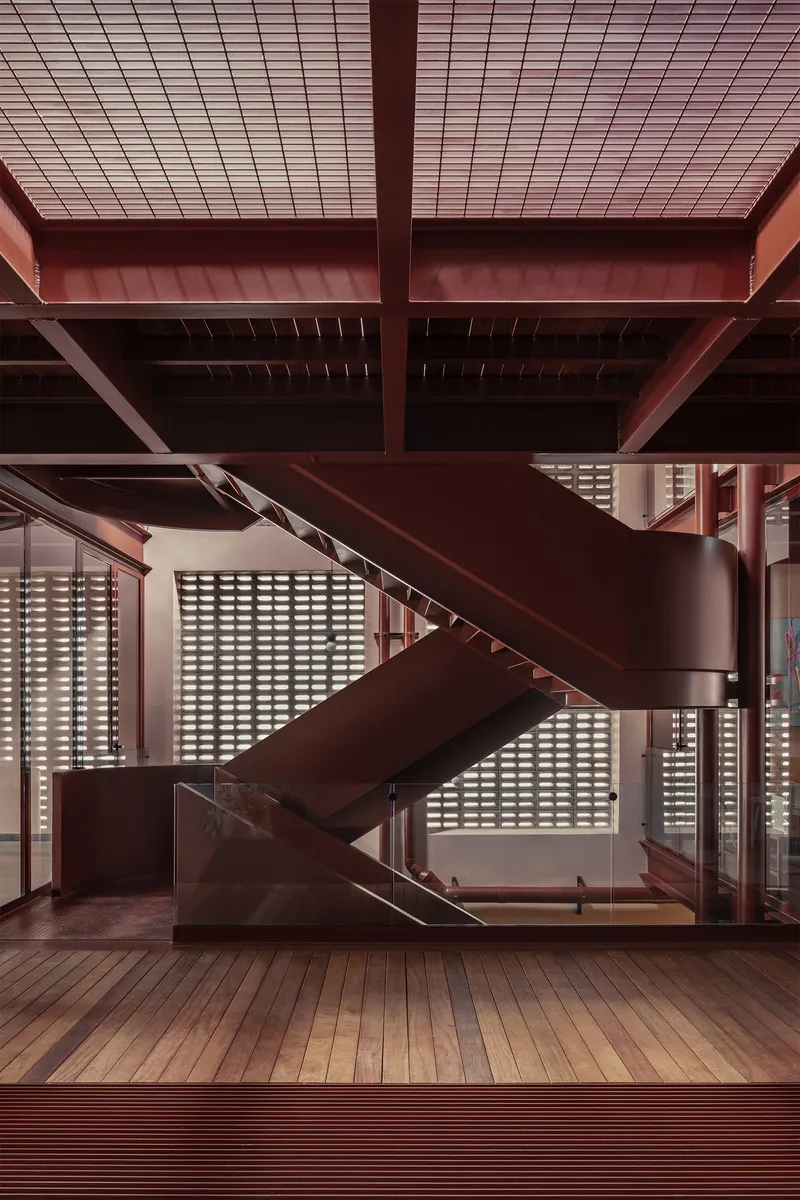
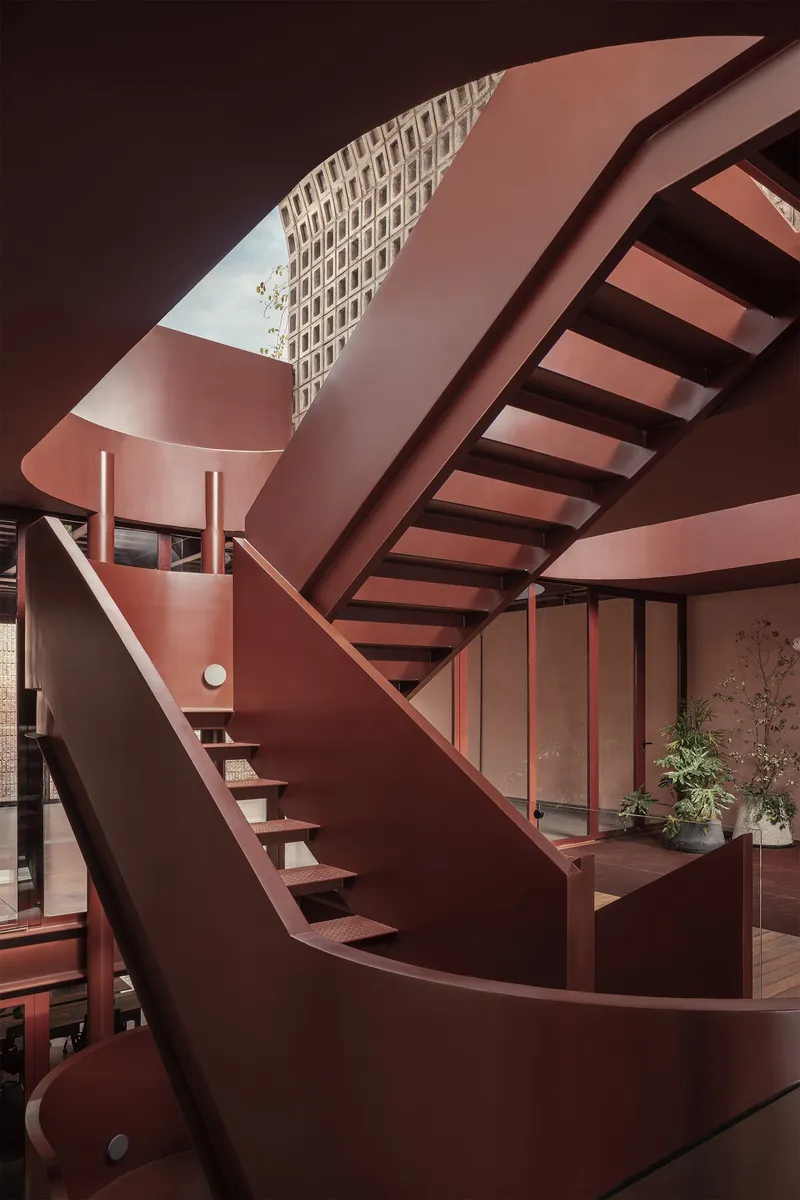
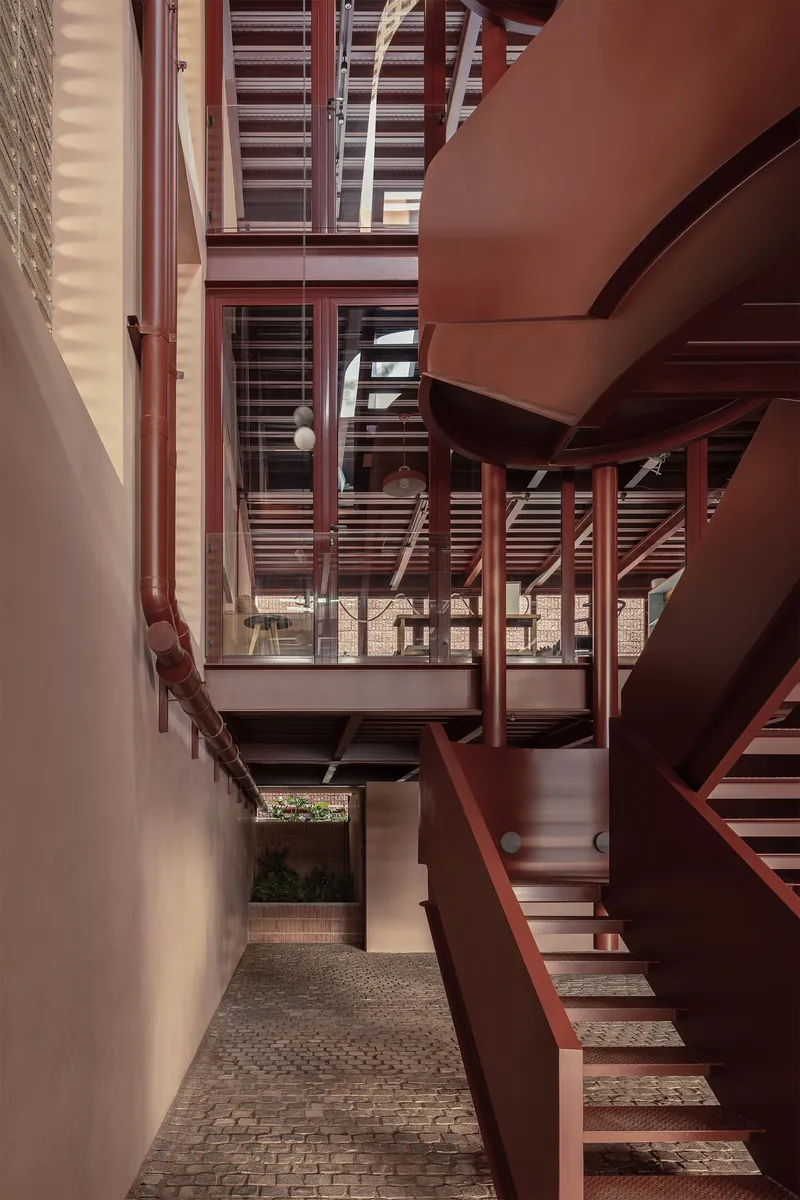
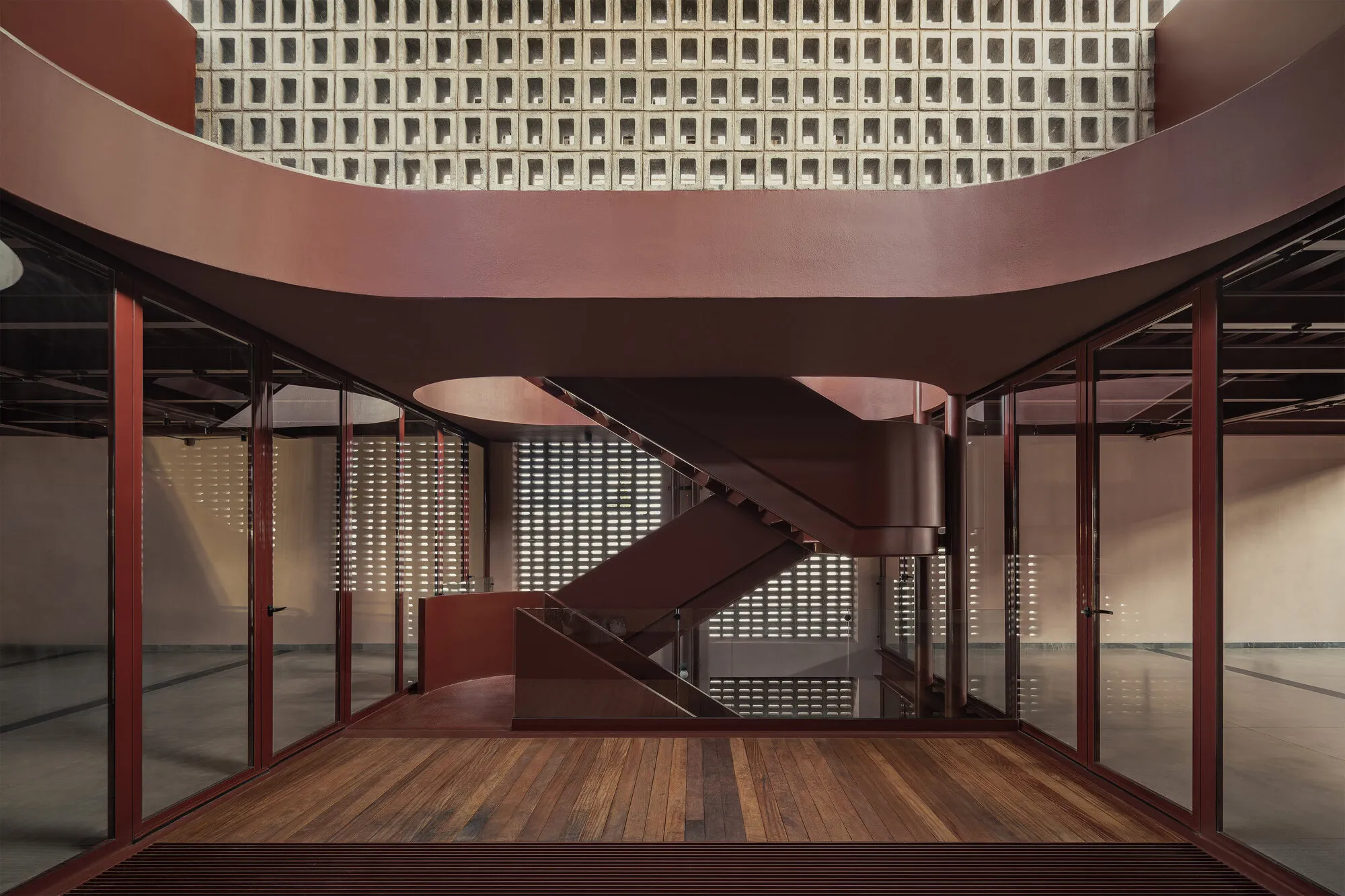
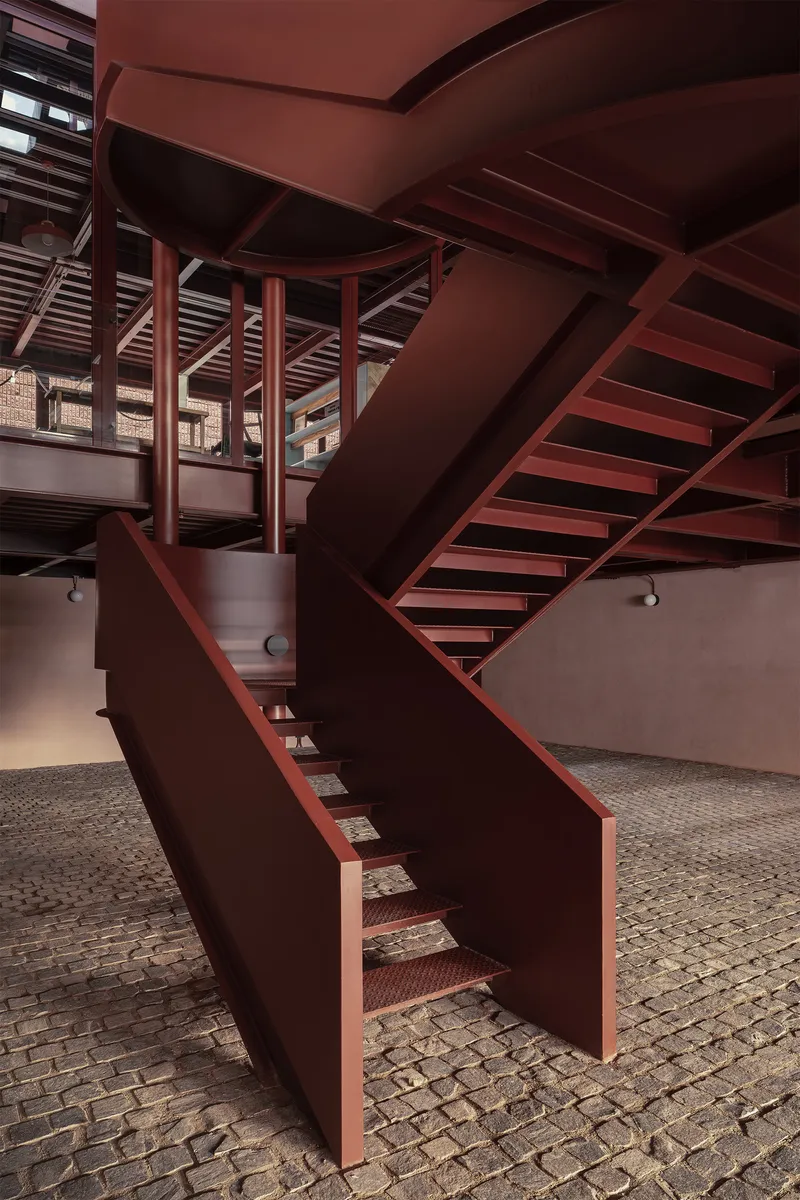
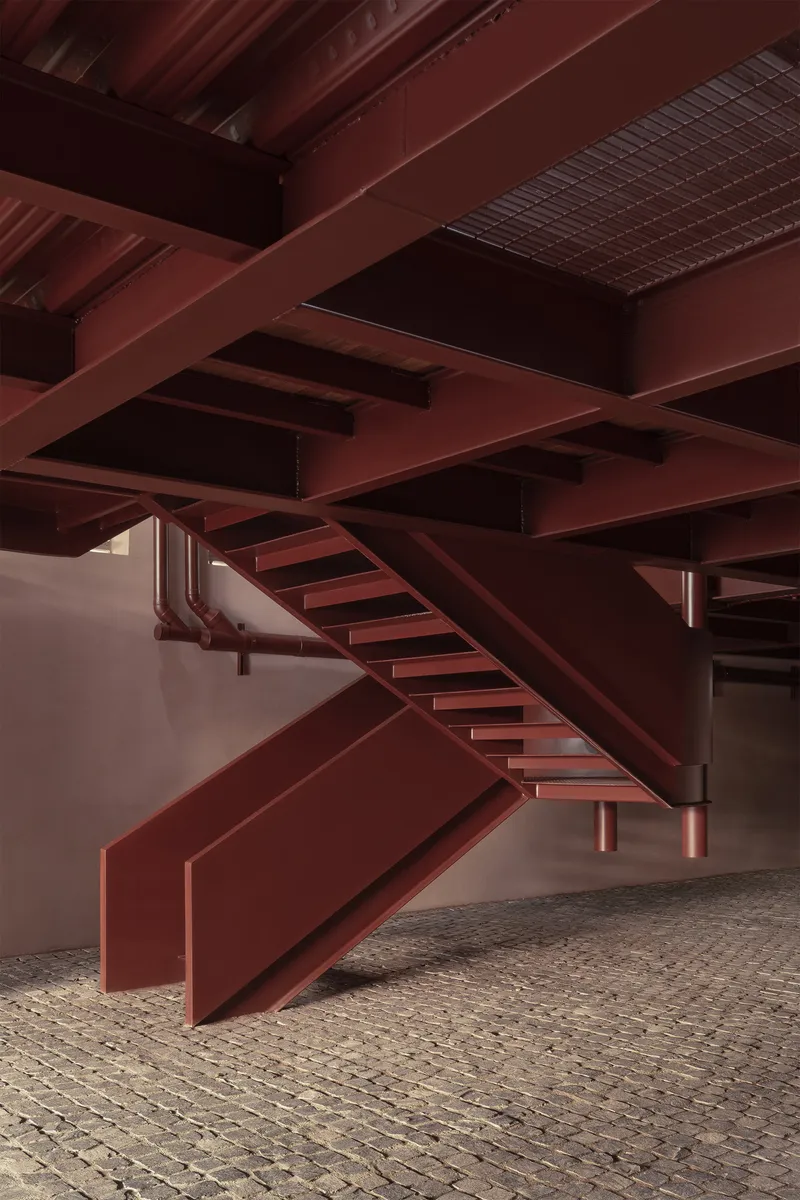
The vertical circulation is the most visually assertive element in the building. A series of red-painted steel staircases with open risers and solid balustrades climb through the section, connecting all four levels and linking interior rooms to exterior courtyards and bridges. Against the muted tones of perforated block and timber, the red steel reads as a deliberate counterpoint: loud, structural, and unapologetically legible.
The staircases are not tucked away in a core. They occupy central and courtyard-facing positions, framed by skylights and slatted screens so that movement through the building becomes a curated experience of changing light conditions. Ascending from the cobblestone ground floor through the perforated brick shaft to the open sky above, you register each level as a distinct place rather than a repeated floor.
Courtyards as Program
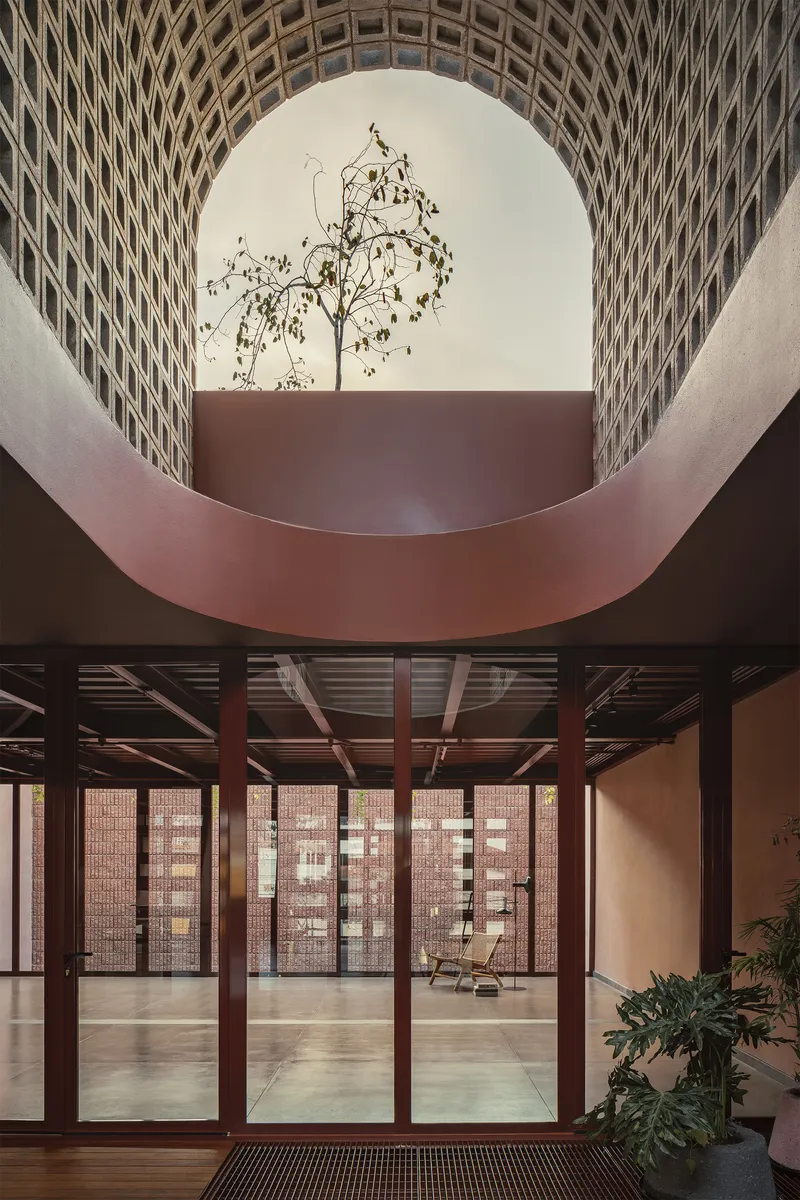
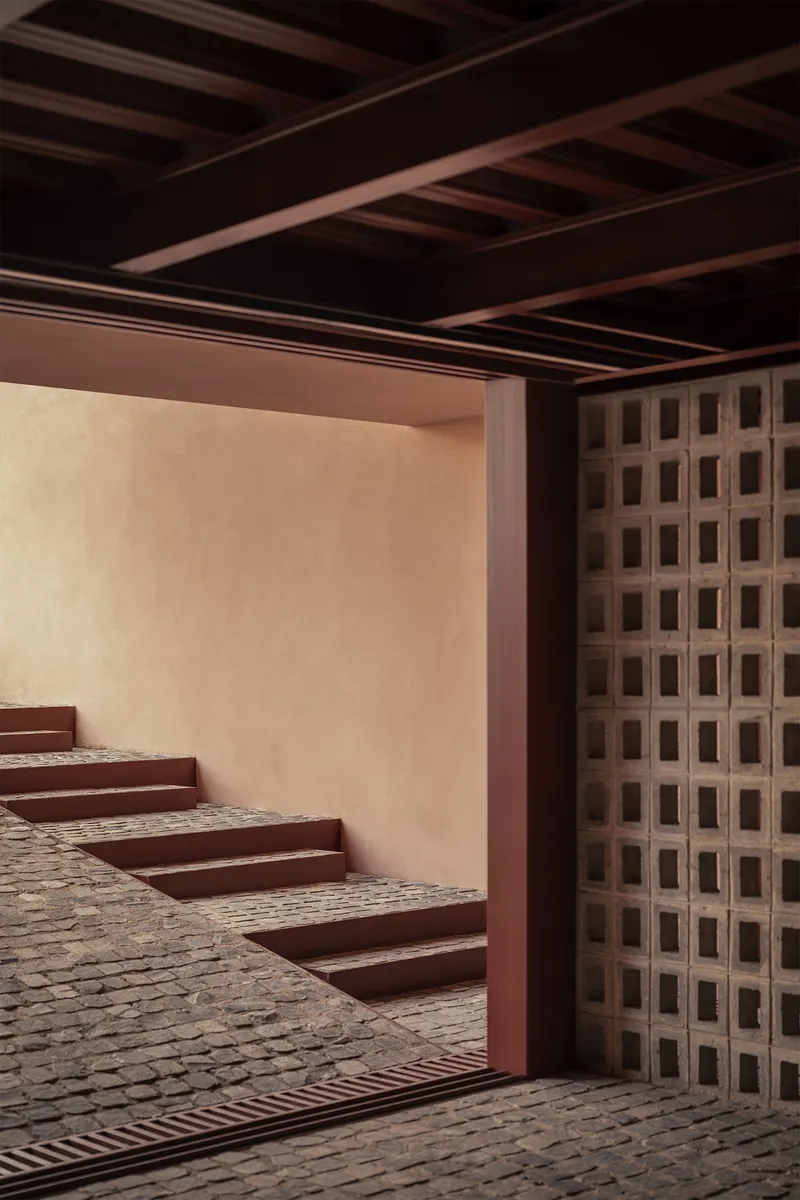
On a lot this narrow, the decision to give square footage to open air is a bold one. REIMS 502 carves out at least two significant courtyard spaces: a ground-level cobblestone court anchored by a tree visible through a curved void, and a timber-decked interior courtyard at a middle level. Both function as light wells and ventilation chimneys, but they also operate as the spatial heart of the building, organizing circulation and providing visual relief from the density of the surrounding neighborhood.
The curved void framing the tree is a particularly elegant move. It introduces an organic geometry into an otherwise orthogonal plan and creates a moment of pause that no retail fit-out could replicate. The perforated brick screen behind filters light into a soft glow that shifts throughout the day, turning a simple courtyard into the building's most photogenic space.
Perforated Block as Environmental Filter
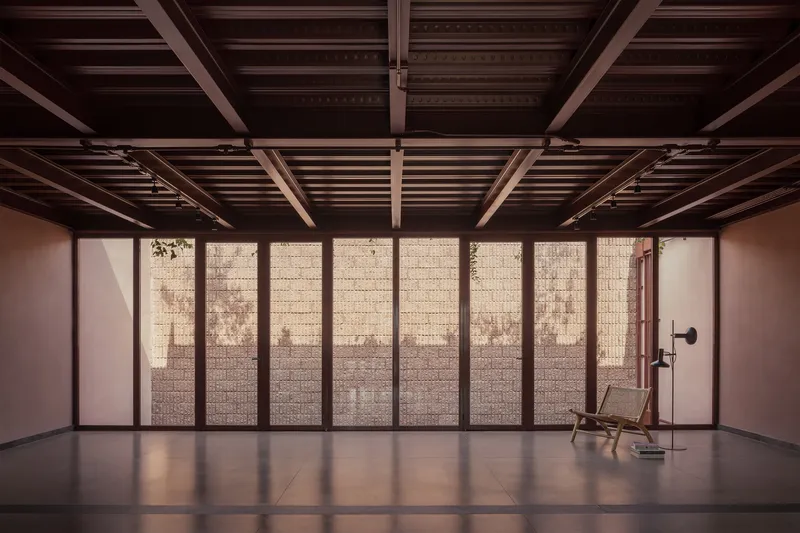
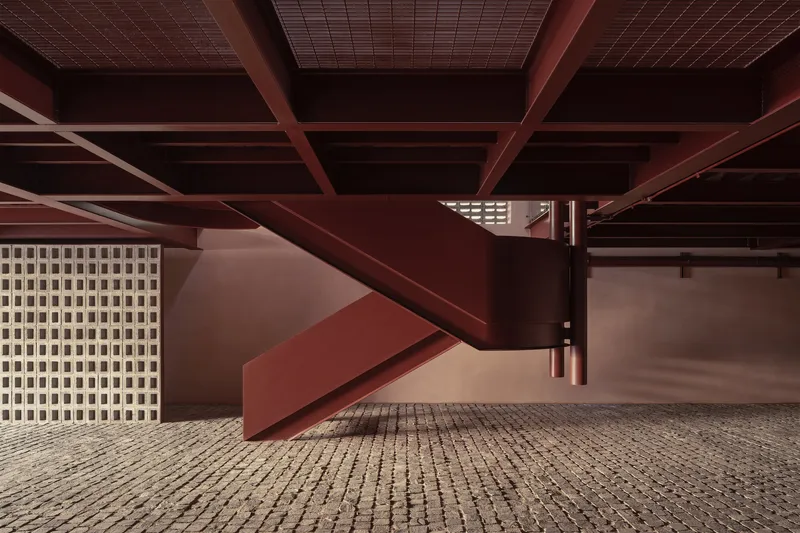
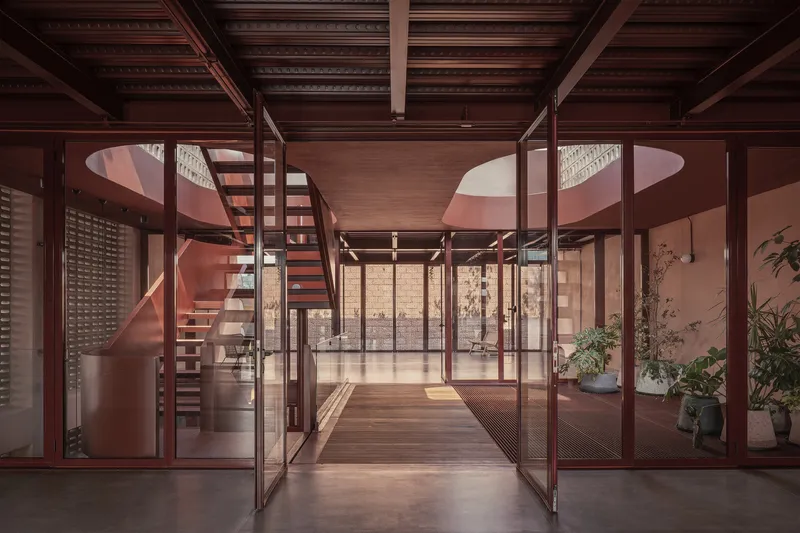
Perforated concrete block appears throughout the building in walls, screens, and skylight infill panels. It is one of the cheapest construction materials in Mexico, and REIMS 502 uses it with the kind of consistency that elevates a budget move into a design language. In the gallery-like upper room, a full wall of perforated block replaces conventional glazing, casting a pixelated pattern of light across the exposed timber joists. At ground level, it forms the screen wall of the parking area, providing security and airflow simultaneously.
The material choice is pragmatic and culturally legible. Perforated block is ubiquitous in Mexican construction, but it is rarely deployed with this level of compositional care. By pairing it with steel framing, timber beams, and cobblestone floors, the architects give it a context where its texture and porosity can be appreciated as architectural qualities rather than cost-driven compromises.
Warm Interiors and the Timber Ceiling
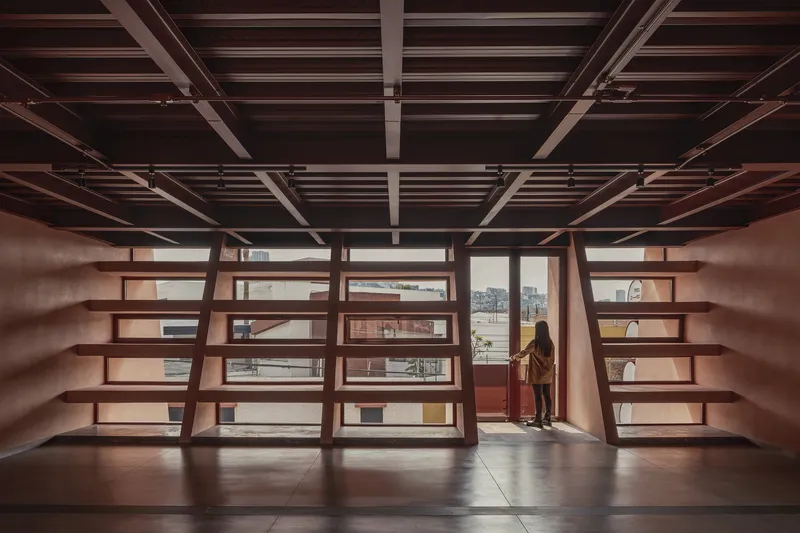
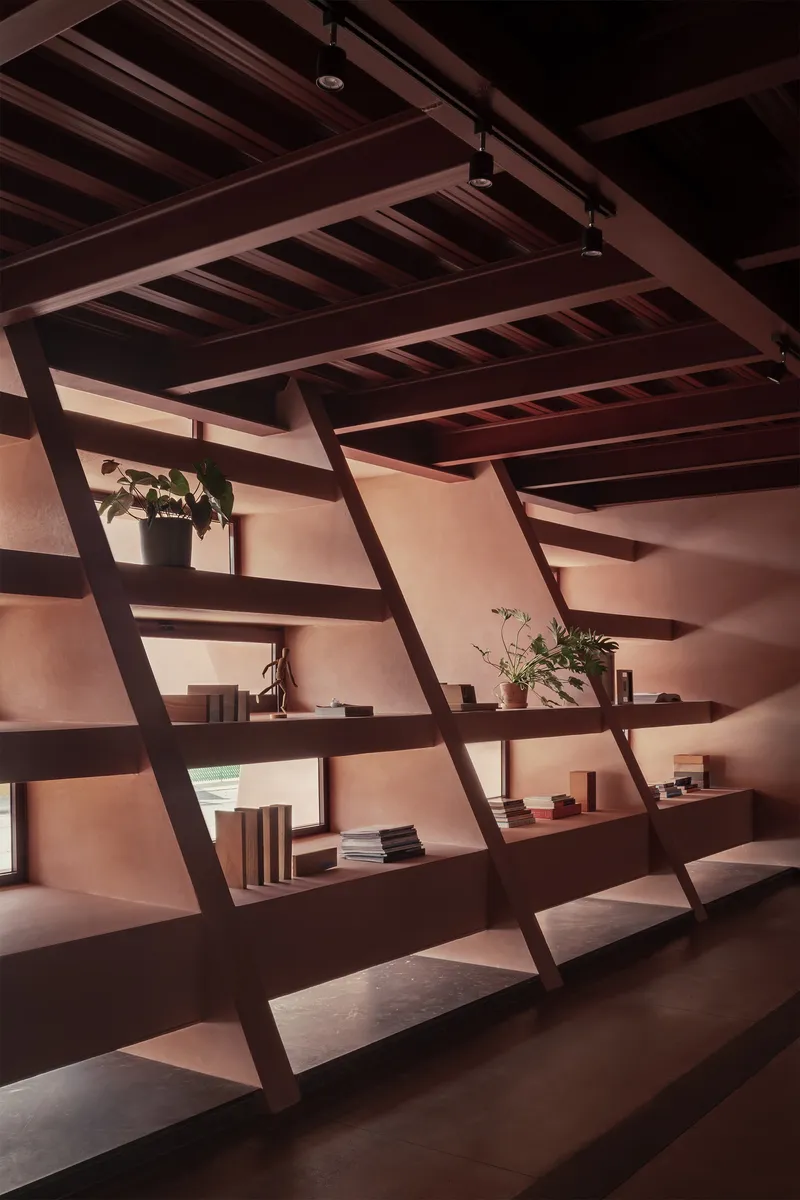
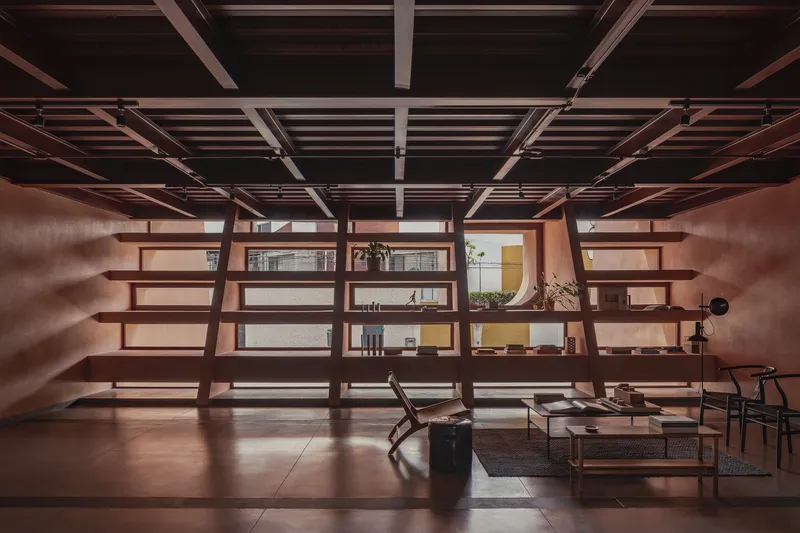
The interior spaces are surprisingly intimate for a commercial building. Exposed timber ceiling beams give the upper rooms a domestic warmth that contrasts with the industrial vocabulary of steel and concrete block. A library space with books and plants arranged on angled steel shelving feels more like a curated living room than a retail unit. The palette is restrained: warm wood overhead, cool cobblestone or polished floors below, and steel connections left exposed.
This is where the pandemic-era design thinking becomes legible. These are not open-plan commercial lofts designed for maximum occupancy. They are rooms with distinct boundaries, operable openings, and cross-ventilation strategies. The glass-partitioned corridor with steel-frame doors leading to the spiral staircase suggests a building that can be subdivided and reconfigured as tenants and uses change over time.
Rooftop Vaults and the Fifth Facade
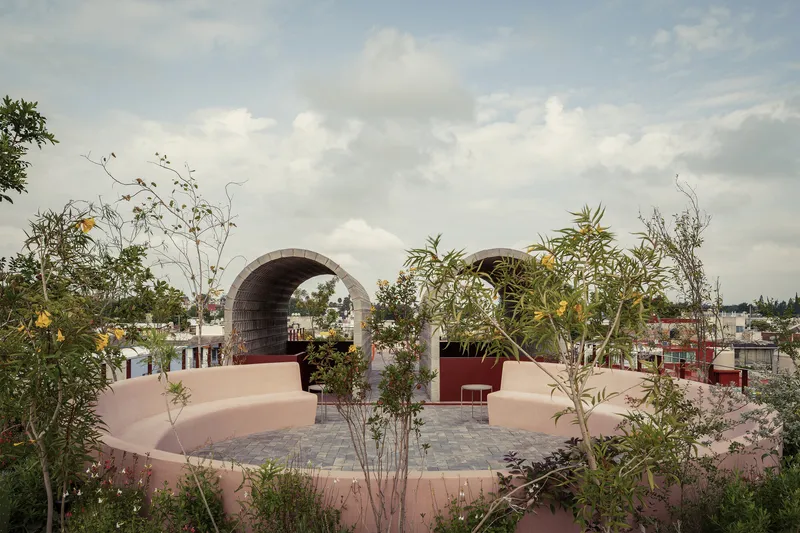
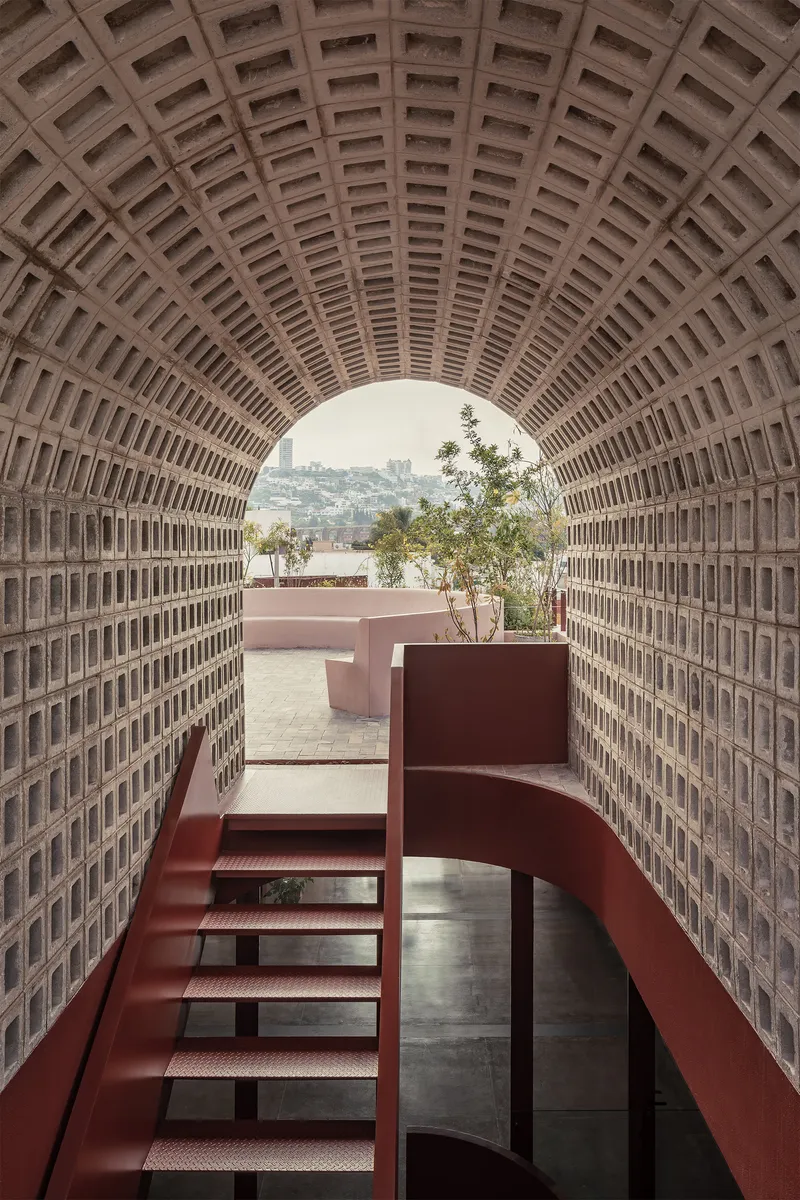
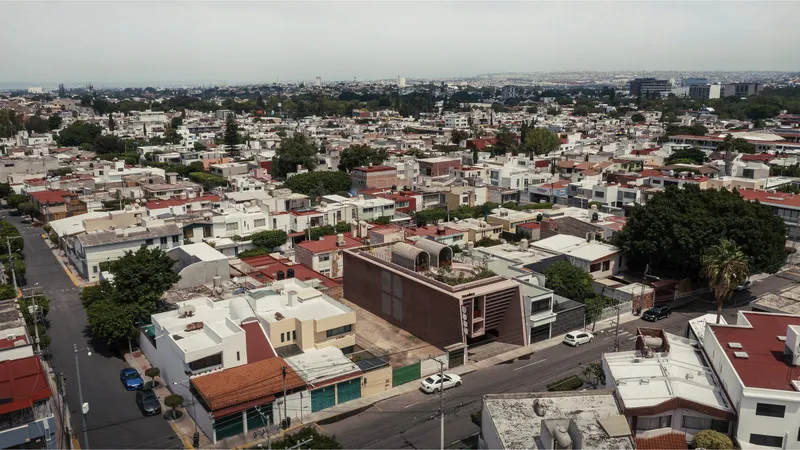
The rooftop is the building's payoff. Twin barrel vaults in brick rise above pink curved seating walls and planted beds, creating a terrace that functions as both social space and the building's most distinctive formal gesture. From the street, the vaults are invisible. From the air, they announce the building as an anomaly in a sea of flat corrugated metal roofs. It is a smart allocation of the most dramatic architecture to the most experiential level of the building.
The vaulted brick tunnel that opens onto a planted terrace is one of the most compelling spatial sequences in the project. You move from a compressed, masonry enclosure into open sky and greenery in a few steps. It is a classic architectural compression-and-release move, but it lands because the material transition from rough brick to open planting is genuinely satisfying.
Urban Context and the Narrow Lot
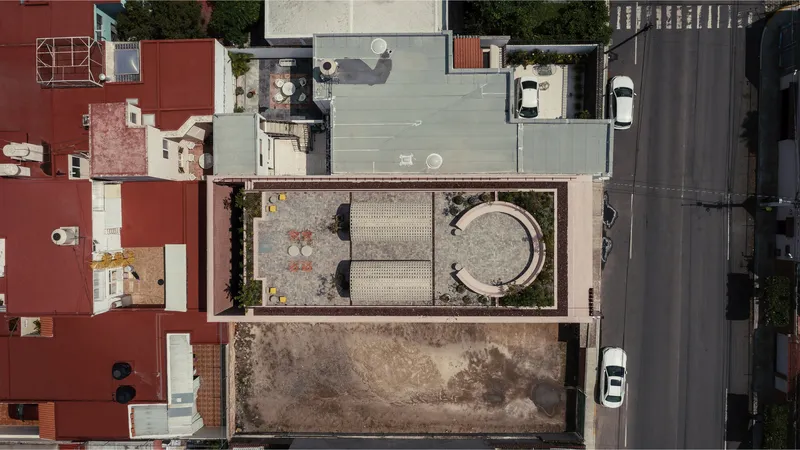
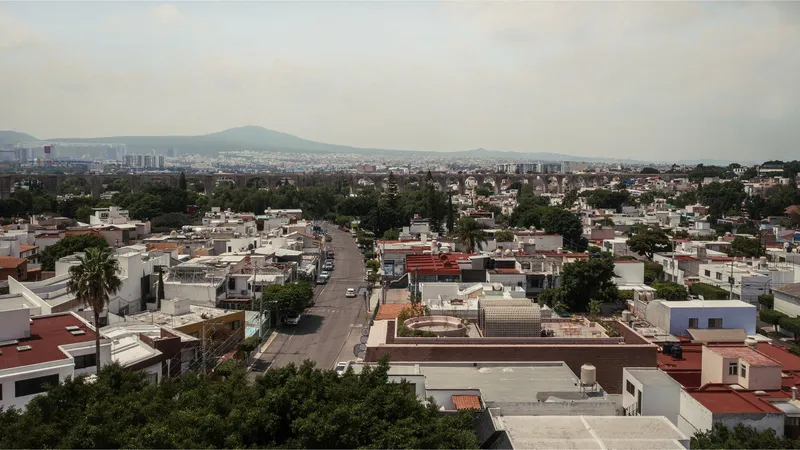
The aerial views reveal just how constrained the site is. The building occupies a narrow, slightly diagonal lot between party walls, with the circular vault structure and rectangular garden court barely fitting between neighbors. The surrounding context is low-rise residential, mostly one and two-story houses with flat roofs stretching toward the mountains on the horizon. ROSADOCE rises just above its neighbors without dominating them, a four-story building that maintains the human scale of its barrio.
The underside view of intersecting steel beams and staircases over cobblestone flooring shows how the architects resolved the structural challenge of an irregular plan. Cylindrical columns and a visible steel grid carry the loads while keeping the ground floor as open and permeable as possible. It is an honest display of structure that gives the parking and entry sequence an almost infrastructural character.
Plans and Drawings
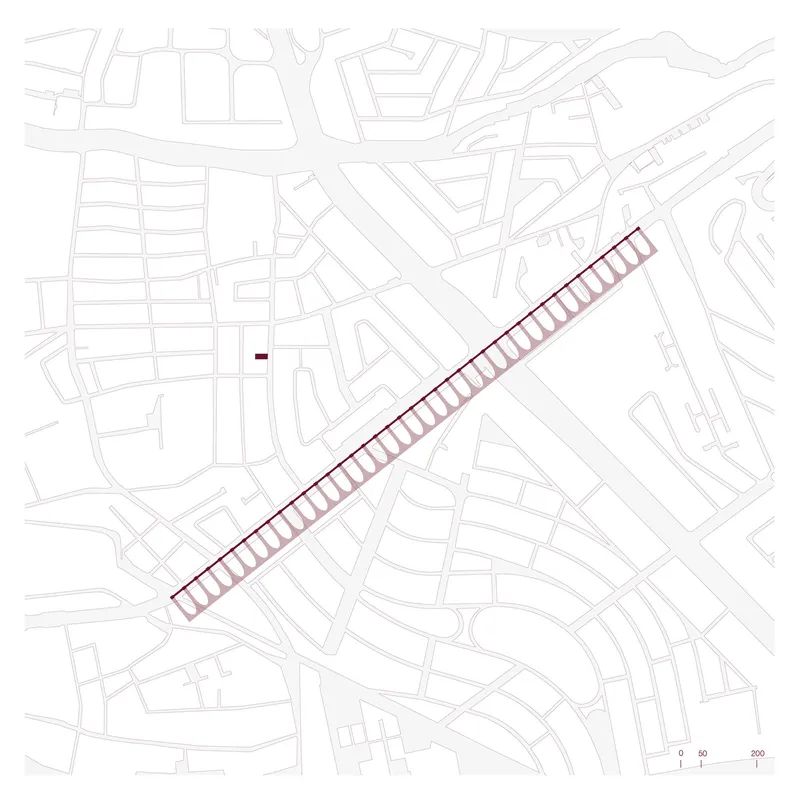
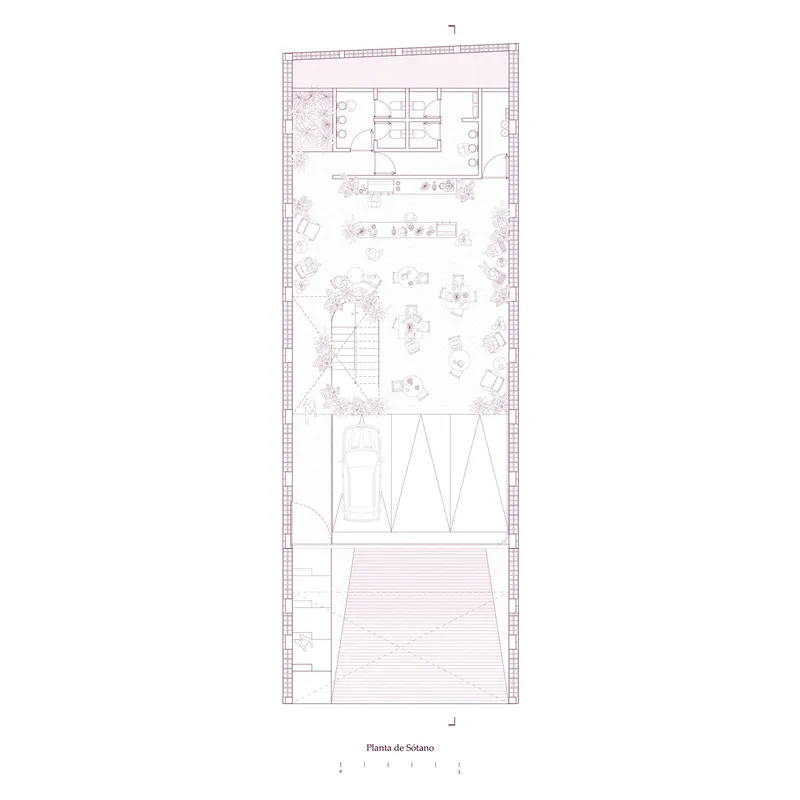
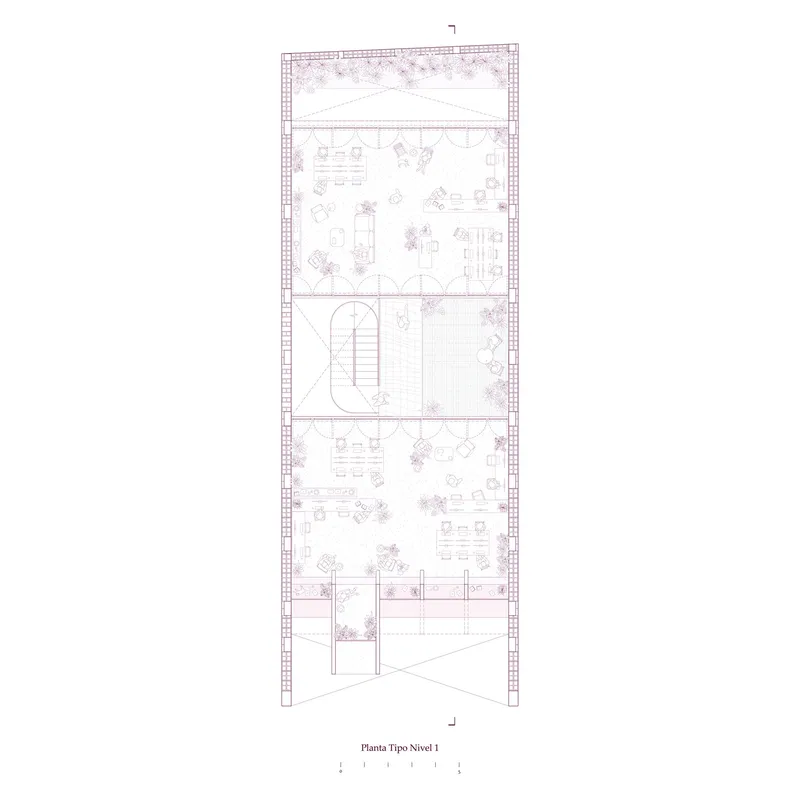
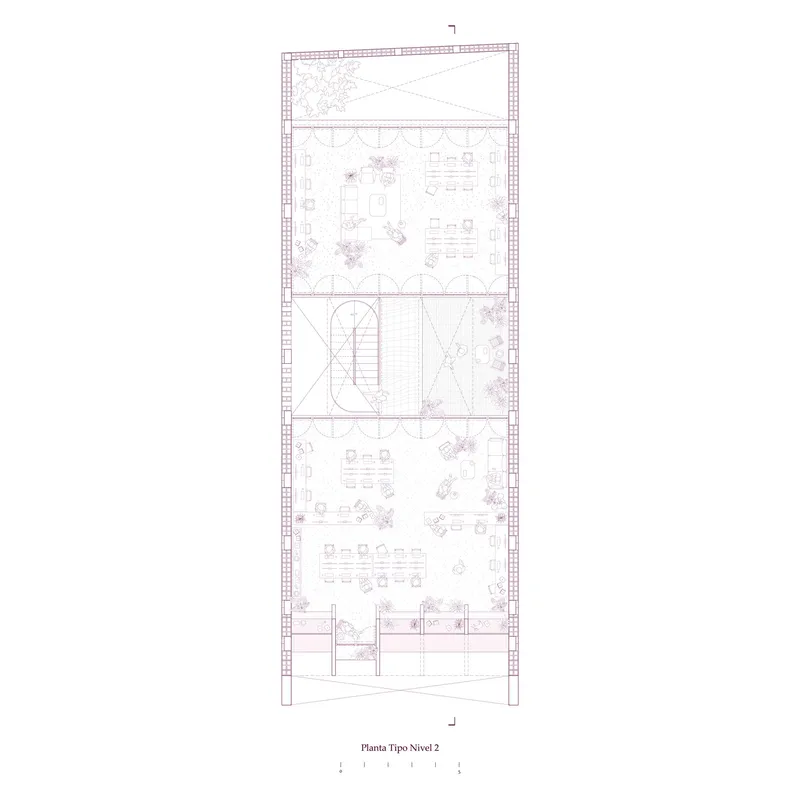
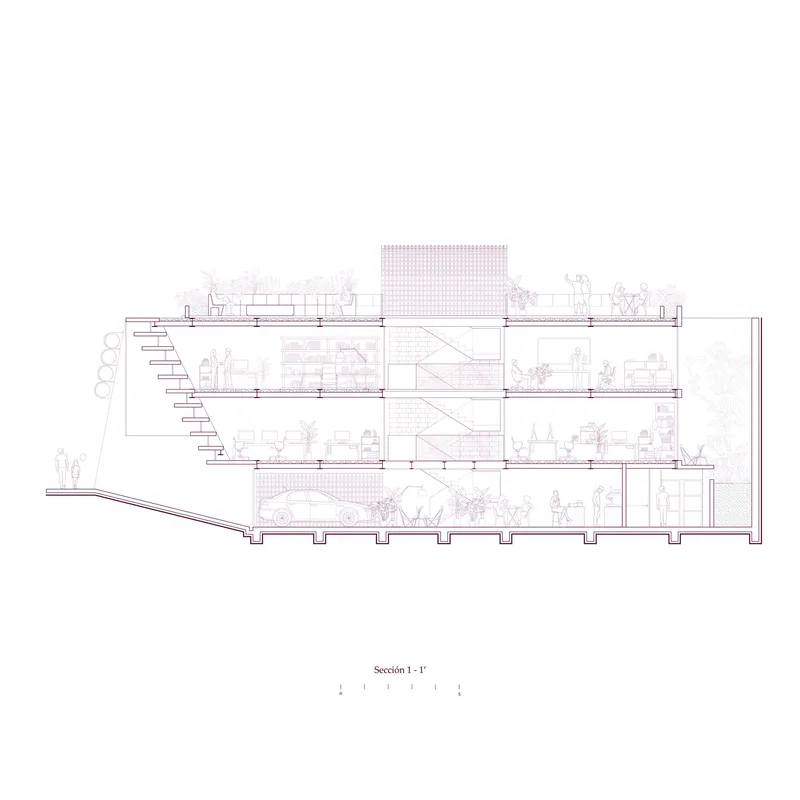
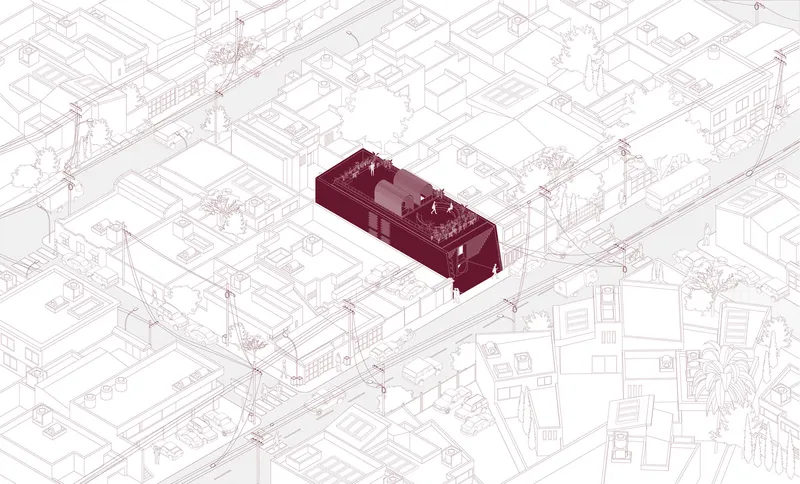
The drawings confirm what the photographs suggest: this is a building organized around its section rather than its plan. The site plan shows the diagonal lot cutting across the urban grid, with landscaped courtyards occupying the gaps. Floor plans reveal a terraced layout that shifts at each level, with the oval staircase operating as the fixed point around which rooms rotate. The section drawing is the most revealing, showing four levels of inhabited space interlocked with planted terraces and crossed by diagonal structural bracing.
The elevation drawing makes the twin barrel vaults legible in relation to the horizontal banding of the street facade. The axonometric places the building in its low-density urban context and highlights the rooftop garden as a significant percentage of the building's footprint. For a project of this size, the drawing set is unusually complete and suggests a design process driven by sectional thinking from the outset.
Why This Project Matters
ROSADOCE matters because it demonstrates that a small commercial building on a constrained urban lot does not have to default to expedient construction and forgettable form. REIMS 502 has produced a building where every material decision, from the perforated block to the exposed timber to the red steel, serves both a practical and spatial purpose. The pandemic framing is relevant not because it explains the building's form but because it explains its priorities: air movement, natural light, adaptable rooms, and outdoor space treated as essential rather than residual.
More broadly, the project is a convincing argument for the kind of architecture that Mexican studios are increasingly producing: materially grounded, climatically responsive, and formally ambitious without relying on expensive imported systems or fashionable abstraction. The brick vaults, the perforated block, the cobblestone, the steel: these are local materials assembled with enough intelligence and care to produce something that transcends its budget. That is the real story here, and it is a story worth paying attention to.
ROSADOCE Commercial Building by REIMS 502 (Eduardo Reims Hernández, Andrea Maldonado Verduzco). Santiago de Querétaro, Mexico. 840 m². Completed 2024. Photography by César Béjar.
About the Studio
Share Your Own Work on uni.xyz
If projects like this are the kind of work you want to make, uni.xyz is a place to publish your own, find collaborators, and enter design competitions.


Popular Articles
Popular articles from the community


Hill & Cross Opera: Sculptural Opera House Architecture Shaped by Tallinn’s Landscape and Identity
Hill & Cross Opera reimagines opera house architecture in Tallinn through its sculptural hill, civic plaza, glass wave and a luminous cross.

Riyadh For All: Intergenerational Urban Design for Active Aging in Rabat
Riyadh For All reimagines urban design in Rabat with intergenerational co-living, adaptive courtyards, and Moroccan cultural exchange today.

Play: Fragments of Their World
Familiar architecture becomes modular playground design, creating safe spaces where displaced children can learn, connect, imagine and play.

Lunar Spiral: Space Architecture Shaped by the Mathematics of the Universe
Lunar Spiral reimagines space architecture through Fibonacci geometry, lunar regolith, levitating habitats, and self-sustaining Moon living.


Similar Reads
You might also enjoy these articles

Bao Huynh Watercolor Atelier: A Serene Art Retreat in Hội An
Bao Huynh Watercolor Atelier in Hội An blends multifunctional art spaces, sustainable design, local materials, and family-friendly living in a serene environment.

Atelier Macri Concept Store Interior Design by CASE-REAL
Atelier Macri store features a "ko" counter, walnut wood details, cork displays, blending retail, gallery, and seamless customer experiences.

Manuel Vargas Izquierdo Stadium and High-Performance Sports Center: Architectural Excellence in Jalpa de Méndez
The Manuel Vargas Izquierdo Stadium blends sustainable design, inclusive sports facilities, and cultural-inspired architecture, revitalizing Jalpa de Méndez’s public spaces.

KAKR Buluh Awar Hall: Revitalizing Community and Ecology Through Bamboo Architecture
Community built bamboo hall revitalizes Buluh Awar village, empowering youth, restoring ecology, celebrating vernacular craftsmanship through sustainable architecture and culture.

Comments (0)
Please login or sign up to add comments
No comments yet. Be the first to comment!